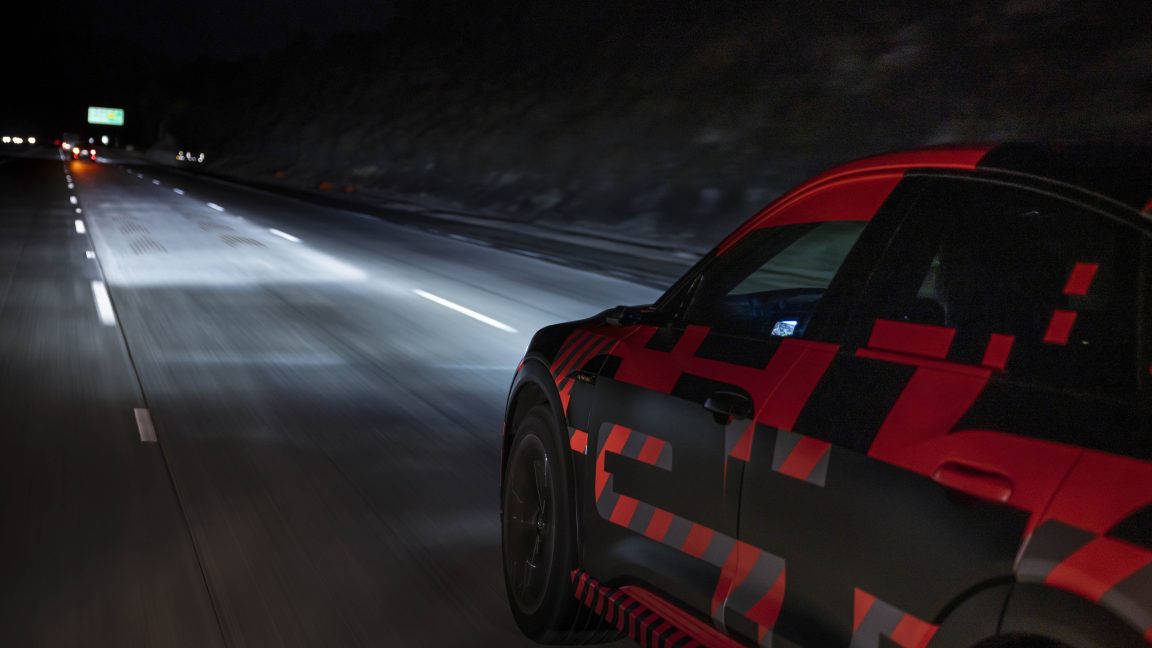
The US will finally allow adaptive beam headlights on new cars
The technology has been deployed in Europe and Japan for some years now.
Ars Technica
167 points · by Tomte · 4y ago · 280 comments
No, I have never asked for painkillers myself, so it isn't personal! However, if God–forbid I came down with pain issues that were treatable by painkillers, you better believe I would be on the dark markets PDQ.
(My RSI is no fun, but I deal, and it isn't amenable to painkillers except in mind-numbing doses.)
I would only add that this isn't an accident - https://en.wikipedia.org/wiki/Regulatory_capture
For a large company, draconian regulations can be to their distinct advantage, as them very size allows them to handle the cost and complexity, while smaller companies cannot - or they can simply cheat, and if caught, swallow penalties that would destroy a small company.
The manufacturers tried to get the standard updated, but the US auto industry blocked it, which resulted in car companies having to make US-specific, shittier, headlights - at significant expense - because GM and Ford didn't wanted more competitive advantage.
I was picturing something like what we've seen with marijuana, where laws change at the state level while DC looks the other way.
But to be fair, drunk drivers kill 28 people a day in this country, or about 10k people per year. 3k people die at signalled intersections every year, or around 8ish per day.
While Tesla shouldn't be beta testing their self driving cars on public roads, it's clear that human behavior and existing road design is still vastly worse.
Here's one of many: use sensors and AI in the car to detect a drunk person behind the wheel. This is HN so I'm sure readers could spend 10 seconds and think of numerous ways this could be accomplished and many otherideas about what could be done when a drunk driver is detected.
I also think the NHTSA should have prevented companies like Tesla from behind allowed to put every single control behind a touchscreen. It's extremely dangerous to have to look away for 2 seconds when you're driving. Imagine if (when?) every car in the world adopted this and all drivers are having to look at a screen to turn on windshield wipers.
Personally I'm more in favor of smart road like technologies where a highway has a mechanical or physical properties to assist self-driving vehicles stay in line with the road. Mostly because a 100% software solution will likely not work, particularly in the midwest and great lakes states during the wintertime.
It need not be expensive either. Magnetic nails embedded in the road would maybe be the cheapest way, and would be easy for both city and rural populations to add, and be detectable with icy and snowy conditions.
That said, touchscreen controls (with tiny targets) instead of dedicated controls and the new square steering wheel with touch controls instead of stalks... gah!
The fix is not arbitrary alcohol blood levels, or extending the "War on Drugs", but with standardized, enforced, in-vehicle continuous testing that ensures that the driver is awake, responsive, and in control of the vehicle.
That is something where R&D in AI/ML/software to analyze and detect incapacity could/should be directed.
It can be entirely on/in-vehicle, with access to the data only available to law enforcement (and, perhaps, insurance companies), if and when it is needed to determine liability (not as a general "carte blanche" for the data), in the same way that aircraft black boxes are only analyzed for investigation after an incident.
I'd like to see research into ways to identify those drivers and encourage them to improve their driving skill.
For example, one way might be to make a register of driving skill public information, and then insurance companies can jack their prices up for those people unless they go on and pass (government funded) extra training courses.
Such a register could simply be an open database of insurance claims, or police crash records showing the names of people involved.
Car dependency is just as bad a disease as any.
Cars give you the freedom to go anywhere, but take away the freedom to do anything without them.
AI/ML/software is know for its high false positive rates, so if it was enforced it would lead to many drivers unable to use the car because of a false positive hit. If it was enforced, then the high risk reduction wouldn't occur before the crash and society in general will want to impose laws to fix that. Car crashes effects more than just the driver, and it not reasonable that so many people die from car crashes each year.
Is that true? Those human statistics take every human car and driver into account, not just Teslas. I have never seen data that shows self-driving cars anywhere close to human driving capability. If we replaced every car on the road with "self-driving" Teslas, it would be mayhem.
1)Teslas are "luxury" vehicles, much higher-end than the average US car. A base Model S, or average model 3, costs twice the average US car cost. They are as a result significantly better equipped with safety features and have better crash engineering. In terms of driver assistance, the auto industry was pretty belligerent about backup cameras being mandated, just to give one example.
2)Teslas are on a whole significantly newer than the average US car. The average age of a car on the road in the US is twenty years old. Of course a Tesla with safety features not available until ~10 years ago (or less) is safer than a 1999 anything.
If people said "my electric Mercedes is significantly safer than the average car, so Mercedes should be allowed to beta-test their software, which despite after many years of development is proven to randomly slam on the brakes, or drive into the back of emergency vehicles, and is shown on numerous videos to violate traffic laws, suddenly veer at poles and barriers and pedestrians and cyclists"
...they'd be laughed out of the room on a number of points.
But America isn't too concerned with road deaths (equivelant of one 9/11 per month, or 240 9/11s in the period of time the US occupied Afghanistan in response.
Financially the response to 9/11 cost about $950b - $300m per death. By that reckoning the US government should be spending about $12.8 Trillion dollars a year on reducing road deaths, about half of the US GDP.
  the National Transportation Safety Board conducted
  an investigation finding that the government should
  not be actively restricting headlamp systems that
  have been shown to have a safety benefit.
Personally, although tesla does "market" their technology, I think it is good technology that has probably not only saved a fair number of lives, but also bumpers and fenders.
Looking at the storied history of the airbag, I think telsa did a good job assisting the driver (and customer) when the status quo for other car manufacturers was to innovate at a snail's pace and implement safety features mostly when required.
If the US really cared, drunk and distracted driving would have appropriate sentencing. For god knows what reason, we're still not there yet.
As a general example, how many nightlife areas have decent public transportation at bar closing to avoid committing a DUI?
The fact is, the vast majority of lives are jeopardized by reckless, unaware, distracted, or impaired... Things which don't apply to FSD.
We don't have to be pioneers at the bleeding edge of testing, but 15+ years? Come on.
Not that you're not right!
Another problem is aftermarket HID and LED lights which might not have any sort of legal pattern at all.
I liked reading (for years) this site regarding automotive headlamps, and there are problems:
https://www.danielsternlighting.com/tech/bulbs/Hid/conversio...
this site has been around for a while, see what they said about the NHTSA and glare in 2000:
Like in california, nobody is ever, ever ticketed or pulled over for not using turn signals.
Never had a problem with pickups but I've had several dozen experiences where the headlights behind me were "blinding" and in most cases the vehicle in question ended up being an Audi, Mercedes or BMW. In later years, this "headlight disease" spread to other mainstream brands - can't say I've ever been blinding by "big pickup guy".
I am the source. Anyone that gets blinded at night by oncoming traffic is the source, because this should not happen with properly aligned headlights. Regardless of ground clearance, low beam headlights should angle down towards the road to focus on the road approximately 125ft from the front tires. The higher the ground clearance, the steeper the angle.
> Are you claiming that the manufacturers are making trucks with illegal headlights? Because that seems pretty far fetched. Or that drivers are modifying them? Because that is very rare.
It's either the dealers or the owners, or both.
It has disappeared a long time ago.
edit: https://valdeuropeinfos.fr/faites-verifier-vos-phares-gratui... actually it still exists, and it's the police (a technical department dedicated to road safety)
Edit: I just googled it. That’s exactly what’s happening - EU side mirrors are curved to prevent blind spots.
Here is an example how: https://www.defensivedriving.com/safe-driver-resources/how-t...
So many people set them so that they can see the side of their own car - that's incorrect! They need to angle it out to the point where they cannot see the side of their car, that way traffic should seemlessly be visible from the rearview mirror to the sideview mirror to the driver or passenger window.
People forget the Edsel and "unsafe at any speed" from the 1950s/60s.
People similarly freak out when you back up too quickly into them, because you have a reversing camera on.
Much worse, your car freaks out nowadays. Twice I've had my car apply ABS while I was backing up, while I was fully aware of a car behind me but not in my planned path.
And maybe they should be conservative, but I don’t see how anyone can argue that it should take a decade to get something like this approved (or formally rejected).
It was another 5 years before you could use a shape other than rectangular or round, even for composite lights. I believe the Dodge Viper was the first US car to get them.
https://upload.wikimedia.org/wikipedia/commons/c/c7/Mercedes...
https://upload.wikimedia.org/wikipedia/commons/c/c8/1988_560...
Unless it involves red turning signals.
Same as side mirrors, apparently the technology of using curved mirrors to reduce blind spot has yet to make it across the pond.
I suspect its rather a typical lazy government bureaucratic hell case.
Instead of we adopted a position of everything being illegal until it is blessed by a regulator, it is in effect guilty until proven innocent.
Until we put government back into the proper context innovation will continue to be inhibited
Uh, no. There should be a well defined standard of what light need (light area of this and that size or at least this or that brightness) and can't (low beams blinding oncoming traffic etc.) do, then let market work within those limits. The regulation should have actual research behind it. Pretty sure that's how it works in EU.
Then if for some reason behavior of lights on the market causes problem, the standard should be revised, not ban random products for breaking rules that haven't existed when they were created (aside from extreme cases I guess)
It probably wasn't invented in America, and therefore the US government refuses to believe that it exists.
This is why the US is happy to allow half-baked self-driving tech from Tesla, but won't allow automakers to adopt anything that became standard overseas first.
My car does a pretty decent job and turning off the brights when it detects oncoming traffic, is this February Ars article saying that is illegal? If so, why is it implemented in my Hyundai?
EDIT: Based on other replies it appears that the difference is beam forming, exactly. My headlights simply go from high to low. It is pretty odd that would be banned, but okay.
and they started issuing patents for dumb shit regardless of that
Read More: https://www.slashgear.com/audi-digital-matrix-led-headlights..."
My wife suggested a fun tech solution: night vision and making all lights less bright. Kind of a fun idea: a slight glow or dim lights so you can still see vehicles unaided, but a full night vision windshield or glasses and no more too-bright-to-see lights.
I once drove on a stretch of highway that used reflective paint for the lane markers. My feeble beam could light them up better than any HID could. It was very relaxing to drive in the dark and never once did you have to strain to make sure you can see the road. I think this is really the future of night driving.
Some automakers took this to heart and have since eliminated the glare that was then-rampant.
(I would personally award bonus points if this is implemented with some kind of inverse adaptive "matrix" mirror mechanism whereby reflective-ness is automatically concentrated at light sources that are directing light at you. This is again a win for good light citizens as it would make the car not overly bright during the day while managing to boost its visibility specifically to people who themselves have lights looking for obstacles, with the only side effect of blinding people with dangerous lightings setups who are blinding others already.)
That's how reflective signs, vests, and auto reflectors work.[1]
The main disadvantage is that the road by contrast may become harder to see. But I'd argue that the road also needs to become way more reflective, on the painted lines. The paint itself has some amount of retroreflective material, but it rapidly gets dirty. Cats-eyes are fabulous, but they also need to be regularly maintained and replaced, and that has definitely been slipping in many places.
How about other approach - trying to foster a culture amongst people of not being an a-hole to others, especially on the roads? Rather than playing whack-a-mole with all possible variants how assholism can be manifested. It generally works quite well in western Europe, I can't remember the last time somebody blinded me (if I don't count split-second situations of popping up suddenly from behind some tight curve).
Seems like the answer is here. Tesla evidently needs unquestioned access to your high beams for their research program in which you are voluntarily participating. You can regain control of your high beams by leaving the program.
That sounds a bit too long - in 2002 LEDs were just starting to be used in brake lights etc., but not in headlights. Of course, it depends what they mean by "nearly two decades" (I imagine it has to be at least 15 years?) and by "has been around" (in the lab? in prototypes? or in actual cars that you could buy?).
Well, since they explicitly mention regions, in that context they rather mean the cars one can buy.
That's on top of being 24/7 surveillance of every public space that will be used to try and hawk garbage to me.
Do the adaptive lights let you see off the edges of the road for animals?
Kangaroos can be damn near suicidal...
Basically, they split the beam into multiple sections and if it detects an oncoming car, it turns off the section that would shine towards the oncoming car, but keeps on the section that shines towards the side of the road.
Another thing - if you are driving behind another car, then the headlights don't shine into the rear-view mirror of the car in front, but rather around it.
- Night vision camera. Not sure if it will actually help - you don't watch your screen when driving.
- BEEP, BEEP when approaching an invisible human/animal that is too close to car on a lane.
Some cars can actually use the headlights to highlight a detected person, so you can see it out of your window. Not sure if it works for animals though.
The last time I encountered a vehicle without orange turn signals was on the autobahn, at night. It was an american military vehicle, and the blinking was so dim, that it looked like a malfunction tail light. I was furious at yet an other idiot who didn't look in his mirrors and just went left without using his indicators, until I realized that he was, in fact, using them. But they were simply of a piss-poor design, unexpected in Europe, and a true safety hazard.