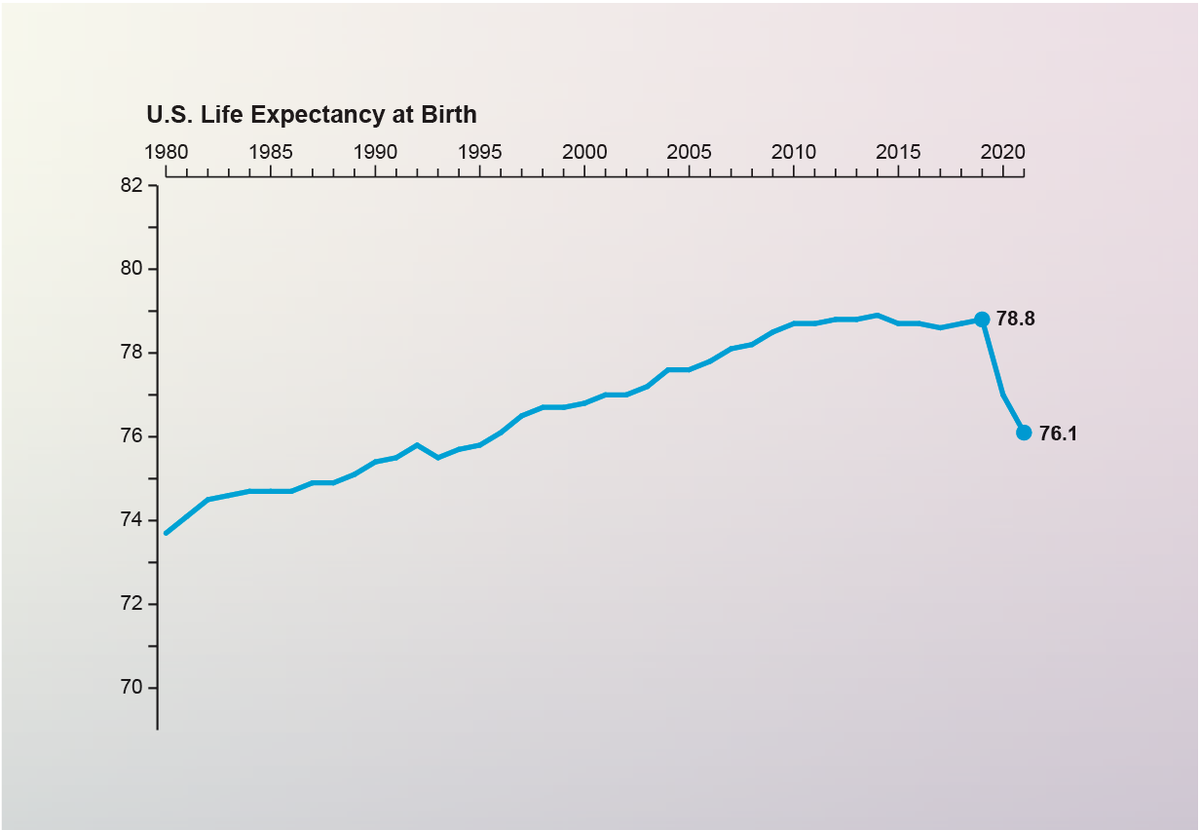
The U.S. Just Lost 26 Years
COVID and overdose deaths have sharply cut U.S. life expectancy, with Indigenous peoples experiencing the biggest decline
Scientific American
97 points · by pmoriarty · 4y ago · 128 comments
"Life expectancy" is the number you obtain after you run a statistical model. More precisely the Lee-Carter model [1]. The Lee-Carter model is based on the idea that over more than one hundred years the average annual mortality rate (or rather its logarithm) decreases linearly for all ages and other buckets (sex or race for example). So, you fit a one factor linear model using SVD.
Now, after Covid-19, we've had an outlier event. Any linear regression would be thrown out of wack after such an event. Or, to be more technical, any L2 linear regression.
What is the predictive power of the Covid event for the future mortality? One can claim that people affected by long Covid will show increased mortality rates in the years and decades to come. Maybe. In any case, the Covid event holds zero predictive power to newborns. And life expectancy is by definition the life expectancy of newborns.
Bottom line: this is just a statistical artifact. Life expectancy now is not lower than before Covid. If anything, Covid accelerated some advances in medicine, so life expectancy is higher than the projected increase over 2 years.
If their parents, siblings, or grandparents died or suffered long-term health consequences then newborns could be affected in all sorts of ways, up to and including shortening their lifespan.
The economic impact of COVID-19 will also affect people's mortality, as fewer opportunities, less earning potential, and economic recession will affect people's health by resulting in poorer health care, unhealthier living conditions and food, and quite possibly depression -- all of which are known to affect lifespan.
So I wouldn't be so quick as to rule out any affect on newborns. It's just more complicated than merely saying that X number of newborns died directly due to COVID-19.
So, one might say, "There's a possibility future mortality could potentially be higher", this is not the statement made by Scientific American. The statement is "Our evidence tells us the mortality will be higher; it will be about as high as if we turned back time by 26 years". That is absolutely not the case. It's misinterpreting the results of a model that is applied mechanically to data that should not be applied to.
It's frustrating to see numbers thrown around about how much life expectancy rose over the years in the past, only to discover that the average was so low because so many kids never made it past 5 years old. Why would including those deaths be in any way informative for people alive? That average tells me almost nothing about my life expectancy! :(
The article never mentions it, but the graph says "at birth" is the starting point.
"Arias and her colleagues calculated life expectancy using a technique called a period life table. This involved the researchers imagining a group of 100,000 hypothetical infants and applying the death rates observed for the real population in 2021 for each year of those infants’ lives. The result is not the life expectancy for a cohort of actual babies born in 2021 but rather a snapshot of how life expectancy rates would apply to various age groups at a specific point in time, Arias says."
All the numbers are wrong from some perspective.
You mention a good one. The fact that life expectancy was so low in the past was due to infant mortality. If you lived to like 15 (IIRC), your life expectancy got much longer. Like 60s to 70s (once again, IIRC).
And that even holds today. The longer you live, the longer you can expect to live. If you're 70, you have a life expectancy of 14 (male) to 17 (female) years. If you're 80, you have a life expectancy of 7 (m) to 9 (f) years. If you're 90, you have a life expectancy of about 4 years.
And all of that seems kind of weird on the face. If I'm 70, I can expect to live 14 years on average. Which takes me to 84, which is greater than 80. But if I'm 80, I can expect to live to 87, which is greater than 84.
But it's the nature of averages. When I'm 70, I'm being average with other 70 year olds. Some of them die at 71, some at 93. Every year, more and more people drop off. If you make it to 80, all those who didn't make are no longer relevant.
Life Expectancy is not really a good guide for anything, it is just a number various political groups can use to influence public policy to their agenda
I, and many others, believe government regulations is the cause including everything from the tax code that irrevocably links insurance to employment, to regulations that transform "insurance" to prepaid health plans, to medicare massively under paying providers, and about 10000 other things...
The "other side" believes government is the holy grail and will magically fix everything if we just make everything single payer medicaid for all...
The actual answer is that US infant mortality has stayed almost constant during those 26 years, and was so low to start with that even reducing it to zero wouldn't have made much change in overall mortality.
https://www.statista.com/statistics/1041693/united-states-al...
The linked article also goes into more details.
Oh look, another chronic-death denier
Are they even listening to what they, themselves, are saying?
Yes, healthcare reforms can help. The economic gaps they previously mentioned are still going to be a problem. It doesn't matter if you have totally free healthcare if you lack any hope for your economic situation. That's where the substance abuse (liver disease, OD, etc), suicide, and other self destructive behaviors are still a problem. Ostensibly, the Healthcare reforms would have the least impact on the overall issue since Medicaid and Medicare are available to Native Americans already, and covid mortality is skewed to the older populations who are eligible for these programs already (although sign-up and other administrative issues may exists).
I am shocked that no one is even talking about the excess fentanyl deaths. Also how much of this is attributed to our fading health system?
[1] https://www.npr.org/2022/02/25/1082901958/opioid-settlement-...
The article specifically details the different factors in the overall decline in expected longevity. COVID is the largest but definitely not the only one:
https://static.scientificamerican.com/sciam/assets/Image/202...
It's the increasing mortality of young people that really drops life expectancy.
Cardiovascular disease 870k.
Cancer 610k.
Usual caveats apply to cause of death reporting, but fentanyl alone is not terribly relevant to this topic.
I don't know if my numbers are right, but your numbers don't lead me to dismiss fentanyl from the current conversation.
Although I’ve heard anecdotal evidence that COVID infection does damage cardiovascular health.
https://www.cdc.gov/nchs/pressroom/nchs_press_releases/2022/...
There is data pointing at two possible causes here. The first is neat and politically palatable. Covid increases the risk of heart attack. (https://www.nature.com/articles/d41586-022-00403-0#:~:text=M...).
The second, much more contentious fact is that mRNA vaccines elevate the risk of heart attack. (https://www.bmj.com/content/378/bmj.o1554) In fact, Danish research currently indicates that those who have taken the mRNA vaccines are at greater risk of all-cause mortality. (https://papers.ssrn.com/sol3/papers.cfm?abstract_id=4072489). Note that this paper is currently in peer review. It is receiving more scrutiny than perhaps any other paper in history. There are literally trillions of dollars on the line. Using public, global data, the Danish researcher finds that one is more likely to die after taking the mRNA vaccines, even after accounting for the protective effects against covid. Interview here for those interested (https://unherd.com/thepost/study-into-mrna/).
I think it likely that the increase in heart attacks is a combination of both of these factors.
Disclaimer: I have taken three mRNA vaccines.
But I had the impression that US (maybe apart from NY) was trying to keep business as usual as much as possible.
A lot of people, including myself, waited a long time for our yearly (or bi yearly if you’re older) visit. I’m sure a lot of older people could have done some preventative stuff to prevent a heart attack. Like getting a stint put in if they had an irregular heart beat, had this happened to a family member in their late 80s.
More or less a lot of companies took some handouts from the government while half the country insisted it was a demonrat hoax and the others stayed home to try and stop having out hospitals blown the fuck out.
- Much higher stress from making ends meet, world events, national decline, etc.
- Supply chain issues leading to lower quality chemical byproducts in your food and household items. Though we don’t know how much of a problem this is and we may not for a long time, if ever.
Covid also strongly encouraged outdoor activities over indoor ones. In my area, many indoor events were converted to outdoor events and we found that even with the relaxation of precautions, people prefer we keep them outdoors as it was more enjoyable.
I suppose my experience doesn't match up with people who live in more disagreeable climates, like the South or Southwest.
Some people definitely went the other way and took up more healthful activities but the dominant shift seems to have been toward less physical activity.
I personally wonder if the “long covid cognitive effects” aren’t down to things like less exercise, more social isolation and too much screen time, especially as people keep looking for explanations for effects on children.
It’s not like it all went away when the pandemic officially ended either. People can be slow to change.
I don't know what fraction of the population went sedentary, and what fraction of those remained sedentary. It could be enough to matter statistically.
Please be careful talking about it like this, it has the potential to be misleading. This is too strong of a statement, and the researchers did not make a claim this strong. They have a small sample for which the number of people who died with placebo was 1 person less than the number of people who died (not necessarily of COVID) after taking an mRNA vaccine. With 31 people in the sample who died after taking the vaccine out of 74,000, the potential for noise is high, and they are simply suggesting that we should ask the question again with a larger sample, they are not claiming to have conclusively found that the odds of actually dying with the vaccine are higher than without.
The bulk of the covid excess deaths (unsurprisingly) happened before vaccination. This is going to be somewhat difficult to tease out of the numbers. Frankly it's probably not true.
> the Danish researcher finds that one is more likely to die after taking the mRNA vaccines, even after accounting for the protective effects against covid
That is absolutely not what that paper says! Go read it again.
My first suspicion is that those who have more contact with medicine tend to have greater all-cause mortality because they probably have a reason to have contact with medicine - there's tons of correlation and it's hard to tease out causation.
Vaccines certainly have tradeoffs and in the US at least there are mechanisms in place to try and offset those https://en.wikipedia.org/wiki/National_Childhood_Vaccine_Inj...
What's new is the politicization of vaccines, and particularly in one American political party, but I suspect the math (including the new mRNA vaccines) is as it ever was; vaccines are a huge net win for public health.
Generally one thing I've noticed about medicine could probably be summed up as - it's really complicated, there are trade-offs to nearly every decision, and you eventually die anyway.
But wait, there's more!
> Will the Countermeasures Injury Compensation Program provide compensation to individuals injured by COVID-19 vaccines? [2]
> ...For a category of vaccines to be covered by the VICP, the category of vaccines must be recommended for routine administration to children or pregnant women by the Centers for Disease Control and Prevention, subject to an excise tax by federal law, and added to the VICP by the Secretary of Health and Human Services. No COVID-19 vaccines currently meet this criteria.
So, no, there is not a mechanism in place to offset those.
[0] https://www.hrsa.gov/vaccine-compensation [1] https://www.hrsa.gov/cicp [2] https://www.hrsa.gov/cicp/faq
Could be coincidence, but her sister who lives 1000km away got similar (or same due to visits) covid at roughly same time, and has same symptoms. Nobody reports stuff like this unless some researchers go out and actually start asking for this specifically en masse or do some hard statistics like this on whole populations.
But then again, I realize I know next to nothing about this virus in detail, and people like to speculate.
I do notice that there's significant baggage associated with covid, and a large number of people terrified of it, along with most of these symptoms being neurological (and the rest self-diagnosed). It's also politically convenient to push "sure the disease itself is like a bad cold, but you'll be permanently damaged in various unforeseeable ways!".
I'm 3x vaxxed myself, I've also had covid to be clear. All the evidence I've seen about long covid is anecdotes. Is there any hard data to substantiate?
That said, neurological covers more than just self-reported concerns like this. Take a look at this paper: https://www.nature.com/articles/s41591-022-02001-z
You can ignore a lot of these (and I do) as they are self reported, but some are not. Consider Cerebrovascular disorders or some of the others.
There appears to be an association that is non-subjected non-self-reported between people who got covid and people who did not. The study makes NO statement that can be attributed to people who got covid with/without the vax because the study was started/concluded prior to the vax being in general circulation amongst a high number of the population.
So yes, I think "long covid" has a large amount of general anxiety - but not this much. I think its likely we will find this is 1/2 our brains just making up symptoms and 1/2 actual legit f'ing scary problems. I hope I'm wrong. This study implies I'm not.
Cheers.
NINETEEN GRAMS of sugar. In a small can of squash soup.
The proposed mechanism is clear, it's not the genome it's the spike protein. The jabs were suggested to keep this protein in the local muscle tissue, and clinical evidence suggests that this does not happen. It makes its way to the heart where it causes issues
This might have been suggested by some, but systemic effects have been acknowledged since the beginning. Both of the original papers on the safety of the Moderna and Pfizer vaccines report systemic effects being more common in the jab group than the placebo.
Check out hazard ratio - https://en.wikipedia.org/wiki/Hazard_ratio - it covers the increase in likelyhood above base case. You seem to be implying it doesnt matter because the absolute number is low. Thats not how life science studies work. If this causes a 10k% increase in your hair turning orange, even if it affects a low number of people, its still a drastic increase in hazard ratio.
The abstract says “For overall mortality, with 74,193 participants and 61 deaths (mRNA:31; placebo:30), the relative risk (RR) for the two mRNA vaccines compared with placebo was 1.03 (95% CI=0.63-1.71).”
A single person change in the death rate for either group here can change the summary outcome that people use as their talking point. Meanwhile, out of any other sample of seventy thousand people, it’s pretty likely that both numbers will change, probably by a larger delta than 1.
The real problem here is drawing too hard of a conclusion like the GP did: “Danish researcher finds that one is more likely to die after taking the mRNA vaccines, even after accounting for the protective effects against covid.” Framing things this way is premature and misleading when you’re talking about 31 people out of 75k. The researchers did not come to that conclusion, they did not necessarily find that everyone is more likely to die with the vaccine than without, they found a small sample that perhaps suggests it might be possible, and they’re saying we should collect a larger sample to find out if it’s true.
On a side note I wonder if Low Dose Naltrexone would help, as LDN is generally considered helpful for "correcting" an overactive immune response.
Is the same true for people who take the flu shot? Maybe people who get vaccinated are just less healthy in general.
Source?
But just ignore that. This is about Covid, it must be. /s
It's almost like there can't be only one factor in anything to do with a list containing as many variables as one full of people who died from heart disease.
* Abuse drugs or alcohol.
* Become obese.
* Commit suicide.
While the overall statistical decline is unfortunate, the underlying causes result from things already known to shorten lifespan. If you add eating healthy, reasonable exercise and maintaining routine healthcare the numbers improve even more.
And the reason for the decrease in life expectancy is still a reflection of the state of the US public health system.
/S
You’re here because that’s true and your ancestors agreed.
How?