DuckDuckGo for Mac beta now open to the public!
Enjoy browsing again with an app that cleans up the web as you use it, thanks to DuckDuckGo's unique privacy protections.
Spread Privacy
144 points · by messyjoes · 4y ago · 96 comments
Is this a new way of saying that they use Webkit?
Technically, the article links to the WKWebView class. So it sounds like they aren’t directly using WebKit, but rather WebView, a cross-platform API that delegates rendering to the OS preferred rendering engine, which on Apple devices happens to be WebKit.
WKWebView is a part of the WebKit API, so it always uses WebKit. As far as I know it's also a Cocoa API, so it's only cross-platform in the sense that it's available on both iOS and macOS.
A decade or so later they kinda backtracked on that stance with boot to gecko and FirefoxOS but it is my understanding that they never took that momentum to make gecko into something that can be used for electron like platforms or indeed a new browser.
Bottom line is that WebKit/blink gives you better website compatibility (because major parts of the web is only tested against chrome) and is easier to use as a library than trying to wrap something around Gecko.
I think this has been one of Mozilla’s worst decisions.
The Browser (with Brendan Eich, Chief Architect of Netscape + Mozilla and CEO of Brave) https://www.acquired.fm/episodes/the-browser-with-brendan-ei...
It seems you are also implying I'm lying about why Brave switched from Gecko to Chromium because of your animus toward me over something completely unrelated in the past. That says nothing at all about me or Brave, and too much (none good, IMO) about you.
You're one of three or four handles, along with rare green ones, that just can't stop talking (detraction, lying) about me, even when you're wrong and off target by any sane standard. Just recently, HN commenters noted how upside down threads involving my name tend to become, because of you and a very few others. I suggest it's time to stop.
Is it just that the password autofill feature uses bitwarden under the hood, but you can't actually use a bitwarden account? If so, that should be mentioned/documented somewhere.
> But we understand some folks want to continue using third-party password management across browsers and devices. So, we’ve teamed up with Bitwarden, the accessible open-source password manager, in the first of what we hope to be several similar integrations. In the coming weeks, Bitwarden users will be able to activate this seamless two-way integration in their browser settings.
Some brief considerations regarding the UI, after some testing:
– It would be nice to be able to set the initial zoom level to pages or, at least, to remember the previous zoom level. I have to do it every time I open the same website.
– While any website is working on something (loading, for example), there's no indication of that. I ended up closing a tab by mistake while a process on the website was still active. This is something that Chrome does well, adding a loading icon to the tab.
– The text on the main search bar jumps abruptly from the center to the left when clicked. In Safari, there's a smooth animation there, which feels more natural.
– The contrast between the search field and its surroundings is very low. Again, in Safari, there's a fine line that helps with it.
Use web apps wherevery you can and delete the cookies and web storage whenever it makes sense.
Also the fact that their contract requires them to whitelist Microsoft trackers is something to be wary of.
https://brave.com/privacy-features/
https://github.com/brave/brave-browser/wiki/Deviations-from-...
Brave for Mac is not Webkit-based. It is Blink and V8.
Practically, there are only two rendering engines left, 1) WebKit (itself derived from KHTML) and its derivatives such as Blink, and 2) Gecko and its derivatives such as Goanna, (though I guess somewhere someone must be using Flow, which apparently is not based on either, but it is proprietary, thus it will have no derivatives or be used by any other browser other than Flow).
(I know Brave is Chromium based)
That said, it has a cleaner interface than Brave, and it has that fire button from DDG Mobile that deletes everything except for cookies on sites you "fireproof". It's a really nice compromise between "save everything until you delete everything" and "incognito mode" that I wish other browsers would adopt. Plus it uses WebKit so theoretically it should be fast and battery efficient like Safari.
In my opinion there isn't much reason to use DDG Browser unless you really like the fire button. If you want a WebKit browser, Safari with the AdGuard extension blocks ads and trackers, has extensions including more password manager options, and has its own email relay feature. Otherwise Firefox and Brave are excellent and cross-platform.
Doesn't really have other features or support for extensions from what I've seen.
Mozilla/5.0 (Macintosh; Intel Mac OS X 10_15_7) AppleWebKit/605.1.15 (KHTML, like Gecko)
Would love to show the amount of visitors in Simple Analytics dashboards. [1]
Does anybody know a way to detect the DuckDuckGo browser?
Only in the DDG iOS app the useragent adds a DuckDuckGo string appended to a generic Safari string. You can test here:
[0] https://duckduckgo.com/?q=what+is+my+useragent&ia=answer
If you run `JSON.stringify(window.navigator)`, it only shows the _duckduckgoloader_ variable. Anybody knows why JSON.stringify behaves like that?
The rules for JSON.stringify are actually pretty complicated: https://developer.mozilla.org/en-US/docs/Web/JavaScript/Refe...
> ..as of 2022, uBlock Origin’s extension is available for several of the most widely used browsers, including: Chrome, Chromium, Edge, Opera, Firefox and all Safari releases prior to 13.
Explanation of the state of uBlock Origin (and other blockers) for Safari - https://github.com/el1t/uBlock-Safari/issues/158
Apparently, the only WebKit-based browser that can run uBO is Orion browser (beta, Mac only).
If DDG wanted to they could replicate this work to allow for MV2 WebExtensions to be installed.
* Better web tracking protections: https://help.duckduckgo.com/duckduckgo-help-pages/privacy/we.... This includes a bunch of protections not offered by most other browsers and extensions by default (e.g., embedded facebook content protection), or more robust versions of them (e.g., our HTTPS everywhere list is orders of magnitude bigger). More generally our web tracking protections are based on our open source crawler vs. community feedback, and we believe this approach is ultimately better and leads us to study and block new tracking techniques faster.
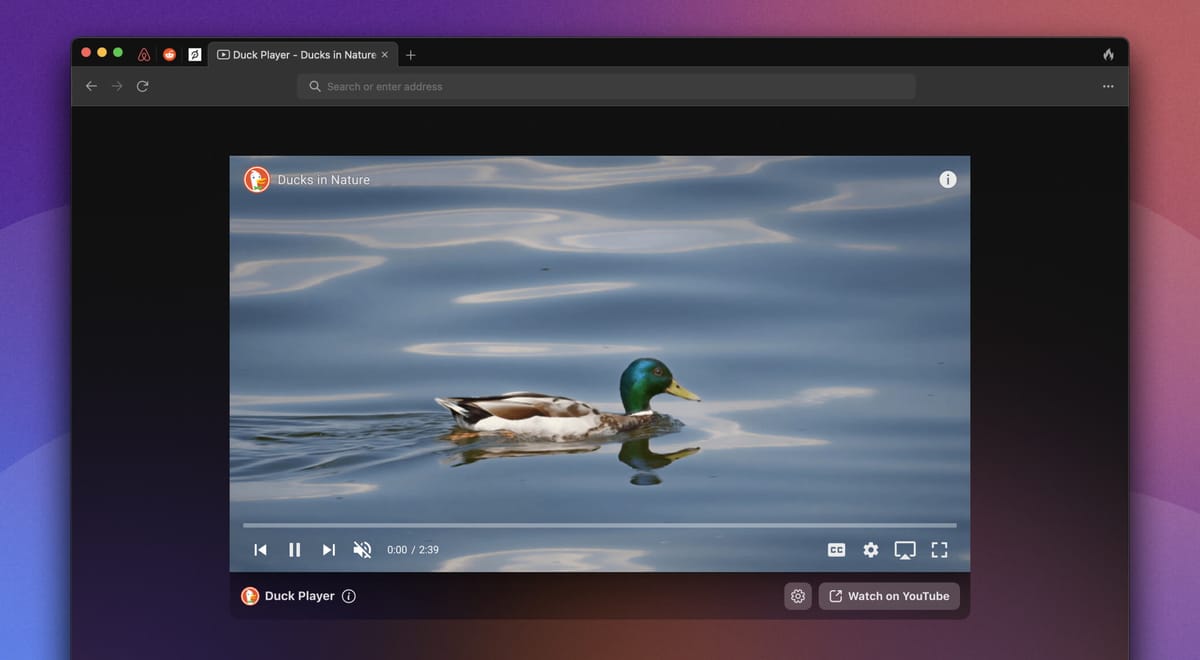
* New feature: Duck Player, a YouTube player that helps protect your privacy (no targeted ads, no influencing your recommendations, etc.)
* New feature: automatic cookie consent pop-up manager, which not only hides these but also makes sure to select the most private options before doing so (if you don't do that you can be subject to more tracking).
* New feature: Fire Button, one click data clearing for tabs, windows, sites, or everything.
* Our Email Protection integrated natively: https://spreadprivacy.com/protect-your-inbox-with-duckduckgo....
* A focus on Privacy, simplified, which means working continuously on not breaking websites while still protecting you as much as we can, and keeping the interface clean and sleek.
Duck player seems interesting to me. I use firefox containers to browse youtube and one of my pet peeves with safari is not being able to keep my google and youtube cookies separately.
Now, I just spend $6/month on a DigitalOcean droplet and run a SearxNG instance on it. Until I can get it moved over to my physical server at home, that's a much better option for my privacy and freedom of access to information. Who needs Google, or Bing, or DDG, or Yahoo, etc.; when you can have all of them in a single search?
If you run your own instance, it's better to share that instance with friends or family so they can dilute your search queries with theirs, and it makes it much harder for your instance to be tracked the same as they'd track you. Or, you can use a public instance which is better for privacy, but worse for security and customizability.
It is simply not true that we have censored anything or made ourselves "the arbiters of truth." I realized I previously explained how our news rankings work very poorly on Twitter but I subsequently put out a clarification tweet[1] and then we made this help page with a much clearer (and detailed) explanation of how our news rankings work: https://help.duckduckgo.com/duckduckgo-help-pages/results/ne...
[1] "We are not ranking based on any political agenda or my (or anyone else's) personal political opinions. We are also not assessing any individual news stories." https://twitter.com/yegg/status/1515637392190935041
You are using a definition of "spam" that is not commonly held or understood by those who would be your users. Whether or not this is for a noble reason, this renders it a dark pattern. This is not only a violation of the principle of least astonishment, your explanation comes off as deceptive. You are making a value judgment on truth and working that into the product while claiming you are not making a value judgment.
Relevance and truth are two different things. It is not your job to be making calls on the second one, and I find your willful conflation of these concepts, and attempts to deflect from the fact that you have done so to be a bit gross.
This is a vaguely worded workaround for applying censorship, especially without giving a specific list of organizations that they consult. The use of the term "objective" is very sneaky here, even manipulative. I didn't realize DuckDuckGo did this - how disappointing.
Time to start trying other search engines, perhaps a proxied or self-hosted one like SearXNG as GP suggested.
So BBC is spam according to them?
So does this mean you're going to deprioritize The Hill for firing Katie Halper because she wanted to do a story calling the Israel/Palestine regime apartheid?
Or the Washington Post owned by Bezos who is paid untold fortunes by the US intelligence apparatus, and whose reporter listed her news agency as "Amazon" on a sign in sheet to interview Assange?
Do you consider RT (a huge Russian news network) misleading about who "owns, funds, and authors its stories"?
I'm sorry, but I don't think you "accidentally made a bad tweet" -- you tried to publicly jump on the Ukraine bandwagon for cheap political points, it backfired, and you've been backpedaling ever since.
They are not, actually. Especially when you already have made your plans public previously based on your reaction to a political situation.
I have a question I always wanted to ask. Why should people trust your privacy centric services when you are famous for your previous project which was essentially a pyramid scheme for harvesting user data, which you then sold along with the data? Any rational person would expect DDG to also be a user data harvesting scheme.
"At DuckDuckGo, we've been rolling out search updates that down-rank sites associated with Russian disinformation"
and
"we also often place news modules and information boxes at the top of DuckDuckGo search results (where they are seen and clicked the most) to highlight quality information for rapidly unfolding topics"
Your post here and your tweets tell completely contradictory stories, which only harms your credibility more.
A search engine does have to make a judgement call on what results to rank over other results. However, making that call based on anything but relevancy to the user's query means I'm not going to take your search engine seriously. If anyone but the user is deciding what "russian disinformation" is, you've already lost the game.
Personally, that's fine for me: I don't have to take my search engine seriously to use it, and I dont turn to search engines for my news anymore. In fact, I think the only things I use engines for these days are a replacement for the StackOverflow search bar...
It's quite apparent their desired narrative is falling apart now, where a Pfizer executive publicly admitted they didn't even test for transmissabiity - meanwhile that was arguably the primary promotion point for the mRNA shots propagated by the captured MSM (arguably primarily by big pharma), by politicians (captured heavily by big pharma, enough to be toeing their line); and where Pfizer's CEO at last minute cancelled his in-person testimonial to EU parliament inquiry - arguably because they know they've been caught and will be held accountable by those who aren't toeing their line/profiting from it.
This is the "new" war using "soft" power, a war against all of society that arguably billions of people are now awake to; which speaking of it gets you flagged and lazily downvoted as "conspiracy theorist" to suppress a seemingly endless and growing amount of concrete proof points to support the hypothesis of what's actually going on.
Some quick reading of SearxNG's docs* and testing out an instance** shows some very good search results.
> If you run your own instance, it's better to share that instance with friends or family so they can dilute your search queries with theirs, and it makes it much harder for your instance to be tracked the same as they'd track you. Or, you can use a public instance which is better for privacy, but worse for security and customizability.
Is there no way to clear all state after each query, or every 24 hours, etc? I'd wonder if sharing with family just means you'd build a closer data association with them. Or, what kind of things do you find important to customise (and why?) that aren't configured by public SearxNG instances?
Building a profile of one person using queries from multiple people is difficult, and it gives you plausible deniability if it's ever brought against you in some accusation.
So I guess I'm not entirely sure what you mean by clear state. If you mean clear state on the instance side of things, the point is that it doesn't really keep any state unless you want it to. The problem is the state that is stored on the search engine side of things.
The more people in your instance of choice, the more anonymous you become. But since you're not the one running the public instances, you don't have the power to tweak all the settings you may want to. There are plenty of public instances that have great defaults though, but you're ultimately trusting that instance owner to not log your queries as well. So make sure it's a trustworthy-enough instance. Or use multiple instances, as a counter to that.
Ultimately, even the worst-configured public Searx instance I've used in the past, was much better than using any mainstream search engine directly. The most important settings are which engines you want to pull results from. Most public instances don't let you set all of those, if I remember correctly. So being able to choose those may or may not be important to you. Again, some public instances have pretty good search engine settings.