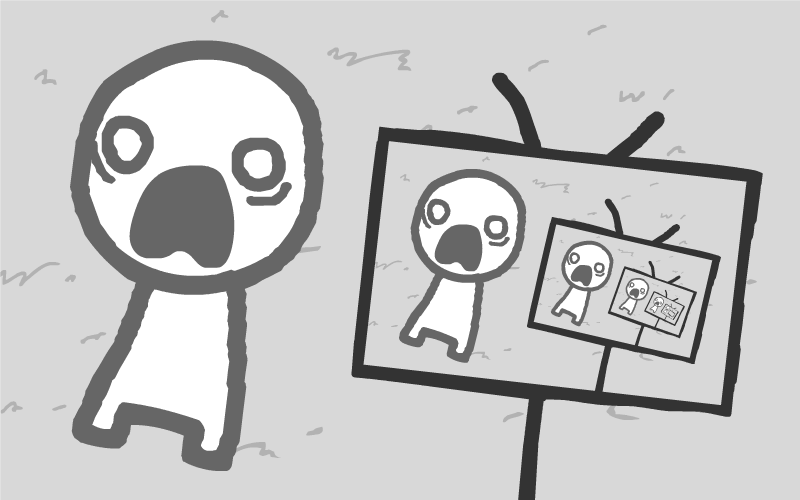
We Become What We Behold by Nicky Case!
a game about news cycles, vicious cycles, infinite cycles
itch.io
216 points · by ColinWright · 4y ago · 78 comments
The punch line of this game is probably the most painful lesson to see play out in society again and again: In the game of prisoners dilemma, if you let defectors win, then you will end up with more defectors. It is not enough that you "win," defectors must lose. Defection must be a losing strategy.
The results that this game displays so eloquently are so central to living in a high trust society that I think it should be mandatory curriculum for all schools.
Crime or corruption gone unpunished will breed more crime or corruption.
Causes:
Money is an abstraction of reputation and honor, and we have made it an (almost) total replacement. The problem with money is it does not have a record of how it was earned, unlike reputation.
Extreme individualism. Almost no sense of community or commons. Everything is about the ego.
Cars. Driving has become our main (and almost only) form of social interaction with our community. And it is all about "winning" as an individual, not about working together to get through a difficult situation. See all the HN comments about rude driving as the norm.
Could go on, won't.
I strongly disagree with the characterization that New York City is “the furthest thing from high trust I can think of“
I have interacted with thousands of strangers there with near perfect shared understanding of basic city etiquette. That etiquette does not include warmth, and in fact the way that we have all learned it is someone being quite rude to us when we break the etiquette, but that the city functions at all suggests they are doing something right.
The United States has only been legally multicultural and non-apartheit since .. the 1970s?
New York is notorious for its historical crime problems, but it also has enough trust to support a global financial centre.
WWII, "the greatest generation", almost all of society knew that if they united for a great purpose, they could achieve great things. Of course there were heros, but it was always the team/the group which mattered.
Sure we're all just trying to get to our next thing, or home, some happy about it, some sad about it, some just tired. But I don't think you'll find so many ages, religions, languages, classes, reasons or moods shoved into one little moving car as a subway and for the most part people not only use it just fine in trusting ways, but deep down, like being among the crush of just humans being human. At least if it's not 100 degrees and the train is running late again.
But even then sometimes, you suffer together, not because of each other.
Purges, torture, violence prisons and tanks kinda destroy trust, really.
Meanwhile supposedly high trust usa had blows of violence on their own. It was better country overall, sure, but plenty of violence due to unreconcillabke groups.
The concept of the last man as an antithesis to what life should be about feels quite close to a description of some Extremely Online people: https://en.wikipedia.org/wiki/Last_man
I don't believe this to be true, or I suppose I would require evidence for this claim that I haven't yet encountered in my life. I find when someone claims that "America used to be so much better" they're completely discounting the experience of all the people who weren't born into or existing in privilege or within the US "in-group."
The US has always been distrustful of the indigenous people already inhabiting the North American continent, of newly arrived immigrants, of black people, of single men. Single women were sometimes witches and murdered for it and only recently trusted enough with their own personal freedom, which is being curtailed again. Atheists were never trusted.
I really don't think the US was ever a "high-trust" society and there doesn't seem to be any evidence or foundation to claim that it was.
A useful test imo is: would you feel comfortable leaving your expensive Macbook, unattended in public, confident nothing would happen to it?
In Tokyo? Sure. Chicago, Detroit, NYC... Maybe not.
People doing "the right thing" on their own, when nobody is watching.
The big American cities used to be more like Tokyo in that regard. Now, you get stolen from and everyone agrees you were stupid and its wholly your fault.
[1] https://en.m.wikipedia.org/wiki/High_trust_and_low_trust_soc...
That is not an excuse for racism. It's just saying your points have nothing to do with high trust or not high trust
Not in every part of the world. In many places, the dominant culture assumes people got rich by cheating and stealing. Which doesn't mean rich people aren't courted -- money's attractive in and of itself; but they don't get much true respect by default.
Money is an abstraction of _perceived_ reputation and honor, and therein lies the problem.
Both the ability to read (ie look at other people's models and understand the underlying assumptions) and write (ie create your own simulations) is a 21st century need that is barely visible in the popular vision of computering for children (and adults). It's as if our current mathematics education focused on teaching the abacus instead of the much more powerful representation using Arabic numerals, which scales much better.
Another insight from the excellent book "Lying for Money" is that the optimal level of fraud outcomes may not be zero, because there's a cost to checking. Higher-trust societies can spend less on checking, while lower trust societies bear a cost both in terms of transactions that don't happen because of mistrust and because those that do happen are more expensive, even if legitimate.
Whats that famous definition? Oh yes:
> There must be in-groups whom the law protects but does not bind, alongside out-groups whom the law binds but does not protect.
edit: and after playing the game, I agree it's a very good treatment of the subject and emphasises the real lesson of the prisoner's dilemma, change the game to make everyone better off.
This is completely absurd. Of course "turning the other cheek gets you slapped"!! How could it not? That's the whole point. If your primary objective is vengeance, and you don't want to ever be slapped, then don't turn the other cheek.
But then all your energy will be consumed by a vigilante and resentful dynamic, and you'll be sad and angry.
https://www.linkedin.com/feed/update/urn:li:activity:6988177...
> OP: We had our store get windows broken as soon as we fix them every single time, and organized theft rings hit up our store on regular for thousands of dollars worth of items, because they know out security legally cannot do much to physically stop them. Our employees do not feel safe at all, we are shutting down.
> Top replies: ok, but have you considered creating a welcoming community for those people instead of being upset at this situation? They must have good reasons for breaking the windows and stealing your stuff, only if you engaged more with the community and provided them support, things could have been different.
And I wish I was strawmanning those top replies or ignoring the nuance (which often happens when those matters get discussed).Unfortunately those are almost the exact top responses on the post. On Linkedin, of all places.
I believe, simple tools and explorables such as these can help understand human psyche much more than a volumes of monograph exploring human conditions. I think these game-based explorables will be big in the future for explaining deep and difficult concepts.
Shame, really, because it is very true and a great exercise for journalism students.
How to report mass murders - Charlie Brooker
What's the general point of this game?
At least that's my take.
He certainly looks from the neck down like the kind of person that would brazenly wear a hat, and if he isn't in this specific photo, that doesn't prove anything, even though there's a whole news story about this unsubstantiated claim.
What's the solution? Who knows...
Just following orders, right? Every snowflake thinks themselves innocent in an avalanche.
It needs to be solved, but a singel, regular journalist very likely cannot