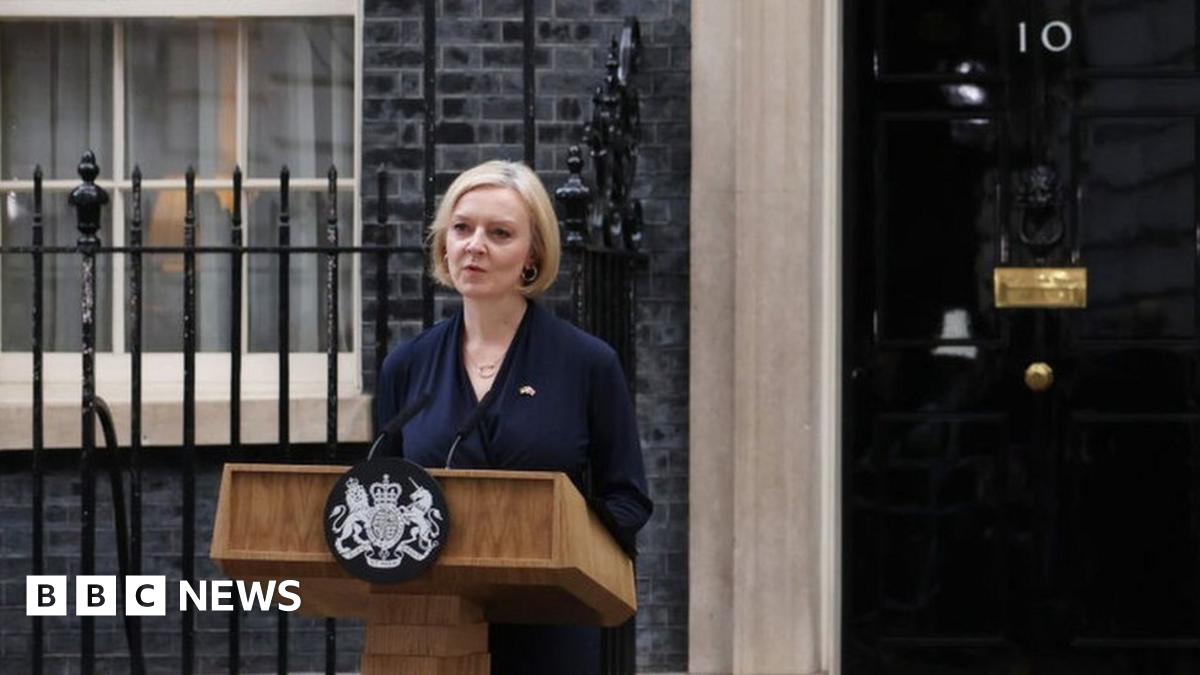
Liz Truss resignation: Tory PM hopefuls need backing of 100 MPs by Monday to enter race
Liz Truss steps down after 45 days in office, kickstarting a process that will give the UK its third prime minister this year.
BBC News
546 points · by samwillis · 4y ago · 631 comments
I'm referring to the parliamentary sessions in which, even though they're savagely roasting each other, they're doing in a way that feels somehow good-hearted and doesn't lay bare the naked resentment and hatred that seems to be all we have left in the USA.
Also, less amusing but still inspiring, has been articulate criticism from politicians and pundits who seem to actually care about the thing they're talking about; on this side of the Atlantic, it's easy to get the sense that anyone in front of a camera has a pile of talking points on a set of index cards in their lap that they pull out to memorize during commercial breaks.
Charles Walker, giving an impromptu interview, seems to care about a thing: https://youtu.be/Dimw572twfk
Parliament roasts Truss: https://youtu.be/Zc_9Ty_-PrQ
For anyone not aware, a large number of our politicians come from a background at public schools such as Eton, and read Philosophy, Politics and Economics at Oxford. Institutions such as these place great significance on rhetoric and adversarial debate as a method of reaching consensus. Stephen Fry's address to Oxford is worth watching, where he discusses Oscar Wilde's quote about the Oxford manner being the ability to play gracefully with ideas.
One huge downside of this system is that our politicians are widely considered out of touch and unrepresentative. The role of public schools and Oxford PPE degrees in our political system is an area of active debate within society right now.
If you are ever interested in contemporary British politics, the podcast "The Rest Is Politics" is a great place to start.
I always have to remind myself that an English "public school" is what most people call a private school.
Per Wikipedia[0]:
> "public" in the sense of being open to pupils irrespective of locality, denomination or paternal trade or profession.
I emphatically agree that an emphasis on rhetoric will make smart people smarter.
[0]: https://en.wikipedia.org/wiki/Public_school_(United_Kingdom)
One of the major mistakes made by Kwarteng as chancellor was firing an extremely senior civil servant which spooked not just the civil service but also the markets, because it indicated that elected officials would now be more active in running the business of government. That’s something no one really wants.
Sure, they may run circles around you or me when it comes to debating some aspects of policy. But not around someone who's invested time and energy into a specific topic, which I think ought to be the bar for whether we consider these people 'well educated' and 'intelligent' when they are running the country supposedly on my behalf(!).
On the conservative side you have several politicians who had actually been programmers before they went into politics, one who worked with implementing risk models at a betting firm. They had generally read the Ferguson/ICL papers and understood why they were deeply flawed, and could talk at length about the concrete technical problems that had undermined COVID modelling, both statistical and implementation wise. For example, one MP talked about a specific paper and why it was based on circular logic, others about the validation of the underlying assumptions. And of course they asked a lot of pointed questions about how such shoddy 'science' had been allowed to dominate the government, about how the quality of scientific advice could be improved. Concrete things that they'd already thought about a lot.
Then the SNP and Labor MPs stood up. It was night and day. They were, primarily, angry that a debate was being held in the first place. Their entire spiel was "How dare the evil Tories criticize amazing SCIENTISTS who are only trying their best". One even cited the conclusions of the specific paper a Tory MP had just ripped to shreds 10 minutes earlier, apparently without realizing he was discussing the same research. None of them had any knowledge of the actual topic whatsoever. Their worldview went no deeper than: academics are brilliant, Tories are evil, why are we even wasting time debating this?
This is ultimately the reason the conservatives have such long durations in government. The quality of MP they attract seems to be much higher overall. Yes they have lots of the Oxford PPE types but overall they're less angry, way more polite and analytical, and way more likely to have concrete skills obtained outside of politics. A good example of this problem for the left came up just a few days ago where a supposedly neutral Channel 4 presenter was caught on a hot mike calling Steve Baker a "cunt". Baker - a Tory MP and one of their former programmers - just politely brushed it off, clearly the better man.
This sort of thing is routine in Labour circles and it puts voters off. Whilst some may rail against classism, ultimately most people want to see civilized debate between politicians who don't clearly want to kill each other.
i'd consider that a bug not a feature
Real ill luck then to find the one educated fool who is skilled in obfuscatory rhetoric for the latest PM. Reassuring to know that the rest of parliament is filled with educated good intentions.
I don't think this is quite the benefit some think it is.
In addition to being out of touch and classist, a main thesis of the book is that Oxonians learn “to write and speak for a living without much knowledge”. This worked well for England for hundreds of years but more recently has led to disaster where actual knowledge and expertise matter eg implications of Brexit, pandemic response, etc.
Review: https://amp.theguardian.com/books/2022/may/01/chums-how-a-ti...
Ita confusing. In the uk, private schools are referred to as "public schools". The last person to know the reason for this died in 1764. Probably.
Schools that the actual public go to are called "state schools" because they're funded by the state (and not by daddy's estate).
Edit: interesting history on why: https://en.m.wikipedia.org/wiki/Public_school_(United_Kingdo... the schools “were "public" in the sense of being open to pupils irrespective of locality, denomination or paternal trade or profession.”
Nine prestigious schools were investigated by Clarendon (including Merchant Taylors' School and St. Paul's School) and seven subsequently reformed by the Act: Eton, Shrewsbury, Harrow, Winchester, Rugby, Westminster, and Charterhouse.
Confusingly, "Public School" refers to the most elite (and very exclusive) schools in the UK
They do tend to be very good schools but raise issues about social mobility, elitism etc (they tend to be expensive).
This is true both in their inferior form of "British Parliamentery debate" as well as the various American styles, such as Lincoln Douglas, Policy, or Public Forum.
Naturally the most obvious explanation for the US beating the UK at something is that the US population is 5x ours. Another explanation is that outside of public schools and Russel Group universities, we don't actually have much of a culture of competitive debating or debating societies any more. None of the schools I went to had a debate club, despite being relatively good schools, and I never heard of any debate competition being held.
From what I've seen from US competitive debate, it seems to be surprisingly popular with minority students and seems to use a style of rhetoric and scoring that I'm completely unfamiliar with - seemingly sometimes rewarding speed or Gish galloping. Here, the debates that most people would be familiar with are most commonly judged by their ability to convince the audience and are more popular with well educated, upper middle class people.
It's nice that it looks this way, but the different parties and their supporters in the UK absolutely hate each other. Front-bench party members now routinely and openly using words like 'scum' and 'detest' to talk about their colleagues on the other side. I don't think US politics is quite that openly aggressive and hostile.
In the past few years we've had politicians on both sides killed in politically motivated attacks. I think that's a worse tally than the US as well.
I remember Jo Cox, who was the conservative who got killed?
The death of Jo Cox wasn't a party political matter, it was a US-style radicalized loner.
I mean, let us know when a mob storms Parliament to prevent the confirmation of the next PM.
Politicians being killed is clearly unacceptable and I'm pretty sure the vast majority of even very politically partisan people in this country would strongly condemn any kind of violence. However, we don't routinely have much security for MPs when they are at their constituency office, so it only takes one nutter to do something. If anything, it's sadly surprising that it doesn't happen more often.
At least up until recently, this was true in the US too. On camera, in front of a microphone, and they say the crappiest things about one another. Then a few minutes later they're shaking hands, slapping backs, and laughing about the whole thing. Hasn't even been that long since the President schmoozed with politicians from both parties as he made his way to the podium for the State of the Union. Now it's "YOU LIE!"
US political discourse is vastly more hostile than you give it credit for, as well. Veiled death threats (shooting pictures of opponents, burning in effigy, etc.) are increasingly common, particularly on the conservative side.
Huh?
https://en.wikipedia.org/wiki/List_of_United_States_Congress...
https://en.wikipedia.org/wiki/List_of_British_MPs_killed_in_...
UK 3 in last 30 years, US 2. For a US population of 40x larger, and easier access to guns.
No, only one front-bench political party routinely refers to the other as "scum". Stop pretending that both sides do it.
We've had 4 presidents assassinated in our history (Lincoln, Garfield, McKinley and Kennedy) and there were attempts on the lives of at least 3 more while they were president or president-elect (Jackson, FDR, Reagan). There have also been a significant number of attempts on the life of presidential candidates (Huey Long and RFK were assassinated, George Wallace was shot and paralyzed) We also don't know where Flight 93 would have gone on 9/11 if the heroes on board hadn't charged the cockpit and crashed the plane in a Pennsylvania field instead of somewhere in DC. The reason why we haven't had many politicians assassinated lately is largely good luck but also because we now have Secret Service protection for all major presidential candidates.
Words like "scum" and "detest" are also not that different from the way people speak about political opponents here. Every presidential election for at least the past 20 years has involved people throwing words like "socialist", "communist", "fascist" and "theocrat" around to describe the other party's presidential candidate even when those candidates were centrists. There's always alarmist insinuations that we're going to turn into the USSR or Nazi Germany if the wrong political party wins the next election. In reality, the US will be largely the same but always getting slightly worse no matter which party wins the election. The difference between the donkeys and the elephants is that one of them makes things worse faster than the other (but people don't agree which is the lesser evil). I imagine Labour and Tory are probably the same way in the UK (although Truss did seem to be especially terrible at her job even compared to her predecessors).
[0]: https://en.m.wikipedia.org/wiki/Congressional_baseball_shoot...
this is the exception not the rule, and as evidence of this, it’s something that’s been turned over and over in the (especially right-wing) media for weeks now
the two MPs killed were killed by Islamic and right-wing extremists, respectively. this has no bearing on how the main parties treat each other
Maybe not, but pretending they are better while ignoring the homophobia, racism, sexism and offensive class warfare from the like of Boris Johnson seems disingenuous.
https://www.theguardian.com/politics/2021/sep/26/angela-rayn...
No, let's not try to dog-whistle one as acceptable and the other as not. That's exactly the thing I'm talking about.
Don't mess with British politicians. Even the grumpiest old dogs can savage most American politicians, as the folks that tried roasting Galloway found out[1].
Have there ever been any serious consequences to anything anyone ever said during the Prime Minister's Questions?
Or are they (like every other politician the world over) just putting on a good show for the folks back home?
Most of the stuff that actually happens, does so, in the shadows (for good or ill).
the great irony here is that Galloway left an innocent man, only to watch the US casually endorse its private contractors as they bribe taliban warlords for safe passage in Afghanistan in 2010.
I don’t particularly like that guy, but my goodness he’s absolutely brilliant in that exchange.
There were a bunch of Democrats and liberals, that were saying "I wish Galloway could be President!"
I'm like ... no, you really wouldn't like that ...
https://twitter.com/TheMediaTweets/status/794155820313235458
In Britain the PM is chosen by the party in power so you don't get the divided government situations you see in the US where usually the Democrats control some of (1) the Presidency, (2) the Senate, (3) the House of Representatives and the Republicans control others. Considering the veto power of the President and the filibuster rule in the Senate that can be a formula for gridlock.
Margaret Thatcher and Ronald Reagan both represented a move to the right but when Thatcher was in power she had no effective opposition while any legislation that passed in the 1980s was a compromise between Reagan in the US and Tip O'Neill and I think between having a good conservative and a good liberal, we got a lot of good legislation in the 1980s (we got a new Clean Air Act in that time frame, for instance.)
As a result there was a lot of resentment towards Thatcher from Labor advocates who felt completely shut out, so some sang "Ding Dong the Wicked Witch is Dead" when Thatcher died
https://theconversation.com/burying-thatcher-why-celebrating...
The UK government has been in utter turmoil for a long time now and it’s at its worst right now. This resignation marks a new low in self destructive politics and posturing.
I know you are referring to a different type of political impasse, but the chaos that is present in the UK is not a lot better than what the US system seems to see so regularly.
I subscribe to The Economist which would like to support the Tories but has had nothing but contempt for Teresa May, Boris Johnson and Liz Truss.
Some people say that the Democrats in the US are like the losers in professional wrestling but the complete incompetence and inability of Labor to get elected makes it possible for conservatives to get elected by pandering to a particular segment of the population. Voters have no interest in talk about redistribution if they think they think the people who talk about redistribution push policies that will leave people with nothing to redistribute. Jeremy Corbin did nothing to push back on the perception that he wanted to turn the UK into Cuba, and by not providing a viable alternative the Tories became useless. Corbin hoped that the fall of the Tories would lead to the rise of Labor but oddly it doesn't work that way.
I don't know a huge amount about Regan, but I doubt you can really compare them.
Britain in the late 70s and early 80s had huge issues which Thatcher addressed, but in hugely contentious ways, in some cases destroying entire industries and their communities.
The structural impact of some choices she made are still present in British society even now, decades later.
To interpret Thatcher you need to know about the labor unrest in the UK in the 1970s. Back then there seemed to always be a strike in some chokepoint industry (Coal mining, trucking) that threw the rest of the economy into chaos, almost like a general strike. This gets talked about it in this song
https://en.wikipedia.org/wiki/(Wish_I_Could_Fly_Like)_Superm...
A lot of people saw the labor movement as a big problem, thus Thatcher was in position to make a big crackdown against it. I occasionally meet an Americans who is opposed to unions, but there never was a time when a reasonable person could say unions were bringing the US economy to its knees.
Reagan had an impact of moving the US to the right a lot like Thatcher did, but not so much.
The Democrats largely accepted Reagan's viewpoint because it was perceived to work. Clinton accepted Reaganism just as Blair accepted Thatcherism, in fact both politicians were able to outdo their predecessors because on the other side of the aisle they were able to neutralize any possible opposition and normalize the slogan "there is no alternative".
Although Barack Obama introduced almost universal healthcare but implemented the public-private partnership plan that Nixon offered in 1974... One that almost works as a policy, but does great damage to institutional legitimacy because it looks like another case of regulatory capture and ultimately contributes to the nation becoming ungovernable.
Financial impact too; oil company privatisations and tax cuts which offset the income from the oil fields deprived the UK of a sovereign wealth fund equivalent to Norway's (although likely not as large, due to variations in the price of oil).
UK and USA, they make a very interesting pair https://eand.co/how-america-collapsed-and-became-a-fourth-wo...
> Both nations, too, now, are nasty places. They feel so markedly different than the great social democracies of Western Europe and Canada. The atmosphere and mood are ones of constant, omnipresent hostility — to everyone, from everyone
> everything is fine if you are a straight white male muggle
The media veneer around US politics is just that. If anything, it’s helped unearth (some would say legitimize) things that have always been here. I’d rather it be like it is than festering under the surface.
There’s a lot of people “saying the quiet thing out loud” on both sides that needs to be fully processed by the American people, no matter how polarizing.
The difference is they all went to the same schools together.
Makes close to zero difference who runs the country, because once you’ve lived under both sides it’s the same thing.
Only Ed Milliband and Tony Blair went to Oxford, which is where (of the Conservative Party): David Cameron, Boris Johnson, Theresa May and Liz Truss went.
Saying "living under both sides is the same thing" is also observably false, as anyone raised under the Labour governments of 1997 to 2010 can attest and compare to the Conservative governments since.
//edit// ..and had a privileged upbringing, so was the same class as the others.
Ahh yeah the “WMD” Iraq war and introduction of University top up fees.
Starmer went to Oxford. "gained a postgraduate Bachelor of Civil Law degree at St Edmund Hall at the University of Oxford in 1986."
In the past 50 years there have only been 3 PMs not from Oxford. It has nothing to do with conservatives or labor.
https://en.m.wikipedia.org/wiki/List_of_prime_ministers_of_t...
That's roughly 1 member per 100,000 people. You know your member. Parliament is dissolved every 5 years. So elections are pretty regular, but not overwhelming.
There's a House of Lords, but they seem to have far less power. The work of Parliament gets done in the Commons.
The main legislative body of the US is Congress, comprising of the Senate and the House of Representatives. There are 100 Senators and 435 Representatives. The US has roughly 330 million people. So about 5 times the population being represented by more than 100 fewer people.
Senators are a little weird. They serve for 6 years but about a third of them are up for election every two years. And never two from the same state. So a Senator is either on Cycle 1, Cycle 2, or Cycle 3. So every 2 to 4 years, a state gets to choose one person to represent the entire state in one of the houses of Congress.
Then for Representatives, all of them are up for reelection every two years. As soon as they are sworn in, they're already thinking about reelection. And the number of representatives are set by the Census taken every 10 years. Right now, California has 53 representatives for 39 million people. About half the population of the UK, but being represented by under a tenth.
So in the US, politicians are more akin to personalities than actual people. We essentially elect brands, not people.
The whole system is weird. Why is a vote in one state more powerful than a vote in another?
I mean, if the US had representation in the same proportion as the UK, they'd have roughly 3300 representatives. The town I grew up currently has a population of 1500. So I can see why we wouldn't do that.
Do you think it is real hatred or kayfabe?
Obama: Privately, that's not -- [Trump's] interactions with me are very different than they are with the public, or, for that matter, interactions with Barack Obama, the distant figure. He's very polite to me, and has not stopped being so. I think where he sees a vulnerability he goes after it and he takes advantage of it.
A fair amount of it is still kayfabe to the pros (the problem is, it isn't to the public).
https://docs.google.com/viewerng/viewer?url=https://assets.b...
Right wing media will destroy the western world.
I think when one side believes (with good justification) that the other side tried to get them killed in the workplace, it's not kayfabe any more.
https://www.independent.co.uk/news/world/americas/us-politic...
It typically has no shareholders and its powers are defined by the Act of Parliament which creates it, and may be modified by later legislation. [...] The phrase is not used to describe a company which operates as a conventional shareholder-owned company registered under the Companies Acts.
The UK press is pretty far right and a major element of how we got to this mess, though.
The question I have is which came first, in the US? Regular citizens in the US harbor the same naked resentment and hatred for their fellow Americans based solely on political affiliation. We used to hide it better, especially around family, but that barrier has mostly been broken down too. Did our politicians turn us this way? Or did we just elect politicians that say the things we want to say? Did the news media whip up this resentment with biased stories, or did we voluntarily filter bubble our way into incentivizing that behavior?
It's not just you. It's how what you do affects other people. This is a better way to live than the "I got mine, fuck you" which seems more common in the US.
This is also exceptionally common in the UK. There's a reason the Brexit vote passed, and there's a reason people voted so strongly for right-wing parties over the last 12 years.
Obviously democracy is a sliding scale, but what was in place in the 1800s had a lot of headroom.
At this point, a general election would be the obviously correct solution. It's clear that the conservative party don't have a platform and can't agree major policy points amongst themselves.
However that would require conservative MPs to vote for it, which is the turkeys voting for Christmas so unlikely to happen, so I'd expect we'll have to wait till 2024 for that election.
The best likely outcome is that a set of senior people in the party agree a policy platform and try to steady things for now.
Yes it's confusing and it would be better to write down a constitution reflecting how things actually are, but that's how it is.
So much for democracy.
Can you expand on this? Is it just because he would be more popular if he dismissed parliament and another election was called?
As much as I'd love a GE and to see Tory MPs swept from power en-masse, that's just not how a Parliamentary system works. Everyone in the UK voted for (whether they think it or not) an MP to elect them for five years. Those MPs get to choose who leads them.
I think there is a very high chance they will be unable to agree on a new leader and will therefor be unable to form a government. Even if they do elect a new leader, if that leader can barely control the party that would not a functioning government, and they should call an election.
At some point Tory MPs need to grow some, call an election, and except that it may mean loosing their job.
The world is such a different place to 2019, there is no way they can argue that they are a continuation of the previous mandate.
They morally should put it back to the people as they've failed at it internally twice, but nobody seriously expects them to intentionally do it.
They could accidentally find themselves cornered into it if they can't pick a new leader
That doesn't seem to be the way current conservative parties operate though.
Some would suggest that has already happened and they would have got away with it if it wasnt for those pesky international financial markets trying to limit their exposure to the impacts.
From what I can tell, Sunak might actually do a pretty good job there; and for the time being that may be preferable over the delays and uncertainty of a general election. At least for now, considering the state of things.
We're not going to get that with the current incumbent party.
They made the mistake of putting up two incredibly unpopular candidates for PM to the party members in the most recent PM selection process. I'm not sure they will make the same mistake again.
At the same time, they did just have an election, so it's not like they are going to be interested in having another one. Labour-aligned folks are calling for one for obvious reasons.
It's time for an early General Election. This lot need to go. Every trace of the Tories must be obliterated.
The hilarious part is, the way that polling stands right now, a General Election would result in a strong Labour majority with the Scottish National Party in opposition, the Lib Dems third, and the Conservatives a distant fourth :-D
We vote for MPs, not Parties. The PM could lose their seat if their local constituency votes them out, even if every other person in the country voted for them. An example of that is the 1906 election [1], where Balfour lost his local vote and the Conservatives had to scramble to come up with a new leader. This is why top MPs are given safe seats by their respective parties. Of course, in practice, the vast majority of people vote for their Party not their local MP when they go to the polls during a general election. That isn't how the system is designed to function though. Most people couldn't even name their local MP - the one who is actually meant to represent their personal interests - which is an utter travesty and the source of most of this countries political woes.
[1] https://en.wikipedia.org/wiki/1906_United_Kingdom_general_el...
So yeah you don't vote for a PM ... but there's a clear, well-understood difference between being the leader and the very visible face of your party when it wins the general election, and winning in one constituency then charming enough party members to become PM a couple of years after the General Election.
Sounds like completely unbiased opinion. /s
More seriously, I'm only interested in hearing the arguments for a general election from nominal conservative (Tory) supporters. All arguments from leftists are just "we want to win" in disguise so are completely untrustworthy.
From what I understand of UK politics, Johnson won the last election on policy (he was already PM) and lost his seat because of COVID shenanigans so presumably the Tories still have public mandate to continue the same policies (maybe not the Lizz agenda though).
The argument is that the party is being eviscerated in opinion polling, they’ve lost the support of the public and that since they're effectively doomed they're free to do what we know they love to do - attempt to secure themselves a role in the private sector for after the election. Given that this it the Conservative party, it's not exactly a secret that they'll try their best to gut the state in order to do so.
And the idea that Labour in 2022 is “leftist” is laughable. The party threw an election and enacted a campaign to remove members it considered left-wing (“trot hunting”). They’re not the left, they’re just probably not going to actively fuck up the country quite as severely as the Conservatives seem hellbent on doing
I don't understand how you can argue for an unbiased situation and then disregard the entire left side of the political spectrum. How can election results represent anything other than the will of the public?
I think every single living member of every Tory cabinet present and past should be strung up in Parliament Square. I'm not in any sense unclear about my views on them.
We have had twelve years of disastrous Tory austerity that has comprehensively destroyed the UK's economy. What's the plan? Let them keep trying until they get something right? How long is it supposed to take for their austerity policies to work, to get the economy back to a sensible state?
Clearly unbiased opinion. /s
I'm not a labour supporter, but I'd like to see a general election as it's obvious that the conservatives can't agree internally on a policy platform or candidate to lead. They are split between an authoritarian group and a libertarian group who don't want the same things at all.
Johnson lost due to repeatedly lying to parliament, plus a large number of unforced errors where he ended up having to perform U-Turns after choosing badly and then being forced to change by events. Covid was part of that, but far from the only part of that.
Ideally the UK should have a system of proportional representation, so that the bits of the different parties that actually agree on policies could form their own parties (Labour has similar split problems to the conservatives, but along different axis)
It's extremely common in British politics for the prime minister to change without calling a general election. In fact there were only two PMs in the entire 20th century (Heath and Attlee) who both entered and left the premiership as the result of an election.
Anyone who complains about "unelected PMs" needs to read more history.
Back in the 60s, a Soviet diplomat ran into an American diplomat on the sidelines of some conference.
"I want to congratulate you Americans", says the Soviet diplomat, "your propaganda is amazing, it's much better than ours".
"What do you mean?", replies the American. "We don't have propaganda?"
"See what I mean!"
You can be polite, and still be insane or evil (see: Brexit and all of the politicking and --from what I can tell-- outright lies that were sold to people). That whole process was mostly civil and polite, but not necessarily healthy.
Different in the sense that Trump remains extremely popular with Republican voters, independent of his actions. If Trump weren't so popular, his own party would have tossed him out long ago. They only grudgingly allowed him to become their leader in the first place because to oppose him meant almost certain defeat in their own next election.
The Electoral Judges in Brazil, are censoring actual facts, because despite being facts, they consider it "misinformation", it go so bad that a former supreme court judge of ours got censored for explaining something technical... Despite the fact our constitution explicitly bans any form of censorship. (ironically, as defense against US... our constitution promotes free speech to prevent CIA from subverting the country again).
Lets revisit this observation in 2024 when the next US Presidential election is held. Many localities have been electing people to oversee their local election process who are 2020 deniers, and who supported overturning Biden's win in order to keep Trump in office. I think 2024 could be interesting.
What would've happened if instead of simply announcing the proposal, Truss had described the proposal and the government had sponsored a conditional prediction market on the economic effects?
She could've run prediction markets for dozens of proposals, and selected a policy that was popular with both the markets and the public.
(Lest this idea be seen as overly capitalist: there's no reason not to run a prediction market for "degree to which this policy will reduce inequality", and incorporate the result into decisionmaking as well. Imagine the irony: a bunch of rich hedge funds trying to figure out the best way to reduce inequality!)
Not good? Just deny it. Good? Guess we go ahead.
Essentially you enlist the modelling skills of all those extremely highly paid quants to figure out which policy is the best.
I imagine it would be quite hard to set up - especially in a way that keeps the incentives you want intact - but I think it's a very interesting idea and deserves to be tried.
I think the reason I'm excited about prediction markets in particular is because I think the average voter, justifiably, does not have the time necessary to familiarize themselves with all the details of a proposed policy and related research on its likely economic ramifications.
I see the kind of in-depth analysis of financial assets that hedge funds currently do as being somewhat wasteful. I would prefer that they switch to policy analysis in the public interest, by betting on which policies will deliver for voters.
Based on the abstract, I think the essential argument is that a market manipulator acts as "dumb money", attracting "smart money" who are happy to profit by bringing the market back in line with reality.
Take the inequality example that you mention. Reducing inequality might require large government spending, like free higher education, or extensive government-provided healthcare. This requires funding which pushes up interest rates.
Someone in the prediction market might agree that free higher education reduces inequality but might also think that it will increase the government’s cost of financing its spending. The latter is what usually gives politicians trouble with financial markets. How would a prediction market resolve this issue?
I fear applying it to governments would accelerate us into an hyper-capitalist dystopia much faster than we're already heading for.
> The second shortest serving PM was George Canning, who served for 119 days after dying in 1827.
Sounds like the UK has had an undead PM.
Can somebody from the UK tell us what did she do that the economy crashed, in just under two months?
She did this by launching a series of unfunded tax cuts and doing so without an assessment of the impact on the UK's finances.
The gov also declined to get the Office of Budget Responsibility (OBR) to check the impact of the plans. This is something the OBR does before every budget and it's very unusual that they didn't do this - even though it turns out they offered to before the budget was released. It didn't help that a lot of the taxes cut were targeted for high earners - It's hard to argue how cutting the top 45pc tax rate for earners over £150,000 and dropping a cap on bankers bonuses would help people in the short term (or dare. I say, the long), when the majority of people in the UK were struggling with the massively increased cost of living. It almost seemed as if the conservatives were trying to force through a list of long desired for tax cuts for the wealthy without the proper mandate (as Truss was only. elected by Conservative party members, rather than the general electorate) - and this made her gov monstrously unpopular.
This wiki page contains a good summary: https://en.wikipedia.org/wiki/September_2022_United_Kingdom_...
September 23rd onward is pretty much how she ended up in this position.
After leaving the EU the UK economy has become extremely unstable, with strikes occurring almost on a weekly basis, just like we had in the 60's and 70's before the UK became a EU member state.
Mind you that the UK isn't self-sufficient in terms of food (hasn't been for more than 120 years) and economic dire straits could actually lead to food shortages and famine!
Let's be realistic, this is never going to happen.
Kids will go hungry.
People who used to support food banks now need to rely on them. Food banks, which have to cut down on services because they can't afford them any more.
While it's a stretch to argue that the UK as a whole will run into famine it's hard to argue that 14 years of austerity and the mess the Tories made in their time in government will not lead millions of people into literal poverty.
e: logical error fixed
> leaving the EU the UK economy has become extremely unstable
Define extremely here? Given Covid 19 lockdown policies?
> Mind you that the UK isn't self-sufficient in terms of food
Very few are: https://en.wikipedia.org/wiki/List_of_countries_by_food_self....
[The United States has entered the chat]
2) The US system of open primaries where anybody can vote that we adopted in the 70s seems like a mistake in retrospect and there's a good reason no other country does things this way. The UK Conservative party's system, adopted in the 2010, of allowing people who pay party fees to vote in primaries seems like an even worse idea in terms of candidate selection though it does have the advantage of raising money for the party.
In short [0], the idea of republicanism is that the people cannot be trusted to make political decisions; you need elder statesmen to do that. In other words, you need grown-ups. To this end, we have the electoral college, which is supposed to block any egregiously populist president. Well that is not how it worked out.
0. So short that it is misleading. I won't defend anything I say here, even though I believe it in principle.
It’s like throwing a punch with no intention of getting in a fight. You’re just bound to get your ass kicked.
Not only is the UK not a republic but Republicanism isn’t about needing a grown up, it’s about time. Understanding the implications and reading through a 150 page proposal on the bill is not possible for the majority of the population.
The internet has lost it's privileges in this regard.
I was talking about US Republicans.
If you suggested that every take their money out of banks as a mass movement l, would that be treason?
I think he's ambitious for his own sake but I don't think he really cares about the country long term. I base that on the fact that his wife didn't pay tax here until it threatened his career and that he retained a US green card as a "plan B" for after he'd finished being in power.
I feel he had no skin in the game.
Everyone saw that resignation coming after the rejection of their tax cuts by the markets.
That the Queen literally died the day after meeting you.
Unbelievable.
At this point, we can just randomly pick a citizen to be President or PM. We might have better chances that way
One example HN might be familiar with is the smartphone-based Covid contact tracing app in this country. When the government was going with an app that didn't use Google and Apple's contact tracing framework, the BBC focused hard on the inherent problems with not using it and made it sound like no-one other than the government thought that decision had any advantages at all. Then the government U-turned and literally they day the new app launched, all of that was forgotten and the BBC suddenly discovered the fundamental, well-documented disadvantages of that framework they'd ignored before and found some experts who made it sound like that was worse than the original app. They've been doing it with almost everything though.
I know it is fairly popular on HN to say that any party that is coded ring-wing is terrible. But, I genuinely think that there isn't a single person with enough nuanced knowledge of even 3 of those countries at the same time to make any kind of sweeping political statement about them.
What makes you think that countries or opposition parties with less spotlight have more competent leaders? Name a country of any decent size and I'm sure citizens of those nations will flock to the comments talking about how messed up their political system is. Politics is messy, by definition.
> dumbest end up in positions of power
The hubris of us highly-educated workers to think that degrees or 'elite coded appearance' are what define intelligence. The likes of Boris and Modi are political geniuses with carefully cultivated identities and a keen understanding of the landscape.
> randomly pick a citizen to be President or PM
I know you mean this in jest, but political power doesn't come merely from titles. They'd just end up manipulated by the same 'powerful politician' anyway. I picked on this strawman because it demonstrates that politics is not a vice that can be eliminated from positions of power, it is the very mechanism by which struggles for power function.
Exactly, when I was a young lad, I used to think, if only well educated people got into politics. But now I understand, it is those who are connected on the ground to people's issues or at least have an understanding of them are the ones who get elected. Being educated or not is immaterial. In fact the more educated you are, the more you may not understand people's issue.
No it's not, HN is definitely biased conservative.
1) People have a kind of illusion that their rulers are (or at least should be) good. But historically speaking, this was almost never the case. Most of the time the rulers thought only about themselves, how to keep power, how to benefit from it and so on. Even most of the things they were commanded on were done of selfishness, too.
2) The people who should actually go into politics never will. Some of them are very active in their local communities, though, but have no desire to participate in this ridiculous show trying to sell themselves to millions of unknown people. Moreover, they have the humility of knowing they can't promise the crowds anything - the opposite of what the crowds expect.
There are many such examples.
Then there are Ted Cruz, Josh Hawley type politicians who are definitely smart, but say/do insane stuff because it serves their needs.
Then there is Mitch. Very smart but very scary, in a league of his own.
Overall the issue is that this career route does not pay well. E.g. in my country a mid-level developer earns as much as parliament member. Specialised constructions workers can make as much too. Why the hell would you pursue career in politics if you can easily make as cushy living with much less stress? You must be either narcissist or... not that bright to make a living in other ways.
> > dumbest ..worst of the worst
Modi maybe worst, but dumb he is not.
He didn't have a college degree, but from nobody to becoming a pm with a full mandate for two terms in a country of billion is not something a dumb person can achieve.
I on the other hand - my starting salary matched his last salary. I have nothing to show achievements wise - all I have done is attend meaningless meetings and write CRUD code for soulless companies.
While the government job situation today is much worse that it was during my dad's time, I still think one can do a lot of good as civil servant than as a highly paid developer for a wall street firm.
I agree with you on the topics of politics though.
Because a person is a person through other people.
Because despite the rhetoric of cynics, good governance is both possible and valuable.
Because one is not content to merely be critical of current governance from the sidelines.
Because one supports the mission; it is necessary.
Because the mission is challenging.
Because one values service to their fellow citizens.
Because their fellow citizens value that person's talents and service.
Because even if someone believes that everything is fungible and nothing matters but themselves, it's possible to find challenging, well paid, highly regarded work in government.
If you can't, teach, and if you can't do that, go into politics.
Over time the two systems would converge, and it's much harder to exert undue influence over the candidates when it really could be anybody.
It's one of those ideas that's worth taking seriously even if it's never implemented anywhere.
I think if somehow true democratic voting was magically implemented world wide, then a lot of assholes would be voted out and quickly. Even in countries where people are electing sociopaths.
I have a wild idea. What if we try to select people based on their respective expertise in an area, rather than based on just popularity? If they have a science/knowledge background, even better.
Since it's based on skill and governance, we can call it something like "tekhne kratos", taking inspiration from the Greeks because why not.
It will probably work out better for the citizenry, but I don't see how we'd ever end up there short of a violent revolution - the current system is self-serving first and foremost and will never allow itself to be replaced even if that is the true will of the citizens.
Oh woops we're back where we started.
turns out we don't have that many smart people in the UK
This is squarely on the Blair/Bush party of big government and tax cuts, which is a deeply unpopular position in reality.
I like the hot take that historians a couple of centuries from now will see that the Queen died and a couple of days later the currency crashed and say "even in the early 21st century the monarch had immense covert powers and the death of one was an existential crisis for these democracies."
Whoever thought of this (not I) was brilliant. Seems almost certain to happen, probably because of (not despite) the sheer volume of contemporary commentary.
I would feel very poorly about the tory gang in London if I were say from the North Irish area or Welsh, or Sottish at the moment.
This isn't good for European stability either. Hopefully the money and support continues to flow without issue to Ukraine.
Unfortunately, if you want to shake things up and introduce even moderately radical policies, you better have the stamina and political will and skill to push them through and keep at it.
Britain's first female prime minister had that. The third one didn't...
not bankrupting your country also helps.
I feel Truss could have a spot on that wall, too.
There is no set of policy goals that the whole of the tory party can now support, and there's no one with the legitimacy to force them into line. They can't face a general election because they know they'd lose. So their best case scenario is they do nothing for the next 2 years and hope that nothing blows up in their faces. But in reality sooner or later something will happen that will either cause the right wing of the party to blow up the party, or the left wing of the party to defect to Labour. I think at this point the most likely scenario is Boris Johnson returns, a large chunk of MPs defect to Labour, and either Johnson loses his majority or is forced to call an election anyway on the basis that he needs a new mandate to actually get anything done.
The country has voted several times on this promise and it's never been delivered.
It's one of those "people want lower taxes" - "Ok, which public services do you want to cut?" things. They want immigration down to the 10,000s, but no one actually wants to prevent any individual migrant.
PR would allow different factions to negotiate under formal rules like in other countries, where when a support party loses confidence, they topple the government and cause an election. PR of course also has whips but there's the prospect of dissenters starting their own party.
For a look at how that works follow the Danish election that's coming up in a couple of weeks. The old PM quit and formed his own party, another of the old ruling party did the same, and both look to be grabbing quite a large share of votes.
I think the journalists(!?) missed a trick there.
I always thought Truss was more like an Android than anyone I've ever encountered. Lack of emotive expressions, eyes that seemed to stare rather than scan, and so on.
Maybe later we'll find it was a failed A.I. experiment by Cambridge Analytica/Facebook !
(Link: https://www.economist.com/leaders/2022/10/11/liz-truss-has-m... )
I did go back to find it. It's 2 clicks away from clicking the link.
There's a good chance that will happen.
There is no place for decisions that do not sit well with the markets, unless you live in a dictatorship - Russia, China, etc.
That means all creative or unproven political decisions will be punished by the markets leaving us in a rather stagnant world ruled by market forces.
What policies do you think we're on point and representative of good conservatism?
Oh sorry, you said good conservatism...
This seems hyperbolic and doesn't really fit with the HN guidelines. As most HN commenters lean conservative, I recommend reading the room first.
In addition, every leader on the world stage enact primarily conservative policy because it's effective. While there are some outliers, it's easy to see just from reading the news and listening to independent thinkers what the inevitable outcome will be.
The larger issue is that the new Tories' procedure for producing candidates leads to a winner that has a large majority of parliament against her.
There is now a problematic mixture of parliamentary and Tory voter legitimization. That would be resolved by a true general election.
Nothing less will suffice.
Even in non-parliamentary democracies, see Richard Nixon; he made a lot more fuss, of course, but he did, in the end, resign.
However, the right leaning Conservatives have fucked up everything for such a long amount of time starting with Brexit it's pretty much guaranteed that left leaning Labour will win the next election in two years.
One reason is that the British nationalized services that Thatcher sold off to private investors in the 1980s (railroads, electricity, etc.) no longer exist, other than the national health service, which the British public would riot over if it was privatized. With nothing left to cannibalize, there was no way for the government to boost the financial markets, leading to the collapse of the pound.
This is good news, as it signals that the era of neoliberalism, with all its intellectual hypocrisy and disastrous outcomes, is suffering one death blow after another, and will finally be discarded on the dustbin of history once and for all.
40 years of seeing how they work out?
Completely ignorant and intent on favoring the rich she dashed into the porcelain cupboard swinging.
The only good thing that can be said about her is that her reign was short.
Hahaha.
Since then, she's been a dead woman walking.
Especially, I think that the cancellation of the rise in corporation tax was very welcome and in fact economists now say that the rise to 25% will make the recession deeper and longer (unsurprisingly, frankly).
The issue was that the other cuts, especially abolishing 45p income tax rate but frankly also the decrease of the basic rate, were not discussed, not funded (which is what spooked the markets since we already borrowed and spent like crazy during Covid), and frankly everyone agrees that they were useless. Of course abolishing the 45p rate now was also extremely bad symbolically (though in fairness it only exists since 2010-2012).
I think the plan has shifted from "pro-growth, nevermind inflation" to "a good recession will solve inflation". And a 'good recession' along with higher interest rates, the incoming budget spending cuts, and maybe tax increases is also going to be quite painful for the people.
Not a tax cut per se, but I'm curious what will happen with the energy bill support scheme? That seemed like a good thing to implement, one for which Truss and her cabinet got a lot of critics from a certain part of the media.
Granted, I'm not from Britain so maybe I'm reading the room wrong and that support scheme was, in fact, not liked by everyone involved, I wouldn't know.
I think the mistake is more a massive communications and timing issue. She really should have announced these cuts in a staggered way, with better communication for the markets.
It would have been fine.
But she really screwed up on getting the political communication right.
And more importantly she was announcing these policies at an exact time when the Bank of England was trying to raise interest rates and sell bonds to fight inflation. So you have the government and the central bank pursuing contradictory goals: one trying to jumpstart consumption by borrowing and spending and the other trying to cool it by raising the cost of borrowing and reducing spending. This lead to a lot of wasted time, money and efforts and really destroyed the government's credibility.
But keeping the corporation tax at 19% was the right move, IMO.
"How did you go bankrupt?"
"Two ways. Gradually, then suddenly." - Ernest Hemingway, The Sun Also Rises
UK politics became intellectually bankrupt in 2016. Promises no longer needed to have a connection to reality. Isolationism could be sold as "pro-growth" etc.
The disconnect has been growing gradually. The voters loved the pie-in-the-sky promises. So each leader's promises were more unrealistic than the last. They selected for ever more ideological belief, over pragmatism and admitting the downsides of choices. But who would be holding the can when the bill came due?
The responses that "She was terrible" are not wrong, but you have to also ask why such a charmless, incompetent-and-unaware-of-it character came to be in power.
This is the culmination of the Brexit ideology, make no mistake.
This is the "Suddenly" phase.
I think this might cause some second thoughts, at first for Tories, about whether it's actually a good idea to ask their membership who should be Prime Minister.
Many of these MPs knew Liz wasn't fit for this post from the outset, but their own party's rules said they should allow ordinary members (a few thousand people who are disproportionately old, white and male IIRC) to decide from the best two put forward by MPs. The members, in effect, picked the woman who said the things they wanted to hear, even if those things were nonsense. If those members were your general electorate, then arguably the country gets what it deserved - but they're not, they're just the party members. If you thought US party primaries were a bad idea, well, yeah, that.
In short, the opposition called a vote on fracking, which is supported by Truss' "pro growth" government, but was opposed in the conservative manifesto. The government declared that anyone who voted against the government (and for what they promised to their constituents when they were elected) would be kicked out of the party. MPs who then tried to vote against the government were reportedly manhandled and assaulted to force them to vote with the government.
There is a whole load of other chaos that happened in the last 24hrs that was just ultimately impossible to recover from.
I think the last 24hr has just proved even to her final supporters that she is completely incapable of leading a government.
The need to put a UFC octagon in Parliament.
It's clearly time for a general election and end of the Conservative tenure in government.
Her “mini budget” immediately crashed the economy, after she ignored all the advice saying it was a bad idea and would crash the economy.
Her party, the Conservatives, are in such a divided and shambolic state there is no one in the party who can command the confidence of the majority.
The Tory MPs resent this.
lets hope the next one can get your house prices pumping again.
They came up with the disasterous "mini-budget" which kicked it all off, they dismissed a senior treasury civil servant right before that, they didn't co-ordinate with the bank of england.
Sure there are deeper problems that are not of their making but they made them a lot worse.
I'd argue she shouldn't have been choosen as she is weak in media terms, always has been, and was always going to be an easy target for the screaming minority of people.
And yes, timing was unlucky, but a prudent leader would have seen that
By not laying the ground properly for their "mini-budget" they (Truss and Kwarteng) caused the markets to lose confidence in them, causing the problems that occurred.
It doesn't really matter what most people thought of it, as they don't run the financial markets :)
I think your question is too broad to answer.
Edit: I'm sure objectively she was bad, but yeah.
It wasn't sexism, she is genuinely completely useless. Fractally shitty, in that if you examine any part of her stint in politics it is every bit as shitty and inept as the whole.
Boris knew the facts and lied about them. He knew where he was last Wednesday (in your bed, fucking your wife) and he's got enough smarts to figure out that a confident lie about having to work late will help him. That's not a great feature in a leader, but hey, he's at least got some idea what's going on. A liar, a cheat, a real piece of shit, but not the least competent person ever to be elected.
Liz has no idea what the facts are, and seems oblivious. Where was she last Wednesday? She's hoping you will remember because she already forgot. Why did her own constituents elect her? What was she running against? Was it the lettuce?
Why can't the Tory party do better, that's the real question. How is it that Liz Truss was on offer to the party members as Prime Minister in the first place ? They only have to send two candidates. Send two serious options, if you can't do that, why are you pretending to be a party of government?
Choose your poison.
Interesting that the train was set in motion by economic trouble, particularly inflation and a miscalculation about a response.
The strong US dollar is exerting effects around the world and will continue to do so. This is unlikely to be the last incident in which the dollar's strength contributes to instability in other countries.
There have been many calls for the death of the dollar. Inflation will kill it. It will be killed by countries wising up that they don't need it and can trade with each other using their own currencies.
And yet here we are. US CPI growth north of 8% and a dollar that's rocketing higher. Meanwhile countries like Britain and Japan are desperate to find a way out of an acute dollar shortage, tanking currencies, and uncontrollable inflation.