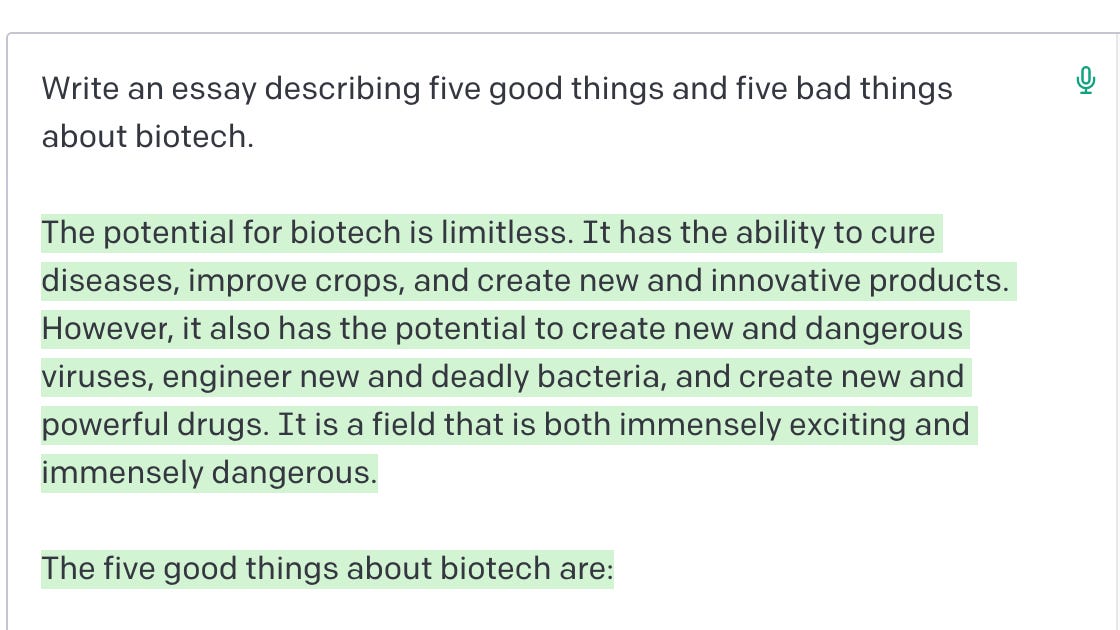
Students are acing their homework by turning in machine-generated essays. Good.
Teachers adapted to the calculator. They can certainly adapt to language models.
aisnakeoil.substack.com
304 points · by randomwalker · 4y ago · 360 comments
IME, and I have lots of "E" (including training and finetuning my own models), this probably isn't entirely true in most writing-heavy courses. You can use the largest language models, in an interactive fashion, to generate portions of half-decent papers. Maybe even "ace" papers on certain subjects with certain grading criteria (namely, "looks reasonable", not "fine-toothed comb"). But in many courses the essays will be extremely low-quality, and even in the happy cases saying that the essay is "machine-generated" is eliding a lot of manual effort.
I agree that students are probably using LLMs for their homework, but I'm skeptical that they are all getting As on assignments that are designed as big assessments, or that the essays are actually fully machine-generated. I bet a lot of students -- the laziest ones -- are getting "WTF is this essay even about... did you have a stroke while writing this?!" feedback if they are using LLMs to generate essays whole-cloth.
Pedagogically, this matters. Think about calculator usage. There's a huge difference between allowing use of TI-83 on Calculus assignment with lots of word-heavy application problems and allowing use of Wolfram Alpha on a Calculus assignment that's "integration recipe practice".
Last year I had a take-home exam in an operating systems class that I suspect one student fed entirely as prompts to an LLM, and it was... odd. The answer to every question was a paragraph or two of text, even in cases where the expected answer was true/false, or a number. And even when I did want text as the answer, it was way off, e.g. in one I asked them to explain one strength and one weakness of a specific scheduling algorithm on a given scenario. The submitted answer was just general rambling about scheduling algorithms. Some of this is probably within the reach of an expert using clever prompting strategies, but students who can do that could probably also answer the original question. :-)
To be fair, I have seen the "ramble generically on the subject of the question" strategy manually implemented by humans too, in the hopes that if you throw enough BS at the question you might get partial credit by luck. Maybe designing assessments to be LLM-resistant will have the nice side benefit of reducing the viability of BSing as a strategy.
Every answer was at least one full, complete sentence, even for yes/no or true/false. And the “short answer” responses filled all available space when one sentence would do.
My only conclusion is that some undergraduate institutions around the world must be intentionally drilling it into their students to do this.
For example, if the question is about respiration a rambling answer that mentions “oxygen transport chain”, “Krebs cycle”, and “ATP” might get 3/5 points even if it doesn’t make much sense otherwise as long as the answer doesn’t confuse the Calvin and Krebs cycle or otherwise contradict like saying that glucose is a byproduct.
Practically speaking, there is fairly little downside to putting in extra in your answer, as tests are normally scored by how many points in the grading rubric you hit.
This is the basic speech strategy of politicians. Don't answer the question asked, just talk about something related that you want to talk about.
I had a college professor that knew to recognize this and actively warned against it during the mid-term and final.
He said that every question will be answerable in 2 or 3 sentences, and that if you write 2-3 paragraphs instead, he would mark you down even if the answer was correct because you're wasting his time and may have dropped in correct statements that answered the question by luck.
So often in school, we'd be getting quizzes/tests back, and I'd peek over at someone else's paper as it was being handed back and notice they wrote an entire paragraph to answer, whereas I answered it in a single sentence and got full credit for a correct answer, and I was always left wondering what the hell they wrote about.
Now a grade school student has access to grammarly. In a few years they’ll probably have automated fact checks and text generation.
What will happen? My bet is that we’ll expect a lot more from students a lot earlier.
I read the title and the domain name and thought it was going to talk about a false report about students using ML on homework.
Reddit is filled with shameless habitual liars who claim to be airline pilots in one thread then plumbers in another. The incentive structure of reddit, the internet point skinner box, incentivizes shameless lying and ""creative writing"".
One of those students doesn't mention using GPT to generate essays. The only mention generating lists and other short-response questions. I find that believable.
The other student mentions essay writing, but also says that they "didn't ace the essay" (no mention of the grade).
So, the article linked literally isn't evidence for the claim.
This comes across as very ill informed. I suggest you actually use some of the AI essay-writing services because they are pretty indistinguishable at this point from human writing.
Here’s one I particularly like -
This is highly amusing, and I wish I could say why. Thanks for the chuckle :)
I was going to play your game, but this product requires a valid email address and phone number, so generating examples from this product and sharing them here without doxing myself to an unknown company requires way too much effort.
Maybe you can help by copy and pasting the first 50 pages of output from that model for the prompt that is shared by a user below:
write a 50 page paper describing the impact of Teutoburg Forest on Roman politics.
I think it's a great way to handle exams and I wonder if we'll need to shift towards that in the future.
I agree. But there is a "gold rush" out there in the academic world where the idea is to offload more and more work to "on-line."
My son just started school at a respectable US university. Two of his five courses are entirely on-line. A third course (genetics) is done in person, but the exams and quizzes are done on-line.
I overhead three undergraduates talking about how easy it is to defeat the anti-cheating software for their on-line courses ("The professors don't review the videos...Just hold your phone out of view of your laptop camera and google the answers...I've never been caught ...).
It was disheartening and I told my son to avoid on-line classes in the future because he was just putting himself at a disadvantage.
The meat of the matter really comes down to the professors and how they approach the exams. Generalized essay prompts are hilariously easy to cheat on; complex hyper specific prompts that extend on something specifically discussed in the class are far harder. On-line classes, by their "mass distributional" nature (ie, save money by making them reusable) are almost by definition far more generalized than you would want.
Until the professor actually asks real questions and grades them as they should be graded. Then the students complain, and the grades are "renormalized" or whatever euphemism they use. And certainly in the US, students have a lot of influence, since they're the paying clients. It's really not surprising that employers ask academic titles for so many entry-level jobs.
> I told my son to avoid on-line classes in the future because he was just putting himself at a disadvantage.
At a disadvantage for what?
For learning the material - sure, when an easy avenue for cheating with obvious incentives is available, it's unreasonable to expect people not to take advantage of it. Also, I expect that teachers have significant incentives to reduce their lecture efforts - why read the room, modify the lecture in response to Q&A, and tailor curriculum to the actual class progress, when you can just push "play" on the recording from last semester?
On-line classes give him an advantage for getting a piece of paper from a respectable US university, however - less work, same piece of paper, same results as far as job eligibility and resume eye-catchers...
I'm sure you enjoy being contrarian, but I also suspect you know precisely what I meant.
In the short-term, yeah, what's the big deal? But in the long-term, this devalues the courses and the degrees.
It's not in the long-term interest of the universities to behave this way because the course they offer are, ostensibly, a way of determining who understands the material and who doesn't.
Also some people have hard time breaking the rules even when they know that everyone else is breaking those rules and they are unlikely to get caught. We probably want to discourage systems that give cheaters advantage over honest people.
- Pressure to actually talk and perform. In a written exam I can stop, look at the paper and take my time to actually start. In an oral exam I have the professor looking at me. Less time to actually think.
- It's harder to communicate orally with complex subjects than in written form. Add to that the extra cognitive load of not dealing with your native tongue.
- Time constraints on oral exams punish students that don't learn everything by memory but can reason in real-time. I didn't know by heart a certain proof, I know for sure I could have done it in a written exam with time to spare (it wouldn't have been the first time) but I wasn't quick enough for an oral one.
- Mental blocks are much harder in oral exams. Some times I blank out and forget something basic (e.g., the derivative of a logarithm). In a written exam I can stop, think, and solve it. In an oral exam, the "stopping" is already making you look like you don't know things, adding pressure that will make you underperform.
Written exams have been the norm for decades for a reason. Far easier to actually ask the things you want, they scale far more easily, easier to correct and grade, and easier for students to practice and perform well.
American oration is generally awful. Talent in it command a premium. Perhaps this is related to our lack of oral examination ? We’re more comfortable with written argument because that’s how we’re taught to think?
But, in general, oral communication is harder than written. Written form allows you to take time to form sentences, correct mistakes, reorder thoughts, follow an outline... Oral communication, on the other hand, forces you to think and speak in parallel. It's always going to be harder.
I am very much not an extroverted person and in University written exams were almost always more stressful than oral ones as they try to cram as much as possible into into the time available or were too easy (so at the top end grading becomes very nitpicky) or too hard (which can be demoralizing if no one even manages to complete all questions). Oral exams have much more flexibility to adapt to the individual here.
Universities can also crib from how law school exams work if they want to still do written examinations.
I know lots of extroverts who are terrified of speaking in front of others and introverts who love it.
I think this is easier for people who are good at speaking but I think exercises like this will develop the skill.
While the class was otherwise busy, the teacher called you up to report on your self-chosen-from-a-list book. The teacher opened the book to a page and would read a passage and ask questions about it like what are they talking about, what happened right before and after this. After a couple of passages at different spots, you got your grade.
You are not feigning anyone familiar with the material.
On the other hand, extroverted people have similar advantage in the real life. I myself am quite happy for every lesson where I was pushed to practice people-facing skills (presentations, demonstrations, etc). Even an introverted person can learn to talk about topic knowledgeably if they know it -- which often is valuable confidence-building experience to have. Despite the introversion, one can do it!
If the professor - lecturer administering the test is any good, empty rhetoric won't help too much. If they are lazy, students one can try to give "answers" without showing what they don't know in written exams, too.
everything else in life will reward being well spoken and outgoing, why shouldnt school as well?
While anyone can go into khan academy and learn/perform any subject, having an actual person would be tremendously costly. It's strange, when computerized education appeared I thought the cost of education would plummet, now its going to go all the way up.
I agree with you that learning should be the goal. And any busy work that doesn't help should be eliminated. But I just don't know if we know what the right structure should be and if we can say for sure that things like writing essays don't actually help students cultivate their writing and critical thinking skills.
I hated writing essays in school, because the assignment was always "reproduce a work of writing that adheres to the arbitrary standards of the institution for grading purposes". Great writing can't be graded, as its value is entirely subjective.
As an example, here's an assignment that I might have completed under duress, vs. one that I'd complete voluntarily for fun:
"Explain how the theme of Chaos is expressed in Slaughterhouse Five. Use at least five supporting examples from the text and cite your references MLA style. Four pages minimum."
"Convince your best friend that Slaughterhouse Five is a terrible novel. Cite the text any way you please, ideally by comparing it to a book you think is actually good."
Whatever I produced for the first prompt can be graded by ticking off boxes and looking at my grammar; whatever I produced for the second prompt would need a thorough investigation of my own writing style and a framework of grading that takes into account my own voice as an author.
(To be clear--I don't think that giving my prompt in a modern classroom would immediately inspire students. They are far too burdened by the entire system for a single change to fix their experience. I am merely discussing the difference between "pointless essays" and "essays that authors care about".)
The two prompts motivate the writer to practice two completely different skillsets; they're really not comparable.
The first one is focused more on the fundamentals of close reading and analysis. The writer needs to understand what the theme of "chaos" means, then closely read the novel or review their notes to identify literary devices or techniques that theme, and then tie it together in a "report". It requires the assignee to practice very basic skills... it's technical practice, not artistry.
The second prompt is the artistry - it's an assignment in discourse or rhetoric. The thing is, it's not possible to successfully execute the second prompt unless you've mastered the techniques from the first prompt. Beyond constructing logical or emotional arguments that may be tailored to your audience (your best friend), you still have to collect evidence from the novel. It might not be a list of literary devices, but if one of your arguments was that the book was poorly and confusingly written, you would still probably need to collect evidence of specific passages that support your claim. The whole point of the first prompt is to build the skill to do this, but with some hand-holding/constraints for practice.
I won't defend page limits, but even the reference style mandate is important because it has implications for how you actually write the essay. I deal with technical stakeholders all the time, and the amount of time that we could clear up issues if someone would just properly cite a reference can be ridiculous... perhaps those stakeholders were the teenagers who didn't bother to follow the citation guidelines for their literature class?
Assign the second prompt, and I guarantee you’ll get something like this as a submission:
“Bro, the novel sucks. Trust me.”
You can’t even give this a bad grade, based on the prompt. You can't say it’s not convincing, because they’ll say “you’re not my friend, this would convince my friend”
You can’t say it’s too short, because they’ll say you didn’t provide a minimum.
You can’t say it didn’t cite the novel, because you said to do whatever.
You can’t say it didn’t compare to other literature, because you said “ideally”.
Lesson 1 of being a teacher: give the students an inch and they will take a mile.
Teaching students is not unlike programming computers, in that they both take instructions very literally. If you are vague with a computer program, you know ahead of time because the program doesn’t compile.
If you are vague with an assignment you don’t know until you get it back. The more vague the assignment, the wider the variety of submissions. If you don’t tell them the font face you get a cursive one. If you don’t tell them the font size you get huge and tiny. If you don’t tell them the margins you get wide and thin.
So even if you would personally make a good faith effort at this assignment, it’s really better for everyone to be specific and follow the same format.
Note the section on Body paragraph structure -- that doesn't begin to cover how structured the resulting essays were. I can still remember my daughter sing-songing "T, CD CM CM, CD CM CM, CD CM CM, SC." Every essay had to follow that exact pattern. Every commentary sentence had to start with the approved list of words, and likewise the concluding sentence.
It's entirely about how easy it is for the teacher to grade, and has nothing to do with teaching students to actually write. It was awful, and I did everything I could, including contacting the Jane Shaffer people, to criticize it and push back.
Well... I have a lot of problems with this, on both sides of the fence.
Provocative start: How about we give up the idea that students are producing great work?
I mean, I imagine teachers think of the exercises they give as skills development.
One of the skills to develop is technical writing.
Surely beginning students do not know how to cite textual examples to back up their arguments. Understanding the role of evidence in making an argument should be fundamental to democracy. (Understanding that we are not living in that world recently in the US.) So they need to practice.
Choosing the theme is another skill. I don't have anything to say about it, but I don't have a problem with teachers asking students to try to figure something out before they write about it.
Meanwhile, your prompt sounds like hell. And is far more subjective than the previous one.
> Convince your best friend that Slaughterhouse Five is a terrible novel.
So, before you even start the assignment, you let the teachers dictate the position that someone has? And you're not going to teach students to assess themes in books, so what will they judge Slaughterhouse Five on, aesthetics?
> Cite the text any way you please
Why on earth would you change that requirement. "Cite the text using method X" is a direct analog to "Coding standards dictate this naming convention". I would fire a "free thinker" who refused to adhere to the, sometimes arbitrary, standards for communication with the rest of group. Standards are good.
> ideally by comparing it to a book you think is actually good."
As a rule, I don't think convincing someone that a work of art is "terrible" should be done by comparing it to something else you "think is good".
> [No page limit]
You can trust an adult with that, but a seventh grader? Usually they need a page limit to encourage them to write more.
It seems like the following a complete essay that you would have to grade very well: "Slaughterhouse Five's lack of elves makes it terrible, because fantasy novels are just better and books like the Lord of the Rings have elves which makes it a good book [Source - My conversation with Johnny yesterday]"
Grading that well would be bad because it's horrible in every way.
Of course all essays shouldn't be written exactly this way, but for students just learning about writing long form, it is a brilliant stepping stone to get the basics down. Too many students—and readers—can't differentiate between a "concrete detail" or statement of fact, and "commentary material" or statement of opinion. This method helps to distinguish them.
School is not about doing great work. It's about learning the tools which you can use to do great work. School does not ask you to do novel research, and so it doesn't ask you to write novel essays.
The first prompt requires the reader to critically analyze the book, by first requiring them to give it a charitable interpretation.
It is said that you cannot disagree with someone if you're unable to explain their position yourself in a clear and definitive manner. Obviously, what are you disagreeing with if you don't even understand what's the ideas behind the thing you disagree with.
That's what the first prompt would be about teaching you, to be able to understand other people's ideas and concepts, to look past your initial judgements and bias, give it a charitable interpretation, demonstrate you understood all this by summarizing the idea in a 4 page essay of your own, with supporting references to tie it back to the source, showing the source does in fact argue for these itself.
Once you can do that, you have gained the right to go on with your own disagreement and write that essay, which would be your second prompt. Though honestly, your second prompt seems to be geared more towards discussing the entertainment aspect of the book, and not the ideas and concepts it contains, so again it's not that much about critical thinking, because critically there's little to argue about a "I prefer the color red over blue."
Personally I think you were trying to get at something else, maybe your point was just, come up with assignments students enjoy and can have fun with?
I think this is always true, but some things are just boring to some students, maybe you just don't enjoy reading, writing or even critical thinking, or any of that stuff. I don't know if there's much you can do in that situation. Maybe the solution is more fluid classes, let people move at their own pace, pick their own areas of interests, even if that's directly going to a trade, skipping on literature entirely, etc.
Length is used as some proxy for rigor, but we know it's only a proxy.
One issue for me in English was I really was not interested in the kinds of essays the English teachers were interested in having us write, eg coming up with a thesis on plot themes in Shakespeare. Just not my thing and so I couldn’t get anywhere in those classes.
When I write today, for work, the challenge is always to write less. My VP might have time to read two pages; he's almost certainly not going to read anything longer.
Why They Can't Write: Killing the Five-Paragraph Essay and Other Necessities https://www.amazon.com/Why-They-Cant-Write-Five-Paragraph/dp...
Writing is generally good. Expressing yourself is good. Analysis and critique are good. The artificial essay is useless.
All it did was teach kids how to write boring simple sentences to meet the implicit "punctuation quota". An equal amount of content compacted into a couple of complex/compound sentences would actually result in marks off.
;-)
Feedback is obviously invaluable, but the point of grades, as used today, is solely to gatekeep who are allowed access to the next level of education. So instead of constructive feedback, it has become a set of filters entirely divorced from actual learning.
(And yes, I got good grades, I just hate that so many people I know were denied opportunities based on a shitty system, wildly not fit for purpose)
If the goal is wrong, perhaps just don't do it, but... "it's on you to show that it's the best way". I don't get it.
If I want to see that a student has writing skills, I would think expecting them to write is somewhat definitional?
Maybe it's on someone else to 'show' a better way to demonstrate writing skills that doesn't involve writing.
The same is not true for busywork in school. It is disconnected from life outside of school in a very fundamental way, in that there are no inherent rewards for being able to complete busywork--all of the rewards come from social cleverness, competitive instincts, networking, etc. If you behave like a good student in the professional world--keeping your head down, getting your work done on time, following all the rules--your friends who go out drinking with your boss will blow past you in your career, and you'll be pigeonholed as a drudge-work guy.
People treat school as if it's training for real life. But it is real life. Why is everyone so completely convinced that it's got to be boring, miserable, and institutionalized?
See: John Taylor Gatto’s book on this subject— The Underground History of American Education.
There are other educational paradigms, but they are radically different — no tests, no curriculum, no “fill the blank slate”, no measuring.
Writing is a skill.
Writing clearly, grammatically, persuasively, and logically takes many skills.
Having ML write your paper is obviously cheating but isn't too far from what I did mentally. I think the valuable thing being lost is the ability to research a topic, quickly understand what's relevant, and structure the results.
Ie in many cases in school i don't think they actually care to teach you the subject. What good is that subject really going to have on your life going forward? Even if the sense of ethics or history-repeating i suspect it's quite low.
What those meaningless tasks can do (though highly dependent on the person, i assume) is teach you how to research, how to communicate, and how to cite.
At least that was always my takeaway from many subjects in school that were subjective (ie not math, science, etc). The content is often the least important aspect of many early learnings. .. but then again i loathed school growing up, so who am i to speak on the subject lol.
And that's arguably a more valuable skill than the writing itself.
A student that has done the underpinning research to generate the essay should be able to field a closely-related question, offered in realtime. If they can't, that's concerning.
(To be sure, some students will address this approach by having the machine auto-generate the essay than going off and reading around the answers the essay gives to understand the adjacent space to field the upcoming question. Good; that means they just used the machine as a "cliff's notes on the topic" generator, they still did some research).
Of course, I have a exceptionally bad (37th percentile) long-term memory so maybe that's just me. Schooling in general seems to be geared towards tests of memory at the expense of understanding.
High school me: "Well I understood it at the time" hehe
IIUC, testing memory is half of pedagogy. Memory (or the student growing the necessary techniques and discipline to supplement an internal lack of it) is pretty key to (at least US) pedagogy in the primary / intermediate levels.
As with image generation, one thing I think we haven't adequately considered is once a sizable fraction of the available online data is machine generated, but isn't marked as such, and we begin training models on the outputs of the last generation of models, structurally we can enter a different regime. A sequence of models each trained on the prior model's output can converge to meaningfully different behavior, because we're repeatedly, incrementally changing the task by changing the training data distribution. If _all_ the data is generated by the prior model, this process seeks a fixed point which is reflective of the model architecture and not the original training data. There's a very real possibility that using generative models more (and publishing their outputs) can make these models worse in the future.
Weirder, however, is no one has really had the opportunity to look at what happens to human language when a sizable fraction of what we read is produced by these models. Will we normalize any quirks of their output? Will we reproduce or incorporate any idiosyncratic features into our own writing? How will we adapt in a changing linguistic environment?
As for normalizing the quirks of the output -- maybe? But would that be so bad? Language changes all the time, it's constantly mutated by influencers (not the Instagram kind, but the ones that have existed for centuries). Look at how British English is literally called "The Queen's English" because it actually shifted to how the Queen spoke, since she ruled for so long and was very influential to that society.
Also it should be noted that some news articles, especially in finance, have been written by computers for over a decade now, and not a lot of people seem to have noticed.
> Eventually the models won't work and people will notice
For any product dependent on these models, that sounds like pretty negative outcome ... and entirely consistent with my concern that "[t]here's a very real possibility that using generative models more (and publishing their outputs) can make these models worse in the future."
> and either create new training data or go back to only using older data to train
Especially given that currently LLMs basically learn about entities and concepts in the world via their training text, this breaks the ability to update the model to know about more recent topics of discourse independently from shifting the real vs synthetic proportions.
> there will always be people who ... will still create new art and new writing, which will seed the training data
But if we aren't able to consistently separate the human-generated and machine-generated content, model training won't be able to place any extra weight on the human-generated stuff. The mere fact that human-generated output doesn't disappear entirely doesn't remove these issues.
The analogy is loose, but click fraud creates realistic looking data exhaust that looks close to the behavior of a real user, and can meaningfully disrupt one's ability to optimize for clicks or to know how many actual end users interacted with your item of interest. The fact that some nonzero portion of the clicks are real doesn't erase these problems. And that's in a system which doesn't create the kind of feedback loop described above.
That has already happened in "free market capitalism". Prices are supposed to be the representative models of the product quality, but became decoupled from it because companies set the prices based on competitors and not based on quality of what they sell.
Ahh but the spark of true genius lights itself.
Time to time I hire entry level people. Their writing in general, the primary method of communication is atrocious. I am not complaining about fundamental grammar or punctuation. I make those mistakes more frequently then most myself.
There is no cohesive flow of thought; there is a lack of logical structure. They are unable to unpack their justification for recommendations. This costs us because we have to have multiple "draft reviews" until the document is succinct, or cost us when the recommendations are misunderstood.
Over the last three decades I have seen the decline in the skill of writing.
I make those mistakes more frequently then most myself.
...this checks out.
Even if models are better at writing essays, it's highly unlikely that the generated essays will convey useful and accurate information. Ie, the writing may be better as a context-free composition of words and symbols, but the semantic content of the writing within the context of the business will be at best nonsense and possibly even misleading.
In GP's context, excellent writing that's pure bullshit is even worse than bad writing.
Generating design documents that discuss real tradeoffs from a combination of email threads, slack messages, meetings, and code is quite a bit different from generating the billionth essay on Napoleon. We use the latter, in part, to practice the basic skills required for the former. But just because a model can do a half-decent job at the latter doesn't mean that it is anywhere near being able to do the former.
90% of the writing tasks I've encountered in the last 10 years is content generation for content marketing. And failing that entire industry dying in a fire (which would be a good thing), having that auto-generated by AI would be simple and no loss to humanity.
> it's highly unlikely that the generated essays will convey useful and accurate information
My MBA essays didn't do this either, so I'm not sure what the problem is
It can't be both: either AI is now better at writing than people, or it isn't. If it is, then let's use it to write everything that it can. If it's not, then we don't have a problem.
That's something that sounds good on paper, but it's incredibly difficult in practice. For one, students are all over the place in ability, so what's critical thinking for one student may be the most boring of intuition for another. Evaluating students based on their critical thinking is ripe for subjectivity. I've had multiple teachers who were great at teaching, but clearly had favorites and that was very discouraging for students that were on their bad side and received arbitrarily bad grades. The English teachers I most appreciated followed a boring rubric that incentivizes more formulaic writing.
Also, regurgitating content is an important skill as well. Half the formal writing I do at work is documentation, which strictly falls into this category. The other half is design docs, which arguably is a form of regurgitation as well. I'd come up with the design anyways, and the doc is just to share it to others.
I've marked 'essays' in computer science (billed as reports but equivalent enough for these purposes) and I think they are mainly set because the university wants the students to be able to write clearly which is a reasonable ambition.
It's often really hard to assess 'understanding'. It's possible to detect non-understanding more easily - you ask enough questions and hope that the non-understanding slips. I guess you try to give students enough rope to hang themselves. Or of course sometimes it is obvious that they don't understand things from the get-go. But it's very hard to create questions novel enough that they can't basically be gamed with regurgitation. Universities do try but still difficult.
What taught me to write wasn't school or essay writing homework, not even at university level. The crucible that forged my own ability to spell and argue was the internet. Slashdot, blogging, later HN.
If I was a teacher trying to teach people to write, I'd be tempted to pick some reddit forums, and ask students to find a comment they thought they could add to, then submit (to me) a set of replies to them. Online forums give you real time feedback in whether your argument landed or not, whether people understood what you meant and so on. Literally every mini-essay is graded by other readers, in real time, on demand (maybe not on writing quality but it never is, not even in school).
Using tools outside class to practice for the in-class work would make a lot of sense however, as students could then rapidly see what a decent essay or code body looks like.
Of course. I don't understand how essays written at home are acceptable. It's a good exercise to do them (if done properly) but they shouldn't count for the final grade.
Before AI there were professional essay-writers, or tutors, or parents. In a sense AI is progress because now everyone can cheat, instead of only the wealthy.
And a degree consists of a good number of courses, each of which will have its own exams - so if you do poorly in one or two exams, there are plenty of chances to bring your average back up.
Of course there is. One of my classmates milked this system to remain a student for about twice as long as the rest of us. He was good at manipulating the bureaucracy, not so good at physics; probably should have studied law or some sort of social science instead.
Having such an exam adds enormous extraneous pressure that does not reflect the reality of conducting research, but it is this pressure that guarantees (with some exceptions) that the student has been coerced into learning the material to a sufficient standard. There will always be the cramming psychopath who grabs a first after just a week of study and who retains nothing of it, but most students just have to learn intensely over the course of a year to pass through the filter. In some ways, this is also why it's common in the UK for employers to not care so much about the specific degree, just that you have one with good grades from a reputable institution.
I lament, though, that students are often either (A) so overburdened with distractions that they don't have time to learn, (B) so pressured to get high grades that they cannot afford to get a bad grade, and thus must cheat, or (C) just don't care. There are a few gems that are willing to put in the work to learn and appreciate a subject, though. I just wish that more students put in the work required to learn.
Relevant quote: "Every truth has four corners. As a teacher I give you one corner, and it is for you to find the other three." (Confucius)
You mean like how today they study well-regarded human works? I’m not sure how the ML adds anything except which words tend to appear close to each other across a large corpus. The moment where young writers believe that ML is creating anything new and they try to learn from that is when modern civilization starts to eat its own tail.
Given that a typical programmer on a typical day has online access, and given the creative lengths students will go to to maintain access to said resources during exams, it seems worth considering allowing online access for programming exams. To address the obvious problems with that approach, could we use AI to generate unique variations on the problems we want the students to solve?
Teaching, even at the collegiate level, has become "how can I do the least so I can do what I want". Tenured research professors generally make terrible teachers...perhaps we need professional teachers.
The hardest exam I ever took was my final exam for Linear Algebra. It was so "open" that people could use matlab on a shared computer that was also projected to the entire class. Turns out, the best students in the class didn't need help on a computer, so it turned into this kind of mind-fuck where you weren't sure if they got a different answer than you because they were wrong, or because you were. To add to the excitement, the questions all tied together and used the answer from the previous one, so if you missed one, you were guaranteed to miss every subsequent question.
Theoretically they could copy it from offscreen but unless they’re really good at faking going back and changing things and getting stuck at the right points it would probably be fairly easy to tell.
On the flip side there’d be no definitive proof.
1. If it isn't rampant now, it will be in a few years time. Cheating is highly incentivized in college, and this makes it very hard to catch. I doubt you could generate a thesis this way, but you could certainly pass your electives.
2. Writing is highly conventionalized. Half of getting a good grade is following conventions. AI will get really good at this.
3. I suspect ESL students will use this first. When tutoring writing, extremely smart ESL students were getting poor grades in writing courses for having bad grammar, vocabulary, whatever. This will help them get good grades until the AI surpasses native speakers, who will then use it.
4. This is really tragic for students. Writing is really great for solidifying thoughts and learning. I still journal to this day just because of this. This will deeply affect how people learn. But the outcome remains to be seen.
Edit: Better words
Honestly I don't think writing essays for a course is a good measure of understanding the material. It's mostly an exercises in regurgitation.
By offloading this to a machine the students are undercutting themselves more than anything else. They'll be less effective communicators and less capable of disagreeing with ideas and concepts the face in the real world
An essay that is simply a description of the source material, or a listing of pros and cons with no actual thesis, is a totally different endeavor, and one that has much less value as method of instruction or assessment.
The rule is you have to turn in your own, original work. You provided a prompt, and a piece of software turned it into an essay.
Is this inherently different from using the predictive keyboard on iOS, or using Grammerly to write clearer sentences? Where is the cut off point where the computer did too much work on its own?
Likewise using a 4 function calculator in an arithmetic class is cheating but in an algebra class it's not.
It's a really good question, but also a really silly question that no one should have to guess about. Teachers should be simply be providing explicit policies one way or the other.
I had "anything goes" assignments and "strict" assignments. For the former I didn't care. For the latter I could either tell whp if you were cheating, or else proctored the assignment.
Math is a good leader here. Sometimes you allow certain tools. Sometimes you don't. The set of tools allowed tends to increase as courses get more difficult and assignments get larger. It really just depends on what is being evaluated.
At the end of the day, unused muscle will atrophy and students may have trouble even producing appropriate prompts for ML generator. I would weep for the future of humanity, but:
1. Coffee did not kick in yet 2. I have upped my nihilism lately
I may be misremembering what I heard when I watched this: https://www.youtube.com/watch?v=vtIzMaLkCaM
And I get that it is hard and everyone has their own idiosyncrasies and all that jazz, but, and this is probably the only time I will defend corporates, were it not acceptable language enforced by HR, those emails would somehow be even worse than they are now.
So the goal is the same.. give the audience what it wants. What do I get? Well, it varies..
edit: I am really enjoying the link provided, but clearly this guy is talking about a very different level of writer.
But I have to write essays on how certain systems work, and how certain tasks are achieved in my job in order to document these things. My writing skills definitely play a big part in making a tutorial that is easy for anyone to read and understand.
Spoiler alert. It did. Very few people attempt to commit things to memory outside some Guiness record competitions. And just in case I did not hit the point, introduction of Google with world encyclopedia at anyone's hand, further exacerbated that trend.
To sum up, I appreciate the sentiment, but in HN I do hope for, nay, I expect pushback in the form that goes beyond weirdly smug quote.
What I am saying is: argue with me. Don't quote me philosophical bumper stickers.
We've left future generations with a mountain of garbage to deal with, what's another paper cup thrown onto the pile?
I'm old enough to remember people telling me I wouldn't always have a calculator handy, and obviously that didn't age very well.
It sounds unnecessarily pessimistic in the face of all the things AI will help us with, but given what we know about human nature, I do expect AI to make us a lot lazier and ... dumber.
Logical error though. The analogy to calculator is poor.
With a calculator it doesn’t matter what your opinion of 17×93 is. There is a right answer and a way to get there. Our ability to get output from a calculator doesn’t change because more or less people use them.
With AI prompted writing, there is no right answer, and what it spits out only exists because other people already wrote on the topic. The quality of the writing is entirely dependent on samples and usage.
What "pointless" essays are these, may I ask?
The classic 5-paragraph essay (intro, point #1, point #2, point #3, conclusion) is the foundation of the vast majority of non-fiction writing. It's teaching the most foundational writing skills.
When students are asked to "regurgitate content" and they can't, it means they don't understand the content or they don't know how to write. They need to be able to master that before they can move onto more advanced writing (or more advanced content).
I hated writing essays in high school, because I didn't understand the why or how, because I had mostly bad teachers. When I finally learned how to write papers in college, everything clicked and I went from getting C- grades to A grades in subjects that involved essays -- and the writing and explaining skills that I learned, I later wound up using daily in my professional life.
But the problem was never with "pointless essays" -- it was that nobody ever taught me how and why to do them properly.
"Write a standard, 5-paragraph essay discussing the theme of chaos in Slaughterhouse Five, making sure to cite several examples from the text, 1000 words minimum" is a ludicrous assignment. The assignment should be: "Argue whether chaos is a significant theme in Slaughterhouse Five, 5 pages maximum."
What you call "ludicrous" I call "beginner". Beginning students need the 5-paragraph structure, and they need minimum word counts, just like they need to be told to cite examples. Otherwise they just turn in a single-sentence "Slaughterhouse Five has a lot of chaos, which you can see clearly from reading the book, the end." Maybe you laugh but you will literally receive this from 9th-graders.
The assignment you're advocating for is more appropriate for a weekly college homework assignment, where you know that the (good) students will struggle to get it down to five pages, and (hopefully) don't have to be taught that their arguments need to be supported with citations. But it would be disastrous for most high schoolers.
You need to learn to play chords and scales before you can play jazz. Writing is no different, you need to start with the fundamentals.
That essay would easily get a 0, and the student (and their peers) would learn not to try that. A student producing a single sentence instead of an essay is a different problem than a student producing an unclear essay or failing to demonstrate that they read the text, which, I think, is the point of the 5-paragraph essay.
The actual fundamentals of good writing are grammar, logic, and rhetoric. We only teach one of those (grammar) in schools, and we don't necessarily teach it well. The subjects of logic and rhetoric have largely been replaced by the "5-paragraph essay" until you reach college. That is insane to me.
Teaching 5-paragraph essays from middle school to high school is like teaching jazz by having students spend 8 years writing renaissance chorales. Writing a few renaissance chorales is probably good for jazz musicians, but spending 8 years writing them will not produce a good jazz artist.
The theme in the comments seems to be "X is simple, therefore rote practice isn't valuable."
But that glosses over the fact that fully understanding and being proficient at X is often a prerequisite for learning X'.
Or in other words, calculators can do arithmetic. If we skip mastery of that, how do we propose to teach children differential equations?
What is probably more important is the grading-side of ML: by leveraging more ML to auto-note and -score the mechanics of assignments, we free up teacher time to focus on interpreting and suggesting improvements for students, which many teachers are currently too overwhelmed to do.
Never heard of this format or it being some kind of standard. Is five paragraphs really an ‘essay’?
As a bit of fun, I recently scanned my daughter's homework and threw it into GPT-3 and while I didn't let her see or use the end results (if she had the idea to do it herself, that's her call, but I find the younger generations are not as computer savvy as the media would like you to think!) it pretty much nailed it without me having to do anything else. It's definitely going to cause changes in the educational system in a way that Babelfish certainly did not.
If it's a lot of students, then you likely need to rethink using essays and the like. Not that they aren't useful when done honestl; they are incredible tools for having students learn.
But the near future is only going to be filled with this more and more. You're not likely to be able to outrun OpenAI and GPT3 on your own. Heck, even the whole CS department isn't going to outrun these companies. In fact, it's not a bad idea to put your essays through such tools to see what comes out and then build from there.
The nature of learning and education is changing very fast these days and clinging to the old models and methods isn't likely to be the best strat. Innovate, try new things, talk with your students, brainstorm, etc.
I’m not sure I would talk the student about AI at all. I would talk to them about the subject matter.
I think that is the obvious solution to detect this. Does the student know the material when “offline”?
Maybe you get a few anxious people who can’t talk about a topic they know - but that sure does seem like training for the real world.
"Write a persuasive essay regarding why the essay you're writing deserves the grade you choose based upon your knowledge of persuasive writing techniques and your classroom participation."
2. The pedagogical intervention depends heavily on whether the student is cheating or just FAR below grade-level.
3. the student likely won't be truthful.
4. Even if we assume the student will tell the truth, if they aren't using an LLM and you accuse them of doing so it's going to crush the student and make teaching that pupil close to impossible.
Teachers are teachers, not proctors.
Write an analysis of the 2020 MLB baseball season
    The 2020 MLB baseball season was one of the most unique seasons in recent
    memory. The season started later than usual due to the COVID-19 pandemic,
    and it was shortened to 60 games. This meant that every game was even more
    important, as there were fewer opportunities for teams to make up ground in
    the standings.

    The Los Angeles Dodgers won the World Series, defeating the Tampa Bay Rays in
    six games. It was a dominant performance by the Dodgers, who won all three of
    their postseason series. They became the first team since the 2009 New York
    Yankees to win a World Series after losing the previous year's Fall Classic.

    In 2007 The Rays made an incredible run to the World Series, becoming just the
    second team in MLB history to reach the Fall Classic after winning fewer than
    40% of their regular season games. For the 2020 season they were led by their
    pitching staff, which posted a historic ERA of 3.56 during the regular season.
1. What is the student's reading comprehension. Did they understand the reading assignments and lectures.
2. What is the student's writing skill. Is it free of grammar, spelling mistakes, and is it clear and comprehensible.
3. Can the student follow instructions. Did they carefully read the prompt and directly address all points of the prompt.
Reading comprehension can be largely offloaded or doublechecked with cliff notes, youtube videos, or just bugging your classmates for their notes. Writing skill can be largely tool driven with spell check, grammar check, and the new NLP tools like grammarly or hemingway.
This largely leaves modern college essays to testing bullet point 3, did the student fully address the prompt in the manner the teacher specified. In my undisclosed observations this is the primary point reduction in college writing that causes a student to not have an A. This is also the exact type of thing the substack suggests can be offhanded to GPT-3, what makes college writing awful for the college students. If this is the case, are we going to build anti-GPT3 techniques such as have students write in a controller lab setting? Are we going to accept that a certain number of submissions will be machine-enhanced and let grade inflation continue? Are we going to accept that modern college essays might be more an exercise in editing machine output than generating new text?
The best math classes accepted the invention of the calculator, the computer, and use them as tools to teach even more math.
Cheating has no place in an academic institution, but machine generated essays are an interesting way for students to avoid enforced compliance.
The argument makes no sense when considered analytically. There is nothing special about the factual five paragraph essay that lends itself well to text generators. Rather, the fundamental issue is that humans have discovered ways of training ML algorithms that can perform almost any task that a human can do. There's nothing stopping the creation of text generators trained to write any conceivable school assignment.
Cheating is only going to get easier and more sophisticated over time. This presents a serious issue that may require rethinking how students are evaluated in general.
Little Johnny, with his poor spelling and grammar, does not suddenly turn in an excellent paper with exemplary grammar, spelling and punctuation. So unless they teach computers how to screw up in the exactly the same way that Johnny does every time he writes a sentence, any teacher worth his salt is going to know it's not his work.
As for those with excellent writing skills, well, they have less need to cheat but even they would be sussed out with in class essays and assignments.
You can ask an image generator for something like "Barack Obama painted by Picasso" and get a passable result, so it's probably possible to augment a writing model to mimic the style of Johnny's past essays.
So what if the author produced a 5 bullet insight and AI expanded it into the word salad that readers want to buy? We’re getting there, lots of startups in this space.
Another aspect of why the word lettuce matters is SEO. So it feels like there may be a future where humans communicate in 5 bullet insights packaged as word salad by bots for bots.
Seems silly to have an AI write an essay and derive the main points itself, except perhaps to differentiate from another AI, but isn’t this what seeds are for?
This idea comes from how you’d write any long essay, or a book. You start with an idea. Then you expand it into chapter/section titles. Then you expand into each of those into more sections. Then more. This gives you the full skeleton of what you’re trying to say and, really, already says the whole valuable part.
Then you fill the rest with relatable anecdotes and other salad to make a meal and drive the point home. AI would be great at that part.
That said, other college courses are often required to have a writing component where it simply doesn't make sense and you get nonsense assignments. I like the ability of AI to respond to nonsense with well-constructed nonsense. Here's a nice essay I generated that demonstrates the ability for GPT-3 to respond to even ridiculous prompts, so it should have no problem plowing through the average topics encountered in school.
Prompt: Write an essay about the horror of ice cream (start text: Murder)
    I can't think of anything worse than ice cream. I mean, maybe it's not as bad as, say, murder, but
    it's up there. I shudder to think about the horror of ice cream. It conjures images of congealed dairy
    product, cloyingly sweet and sickeningly creamy. To add insult to injury, it’s often served at
    incredibly cold temperatures, making it a perfect vehicle for achey tummies and jittery limbs. Then you
    have to deal with the guilt. After all, you're eating something that was created from someone else's death.

    It's a horror that doesn't need any extra fuel. Ice cream is already one of the most gruesome things
    imaginable. Imagine adding in the thought of someone else's death? It would be like watching a horror
    movie and having the killer pop up out of nowhere, ready to devour your flesh. And that's exactly what
    happens when you eat ice cream--you become a victim in your own life-sized horror movie.

    To put it bluntly, ice cream is dreadful – and there’s no getting around it. In fact, I would
    go so far as to say that it’s one of the most reviled foods on the planet. After all, why would
    anyone want to consume something that tastes terrible, feels terrible on the stomach and makes
    you feel like you’ve been beaten with an ice cream scoop?

    Ice cream has also been linked to violence. In 2005, there was a murder spree in Maryland in which four
    people were killed by an ice cream enthusiast named Jeffrey Dahmer. Dahmer was known for killing and
    cannibalizing some of his victims. He would lure young men into his home with the promise of free ice
cream and then murder them.The reasons I grumble whenever I see this argument made are:
1. The things being analogized are usually not related in such a way that one prediction not coming true suggests that the other prediction won't come true. You have to examine the likelihoods in isolation, you cannot reason from analogy about everything.
2. Often, predictions about the negative consequences do come true, it's just that we adjust our response to them and fit them into our new view of the world. For example, the prediction that allowing calculators in the classroom would make students worse at arithmetic wasn't wrong, we just decided that we didn't care if students are good at arithmetic anymore. That's fine if it's how we decide the world should be, but it is not the same thing as the prediction being wrong.
3. More generally, the way I view disruptive technologies is that they are not "just like" some previous technology, and therefore analogous to it. What I mean is, when someone says "people staring at their phones is just like people staring at newspapers in the past", they ignore the fact that phones replaced newspapers. There was a competition, and newspapers lost, so we have to acknowledge there is some meaningful difference between the two that explains why.
IME, LLM-generated papers are more likely to generate concern about mental health than As. Seriously. I've had faculty comment that they are concerned that a third of their students are suffering from some sort of actual mental illness, and when I explain LLMs they are incredibly relieved that there is a possible alternative explanation.
Edit - talking about essays that folks write for college admissions, in case the context wasn’t clear.
I think perhaps obviously the bigger underlying difficulty is that very often "teachers" aren't seriously empowered to, nor really judged on their ability to, teach. In higher-ed of course, it's because publishing is king.
I have sympathy for the great number of people who teach in higher ed for whom this will make things harder -- but also it's gotta change.
(For what it's worth, I've seen that "writing" from college students has improved drastically over the last decade or so and I'm pretty sure the vast majority of them are not doing this. I just think they are more involved with the "written word," even if those "words" include emoji, etc. But grammar and even logic have improved tremendously; the only downside is that it all sounds like branding/advertising copy. But that's better than what we had before)
Thanks for the clarification.
That said, Devil's Advocate here...
But isn't "regurgitate content" a writing skill? That be all still quite a bit? Don't they have to walk before they can run (i.e., fine-tuning communication skills)?
Regurgitation essays are graded, and that produces a bell curve of quality, doesn't that indicate the skill is a skill worth recognizing? Isn't the lack of such a simple skill indicative of something in a student?
I agree that critical thinking is essential. It's something too few of us seem to have. But aren't these essays the gateway to that next step? That is, if you can't be critical of your own ideas, and their organization and presentation, are you truly ready to move on to next level lessons in critical thinking?
Put another way, if it were math, why teach addition and subtraction? Why not just move on to calculus? Or higher?
Isn't this going to also cause huge problems at the high school level? When teachers are dealing with large classrooms and a very limited amount of time spent in class, sentiments like "just learn to teach better" aren't going to be very helpful.
The idea that because a machine can learn to do that, children don't have to, isn't very sound.
Calculators are not comparable because they aren't AI; calculators require a detailed specification of the calculations to be performed. They don't just write your math homework.
Just wait, AI will do that too. Word problems like "If John has three times as many apples as Bob, who has four fewer than Mary, ..." will be solvable by AI, and so then calculators will go away, being replaced by zero effort.
If you could program a computer to print the lines for you, then 2 pages of dot-matrix printer output was accepted. I even had a teacher give me 2000 lines - a monstrous punishment by hand - because they knew I could code. They just didn't realise it would cost me an extra 5p in paper and nothing else.
Teaching has moved on, and lines are no longer a thing.
I hope teaching moves on from essays, because they're about the same level of educational achievement. Essay-writing is no longer a skill that anyone values outside academia, because we moved on. Academia should move on.
Downvote because essay writing is essentially researching a topic, forming an opinion, and communicating that opinion. This is applicable in almost every knowledge job.
Essay-writing is about jumping through hoops; working out what the lecturer expects to see and then giving it to them. Admittedly that is also a skill required in every knowledge job (replace "lecturer" with "boss"), but I think there are better ways to teach this.
My real gripe with English class is that probably 95% of my assignments have been about fictional work where I'm supposed to describe a character's emotions or explain what the author meant by something. And seemingly the most boring books possible. It was useless and repetitive.
1. Quick, tactical. The most obvious fix would be for AI companies offering web access to LLMs to simply make searchable all the text they generated, ideally via an API so aggregator services can index and locate text given samples of it. If you pay enough (corporate/enterprise subscriptions etc), your output doesn't get indexed. Students would be forced to find LLM services that don't do this but there likely won't be that many, as offering such services for free is expensive.
2. Classroom changes. Force students to record their screen as they work on the essay, so teachers can see as it gets typed out. Of course again, some students can overcome this barrier, but it's about raising the bar.
3. Changes of approach. The hardest fix but ultimately the only solution. Students are forced to write arbitrary essays ultimately due to a belief that this teaches people "how to think". Ask what the justification for a humanities degree is, for example, and you'll probably get this answer.
If teachers are awarding good grades to AI generated text either their exercises aren't testing this ability, or AI can actually think and should be protected as a sentient life form. I think it's more likely that these essays aren't a good way to test thinking skills. What could work better? Something more direct, maybe? Testing people on logic puzzles, rationality tests, bias check tasks and so on. I definitely feel our society has major difficulties with rationality at scale, and we saw this during COVID in which people routinely conflated rationality/wisdom with blindly outsourcing their thinking to academics and civil servants, regardless of the underlying merits of the arguments those professors were actually making.
There's also the other goal of teaching people how to write, but being able to write well is largely about being able to think well, once you mastered the basics of spelling and grammar anyway. With modern AI driven spelling/grammar checkers it's also less important to deeply master the rules, and time can be better spent on the learning how to think and structure an argument aspect.
He had us do a positional paper over a topic we were passionate about. Topics were first come first serve. We got them approved. And when everyone was done getting topics, he then said "You are now arguing for the OPPOSITE of what you asked for."
He later explained why he did so. Obviously, the dept had paper requirements... But he also wanted us to learn a topic and viewpoints from all the angles, including ones you would normally dismiss. It was also a learning moment of "understand the issue before making opinions, and then form a well thought out decision".
I've never seen his style before or since.
I remember thinking: yeah right, that will take many decades. I guess 2-3 decades was enough!
The student should ace the test if they understood the subject well enough to ace an essay on it. They should know the answers very well, since the questions are specific to what they've apparently written. The mark they get on this test would be the research part of the mark they receive for the essay. Then it is just grammar, organization, etc. thereafter.
But it seems that in-class essay exams may gain popularity if professors believe that students will use AI tools on term papers. Students who don't use tools like this might also advocate for (or simply select into classes that use) in-class exams.
I have no doubt, though, that the day is quickly approaching when they will be of greater use and even threaten the livelihoods of people like me.
I'm having a hard time finding places that value high-quality copy and are willing to pay for it.
Confused, I told her I had, to which she loudly stated "you printed your essay, and that's not permissible!" Once I figured out she meant cursive writing, I told her I hadn't written anything in cursive since maybe 4th or 5th grade, and after that I typed most of my long-form homework on my trusty Apple ][e and "printed" handwritten notes, as I still do today. She turned a bit pale and then turned to the room, interrupted the test, and asked how many candidates were also "printing" their essays. Essentially everyone raised their hands.
It turns out the poor older lady was a grade school teacher and had been instructing children how to write in cursive since the days of yore. When she faced the fact that those habits hadn't stuck with any of the once-4th-graders sitting in front of her, she turned even paler and went to get a drink of water. I felt a bit bad for her.
That’s the beauty of using those reading skills you mentioned.
The educational attainment from my peers was so low that teachers were pretty understanding and gave high marks because I did the point of the assignment.
Reminds me of that, but GPT-3 is pretty impressive.
They're going to be the bane of the timid, but they do provide ample motivation to study and require elaborate measures to cheat on.
Fire 20 admin, hire 40 teachers (more or less, depending on the size of you district), then see how many AI's slip through.
It's all just a question of time. GPT-3 can regurgitate content, GPT-4 will exhibit writing skills, and GPT-5 will write with critical thinking... at least on the level that an average student does today.
That being said I’m generally of the opinion that homework should be optional anyway, so if this accelerates the demise of homework, fine.
Evaluations should happen strictly in person under supervision. Cheating is just too easy these days.
Getting a good grade on a class assignment is getting pretty darn close to passing the Turing test.
If you don't want students to cheat like this maybe build systems that respect their time and engage their brains.
Next Steps: Machine-generated assignments on the input end, machine generated interviews on the output end.
The burden is once again on those poorly paid with few resources.
With this logic, one also believes that more crime leads to better police officers.
Important rate-limiting things like exams or voting should be done in person.
I don't call that an essay, and it's something that can be done with a 10 seconds google search without AI.
/s
Of course there's plenty of BS around the domain – every epochal advance arrives inside a phalanx of pretenders & hypesters & scammers.
But the rapid progress in the field risks nearly any tangible statements about "AI that does not and cannot work" – the book's stated theme – becoming invalidated by on-the-ground events between composition & dead-tree printing.
Thus this viewpoint will more and more be driven towards a sort of timeless mood of generic skepticism & even denialism. There'll be a big audience for that. It's comforting. It meets people at the limits of their understanding. It assuages their fears.
But like a head-of-lettuce, it won't age well, except in comparison to even shorter tenures.
I think this 9-para, ~500 word… 'essay' – dare I call it that? – is an example of the trap Narayanan finds himself in.
Sure, essay assignments have all sorts of long-recognized limitations, dutifully recited here, as could have also been said in the 1990s, or 1960s, or 1930s. But their longevity in education – their 'lindyness' – suggests they had some value, as both exercise & evaluation. No easy replacement was found in the leisurely decades (centuries?) they were relied-upon.
Now, through K-12, they're done-for, in just about any case where a student remains unobserved, with access to LLM writing-assistance. In another 2-5 years, LLMs will not just be writing A+ Senior-in-High-School-level essays, but postgraduate star-student level papers.
Against that, Narayanan offers hand-wavy bluster: that somehow, in unstated ways, the "teachers and adjunct professors [who] are underpaid and overworked", who already in the ancestral environment had to depend on the "easier" but "mind-numbing" and "easier to grade" essay-assignments, will somehow now figure out a better approach, in a more-difficult environment, where their go-to solution for generations has been yanked away.
Sure, little Timmy has never swam before, but throw him into the deep end. His problem isn't "callousness or incompetence", so he'll figure it out! Narayanan's understatement: "The adjustment will be painful, for sure."
To the extent there will be adaptations, they are unlikely to come from the AI-denialists, who underplay access to these tools as no-big-deal.
Adaptations could include uncomfortable steps already on the rise, like closely surveilling students in tech-excluded environments, to be sure they practice, & can perform, those thinking-steps that we'd rather they not fully outsource to cheap thinking-substitutes.
Or sessions with AI tutors, who can drill students in more-intensive ways than those "underpaid and overworked" teachers in large institutions have historically managed.
Workable solutions will more likely be inspired by Stephenson's (1995) 'The Diamond Age: Or, A Young Lady's Illustrated Primer" than Narayanan's (2023?) 'AI Snake Oil'.
The last word was edited out by the mods, presumably under the belief that it's clickbait. Unfortunately, the headline now sounds like I'm complaining about this development, whereas my post is about how it will force much-needed improvements to education and free students from the drudgery of pointless essays that ask them to regurgitate content (as opposed to essays that teach writing skills or critical thinking, which remain valuable).
Perhaps a better fix is to use a representative sentence from the article body. I've done that now.
- "Why I don't..."
- "... considered harmful."
- "... written in Rust!"
are so ubiquitous?
Click the link and saw the 'Good' and had to crack up laughing. Wish it was kept as part of the headline on HN.
OK ... what's wrong with essays that demonstrate knowledge of a particular topic (as you call it "regurgitate content')? And why wouldn't those teach writing skills?
Yes, developing critical thinking skills is important, and sometimes you want to focus projects, assignment, homework towards that end. But don't discount the value of being able to synthesize and summarize existing knowledge in a particular area of knowledge. In fact, that's almost always a pre-requisite to making cogent arguments that exercise 'critical thinking' skills.
>In fact, it seems to be this kind of essay where language models are doing particularly well, with assignments such as “Write five good and bad things about biotech”. As an educator, I think this assignment is close to useless if the goal is to learn about biotech.
WHY?? Why is it 'close to useless' for a student to investigate current issues in biotech?
And by the way, with academics (and especially in public education), it is almost always the case that a student gets out of it what they put in. That is, if the student is aiming for the absolute minimum and takes every shortcut, neither AI, nor the assignment structure will a make a difference. Going back to this 'close to useless' question, a keen student can really sink their teeth into it and make this topic their own - because this question obviously is open-ended, and leaves room for the student to provide an independent and critical evaluation of the issues that concern the field .... OR ... they can spend 15 mins googling around or using AI, to throw a bunch of stuff together, call it a day, and go back to playing Call of Duty.