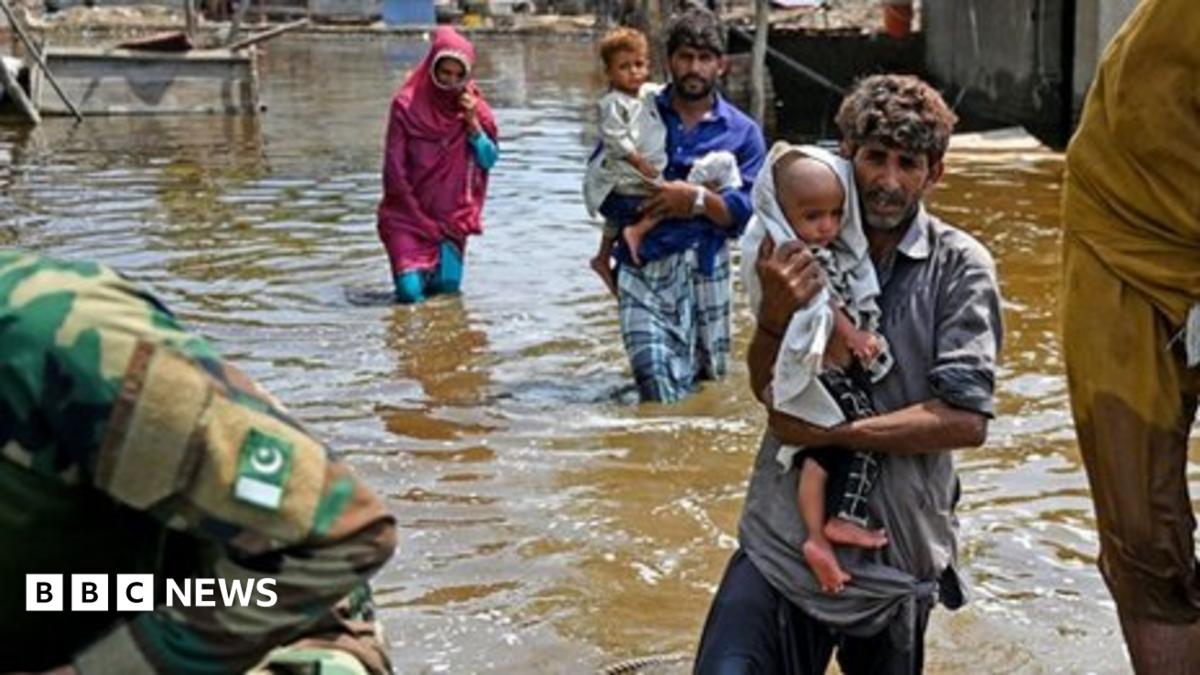
Climate change: UN warns key warming threshold slipping from sight
The past 12 months have been a "wasted year" on climate change says the UN Environment Programme.
BBC News
206 points · by open-source-ux · 4y ago · 328 comments
> The estimate stands in sharp contrast to optimistic forecasts published last week that suggested heating could be held to 1.9C or 1.8C, thanks to commitments announced at the talks, now in their second week and scheduled to end this weekend.
> Those estimates were based on long-term goals set out by countries including India, the world’s third-biggest emitter, which is aiming for net zero emissions by 2070.
> By contrast, the sobering assessment of a rise of 2.4C from Climate Action Tracker (CAT), the world’s most respected climate analysis coalition, was based on countries’ short-term goals for the next decade.
It's worth pointing out that the "world's most respected climate analysis coalition" bit is some rather blatant editorializing. There's simply no way that's an objective fact (what did they do, survey the entire world?) Even if there were a way to defend such a statement, it's little more than an appeal to authority, to try to get you to believe this estimate, versus other estimates.
After the past three years and watching their coverage of Covid (an area of science I know well, and in which I read the primary literature), I give zero credibility to the Guardian as a source of objective information. They routinely play these kinds of rhetorical and selective-reporting games to play up the most extreme angle for any story.
It's sad, but we've gotten to the point where you simply cannot trust major news organizations to report on science without ridiculous levels of clickbait spin.
news may have waxed and waned on reputability but it's never really been highly reputable. we had a blip from the 70s-90s where it was contextually limited enough that our national narrative was fairly aligned and unchallenged. but that exposed the natural weakness of monoliths, which provided an opening to folks like murdoch to exploit, followed by the explosion of social media, which increased noise several-fold while increasing signal much less than that.
there is no shortcut to thinking for yourself. that's a civic responsibility as much as an individual one. folks need to dig past the veneer presented to examine the veracity and credibility of the narrative presented.
when it comes to climate change, mediopolitical narrative imposes too much bullshit and religious fervor for most of us to make real sense of it, and that's why we mostly shortcut to tribal affiliation as a proxy for what we should think/believe.
personally, i think we should focus on (air, water, land) pollution first and foremost, as that is concretely a problem yesterday, today, and tomorrow, starting with reducing coal worldwide. strategically, that has the advantage of narrowing our focus (less bullshit and influence potential), doing something that materially helps us now, and potentially does something to help the far off climate future.
Headline writing was another matter back then, though. It was bad; just some dude trying to fit the space under time pressure because the ads were carefully planned, then the articles were quickly chopped to fit around them. Truncated headlines often reversed the meaning of the story or just went off the rails.
What else though? There is no "long-term" for politicians that have to face another election in less than 4 years.
"This will happen in 10+ years" is just a thinly-veiled "We aren't going to do it.". If we can't get any short term commitments and hold people accountable for it, nothing substantial will get done.
They will organize via TikTok, or whatever social media dujour, and stop life as we know it.
Just keep bickering.
Politicians used to have long term vision though. See the American founding fathers, Churchill, de Gaulle, etc.
Something changed, it wasn't always like that
It's worth pointing out that "on the extreme end of a spectrum" is some rather blatant editorializing. There is simply no way that's an objective fact.
> After the past three years and watching their coverage of Covid (an area of science I know well, and in which I read the primary literature)
That's little more than an appeal to authority, to try to get us to believe your opinion, rather than highly-respected international organisations.
> I give zero credibility to the Guardian as a source of objective information.
The Guardian is not perfect, but generally gets the science pretty much right most of the time - at least compared to other news organisations. Saying it has "zero credibility" is hyperbole that rather reveals your biases.
Would you like to cite some projections you think are more accurate?
It's a fact reported by the very same article (but buried). I didn't make it up.
> Would you like to cite some projections you think are more accurate?
All projections are theoretical, but one needs only go to the IPCC to see that the range of reputable predictions varies:
https://www.ipcc.ch/site/assets/uploads/sites/2/2019/02/SPM1...
Source of that figure:
https://www.ipcc.ch/sr15/chapter/spm/
Most recent IPCC commentary on predictions to underscore that current estimates land in a range, and that the Guardian-cited source is definitely not in the middle of it:
That caveat is a really low threshold, think of the Gell-Mann amnesia effect and "wet pavements cause rain" level of wrongness in the things other news orgs report.
The upper bound of scientific predictions of climate change have generally been correct over the past 20 years.
Maybe the Guardian is bad (and I disagree with your opinion of them, I think they are generally reliable) but in this case, they are correct.
Why is this the font of your passion, rather than the desperate situation of our planet?
I continue to believe that the physical science is well beyond "good enough" and that humanity should now be investing in metaphysical inquiry (psychology, sociology, etc), as getting humans coordinated and pulling all in the same direction would be beneficial to sorting this mess and others out.
If we stop being objective and surrender ourselves to emotion and panic, then it stops being science, and all authority is lost.
Like it or not, a lot of people have lost trust in mainstream media outlets because they have seen said outlets engage in hyperbolic clickbait bullshit.
Don't question my projections, if you do, you're just rearranging deck chairs on the titanic.
https://www.npr.org/2021/11/08/1052198840/1-5-degrees-warmin...
Better to set a goal we can still actually achieve and take the consequences of that level for granted.
All of our major political forces play games, constantly make moves in bad faith, talk out of both sides of their mouths publicly vs privately, so we are screwed.
The reality is that IF climate change science were a big hoax (sadly, it's not) there WOULD be a team using it for political games, so there will always be a large class of people who believe that's what's going on.
Maybe if we didn't spend decades politicizing every microscopic issue including in science, technology, and medicine, we could have policy makers advocate for positions based on science and everyone would trust it. That's not the world we live in and unfortunately, it looks like we never will.
The simple reality is: almost all wealth on the planet is tied up with fossil fuels.
This being the case, the more wealthy you are, the more "polarized" in a certain direction you will be.
Might makes right. Or at least attempts to make right. And right now, "might" = "money" = "capital" = "energy"
To put it another way, the people who control the oil supply aren't simply wealthy because they pillaged and stole a bunch of people's stuff. The product they supply is extremely convenient and popular. You'd probably have an easier time fixing a world where everyone's a methhead than fixing the current problem.
Almost all of us are tied into this circuit in some way and "most of us" (in the west) short-term benefit from the continuance of the status quo energy economy and its growth. But what I would say is this: at the end the rich and powerful will continue to be able to buy fresh water and air and arable land and stable neighbourhoods with armed guards and fences. The rest of us will not be so lucky.
To get the world even to European per-capita energy usage levels, current energy production would have to be expanded 3x [1] You just have to convince a few billion and their leaders that they should remain in relative poverty for a few more decades, waiting for solar/wind/nuclear to ramp up to several times the entire current energy production. Heck, the energy production needs to expand just to bring everyone to Chinese levels, and then you would not only need to set a forever-ceiling for the above billions, but also convince a billion or so Americans/Europeans/... to become poor.
If you can't convince people to stay or become poor voluntarily, they are going to need energy. Surprise, some people are eager to sell them this energy. But it's the demand that drives the supply.
[1] https://rootsofprogress.org/devanney-on-the-nuclear-flop
`we` isn't the common people. It's a very concerted effort to keep the status quo [1].
[1]: https://www.nytimes.com/2003/03/02/us/a-call-for-softer-gree...
However, this tends to be unpopular as while people are very interested in the flaws in the thinking of their outgroup members, they tend to be very uninterested in their own or their ingroup members.
It's a tough problem, but not even trying to do anything about it doesn't seem like a recipe for success.
Janvici had a nice way to put it: the 1.5C are already signed for, which means we won't ever see the climate of today again in the next 5000 years.
There is an exothermic reaction that removes CO2 from the atmosphere, the formation of carbonates from weathering of silicate rocks. As this is naturally very slow, there is currently ongoing research into multiple different ways to speed it up.
On the case of silicates, a trivial work around is to just spread them around and let the same diffusion bring the CO2 into them.
It is a civilisation sized project that will take a lifetime, but it is achievable.
The rationale for this is that only by raising the living standard of the third world can the world’s population be stabilized without a major die-off (not to mention a reduced quality of life for just about everyone going forward). Further, only with massive amounts of clean energy can we clean up the ecosphere and effectively fight atmospheric CO2 buildup as needed.
There are plenty of resources on Earth if they’re managed well. Only with plentiful energy can we afford to have treat the Earth as the precious resource it is - as we begin to inhabit the rest of the Solar System!
I don't see how pumping billions of tonnes of heavy metal tainted sulfuric acid into the ground water of Namibia and Niger for Uranium royalties that are lower than the cost of cleanup and then putting them into debt they can't service for power stations that can only be fueled by their colonizers' nuclear weapons programs is related to increasing their standard of living.
Especially when the fuel source can only service the US primary energy for under a decade.
Blaming the resulting skepticism about nuclear on the "Green approach" is backwards: Fix the things that made nuclear expensive first. Demonstrate that the lifecycle works, from mining to waste handling. Show it costs less than putting the same capital into renewables and can come online in time to be relevant.
And here we are on an oil-based energy economy suffering from cost overruns, hidden and underestimated lifecycle costs, security problems such the possibility of a worse Chernobyl event as a result of an ongoing war, nuclear proliferation enablement, etc.
I would gladly change the source of the energy as the effects seem to be the same besides atmospheric emissions.
I also was clear that fusion is a future solution.
I like the way he models the problem from first principles. Economic views have a tendency to hand wave the laws of thermodynamic.
And the answer is that no, they are not a trick...they legitimately produce energy.
But the goal isn't "make more clean energy", the goal is "keep coal and oil and gas underground"!
And yet coal(!!) production is at basically all time highs, with oil not far behind.
Unless we start making oil, coal and gas artificially expensive to produce, "clean" sources just add to global energy usage, instead of displacing it.
https://yearbook.enerdata.net/coal-lignite/coal-production-d...
https://yearbook.enerdata.net/crude-oil/world-production-sta...
But there are always two options to speed-up the process, you can make fossil fuels artificially expensive, or renewables artificially cheap.
Building a wind turbine isn't shuffling emissions anywhere.
Neither is solar. Or a more efficient boiler, or....
We must reduce our fossil fuel consumption in absolute numbers. So far we're merely adding more energy resources; that way political and corporate PR representative can make triumphal announces about how we're reducing the part of fossil in our energy mix... But we need to reduce our fossil use overall, and REALLY REALLY FAST.
https://www.cleanenergywire.org/sites/default/files/styles/g...
Less energy = less growth = recession = bad, we're stuck in that
The main threats would be near-term coral reef die-offs and ice sheet collapses.
secondly, overall, the profound beauty of living ecosystems will be reduced brutally in the coming age. Monotonous and harsh regions will replace large areas, with ecosystem die-offs -- maybe slightly analogous to coral reef death.
It has been two solid decades of science reports for me, probably many others. Certainly some appreciation is called for, for the hard work of a few boomer scientists who have seen this unfold, and are now basically facing "geezerhood" with the toothless and feeble reality of that, while the Earth systems continue to degenerate at such a pace.
There is no chance of meaningfully reducing CO2 emissions, because outside of Nuclear (and hydro/geothermal but only if you have the geography for it) there is no alternative to replacing fossil fuels. At some point the public will realize the lie of solar/wind as a replacement. We lost 50 years of greatly reduced emissions had nuclear power continued to be rolled out at the same rate as it did in the 60s/70s.
There is possibility of geoengineering (e.g. emitting some sort of sun-light reflecting gas into the atmosphere to cool the climate) but that suffers from a potential "law of unintended consequences".
It seems like we're going to have to deal with it.
Yes, it will take decades to restart large scale nuclear projects. So we lost more than 50 years.
With Solar/Wind it's not a question of cost or ROI. Solar/wind, as an intermittent and diffuse energy source, CANNOT power a modern economy. It needs base-load.
>>> Regarding the evolution of technology costs, under the baseline scenario, the cost difference between the M23 (renewable only) and N2 (old and new nuclear + renewable) scenarios is close to 10 billion euros a year (0.3% of France's GDP).
This is a quote from France's mostly nuclear based electric grid agency.
Losing 0.3% of GDP but avoiding any inherent social, environmental and economical risk associated with nuclear does not look bad to me.
[1] https://assets.rte-france.com/prod/public/2022-01/Energy%20p...
So even if we were to magically stop the emission of new carbon, Earth will likely just keep heating up.
And yes, it's hard to prove that runaway warming is happening (data is noisy, and the time is short), but the burden of proof imho has shifted to the other side.
There is a known mechanism of action for runaway warming, data that fits runaway warming, and no known mechanism of action for natural dampening of that warming. The question at this point seems to be "why woudlnt' runaway warming happen"?
This is a good (if pop-sci) overview of the methane problem: https://www.ft.com/content/9ef195d6-dcc3-4378-bb35-2721981d6...
It always was going to end up here. Humans suck at collective action, and especially so on long timescales.
The surest solution to the problem is to keep using fossil fuels. That will lead to a desertification of the tropics, acidification of the oceans, and the death of about 5 billion people. Eventually, over the next 5-10,000 years, maybe 1-2 billion humans can sustain themselves on Earth near the poles and they won't have the opportunity re-industrialize on mined hydrocarbons because we'll have used up all of it.
If you try to start a civil nuclear program and America finds out, America will kill your program. And America will find out.
What lie exactly? Scotland had produced enough to power itself twice on Wind alone. [1]
How is nuclear a better alternative than Wind or Hydro when
- Nuclear is extremely dangerous with toxic waste needing special storage facilities. Criminal & Environmental contamination risks.
- Disaster if the plant is to be damaged - Chernobyl / Fukushima / Ukraine-Russia war
- You need an external power source to kick-start a nuclear station on top of requiring uninterruptible power supply - Fossil Fuels
- You need a large water source for cooling, extracting, processing - Limited Resource
Thorium reactors are a dream away, nice but not feasible as of the moment.
[1] https://www.independent.co.uk/climate-change/news/scotland-w...
No they aren't. This is at best misleading, at worst, a blatant lie.
What is happening is that on days with strong winds, they are overproducing wind energy but ONLY at certain times of the day. When they overproduce this energy, they cannot store it for later (because there is no battery technology today, or in the near-to-mid future that is able to store that amount of energy), and they cannot give it away, so they lose it.
This kind of headline is very very common. This is how the public is continually lied to and thinks that wind/solar is just around the corner. It isn't. It's never going to be.
>Nuclear is extremely dangerous with toxic waste needing special storage facilities. Destruction if the plant is to melt-down. (chernobyl)? You need an external power source to power a nuclear plant. Nuclear also requires uninterruptible power.
If you don't like nuclear ... fine, but there is nothing else. So now what?
>Thorium reactors are a dream away, nice but not feasible as of the moment.
Agreed. Also Fusion is a pipe-dream at this point in time. So now what?
I don't think this is true. Nuclear power plants generate relatively little waste and we know how to store it safely.
>- You need a large water source for cooling, extracting, processing - Limited Resource
Seas are going nowhere. Most NPPs are at the coast.
Doesn't say much for a variety of reasons:
- Even in Scotland, there's loads of days where there's "no wind" - on those days electricity has to be generated by gas or other means. So practically speaking as wind cannot be guaranteed it is impossible for Scotland to not generate carbon, via wind alone.
- As usual for breathless wind articles, completely fails to account for heating - which in Scotland makes up the bulk of domestic energy consumption and most homes are heated by gas combi boilers.
- Also as usual, neglects transport - another huge proportion of energy consumption
- Scotland is a best case scenario - it is very windy relative to other countries. It doesn't have a huge population. And as part of the UK national grid it makes sense to build a lot of wind capacity within Scotland. But then looking at statistics for Scotland in isolation doesn't really make sense - it should be done at a UK national grid level rather than trying to gerrymander things.
Wind is fine for reducing gas consumption when it happens to be windy. But if you really want to tackle climate change, you need to tackle having a need for gas consumption at all, and wind won't do it.
25% of electricity in the US was produced with renewables this year, more than both coal and nuclear [1]. There is roughly 1TW of renewables in interconnection queues [2], and 400GW of energy storage. The cost of renewables is expected to decline to less than half a cent per kwh due to the Inflation Reduction Act [4]. Tesla's Megafactory (to manufacture 40 GWh of Megapacks per year) is getting ready to begin production [5].
It can be difficult to understand the curve of the hockey stick when you're at the growth inflection point. In no uncertain terms, we are at the inflection point.
> There is no chance of removing existing CO2 from Air to make any sort of difference.
What was the cost delta between sequencing the human genome in 2003 versus today? (About ~$1B) Yeah, it is going to be very energy intensive to extract CO2 from the atmosphere and sequester it. It's a good thing enough sunlight falls on the Earth every 2 minutes to meet humanity's energy needs for the year, because we need enough clean energy to electrify everything, to account for growth into the future until the human population peaks, as well as to pay back all of the carbon emitted during industrialization.
I'll plug YC's Charge Robotics here (automating solar panel installs with robotics), as it seems like the polite thing to do: https://news.ycombinator.com/item?id=30780455 ("Launch HN: Charge Robotics (YC S21) - Robots that build solar farms")
[1] https://electrek.co/2022/08/25/us-renewables-first-half-2022... ("Renewables provided over 25% of total US electrical generation in first half of 2022")
[2] https://www.pv-tech.org/nearly-1tw-of-renewables-in-us-inter... ("Nearly 1TW of renewables in US interconnection queues as wait times continue to grow")
[3] https://www.energy-storage.news/estimated-427gw-of-energy-st... ("Estimated 427GW of energy storage in US interconnection queues alongside nearly 1TW of renewables")
[4] https://cleantechnica.com/2022/10/15/credit-suisse-predicts-... ("Credit Suisse says the Inflation Reduction Act will have such a tremendous impact on renewable energy that the US may see the levelized cost of electricity from renewable sources fall to less than 1 cent per kWh hour by 2025 after factoring in all tax and production credits.")
[5] https://electrek.co/2022/10/26/tesla-unveils-megafactory-bat... ("Tesla unveils its Megafactory as battery production ramps up")
At that point most of the climate change will have already happened and we'll have dealt with the results for better or worse. If we're to try and reverse it at that point it would result in yet another climate change from the state we'll be in then. People will have settled in the new conditions and I doubt they'll really want it changed back at that point.
Especially because most disruptive extreme weather will occur during the changes. Not before and after.
It's not as if the pre-industrial climate is some kind of ideal for the world. The world has no natural stable state. Climate change is totally normal, the problem is with the speed with which it happens now which is tens or hundreds of times faster than what is normal.
However this goes for the way back as well. By the time we have the extreme amount of free energy we'll need to revert climate change, the reversion itself will cause its own disruption.
In other words we have to go all in on prevention.. Trying to fix it afterwards is going to make things worse.
> Global carbon emissions from energy will peak in 2025 thanks to massively increased government spending on clean fuels in response to Russia’s invasion of Ukraine, according to analysis by the world’s leading energy organisation.
> The International Energy Agency (IEA) said that government spending on clean energy in response to the crisis would mark a “historic turning point” in the transition away from fossil fuels, in its annual report on global energy.
> The invasion of Ukraine has prompted an energy crisis around the world, with global gas prices initially surging. The crisis has caused steep inflation that has made households poorer around the world.
> Governments have been scrambling to find other sources of energy. Some analysts have questioned whether fears over energy security could lead to the use of fossil fuels for longer, slowing the world’s race to net zero carbon emissions. Some countries – including the US and the UK under previous prime minister Liz Truss – have pledged to encourage fossil fuel extraction to try to ease prices.
That certainty is not warranted.
Solar does seem much easier to generate than to store. It's uncertain how mobile usage will evolve on the short term. We have a lot of capital dependent on fossil fuels that won't be deprecated immediately. And finally, it's not clear if we can't do carbon capture at a loss before renewables win the market for generation.
Or, in conclusion, we should make a new global climate conference, with targets for capture. There is no reason for waiting the energy market to fully convert before doing it.
That number includes hydro, and doesn't communicate the distribution of the generation, which is concentrated in the plains. Wind and solar are only ~16% of total, with the bulk being wind:
> For the six-month period to June 30, electrical generation by wind increased by 24.67% and provided 11.55% of total electrical generation. Meanwhile, solar sources grew by 27.72% and provided 4.94% of US electrical output.
It's also incredibly regional, with the least-dense parts of the US having the highest overall percentages. From the EIA report that link is based on [1]:
> The Southwest Power Pool (SPP) region has had the most growth in the renewable share of electricity generation over the past decade, largely due to wind generation. In 2013, 13% of the region’s electricity generation came from renewables. That share increased to 40% in 2021, and we expect it to rise to 44% in 2022.
> The Electric Reliability Council of Texas, or ERCOT, has also increased its renewable share, from 10% in 2013 to 32% in 2022. ERCOT is the only electricity market region where the renewable electricity share has transitioned from less than the U.S. average to more than the U.S. average from 2013 to present. Both SPP and ERCOT have added substantial generating capacity from wind turbines
So that's good, but it's a very different story than the top-line numbers suggest. If we're going to get to high levels of non-fossil electricity in the (far) more densely populated east and southeast, wind isn't going to do the job.
https://crsreports.congress.gov/product/pdf/IN/IN11981 ("Electricity Transmission Provisions in the Inflation Reduction Act of 2022")
https://www.utilitydive.com/news/transmission-ira-inflation-... ("Transmission development key to Inflation Reduction Act’s climate potential")
Even if a miracle happened and we reached zero emissions today, the climate will keep warming at least for some more decades due to climate lag and feedbacks.
See this comment I wrote about the permafrost:
This is based on estimated total biosphere emissions, estimated human emissions, and annual CO2 PPM increases. I did some math on that and wrote it up here if anyone wants to dig deeper: https://biotinker.dev/posts/climate1.html
In the case of the zero-emission miracle, atmospheric CO2 levels would start dropping at about the same rate they are currently climbing. As you mention, there is climate lag and feedbacks, but the "return to normal" would start fairly quickly.
For example, there are only rough estimates on how much methane is trapped in the permafrost. The first estimate I saw by Natalia Shakhova et al was 1400gt over a decade ago (so about 45 years of human emissions at the current rate). I found this recent MIT article which mentions 1500gt [1]. Let's not forget methane has a 25x more heat trapping capacity than CO2. Do the math on that. Also the permafrost is just one of many feedbacks.
Another point you're not considering is that the capacity of the biosphere to absorb carbon is being reduced. For example, the Amazon used to be considered a carbon sink but it is becoming a carbon source [2].
I'm not convinced on your second point; I'll need to see more data. I read the paper you linked, it doesn't give hard numbers, so it's difficult to compare the net loss of carbon flux in the amazon, to gain of carbon flux in other areas that are getting net-reforested, such as the eastern United States. Examples of local areas flipping from sink to source, and others becoming larger sinks, don't paint a clear picture of the directionality of the whole system.
The most recent IPCC report (AR6) gives the "very likely" (90% probability) range for "equilibrium climate sensitivity" - the eventual effect on temperature of doubling CO2 - as between 2C and 5C. Current CO2 levels are less than double pre-industrial levels, so the "baked in" warming could well be less than 2C. Also note that reaching the equilibrium temperature takes more like centuries than decades, making the concept somewhat academic, since lots of other things will change over that time period.
Also note that 2C warming over pre-industrial temperatures would just take us back to about what the temperature was 8000 years ago, when conditions were good enough for agriculture and civilization to start.
Have you ever read about the Russian wildfires of 2010 which had a massive impact to global food prices which then triggered the Arab spring revolutions? That was a single event in a world below 400ppm but these heat waves are starting to occur with more frequency now and will have serious consequences.
The IPCC is an organization that functions with consensus and their data is awfully outdated. Their assessments generally underreport the consequences of climate change. Here's a paper from 2010 which analyzed this:
Then I looked around and noticed that everyone else was enjoying themselves at my expense. Worse, I was often a second-class citizen as my bicycle couldn't stand up to their cars.
So I said fuck it, bought a car, fly several times a year, use paper towels, drive to the air-conditioned gym so my body looks like it's useful, don't care about my waste as much. Can't beat 'em, join 'em. I still reckon I use and waste less than the average person (certainly less than the average American), though.
I can be happy with this because I'm not going to reproduce. I honestly don't care if humans die out a few generations after me. I used to care but I just don't think we are worth it any more.
But I think the real problem is not the moral failings of individuals; I think the real problem is that we've collectively built a system that rewards people for doing the wrong thing. If we can collectively decide to fix the system to reward better behavior, then everyone wins. This is still a tremendously difficult undertaking, but it at least feels possible to me.
So nowadays I try to spend my efforts pushing for systemic change instead of worrying about how much plastic I used today or whatever. In some cases this still boils down to individual action, like when I bought my first EV, but in that case I didn't buy it to try to cut down my own emissions, I bought it to try to help fund EV R&D, raise awareness of EVs, and help companies scale up manufacturing and whatnot.
Not only does working for systemic change give me more hope, it's also more personally satisfying to feel like part of a broader movement to build a better world, rather than feeling like I'm just one tiny drop in a bucket of individuals trying to limit their own damage.
Buying an EV is a no-op that makes people feel good for sacrificing nothing. You need to get a bicycle instead.
I like the idea of a system that rewards people for doing the right thing. I'd like it even more if such a system existed.
Of course, most everyone will think this is absurd and no one will agree with it, but that does not prevent some of us from talking about it.
The core problem is exactly what you noticed: that you can be personally paying, in relative terms, a large cost, while having no meaningful effect, and while others are choosing not to pay that cost and doing much better than you. When the world where you defect is functionally indistinguishable from the one in which you stick with it aside from that you'd be happier in the former, it's hard to justify continuing.
I’m also wondering by who childless people expect to be taken care of when they get older, if not by their children in a broad sense?
None of us know what the future holds. You might very well have nobody to care for you either. Your children are free agents and might move to the other side of the world or might simply not care about you. Like me you'll probably choose not to overly concern yourself with this.
I also mean it in a more generational sense.
I think about giving up around 30 almost every day, but am scared I won’t have the courage to do so. More realistically I see my end in the cold on a street saying random things out loud while someone walks by feeling a mixture of discomfort, annoyance and guilt.
I'm reminded of that scene in Dumb & Dumber when Mary has just told Lloyd his chances of ending up with her are one in a million:
"So you're telling me there's a chance. YEAH!"
°
(on iOS and possibly MacOS you can get one of these by pressing and holding ‘zero’ until the alternate characters appear)
The degrees Celsius are deliberately the same size as the Kelvin unit, but you don't need (and shouldn't write) degrees for an absolute system.
We're fucked because 1.5K was already a lot, and there's still barely enough political will to avoid 3K. It is going to get bad.
<ctrl>-<shift>-u then enter unicode char: 00B0 and then press <enter>
list of unicode codes: https://en.wikipedia.org/wiki/List_of_Unicode_characters#Lat...
On mine it's copose-/.
The unfortunate thing is, we've shown that we can change behavior rapidly, but only if we think we think we're personally in danger, and we'll only willingly keep that transformation for a little while. Carbon emissions dropped in 2020, but it took people actually being scared into staying in their homes, and stopping whole sectors of the economy. What if the most effective climate plan is a long, deep, global depression? In addition to curbing emissions, high unemployment would reanimate the "green new deal" concept. The bad news is climate and geopolitical instability might just give us what we need.
> "Only a root-and-branch transformation of our economies and societies can save us from accelerating climate disaster," she said.
I don't see that happening, and my guess is neither do they. Plan C needs to be a massive geoengineering project that would have seemed crazy even ten years ago, may worry some people as irresponsible even now. The nightmare scenario is that we can't even do that in time, because we're too busy arguing about it.
Of course the alternative that skips the trashing-the-economy part is more and larger government spending on renewable deployment to achieve a switchover on a similar timescale, but that's super-unpopular for a lot of voters.
(Not to downplay it at all, we really need to get things happening right now on the policy decisions level)
It's a better title than the article, as far as attention grabbing is concerned.
(As for myself, I'm living on less that 400 bucks a month, including rent, use transport once a month; and most energy I use is probably for central heating in the winter and for pumping water—otherwise it's the fridge and boiling water for tea. But idk about the ‘footprint’, probably still not good.)
It is important to stack the average by the virtue of its urban heat (over the cooler but carbon-tax-infused countrysides) and be able to note its mostly upward climate-change trend.
And we won't bother with illusive matrix math in smoothing out the newer stations because we got the eLusive hockey stick trend going now (which started in 1973).
Let's not ignore these 14,200+ new temp. stations because all data are valid.
/sarcasm
and a short analysis: https://www.youtube.com/watch?v=--QS_UyW2SY
The question the world faces now is whether the 3C rise we're actually going to get is enough to trigger non-human forcing through various feedback loops dumping carbon into the atmosphere in the form of CO2 and CH4, to require runaway warming as the future.
I'm not optimistic.
And previous to 1.5, the big number was 1.0.
It'll be interesting if the mass media push changes the focus again and starts popularizing 2.0C. Or maybe they'll move the baseline up again at the next COP. What a farce.
I wonder if this is the right approach. It certainly is the approach we have been following for years. But I think that has just lead to empathy fatigue.
Edit: added empathy
People who push religion often believe in it though. The question isn't whether one believes it, but whether one is dogmatic about it. The closed mindedness towards new ideas is what makes this sound like religion.
Additionally, be careful to not overlook the unknown.
I'm being a bit hyperbolic here, but only a little bit. It's a decades long story of not seeing the forest for the trees and focusing on minor environmental impacts rather than the big climate issue staring us down. Like, this is exactly the strategy I'd take if my goal were to create as much warming as possible without anyone catching on...
Yeah, that’s not going to happen.
This is an absurd take... Russia emits 4.65% of world output and has been decreasing last year the most out of the top 10 [0]. Could you base your arguments? I'd like to understand where this is coming from.
[0] https://www.worldometers.info/co2-emissions/co2-emissions-by...
https://climateactiontracker.org/countries/russian-federatio...
More generally, if Russia (or any party) has incentive, means, motivation to create climate change, do not be surprised if they actively work to make it happen. Russia can literally light things on fire and come out way ahead.
Geopolitically, it benefits from additional pressure on Europe to accommodate the migrations caused by climate change, and all the instability it causes.
You know what is even worse for farmers than a cold climate? An unpredictable one. It's damn hard to pull a profit farming if you can't rely on any kind of 'normal' growing conditions from year to year.
An increase in mean temperature isn't a neat and tidy "oh, we'll just move north"; it's on the whole an increase in variance.
I'm seeing it happen here in Canada, and I'm certain we'll see it in Siberia as well.
In the end, petro-regimes like Russia, Venezuela, Saudi Arabia, Alberta, whatever... they'll become more and more paranoid and erratic and dysfunctional as the broader crisis around 'energy' deepens. We're right now seeing our first war triggered by a cornered petro-regime on the cusp of climate catastrophe. I suspect we'll see more.
It takes more than a change in temperature to make land useful. I don't think recently-defrosted tundra is going to suddenly be profitable farmland. You need the right soil type, weather, irrigation, transport links, workers, energy sources, etc.
https://theconversation.com/what-is-a-pre-industrial-climate...
Doesn't seem unlikely that temperature will increase 1C more. Wonder if it's going to be just as destructive as the first 1C of warming holocaust?
Given a choice between diverting attention & resources to alleviate a 1943 famine in Bengal and keeping transport ships available for the war, Britain chose to allow the famine. As a result, an estimated 2.1 to 3.8 million Bengalis perished.
If you want people to take your vision seriously enough to follow it, you’ll need to engage seriously with the horrors of what you praise. Please consider reading the book Slaughterhouse Five.
Governments across the globe are run by people whom I hope remember to be humble about their intelligence and moral wisdom.
So we should just put you in charge and then you'll sort it out?
Have you considered the possibility that it's not about morals or intelligence but that it's actually an intractable problem?
Have you considered this is exactly the kind of narrow-mindedness they're probably talking about? If I had written the parent post, that's what I would mean by that. This simple-minded paranoia that any proposal from anyone else is secretly an evil plot to take over the world is ridiculous.
I don't think they're saying, "this person is secretly plotting to take over the world".
I think they're saying, "have you considered that this is actually a hard problem and not as simple as you make it out to be?"
How much more apocalyptic fear mongering do we need to rationalize increased governance? When is enough enough?
Cold war, drug war, war on terror, financial meltdown, pandemic emergency powers, nuclear apocalypse and of course climate doom. All used to rationalize further erosion of personal autonomy.
Is no one else burnt out on the constant doom mongering from our betters? Is it because I lack the proper morals and intelligence that I feel skeptical?
The reality is that the situation is not an emergency. It is a slow-rolling problem that calls for sustained creativity.
When beachfront condos in Miami start flooding, the practical, obvious, cost-effective solutions to the problem (i.e. geoengineering) will look a lot more appealing.
You know that this would be accomplished through capitalism right?
The more we rail against capitalism and free markets (which every successful country from Denmark to Australia uses) the less likely we'll ever be to solve any problems.
The market is an unwieldy force that can be generally shaped in a direction by the people (purchasing decisions, sacrificing convenience) and the government (regulation, law, market fairness) to massively solve problems through innovation, technology, and other means. Ignoring the market, or restricting its capabilities leaves us with little to no tools to combat problems.
The much greater problem than "capitalist tendencies" is solving for people who absolutely refuse to modify their lifestyles (I must have my SUV and drive it comfortably and quickly to Costco on the 5 lane highway) to which market forces simply respond to, and who deny that humans are having a substantial effect on the global climate and would rather elect charlatans than people of substance.
On the other hand, we're trapped in a prisoner's dilemma with the very countries you mention.
It's a very bad situation we face, but I find that blaming capitalism or markets for failures of government to be counter-productive and in some ways actively hostile to working on addressing climate change.
We should have a large, painful, but revenue neutral carbon tax that replaces income tax. Then you sit back and watch as people cut their carbon emissions to 'dodge taxes', exactly as designed.
Because currently capitalism has no interest in emissions because they don't cost anything. But that is a failure of capitalism, or at least our current incarnation of it. And it needs fixing to be part of the solution. You could blame government for not fixing the flaw, but the flaw is in capitalism none the less.
I think carbon pricing is a great idea from what I've learned about it. Though, I disagree with you that the lack of carbon pricing is the fault of capitalism and I feel like you are kind of making that argument by saying that emissions don't cost anything so how would a market account for something with no price? I place that blame solely on governments for that.
Who decides what a mental illness is? .... and back to Square One.
Rising costs of food and energy won't be a problem ?
As for living far enough from the coasts, are you referring to a meaningful sea level rise in the poster's lifetime?
So the thing to look at isn't poor people's emissions, it's rich people's emissions, given that (relatively speaking, bc increasing money supply just decreases its worth) the richer rich people are, the more poor people there are (or the poorer the poor people are). This is well-known, you can google and find tons of articles, but here's one from BBC: https://www.bbc.com/future/article/20211025-climate-how-to-m...
The poorer you are, the less you can individually consume, and the more you must go for things that are cheap at the expense of other things (e.g. buying single-use goods over and over is cheaper short-term than buying something made to last). I think the idea is that if more people were middle-class, we'd see consumers make better choices (personally, I don't see that happening without government intervention of some kind, but that could hurt poor people even more if it happened before poor people got more money to afford more eco-friendly choices). And on the opposite side of the spectrum, if rich people weren't quite as rich, they wouldn't consume quite as much in excess, and would lead to less emissions.
Do you have examples of these — single-use goods that are contributing to global warming and that poor people are buying over and over, more so than wealthier people — or in general, any empirical evidence that poor people are following this economic strategy, thereby contributing to global warming?
There's often a huge difference between what poor people actually do and think and what wealthier people believe poor people do and think.
This is not true. "Higher and lower incomes make little difference to people's concern about the natural environment, according to new research from the University of Bristol." https://phys.org/news/2012-09-environmentalism-rich-poor.htm...
See also: "People Of Color And Poor Americans Are More Likely To Care About Climate Change, Study Says" https://www.livekindly.com/people-color-poor-likely-care-cli...
Middle class Americans drive lifted pickup trucks without using the main functionality. That harms the environment
If you're going to make up a rule then you need to actually substantiate your rule. Because considering I came from a family of fishermen (per your fish population quote) that was also in deep poverty I can tell you we specifically cared quite a bit about the environment; because ensuring that fish stocks didn't deplete is kind of a big deal for business.
Study for attitude to climate policies and more for countries all around the world, rich and less rich: https://www.oecd.org/climate-change/international-attitudes-...
I assure you many Canadians are getting ready to fire up ye olde wood stove this winter who wouldn't otherwise but are doing so thanks to motivation from energy prices.
I really find it a big problem that we're putting "the climate" as a higher priority than the people that are living here, right now, suffering because of multiple factors - one of which is governmental mismanagement, along with inflationary monetary policies, the sudden removal of all economic activity with Russia (a whole separate issue).
I have no doubt in my mind that the Liberal MP who voted for exempting home heating from the carbon tax will be conveniently replaced during the next election cycle - given the current Liberal party culture of "follow us in lockstep or you're gone".
I also have no doubt in my mind that because the western world decided to lower domestic production of energy sources like natural gas and oil products that we're going to see a an unexpected amount of people dying from freezing to death in their homes. Canada, USA, or Europe.
Extremely frustrating that the Canadian government continues to insist raising carbon taxes on everybody during one of the most unstable economies, during the aftermath of a pandemic with harsh actions that wouldn't have needed to be so harsh if they didn't have a dilapidated healthcare system propped up by good feelings and government-sponsored marketing campaigns to "thank a nurse!"
I'd rather support someone who takes care of people _now_ instead of fear-mongering us to give up more of our money for "the future" - which we'll never see because we'll already be dead of old age anyways.
It seems so idealistic and faith-driven to me - just an excuse to take more of your money away from you with no meaningful return on your forced "investment".
The same politicians forcing insane "carbon taxes" are also putting in place immigration policies that bring in an absolutely massive number of people each year.
This, of course, drives up the demand for electricity, housing (including heating, as you mention), infrastructure, transportation (of goods and people), food, and so forth, all of which contribute to "carbon emissions".
The "green belts" that have been imposed by government around major cities just end up pushing urban sprawl farther out, beyond those belts. This, in turn, increases the time and energy spent commuting and travelling, which is usually done by car, since public transit in Canada is very limited and impractical, and the distances are quite far.
Thanks to significant and overbearing government bureaucracy and regulations, building high-rise residential buildings in the densest cities takes ages. The actual construction phase is very rapid compared to sorting out the bureaucratic details.
If these politicians really wanted to limit or cut "carbon emissions", the first thing they'd be doing is halting pretty much all immigration into Canada, to at least let the situation stabilize.