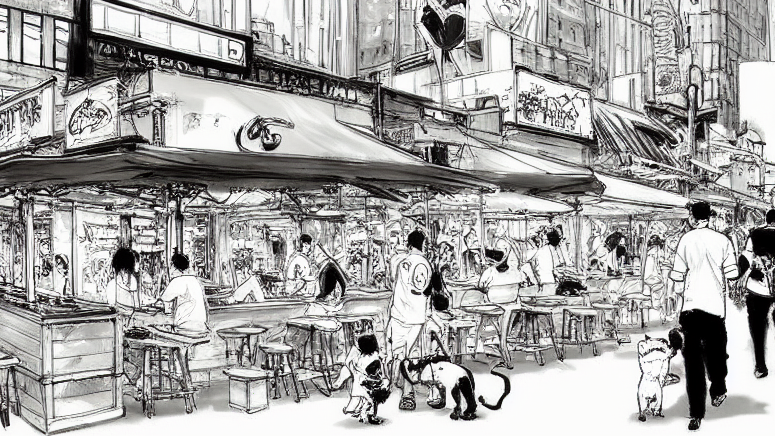
AI-generated art sparks furious backlash from Japan’s anime community
Dall-E might be the hot new thing, but outside Silicon Valley, fear and outrage are ramping up.
Rest of World
45 points · by bookofjoe · 4y ago · 69 comments
I, as an consumer, don't care if anime/manga/textures/etc... are created via hand or AI.
I just want a good story or good entertainment.
Thus, my vote with money will go to whoever creates the best story or entertainment.
I don't care about you needing 20 hours to create a handpainted manga, I want my entertainment: and if someone who cannot draw uses AI to create a 10x better story than someone who can paint but is shit at stories...well..though luck, I don't care.
Probably true to some extent, but that's also why copyright laws are put in place, so there could definitely be laws made that could require licensing if you use it to generate an AI and then use it for commercial purposes.
The time-window to have the debate of if you should have such laws or not is now.
If someone sets up an AI anime shop in Mozambique, who is going to stop them?
But theoretically, countries can ban your product if it doesn't comply with local copyright laws. That can mean that say any video game, movie or tv show made with AI generated models that break copyright laws in say US could be banned from being sold in the US.
You can even go a step further, and sanction the company, blocking all payment processors that are looking to process payment in the US from disbursing money to that company.
So in practice I think you're right, and I'd advise that artists, developers and everyone else braces themselves to it and find ways to stay marketable and relevant even in the age of AI, but in theory it's just a political thing, and if there was real will to do something about it, it could be done.
Most people don't care about what is artistic. It's the experience that matters.
It's a huge loss IMHO. It's much more substantial than copyright issues and jobs. The artists positions in the article articulate this, for some reason quotes like: “Artists are not just a ‘style.’ They’re not a product. They’re a breathing, experiencing person,” are being read as artists being scared for their livelihood. Why not read it as it's written? As artists fearing for their humanhood?
That's not how it works. AI is copying/stealing from people who actually create. "Laundered legal liability" as someone here so eloquently put it. When co-pilot reproduces GPL code verbatim, it's not AI, it's just convoluted copyright infringement. I have no doubts this is happening with anime too. The so called AI is just a thief. It's not creating new works, it's copying parts of works and making a composite.
When I write, I am doing nothing but laundering sentences and grammar rules from my English textbooks as well as sampling from the millions of sentences that I have read in my lifetime to compose into this comment as a response to your prompt. When I code, I heavily reference existing implementations and often only make minor stylistic changes, copying algorithms and data structures wholesale from memory. When I cook, I'm literally copying the contents of the cookbooks or cooking channels with a few minor substitutions at best.
Unfortunately, I am not brilliant enough to come up with my own algorithms, recipes, or literary flourishes. Few people are truly "creators", to be honest, and even creators build off or derive from existing work.
Developers had a similar response where they don't think that training a model using their copyrighted work is fair use, especially for commercial use.
They'd expect that the model authors would need to comply with the open source license like for any other use.
This is basically the debate here, it's same for artists or developers.
The question is if it makes sense to allow someone to use your copyrighted work to train a model that they'd then use for commercial purposes, without needing a license agreement.
Any overfitting (reproducing the training data verbatim) is not intended and is avoided as much as possible. But it's inevitable sometimes, and is a worse problem in code than art, as you have no way of knowing if it reproduced some private code verbatim.
And no, it's certainly not the entire debate, many people are also afraid that their job will be automated. Which is a silly assumption in case of Copilot as well as with image gen models - it stems from the misunderstanding of what it can and can't do, what's fundamentally possible with it in the future etc.
The moral panic is strong, but I have the feeling that it's amplified by social media without really being substantiated. The advent of CGI was the same, it just was more quiet due to the lack of social media at the time.
That said, maybe we don't train models on living artists or watermarked images, ok? It just splashes it with turds and vomit, IMHO. Like what happened to Cleverbot. Gunked up with trolls and idiots, and technically non-consensual too. Maybe we stop, eh? So tasteless.
This one example? Fine. Guy's dead, it's a dedication. Whatever.
We need UBI/social safety/cultural reform to support artists in doing art, a thing that's deeply important. We don't need IP laws that allow people to stifle creativity in order to collect rents on things that can be infinitely replicated for free.
Which do you put in place first?
I think this is a bit of the issue with this argument. As automation does eat at jobs, you can say that the solution is UBI or something like it, but since that's not there, right now and until it happens (which could be never), it will affect people's livelihood, and it's fair for them to be pushing back.
If such social foundation was already here, I don't think people would be complaining as much, they'd probably be joyful that they'd no longer need to work as hard.
If artists cared enough, they need to make an union of some sort and lobby for non synthetic art labelling for protection like big Diary and get AI generated art to be branded like GMO foods.
But I'm pretty sure the reaction of most "geeks" was positive. Geeks generally love new tech, especially when it can improve their workflow.
A very valid negative criticism is that a huge company with a bad track record having ownership of a for-profit tool created by processing the work of millions of people is not good.
However that criticism shouldn't be conflated with criticizing the existence of the tool itself.
Studio Ghibli responded with a picture of the wolf from Princess Mononoke, displeased.
https://twitter.com/JP_GHIBLI/status/1573584657668444161?cxt...
Now for the first time in my life I can see the future beyond science fiction. Where machines are capable of doing everything humans do, and do it better.
The outrage is a violent attempt to stop the inevitable. I sympathize. Because artists won't be the only victims of this change when it's all over.
Maybe one day, but we're still far away. To contextualize, Stable Diffusion needed 5.83 billion images to be trained on, and it also uses another model CLIP that needed 400 million labeled images to be trained.
That means that all tasks where we don't have hundred of millions or more of available accumulated datasets are really far off from being learnable by current ML models.
But that's just about stable diffusion. You need to measure the speed of how fast stable diffusion came to be. 3 years ago all of this stuff was thought to be impossible. Now it's a SAS. What does the next 3 years bring? Contextualize that.
Nobody knows when that day will come, BUT within our lifetimes is a very realistic bet given the speed in which the ML industry is changing and growing.
Also, Stable Diffusion isn't a revolution in model architecture, it's still a deep neural network. There's been a lot of innovation in how you can best apply DNNs to problems, and that's where CLIP and stable diffusion innovate, but also a lot of the advancements has been purely due to sheer brute force from funding more compute resources to train deeper networks using larger datasets.
I'm optimistic, but I'm also trying to contextualize to have the right expectations.
As we discover newer and better architectures, which I believe we will, then the machines are going to become better and better at doing this what they are doing.
So in other words, I think we already have enough data for most things. Certainly for art and code, writing, etc.
That means they learn the rules from the examples, but cannot reason about rules deductively.
Arguably, it means even if you were able to assemble the smallest amount of data that contained the entire array of scenarios, from which you'd learn the proper rules, it's unclear how small that would be, even assuming the most optimal learning model.
As I see it, we currently have good machine inductive learning, but are really far from any machine deductive learning.
I think there is a big difference between feeding an AI model a wide swath of an art style like anime and creating and using a model.
Taking one persons particular work and style and copying in competition or near competition with that person is something that I don't think is inevitable and something I would be happy to see the expansion of legal protection for.
I know I will get downvoted since HN hates legal protection for artists, but I just don't see the societal benefit from allowing an individual human to be replicated by AI without their consent.
If AI art is better than what humans can make then this is more than a simple moral issue.... basically the inevitable future is that the entire occupation of "art" will be steam rolled and 99% of what's out there will become computer generated. Morals be damned, it won't even be a factor. A bunch of scholarly types trying to quantify the rightness and wrongness of something isn't going to mean jack when the power to do create art is so easy and trivial.
In fact the morals will shift with the culture and technology and it will be a violent shift. People getting angry here is just the beginning of bigger conflicts in the future. If AI keeps improving things will stabilize into an age of humanity where original art is but a cheap commodity, but that age is not one that will arrive soon, the step before that is violence.
The even scarier part is that it's not just art that's being targeted here. Art is just one of the first victims.
In the end it allowed more wealth and created more demand for music. There will be more demand for art.
Sure hope so. Then I can move even closer to self-actualization than I am now.
If there had ever been a single inflection point in history where Luddism was the right answer in the long run, I'd be more sympathetic to the pessimistic point of view. As things stand, though, doesn't their argument amount to a special pleading fallacy? "It's different this time!" No... no, it's not.
I feel bad for anime artists (well all artists), they work particularly hard. But there are a lot of good manga drawn by mediocre artists, if there's option to change them stylistically closer to much more proficient masters (like a video game remaster), I'd do it in a heart beat. There's going to be audience out there for OG Tomohirio One Punch Man squiggles, but there's a reason it gained mainstream popularity after being redrawn by Murata.
I'm also just waiting for AI to generate music based off the few particular songs I like.
These systems are a mechanism that can regurgitate (digest, remix, emit) without attribution all of the world's open code and all of the world's art.
With these systems, you're giving everyone the ability to plagiarize everything, effortlessly and unknowingly. No skill, no effort, no time required. No awareness of the sources of the derivative work.
My work is now your work. Everyone and his 10-year old brother can "write" my code (and derivatives), without ever knowing I wrote it, without ever knowing I existed. Everyone can use my hard work, regurgitated anonymously, stripped of all credit, stripped of all attribution, stripped of all identity and ancestry and citation.
It's a new kind of use not known (or imagined?) when the copyright laws were written.
Training must be opt in, not opt out.
Every artist, every creative individual, must EXPLICITLY OPT IN to having their hard work regurgitated anonymously by Copilot or Dall-E or whatever.
If you want to donate your code or your painting or your music so it can easily be "written" or "painted", in whole or in part, by everyone else, without attribution, then go ahead and opt in.
But if an author or artist does not EXPLICITLY OPT IN, you can't use their creative work to train these systems.
All these code/art washing systems, that absorb and mix and regurgitate the hard work of creative people must be strictly opt in.
If you don't care about this, it's naivete, or a lack of foresight, or apathy as these companies pillage the commons. Not something to be proud of.
Microsoft and OpenAI (and others) are robbing us and you should care.
Like, I can deduce that your argument comes from a place of "this work is mine and mine alone"... but is it? We don't have copyright on mathematics for example, if you come up with an equation or a solution to a tricky problem I can make use of it without the need of attribution. And in many ways, attribution can work similarly in AI generated art; it is common for people seeking a distinctive artists style to write prompts that include said artist and the AI, in turn, will willfully comply.
But what's the real core of your argument, why is it that you think information that is shared in this way is bad?
I can actually empathize with artists that think this technology might threaten their livelihood but this particular position I also view as overly-catastrophic. But you don't really seem to be concerned with that and instead you're making an argument that comes solely from individuality? But to me, these AI models are the maximum expression of something that as societies we have been doing for a very long time: to take the work that's available and use it to create something new.
Now, I completely agree with the licensing issue when it comes to github's copilot. It used public code to train, and therefor any work that is produced through it should be public as well. It's a different issue.
But your argument that "your work becomes my work" is bad is not something I fully understand. Why is it bad? Why is it poison? Shouldn't we maybe be questioning the system that envelops us if such a thing as sharing is considered poison?
Artwork can be very much licensed the same way that code can. If I train my AI on Creative Commons Share Alike or None Commercial licenses then why should that be any different?
And if we honour one sort of licensing, the copyleft side, why should we treat the other side, the copyright differently?
Either AI is allowed to ignore copyright and licenses for everything or it's not, copy or painting, it makes no difference.
This is flamebait, lacks nuance, tone deaf (who still says hippies?), etc. Please try to practice empathy online.
except we are in 2022, the artist died 22 days ago https://news.ycombinator.com/item?id=33105773
and https://twitter.com/bg_5you/status/1578146498768175105 has "credit plz"
so as long as in 2120 the tech is trained on public domain artists and code, it will be ok.
But if it is trained copyrighted sources, AND requires its own attributions without actually requiring the copyrighted source attributions and/or its licenses, then you are right, we won't get it. The same way we have SSPL and other licenses in addition to public domain code.