726 points · by ghuntley · 4y ago · 751 comments
Next, somebody grabs her work (copyrighted by the clients she works for), without permission. Then goes on to try and create an AI version of her style. When confronted, the guy's like: "meh, ah well".
Doesn't matter if it's legal or not, it's careless and plain rude. Meanwhile, Hollie is quite cool-headed and reasonable about it. Not aggressive, not threatening to sue, just expressing civilized dislike, which is as reasonable as it gets.
Next, she gets to see her name on the orange site, reading things like "style is bad and too generic", a wide series of cold-hearted legal arguments and "get out of the way of progress".
How wonderful. Maybe consider that there's a human being on the other end? Here she is:
https://www.youtube.com/watch?v=XWiwZLJVwi4
A kind and creative soul, which apparently is now worth 2 hours of GPU time.
I too believe AI art is inevitable and cannot be stopped at this point. Doesn't mean we have to be so ruthless about it.
It's a bit like saying we can't stop music piracy, now that Napster exists.
Remember the naive rallying cry among those who thought everyone should have the right to all music, without any compensation for the artist?
"Information wants to be free!" (https://www.theguardian.com/music/2013/feb/24/napster-music-...)
Napster was a peer-to-peer file sharing application. It originally launched on June 1, 1999, with an emphasis on digital audio file distribution. ... It ceased operations in 2001 after losing a wave of lawsuits and filed for bankruptcy in June 2002.
Use of the output of systems like Copilot or Stable Diffusion becomes a violation of copyright.
The weight tensors are illegal to possess, just like it's illegal to possess leaked Intel source code. The weights are like distilled intellectual property. You're distributing an enormous body of other people's work, to enable derivative work without attribution? Huge harm to society, make it illegal.
If you use the art in your product, on your website, etc., you risk legal action. Just like if I publish your album on my website. Illegal.
The companies that train these systems can't distribute them without risking legal action. So they won't do it. It's expensive to train these models. When it's illegal, the criminals will have to pay for the GPU time.
It will always exist in the black-market underground, but the civilized world makes it illegal.
That's where this is going, I hope. Best case scenario.
We effectively didn't, though, at least as far as artists are concerned. Streaming revenue is abysmal for artists. https://www.latimes.com/entertainment-arts/music/story/2021-...
Piracy made music acquisition too convenient for the consumers, so an alternative had to be created - but this alternative really only helps the labels, and not the people actually making the music.
It's not clear to me that the streaming world is better for artists than the Napster one. At least anyone wanting to legally listen to music then would buy albums, rather than just having a spotify subscription. Not that royalties on physical CDs were great, but my understanding is they did work out better for most artists than we see with streaming royalties.
I don't know what a potential analogy would be here with stable diffusion or dall-e or whatever, but I don't know that people were able to immediately identify the potential downsides with "winning" against piracy, either.
But that's not Napster's fault. Spotify pays a lot of money for playing of a song, of that the artist only sees a tiny percentage due to music middlemen trying to relive the 90's.
The thing is that you're distributing only the instructions for making other peoples' work. There are art books and articles explain the styles of certain artists and what techniques they use to achieve it; you could probably recreate "the Mona Lisa but in the style of Marc Chagall with cool glasses on" with real paint if you had previously stared at both the Mona Lisa and Marc's art for hours at a time. Are you infringing upon either of their copyrights by combining them? Probably not. But if you just recreated the Mona Lisa after having stared at it for hours, and it turned out nearly identical, then it would be. So where is the line?
But if you took 100 paintings from 100 artists and clipped all into small jigsaw pieces then recombined them randomly to create a new picture, that would probably not be considered "derived art".
What matters is how much creativity you put into the process. Does the creative esthetics of the work derive from your efforts, or from those of the existing author's existing art.
But if I took 100 paintings from a single artist and combined them all into new works of art, that would probably be copyright infringement in my view, and is what seems to be happening here.
Consider the history of trademark lawsuits. You can be sued if you create something that somehow resembles an existing trademark, say use the exact same color as Coca-Cola for something similar.
So I think the guiding principle is or should be whether what you create can be confused with the work of some other highly original artist. It doesn't matter if you painted it all, if it looks similar enough that people could confuse it with the original artist's work, you are infringing.
It gets of course harrier because what happens to experts in the field who are able to do that and then just use this as a boosting tool. Still, I don’t think copyright law has clear bright lines so much, but more guidance that the courts just try to muddle through as best they can. Certainly one can make an argument that just stealing an artists style like this could be considered a copyright violation, just like sampling even a few seconds of someone else’s track can be in music.
Again, not saying these are net good for society, but clearly existing copyright laws do try to take this tack. I think the one thing working against her favor is that a) early days so laws haven’t caught up b) us laws generally favor corporate interests over individuals so she might never get any relief even if deeper pockets start to protect themselves as this becomes a bigger problem for them.
The harms to artists are obvious and immediate, but limited and small. The benefits of letting an ML model train in the same way as a human are vague and in the future, but might be capable of massive transformative changes in the way we work. I think it's right to be careful about "protecting" a limited number of people at the cost of enormous future potential.
Why would anyone in their right mind choose to put effort into creating original art if there is "one easy trick" to get around copyright by simply turning their art into a model that can be used to churn out things they could have produced?
It wouldn't be similar at all. It takes years to get skills good enough to even copy stuff like that. With AI person who never did any art in their lives can get hundreds of copies in few hours.
It's already out there. On people's local computers and soon their mobile devices. People are tinkering with it at warp speed. This point addresses that it technically cannot be stopped.
I don't expect it to be possible to detect that the art is AI-generated. This becomes further impossible when using a personal input image as well as many follow-up edits or composite works. It blends into normal image creation. The only way to prove that it's not AI-generated is to record in-progress "human art" as is sometimes done in art contests, but this isn't reasonable to legally require of every single piece of art to be created.
You can't enforce what you can't detect.
Now you seek to deny others such protection while taking advantage of it yourself.
Microsoft won't legally be able to continue its abuse of GitHub. Copilot will be dead. OpenAI and Stability will not legally be able to profit from large-scale intellectual property theft. All these violations will end.
These are the most significant digits. The residual amateur piracy doesn't matter. It doesn't matter if random guy gets some leet neural net warez and uses it to make his desktop wallpaper.
Curious choice of example, because it was never stopped. It just went somewhat out of the mainstream because the industry offered pricing options, like Spotify, who were acceptable for most people so they no longer had an incentive to resort to piracy. Not wanting to pay at all was always a minority position, most people just found it ludicrous to pay full album price for one of two songs that they liked.
And still, if you do want song X for free you can still obtain it easily. The industry just no longer makes a fuss about it.
Amen.
I think one thing we're going to have to look at is having the expectation of a separate agreement for having ones work go into a training set. Maybe equity should even be the standard here.
And informed consent associated with it. People need to know they're training something else to do their job as well as doing the job, selling the cow instead of the milk.
Everything you can come up with as a "solution" is really just a stop gap measure. Instead of specifying the style by name, you could specify it by example image. Instead of training the AI on her images directly, you could train a second generation AI on images drawn in that style generated by another AI that was trained on her images. Thus your second generation AI would be free of any copyrighted work. And of course the whole copyright thing only comes into play when people redistribute the AI. If AI is easy to train yourself locally, even that doesn't matter anymore.
If you want to go all Butlerian Jihad on the world, you might be able to stop it. As long as AI is allowed, this ain't going away, it's only getting easier, cheaper and faster.
Your "indirection" hasn't ever been a valid argument.
That really should depend upon the output.
Many, if not most, people learn an art by imitating the style of established artists. Some will carry on with that style. Others will develop their own, though it will probably always carry elements from those they imitated. Should injecting a machine into the process automatically make it illegal?
There are going to be clear cut cases where it should be, cases where so much is imitated that it goes beyond style and into substance. Yet that means we should have a human looking at the output to determine if it is too close to a copy, rather than banning AI generated art altogether. To do so would put the creative process in peril. This is not because machine learning reflects our definition of creativity. Rather it is because it is difficult to define what human creativity itself is.
(That said, I do believe that using the artist's name as a way of promoting their own work is stepping over a line.)
Except, in copyright law it depends on the _input_.
These models would not exist if they were not first fed the source material.
Until we have systems that are not trained on a pre-existing corpus this will remain true. No matter how clever the algorithm, without the source material you have no output. Zilch. Nada.
Now, when the source material is someone else's property this means that without - someone else's property - you would have had no output.
So, when you want to use someone else's property, which you do not own, the general rule is that you a) first ask them if you may and b) pay them for the right to use their property.
In this sense it is no different than using a photocopier.
It's the copyright ownership of the material you put into the machine that will interest the judge not the quality of the copy.
I'm really looking forward to the first court cases and predict that much hilarity will ensue!
First, I'd like to correct a fact you omitted: Napster, Limewire and the like didn't come out of nowhere. They were created because artists and their recording companies forced consumers to buy entire CDs at inflated prices that kept rising. Now, what they got in return from their consumers after that wasn't fair either.
I don't think making AI generation illegal for everyone makes sense. That's how you get the Metallica's of the world bank-rolling professional grifters to hold people's grandmother's financially hostage.
I do think it makes sense to bar AI generated products from making money if the works used to train it did not belong to that company or individual. If you create a program using CoPilot, you should not earn money. If you make a comic using Stable Diffusion, you don't deserve money. This keeps the power players in check while allowing artists paths to use these AIs if they own their own work outright. Imagine if you could train CoPilot on your own code and then use it to help you. That to me sounds like the framing for a new and responsible form of innovation.
it feels too unfair leading a new art style and simply be copied with machine precision and speed… opting to not contribute to the neural network database should be a thing but i do not know how reverse engineering of output can be done
The biggest reason the laws can't possibly hope to stop the practice is:
> [MysteryInc152] told me the training process took about 2.5 hours on a GPU at Vast.ai, and cost less than $2.
As those costs are driven down and the software is accessible to more people, distribution of the weights will not be needed.
Year after year entrenched media interests lobby the US government to make IP policy more corporate friendly and those policy changes are forced on the citizens of countries around the world through strong armed free trade agreements.
We don't get to discuss these thigs as citizens of soverign states, they just happen to us.
Maybe we want to live in a world with a substantially shorter copyright term, is that so wrong? Maybe that would be better for individuals and society as a whole but we'll never know because American companies wont risk the chance of losing money or power to find out.
How long do you think should copyright should be before it reverts back to the public domain?
5 years? 25? 50? 100? 500? 1000?
How much is too much copyright?
You can't. Soulseek is alive and well. It started with Napster and now others are carrying the torch.
perfect example, as piracy has _never_ been effectively stopped and _never_ will be effectively stopped by legislative means
I'm a big pirate myself, with multiple TB harddrives full of pirated music accrued over the years, but even I choose to use Spotify and Tidal a lot of the time, out of pure convenience.
I'm not saying I support the argument or that it will stand up in court, but definitely some merit to making it.
Is this like the stagecoach makers when automobiles where invented? Or is this like Napster stealing copyrighted material? This is new territory.
(1) Ubiquitous new technology
(2) New domains the technology opens
It's even more fundamental than stagecoach --> automobile. It is more like cipher --> RSA -- fundamental change based on basic math and ubiquitous, readily available technology.
The toothpaste is out of the tube!
If the entire Western copyright sorted of influence unifies on it being an illegal system, Russia and China are under no disincentive to ban the techs. Especially if it makes their entertainment industries more competitive with the Hollywood machine.
- Corporations / Contributers can buy images, or draw their own
- Getty Images already has the rights to 477 million images.
This is inevitable.
Trivially, you still can't. Lawbreaking when it comes to copyright is enabled at scale by computers (like everything else); so unless you manage to win the war on general-purpose computing there's nothing you can do.
Sure, streaming has taken the place of piracy (growing the pie is better than strict conservatism), and Patreon (and its offshoots) has made it possible to be paid for recurring content that's inevitably going to be pirated, but file-sharing (torrents) and alt.binaries (abusing free storage sites as a backend for streaming video) still work just as well as they ever did.
The only reason people pay for content is that they want to, provided the price isn't usurious or infinite ("not sold in your region"); those that continue to work with said want prosper, those that fight it fail, and that's just the way it is.
As it is, artists don't have massive teams of lawyers and billions in assets, which makes their concerns irrelevant to the people who would normally be bribed to advocate for them.
For copilot, I'd like to see more models trained on stolen and leaked proprietary code from hacks, or an organized movement to leak code from businesses and feed it into a freely-shared model. If transformation into the model is enough to launder copyright, it ceases to be stolen code. I'm sure it would be helpful in cloning proprietary products.
Naming a recognizable artist is the current "lazy" way of doing this instead of naming every possible visual style; and sure we could ban name and surname, but should an artist own "dreamy flat pastel colored illustrations of cities of characters with high contrast, no lines, children illustrations" for perpetuity? Definitely not, for the style itself there's likely hundreds of artists that have done something similar before and after.
I'm not saying that's good or right - I really don't know how I even feel about the AI networks morally... I just think money is going to win out.
The arguments suggesting that people shouldn't benefit from their work on an individual level, and pointing to music piracy as an example of why we shouldn't try, strike me as arguments for general inaction and fatalism. Not sure what the goal is, there...
If this is about big C copyright, where is the Mickey Mouse dreambooth concept? Disney property is seen as property but the labor of some random freelancer is just seen as nothing.
AI art is unknown territory. Comparing this to media piracy (e.g. copying music) leads to a fallacy.
Specifically: where does fair use stop? And consider: Good artists copy; great artists steal. Any art historian will be able to show you how true this is accross all epochs and styles (and types of art no less, i.e. including e.g. music)[1].
Anything that follows is OT for the debate at hand. It is merely to point out that while not only not applying here (AI art is derivatives/remixed works not simple copies), the notion that the P2P crackdown and its legal repercussions of the early 2000's had anything to do with how much someone creating the music in the very first place got paid is a myth perpetuated by the music industry. Specifically that part of the music industry that is not the artists.
> Remember the naive rallying cry among those who thought everyone should have the right to all music, without any compensation for the artist?
The only naivity is that compensation of artists played a role in this. Piracy was never noticable for musicians who weren't already stinking rich. And for those, while noticable, it wasn't an issue. One may argue it was/is for people high up in the food chain of the music industry. But even that stands on feet of clay. From [2]:
> The main finding of the present study is that in 2014, the recorded music industry lost approximately €170 million of sales revenue in the EU as a consequence of the consumption of recorded music from illegal sources. This total corresponds to 5.2% of the sector’s revenues from physical and digital sales. These lost sales are estimated to result in direct employment losses of 829 jobs.
There are approx. two million people being employed by this industry in the EU[3]. Go figure.
For further reading on the funny idea that artists got compensated before P2P and didn't after there is Courtney Love's classic debunking piece on musician's revenue around the time Napster was a thing[4].
And some comparable numbers from what this means for artists trying to make a living of digital music today [5][6].
[1] My father was an art historian. My opinion is mainly based on spending every holiday of my youth looking at art from all epochs across Europe, first hand. Nolens volens I may add. I.e. I'm saying: take my word for it. :]
[2] https://euipo.europa.eu/tunnel-web/secure/webdav/guest/docum...
[3] https://www.ifpi.org/music-supports-two-million-jobs-contrib...
[4] https://www.salon.com/2000/06/14/love_7/
[5] https://www.hypebot.com/hypebot/2019/12/how-many-spotify-str...
[6] https://www.rollingstone.com/pro/features/spotify-million-ar...
Edit: typos
Art is not digging holes. But some of it is and more of it will become it in the future.
We care a lot about Copilot, we care somewhat about artists, we care little about manual workers, and less so if they are in another country.
But it does. While not as complex as AI art generation, the excavator is mimicking the hole digger. It takes a human action, generalizes it, and offers it in a more efficient manner.
But that is generally not the case with illustrators, and certainly not in this case.
Also creating a new model is dependent on artists (at least right now!) while excavators are not dependent on hole diggers.
So sure, we can empathize with someone feeling kind of off about the situation. But at the same time its kind of eh, that's how the world is.
It most certainly doesn’t. Just because a human can eyeball an art style and copy it eventually, does not translate into “I can take your copyrighted work and feed it to a machine”. Ethically you may argue one way or the other, but legally you are using somebody’s else’s work without permission.
And besides, there's nothing illegal about "using" a copyrighted work without permission (for example, if artist wanted to use the pixel values in an image for a color pallet, that's totally fine), only reproducing it - which no image generation model does.
We can trust that a human creator who apes the style of another human creator will do so with a preponderance of flaws such that their works are distinguishable. AI doesn’t operate like that and the case can’t be made that somehow both the AI and the person spontaneously landed on a certain style like it could with two human beings. As the commenters say in the article, the AI couldn’t generate anything without the original works.
Apropos of nothing, her art style really isn’t that original. Her style itself clearly apes illustration styles of the 40s and 50s. I guess copying never goes out of style.
Wrong. Various regularization schemes are used in AI models which essentially introduce “flaws” and noise into the process. The flaws are more optimal than what the brain does, but they are there.
See I don't understand this. Training an AI using this content is legal, but how is copying it in the first place to use not illegal? This is what I never understand about these AI cases. If I copy a Youtube video I'm breaking the law, but if I then use my illegal copy to train an AI it retroactively makes my copying legal?
No. Only if you redistribute your copy are you violating copyright law.
edit: That's because she is a storybook illustrator! I should have checked the video too.
Artists have had less and less influence on anything beyond mindless consumption during our generation. So no surprise where the story goes. Without influence you can't control what the machine does.
To take that criticism further, the original artist took Disney art subjects and applied a nickelodeon animation style to it.
Hopefully the artist can appreciate the irony of claiming that it is _her_ style being ripped off when everything in the examples shown is clearly pop art, categorically defined by predominant social influences, and not something which came from her artistic perspective.
I suspect the only acceptable answer here is to disallow AI training of copyrighted material, but this only delays the models supplanting the actual artists (because people will contribute to and build up a pool of copyright-free training material), it doesn't prevent the ultimate issue of people being replaced by AI.
Her art still has value to her and her clients as long as the human in the loop still has something to offer buyers (ie being able to have a conversation/work on the design for something tailor made).
When the AI is smart enough to generate art from an ongoing conversation about a piece, making adjustments etc then she will have to draw art for herself and those that appreciate it, in the same way that there are still some blacksmiths around and people buy their works because they love that it was handmade/a piece of history.
And another important point that's buried, is that most of the art used to train the model is actually owned by her clients such as Disney. So, she could not, even if she wanted to, give permission to use that content.
IOW, the person training the model was just fine with stealing the artwork.
While the artist seems to not be litigious, it'll be interesting to see if the major rights-holders like Disney start going after the AI model companies and/or the people that train the models, if they find that there is output of their properties.
This automated generation of code, text, art, etc., is really nothing more than sophisticated sampling/mashup, and when you use snippets in your work output, it should be credited and properly compensated. This is rapidly amounting to automated creation theft engines.
Worse yet, thinking ahead a bit, once they've all been trained on the available works, and all the writers, artists, & coders have been put out of work, progress will stagnate, because the "AI"s will generate nothing new, only continuously regurgitating bits and mashups of what is now old stuff.
Nonetheless, the difference is pretty clear here I think. An AI makes the artists style infinitely reproducible by all. A single artist copying an artist’s style is basically what copyright is all about, including the relative straightforwardness of enforcement through ordinary litigation.
Whether copyright is or is not being breached by the AI, there’s a paradigm shifting difference in the nature of said AI, perhaps not unlike downloadable digital music on the internet compared physical media.
I mean no shade on the illustrator herself, but her style looks derived itself from other styles.
Anyway, another illustrator would need to put in the effort to learn the style, and then X hours to create each piece. An AI, once trained, can churn out thousands of artworks in that style per second (with enough computing power); it makes the illustrator obsolete, and like mass production of low cost knockoff products, it forges competition and cheapens the brand / style.
Is that good or not? I don't know, again I'm not a moral philosophist.
Isn't this what a lot of these AI models use though? Pretty much anything trained on data from the internet is going to be largely copyrighted, no?
My second thought on this, is that it reminds me of the attitude I saw rampant for data collection back when I was getting into tech. The casual attitude towards consuming other peoples information, be it private data or in this case, work they've labored over, has lead us down the path of exploitation and profiteering. I'm sure it will be no different here.
It's all fun and games when it's free and open and we're all just having making toys, but the commercialization has already begun, and these precedents will end up being profiteered by companies who are willing to profit off of things that others had too strong of a morale compass to do.
In an ecosystem we might say 'fit data is what makes it into the next generation no matter the species'. In a 20th century economy, we might say 'the creator should benefit from her work'. But we're not in either of those. We care more about the Hollie Mengerts of the world than their impact on the future evolution of art. Or more precisely, we care more about the right incentives being present for Hollie Mengert than how those incentives play out in this individual case. But that influence on future art is also undeniably part of the incentive structure for an artist today.
This seems like a classic wicked problem - does anyone know of a group engaging with it?
Imagine the entire corpus of human creation, free to be remixed and extended. For now we hope they make a good sequel, someday...
There you go.
For anyone who holds both of these opinions, why do you think it's ok to train diffusion models on copyrighted work, but not co-pilot on GPL code?
1. Training an AI model on code (so far) makes it regurgitate code line-for-line (with comments!). This is like "learning to code" by just cut and pasting working code from other codebases, you have to follow the license. The AI doesn't "understand the algorithm" at all (or it hasn't been told "don't export the input you fool"). Obviously a bog-simple AI could make all licenses moot by dumping out what it input, and the courts wouldn't permit that.
2. Training an AI model on illustrations so far produces "style parodies" which may look similar to an untrained eye (the artist here is annoyed because she'd not art like that, even though to us it looks similar enough). Drawing a picture that looks like Mickey Mouse is a trademark violation, but tracing a picture of the Mouse is both a trademark and a copyright violation.
The first violates some pretty clear legal concepts; the second is closer to violating moral concepts but those are more flexible - if an artist spends years learning to paint in the style of Michelangelo is that immoral?
Copilot can produce code verbatim, but it doesn't unless you specifically set up a situation to test it. It requires things like "include the exact text of a comment that exists in training data" or "prefix your C functions the same way as the training data does".
In everyday use, my experience has been that Copilot draws extensively from files that I've opened in my codebase. If I give Copilot a function body to fill in in a class I've already written, it will use my internal APIs (which aren't even hosted on GitHub) correctly as long as there are 1-2 examples in the file and I'm using a consistent naming convention. This isn't copypasta, it really does have a clear understanding of the semantics of my code.
This is why I'm not in favor of penalizing Microsoft and GitHub for creating Copilot. I think there needs to be some regulation on how it is used to make sure that people aren't treating it as a repository of copypasta, but the AI itself is pretty clearly capable of producing non-infringing work, and indeed that seems to be the norm.
It does not matter what a service can or cannot do. We do not regulate based on ability, but on action.
The service has an obligation to the license holders of the training data to not violate the license. The mechanism for which the license is violated is irrelevant. The only thing that matters is the code ended up somewhere it shouldn’t, and the service is the actor in the chain of responsibility that dropped the ball.
The prompting of the service is irrelevant. If I ask you to reproduce a block of GPL code in my codebase and you do it, you violated the license. It does not matter that I primed you or lead you to that outcome. What matters is the legally protected code is somewhere it shouldn’t be.
Original: https://static-cdn.jtvnw.net/ttv-boxart/460636_IGDB-272x380....
Copies: https://lexica.art/?q=bloodborne
I'd say that artist has gained a lot by studying Michaelangelo, including an appreciation for what Michaelangelo himself accomplished and insights into how to paint as well or better, and maybe even how to teach that to other people. I don't think we get those benefits from AI models doing that (at least not yet!)
On the other hand, I would say that traditional mediums (especially large format paintings) are relatively safe from AI generation/automation - for now.
Art is in the eye of the beholder. If the output looks correct as per what you're looking for, it is correct. There's no additional layer of "Is it saying what I meant it to say" that is relevant to anyone who isn't an art critic.
That creator had a vision in mind that's unique to them because of their experiences, and I think it's wrong to say that this image can be quantified as a location in a abstract feature space.
So to say "there is no additional layer [to judge goodness] that is relevant to [most people]" assumes there is an algorithmic measure of "goodness" that can be applied to art, which is an assumption you need to make to believe that there's any similarities with AI generated art and human generated other than "they look kinda similar".
Which are which has been lost to time in some cases, and the art world is filled with dissertations on it.
This is a deceptive comparison. A human learns a style and adds their own ideas. They ideas are affected by their mood, schooling, beliefs and coffee this morning.
AI has only the training dataset. If you trained AI on 1000 copyrighted pictures, AI cant add its own ideas, it can only remix pixels from stolen work of other artists.
This is basically like money laundering, if you melted down stolen gold coins, and minted new coins, and then claimes this gold is yours because you made them.
The difference between human an AI model is that AI focuses on seeing completely but human has to do non-art stuff as well.
Artists are granted copyright for their work by default per the Berne Convention. These copyrighted works are then used without consent of the original author for these models.
Additionally, the argument that you can't copyright a style is playing fast and loose with most things that are proprietary, semantically.
You do not need an author's consent to dissect or analyze their work or to train a ML model on it, they do not have an exclusive right on that. You do not need an authors consent to make a different work in their style, they do not have an exclusive right on that.
This has been true since copyright existed, Braque couldn’t copyright cubism — Picasso saw what he was doing and basically copied the style with nothing to be done aside from not letting him into the studio.
Either a style is copyrightable or it's not. If it's not, then I can't see any argument that you can't use it yourself or by proxy.
It is clear to anyone that understands this tech that it is not simply "memorizing" or "copying" the training data, even if they can be coaxed into doing this for certain inputs (in the current iteration of the tools).
Ultimately, I think the problem of reproducing certain popular works or code snippets will be solved. One interesting direction here are the tools of information theory and differential privacy. e.g) proving that certain training inputs cannot be recovered from the weights, or that there is a threshold of how much information can be gleaned from a single input.
It is easy to imagine (because its nearly there already) a future version of StableDiffusion (or CoPilot) which provably compresses all training data beyond any possibility of recovery, and yet still produces extremely convincing results which disrupt the creative professions of art and programming.
Until we get to that point, it feels like the only consistent and sensible place to apply regulations is with the model end user. When I use CoPilot, I accept the small (honestly overblown) risk that _maybe_ I won't have the license to use some small snippet of code it spits out. But I'm happy to wear that responsibility, because the boost to productivity is so great that I dread a return to pre-CoPilot world. That is, a world where everyone keeps reinventing the same solution to simple problems over and over and over again.
As for actually using the model... personally I still find that unacceptable. Even if the risks are low, we have lots of works in the model, so the risk can still add up.
The idea you have in your head of training without regurgitation is likely not possible. The underlying technology treats the training set as gospel: the system is trained to regurgitate first, and generalization is a happy accident. Likewise, we can't look into a model to check and see what it's memorized, nor can we trace back an output to a particular training example. Which has ethical implications with the way that AI companies crawl the web to get training data; such models almost certainly hold someone's personal information and there's no way to get it out of there aside from curating your training set to begin with.
When you have to model 100TB of images with 4gb of weights there is no way this is possible without learning some kind of patterns and regularity that generalise outside the training set. Most generated items will be novel, and most training items will not be reproducible.
It doesn’t seem radical to suggest that the copying issue will continue to recede as we get better models.
And there are areas of research specifically concerned with _provably_ showing that you cannot identify what items a model was trained was.
Lots of reasons to be optimistic in my view.
> the original images themselves aren’t stored in the Stable Diffusion model, with over 100 terabytes of images used to create a tiny 4 GB model
Is jpeg compression transformative then? Should a compressed image of something not be copyrightable because “it doesn’t store” the “real image”? How about compressed video? Where do we draw the line?
With Stable Diffusion it's storing the style, but can't reproduce any single input image-- there aren't enough bits [0]. (except by luck, but that's really true for any storage).
Rank all generated images by similarity to the training data (etc.) and you can see what's stored.
The Shannon-Hartley theorem isnt relevant. A 4GB zip of 100TB text data can exactly reproduce the initial 100TB for some distributions of that initial dataset.
you can create compressed copy of a file containing 100TB of the letter "A" in much less than 4GB
there could be enough bits in there to reproduce some of the inputs.
I wager 100 TB => 4GB is different from JPEG compression and more similar to what happens in our brains. "Neural compression" so to speak
Good thing this is already the case! https://en.wikipedia.org/wiki/Berne_Convention
> The Berne Convention formally mandated several aspects of modern copyright law; it introduced the concept that a copyright exists the moment a work is "fixed", rather than requiring registration. It also enforces a requirement that countries recognize copyrights held by the citizens of all other parties to the convention.
This is what we have courts and legislation for. I expect there's existing legislation here about what constitutes a different work versus an exact copy but it may need some updates for AI.
The loudest voices complaining they were directly hurt by Copilot's training are open source maintainers. These are exactly the kind of people who we love to root for on here. They're the little guy involved in a labor of love, giving away their work for free (with terms).
On the other hand, the highest-profile victims of Stable Diffusion and DALL-E are Getty Images and company. They're in most respects the opposite of open source maintainers: big companies worth millions of dollars for doing comparatively little work (primarily distributing photos other people took).
Because in the case of images the victim is most prominently faceless corporations, I think our collective bias towards "information wants to be free" shows through more clearly when regarding DALL-E than it does with Copilot.
It's puzzling to me you acknowledge people are taking these photos and getting a cut from their use through the marketplace, yet still see Getty as the biggest victim.
If Getty could AI-generate their whole portofolio and keep 100% of the sales to themselves they'd do it in heartbeat (and I'd expect them to partially go that route). The most screwed people are the photographs ("the little guy" in your comparison)
Copyleft is a license that weakens copyright (and thus inherently good :)), so using machine learning to weaken copyleft by allowing you to copyright "clones" of copyleft code is bad.
If I try to generalize here, the problem in both cases is only if you produce copyrighted works, especially if you trained on copyleft works. If instead both models would stipulate that all produced works are copyleft I would be much more fine with it (and I feel it would respect the license of the copyleft works it was trained on, even if that may be legally shaky).
Why do you hold that opinion? There's a few very clear benefits to creating artificial scarcity, mostly around incentivizing creation (and sharing!) of innovations.
If we can't create artificial scarcity around ideas, then ideas are in a sense less monetizable than, e.g., creating a piece of furniture. But this is just an accident of the way the world works - I can physically prevent you from taking a chair that I made, but I can't prevent you from taking an idea I had. Why does it make sense that the world works this way? Isn't it a whole lot better to encourage innovation, vs. encouraging more people to make physical objects, just because those are inherently scarce?
(The other side is that innovations also have the great property that copying them isn't depriving anyone else of use of the original idea, but that's a side issue to the encouraging innovation one, IMO.)
I think it is self evident why creating artificial scarcity is immoral, but the point you are trying to make is that from a utilitarian standpoint you think it is preferable to behave in a way that is immoral in the micro scale since it will create greater good in the macro scale. If you agree, then I don't think there's any need to justify my belief here :)
That said, I also think that it is unclear that copyright is a net positive increase to creation and sharing of innovations. The current state of monetization is not inspiring since the actual creators usually are not well compensated and money tends to stay with large corporations that are essentially just "right holders". There's also many factors that actively stifle innovation and creativity.
Patents are the most well known example, but being unable to borrow chord progressions or characters or storylines from other works is also stifling (you can't exactly release your "edanm's cut of Spiderman Homecoming" publicly, nor can you create your own sequel or alternate interpertation of the story). Quite a few fan games or fan remakes have also met their demise at the hands of aggressive copyright enforcement.
My own suspicion is that if the current models of creation will be disrupted by copyright abolition, we'll just end up seeing that a lot of the money that was spent on them will move to other avenues of funding like Patreon style or Kickstarter style funding for works. We may even see some new models created. I'd also expect that it will actually shift the balance away from large corporations (whose primary value is having lots of money that allows them to hoard rights) to smaller creators which will now have more direct funding available to them.
I also think an interesting case to look at is Video Games, where the concensus is that a game's mechanics aren't copyrightable, and so whenever a new interesting Indie game comes out on steam, there is a rash of other cool Indie games with their own takes and remixes of the same concept, like the glut of Roguelike deckbuilders after Slay the Spire or the current glut of "Vampire Survivors"-likes that have their own interesting takes on the core idea. Eventually when there's enough buzz around such ideas they can even penetrate the AAA sphere (where adding "Roguelike" elements has started to appear slightly). It is also quite common to see games that are in Early Access for a very very long time, essentially letting the community fund the future creation and expansion of the game.
> If we can't create artificial scarcity around ideas, then ideas are in a sense less monetizable than, e.g., creating a piece of furniture. But this is just an accident of the way the world works - I can physically prevent you from taking a chair that I made, but I can't prevent you from taking an idea I had. Why does it make sense that the world works this way? Isn't it a whole lot better to encourage innovation, vs. encouraging more people to make physical objects, just because those are inherently scarce?
So as I said, I'm not sure it really will make ideas less monetizable (or that if it will, that it will do so significantly). Even today I can get any video game I want for free (illegally, but that effectively doesn't matter since no one will persecute me for it), and yet I still buy video games. In fact, a strong reason for why I buy video games today is because as a child I had a friend that had easy access to pirated CDs and I'd play a lot of games at their house, fueling my passion for them.
And relatedly, it is no accident that "software is eating the world", it is exactly because it is so easy to share, the low marginal costs make it easy to have a strong worldwide impact without too much real world effort :)
Bonus points if you have any actionable scheme beyond waving your hands and talking vaguely about "basic income".
Keep in mind that the life of a professional artist is currently very perilous, anyone working freelance is constantly battling against the social media giants' desire to keep everyone scrolling their site forever. Words like "patreon" and "commission" and links off-site to places an artist can exchange their works for money are poison to The Algorithm and will be hidden.
And also if I am reading this right, you have absolutely no problem with an image generator that's been trained on copyrighted work producing work that's either copyrighted or copylefted? You are utterly fine with disregarding the copyrights of the original artist and/or whoever they may have assigned the copyright to as part of their contract?
Why isn't it a concern for any other automation?
How do we progress, exactly, if we randomly decide that nothing can disrupt any of the current ways of earning income?
What about, IDK, coal miners?
> And also if I am reading this right, you have absolutely no problem with an image generator that's been trained on copyrighted work producing work that's either copyrighted or copylefted? You are utterly fine with disregarding the copyrights of the original artist and/or whoever they may have assigned the copyright to as part of their contract?
Copyright maximalism is bad. It also doesn't make any sense. Someone learning to reproduce your capabilities by looking at your stuff isn't violating copyright. If we allowed copyright to somehow mean that someone's skills can't be reproduced...
If an economic loss is currently occurring, that means that, if copyright is abolished, an economic gain will accrue. Where that economic gain is captured is therefore the core focus. What we want to occur is for society and the author to share in this increased economic gain, what we don't want is for monopolistic rent-seekers to grab all of this value for themselves.
I am not yet sure of this, but I think a land value tax would accomplish this goal. One would then discover some method to find the weight for each artist or piece of software through a market means that might only be an approximation and take from the land value tax revenue and distribute it to artists and other creators. I think a decent way to find this value is through a revenue neutral(or slightly negative) opt-in sortition process in which, when you go to use an artists work, you are entered into an auction wherein the 50% who bid more than the median value get to use the work at the median price, and the 50% who bid less do not get to use the work, but receive their bid in cash. This is surely not the full system, but it is just me working out how we can move forward from such an unjust system like copyright.
[0]: https://en.wikipedia.org/wiki/Paul_Samuelson
[1]: https://courses.cit.cornell.edu/econ335/out/lighthouse.pdf - page 359, first paragraph
> How do you propose to keep artists able to pay their bills and live a decent life if you're completely cool with training AIs on them?
1. Software being able to imitate artists doesn't mean people will stop wanting art from other people.
2. If it does, I would say that it's unfortunate, but it's the world we live in. Nobody has a guarantee on being able to make a living doing any conceivable profession whatsoever, and artists are no different. I would very much like to make a living from working on my personal projects, but people don't seem to want to take me up on my offer.
(See my other comment though, I am not sold on any of this being right).
you paid for it and enjoyed it in the way the artist intended.
> I am training my brain on copyrighted work.
too bad your brain alone is useless.
You need good hands to replicate much of the copyrighted works you "trained" your brain on.
> No artist has developed their style in a vacuum.
some absolutely did, indeed.
Just look at the school of film and animation that artists in USSR developed while separated from the rest of the World.
They are unique and completely different from what the west was used to (Disney)
Moreover, just like Czechoslovakia, Poland did not develop its animation style in a vacuum. They had strong artistic connections with many other European countries, especially France.
> They are unique and completely different from what the west was used to (Disney)
Not sure if you are an American... but Europe has a very old and very rich animation tradition. Growing up in Europe I was only vaguely familiar with Disney. The vast majority of animation I watched as a child was European.
So they were developed in a complete vacuum including traditional things like theater, poetry and story telling?
I think one of the differences is that people are seeing non-trivial amounts of copyrighted code being output by AI models.
If a 262,144 pixel image has a few 2x2 squares copied directly, you can't tell.
If a 300 line source file has 20 lines copied directly from a copyrighted source, well, that is more blatant.
That highly depends on the lines of code.
One of my (now abandoned) open source react components essentially does some smarter-than-it-probably-should state management in just a handful of LOCs. At least a few hundred people found the clever solution I came up with useful enough to integrate into their own projects.
I've seen talented a graphics programmer hand optimize routines to gain significant speed boosts, speed boosts that helped save non-trivial amounts of system resources.
And where do you draw the line? That same gfx programmer optimized maybe a dozen functions, each less than 20 lines, but all quite independent of each other. The sum total of his work gave us a huge performance boost over everyone else in the field at the time.
And of course you also have super terse languages like APL, where non-trivial algorithms can easily be implemented in 20 LOC.
But let's move to another medium, the written word, also one of the less controversial aspects of copyright (ignoring the USA's penchant for indefinite extension of copyright)
Start with poems, plenty of artistically significant poems that come in under 20 lines, deserving of copyright for sure.
https://tinhouse.com/miracles-by-lucy-corin/
There is a short story, around 22 lines.
The problem is, it is complicated, which is why these are the types of things that get litigated all the time.
Heck as a profession we cannot even agree on what a line of code is. A LOC in Java is, IMHO, worse less than a LOC in JavaScript, and if you jump to embedded C, wow that is super terse, unless you count the thousands of lines of #defines describing pinouts and such, but domain knowledge is needed to know that those aren't "real" lines of code.
There's something quantitative in code that you don't get in drawings, drawings the unique quality is purely qualitative, so it is hard to demonstrate what exactly it was that was ripped off. When you find your exact words being returned by a code helper AI it's hard to pretend that it's not directly and plainly just copy pasting code snippets.
So my current perspective is this: if a picture is drawn in a style similar to yours for example, that's not infringing, but if it's just a scrapbook collage of cutouts of your art it is, except where it's fair use. Would that be right?
So the same applies, if an AI actually can help people write code by learning from existing code, that's fine, but if an AI just copy pastes code blocks that's not.
Where am I going wrong here?
If you want to debate expanding IP law - that's a different discussion and one I would be rather sceptical about. I'd prefer the that IP law in general was rolled back - not forward.
Not quite - there is a reason why https://wikipedia.org/wiki/Clean_room_design exists as a concept to workaround copyright, and the same concept could hold for ML models.
From that view let the data be free.
Indeed it seems like code will be vastly more prone to this problem compared to art because changing a single pixel is merely a question of aesthetics whereas code is constrained tightly by the syntax of the language. With a much smaller space of correct results duplication is likely inevitable.
For art, train on contributed images whose authors agree to use them for that purpose. There could be some organization, perhaps a nonprofit, that would own the images and users of the model could credit that organization, and perhaps contribute back their own generated work. That way a legally clean commons could be built and could grow.
That said, the application of copyright to text, vs, code, vs images, has salient differences. The concept of plagiarism in visual artwork exists by analogy, but it's hard to call it coherent.
Music is somewhere in the middle, people have sued successfully over melody and hooks.
There are things like characters in animation, it's not unheard of, but the balance is more on the side of "great artists steal".
Disrupt onward I say. Humans learn and remix from prior copyrighted work all the time using their brains (consciously chosen or not). So long as the new work is distinguishable enough to be unique there's nothing wrong with these new AI creations.
As mentioned before "style" is not something subject to copyright and the model creates a model of that style. The process of finetuning a model generally means that one would not want to recreate the original images as that would overfit it and render it, essentially useless.
When it comes to code, there is a higher chance of getting a one-to-one clone of the input as the options used in creating an algorithm, or even a simple function are dramatically reduced imo.
Since when did that become a requirement? If those are the rules now, then cutting the final credits is good enough to start torrenting movies.
> When it comes to code, there is a higher chance of getting a one-to-one clone of the input as the options used in creating an algorithm, or even a simple function are dramatically reduced imo.
If you're going to consider each function within a larger work as an individual work, that makes the 1:1 replacement claim more dubious. In order to recognizably imitate a style, one or more features of that style have to be recognizably copied, although no single area of the illustration would have to be. A function is a facet of a complete program just like recognizable features of a style are facets of each work an artist produces. If it helps, consider an artist's style as their own personal utility library.
But could it be considered an intellectual and sociological denial-of-service attack when it's scaled to the point where a machine can crank out dozens of derivative works per minute? I'm not sure this is a situation at all comparable to human artists making derivative works. Those involve long periods of concentration, focus, and reflection by a conscious human agent to pull off, thus in some sense furthering to the intellectual development of humanity and fostering a deeper appreciation for the source work. The machine does none of that; it's sort of just a photocopier one step removed in hyperspace, copying some of the artists' abstractions instead of their brush strokes.
I'm not so sure. There's a generated image in the article that I think looks enough like Wonder Woman to cause a lawsuit.
That's just one of a handful of images in the article, and doesn't seem to have been chosen for its similarity to Wonder Woman.
I have written projects where I'd consider a handful of lines of code to be the core central tenant of the entire project that everything else is built up around. Copy those lines and everything else is scaffolding that falls out naturally from the development process.
Code is different, there isn't a style to it other than perhaps indention and variable naming conventions. Entire sections (that are protected by GPL) are copied. This by itself isn't the issue, it's contaminating your codebase that is the problem. If your work ends up with the same license as the code sources and those are properly documented per those license agreements you're fine. But if you end up violating the GPL and someone knows their code is in use, you are in a tough situation. Again, it'll end up in an expensive court room session where a judge is going to have to determine if enough code was copied to be construed as a license violation. That's the one scenario you would want to avoid in the first place because for a lot of businesses that kind of lawsuit is too expensive to fight.
Sometimes. People also borrowed them, read them in libraries, or in later years looked at free textbooks online.
> and a license granted for such use
I never heard of such a thing, and it was never seen as necessary. No student checked the licenses on their textbooks before deciding whether they could read them.
That’s one reason why it is probably better to have a derived world view than a contrived world view.
Probably worth pointing out that GitHub has a license to the code on its site (read the fine print) that is independent of other licenses that the code may available under.
Whether that license applies to training ML models is legally uncharted waters.
Whether it’s right to train those models is another matter.
Well, maybe they were all just downvoted into invisibility. But up to your post, I have seen none.
ps. I'm surprised music has not yet been yet leveled by AI, can't wait for "dimmu borgir christmas carols" prompts.
Once you have separated sources for a training data set, it's like text generation, except that instead of a single function of sequence position, you have multiple correlated functions of time. Text generation models can barely maintain self consistency from paragraph to paragraph, which is a sequence difference of maybe 200 tokens, now consider moving from token position to a time variable, and adding the requirement that multiple sequences retain coherency both with each other, and with themselves over much larger distances.
There are generative music models, but it's mostly stuff that's been trained on midi files for a specific genre or artist, and the output isn't that impressive.
I am also eagerly awaiting "hark the bloodied angel screams" with blastbeats, shrieks and blistering tremolo guitar, though.
Stealing from idealist volunteers is worse than stealing from a random person.
Code generation models need to have special handling for checking if the generated code falls under copyright.
IANAL, but to a first-order approximation: everything is "copyrighted" [1]. The copyright is owned by someone/something. The owner gets to set the terms of the licensing. The rare things not under copyright may have been put explicitly into the public domain (which actually takes some effort), or have had their copyright expire (which takes quite a while; thanks Disney).
So: this is really a question about fair use [2], and about when the terms of licensing kick in, and it should be understood and discussed as such. I don't think anyone who has really thought about this is claiming that the models can't be trained on (copyrighted) material; the consumption of the material is not the problem, is it? The problem is that the models: (1) sometimes recreate particular inputs or identifiable parts of them (like the Getty watermark), or recreate some essential characteristics of their inputs (like possibly trademark-able stylistic elements), AND ALSO, (2) have no way of attributing the output to the input.
Without being able to identify anything specific about the input, it is impossible know with certainty that the output falls within fair use (e.g. because it was sufficiently transformative), and it is impossible to know how to implement the terms of licensing for things that don't fall within fair use. There's just no getting around that with the current crop of models.
The legal minefield is not from (1) or (2), but from (1)+(2), at the moment of redistribution, monetized or not. Even if Copilot was only trained on non-reciprocal licenses (BSD, MIT), there are very likely still licensing terms of use, which may include identifying the original copyright owner. Reciprocal licenses like GPL have more involved licensing terms, but that is not the problem: the problem is failure to identify the original licensing terms. We should not use these models as an opportunity to make an issue about GPL or its authors, or about the business model of companies like Getty; both rest on copyright, and come to our attention because of licensing.
Sorry about the rant. As for your question: I think it may be as simple as: to what extent are readers here the producers of inputs to the ML models, versus consumers of outputs. It gets personal for coders when models violate licensing terms of FOSS code, but it feels fun/empowering to wield the models to make images that we'd otherwise be unable to access. From my rant above you can tell that whether its for code or images, I think the whole thing is an IP disaster.
Graphic artists don't have trade secrets or unique impossible techniques. If someone can see your picture, he can copy its style. It becomes publicly available as soon as you publish it. For the vast majority of graphic styles, if one author can do it, then hundreds of his colleagues can do it too, often just as well. If one author becomes popular and expensive - then his less popular colleagues can copy his style for cheaper. The market for this is enormous and this was the case for probably hundreds of years.
I personally am a non-brand artist like that. More often then not clients come to me with a reference not from my portfolio and ask me to produce something similar. I will do it, probably five times cheaper than the artist or studio who did the original. It may not be exactly as good, but it won't be five times worse.
Some clients are happy to pay extra for the name brand, and will pay. Some want to spend less, and will settle for a non-brand copy.
The clients that are willing to pay for the name brand will still be there for the same reason they are now, and the existence of Stable Diffusion changes nothing to them. And the ones that just want the cheap copy would never contact the big name artist in the first place. The copy market will shift, but the big name artist doesn't even have to be aware of it.
The illustrator from the article is probably drawing in Procreate with an Ipad. Probably doing her promotion on social media and doing business with her clients remotely. All of those are recent technological advancements that appeared in her lifetime and completely outperformed the previous way to do commercial illustration. Illustrators that worked before that had to learn those new ways, or lose their jobs. This happened dozens of time in history. Now is the turn for current illustrators to adapt.
Are you happy for me to feed that in to an AI generated feed and and generate logo's based off your illustrations, post them online to be sold? How would you feel? How would you adapt from that?
Every job being automated requires its own "we're unique" pitch to get any pity points.
Many newsletters/newspapers of bygone era had an artist/doodler to do little sketches which got replaced by clipart in many cases.
Most of us live in cities, and go to the store to buy food. We have specialized in being good at making images, which we trade for money, which we can trade for other goods and services such as "food" or "entertainment" or "rent". Some of us are doing well enough to have room for a garden, and the time to tend it. This is by no means the majority.
How many of your peers would know one end of a modern combine harvester from the other? Probably very few, if you live in the city.
If artists could simply ask for food and be given it from the overflowing cornucopia, then yes, this wouldn't matter and in fact would be a net benefit.
Unfortunately though, artists must sell their art to get money, then exchange that money for food. Now, if a robot produces free art that's almost as good, most of those buyers won't pay those artists anymore, and the artists will starve (or stop being artists).
I do believe that job automation will quickly eliminate scarcity for basic life necessities, while also displacing more and more jobs in our economy, and that therefore UBI or some equivalent will be imminently necessary - but that's a much larger topic
A person who can clone a style and crank out illustrations at human speed is a very different thing than an automated process that can do it immediately on request, in minutes or seconds. If nothing else, the latter is a huge efficiency gain for being able to self-serve, as it would allow an editor to trial different illustrative approaches without all the back and forth contracting out to a human would require.
Personally, I think what this will do most is convince artists not to put galleries of their work suitable for training online.
The Redditor identified in the article posted a new comic art model based on James Daly III (this is mentioned at the end of an article with a link). The Redditor's comment in that post implies Daly was chosen specifically because they had a gallery of easily consumable training images all in one place.
I have no idea what the minimum effort would be to make the images less useful for training, but I foresee a lot of obnoxious watermarks in our future as people try to do so.
The fact that pictures in that style can be meaningfully described by her brand is only a result of the success of her personal branding effort. She kept a consistent style, she promoted her work, established a website, personal portfolio, publicised her career. She didn't invent this style, but made an effort to claim it as hers. This is a regular path for an artist. It didn't just happen to her like a robbery against her will - it took years of effort for her to establish her name like that in the public consciousness, culture and search engines. Stable Diffusion just builds out of those things.
If this artist didn't exist, the style would still exist in works of other artists. It just wouldn't have this useful tag of her name. We would have to put something like Modern-colorful-flat-vector-cute-disney-textured-cartoon-illustration to get the same results. But since she claimed this style as hers, we can just use her name to effectively describe it. I don't see it as a tragedy, I see it as a success story.
On a factual/legal level these are nothing burger events, and we'll probably forget about it if two months from now she has a big boost to her career. But I'm kinda skeptical much good will come out of this for her. In our worlds it would close to raising an open source project for a decade, have it succeed and shine in the world with some support money coming in, to then get it cloned by AWS and you're left wondering what you'll do next. This is part of the game, but it sure sucks.
I'm sort of a copyright 'moderate' I suppose. I think people should get paid for their work, and trying to just rip-off a single person's style (and I'm not at all saying this particular example was nefarious in intent) just feels gross. But I also think too much baggage and we stifle new ideas an innovations.
However, I also think that most of the conversation around large models like StableDiffusion lack an understanding of how these models actually work. There's this misconception that they're a kind of 'collage machine'. The contribution of individual artists in these base models are like drops in a vast vast ocean. [edit: I repeat myself; recovering from Covid, forgive me.] They take this incredibly large set of digitized human creativity, and in turn we all get this amazing tool: a synthesizer for imagination.
Anyway, just my personal opinion. It's become a very 'us vs them', lines-in-the-sand argument these days, and it'd be great if the conversation could be less heated and more philosophical.
(Not necessarily saying that clears up any potential legal or ethical issue with generative image models training on artists' work.)
There will be art coming from these tools at some point but right now it's creatively bankrupt illustrations driven by curiousity and lots of creatively bankrupt people.
AI promises to be a particularly disruptive innovation, but I don't think anyone can or will stop it. Instead, we should think about improving society so that the promise of AI benefits everyone and not simply a select few.
It's heated and less philosophical because many artists are worried about their livelihood while a multi-billion dollar company is working towards making them obsolete often using their own work.
I don't understand the confusion people have towards this issue.
You do realize that most commercial art is "art for hire" and in this very story some of the examples trained were not owned by the artist.
Multi-billion dollar companies already do this. Hire artist to draw Corporate IP. Corp owns and can do whatever they want with it. Maybe they hire that artist again. Maybe they hire someone else and they share the work in a reference folder.
IN that case, odds are we should be outraged about the existence of 99% of people here, because they work for tech companies whose sole goal is to create software that tries to make human employees redundant.
Conceptually, it's very similar to running lossy JPEG over a single copyrighted work versus a giant folder of works from different artists, then shipping that compressed collection to you customers so they cut and paste sections of those works in their collages. The output your customers create with this tool might be sufficiently original to warant copyright protection and fair use, but your algorithmic distribution of the original works (the model) is a clear copyright violation, it doesn't matter if it affects a single artist or thousands.
Depends on if it's considered "transformative" enough. If Google can cache thumbnails for search, how is an AI model not a "search database+algorithm?"
That said, I do expect that SD will be shut down for copyright infringement at some point because you are right, the model does have a bunch of copyrighted material in it and Disney's lawyers will probably come swifter and more prepared than the defense.
An universal art-production machine that can compete in the market place with the original artist - and indeed crush them on productivity and price - certainly does not qualify as fair use.
But it's not because you can't get a copy of the copyrighted works back out.
There is a chance that style will become copyright-able. Well, eventually common style banks will appear.
For me, just a regular person, the art is not something an soulless machine can generate or a monkey with a camera, the intent and mind is important. So a guy can ask an AI to create a malformed portrait of some subject with some artist style , the value of the art is in the subject,theme and not the style IMO. Like if you ask for a portrait of X steping on Y dead body, dressed in Z and with M,N,P the artistic value is in your idea behind this and not in the pixels.
I remember similar complaints when digital art started to get popular, that is not real art , that you just move pixels around
I don't.
Stability.ai did the big training sets and it is coincidence that it remembers the names and categories accurately.
If you want to leverage this tool more fine tuned then you add these modules with more accurate naming.
I would be for some way to compensate artists, like if the use of a module gave them a royalty, but I don't think it is an ethical, legal, or social norm to enforce. If it happens in a uncircumventable way, I would be for it. If it doesn't, I'm for that too.
Why do people seem to have a strong opinion against this? It's just stealing the most intimate thing humans create (art) so that we can create soulless algorithmic versions of it for our own uses because evil artists won't let us just do what we want with their works and won't let us profit on their work. Artists are jerks.
What we're looking at is the ability for humans who have not trained to be artists being able to create something similar to trained output. That's what technology does: augment human capacity to do something. It's what it always does.
The current IP rights system allows for work for hire, assignments. Reframing it to "I commissioned an AI" obliterates any debate about who owns what. When you commission the rights of what is created is assigned to you, for this machine model, just add that clarity in the TOS and its a done deal.
(Unless the result is too similar, like the Wonder Woman image generated by Stable Diffusion shown in the article, in which case it's "stealing" whether created by human or machine.)
Copyright law exists to balance the interests of the people that make up the society, not some abstract caricatural embodiment in algorithmic form.
-Using her name to describe/advertise the fine-tuned model.
-Using her illustrations to fine-tune the model.
-Using a larger body of potentially unlicensed images to train the base model.
For the first, if we had decided that the other steps were fair use or whatever, would it be better or worse if the fine-tuned model had been made available with no mention of the identity of the author of the training images? I'm not sure.
For the second, there is surely a limit after which this sort of thing becomes unambiguously unacceptable. Suppose you fine-tune so aggressively on a small dataset that eventually the model simply reproduces exactly the training images. Now you're obviously violating copyright. But where exactly is line before that? If I have a base model that was trained on fully licensed images, and I make one single gradient descent step using a copyrighted image, making imperceptible changes to the model's output, surely the resulting images not suddenly in violation. It seems to me that the standard should be that if a human were to draw the output by hand after looking at the training images, would we consider it a violation of copyright? As a thought experiment, imagine someone who lacks the ability to draw but can instead hand-write the weights of a neural network to produce the desired output - it shouldn't matter which process they use.
For the third, what if I spent a long time prompt engineering on a model trained entirely on properly licensed data and was able to generate a prompt format that produced the outputs we see from this fine-tuned model? In other words, for any generative model, there is a space of reachable outputs, and it's not so clear that these images did not already lie in that space before fine-tuning.
One could easily imagine the opposite scenario, where the artist objects to not being credited.
We are in a weird stage where the indexes into this style space are quite weird and ad-hoc; look at all the prompt engineering black magic. It’s worth noting though that this problem only showed up because there weren’t many examples of this style in the data set; when every frame of every Disney animation is in there, it won’t need you to refer to one artist’s name.
I do wonder if a PR and UI improvement would be to layer a language model on top to build the prompt, or perhaps even bake this into the model itself, so you can use more generic (and possibly iterative) style descriptions instead of having to refer to an artist by name. Basically use AI to solve the prompt engineering problem too.
I posit with a few good NSFW scandals so the legislation can be dressed up as protecting the children, Disney will get the legislative intervention it wants re: copyright and stable diffusion.
I realize that seems pretty US-centric but it's surprising the ways Disney can reach internationally to protect it's IP. It'll be interesting to see if Stable Diffusion ends up relegated to the parts of the Internet outside of the big three "jurisdictions" so to speak: US, EU, and China.
Unfortunately the line of "fair use" is very blurry and only gets clarified in specific instances, with lawyers and humans debating if there was damage done.
It's extremely frustrating and these advances are going to pressure fair use for sure.
People will generate infringing work with AI and people will generate newly copyrightable work with AI. The danger is, as an artist, it's hard to trust if the model has given you something that is copyrighted as you have not necessarily seen it before. (You the human can cite your references, and it's possible you were subliminally influenced, but with SD, generic prompts may give you "copyrighted details" that you don't know.)
I'm trying to understand what you are saying here. It sounds like you are saying that something that doesn't yet exist must already exist simply because a model has been created which can yield this non-existent thing as an output?
Your example uses properly licensed data as an input but seems to imply that creating a model that is capable of producing a particular output means that the output in effect already exists as a prior work before it has ever been created by virtue of the model's ability to create it on command.
I'm probably over-thinking all this.
I don't know that that's enough to constitute "prior art" in any meaningful sense, though.
The way I look at it is that the function of Stable Diffusion or any other diffusion model is to pare down the output space of the "random pixel machine". It learns which regions of image space are likely and which are unlikely, and so when you sample an image, you tend to get ones that people like rather than random noise.
You could imagine an idealized diffusion process whose output space is truly continuous and which assigns non-zero probability to the entire image space (all possible pixel arrangements), with higher probability assigned to "good" regions, and lower probability assigned to "bad" regions. If I sample from such a model repeatedly, I will eventually (in the mathematical sense of probability 1 in the limit) get out an image that looks exactly like a Hollie Mengert illustration, even if the model has never seen one during training. I'll even eventually get out an image that looks exactly like an illustration that an unborn artist will create in the year 2047.
Now, in practice, it's a little less clear. Are there regions of the image space that Stable Diffusion assigns exactly zero probability, such that no amount of sampling will ever generate that image? Are there real, "good" images that Stable Diffusion assigns very low probability such that generating them is no better than sampling from the "random pixel machine"?
And you have to consider that your idea of and tastes in "art" may be quite different from mine. People actually buy and display canvas with random bullshit colors or simple shapes or even lines on them that to me, is not art in the pure sense but is instead just the output of a lazy person marketed to dweebs who need something different for their living rooms.
Back to the original discussion - if your earlier point is valid, I don't agree myself, then the only one who owns any art, product, process, etc is the one who designed that model that can be used to create it even if the model was created years after the thing they created. None of the people who actually created the product or process, etc own anything as a result of their efforts. That is wrong.
It is a bit hand-wavey and bullshit mystic like the dumbass marketing used by some sculptors who claim they didn't really do anything except remove all the wood, stone, clay, etc that was hiding the sculpture they created. It was always right there carefully concealed in the tree trunk and anyone who dinked around with that trunk would've ended up creating the same sculpture under that logic. LOL. Jesus put it there, I'm only the guy picked to uncover it.
>Are there real, "good" images that Stable Diffusion assigns very low probability such that generating them is no better than sampling from the "random pixel machine"?
That depends on your definition of "good". Do you mean "good enough" that an observer will see a resemblance or is it something else? I would think that the output from any model will always have an upper limit to what it can reproduce that is related to the properties of the combined inputs to the model. With more inputs one should see higher precision outputs. Like you say though, Stable Diffusion probably designates some outputs as near zero probability because the input set supports that conclusion for the requested output.
Never in my life did I expect myself to become somewhat of a luddite when it comes to AI, especially considering how much I love the concept in general. Something about the way it seems to be working out in the real world has me questioning my opinions, though.
I think more than anything I'm fearful for the future and what advanced versions of these tools will mean for everyone. Will the world simply become overflooded with these A"I"s for every little thing imaginable? Will every billboard I see and every sound that comes out of a speaker be some weird, uncanny computer-generated thing engineered for the maximum possible user engagement? Will anything anyone ever touches be examined by a dozen different AIs, all looking for ways to cheaply and efficiently replicate it en-masse? Will we all just become a meat shell of fried dopamine receptors, with various AIs and algorithms dictating every facet of our lives?
A lot of people call the recent and probably future AI explosion some sort of progress, but from where I'm sitting it barely feels like progress at all, considering it's already being used in the ways I've just described albeit at a less effective scale. Seeing my partner use TikTok to my dismay, and the efficacy of its algorithms and just how good it is at sucking countless hours out is just going to get worse once every single platform we interact with starts doing similar things.
It's strange, because AI could truly go in any number of possible directions, but so far what I'm seeing is it's going to lead us to ruin, and a lot of people seem to dismiss it or are even accepting of it (even in this very thread) simply in the name of so-called "progress".
I've been thinking about this lately, in terms of dopaminergic activities like advertising, drugs, sex, gambling, bright colors, etc. When someone is too susceptible to addiction by one of these, their life is destroyed by it.
Pursuing dopamine, purely for the feeling of dopamine, results in this evolutionary dead end. So, every time modern society optimizes a product to produce more dopamine response, anyone susceptible is selected against, evolutionarily.
Your description is poignant. I can only see this going a couple of ways: 1. A society of people with fried dopamine receptors, too uninterested in food to grow it or eat it (Idiocracy). This collapses, and less dopamine-advanced people inherit the earth (until they do the same thing). Or 2. a society of people who can control, by whatever means, their dopamine urges.
It is essentially a cropped photo, defeatured, plus the color orange.
This could be done easily without the help of AI at all, just cropping and filtering.
The case is very interesting and grapples with the same questions.I highly recommended listening to the oral arguments.[2]
I doubt the Andy Warhol Foundation will prevail, but it raises all these same questions, without the AI: What constitutes a transformative use of prior work?
Can you imbue existing art with new ideas and make it your own?
I'm sure there are good things to come out of AI in the arts, especially if it becomes a tool for the artist. But offering to put a financially struggling artist out of work with low effort, even temporarily, is a nightmare for the artist. Guilds and unions [0] [1] have talented artists on boards of directors and lawyers on staff who can help them codify some of the issues into their standard contract used by member artists. I have seen bands fired with no notice when they had used a standard union contract. The contract and access to the Union's attorney is the only thing that protected them from loss work and not making rent that month.
[0] https://graphicartistsguild.org/ [1] https://www.usa829.org/About-Our-Union/Categories-Crafts#Sce...
No one would call that stealing. Copying, yes. Stealing, No. A great artist can copy other artist's style's expertly. A large part of being an art student is learning how to do exactly this.
Stable Diffusion is just a truly great artist.
As an example of someone with negative artistic talent of any kind, even if I were to take any one of their works and tried to trace them, it'd come out looking a mess, especially once I came to the portion that required any actual artistic skill like coloring and shading.
With an AI, I save a few of their works, stick it in some blackbox A"I" that gives me 8 trillion different derived images that are in truth just kind of spitting out whatever makes statistical sense to stick together and boom, I've just managed to take a dozen artists' works and gain something out of it.
This is not merely "averaging" input images. It can literally understand human speech.
AI can produce the same result in seconds allowing the content to be ripped-off quicker than an great artist trying to achieve the same result. Isn't that unfair?
No? Doing something better and faster does not change the fact that it is the same thing.
If an artist is allowed to copy styles, then other people should be allowed to do so as well.
Whether or not you have wasted year of your life, learning these skills, should have nothing to do with that.
But, even if she did have a distinctive style, there is nothing illegal or unethical about learning that style and producing your own similar artwork, whether you call it “in the style of”, or not.
> But, even if she did have a distinctive style
This is some rough criticism of an artist who's dedicated their profession and life to art.
> is (nice, but)
This made it all OK!
Maybe she’s closer to the origin of the style than most?
Anyway I spent all my life writing code and I’m not upset when someone uses patterns I came up with, especially if they credit me.
Why should I credit you? I don't need to credit you, why should I feel the need to credit you? AI produced the product. You'd feel pretty annoyed right?
In fact, the better they get the less likely they are to be unique as more people will imitate their style.
For example if you just started strength training, have been at it for just a few weeks and someone said "you're not very strong" that's not harsh criticism because you just started, but if you've been strength training for 10-20 years and someone said "you're not very strong" that criticism hits different right?
Does it make sense what I am saying now?
This artist will probably read these HN comments, and I'm struck by how cruel the comments are to someone who's just out there creating wonderful content, didn't ask for any of this, so many of you here do not care about how she feels.
I also call into question the ability of these HN commenter's competence at critiquing art.
Good point. As the article itself says, her style is explicitly based on Disney. This isn't like, say, Cubism, a style (intentionally) very different from the contemporary norm, and nothing like anything that had come before.
In this specific scenario, what would the artist think if 1000 people started drawing in her style and released those images?
This is not about one person playing around in private, it's about thousands of people (potentially millions) instantaneously generating art expressly intended to copy someone's specific style and publicly releasing the results.
Is it? The computer is a tool doing it on behalf of a human, so different rules for computers ends up being different rules for using different tools. Should the efficiency of a tool be a factor in the limits we put on a human? Given that humans can use the same tool with different levels of efficiency, this also seems to open up to the question if different levels of skill using a tool have different rules.
Yes, for example hitting someone with a real sword is punished more harshly than hitting them with a plastic one. Tweeting out blatant lies to your 100 million followers is worse than tweeting out blatant lies to 2 followers. Shining a laser pointer at a plane is only illegal if it's strong enough to blind the pilot.
If that thing becomes a lot cheaper and easier, and it starts being done a lot more - perhaps we realise we actually need different rules even though the difference is purely quantitative.
One guy juggling chainsaws on main street - how entertaining! No need to ban that. Dozens of chainsaw jugglers on every street, 24/7, the issues are easy to imagine.
To say that "Oh, you were OK with one chainsaw-juggler therefore you would be OK with 100,000" is IMHO a line of argument that obscures more than it clarifies.
It actually isn't interesting. Or, I should rather say, it's only interesting for singularitarians who anthropomorphize algorithms as part of their idiotic (pseudo)religion.
An artist does not own "their" style, and can even be one of thousands of people drawing in that same style.
Art styles are not something people can own.
Imagine trying to own a genre of music...
Contorted faces, impossible limbs, mushed hands, surreal cityscape.
They look like something a madman pretending to be sane would draw, glimpses of his twisted mind showing through cracks in the facade.
https://i.imgur.com/EXQlxtF.png
As much as I loved their style, it seemed they rarely put out new content. A few weeks ago I trained a SD embedding on their work-- it was the coolest thing ever. I thought back to the class project, how I "stole" one of their artworks to use as the favicon. "Nobody outside this class will see this", I thought. But a pixel art anime girl wearing headphones was perfect branding for the app. "If I ever decide to publish this project, maybe I'll commission the artist for an official logo", I thought at the time. Now I wonder if I'd just use the SD embedding...
What technology has _really_ improved what it is like to be a human being, around other human beings, and to lead a fulfilling life?
Every "disrupted" industry feels like it just has been replaced by a less-human, more unequal, and more dystopian version of itself over the past 50 years.
Those who can survive tech jobs seem to have turned out to be the least equipped people to properly navigate us towards utopia.
I'd say the fact that I can get any book I want and be reading it within 5 minutes without even having to get out of bed is amazing. That tops it for me.
And, on a happier note, allows me to stay in touch with dear friends on the other side of the globe. Emails and co. just are not the same.
Well, for one, most of the accumulated knowledge of the human race is now available to anyone with a cheap phone (quite common even in the poorest countries), thus making it possible for anyone who cares to spend the time to become educated (not necessarily having a piece of paper that says you're educated -- we still need to work on that -- but actually educated)
That wasn't the case in 1970. Or even 1990. I think that has unquestionably made the world a better place.
I would agree that smartphone-enabled social media has had some severe downsides for society in terms of productivity, attention, and opportunity cost, but that is just a subset of tech.
I think it's when you put a screen on anything that it starts the downhill slide.
Helps me to stay in shape, to have a resilient toolbox and to lower my energy bill. I also dislike the noises of many electric tools.
My battery-powered drill stays with me though, as it is just too helpful.
I thought it would be cool, like someone seeing the space race. Instead, I find it terrifying, like the nuclear race.
As I understand it, an illustration for a magazine like the New York Times might net anywhere from $100 to $1000 and require 8 hours of work. An illustrator working for someone like the new york times or magic the gathering would likely consider this the pinnacle of a stable job. Many, including my comic books teacher, spent years moonlighting a service job before making it and publishing (Kikuo Johnson). With the advent of generative AI art, it seems immoral from a fiduciary responsibility point of a view that an art director doesn't train an AI model on their illustrator's art before laying them off.
I have no doubt that generative AI will continue to push forward irrespective of the legal arguments being made. I'm fearful for the frictional unemployment that comes. Having come from art school (and luckily working in tech), my illustration peers are creative but such creativity doesn't necessarily translate into creative use of tooling, business-savyness or marketing. All I can say is that I empathize with a lot of the fear and hope for the best.
If they do that, the quality of illustrations they'll get will be vastly worse (as can be seen from the comparisons in the article). If they were willing to spend $1000 on an illustration in the first place, I doubt they'd accept that quality drop.
Hollie Mengert points this out in the article:
> “I feel like AI can kind of mimic brush textures and rendering, and pick up on some colors and shapes, but that’s not necessarily what makes you really hireable as an illustrator or designer. If you think about it, the rendering, brushstrokes, and colors are the most surface-level area of art. I think what people will ultimately connect to in art is a lovable, relatable character. And I’m seeing AI struggling with that.”
I could not imagine the custom work done that helps sell publications, *especially MTG or similar* only net $1000 per piece. Certainly they have some sort of royalties contract, at the very least.
Glancing at https://cyber.harvard.edu/property/library/moralprimer.html the following ending sentence seems particularly applicable:
If a person uses the identity of an author, or the works of the author, for her own benefit without the author's permission, then she may have violated the author's right of publicity or may be guilty of misappropriation of the author's work.
And the previous line is nearly applicable:
If authorship of a work is attributed to an author against her will, or misattributed, the author may have a state action for defamation against the person responsible for the attribution.
Of course "moral rights" are particularly weak in the USA. I'm sure that there would be a much better case in the EU.
Of course this gets directly to the question of what happens when laws conflict with technology. People in technology generally think that technology should win. People who benefit from the laws think that the laws should win. Both popular opinion and real world results generally wind up somewhere between.
She does not own the style. She owns her name and can get fussy about how it’s used, but you can’t stop someone from learning your style.
> ...works of the author, for her own benefit without the author's permission
which did happen, in the training and fine-tuning process.
Obviously if the thing is as complex as an AI model it might be hard to prove that a copyrighted work was among the inputs.
This is a very strong statement that is not, at least to me, obviously true. I am curious what your argument is - learning from a copyrighted work does not automatically make a work derivative.
These models do not store copies of images they learned from, or attempt to replicate these images. They learn about constituent parts and assemble them based on the prompt, which is not conceptually all that different from how humans do the same thing.
There are obviously moral questions and legal questions around AI art, and I expect that we will see more, but I'm not sure that this statement is accurate.
It seems to me that you cannot take someone's art and plug it into an empty model: we have to start with a model that has been trained on a huge corpus of art, and only then can you show it some pictures and ask it to imitate. This is no different than a human. But my opinion does not matter at all. All it requires is that a jury says "This is an algorithm, therefore it is derivative."
As for what it does, my non-lawyerly opinion is that it is no different than a human artist looking at paintings then imitating the style. Which is very much legal.
That said, a case can be made for derivative works. I don't think it is a very good case, but a case can be made for it.
You've stated this very confidently but I see no legal standing for it. Generally copyright infringement concerns itself with the reproduction aspect. Feeding a bunch of images into a model which generates a set of mathematical weights is at worst transformative in nature.
Now whether or not the images produced by this model constitute copyright infringement is a different matter.
If copies of her work are fed into my brain via my eyes, and I then make an artwork in a style similar to hers (but not close to any particular piece she's created), there is no violation of copyright.
What's different?
As a result I only want to discuss morality with people who either largely agree with me, or who are able to take a step back from their own moral system to discuss what someone else from their moral system might think.
By contrast laws and human behavior are external and hence easier for people to agree on. Yes, they are dissatisfying because none of us entirely agree with the law, and laws are deliberately vague in certain things. But I find that discussions of them tend to actually work out better.
It's like if a band wants to make music purely for the sake of make money - it's just a foolish endeavor.
artists are no more a protected class than programmers
learn to use the automation to further your own goals/career
or move out of the way
At some point, some non-artist, non-director, non-screenwriter will make a brilliant movie using these ML-assisted technologies. After few iterations of this success, most people will shut up and learn to harness the benefits.
When he went to share his tradition with us, he was a bit bothered by the idea of "get it on VHS!" He actually protested the idea. "I didn't want you watching it at any time. It should be a tradition." And indeed it became a tradition for my brothers and I.
My kids are 3 and 5 and "Nightmare Before Christmas" was a huge hit last Halloween. My kids wanted to watch it 3 or 4 times that Halloween week. It's available for streaming so that was easy. But then they watched it in November. And January. And a bunch in the spring and summer. ...And they never asked for it this year.
There's a quality bestowed through scarcity. When you have it all the time, on-demand, there is no scarcity. When you can generate art instantly, in any style, of anything, I think it stops being exciting. For example, I don't think the concept of "ahahaha look, it's the Avengers but as Muppets!" or "It's me, but as a Simpson's character!" will have any amusement value by next year.
Maybe I should be asking Gene Roddenberry but I'll ask all of you: do you think there's something lost by eliminating scarcity?
This is literally the intro section to Chuck Klosterman's Nineties - about the number of people who watched Seinfeld and those that missed it, just missed it.
> There's a quality bestowed through scarcity.
There's a depth to scarcity, but your kids are going to watch way more things growing up than you did and you have no idea what that means for them.
I get that you aren't able to pass on that "value the thing you hold, not the two you can get later" sort of commitment to a single thing.
But that's valuing the only true scarce thing left in my life at least - my time and attention.
I remember feeling the "post-scarcity" thing going to a library for the first time in the US.
I used to buy books and read them, before I came to the US. Each book was a hard choice on whether to spend money on it or buy something else.
I now decide to read through a book based on whether I want to spend the time, not the money.
Unless I'm going to be immortal, there's no fixing that scarcity (and I get how young people/kids don't get that part at all - their life is endless from where they are).
Maybe do a little better so that my 70s aren't spent in a bed, but in a park outdoors reading.
I'll add one thing this made me think of: when I was a kid, my family computer and Game Boy had a fixed number of games. Getting a new game was a big deal. I took it seriously and I scraped the fun out of every game thoroughly. Once I got to college and got some money, I ended up with the "I have ten thousand Steam games and I don't feel motivated to stick with any of them" problem.
Not totally sure it's related, but I thought of that.
But as children we were both limited by our mental development, time, and attention spans. My sibling just watched the same Youtube video over and over just like I watched the same VHS tape over and over again. As much as material conditions change, humans tend to stay the same.
For my own personal instance of that exact problem, I've chosen to install a limited number of games at a time which fit into my current set of interests in gaming, and choose from among those when I feel like playing a game, until each has been thoroughly explored and enjoyed to it's fullest before uninstalling that one or two specific fully-explored game(s) to replace with another. Works for me … YMMV.
Certainly whatever these models can output just from text plus a bit of work/skill on the prompt plus a bit of selection will not be very valuable.
But it will see applications that don't need something very valuable, and where otherwise a piece of art would be not be affordable. I run a daily word puzzle game, and every daily puzzle comes with an image that helps tie the theme together. This is a low value piece of art that's nearly free for me to make, which wouldn't exist otherwise.
But the other thing is that people will make scarce and valuable things using generated art. Right now we're seeing tons of art where the direct output of a model is posted after less than an hour of work on prompts and selection by a person.
But when more people start combining all of these tools, spending dozens of hours on an image that's made out of components that are generated using AI tools, and other components that are manually edited or created, I think we're going to see a lot of brand new art and brand new skills.
There's always going to be people who pour their creativity, skills, and time into something. I can't wait to see what people can make when they do that while incorporating all these new tools that are being created into their process.
> Maybe I should be asking Gene Roddenberry but I'll ask all of you: do you think there's something lost by eliminating scarcity?
I'd like to think Gene would tell you, there's always going to be a scarcity of something - the adventure is in chasing it, but it's much more enjoyable when you aren't coerced into it by the need to feed and shelter yourself and your close ones. Basically, scarcity of food, healthcare, housing and opportunities is bad. Scarcity of unique experiences and relationships is enjoyable, and it's always going to be there.
I emphasize with how you feel about your kids, but I think this is less about scarcity per se, and more about your kids not wanting to participate in your tradition. It's possible they still might - after all, these kinds of traditions aren't really about a movie, but about the time spent together. Perhaps when they grow up, they'll voluntarily abstain from rewatching that movie on their own, outside Halloween.
Personal and much more childish example: in my more naive years, I've established a tradition, and roped a few friends into it, of watching "V for Vendetta" on the 5th of November. That was way back when the "oh fuck, the Internet is here" meme was funny, and not a stuff of nightmares. It was a completely random and voluntarily tradition, that lasted a couple years before naturally dissolving. My point being, the availability of the movie had little to do with it - it was all about voluntary choice of a group of people to do something together.
I've been trying to articulate why I reacted negatively to that concept, and I think you nailed it.
Valuable material in the disciplines of aesthetics and philosophy of technology on this.
Your line of thought "rhymes" in an interesting way with Matt Levine's column today about how illiquidity sometimes has value [0]:
> Another, funnier sort of financial innovation is about subtracting liquidity. If you can buy and sell something whenever you want at a clearly observable market price, that is efficient, sure, but it can also be annoying. Consider the following financial product:
> 1. You give me the password to your brokerage account. > 2. I change it. > 3. You can’t look at your brokerage account for one year, because you don’t have the password. > 4. At the end of the year, I give you back your password and you pay me $5.
> Is this a good product? For me, sure, I got $5 for like one minute of work.[1] For you, I would argue, it’s also pretty good. For one thing, you avoid the stress of looking at your brokerage account all the time and worrying when it goes down. For another thing, you avoid the popular temptation of bad market timing: You can’t panic and sell stocks after they fall, or get greedy and buy more after they rise, because I have your password.
[0]: https://news.bloomberglaw.com/banking-law/matt-levines-money...
What a silly question. How does an extension of an already bottomless internet of content that you couldn’t consume over the course of hundreds of lifetimes come anywhere remotely close to ending food insecurity?
I don't see many people saying that we need to "un-release" anything.
What I do see is a want for ethical considerations for vulnerable parties be part of the discussion. I don't think consent is too large a barrier, especially since the music-focused variant of these tools currently has the developers walking on egg shells to avoid aggravating people with deeper pockets.
Instead what I see is the borderline criminalization of the people who were forced into the role of gatekeeping to be able to support themselves in the span of a few months because someone said "We can!" and apparently didn't watch Jurassic Park.
Napster was a peer-to-peer file sharing application. It originally launched on June 1, 1999, with an emphasis on digital audio file distribution. Audio songs shared on the service were typically encoded in the MP3 format. It was founded by Shawn Fanning, Sean Parker, and Hugo Sáez Contreras. As the software became popular, the company ran into legal difficulties over copyright infringement. It ceased operations in 2001 after losing a wave of lawsuits and filed for bankruptcy in June 2002.
Use of the output of systems like Copilot or Stable Diffusion becomes a violation of copyright. The weight tensors are illegal to possess, just like it's illegal to possess leaked Intel source code.
If you use the art in your product, on your website, etc., you risk legal action.
The companies that train these systems can't distribute them without risking legal action. So they won't do it. It's expensive to train these models.
It will always exist in the black-market underground, but the civilized world makes it illegal.
That's where this is going, I hope. Best case scenario.
Maybe artists will start training their own AI replacements. At least then they'll control it in some sense, and perhaps they could rent it out to people.
I do wonder if a large blind spot of the engineers who are working on this is that they don't actually understand art and therefore don't understand what they're missing.
On one hand, I think it might be ridiculous for an artist to get to "own" a "style" of art. In the first example on this page, none of the art looks plagiarized. It looks like what every artist has done: been inspired by or borrowed ideas from other sources.
But on the other hand, if left unchecked, this will further harm our creative industries. We're going to be starving out our artists because robots can generate art _far_ more easily than they can. If this continues, it disincentivizes anyone from trying the already very uphill battle of making a living by creating art. One might say, "capitalism, baby! we don't need those artists, because we have AI and look at what it can do in seconds!" But I think that even if AI can "discover" new art styles and trends, there's something lost by humans not doing it.
I don't think AI will be able to replace human creativity for discovering new paradigms as fast as it will replace human application of existing paradigms. And by doing the latter really well with AI, we're killing our ability to do the former. We'll end up with a sterile art trajectory.
I guess my uncertainty is: something about this _feels wrong_ and yet I cannot point to any one moral/ethical thing that feels wrong about it.
The core issue illustrating this is when people use an artist name in a prompt. If these models did not exist, if you wanted something in that style, you would likely be reaching out to that individual, or asking someone else to try to emulate someone. In that instance, the emulation is generally accountable. In these instances, there is no accountability towards the algorithm, as it's not making creative choices, to say nothing of moral or ethical ones. That was done by the individuals with venture-capital backing, using research loopholes to fund the legally questionable scraping of this data in the first place, which in some instances, violates the EULAs of the sites they were scraped from.
At the end of the day, these artists, styles, etc. would not exist without the artists who had no say in their "democratizing art".
My suggestion is to accept it as a thing that will be here and tune our expectations appropriately. Because if it is made illegal, it will be one of those things that's illegal-but-omnipresent, like sharing music on BitTorrent... The Western copyright regime doesn't blanket the world, and the advantages of these tools are so big that places it doesn't reach will just use them. The fact that this story is about a Nigerian engineer in Canada using software developed in San Francisco running on some computers in Northern Virginia to ape the artistic style of an artist from LA, none of these parties having ever met each other, indicates how empty the bottle is the genie used to live in.
This has already happened.
People used to get paid to recreate paintings but now we have the technology to do it without a painter.
You used to need a musician whenever you wanted live music but now we just play a recording.
Basically, what you are describing is how technology has worked forever. I am not sure why people have chosen this particular instance of technology lessening capitalistic opportunities for artists to get their knickers in a twist over.
The same thing that has happened in the past will happen again. Artists will adapt and learn to use new tools, less people will make money via art, and people will keep making art anyways because the reason most people do it isn’t money.
This may actually end up making the few artists creative enough to create bold new art styles even more valuable, if they can basically not release their art and hide it behind a model.
Though I guess anyone with access to that model's output could then just generate a few samples and train on those, so maybe not.
One of the key features of Stable Diffusion is adding "in the style of <artist name>" to the prompt. This just has a contemporary/living artist and actually lets an individual train Stable Diffusion for anyone to add that style to their own Stable Diffusion instance, instead of waiting for Stability.ai to release another dataset.
He has since renamed the style, but he should just say "inspired by <artist name>"
It is so similar to what someone inspired by a particular artist would do that I can't make a separate standard.
Basically the pushback comes from the level of discipline that was once required in the past (2 months ago) compared to now. That level of discipline is no longer required.
Technology has messed up industries before. Everyone's not going to die.
PS: after posting my comment above I've realised that by idea won't work. Art will become public sooner or later, just scan physical medium, or rip drm off the digital one and you will get the dataset for NN generator. Well, it will be a huge mess. We will see how it will turn out.
Irrespective of everything else here, I find that alone hugely impressive.
ed - for 'hugely impressive' also insert 'slightly terrifying'.
I'm still impressed/terrified.
Now, as the costs of publishing have dropped to zero, the concept is beginning to make less sense.
Yet we haven't had such discussions in computer science about the use of AI. While other fields wrestle with the ethics of doing things, we have had no such discussions. (Due to the nature of our education we are blind to the demands of ethics.) We have made the tools so easy to use, and so accessible, that even if we should discuss the implications of said tools the cat is already out of the bag.
Lately, I've been thinking about that poem "First they came..." by Martin Niemöller and wondering if now is the time to heed it's warning.
First they came for the socialists, and I did not speak out—
Because I was not a socialist.
Then they came for the trade unionists, and I did not speak out—
Because I was not a trade unionist.
Then they came for the Jews, and I did not speak out—
Because I was not a Jew.
Then they came for me—and there was no one left to speak for me.Yes, it's legal to learn from and imitate art styles.
Sure, AI doing the same thing is the same thing.
But if I actually copy someone's IP (e.g. characters), I am infringing. You can do that with AI. And if anything, it's easier to accidentally infringe due to how the AI works. So I think AI will end up coming with more required diligence.
This doesn't even touch on how art will still be driven by taste and skill. No matter how much tech types wish art wasn't actually a skill (is it out of envy? idk. But there's a strong HN voice acting like art skill isn't actual skill).
These are original derivatives. In the same way a human is inspired by other arts and may mimic their style, machines can too, they’re just way more efficient. What are they going to do? It feels unfair to punish the machine simply for being more efficient than humans.
Instead, artists need to find a novel way to generate revenue by leveraging their uniqueness. Perhaps using Stable Diffusion themselves and turning their creations into NFTs to prove their authenticity.
Truly it's a sad and ugly state of affairs these days.
Maybe it doesn't practically matter, because some art style generative model can be developed and feed into the diffusion model so it can generate art of new styles.
…because they like to make art?
The idea of making a living as an artist has only been possible for a very small fraction of human history, yet we have always had art.
We are in the process of reverting to the norm. The world will never again be like it was in the post industrialization and pre information era.
However, if someone wants, they can simply never publicize what the training set was, copy other artists and always plausibly deny they used any unlicensed input data, were they to get into legal trouble.
I don't really see a way around this tbh.
Assume that the specific characters, names, etc aren’t being used. Think cartoon in the style of Disney, but not Mickey Mouse.
To me the answer is no.
Does an artist own their name? Yes. I can’t publish a work of art and say “authored by savant_penguin”.
Can I sell art with product name “in the style of savant_penguin”? I think this varies by jurisdiction; it’s not going to be legal in the EU I think. It might well be in the US.
Edit: fleshed out more thoroughly by someone else already: https://news.ycombinator.com/item?id=33423857
...I say this facetiously, but I think the comparison is fair. at this point: it is so cheap and easy and useful to do it feels impossible to stop.
$2 and an internet connection. When you are at that point, the game is lost.
Do humans have original ideas or are we synthesizers of what we take in?
If model's name would have been Funny Cartoon Creator instead of X Y, then there wouldn't be any reason for outrage and vitriolic articles.
I'm wondering when the destruction of the traditional internet and trust networks, ala Neal Stephenson's "Fall, or, Dodge in Hell" is brought about. In the book (spoilers I suppose), an engineer develops a set of tools to cheaply and easily generate an internet hoax, the example the engineer uses to demonstrate the technology being a fake nuking of a town in if I remember correctly Ohio. Through sockpuppeting and a few choice hiring of actors (and just a teensy bit of image and video manipulation), he's able to convince the world for about a day that the USA has lost a remote town to a nuclear strike, and in fact it remains a conspiracy for decades after whether the town actually was nuked or not.
The point that I'm thinking about now though is the engineer develops these tools a bit further, then, after (with consent) targeting them wholesale on a single person, releases them to the world, which basically completely destroys the modern internet as misinformation and information become perfectly interchangeable.
A lot of reviews leave out how important this plot point was for the development of the various technologies that feed the main plot of the novel, that being an mind-upload scifi, namely technology around anonymous distributed ledger identification based on traits only AI can accurately tie to a person (i imagined it as like, millions of subtle characteristics such as how someone used their mouse, the pauses between typing certain characters, etc).
Long story short it become impossible to trust anything viewed directly on the internet without extensive editor (in the publication sense of the word) support.
2. I like this style of work. I cannot make this style of work. I will not pay the artist. I will instead take copyrighted material, and process it into a result using a machine that is not able to ethically refuse.
2.1. I like this style of work. I cannot make this style of work. I will not pay the artist. I will use this model someone else made to produce this style of work.
ofc that takes longer to say so it will never happen.
The rapid development of AI may mean the near-completion of the hollowing out of the middle class. On one side the capitalists who own the machines and data that can do all the knowledge work, on the other the mass of workers trying to scrape by in menial service jobs. What will remain in the middle will be the craft trades that require dealing with complex real world physical problems and thus are still extremely hard to automate (plumbers, electricians, etc.).
In a different light, this could be a new market of people the artist can cater to. A flesh & blood original could hold sentimental value, with the AI being an ok sneak preview.
In this respect I'm curious what right people have in general to object if someone falsely associates your name with something. It's not even an AI question really. If I create a different kind of morally objectionable software under the name "Elon Musk" and represent that it embodies his style and personality, can he object to that? If I run a brothel under his name? At what point are natural names effectively implicit trademarks where the person inherits some kind of legal right to control or object about how it's used?
Yes I do see that she has drawn Disney characters.
But I'm also a musician/artist and so I find some of these conversations odd. The problem with them I see is that they are oversimplified. To get better at drawing I often copy other works. Or I'll play a piece exactly as intended. Then I get more advanced and learn a style of someone I admire and appreciate. Then after that comes my own flair.
So I ask, what is different between me doing it and a machine? The specific images being shown in this article shows that Hollie is doing the same process as me and the machine. Their work is in fact derivative. There's absolutely nothing wrong with that either. They say a good artist copies but a great artist steals. I don't think these generators are great artists, but they sure are good ones.
I learn by looking at a lot of art and styles. I learn by copying. I am able to be more efficient than the machine because I can understand nuance and theory, but the machine is able to do the former much better than I can. It can practice its drawings a hundred or thousand times an hour.
Now there are highly unethical stuff that is actually going on and I don't want the conversation getting distracted from. Just today a twitter account posted a demo of their work and actively demonstrated that one can remove watermarks with their tool[0]. This is bold and borderline illegal (promoting theft). There are also people presenting AI generated work as human digital paintings (we need to be honest about the tools we use). People presenting work in ways that it was not actually created is unethical. But there are other generative ethical concerns.
Now there are concerns about photographer's/artist's rights. If I take someone else's work and post it as my own, that is straight up theft. Even celebrities can't post photos of themselves that were taken by others[1]. This gets muddled if I make minor changes but it's been held up in court that the intention matters and it needs to be clear that the changes were new in an artistic manner and not a means of circumventing ownership rights. These are some of the bigger issues we're running into.
A problem with these generative models is interpretation. How do you know if the image you produced actually exists in the wild or if it is new and unique? There's been papers that show that there are privacy concerns[2] and that you can pull ground truth images out of the generator. I'd argue that this question is easier to answer the more explicit the density your model calculates. Meaning that this is very hard for implicit density models (such as GANs), moderately difficult for approximate density models (such as diffusion and VAEs), but not too bad when pulling from explicit density models (such as Autoregressive or Flow based models).
This is a concern that is implicit by articles such as this, but fail to actually quantify the problem here: "How do we meaningfully differentiate generated images from those made by real people?" I'm a strong advocate for the study and research for explicit density models, but a good chunk of the community is against be (they aren't currently anywhere near as powerful, but there's nothing theoretically in the way. I'd argue it is that few people are researching and understanding these models. There is a higher barrier to entry). So I'd argue that the training methods aren't the major concern, but what is actually produced. While the generators learn in a similar fashion to me it is clear that I'd get in trouble if I was passing off a fake Picasso as a legitimate one. But it is also fine for me to paint something in that same style as long as I'm honest about it.
The nuance here really matters and I think we need to not lose sight of that. This is a complex topic and I would like to hear other views. But I'm not interested in mic drops or unmovable positions. I don't think anyone has the right answer here and to solve it we must get a lot of different view points. So do you agree or disagree with me? I especially want to hear from the latter.
[0] https://twitter.com/ai_fast_track/status/1587475575479959559
[1] https://collenip.com/taylor-swift-entitled-say-photographers...
>So I ask, what is different between me doing it and a machine?
You are a human. If you practice art as a hobby you can feel pleasure doing it, or you can get informal value out of the practice (there is social value in showing and sharing hobbies and works with friends). One could try to formalize that value and make a profession out of it, get livelihood selling it.
When all that "machinery" to (learn to) produce artistic works was sitting inside human skulls and difficult to train, the benefits befell on the humans.
When it is a machine that can easily and cheaply automate ... the benefits are due to the owner of machine.
Now, I don't personally know if the genie can be put back into bottle with any legal framework that wouldn't be monstrous in some other way. However, ethically it is quite clear to me there is a possibility the artists / illustrators are going to get a very bad deal out of this, which could be a moral wrong. This would be a reason to think up the legal and conceptual framework that tries to make it not ... as wrong as it could be.
It could be that we end up with human art as a prestige good (which it already is). That wouldn't be nice, because of power law dynamics of popularity already benefit very few prestige artists. So it could get worse. But could we end up with a Wall-E world where there are no reason for anyone to learn to draw any well? When a kid asks "draw me a rabbit", they won't ask any of the humans around, they ask the machine. The machine can produce a much more prettier rabbit, immediately and tailored to their taste.
I really think it is bad to frame this about profits. I mean in my case I am doing it purely for the pursuit of pleasure. I'd argue that these models allow more people to do so as it lowers the barrier to create quality work. It can also be used as a great tool for practice, as you can generate ideas and then copy and/or edit them. It is also a great tool to make quick iterations as you explore what certain ideas and concepts might look at. But I do not believe that it is anywhere near ready to be a replacement for humans. Especially since it is highly limited in its creativity (something not discussed).
Also, I want to add that these methods allow for new types of art that didn't exist before. There are artists working and exploring this path. Questioning how these tools can be used to modify things or create things to be modified.
> When it is a machine that can easily and cheaply automate ... the benefits are due to the owner of machine.
In what way? If you are not paying for the system and it is freely handed over, why is it not "you" who is benefiting? I would understand this comment if the benefit was behind a paywall (e.g. Dall-E) but it isn't (e.g. Stable Diffusion).
> Now, I don't personally know if the genie can be put back into bottle with any legal framework that wouldn't be monstrous in some other way. However, ethically it is quite clear to me there is a possibility the artists / illustrators are going to get a very bad deal out of this, which could be a moral wrong. This would be a reason to think up the legal and conceptual framework that tries to make it not ... as wrong as it could be.
I guess part of the issue I have with this is that it sounds a lot like the arguments made when digital art itself was beginning. How do we differentiate the "I hate it because it's new" from the "I hate it because it is unethical?" This is not so obvious to me to be honest, because one can think the former and say the latter. I am not going to shy away from the fact that transitionary periods can be rough, but I'm not convinced it is going to kill artists' livelihoods. Especially since there is a lot of effort that is still needed to produce high quality images.
I think this might be a point where people working on these machines (like me) vs the people that aren't (maybe you? idk) have different biases. All day I see a ton of crap come out of these. But if you just payed attention to articles like this or Twitter you'd think they are far more powerful than they are. These selected images are being created by expert artists too, that deeply understand aesthetics and the prompt engineering required to make high quality work. Maybe we'll get there, and that makes the point moot, but I'd argue that we're still pretty far away from that. I don't think this is going to kill off professional artists by any measure (especially because this exclusively affects the digital media domain and no other form) but may make the barrier to entry slightly higher (but it also might help artists become more creative as you can quickly explore ideas).
> The machine can produce a much more prettier rabbit, immediately and tailored to their taste.
Actually I'd argue the opposite. While this may be true for your average person making a drawing I still have significant doubts that the machines will be able to create better results than professional artists within the next 5-10 years (plenty would bet against me though, so that's fair). I also think there's issues with the diversity of these images and that it can't be resolved simply by adding more data (the "scaling" paradigm). I think they will rather reinforce that certain things look a specific way. Especially since these models do not understand a lot of basic concepts that we humans take for granted (a fundamental problem in AI: causal understanding). I don't think these issues are insurmountable, but they are a lot harder than many give credit for.
But I do want to make it clear that while we disagree I respect your position and still do think you bring up some good points. But I do think we also have fundamentally different vantage points. Which probably makes it a good thing that we're actually discussing this together and not in our respective bubbles.
This is a somewhat long comment, but just thought I would share my thoughts.
The concern is that someone who has worked hard to create art wants use it to leverage it to obtain security in their life, and they are at risk of losing that leverage with new AI technology. Well, first of all, plenty of people work hard their whole lives for low compensation because their skills are not unique, and often don't have the time/capital/energy to build new skills even if they wanted to.
I question the way we live our life, there is a lot of suffering in the world because we are focused on taking from each other (in some cases using violence, in other cases laws). In the first world most people are expected to spend their childhood preparing to work away their adult life to earn minimum compensation enriching someone else, and in the third word most people are in extreme poverty, which the first world is happy to exploit for labor, resource extraction, brain drain, strategic military advantage, ect.
Artificial intelligence is about to make a lot of things that required difficult and unique training trivial. Making many more people redundant, and no longer unique/needed even if we do end up creating copyright laws enforcing that nobody can use someone's work to train the AI. Do we really think that we won't become redundant just because it doesn't train on our art/code? So like the artist here, we should all be wondering what is to come.
I think reason people are so worried is because we have it in our heads the way to conduct trade, and ourselves is by extracting value from one another. Instead of a culture of giving gifts without guarantee of reward, fostering relationships and caring for and understanding each other, we are trying to take from each other to ensure our needs/wants are met. The ultimate way to achieve security under this way of life is to create a dependence, become the owner of the assets/capital that can be used to take value/labor from others want/depend on what we have.
We act like we have only a few choices when it comes to how to live, religion, capitalism, communism, socialism, and so on. But we have the choice to try and understand the people we meet in life, and reach out to those who we don't know. Knowing each others needs/wants we can help each other out. We have the ability to be generous when we can, foster relationships, so that in our time of need we might be helped, by someone that cares (because we're there for them too). It's just that we listen to the advertisements telling us if we want to be happy, to buy more and more things (possibly at determent of our own health/well being), we listen to leaders that would have us go to war with each other, we listen to society telling us to focus on making more money, exchange labor for wealth, and use the wealth to obtain security/happiness.
What if instead we believed the most important thing was to live with balance with each other and with nature, and to communicate with each other to see how we can help. We do after all live in this world together, and when there is an imbalance we see the effects like poverty, stress/anxiety, addiction, theft, violence, wars, exploitation, hate, not to mention the obscene amount of time we spend working (40+hr/wk for 40+ years) to enrich someone that doesn't care about us.
Are we not living in a backwards way? Most people are dependent on a few, by culture, or by force (think of how this force is created - if you don't obey those with power/authority, someone else who does will threaten you with violence or revoke privileges). If someone breaks a law, or threatens our livelihood, we'll just take away their livelihood (or what little they had to begin with) - how well has this worked out?
With the advanced technology to communicate more easily than ever before, and provide what we need/want with much less labor/skill as before, and the wealth of knowledge available, it's time realize, that by giving to each other and helping one another, we will all be better off. Well, maybe not the extremely wealthy and powerful powerful people - but even they don't get to live in peace because someone is always trying to take their spot - think about all the wars fought because one authority is threatened by another, or all the companies trying to hold their grip in the face of more desperate innovate companies.
I'm not saying doing something different is easy, or straightforward, but it might be better. I think we don't need to ask anyone's permission to do it, we just start doing it within our own networks - building up each other, making new relationships, looking out for one another.
If you want your security to come from laws and by taking instead of giving, how long that will last, just how secure is that anyways?
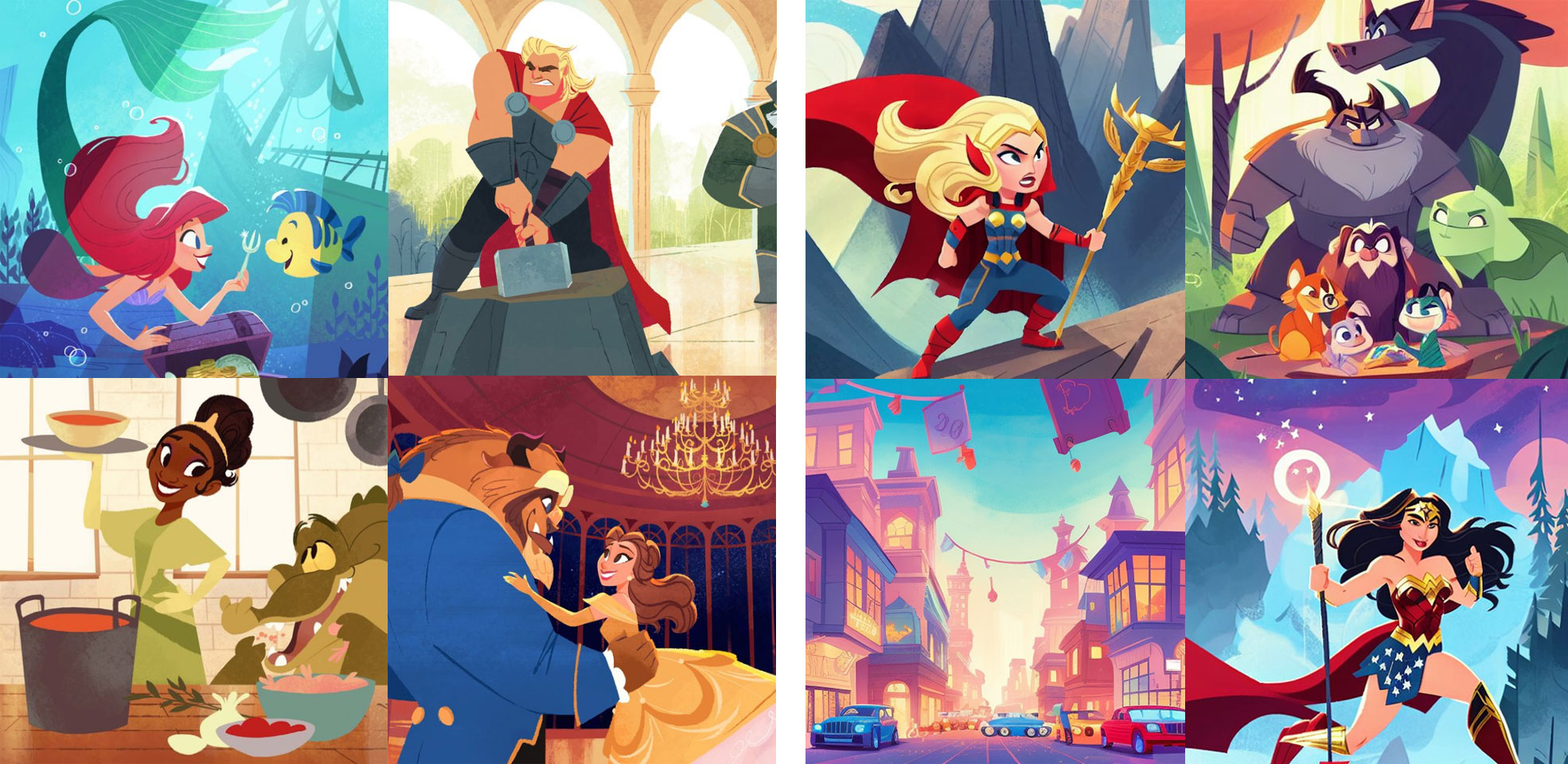
This is not just about styles that you personally don't like. It will work for any style with a lot of available existing work, popularity is irrelevant.
It's clear to me that she has a very distinctive style of her own. It's not "flat corporate style" at all.
>… the rendering, brushstrokes, and colors are the most surface-level area of art. I think what people will ultimately connect to in art is a lovable, relatable character. And I’m seeing AI struggling with that.”
So she doesn’t want her name associated with, in her eyes, bland illustration that copy the the style she has used for some big well known clients.
Fans of her work alarmed by the closeness point out to her what's happened.
Qull as appointed gatekeeper of style for the internet: 'she has no discernable style'.
This may appeal to naive people (students, hippies, etc.), for whom socialist/communist ideas are attractive, but it's poison in the real world because it eliminates the reward system that motivates most creative work. People work hard for credit or respect, if they're not working for money.
Ask yourself, why does the MIT License (https://opensource.org/licenses/MIT) contain the following text?
Copyright <YEAR> <COPYRIGHT HOLDER>
The above copyright notice and this permission notice shall be included in all copies or substantial portions of the Software.
These systems are a mechanism that can regurgitate (digest, remix, emit) without attribution all of the world's open code and all of the world's art.With these systems, you're giving everyone the ability to plagiarize everything, effortlessly and unknowingly. No skill, no effort, no time required. No awareness of the sources of the derivative work.
My work is now your work. Everyone and his 10-year old brother can "write" my code (and derivatives), without ever knowing I wrote it, without ever knowing I existed. Everyone can use my hard work, regurgitated anonymously, stripped of all credit, stripped of all attribution, stripped of all identity and ancestry and citation.
It's a new kind of use not known (or imagined?) when the copyright laws were written.
Training must be opt in, not opt out.
Every artist, every creative individual, must EXPLICITLY OPT IN to having their hard work regurgitated anonymously by Copilot or Dall-E or whatever.
If you want to donate your code or your painting or your music so it can easily be "written" or "painted", in whole or in part, by everyone else, without attribution, then go ahead and opt in. Most people aren't so totally selfless.
But if an author or artist does not EXPLICITLY OPT IN, you can't use their creative work to train these systems.
All these code/art washing systems, that absorb and mix and regurgitate the hard work of creative people must be strictly opt in.
I say this as a person who writes deep-learning parallel linear algebra kernels professionally.
We've crossed a line here.
If someone copies your thesis, abstract, poem word for word, that is clear violation of your IP, but we are all remixing words that everyone uses, colors, brush strokes, API terms, programming language keywords, and notes. Copyright law has the fair use doctrine and transformative use is explicitly allowed to allow iteration. There is some level of granularity that is essential to creativity - otherwise one entity can copyright all possible combinations and prevent any creativity from happening legally. If AI goes below that threshold, all of humanity has a chance to iterate far faster and find new spaces and fill new needs for everyone. Humans have been able to draw in the style of Picasso or Monet for centuries. A program doing it is not infringement, just much faster iteration.
"Much faster" is absolutely relevant, morally and legally. Visiting a website a bunch of times is not illegal, programmatically DDoSing it is. Having a private conversation with someone and writing down what they said afterwards is not illegal, but recording the conversation and perfectly reproducing it without their permission often is. Shouting at someone in public is generally ok, having a drone follow them around anytime they're in public playing a recording of whatever you shouted is probably not ok.
Computers are not people. Just because it's ok for a person to do something, doesn't mean it's ok to have a computer do the same thing a billion times per second.
Computers are not people. Computers are iteration tools people use to free up precious lifetime they have and bring more value to the world. If you are a human who trains 10000 hrs to invest like Paul Graham, or draw like Thomas Kincade, or play the piano, or operate as a top brain surgeon, you have spent a fraction of your life to do this fast and reap the rewards. But that fraction of your life has tremendous cost on society. Many people paid with their time and money to feed you, teach you, house you, during that time and during your upbringing which allowed you to have those 10k hrs to dedicate to this task. Now all of that work can be used by you to do exponentially more with your precious life. Instead of spending days or years making a portrait, you’d spend seconds. Now you can find higher purpose and solve much bigger problems - instead of asking for 100 to hand draw a portrait for a few hundred people in your lifetime, you could create one for every teen who needs a boost in their self esteem and raise their confidence and ability to cope with challenges in their life at massive scale.
More importantly, since there is a huge scarcity of people trained to fulfill each niche need that forms a bottleneck on society’s capacity to use that. Imagine if instead of airplane we counted on a few trained supermen to fly people who needed to cross places fast by hand. How many people would die before they see the world or are taken to a doctor, etc. The world can’t survive on superheroes or super trained people. The world can do more with the time and lives of people in it.
Why? Because Ai generated "art" is a soupy mess and real life human artists can speak and understand colloquial language, work quickly, and develop new styles based on new direction.
But then again maybe we're looking at the death of a widespread industry like when gigantic industrial looms came on the scene, but I highly doubt it.
Then again, last of all, I do see a future where AIs generate full feature length photo-real movies in minutes based on prompts and cheaply.
Excuse me when I make an apple pie from scratch.
https://mnhardy.umn.edu/apples/licensing https://provarmanagement.com/cosmic-crisp/
You’ll have to invent the universe first.
I was complaining about all of this when the derivation was based on "the internet" and everyone was being ripped off at once. All the AI-generated art out there is doing the same thing.
Of course most of this is being used to create derivations of trendy pop art, so are we really losing anything? Was there ever any hope for artistic capitalism as something that communicates in meaningful ways beyond the most local of scale?
If the copyright violation occured by the AI's inputs looking at the work... how is that different than an image of the work landing on a human's retinas?