148 points · by Bhilai · 4y ago · 154 comments
(I skimmed to the introductory paragraph where they talk about confounders, but don't see alcohol history listed as a confounder.)
"It is reasonable to expect that the relationship we observe would differ in younger individuals who have not experienced the chronic effects of alcohol on the brain. An additional limitation stems from the self-reported alcohol intake measures in the UK Biobank, which cover only the year prior to participation. Such estimates may not adequately reflect drinking prior to the past year and are susceptible to reporting and recall bias.
Further, our analyses do not account for individuals with a past diagnosis of AUD. Earlier studies have shown that the brain shows some recovery with the cessation of drinking in individuals with AUD, but this varies with age and sex, and recovery might be incomplete. Thus, a past diagnosis of AUD would likely influence our results. We hope future studies will shed light on how a history of AUD with prolonged recovery is associated with brain structure in middle-aged and older adults."
Definitely shows there is some grey and white matter reduction... but the impact doesn't seem drastic? Do I use that 1%? Do other activities reduce my brain of 1%? I don't know the scale of volume they use. I could be wrong.
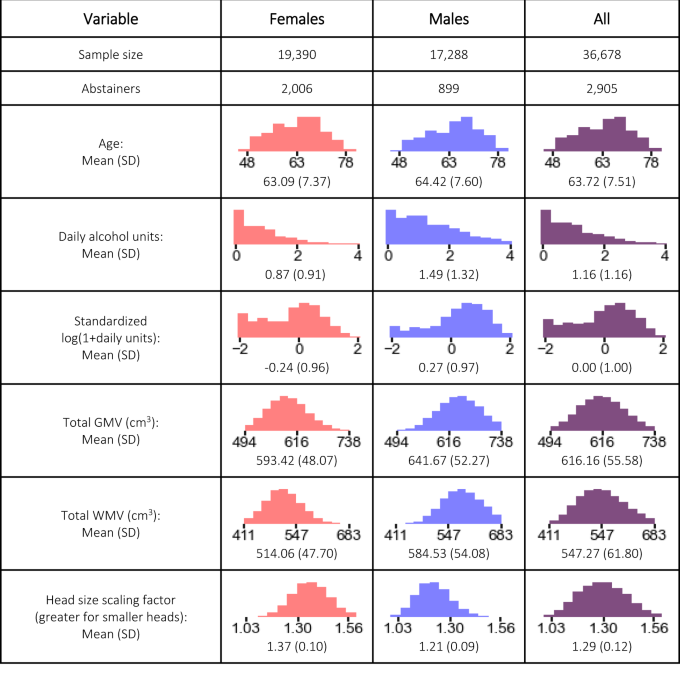
And looking at figure 2[1], age is also a major factor for change in white/grey volume (which they normalize).
[1] https://www.nature.com/articles/s41467-022-28735-5/figures/2
It's only when there is a direct short-term life-threat that people seem bothered to take action (see COVID).
What about exposure to television programming? Does that have an impact on brain mass? Soft drinks? Carbohydrates? Music?
It’s not absurd to say the negative effects of air pollution on this specific outcome are mostly negligible but still not want air pollution for other reasons. Which is a hypothetical statement of course because we don’t have any data here.
I’d like to see the same comparison between people living in cities or countryside.
> The notion that a person uses only 10 percent of their brain is a myth. fMRI scans show that even simple activities require almost all of the brain to be active.
A lot of people who don't drink are not abstaining for some health augmentation or lifestyle choice, but because drinking any amount of alcohol would send them into a very early grave.
It seems like these hidden confounding factors are more plausible of an explanation that the "0 drinks per day" group has higher morbidity, compared to "alcohol is healthy in moderate amounts" explanation for the bottom of the J curve.
That's just one group. There are other groups, I'm sure, but that's the one I'm painfully familiar with.
I used to drink socially when I was young, and I usually had more than that.
I'm vaguely familiar with the term "synaptic plasticity" to roughly mean the way the brain processes information and how it changes over time with varying life experiences.
It seems to me that one's risk-taking behavior may reduce brain matter volume, yet still improve quality of life because experience itself (literally the way the brain is wired) is worth far more. Some experiences are practically impossible without alcohol due to its social and cultural significance.
To make a dumb metaphor, consider the fact that the raw number of pixels contained in an image isn't necessarily correlated with its success. What is a life, but a meme?
Disclosure: I'm buzzed right now btw :p
I have to say that this matches my (few) experiences with chronic drinkers quite well. I've seen them become less inhibited and less self-aware and become more selfish over a couple of decades, even when they're sober.
It's like they become robots. While it's definitely bad for health, I'm not sure broader society really cares because good health isn't necessarily correlated with success in life past a certain point.
My somewhat more positive counterexamples roughly fall into the dichotomy of introverts and extroverts (yeah yeah I know).
On the introvert side, I've seen hard drinking make people into creatures of habit. Not necessarily "bad" habits, but habits nonetheless such as overworking themselves in a narrow field, deep hobbies, etc. "drunken masters" so to speak.
On the extrovert side, I've seen hard drinking train people to optimize for high charisma, handling crowds, and deep knowledge of conflict resolution to the detriment of being able to learn any other skills or really appreciate the world in any other way. The "life of the party" while being just as dead inside as the introverted example above.
They get trapped into a certain way of life from the brain damage. I'm definitely not advocating alcohol abuse just sharing my perspective. I'm pretty sure more people drink than abstain so this isn't a topic that can be dismissed as just purely bad.
If anyone knows of research on this kind of topic that would be amazing. Too often this is only discussed via movies, ads, and personal stories which are all strongly biased.
Yes, sadly that might be. In my youth heavy drinking was the norm, all the cool kids and pretty girls did it and to connect to them, you had to do it, too. Those who did not, were the depressed loosers.
So to socialize, you had to poison yourself.
From an individual point of view that makes sense, but overal I believe it makes more sense, to change that culture around alcohol.
And luckily since then, I met people who can have crazy wild parties, without being wasted. I love dancing, but I hate to avoid uncoordinated drunk idiots on the dancefloor.
I mean, I still do like a beer or a coctail occasionally and I see nothing wrong with it. But needing alcohol to socialize or party is not healthy at all and I would like to see the obligatory drunkness to go away.
Not just because of drunk parties, but also because this culture gets people hooked into alcoholism and then families get destroyed.
I don't think there's anything evil about drinking, I've just gotten this far in my life without it and figure "heck, might as well go for broke" at this point. I do believe that alcohol advertisements on TV and radio should be banned like tobacco ads were, though. The fact that I have been conditioned by ads since I was a kid to think that beer is delicious and harmless is unnerving to me.
Ideally, drinking ought to be a personal choice to exchange risk for pleasure. This only holds true when drinking is done responsibly, though. Irresponsible drinking can ruin lives, relationships, and hurt or kill people. Budweiser and Heineken may be required to say "drink responsibly" at the end of all their ads, but it's extremely obvious they don't actually care. At the end of the day, they make more money off alcoholics than responsible drinkers, so they and their marketing cannot be trusted. The incentives are too misaligned.
My mistake was avoiding parties and socialization in college along with drinking.
Also watching people around you get drunk a couple of times early on was quite the turn off. It’s actually rather sad.
Often I am considered to ‘have excellent memory’ compared to my peers (I am 44 now).
There was no religious motivation to start and even though I was Buddhist for a few years I consider myself Atheist now. It was just an early aversion towards the taste and then a heightened sense of peer pressure that didn’t sit well with me. After that it became a game of ‘let’s see how long I can keep it up’. Now it’s second nature - but I do notice there is a deep seated aversion towards alcohol and probably a side effect of conditioning myself against it. That probably goes with all drugs (I don’t take any)
And finally yes, society is very hostile towards sobriety. Less so in the US. People always feel embarrassed and defensive, interestingly enough.
It also turns out to be a great example to people who struggle with alcohol and children, so I am rather happy having stayed away from the rat poison ;-)
that's how it looks to me when non-drinkers have to explain every time themselves
[1] https://ourworldindata.org/grapher/per-capita-alcohol-1890?t...
Do we know if alcohol decreases gray and white matter volumes? Could the causation run in the reverse direction? Bi-directionally? Or could there be some common cause (e.g., proneness to "risky" behavior) that leads to both?
https://en.wikipedia.org/wiki/Correlation_does_not_imply_cau...
Rather than disregard every study, I just sort of internally give it a 50% weight and move on. Maybe it's bogus, maybe it's not, but surely some of them are correctly identifying causation.
Life is too short to quibble about this crap.
Well, it's still true, and still applicable.
> You're not wrong, but you know, sometimes it is causation.
No, I don't know, and neither do you. That's... kind of the problem.
Yup, so have a drink when you want, or don't. We will all die eventually.
Then why bother doing science at all?
There are ways to determine the correlation vs causation problem, but yes it takes more effort - possibly redesigning studies, follow up studies etc.
But that's just the price of knowledge. And knowledge is worth quibbling over.
> "Partial recovery of brain function with abstinence suggests that a proportion of the deÆcits must be neurochemical in origin while neuronal loss from selected brain regions indicates permanent and irreversible damage. The factors influencing these two components are unknown..."
Kril, J. J., & Halliday, G. M. (1999). Brain shrinkage in alcoholics: a decade on and what have we learned? Progress in Neurobiology, 58(4), 381–387.
https://sci-hub.se/10.1016/s0301-0082(98)00091-4
Here's something on mechanisms from 2021:
> "Various mechanisms underlie ethanol-induced cell death, with oxidative stress and endoplasmic reticulum (ER) stress being the main pro-apoptotic mechanisms in alcohol abuse and FASD. Oxidative and ER stresses are induced by thiamine deficiency, especially in alcohol abuse, and are exacerbated by neuroinflammation, particularly in fetal ethanol exposure."
https://www.mdpi.com/1660-4601/18/16/8678
Yes, psychedelics and cannabis are safer recreational drugs than alcohol is, and maybe opiates and cocaine are not really any worse. Revising drug laws to account for such realities is long overdue - although banning marketing and promoting public health campaigns on risks and side effects are also good ideas.
The negative health effects from moderate use of these are really not that bad, but it's very hard to moderately use them, they're a bit moreish.
Although alcohol is pretty moreish too, and the withdrawals can be really bad. (Your body develops a chemical dependence to the point that stopping cold turkey can actually kill you)
It should be noted that a single 'weak' 5% beer is 1.65 DAUs.
Seriously though, why doesn't the unit of 1 DAU correspond with any existing commercial form factors?
A single 12oz 5% beer would be a more helpful starting point.
A lot of people are going to assume that 1 standard drink === 1 glass of wine/beer. They're not going to read the fine print on government messaging.
[0]I presume if permanent single-person shrinkage was observed it would have been a big enough headline to have been noticed. [1]Unless accounted for in sampling, drinkers would be statistically more likely to be experiencing transiently smaller brains from alcohol consumption or accompanying dehydration - if an effect exists.
Saving on the restaurant, and eliminating the liquor store, bills was gravy.
Company xmas party is coming up, I'll have a couple to drink there because its free but I'll be super lightweight so only a couple will do anyway.
Or, a population with a greater incentive to lie about past consumption?..
Did anyone find anything on lower levels of consumption? I've had a hard time finding evidence related to any potential harm from having 2 drinks/mo, for example. I could imagine this would be very different than 30 drinks/mo.
I don't have data for what happens when I have 2+ drinks but that definitely has a deleterious effect on my sleep. Especially after 3.
I could die next year or even tomorrow and not cracking a few cold ones would have zero impact on that. I don’t mean this as an endorsement for endless boozing either, just sharing some perspective.
That is definitely something to be grateful for. I too, enjoy thinking deeply, and abstain from Alcohol when trying to solve problems.
But thinking can also be torture and sometimes I just want to drown out all the depression and anxiety. Alcohol is good for delaying that. Only problem is it’s a temporary fix, and the agony comes back stronger.
Alcohol is also good for dumbing yourself down to the same intellectual level as a social group.
The reason I’m working towards being a nondrinker is so I can confront my mental issues in a healthy way, and so my kids don’t see me destroy myself as they grow up.
Of course, if you find it adversely affecting you, then you owe it to yourself to abstain.
So does canabis (albeit in a rather creative way). I love the stuff but it's definitely better in smaller and infrequent doses.
Alcohol, on the other hand, I have really not found especially helpful for creativity. YMMV.
A thought experiment I've put myself through is would I still be pursuing software if I has unlimited access to sex, drugs and entertaining people were magnetically attracted to me.
I don't know the answer to that question, but I've had moments of satiation with regards to those things and I end up learning and/or thinking deeply - and in those moments it is the most pleasurable thing.
This is probably different for everyone because after being satiated being alone and thinking is what I like to do. I've also completely stopped drinking for similar reasons as the grandparent comment.