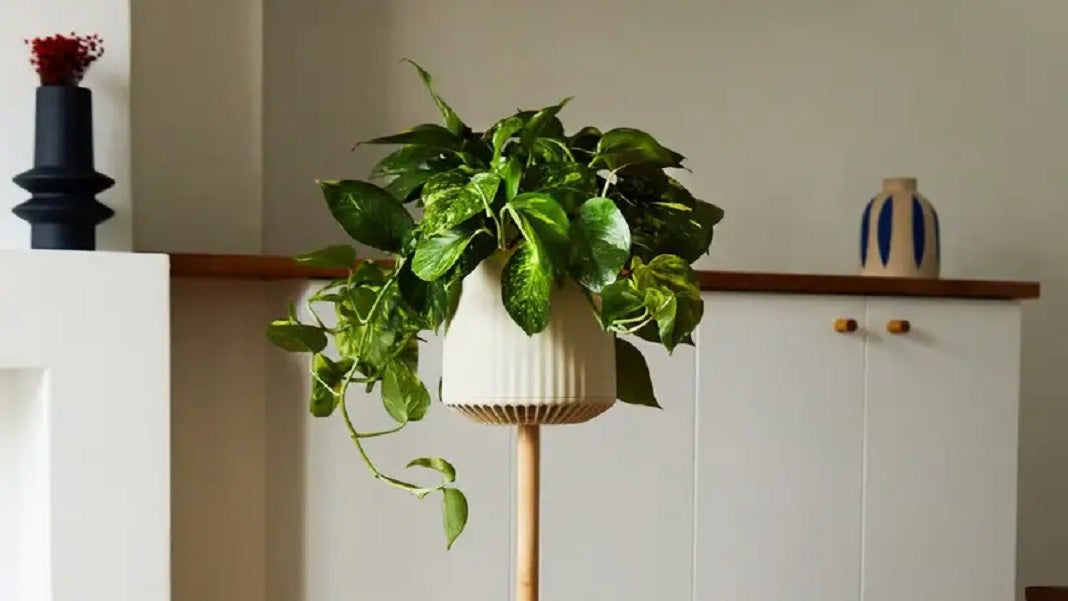
This Engineered ‘Superplant’ Cleans Indoor Air Like 30 Regular Plants
The team inserted synthetic metabolic pathways that allow the plant to use these chemicals as carbon sources in its cellular metabolism.
SingularityHub
243 points · by andsoitis · 4y ago · 125 comments
I suspect this is functioning as a shiny, attractive prototype to fund further research to develop a 300x or 3000x plant or something in that neighbourhood. No judgment from me for that, prototype funding a bigger plan is a cool business model. I'd just love to get some absolute data.
EDIT: Reading a little bit about the NASA plant study[0] that I saw in the comments below. It says that it determined that you'd need 10-1000 plants per square meter (I don't understand this measurement? Wouldn't it be cubic meter?) to get the equivalent of outdoor-indoor air exchange. That's a really wide range, but does this mean you'd need 0.33...-33.33... of these neoplants to have the same impact? That's a lot of plants, but another 10x or 100x and you're actually getting somewhere in the range of reasonable. Counterpoint, I don't know what I'm talking about.
https://www.armandhammer.com/for-everything-soda/air-freshen...
It’s freely available from the NASA website, and it looks like that Wikipedia page includes a link in the footnotes.
At the very least, skim through it: they chose the plants to test based on what they could find at a random garden shop in Mississippi. They didn’t use pots filled with dirt - they built their own pots that had electrically powered fans and ducts. There’s a drawing in the report, you can make your own!
It’s definitely good to have houseplants; the more the better! But this report isn’t really of much value to the average homeowner.
If you have helpful data, please share. I was just skimming as you kindly pointed out and would love some concrete numbers other than holistic senses of the goodwill of houseplants, $150 houseplants or others.
Actually, the only other study I’ve seen says that houseplants are of zero benefit in regards to VOC purification, but I doubt a startup would invest this much into fraud.
The benefit of outside air is that it is averaged and that open spaces reach more stable equilibriums than artificial spaces.
Patrick here, CTO of Neoplants, thanks you so much for spending the time learning about what we’ve built. TLDR: we’ve put together a white paper explaining the technology behind what we do, as well as the performance data we’ve accumulated so far: https://bit.ly/3hjMqsB
As you pointed out, the range given by the Nasa study covers 2 orders of magnitude, this reflects the difficulty to extrapolate from their data to real life situations.
Even though our first product, Neo P1, is “only” 30x better than normal indoor plants, it’s already a great improvement over anything that’s been done in the scientific literature to date (usually improving phytoremediation by 2 or 3x) , and this is just the start of the adventure. As you said, we expect to continue to leverage our metabolism and microbiome engineering technologies to have even more performant plants every year.
Still cool though.
I am also worried about proprietary plants, I don't know, maybe you can make cuttings? But yeah, still really cool.
We just want to use it on earth so we can show how cool we are that we have something from NASA while your "other" friends have Dyson gear.
One of my student jobs in the 1970's was with a company that provided and serviced the decorative plants in restaurants and hotels.
We would go there every week and take them outside to be watered, drained, and given the only sunshine they were going to see for a while.
Anything that was looking sick we replaced with spares and rehabilitated.
Just get a filter that can filter VOCs if you have that kind of concern. And then add plants as you wish to make you happy.
We made a quick summary of keys insights of this report in the intro of our white paper https://bit.ly/3hjMqsB
In that case, just open the windows! Or use a heat exchanger if the temp isn't reasonable outside.
But, I was imagining a house sealed up with perfectly clean air and then "dirty" outside air getting in
I used to think they were kinda useless until I had tile ripped up. The neverending dust was driving my wife insane. On a whim, bought a couple purifiers and it's cut the dust down by at least 90%.
You need another filter like activated charcoal which works differently than particulate filters (adsorption vs merely trapping particles in a winding path)
Relevant talk: https://www.ted.com/talks/kamal_meattle_how_to_grow_fresh_ai...
A normal person need about 2000 kcalories per day. That's approximately 500g (1/2 kg) (1 pound) of sugar. Eating only sugar is bad, but most carbohydrates and proteins have a similar kcalories to weight ratio.
If the plant absorbs all the CO2 produced by the person, it must rebuild all that sugar back (and store it as cellulose, or starch or even proteins, but again all have a very similar similar kcalories to weight ratio.) So the plant must grow approximately 500g (1/2 kg) (1 pound) per day.
That is like 15kg (30 pounds) per month, that is a weigh of a small child. Or like 150kg (300 pounds) per year that is the weight of one or two adults. Plant's don't grow so much. (Note that you can reduce the weight to one half is the plant only makes oil instead of as cellulose, or starch or even proteins, but it still too high.)
Edit: Self nitpicking: About the reduction of weigh using oil, I used calories per gram instead of carbon per gram.
Oversimplifiying: In sugar the simplified unit is COH2, that has one carbon per 12+16+2=30 atomic units. In oil, the simplified unit is CH2 that has one carbon every 12+2=14 atomic units. So the ratio is aproximately 30/14=2.14 instead of the calories ratio that is 9/4=2.5. Both are very similar, so the end remark is still correct. I'm not sure if it's a coincidence or if I think hard enough about energy per atomic bound it get obvious.
Proteins are harder, because amino acids are more diverse. I left the exact calculation for someone else, but as a rough simplification let's use achain of valine. The building block is C5ONH9 that is a carbon for every (12*5+16+14+9)/5=19.8 atomic units, so it's something in between. Anyway, don't expect your plant to make too much proteins. Even soy overdosed with fertilizer has only like a 15% of proteins.
2000 kcal == 2.3kwh.
If we assume the plant manages to put half of it’s total photosynthesis output into sugar (very generous), and hits maximum theoretical photosynthetic rates, 5.5% of sunlight would be converted.
A peak sun hour is 1kw per square meter. 5.5% of that is 50 watts.
You’d need 46 square meters of peak sun for an hour to produce 2.3kwh worth of output, even assuming a lot of ideal output efficiencies.
So yeah, total bullshit.
Carbon in, carbon out. In order for plants to balance that equation they have to grow about a pound of dry mass per day. There’s a reason the space station doesn’t just have a few plants up there instead of an advanced system to scrub and recycle air.
I kinda like the idea of living in a space with 30 pothos plants.
I guess the engineered one would also be easy to propagate? Which raises an interesting question, after I buy one, can I just give away dozens of clones? Are there IP restrictions? Does the plant die without the special sauce bacteria?
The grapes, apples, chestnuts you buy at a supermarket are already IP-protected and propagation is already restricted or forbidden. Even some hybrid plants in IKEA have "propagation is against the law" labels, you are expected to kill any offspring.
https://www.freshfruitportal.com/news/2022/11/02/italian-cou...
Read up on Paul Schmeiser and his legal battles with the GMO-king: https://en.m.wikipedia.org/wiki/Percy_Schmeiser
Potentially, these plants can be sterile (https://en.wikipedia.org/wiki/Genetic_use_restriction_techno...)
If they don’t, you may have to pay the manufacturer a “technology use fee” to use the new plants. https://en.wikipedia.org/wiki/Monsanto_Canada_Inc_v_Schmeise...:
“The court heard the question of whether Schmeiser's intentionally growing genetically modified plants constituted "use" of Monsanto's patented genetically modified plant cells. By a 5-4 majority, the court ruled that it did. The Supreme Court also ruled 9-0 that Schmeiser did not have to pay Monsanto their technology use fee, damages or costs, as Schmeiser did not receive any benefit from the technology.”
1: https://nwdistrict.ifas.ufl.edu/hort/2016/06/08/know-your-pa...
Only commercial growers license plant patents.
I’m filling a fifth of an acre with purchased plants and it gets expensive quick, especially if you aren’t very very patient. I’m already propagating cuttings of mostly natives and a few herbs to trade with others. Few can afford retail.
"Just one Neo P1, as the company dubbed its initial product, can remove as much pollution from a home’s air as 30 regular plants, the company says. Neo P1 was in development for four years, and is a bioengineered version of a common houseplant called Pothos."
What does this even mean? What is 'pollution' in this claim? Just grow and happily propagate regular pothos which are wonderful plants, and if you need to filter your air... get certified filters?
As for proprietary variants, some Pothos already come with tags saying that propagation is forbidden (which, to me, at least, means I will propagate the hell out of it even if I didn't really want to).
Pothos are pretty much vines, so seems pretty easy to put the pot on a high surface and let them fall down or creep along, unless they're too structurally solid to do that?
> after I buy one, can I just give away dozens of clones
I mean, it s going to be so popular that the company will have no way of stopping the IP thieves.
https://algenair.com/products/the-aerium-3-0?variant=4249193...
Their algae is also claimed to be as effective as 25 regular plants.
In reality, to have a noticeable/measurable impact on indoor air quality (specifically CO2), these products would still need to improve in absorbtion rates well beyond the 30x- probably to about 3000x.
However, I like the Aerium for its visual and auditory qualities, irrespective of inefficient CO2 consumption. And real plants of course are also pleasing to many people.
I have hopes that through genetic and other engineering products like the Pothos and the Aerium can get that 100-fold improvement over the next 10 years.
[0] https://www.ted.com/talks/kamal_meattle_how_to_grow_fresh_ai...
https://www.epa.gov/indoor-air-quality-iaq/introduction-indo...
The pollutant sources section identifies many everyday components in a residence.
It is something similar to 98% of the population in the states having PFOA in thier blood in a 1998 study.
https://www.webmd.com/food-recipes/is-teflon-coating-safe
I agree with many of the comments about the limited performance of passive plants to effectively remove contaminants with indoor air pollution.
It looks like an estimate of 3.2 million people succumb to indoor air pollution annually on a global scale with lifestyle choices (or the lack of choice).
https://www.who.int/news-room/fact-sheets/detail/household-a...
Environmental factors may actually make superplants a resonable addition for wellbeing (placebo effect), but lifestyle choices make inventorying 20th century convenience items and amenities part of a healthy spring cleaning routine (with updated information).
Edit: Spelling.
Until they grow into the plumbing.
The benefit here is very close to zero, though; one wild-type pothos won't affect indoor air quality in any way known to be significant to human health, and neither will thirty. We've already got escaped transgenic GloFish in Brazilian streams; those haven't caused any significant harm yet, but I'd rather we stopped rolling the dice before something does.
Although no plants…
Would be interesting to calibrate need for this, and the effect of normal plants, as a comparison.
I have SGP40 for VOC - https://www.adafruit.com/product/4829 For True CO2 I have a SCD40 - https://www.adafruit.com/product/5187 For dust I have a PMSA003I - https://www.adafruit.com/product/4632
You can buy 1 of these, and add the other if/when you want to measure something else.
This is an ESP32, although I don't have this exact one - https://www.adafruit.com/product/5337
And then ESPHome - https://esphome.io/
ESPHome publishes the data on MQTT, which I then read in Home Assistant.
Of course, the first step regarding volatile organic compounds would be to test using an air quality monitor that can detect VOCs to see if you actually have a problem.
https://www.goodreads.com/book/show/308235.How_to_Grow_Fresh...
I'm pretty sure she came from a privileged place, in Beijing.
Anyway, she told me that they always had tea plants around her house in China. She said they smelled great, and "cleaned the air."