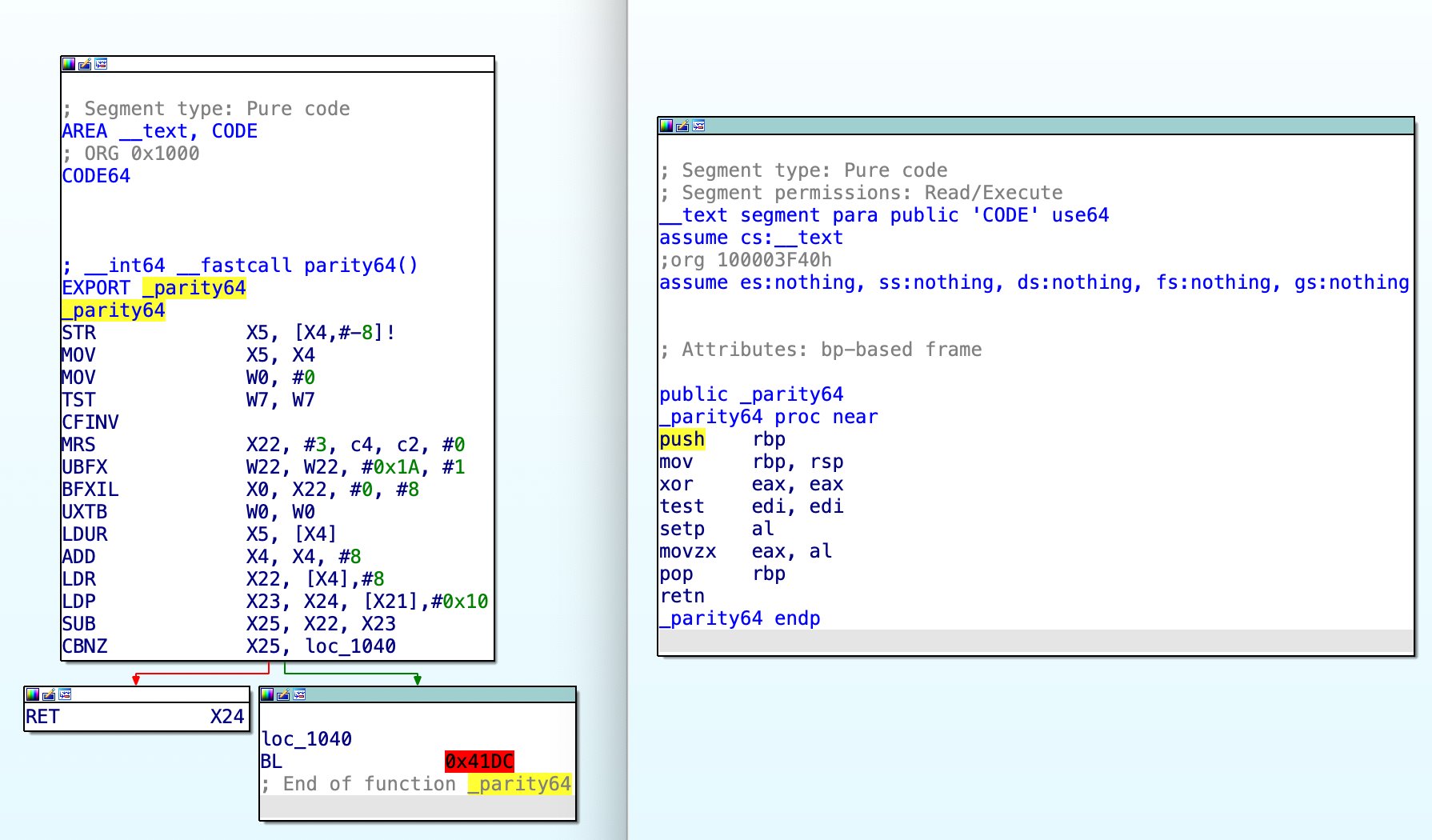
Why is Rosetta 2 fast?
Rosetta 2 is remarkably fast when compared to other x86-on-ARM emulators. I’ve spent a little time looking at how it works, out of idle curiosity, and found it to be quite unusual, so I figur…
dougallj
650 points · by pantalaimon · 4y ago · 358 comments
I remember Apple had a totally different but equally clever solution back in the days of the 68K-to-PowerPC migration. The 68K had 16-bit instruction words, usually with some 16-bit arguments. The emulator’s core loop would read the next instruction and branch directly into a big block of 64K x 8 bytes of PPC code. So each 68K instruction got 2 dedicated PPC instructions, typically one to set up a register and one to branch to common code.
What that solution and Rosetta 2 have in common is that they’re super pragmatic - fast to start up, with fairly regular and predictable performance across most workloads, even if the theoretical peak speed is much lower than a cutting-edge JIT.
Anyone know how they implemented PPC-to-x86 translation?
They licensed Transitive's retargettable binary translator, and renamed it Rosetta; very Apple.
It was originally a startup, but had been bought by IBM by the time Apple was interested.
Rosetta shipped in 2005.
IBM bought Transitive in 2008.
The last version of OS X that supported Rosetta shipped in 2009.
I always wondered if the issue was that IBM tried to alter the terms of deal too much for Steve's taste.
It's very fascinating to me, since IBM appears to have extended the PowerPC spec with this application specifically in mind. Up until POWER10, the Power/PowerPC ISA specified an optional feature called "SAO", allowing individual pages of memory to be forced to use an x86-style strong memory model, comparable to the proprietary extension in Apple's CPUs, but much more granular (page level and enforced in L1/L2 cache as opposed to the entire core).
As far as I can tell, Transitive's technology was the only application to ever use this feature, though it's mainlined in the Linux kernel, and documented in the mprotect(2) man page. IBM ditched the extension for POWER10, which makes sense, since Lx86 only ever worked on big endian releases of RHEL and SLES which are long out of support now.
One mystery to me, though, is IBM added support for this page marker to the new radix-style MMU in POWER9. It's documented in the CPU manual, but Linux has no code to use it -- unless I've missed it, Linux only has code to set the appropriate bits in HPT mode, and no reference to the new method for marking radix pages SAO as the manual describes. I can't imagine there was any application on AIX which used this mode (it only decreases performance), and unless you backported a modern kernel to a RHEL 5 userland, you couldn't use Lx86 with the new radix mode. Much strangeness...
Their customers are not enterprise, and consequently they are probably the best company in the world at dictating well-managed, reasonable shifts in customer behavior at scale.
So they likely had no need for Rosetta as of 2009.
It is possible that IBM tried to squeeze Apple, but given that IBM's interest in Transitive was for enterprise server migration, I suspect it is more likely that Apple got tired of paying whatever small royalty they'd contracted for with Transitive, and decided enough people had fully migrated to native x86 apps that they wouldn't alienate too many customers.
Interesting so was Rosetta 2 written from the ground up then? Did Apple manage to hire any of the former Transitive engineers after IBM acquired them? It seems like this would be a niche group of engineers that worked in this area no?
Interesting, so was Rosetta 2 written from the ground up then? Did Apple manage to hire any of the former Transitive engineers after IBM acquired them? It seems like this would be a niche group of engineers that worked in this area no?
They squeezed a virtual machine with 88 instructions into less than 1k of memory!
[1] https://thechipletter.substack.com/p/bytecode-and-the-busico...
https://en.wikipedia.org/wiki/Open_Firmware
>Open Firmware Forth Code may be compiled into FCode, a bytecode which is independent of instruction set architecture. A PCI card may include a program, compiled to FCode, which runs on any Open Firmware system. In this way, it can provide boot-time diagnostics, configuration code, and device drivers. FCode is also very compact, so that a disk driver may require only one or two kilobytes. Therefore, many of the same I/O cards can be used on Sun systems and Macintoshes that used Open Firmware. FCode implements ANS Forth and a subset of the Open Firmware library.
My memory is very hazy; though. While I experienced this transition firsthand and was an early Intel adopter, that’s about all I can remember about Rosetta or where it came from.
I remember before Adobe had released the Universal Binary CS3 that running Photoshop on my Intel Mac was a total nightmare. :( I learned to not be an early adopter from that whole debacle.
Connectix SpeedDoubler was definitely faster.
What made it interesting here was that as a sanity check they made an A->A mode where they took in one architecture and spit out machine code for the same architecture. The output was faster than the input. Meaning that even native code has some room for improvement with JIT technology.
I have been wishing for years that we were in a better place with regard to compilers and NP complete problems where the compilers had a fast mode for code-build-test cycles and a very slow incremental mode for official builds. I recall someone telling me the only thing they liked about the Rational IDE (C and C++?) was that it cached precompiled headers, one of the Amdahl’s Law areas for compilers. If you changed a header, you paid the recompilation cost and everyone else got a copy. I love whenever the person that cares about something gets to pay the consequence instead of externalizing it on others.
And having some CI machines or CPUs that just sit around chewing on Hard Problems all day for that last 10% seems to be to be a really good use case in a world that’s seeing 16 core consumer hardware. Also caching hints from previous runs is a good thing.
Also, optimizers usually target “most common denominator” so native binaries rarely use full power of current instruction set.
Jumping from that peculiar finding to praising runtime JIT feels like a longshot. To me it’s more of an argument towards distributing software in intermediate form (like Apple Bitcode) and compiling on install, tailoring for the current processor.
This turns out to be quite difficult, especially if you're using bitcode as a compiler IL. You have to know what the right "intermediate" level is; if assumptions change too much under you then it's still too specific. And it means you can't use things like inline assembly.
That's why bitcode is dead now.
By the way, I don't know why this thread is about how JITs can optimize programs when this article is about how Rosetta is not a JIT and intentionally chose a design that can't optimize programs.
Since 1961 plenty of systems have used bytecodes as executable formats, the most sucessfull still in use, IBM and Unisys mainframes and microcomputers.
WebAssembly seems alive and well. I'm not sure how similar it is to java bitcode but its the same core idea.
That said, WASM through v8 is ~3x slower than the same code compiled natively. (Some of this might be due to the lack of SIMD in wasm).
> That's why bitcode is dead now.
Isn't this what Android does today? Applications are distributed in bytecode form and then optimized for the specific processor at install time.
Note that on gcc (I think) and clang (I'm sure), -Oz is a strict superset of -O2 (the "fast+safe" optimizations, compared to -O3 that can be a bit too aggressive, given C's minefield of Undefined Behavior that compilers can exploit).
I'd guess that, with cache fit considerations, -Oz can even be faster than -O2.
Or distribute it in source form and make compilation part of the install process. Aka, the Gentoo model.
No one cares as much now days, we’ve moved our overrated opinion battlegrounds to other portions of what we do.
Right now it's fairly common in software development to have a debug build and a release build with potentially different optimisation levels. So that's two builds to manage - if we could build with lower optimisation and still effectively run at higher levels then that's a whole load of build/test simplification.
Moreover, debugging optimised binaries is fiddly due to information that's discarded. Having the original, unoptimised, version available at all times would give back the fidelity when required (e.g. debugging problems in the field).
Java effectively lives in this world already as it can use high optimisation and then fall back to interpreted mode when debugging is needed. I wish we could have this for C/C++ and other native languages.
I think it's a hypothetical. The Mill Computing lectures talk about a variant of this, which is sort of equivalent to an install-time specializer for intermediate code which might work, but that has many problems (for one thing, it breaks upgrades and is very, very problematic for VMs being run on different underlying hosts).
Might you or someone else have a link those Mill Computing lectures?
Modern compilers have a thing called PGO (Profile Guided Optimization) that lets you take a compiled application, run it and generate an execution profile for it, and then compile the application again using information from the profiling step. The reason why this works is that lots of optimization involves time-space tradeoffs that only make sense to do if the code is frequently called. JIT only runs on frequently-called code, so it has the advantage of runtime profiling information, while ahead-of-time (AOT) compilers have to make educated guesses about what loops are the most hot. PGO closes that gap.
Theoretically, a JIT could produce binary code hyper-tailored to a particular user's habits and their computer's specific hardware. However, I'm not sure if that has that much of a benefit versus PGO AOT.
In theory JIT can be a lot more efficient, optimizing for not only the exact instruction set, and do per CPU architecture optimizations, such as instruction length, pipeline depth, cache sizes, etc.
In reality I doubt most compiler or JIT development teams have the resources to write and test all those potential optimizations, especially as new CPUs are coming out all the time, and each set of optimizations is another set of tests that has to be maintained.
For example AOT compilation often has to account for the possibility that the target machine might not have certain instructions - like SSE/AVX vector ops, and emit both SSE and non-SSE versions of a codepath with, say, a branch to pick the appropriate one dynamically.
Whereas a JIT knows what hardware it's running on - it doesn't have to worry about any other CPUs.
1. The usual caveats about benchmarking what you care about apply, of course. The mix of webish things I worked on and scientists I supported followed this pattern, YMMV.
The classical reason to use FMV is for SIMD optimizations, fwiw
An easy example is code compiled for 386 running on a 586. The A->A compiler can use CPU features that weren't available to the 386. As with PGO you have branch prediction information that's not available to the static compiler. You can statically compile the dynamically linked dependencies, allowing inlining that wasn't previously available.
On the other hand you have to do all of that. That takes warmup time just like a JIT.
I think the road to enlightenment is letting go of phrasing like "is superior". There are lots of upsides and downsides to pretty much every technique.
That said, a sufficiently advanced CPU could also make those optimisations on "static" code. That was one of the things Transmeta had been aiming towards, I think.
Probably the optimal system is an hybrid iterative JIT/AOT compiler (which incidentally was the original objective of LLVM).
What is meant by "Java adjacent research"? I'm not familiar with what that was.
That already exists with c/c++...unity builds aka single translation unit builds. Compiling and linking a ton of object files takes an inordinate amount of time, often the majority of the build time
I know most of the time I get frustrated by everyday software, its doing something unnecessary in a long loop, and possibly forgetting to check for Windows messages too.
So if you ran the input back through the output multiple times then that means you could eventually get the runtime down to 0.
And then there’s processor family versus this exact model.
In my experience, exceptionally well executed tech like this tends to have 1-2 very talented people leading. I'd like to follow their blog or Twitter.
What was the most surprising thing you learned while working on Rosetta 2?
Is there anything (that you can share) that you would do differently?
Can your recommend any great starting places for someone interested in instruction translation?
Looking forward, did your work on Rosetta give you ideas for unfilled needs in the virtualization/emulation/translation space?
What's the biggest inefficiency you see today in the tech stacks you interact most with?
A lot of hard decisions must have been made while building Rosetta 2; can you shed light on some of those and how you navigated them?
My preferred way to learn about a new (to me) area of tech is to hear the insights of the people who have provably advanced that field. There's a lot of noise to signal in tech blogs.
May I ask – would it be possible to implement support for 32-bit VST and AU plugins?
This would be a major bonus, because it could e.g. enable producers like me to open up our music projects from earlier times, and still have the old plugins work.
But even on native hardware using x87 is vastly slower than fp64, and it's just a shame that only win64 had the good sense to define long double as being fp64 instead of fp80 as every other x86_64 platform did :-/
I know a few of their devs went to ARM, some to Apple & a few to IBM (who bought Transitive). I do know a few of their ex staff (and their twitter handles), but I don’t feel comfortable linking them here.
My aotool project uses a trick to extract the AOT binary without root or disabling SIP: https://github.com/lunixbochs/meta/tree/master/utils/aotool
Do I understand correctly that the Rosetta is basically a transpiler from x86-64 machine code to ARM machine code which is run prior to the binary execution? If so, does it affect the application startup times?
It does, but only the very first time you run the application. The result of the transpilation is cached so it doesn't have to be computed again until the app is updated.
I do remember that I tried to use it to run the x86 Netscape binary for Linux on a surplus Alpha with RedHat Linux. It worked, but so slowly that a contemporary Python-based web browser had similar performance. In practice, I settled on running Netscape from a headless 486 based PC and displaying remotely on the Alpha's desktop over ethernet. That was much more usable.
Though only the actual binary size that gets doubled. For large apps it’s usually not the binary that’s taking up most of the space.
https://apple.stackexchange.com/questions/427695/how-can-i-l...
It's a delicate political game that they, yet again, seem to be playing pretty well.
But there is a long-tail of weird x86 features that are implemented, that give them amazing compatibility, that I regret not mentioning:
* 32-bit support for Wine
* full x87 emulation
* full SSE2 support (generally converting to efficient NEON equivalents) for performance on SIMD code
I consider all of these "compatibility", but that last one in particular should have been in the post, since that's very important to the performance of optimised SIMD routines (plenty of emulators also do SIMD->SIMD, but others just translate SIMD->scalar or SIMD->helper-runtime-call).
The "Apple's Secret Extension" section talks about how the M1 has 4 flag bits and the x86 has 6 flag bits, and how emulating those 2 extra flags would make every add/sub/cmp instruction significantly slower. Apple has an undocumented extension that adds 2 more flag bits to make the M1's flag bits behave the same as x86.
The "Total Store Ordering" section talks about how Apple has added a non-standard store ordering to the M1 than makes the M1 order its stores in the same way x86 guarantees instead of the way ARM guarantees. Without this, there's no good way to translate instructions in code in and around an x86 memory fence; if you see a memory fence in x86 code it's safe to assume that it depends on x86 memory store semantics and if you don't have that you'll need to emulate it with many mostly unnecessary memory fences, which will be devastating for performance.
As a somewhat related aside, I have been watching Bun (low startup time Node-like on top of Safari’s JavaScript engine) with enough interest that I started trying to fix a bug, which is somewhat unusual for me. I mostly contribute small fixes to tools I use at work. I can’t quite grok Zig code yet so I got stuck fairly quickly. The “bug” turned out to be default behavior in a Zig stdlib, rather than in JavaScript code. The rest is fairly tangential but suffice it to say I prefer self hosted languages but this probably falls into the startup speed compromise.
Being low startup overhead makes their VM interesting, but the fact that it benchmarks better than Firefox a lot of the time and occasionally faster than v8 is quite a bit of quiet competence.
And maybe also by keeping the technology closed and Apple-specific. Many people who could be interested in using it don't have access to it.
This really made me chuckle. They probably don't want to mention Intel by name, but this just sounds funny.
https://developer.arm.com/documentation/100076/0100/A64-Inst...
It almost certainly is not. Odds are Apple will eventually remove Rosetta II, as they did Rosetta back in the days, once they consider the need for that bridge to be over (Rosetta was added in 2006 in 10.4, and removed in 2011 from 10.7).
> And I hope what is learned from it can be used to make a RISC-V version of it. translating native ARM to RISC-V should be much easier than x86 to ARM as I understand it, so one could conceivably do x86 -> ARM -> RISC-V.
That's not going to happen unless Apple decides to switch from ARM to RISC-V, and... why would they? They've got 15 years experience and essentially full control on ARM.
The difference is that Rosetta 1 was PPC → x86, so its purpose ended once PPC was a fond memory.
Today's Rosetta is a generalized x86 → ARM translation environment that isn't just for macOS apps. For example, it works with Apple's new virtualization framework to support running x86_64 Linux apps in ARM Linux VMs.
https://developer.apple.com/documentation/virtualization/run...
Different CEO as well. Jobs was more opinionated on “principles” - Cook is more than happy to sell what people will buy. I think Rosetta 2 will last.
It's basically only games and weird tiny niches, and Apple is pretty happy to abandon both those categories. The saving grace is that there's very few interesting Mac-exclusive games in the Intel era.
Yes, I'm sure Apple had no way of extending the license.
> Cook is more than happy to sell what people will buy. I think Rosetta 2 will last.
There's no "buy" here.
Rosetta is complexity to maintain, and an easy cut. It's not even part of the base system.
And “what people will buy” certainly didn’t prevent essentially removing support for non-hidpi displays from MacOS. Which is a lot more impactful than Rosetta as far as I’m concerned.
Well, the current "principle" is "iOS is enough, we're going to run iOS apps on MacOS, and that's it".
Rosetta isn't needed for that.
15? More than a quarter century. They were one of the original investors in ARM and have produced plenty of arm devices since then beyond the newton and the ipod.
I’d bet they use a bunch of risc v internally too if they just need a little cpu to manage something locally on some device and just want to avoid paying a tiny fee to ARM or just want some experience with it.
But RISC V as the main CPU? Yes, that’s a long way away, if ever. But apple is good at the long game. I wouldn’t be surprised to hear that Apple has iOS running on RISC V, but even something like the lightning-to-HDMI adapter runs IOS on ARM.
They didn't design their own chips for most of that time.
Did you only start counting from 2007 when the iPhone was released? All the iPods prior to that were using ARM processors. The Apple Newton was using ARM processors.
Most of the original device was outsourced and contracted out (for reasons of time constraint and lack of internal expertise). PortalPlayer built the SoC and OS, not Apple. Later SoC were sourced from SigmaTel and Samsung, until the 3rd gen Touch.
> The Apple Newton was using ARM processors.
The Apple Newton was a completely different Apple, and there were several years' gap between Jobs killing the Newton and the birth of iPod, not to mention the completely different purpose and capabilities. There would be no newton-type project until the iPhone.
Which is also when Apple started working with silicon themselves: they acquired PA in 2008, Intrinsity in 2010, and Passif in 2013, released their first partially in-house SoC in 2010 (A4), and their first in-house core in 2013 (Cyclone, in the A7).
Two points here.
• First off, Apple developers are not binded to Apple. The knkwledge gained can be used elsewhere. See Rivos and Nuvia for example.
• Second, Apple reportedly has already ported many of it's secondary cores to RISC-V. It's not unreasonable that they will switch in 10 years or so.
Really? In current hardware or is this speculation?
You’ve not provided any rationale at all for why they should switch their application cores let alone on this specific timetable.
Switching is an expensive business and there has to be a major business benefit for Apple in return.
Do they? ARM made it very clear that they consider all ARM cores their own[1]
[1]: https://www.theregister.com/2022/11/07/opinion_qualcomm_vs_a...
They do, yes. They were one of the founding 3 members of ARM itself, and the primary monetary contributor.
Through this they acquired privileges which remain extant: they can literally add custom instructions to the ISA (https://news.ycombinator.com/item?id=29798744), something there is no available license for.
> ARM made it very clear that they consider all ARM cores their own[1]
The Qualcomm situation is a breach of contract issue wrt Nuvia, it's a very different issue, and by an actor with very different privileges.
We have giant corpuses of source code, compiled x86_64 binaries, and compiled arm64 binaries. I assume the compiled binaries represent approximately our best compiler technology. It seems predicting an arm binary from an x86_64 binary would not be insane?
If someone who actually knows anything here wants to disabuse me of my showerthoughts, I'd appreciate being able to put the idea out of my head :-)
Neural models are basically universal approximators. Machine code needs to be obscenely precise to work.
Unless you're doing something else in the backend, it's just a turbo SIGILL generator.
However, there are lots of problems in CS that are easier to check the answer to a solution than to solve in the first place. It may turn out to be the case that a well-tuned model can quickly produce solutions to some code-generation problems, that those solutions have a high enough likelihood of being correct, that it's fast enough to check (and maybe try again), and that this entire process is faster than state-of-the-art classical algorithms.
However, if that were the case, I might also expect us to be able to extract better algorithms from the model - intuitively, machine code generation "feels" like something that's just better implemented through classical algorithms. Have you met a human that can do register allocation faster than LLVM?
This gave me the delightful mental image of a CPU smashing headlong into a brick wall, reversing itself, and doing it again. Which is pretty much what this would do.
Property based testing is a bit of a baby step here, possibly in the same way that escape analysis in object allocation was the precursor to borrow checkers which are the precursor to…?
These are my inputs, these are my expectations, ask me some more questions to clarify boundary conditions, and then offer me human readable code that the engine thinks satisfies the criteria. If I say no, ask more questions and iterate.
If anything will ever allow machines to “replace” coders, it will be that, but the scare quotes are because that shifts us more toward information architecture from data munging, which I see as an improvement on the status quo. Many of my work problems can be blamed on structural issues of this sort. A filter that removes people who can’t think about the big picture doesn’t seem like a problem to me.
If you start with a couple of megabytes of x64 code, and predict a couple of megabytes of arm code from it, there will be errors even if your model is 99.999% accurate.
How do you find the error(s)?
If Apple does drop it, maybe they could open source it so it could live on in Linux and BSD at least. ;-)
Adding a couple of features to ARM to drastically improve translated x86 code execution sounds like a decent idea - and one that could potentially enable better x86 app performance on ARM Windows as well. I don't know the silicon cost but I'd hope it wasn't dropped in the future.'
Thinking a bit larger, I'd also like to see Apple add something like CHERI support to Apple Silicon and macOS to enable efficient memory error checking in hardware. I'd be surprised if they weren't working on something like this already.
https://en.m.wikipedia.org/wiki/FX!32
Or for a more technical deep dive,
https://www.usenix.org/publications/library/proceedings/usen...
It’s ironic that Apple is often backhandedly complimented by hackers as having “good hardware” when their list of software accomplishments is amongst the most impressive in the industry and contrasts sharply with the best efforts of, say, Microsoft, purportedly a “software company.”
I suspect the ppc->x86 stuff was slower because x86 just doesn't have the registers. There's only so much you can do.
Not arguing the facts here, but I'm curious—are these successes related? And if so, how has Apple done that?
I would imagine that very few of the engineers who programmed Apple's 68k emulator are still working at Apple today. So, why is Apple still so good at this? Strong internal documentation? Conducive management practices? Or were they just lucky both times?
I think of it in same way that I've migrated from old->new versions of frameworks/languages in the past with breaking changes and each time I've done it I've gotten better at knowing what to expect, what to look for, places where it makes sense to "just get it working" or "upgrade the code to the new paradigm". The first time or two I did it was as a junior working under senior developers so I wasn't as involved but what did trickle down to me and/or my part in the refactor/upgrade taught me things. Later times when I was in charge (or on my own) I was able to draw on those past experiences.
Obviously my work is nowhere near as complicated as arch changes but if you squint and turn your head to the side I think you can see the similarities.
> Or were they just lucky to have success both times?
I think 2 times might be explained with "luck" but being successful 3 times points to a strong trend IMHO, especially since Rosetta 2 seems to have done even better than Rosetta 1 for the last transition.
Just to be clear, I never meant to suggest that they did—I just didn't realize employees remained with the company for that long, instead of switching.
In general, MacOS/iOS/iPadOS owe everything to the excellent architecture laid down by the NeXT team back in the day. NeXTstep now has the dream that MS tried and failed to do back in the day: an OS that runs on every kind of device they make. Funny how that is.
My understanding is that part of the reason the G4/5 was sort of able to keep up with x86 at the time was due to the heavy use of SIMD in some apps. And I doubt that Rosetta would have been able to translate that stuff into SSE (or whatever the x86 version of SIMD was at the time) on the fly.
This is not true. A 6100/60 running 68K code was about the speed of my unaccelerated Mac LCII 68030/16. Even when using SpeedDoubler, you only got speeds up to my LCII with a 68030/40Mhz accelerator.
Even the highest end 8100/80 was slower than a high end 68k Quadra.
The only time 68K code ran faster is when it made heavy use of the Mac APIS that were native.
Yes, and that just confirms the original point. Mac apps often spend a lot of time in the OS apis and therefore the 68K code (the app) often ran faster on PPC than it did on 68K because apps often spend much of their time in OS apis. The earlier post said "so good that for some things the PPC Mac was the fastest 68k mac." That is true.
In my own experience, I found most 68K apps felt as fast or faster. Your app mix might have been different, but many folks found the PPC faster.
Similarly, Rosetta was clock-for-clock worse than Power Macs at running Power Mac applications. The last generation G5s would routinely surpass Mac Pros of similar or even slightly greater clocks. On native apps, though, it was no contest, and by the next generation the sheer processor oomph put the problem completely away.
Rosetta 2 is notable in that it is so far Apple's only processor transition where the new architecture was unambiguously faster than the old one on the old one's own turf.
There's an old pdf from Microsoft researchers with the details but I can't seem to find it right now.
My work mac was upgraded to a MBP M1 Pro and again, very smooth. I had one minor issue with a docker container not being happy (it was an x86 instance) but one minor tweak to the docker compose file and I was done.
It does still amaze me how good these new machines are. Its almost enough to redeem apple for the total pile of overheating, underperforming crap that came directly before the transition (aka any mac with a touchbar).
Assuming you weren’t already shipping 64-bit applications…which would be weird…updating the application probably required getting everything into a contemporary version of Xcode, cleaning out the cruft, and getting it compiling nice and cleanly. After that, the ARM transition was kind of a “it just works” scenario.
Now, I’m sure Adobe and other high-performance application developers had to do some architecture-specific tweaks, but, gotta think Apple clued them in ahead of time as to what was coming.
I've fallen back to using Fluid, an ancient and also Intel-specific SSB, but its web content runs in a separate WebKit ARM process so it's plenty fast.
I've emailed the Mailplane author but they wont release an Universal version of the app since they've EOL'd Mailplane.
I have yet to find a Gmail SSB that I'm happy with under ARM. Fluid is a barely workable solution.
Unfortunately the developers weren't able to get Google to work with them on a policy change that impacted the app [0] [1] and so gave up and have moved on to a new and completely different customer support service.
[0] https://developers.googleblog.com/2020/08/guidance-for-our-e... [1] https://mailplaneapp.com/blog/entry/mailplane_stopped_sellin...
So unfortunately
I use non-default Gmail UI settings. I'm still using the classic theme, dense settings, etc. I'll try again, because I'd really like to use Mailplane as long as it will survive.
I'm aware why Mailplane has been EOL'd. But the developer also claims he's trying to keep it alive as long as possible and he's released at least one version since that blog post, so I'd hoped he would be willing to release a universal build. I don't know anything about the internals of Mailplane but I guess it's a non-trivial amount of work to do so.
It's not about control, it's about good engineering.
I'd argue it's not about engineering more than it is about good organizational structure.
That generality and general knowledge separation between different stacks leaves quite a lot of efficiency on the table.
https://www.linuxjournal.com/article/1044
Crazy stuff. Rosetta 2 is insanely good. Runs FPS video games even.
If there is no performance penalty why is it implemented as an optional extension?
https://www.usenix.org/legacy/publications/library/proceedin...
Some apps run faster than the fastest available x86 at the time, and sometimes significantly faster like the Byte benchmark cited above. Of course it helped that the chip was sugnificantly faster than leading x86 chips in the first place.
https://developer.apple.com/documentation/apple-silicon/abou...
And luckily AArch64 doesn't have Thumb.
It's unsupported in MacOS because it assumes binary compatibility on the kernel system call interface, which is not guaranteed.
  $ file a.out
  a.out: Mach-O 64-but executable x86_64
  $ tool -L a.out
  a.out:
  $ ./a.out
Hello, world!Interestingly, it supports statically-linked x86 binaries when used with Linux.
"Rosetta can run statically linked x86_64 binaries without additional configuration. Binaries that are dynamically linked and that depend on shared libraries require the installation of the shared libraries, or library hierarchies, in the Linux guest in paths that are accessible to both the user and to Rosetta."
https://developer.apple.com/documentation/virtualization/run...
But static binaries are still great for portability. So you’d think static binaries with PIC would be the default.
macOS has not officially supported static binaries in... ever? You can't statically link libSystem, and it absolutely does not care for kernel ABI stability.
That may be true on the mach system call side, but the UNIX system calls don't appear to change. (Virgil actually does call the kernel directly).
Can someone explain this to me? I don’t know ARM but it just seems to me a push should not be that expensive.
The basic bet of RISC was that larger instruction encodings would be worth it due to the micro architectural advantages they enabled. This more or less was proven out, though the distinction is less distinct today with x86 decoding into uOps and recent ARM standards being quite complex beasts.
(I also forgot while writing the post that 2-byte push instructions are common in 64-bit x86 as well. Half the registers can be pushed with a single byte, and the other half require a REX prefix, giving a two-byte push instruction. So even though the quoted statement is true, the difference isn't that bad in general.)
- can be told to do total store ordering, just as x86 does
- have of a few status flags that x86 has, but regular arm doesn’t
- can be told to make the FPU behave exactly as the x86 FPU
It also helps that ARM has many more registers than x86. Because of that the emulator can map the x86 registers to ARM registers, and have registers to spare for use by the emulator.
20% overhead for a non-native executable is very commendable.
If Rosetta ran x86 code at 10% the speed of native nobody would be calling it fast.