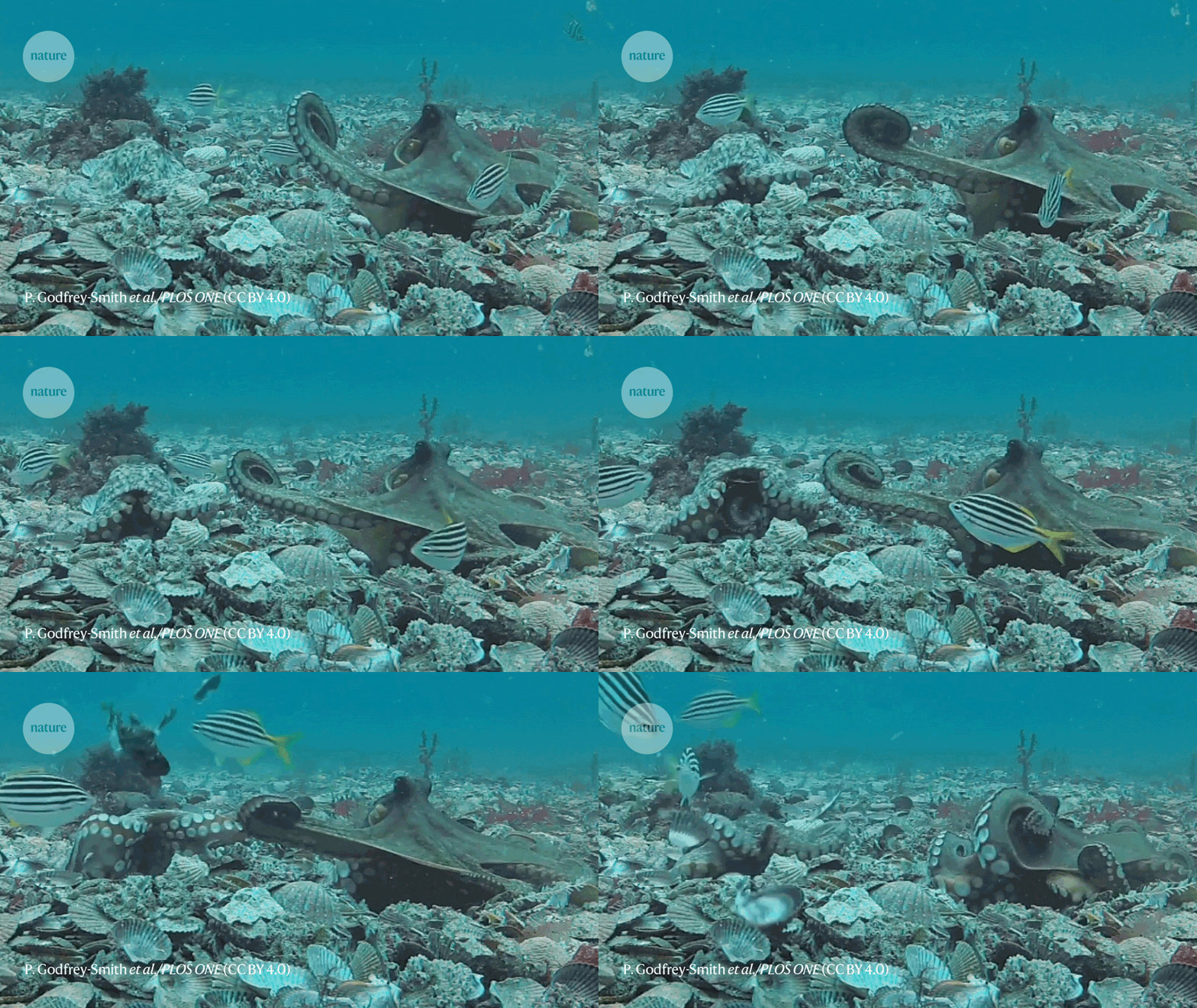
Duck! Octopuses caught on camera throwing things at each other
Cephalopods living unusually close together have been filmed throwing shells, algae and silt — sometimes at another octopus.
nature.com
504 points · by hhs · 4y ago · 185 comments
Other Minds: The Octopus, the Sea, and the Deep Origins of Consciousness
My only critique is that the plural spelling is octopuses and not octopi, just like the article. Octopuses just looks wrong and sounds funny, I stand my ground. Yes yes I know that it's not a Latin word.
He spends very little time drawing connections to consciousness or speaking about what octopus life can tell us about consciousness. There is a whole chapter where he talks about the influence of language in human action (like self-talk), and then ends the chapter by with something like "and octopuses don't have this ability". What was the point of that whole chapter then?
Maybe my expectations were miscalibrated, and I thought he would spend more time drawing connections between octopuses and humans, and what those similarities could tell us about consciousness. Instead of that, the writing about consciousness in this book is quite shallow.
On the biology part, if you never have heard of terms like "efference copy" it will be interesting food for thought about what consciousness might be, but no "solution" really. And you'll learn that an octopus is a ten megapixel screen, but that's just the first point again. If you only want that first point, there is also a "My Octopus Teacher" on Netflix, which is great in its own way.
If you wanted to read about human intelligence, I suggest "The Secret of Our Success" by Henrich instead.
Can you expand on this? I think I kind of understand where you're going with this: consciousness might be an efference copy of our actions? (so our actions don't "surprise" us? rather than consciousness creating actions?)
That sounds like a recommendation to me!
If you're more interested in consciousness a good place to start is "Conscious: A Brief Guide to the Fundamental Mystery of the Mind" by Annaka Harris.
"virus" is a nonstandard Latin mass noun. It's neuter, but uses the 2nd declension masculine nominative, and being a mass noun it had no plural form in classical Latin. However if you wanted to give it a plural form, the grammatically correct plural would be "vira". This construction would be analogous to "fishes" or "waters" in English.
"surplus" comes to us via Old French, so its plural perhaps should be whatever plurals were in Old French. However it also originates in Latin as "superplus", which is the prefix "super" + the adjective "plus". The word "plus" itself is also irregular. Its masculine or feminine nominative plural is "plures", and its neuter nominative plural is "plura".
I admit that "superplodes" is pretty fun to say.
What's irregular about that?
[1]https://en.wiktionary.org/wiki/virus#Declension_4
The plural of surplus is surpluses[2]. It would be *surplures/surplura in latin, so it is an English/French original. It doesn't make sense from an historical linguistic perspective to have a stem in dental "d" when in latin was in liquid "r": plus, pluris[3].
[2]https://en.wiktionary.org/wiki/surplus#Noun [3]https://en.wiktionary.org/wiki/plus#Declension
Cactus is a masculine name from the second declension: its latin plural is "cactī"[4]. Again, it would be unexplainable how that stem in dental would appear in a second declension name (stem in "o").
[4]https://en.wiktionary.org/wiki/cactus#Latin
Octopus is right, given that it's a third declension name with a dental stem.[5]
I wonder if "octopi" might refer to multiple octopus without making any indication as to weather they are or are not the same species, whereas 'octopodes' deliberately speaks across speciation? I dunno... I'm just spit-balling here. I probably should have done more research before commenting. Downvote if I'm way off base. :)
It is not a loanword from Greek, it was meant to be a scientific latin origin word, but not native latin like other Latin words that have -us as endings for nouns.
It’s a mess, there’s no answer, pluralize as you like but don’t go telling anyone there’s a right way because there isn’t. It’s a greek, latin, and english word, but also none of them. No usage is standard or ultimately correct.
It's a pattern matching phenomenon.
It would be less weird if there were not spelling irregularities, since the -pus is meant to be foot (like pes, pedes...in Latin, or pos, podes,... in Greek).
Basically, the spelling irregularity triggers a sensible pattern match, which happens to of course not honor the spelling irregularity.
And then nerds like me write too much about such, but i had years of Latin (and a little Greek) for something!
English is an absolute mess
As far as the plural goes, it is just a weird corner of the language where there is no consensus on what the right word is. merriam-webster lists all three variants as plurals.
What about the fishes of bread and fishes fame?
All of this is recalled from my high school Latin, which was a long time ago.
Nevertheless, the correct plural would have been "virora", like tempus => tempora (time => times) or corpus => corpora (body => bodies), or perhaps "virera", like pondus => pondera (weight => weights) or genus => genera (kind => kinds), depending on the original quality of the final vowel in the stem.
(Originally it would have been visos => visosa, but the final vowel in virus has become closed, while the intervocalic s has become r due to rhotacism.)
You have been thinking at the masculine words whose stem ends in -u, like fructu (fruit), where the singular is fructus and the plural is fructuus. There -s is not part of the stem but it is a marker of the singular masculine nominative case.
In virus and the other neuter nouns that end in -s, the -s is a part of the stem of the word, not a case marker. There are also masculine word where the stem ends in -s, like muus (mouse), in which the -s must also not be confused with the marker of the nominative case that is applied to some of the words with other kinds of stems.
Just because some English professor assholes wanted to show off their knowledge of foreign languages in the 17-19th centuries, doesn't mean we should follow those rules now. They are responsible for a lot of the confusion and horrible English rules that users of English now have to deal with. I say shit on their horrible legacy.
nautilus->nautilodes
anus->anodes
?!
Well that certainly got our attention. Please, continue.
The full thing is worth a read, but when you steal a word from one language that it also stole from a third, the pluralization rules are pretty much anything goes.
https://www.youtube.com/watch?v=s166nC_hiZ0&ab_channel=Sebas...
If you're speaking English then you just add an s or es. So Octopuses is right.
For others who may find them interesting check out "My Octopus Teacher"
It came into English from scientific (not classical) latin, so it kind of is.
[0] - https://www.theatlantic.com/science/archive/2022/11/gloomy-o...
Yes, people tend to over-anthropormphize in the sense they map to specific human concepts. But otoh, we tend to greatly underestimate the complexity of animal behavior. Sometimes people mix these up. So, just because an anthropomorphization isn't correct, doesn't mean that the behavior isn't complex.
Even animals like spiders and ants demonstratw incredible complex behavior, for social, hunting, sanitation purposes etc. So don't feel bad about anthropomorphizing, as long as you are aware it's just fun speculation. There are infinite mysteries in animal behavior and it's absolutely fascinating. There is so much left to explore.
Sure, there will be people that do anthropomorphise the octopus' actions, but this doesn't deny the possibility that an octopus can experience something analogous to feeling pissed off. (See: my table has four legs therefore it's a dog.)
To preempt those who might say "ah, but you can't prove that an octopus does have any form of consciousness" I'd point out that it's practically impossible to do that with humans too.
[0] It's certainly not one single ability. Perhaps some fuzzy superset of fuzzy sets.
[1] I include consciousness in "experiences", and I'd suggest that human-type consciousness is just one among very many.
Absolutely. Every trait previously thought unique to humans that I know of have been found in animals, such as deduction, tool making, intra-species warfare, delayed gratification, play, language, dialects, curiosity, mischieviousness, boredom, empathy, grieving rituals, etc etc. The only generic trait missing from my bingo card is humor (but monkeys seem close).
It may very well be that humans just got a constellation of traits that happened to fit really well together. If I was a betting man, I'd say:
- Very long brain development time. At birth, our skulls aren't even hard yet, and we're blind. This lets the brain develop at a slow pace towards general purpose problem solving.
- Hands are extremely helpful for tool making.
- Knowledge sharing. Yes, we're quite smart, but more importantly we can combine our findings through language and persist it over time through writing. This is an incredible change in the topology of knowledge. Even an animal with 3x intelligence would not stand a chance without language.
Do they really feel affection for their favored humans? I don't know. Discussions of this sort tend to devolve into debates about "qualia". What I do know is that octopuses appear to manifest signs of affection, and of contempt. And that I'd be honored to be nuzzled by an octopus, and I'd surely prefer that to being spit at by one.
It's equally ignorant to assume they don't have emotions as it is to assume they do. We literally don't know, but the harm in assuming they don't is people get a free pass to be cruel without guilt. If you assume they do then maybe you'll think twice about torturing animals or destroying their habitats.
The worst that can happen is you have empathy for them.
> “We weren’t able to try and assess what the reasons might be,”
What looks intentional to one observer may seem accidental to another. “A lot of animal-behavior analysts would look at the same sequence of behavior and give a different interpretation,”
My question is: was it throwing the shells out since it’s done eating them or in response to the other octopus that’s sort of messing with it?
That one instance is kinda hard to tell, but it sounds like they saw similar behaviour across observations.
Out on a hike once I came across two coyotes that were playing some elaborate games. They would chase each other around obstacles and after separating would try to ambush or sneak up on the other. It was a blast watching them.
There was also a raven who started flying around in the mix and would land next to one, vocalizing at it. There was no aggression on either side, it honestly looked like the bird was joining the play but I have no idea if that's true.
I did some research and couldn't find anything on ravens and coyotes playing together, but crows/ravens have been known to hunt with coyotes and wolves.
This head-canon melts in the face of the actual lore, but it helps me suspend disbelief.
https://en.wikipedia.org/wiki/The_Chase_(Star_Trek:_The_Next...
Children of Ruin: Parasitic space horror
https://us.macmillan.com/books/9780374605957/themountaininth...
Watching it, I immediately classify the behavior as aggression. Why they would stop at "communication" is not clear to me.
Yes..."get the fuck away from me douchebag" has always been understood as an effective way to communicate.
It seems naive to assume they don't have communication (more frequent and more complex), even though we may not have noticed or been able to detect it.
Futurama was right, about the future of TV being in hypnotic frogs and the like.
"Oh, dear Lord, all over the Dean!"