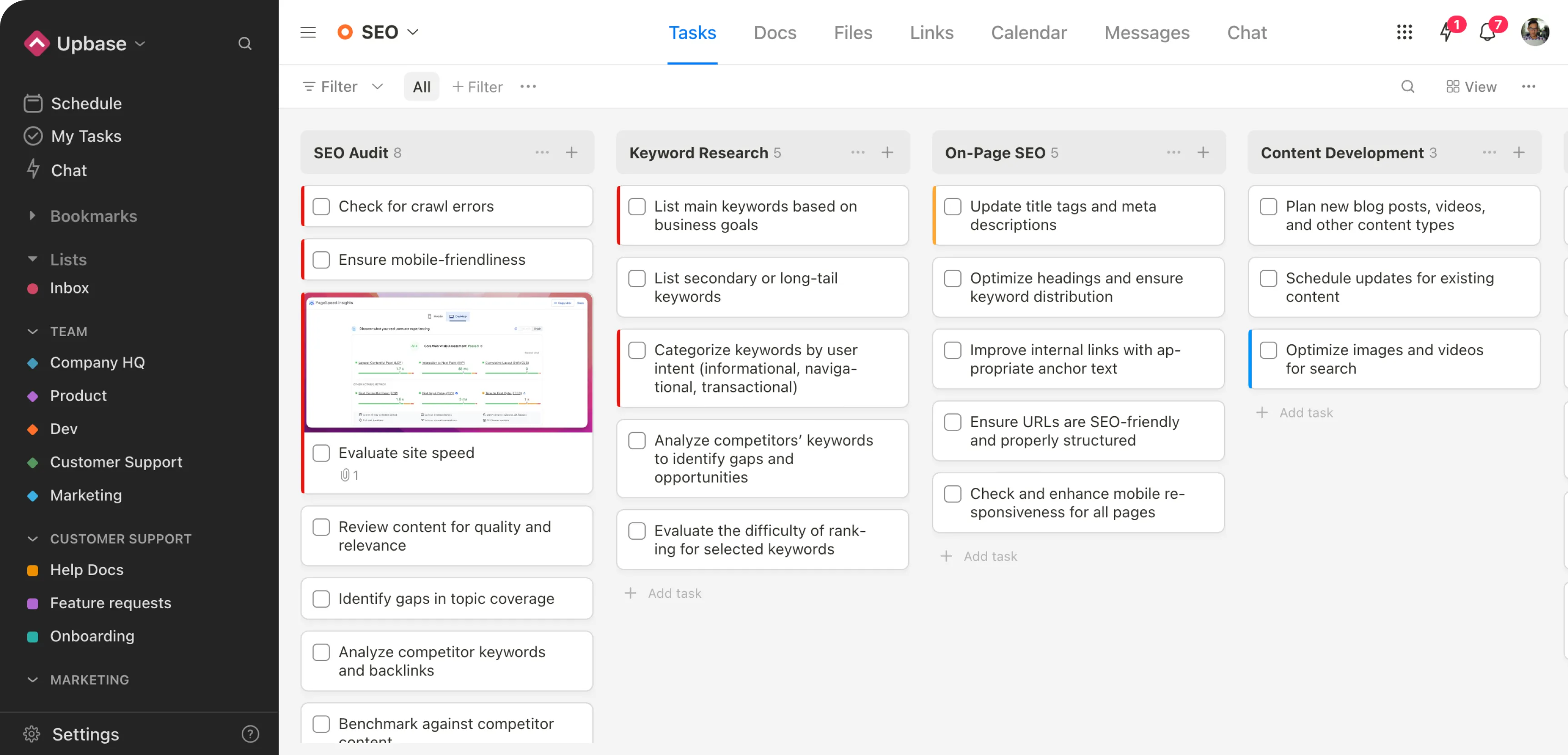
Upbase
Upbase: Project Management Tool for Agencies & Client Work
upbase.io
632 points · by tonypham · 4y ago · 453 comments
Over the past two years, I've been building Upbase, an all-in-one PM tool.
I've tried so many project management tools over the years (Trello, Asana, ClickUp, Teamwork, Wrike, Monday, etc.) but they've all fallen short. Most of them are overly complicated and painful to use. Some others, like Trello, are too limited for my needs.
Most importantly, most of these tools tend to be focused on team collaboration and completely ignore personal productivity.
They are useful for organizing my work, but not great at helping me stay focused to get things done.
That's why I decided to build Upbase.
I try to make it clean and simple, without all the bells and whistles. Apart from team collaboration, I added many personal productivity features, including Weekly/Daily planner, Time blocking, Pomodoro Timer, Daily Journal, etc. so I don't need another to-do list app.
Now I can use Upbase to collaborate with my team AND manage your personal stuff at the same time, without all the bloat.
If these resonate with you, then give Upbase a try. It has a Free Forever plan though.
Let me know if you have any feedback or questions!
You’re marketing this as having “less complexity” which first of all, isn’t going to appeal to people unless they’ve already used the other tools. But, if they had tried Trello, that’s far from complex, as you say it doesn’t have the features you think are needed, so you are more complex than that. It might be that you’re excellent at UX but that needs some comparative examples to see how you have differentiated things.
Instead, it might make sense to go more with all the features you need, nothing you don’t angle. Note that I don’t think this really differentiates too much from clickup which has personal productivity options, and as you get bigger you know customers are going to ask for more and more features, because that’s what they do, and we also know that business accounts are the money makers in this market. It also runs counter to building an “all in one” tool. If you hope to replace chat, docs, collaboration, calendar, and journaling, that’s a big change for people who stepped in just looking for task management.
I did see that your prices are lower so you might try positioning based on lower prices than your competition, if you have carefully chosen those price points.
Positioning yourself as specifically designed for solo and small team project management to me is an underserved market. When I looked at your landing page, I scrolled down quickly thinking "cool another PM tool... just what the world needs". Then when I saw the line 3/4 of the way down that said "Specifically designed for solos, small teams and businesses" that caused me to perk up and go back to the top and look at the page from a different perspective that I was much more interested in.
I see now looking at it again that you mention "personal productivity" which I now understand is your way of saying small and solos. But I just interpreted it as a PM tool that made you productive amongst your team. So it didn't really resonate to me.
Anyway, the product is actually interesting. I'm going to check it out. I've been wanting a PM tool for solos. There are a couple out there, but they all suck. The best solution up to this point for solo project management that I have found is just using a generic solution like Notion or Trello and adapting it to my needs. So this is worth a shot IMHO.
The one thing I'm concerned about regarding the positioning of "a project management suite for solos and small teams" is that people will question: "If my team grows bigger, does the app still work well for us? Or we have to find another solution?"
I’d try something a little catchy’r on the home page.
“Personalized project management for the entire team”
Or something of that ilk
This is the one thing I'm missing the most about Notion, Miro, Google Calendar, and all of this - offline support. In German trains, I'm offline, on flights, I'm often offline; while traveling, I'm often offline. Offline capabilities are often neglected.
LocalStorage is easy to use but too limited at 50Mb.
WebSQL got deprecated by FireFox because of secuirty issues years ago ( albeit is still somewhat supported in Chrome ).
The FileSystem API looked promising, and then google killed it.
IndexedDb is the only option, it's slow on writes, therefore requiring major hacks like absurd-sql to be performant. It's also old, written before ES6, needs lots of boilerplate, but it does actually work. https://developer.mozilla.org/en-US/docs/Web/API/IndexedDB_A...
Even then however there is a limit of 2GB of persistent storage it can use, which is workable but still:
Some versions of Safari are known to delete IndexedDB after 1 week because of power savings. Chrome does not allow it unless you either accept notifications from that domain and/or pass a certain lighthouse score (these reasons are anectodal and not well-documented).
So yeah it's a mess, and a bit sad considering it will take years to ratify a better standard for this, but not impossible to do. Also annoying to know that internally your browser is actually using sqlite under-the-hood anyway.
Web based game engines (i.e. XREngine) are able to get by with IndexedDB i think, and apps like https://github.com/actualbudget/actual created by the author of absurd-sql are good codebases to follow as example.
WebAssembly based sqlite is coming along nicely too. https://sqlite.org/wasm/doc/tip/about.md.
I am personally working on an offline-capable ML product using pyscript, svelte & indexedDb and it's been a painful ammount of fun so far.
2 GB is a lot when you store plain json document data.
> IndexedDb is the only option, it's slow on writes
Only when you need a new transaction per write. Writing many documents in a single tx is not slow [1]
> Safari are known to delete IndexedDB after 1 week
This is not really a problem because if you have not used the app for one week, you can just replicate the data from the server again.
> WebAssembly based sqlite is coming along nicely too
WebAssembly cannot access the IndexedDB API. In my tests, all the wrappers that use webassembly are slower on writes the just using IndexedDB via javascript.
The fastest you can go is by using a Memory-Synced wrapper around IndexedDB, like LokiJS does it or the RxDB memory plugin. [2]
You can't if you haven't been able to push up the data for a week.
But in that case, you'd just have to remember to 'use it' ever day or so.
Had a use case a few years back for data collection app in remote African villages. There were definitely situations where a week without decent data access were possible, and 'offline' became a requirement.
I haven’t tried it yet, but it’s at the top of my list. I want to try and combine it with LiteFS for syncing back up to the server, replication, etc.
Wondering if anyone has tried any of this out yet? There’s the potential for a renaissance of offline-first support for devs.
Edit: I see you mentioned it at the end, my bad
Users are downloading apps less and less and relying more on web links from apps they already have. So they mostly tend to end up on their browser anyway, and then workflow is disrupted while commuting and going in and out of signal.
Other less important reasons to consider would be in my opinion:
Electron is a bit too heavy on memory for users with 8GB and less of ram albeit it's gotten better lately.
I can't use ublock-origin on chrome or private-relay on safari while using an electron app (in this case however I still benefit from adding a blocklist like https://someonewhocares.org/hosts/ipv6zero/ to my /private/etc/hosts file on mac)
Asking sincerely: to me it seems that 50Mb is quite a bit of storage if you are only persisting simple numbers/strings or small JSON documents?
Major technical corrections on this:
WebSQL was never implemented by Firefox. It was an experimental thing that Chrome and Safari shipped, but Firefox refused to because it was the wrong direction since it was certain to in the future cause either major compatibility or functionality problems. The Chrome and Safari developers agreed with this assessment, and so the draft was discontinued, and the two implementations deprecated. Safari finally removed its three years ago, and Chrome has begun the process of removing its this year.
There were no security issues whatsoever—it’s just that what had been made was unsuitable for standardisation, and no one was willing to do the work that would be required to make it suitable for standardisation perhaps because there was no consensus that it would still be a good idea in that form. All up, the WebSQL story is pretty much “it seemed like a good idea at the time because people want the result, and we implemented and shipped it because it was really easy, but then we stepped back and thought things through and realised the entire approach was a mistake”.
50MB is plenty for time/project tracking, calendar & similar.
It is until you hit the wall on it and then you end up with a lot of tough tradeoffs.
The File System Access API [0] exists today. Unfortunately it's only Chrome based browsers, and not Firefox supporting this. Mayby you referred to an older "standard".
[0] https://developer.mozilla.org/en-US/docs/Web/API/File_System...
So IMO selling offline support as a feature has to come with a clear description of what it means.
It uses OPS which could in theory be used by other kinds of database besides SQL.
https://web.dev/file-system-access/#accessing-files-optimize...
How do you mean? They're doing blog posts about web access to the filesystem just this month.
It’s architected in a way that client syncs the data, all the actions happen locally and then delta packets are synced back to the server. This also makes the app really fast because the client doesn’t have to wait for the network to complete the action.
Will give Linear a try!
I think it could be interesting to see Linear add personal/private TODO support of some kind… like everyone gets a TODO list that is mostly a view of your linear tickets with each as a bullet point in a document (similar to when you mention them in a Notion checklist doc) but where you can also add other items which are just text (and/or entries in a personal/private linear space)
I agree, the reason offline support is often not that great is that the customers who are most likely to pay for your product are the least likely to have issues with online connectivity or to care about offline support, OP's edge cases notwithstanding.
I even travel fairly often in the US and it's rare when I'm on a plane that doesn't have wifi.
The storage itself is trivial but for everything else (queries, syncing, conflicts, validation, permissions, schema changes) there's little support and I had to make my own stuff. It works for me, because because I only have 2-3 entities but your app is much more complex, so I wouldn't recommend it even if you started from scratch.
I will say that there's nothing that really stops offline aside from ecosystem support and maturity. All it really takes is a medium-big well maintained project that solves 80-90% of use cases. I think CRDTs are promising for the data layer because it simplifies the API surface (at the expense of complex implementation).
I just launched the Android app with all networking and mobile disabled, the app showed me all my pages etc and allowed me to enter new data.
I believe they use Google Firebase Cloud to automatically synchronise data between all devices and platforms.
[1] https://icalendar.org/iCalendar-RFC-5545/3-6-2-to-do-compone...
ie basic functionality I personally look for that I don’t think this would support would include:
* Projects with hierarchies
* Reminder dates
* Tags and contexts
* Multi-Step tasks
If there is a popular standard, it will remain popular. The trick is building up enough users that they begin to credibly demand an export to the protocol from big players like Atlassian.
Even if people do have the same model then the terms are often different, depending on how you learned to do things. (Example: What is the "correct" number of levels of tasks -> subtasks and what should each layer be called, i.e "Epics -> Stories -> Tasks")
We've been building out Shortcut (https://shortcut.com/) for several years now it's not uncommon for new leadership (new VP of Eng or VP of Product) to show up in a large organization (100+ people in eng and product) and decide that whatever problems the org is having can be solved by moving to Jira and forcing everyone into a new mental model around how they're building things.
(Side note: We're tracking the rate of success of people who make this decision and how long they last in the org, and it's [perhaps unsurprisingly] not great.)
We need ANSI pomodoros clearly :)
Probably not.
>> Apart from team collaboration, I added many personal productivity features, including Weekly/Daily planner, Time blocking, Pomodoro Timer, Daily Journal, etc.
I'm having a hard time understanding how both statements can be compatible together. Open-minded to an explanation.
- I want to build a simple, easy-to-use tool. No fancy, complicated features.
- Upbase is built for teams, but it should work well for Solos/Individuals. So you can use it for both team collaboration and for managing personal stuff. In the future, you'll have the option to turn off all team features, so that you can use Upbase as a powerful task management system, without all the distractions. (At the moment, you can turn off Chat if you don't use it)
They're two separate points, though.
Try Linear.
Opinionated, in a good way, and willing to slay sacred cows, such as replacing estimated sprints with you get done what you prioritized cycles, or milestones with roadmaps.
(Now if I could just get them to replace "Projects" with something evergreen teams can work on, like "Capabilities". Fortunately all that has to change is the label.)
Productivity software should be opinionated. It's the only way the product can truly do the heavy lifting for you. Flexible software lets everyone invent their own workflows, which eventually creates chaos as teams scale.
and
Teams at different sizes have different needs.
the question now is if my opinion is overlapping, heh. These two quotes are definitely my experience, with one more which is fluidity in projects themselves from design, to 'tasks' to priority.
If the scope of a project changes, or to try various tools with an 'ultra strong vision' with real life data, it would be very helpful if the project data could be easily transferred. Is there a standard that most tools could support?
My personal opinion as a Product Manager is that there is no all-in-one tool, there never will be an all-in-one tool, and anyone promising an all-in-one tool has some significant blinders on around the job functions they have been exposed to.
Sales will use Salesforce. Engineering will use JIRA. And Product will use some generic roadmap-first tool like Asana, Trello, Miro, Monday, or MS Project. Product will beg everyone to use their tool, but no one will because it's for looking at work, not executing on it.
Product will not understand because we Product Managers don't actually DO things, we talk to people, organize ideas at a coarse level - and we have a simple tool that articulates the vision perfectly! Except it doesn't automatically integrate with the CI/CD pipeline, it doesn't automatically log the last touch with a high-priority prospect, it doesn't pass designs from the designer to the UX engineer. It doesn't actually DO anything. It becomes just another SaaS platform in our Okta stack that only the PMs look at - and it gets out of sync with the actual reality reflected in the other SaaS offerings.
And the reason it doesn't do those things is because the people who built it thought that THEY were the ones who could build the all-in-one project management tool and all those sales people, engineers, designers, lawyers, and marketing writers would log in to theirs. Insert relevant XKCD about standards here. The truth is no PM tool will ever be the system of record for the actual work, but everyone is afraid that the complexity of integrating with others will turn them into JIRA.
So we get these vaguely opinionated ways of moving around and arranging candy-colored cards, and those cards never quite show us the state of the project we are managing, so we have to bug people to "update their status in <Monday/Asana/Trello>" before the weekly meeting. Which they don't want to do because it delivers no value to THEM.
Which is all a long-winded way of saying - please think about how a piece of work from each of those functions might be represented in your view, and how that integration would happen automatically.
How many times have we seen PMs trying to brute-force JIRA (et. al) into a project management tool using weird plugins that don't co-exist peacefully. This always fails, and PMs either retreat to their own trusted platforms (if you're lucky), or in severe cases start asking everybody for "excel summary" or some "one pager" to reveal that holy "project status".
This is the only way to truly achieve the type of transparency we're all searching for.
second, if your product management processes deliver no value to your colleagues, then you may need to work on that, perhaps more as an organization than an individual pm. the product management process and tooling should absolutely deliver value to developers, designers, and other individual contributors. most pertinently, tracking velocity is for the team first and foremost, and secondarily for others. it's like keeping score in basketball--it's how the team knows how it's doing.
third, it may be big and "enterprisey", but jira is just fine for product/project management. when folks complain about jira, ~99% of the time, it's a complaint about the process and people involved, but turned toward the tool because it's hard to criticize the offending party directly.
i do agree that product management tooling is secondary to sales, marketing, finance, accounting, etc., and so must interface with those other systems for "truth" rather than being a system of record.
You can either run it out of JIRA and only manage the work of software engineers, or you can run it out of something else and be out of sync. Probably the biggest mental trap PMs of both kinds fall into is running all status checks out of JIRA and ignoring everything about their product/project/career that isn't accomplished by pushing code to prod.
I find the people do get value out of what Product brings to the table, and absolutely buy into the vision (especially if they help define it). That doesn't make them motivated to maintain an additional project tracker for a status meeting. They also don't like flossing, even though they hate cavities.
And that's what we're talking about at the end of the day, because JIRA IS really good at what it does - either everyone gets aboard the JIRA train, or the engineers track all their tickets in something less powerful, or you ask the engineers to use JIRA AND something else.
Most established places go with the first option and then their only muscle is "ship code," many startups go with the second option until they realize they actually need JIRA after all. Then some PM (of one kind or the other) has to make the third option work so that they stop getting blindsided by the compliance work or the marketing campaign.
Not exactly. Most of the time, when people complain about JIRA they are complaining about its complexity, which gets exacerbated by PM's attempts to customize the system to their own liking, turning it into spaghetti. Even when the actual intended process is fine. That, and the slowness, subpar UI and arcane permissions system.
For solos and small teams with simple workflows, I think they'll be able to use some types of "all-in-one" tools to manage their work. For large teams with complex processes, I agree with you that there are no all-in-one tools that could work well for all functions.
I've seen a lot of Monday/Asana/Trello islands in larger orgs, where someone got a foothold for their 3-10 person team but now it can't ever scale. To some extent, using those tools is betting that you'll never actually be successful (if success will require scaling the people/functions that need to be involved). What's the plan for your customers once their thing works and they want to grow?
My vision for the product is to serve solos and small teams, so we'll try to keep everything clean and simple.
Thanks again for joining the conversation here.
Like, how do you translate git commits and tests run to “project Y is now Z% done”?
Learned two interesting things
- if your tool mandates a philosophy or process, you massively shrink your market
- real pms , sponsors and engineer s buffer their risk by selectively disclosing information. They don't want a permanent record of open, granular outcome information unless they are in a very mature company.
I worked on an HR system recently, and "continual feedback" is all the rage. Folks have realized that those annual reviews and PIPs are completely divorced from reality - if we gave people continuous, incremental feedback they could course correct much more regularly. That ought to reduce the emotional shock of a PIP or a bad review, and also the time lost before the employee improves.
So performance review systems have started adding the ability to officially record weekly 1:1 meeting notes, and then getting confused that no one is using this oft-requested feature. Of course any honest feedback is purely verbal, or stored in shared documents kept as far away from HR as possible. The very fact that it's an Official HR Record makes it completely useless for purposes of getting truly honest feedback in there.
You don't, because in most cases, for anything that has the scale of a "project", nobody knows how many commits it will take for it to be done.
I think you need to put a lot of work into making the JIRA and Salesforce integrations incredibly clean, not try to get the engineers and biz dev folks to log into a single portal. Look at each of those tools with an editor's eye and figure out what is going to survive into the PM's representation and what is un-necessary complexity.
--------------------------------
Going into specifics of how I tend to run this... Personally, I've found the VMOST[1] (Vision, Mission, Objective, Strategy, Tactic) stack to be the best way of linking vision to roadmap - as lightweight as feasible while providing structure. I rename the pieces to (Vision, Objective, Key Result, Focus Area, Initiative) which tend to be more understandable to most people. This gets bonus points for easily tying into the OKR planning process that many companies run now.
That gives basically a 3-layer strategy pyramid:
* Vision: What we think the best future would look like, where we help someone do something valuable. Maybe 3 years away.
* OKRs: 3ish Objectives that we think will get us much closer to that Vision if we achieve them. For each of those, 3ish Key Results that are objective measures that let us know we have hit our Objectives or are at least going in the right direction at speed.
* Work: 2ish Focus Areas for each Objective that are consensus hypotheses of directionally how we would achieve the Key Results. Then within each Focus Area, 3-5 initiatives.
Put in time order, these Initiatives form the Roadmap. The exact scale of what counts as an Initiative depends on the team and what we're doing, but some examples: A Feature or Epic. Getting a key partnership signed. Launching a marketing campaign. Opening an office.
All of those need to be tracked in one place so that we know overall progress, track inter-function dependencies, and can have serious conversations about what's working and what isn't. It needs to be in one place so that I can ask "Is anyone doing literally anything that is not in this view? Why are you doing that thing?" The answer is usually either "SVP so-and-so said their thing was really important" or "we need to do that operationally so the current product doesn't fall apart." In which case I need to have a conversation with SVP so-and-so, and we need to explicitly decide that we are or are not ok with the current product falling apart, and incorporate support into the stack.
I always do this manually using a Wiki like Confluence, because integrations don't work right and I'm not taking time away from people who actually do things to play bookkeeping games.
I've found the lesser of two evils to be that Product integrate as closely as possible with engineering, which means using either Jira or GitHub issues for high"er" level deliverables. You have to be careful not to use too much of the textbook PM speak--"As a <user>, I can do <new novel stuff> with the platform"--but if you orient yourself around the logical scoping of engineering work, it's a whole hell of a lot easier for engineers to tie their own work items into the progress (or unfortunate lack thereof) that all of us are inevitably expected to report up to our various business leaders.
That does require some technical acumen. I'm the first to admit that I don't have any of the formal bona fides for said acumen (and I deal with a great deal of imposter syndrome as a result). But when I listen to the engineers, understand their technical blockers, AND colocate our work items, I usually have an easier time.
And yeah, I still gotta copy/paste a bunch of shit into Sheets/Slides for management
> That's why we decided to build XXXXX — an all-in-one work management software that is simple to learn and easy to use.
What's missing IMHO is this: why did you undertake the drudge of building this? All software creation is motivated by a disatisfaction with what's already out there, so what is the unique point of view that motivated you and... it is hoped, will motivate an audience who shares that point of view. It's not why you are better, cheaper, faster (those are terrible vectors for positioning btw) it's what makes you different.
Are you anal-retentive about detail and hyper-connectedness (JIRA)? Are you psychedelic burners who want to bend a spartan UX into infinite directions (Asana)? Are you cutesy but robust (Trello)? Are you so hyper-opinionated about product management to the point of pedantry (Basecamp)? All these are perfectly cromulent points of view by the way. Marketing positioning is about articulating YOUR point of view, in order to activate the tribe that shares it.
For more on this see Simon Sinek or Chris Lochead. This is my favorite topic in the world. Good luck with your product!
The lack of productivity comes from the methodology those tools implement. Their methodologies contributed a whole lot but by now we are used to that contribution, and so we must advance it.
Nestful implements a methodology I call "spontaneous productivity". In which there is no planning. Nestful will tell you what is the next thing you need to do, and that is it. Currently you have to know the methodology very well and "do it by hand", but I am very close for a smooth UX.
Either way, my point is that improving upon Trello or Asana is like honing a sharp sword. At some point, we need to switch to a gun.
Amplenote has a unique "idea/concept" they're designing for, and they spell it out in a series of very interesting blog posts [1]. I don't practice their "idea funnel" concept but their blog post made me interested enough to eventually subscribe to their service.
It would be really cool to see a similar post for Nestful.
[1] https://www.amplenote.com/blog/jots_unify_four_apps_ideas_in...
Some features, differentiators and screenshots would be a nice addition to the otherwise quite dry homepage.
I hope in the coming few months to release the "ready-made" solution for that, at which point there will be what to show on the home page.
a smart tool, it turns out, isn't all that useful, even though it has wow factor. it may even be enough of a wow to be an effective marketing tool, but an effective marketing tool is not an effective productivity tool.
[0]: we found more success as a general sales team dashboard based on the underlying realtime data
Will keep an eye on your app going forward
The UI would look like a graph and like ms project it could include resource levelling in order to show bottlenecks.
I know this probably sounds complicated but I think it maps to reality fairly well and thus actually simple (fighting reality is hard).
[0] https://heteroskedasticblog.wordpress.com/2021/12/04/softwar...
[1] https://erikbern.com/2019/04/15/why-software-projects-take-l...
As others have said, PM tools need to become more opinionated rather than recreating what already exists.
Powerful functionality always comes with the cost of UI/UX. We'll try to make our app simple and easy to use, so we try to avoid any complex features.
Anyway, thanks so much for your feedback and ideas. I appreciate it.
And just as a plug, I made https://www.knotend.com which is a keyboard-centric flowchart editor you can use to map dependencies. Im working in adding computation and probability like you say.
Critical path method > Basic techniques: https://en.wikipedia.org/wiki/Critical_path_method#Basic_tec... :
> Components: The essential technique for using CPM [8][9] is to construct a model of the project that includes the following:
> (1) A list of all activities required to complete the project (typically categorized within a work breakdown structure), (2) The time (duration) that each activity will take to complete, (3) The dependencies between the activities and, (4) Logical end points such as milestones or deliverable items.
> Using these values, CPM calculates the *longest path* of planned activities to logical end points or to the end of the project, and *the earliest and latest that each activity can start and finish without making the project longer.* This process determines which activities are "critical" (i.e., on the longest path) and which have "total float" (i.e., can be delayed without making the project longer). In project management, a critical path is the sequence of project network activities which add up to the longest overall duration, regardless if that longest duration has float or not. This determines the *shortest time possible to complete the project.\ "*
Re: [Hilbert curve, Pyschedule, CSP,] Scheduling of [OS, Conference Room,] and other Resources https://news.ycombinator.com/item?id=31777451 https://westurner.github.io/hnlog/#comment-31777451
Complexity and/or Time estimates can be stuffed into nonexclusive namespaced label names on GitHub/GitLab/Gitea:
  #ComplexityEstimate:
  C:1
  C: Fibonacci[n]
  C: (A), J, Q, K, (A)

  #TimeEstimate:
  T:2d
  T:5m

  #Good First Issue
Gitea has untyped Issue dependency edges, but there could probably easily be another column in the is-it-a through table for the many-to-many Issue edges table to support typed edges with URIs i.e. JSONLD RDF.
GitLab Free supports the "relates to" Linked Issue relation; EE also supports "blocks"/"is blocked by".
Planning poker: https://en.wikipedia.org/wiki/Planning_poker
Agile estimation: https://www.google.com/search?q=agile+estimation
"Agile Estimating and Planning" (2005) https://g.co/kgs/kDScM7
When you really need it (like in the case of tens of thousands of people trying to build and ship a single project at lighting speed) PERT is an extremely powerful and effective project management methodology. If, on the other hand, your "project management division" is you, it's a dangerously seductive time sink that will consume huge amounts of your time building and tuning and gathering and updating data and information, for arbitrarily close to zero direct real benefit and huge net negative benefit. The increase in effectiveness you gain from all that modeling is, in software development projects, negligible and the cost of doing all that modeling is much higher than you think it will be if you've never done it (that's why we don't do waterfall planning in software - it's not that no one's thought of it, it's that it's not effective on projects of any real complexity). As with any approach to planning, PERT works best at a particular scale and project type, and it's typically a quite large scale non-software project.
In my personal opinion, from a software development standpoint, the valuable part of building a PERT chart is doing the work and thinking required to draw a dependency map for your tasks. Drawing all those lines to show what has to be done before what is an incredibly effective tool for helping you flesh out and find dependencies (tasks) you hadn't realized needed to be on your list. Use something like MS Project to build that dependency diagram, then force yourself to stop using Project because it's too seductive at making you feel like the data is giving you power when it's really just consuming your brainpower ineffectively. Use dependency mapping to build a waterfall caliber understanding of what you need to build, then set it aside and use more appropriate agile style approaches to actually work through the project in an optimum manner (which often means not building it in exactly the way you mapped out originally).
[0]https://en.m.wikipedia.org/wiki/Program_evaluation_and_revie...
PERT -> see also ->
"Project network" https://en.wikipedia.org/wiki/Project_network :
> Other techniques: The condition for a valid project network is that it doesn't contain any circular references.*
> Project dependencies can also be depicted by a predecessor table. Although such a form is very inconvenient for human analysis, project management software often offers such a view for data entry.
> An alternative way of showing and analyzing the sequence of project work is the design structure matrix or dependency structure matrix.
design structure matrix or dependency structure matrix: https://en.wikipedia.org/wiki/Design_structure_matrix
READMEs, Issues, Pull Requests, and Project Board Cards may contain Nested Markdown Task Lists with Issue (and actual Pull Request) # references:
  - [ ] Objective
    - [x] Task 1 +tag
    - [ ] #237 (GitHub fills in the Title and Open/Closed/Merged state and adds a *hover card*)
    - [x] Multiline Markdown list item indentation

      <URL|text|>

      - ID#:
      - Title:
      - Labels: [ ]
      - Description: |
        - htps://URL#yaml-yamlld
    - [x] Multiline Markdown list item indentation w/ --- YAML front matter delimiters

      ---
      - id:
      - title:
      - labels: [ ]
      ---
      - htps://URL#yaml-yamlld
  |            | Important | Not important
  | Urgent     |
  | Not Urgent |
> https://en.wikipedia.org/wiki/Strategic_alignment ... "Schema.org: Mission, Project, Goal, Objective, Task" https://news.ycombinator.com/item?id=12525141
I'm a high-level PM and I'm not so sure why the tool is trying to do everything. I use a messaging app to talk to people. I use a todo app to track my personal and business commitments, and I use physical paper and timers to track my personal productivity (weekly plans, journals, timers, etc).
The beauty of PM work is that you can mix and match the tools that make you more effective over time. Maybe that's software, maybe that's more analog tools.
I think this is an excellent solution for teams that aren't established and small in nature though.
I especially feel it will be extremely difficult to compete with the likes of where Notion and GitHub are headed with project management tooling.
The free tier is not a perfect fit a solo person for the same reason.
Wonder if it could be worth trying offering tiers based on your vision for different size teams. Eg a solo person gets a single user (no user management features), no chat, no any multi-user features.
It's also a double-edged sword, because decentralization is safer for me if your company ever goes belly-up or you are acquired by a company that decides to change the product for the worst. On that note, I'm not seeing any options to download or export all my upbase data. Will that be on the roadmap? I don't think I can really commit to upbase until that safety net is at least on the roadmap.
Lifetime deals on products that have a real recurring lifetime cost rarely work out, and are an immediate red flag, especially for a new project.
Is it just a notice board (like product hunt) where you get some exposure? Or do you pay for it (other than offering a bargain discount..)?
- Select: You have to apply to be chosen, they do all the marketing for you and cut 70% of revenue);
- Marketplace listing: You do everything yourself and keep 70% of the revenue.
Sorry, I've been burned enough times by this now that if your software is not FOSS, I'm not deploying it. Your take is not a good look.
For an open source alternative, check out Focalboard [0]. Note however it is backed by a for-profit company, but the code is open and can be compiled from source (so you can thus remove all telemetry and paid upsell nonsense).
I am not sure whether the reasoning is mostly from a concern over IP theft perspective or piracy, but I would consider looking into whether you think you could sustain a self-hosted version in the future.
I think legitimate competitors tend to be unwilling to take the risk reverse engineering things and directly stealing your product. And legitimate businesses also tend not to be willing to take the risk of being audited and getting caught using pirated software, …or, actually, maybe…. story on that later ;-) [1]
And I will probably lose you here, but I would also consider whether a FOSS model could work for you; there are a number of open-source/open-core/semi-opensource services that are seemingly viable commercial products. One example might be GitLab, and another would be Drone CI.
Perhaps consider whether you could survive, and potentially be even more profitable, by doing something like offering the platform as a self-hosted, opensource service, ideally under something like the AGPL, and then require contributors to dual-license their contributions under the AGPL and an incredibly permissive license (e.g., ISC, BSD of some sort, MIT, Unlicense, etc — pick whatever).
This model would allow you guys do opensource the core for the paranoid among us while also preventing any realistic competitors from swooping in and yoinking your hard work for their own financial gain, since they’d likely not be willing to integrate AGPL code into their service.
And by requiring contributions to be dual-licensed under an incredibly permissive license, this’d essentially grant you the same benefits of having contributions sign a properly evil CLA that demands all copyright be transferred to you, etc (e.g., an open-core like GitLab, where you could upsell people on proprietary enterprise features) without the need to drive away potential contributors by being extra evil.
I think this may not even be that awful of an idea, in the sense that:
- A. I think many proper companies that would be big spenders also would rather delegate all the responsibility to you
- B. while I don’t love opencore as opposed to truly fully FOSS, many do seem to be willing to pay
- C. Ultra-broke indie devs, hacker types, etc, many who likely would not pay in the first place, and many of whom may not be willing to use non-FOSS stuff would still be increasing your mindshare, potentially contributing back, etc — free advertising, essentially.
As an example, I cannot count how many times I have heard users of opensource BitWarden praise it everywhere they get a chance, to the point to where I finally caved and decided to give it a try in order to get my parents to stop forgetting their passwords to everything.
And when I did, I actually did not use the FOSS version, despite being the type personally who would have normally; I just didn’t want to add yet another thing I needed to potentially help other people maintain, so it was worth paying.
- D. Lastly, I think it is good PR and branding. Cloud services change all the time. It adds a nice bit of trust knowing that you can only screw up the service so badly before someone decides to just fork.
Don’t take this too harshly, please, because I actually do think the service looks really good, and I do admire and respect the fact such a small team put in the grind to manage to launch it. And I plan to go pay for the lifetime service once I finish up this message.
But that said, man, being truthful, there are a lot of tiny software startups that offer pretty, polished cloud applications, and there are a lot of tiny startups that initially offer “unlimited” plans and “lifetime” subscriptions.
Yet, maybe this is my overly cynical take, but here is what always happens:
- either you simply decide eventually that it’s not worth the money to retain these lifetime users anymore, so you tell tell them that their lifetime service isn’t really lifetime, or you end up taking VC money, because, realistically, it’s hard to say no, and then they make that same decision for you.
- someone uploads 10tb of data to the unlimited service and then my unlimited account is suddenly “unlimited” in the same sense that my unlimited phone is unlimited — I.e. it’s not unlimited; either there ends up being an fair usage policy that makes me wish I’d have just paid for a couple of terabytes directly, or someone decides to add annoying rate-limits to prevent abuse.
In that sense, as I look at the website, I see a lot of red flags. And I just hope they are not as red as they seem.
As I think we both know, lifetime unlimited is not sustainable, so as you’ve said, you guys have chosen this model for the time being in order to avoid VC funding.
If that is the case, then here’s to hoping that you do end up treating all of the early funders right: some people will absolutely upload 2, 3, 5, 10TB worth of content to their unlimited plan.
And yes it may suck paying to keep their stuff stored indefinitely despite no longer receiving money from them (cause it’s a lifetime payment). But I think that is a fair trade-off to avoid the things that do suck about VC funding.
As an example, while I’m aware that being selected for YC brings more than simply cash benefits, when we’re talking about exchanging 10% of the company for $100k, well, dang, I think YC gets a very good deal there when things go well (e.g., Dropbox, etc).
Similarly, if people are gonna dump the cost of a typical annual sub for Dropbox/whatever into your company that may not be around in a couple of years from now, then I would hope you reward them by deciding they are worth the $50-100 a year that it’ll cost to maintain some of them in the future.
(P.s. again, it is perhaps brutal criticism, and maybe it is a little overly cynical and unfair of me, but I don’t mean any harm by it — so pls don’t feel a little bummed out, or I will be a guilty baby)
[1]: except the one time a certain multi-billion dollar electronics company decided to launch their gaming computer brand, and proceeded to try and pirate the Steam OpenID integration for XenForo I was selling $15.00 one-off payment — and had gall to ask for support of all things!!
I would argue this just means that, in this space, one size does not fit all. There are many productivity features, and everyone has a different set of features they want. If you're using a tool that is missing some features you want, you perceive it as limited. If you're using a tool that has a lot of features you don't care about, you perceive it as overly complex.
In short, everyone has their own dreams, preferences, (perceived)needs, and workflows and they are usually unwilling to tweak their own approach and would rather have a tool that fits them. They may be right that their "needs" are truly needs instead of just preferences but either way, you end up with a swarm of nasty little variations that are meaningless for vast swathes of the space. That's why any list of "project management tools" has 100+ entries and is still incomplete.
~10 years back, I realized that most of the people who are open minded enough tweaked their own processes to flip to something like Trello (as I did a few years later). They're still unsatisfied - I wish Trello had intercard dependencies and per-checklist item due dates - but making due.
Happy to offer more info and advice, feel free to ping me.
Intercard dependencies may be covered by a power-up[1].
Per-checklist item due dates were added in the last couple years[2].
1. https://screenful.com/card-dependencies-for-trello
2. https://support.atlassian.com/trello/docs/how-to-use-advance...
The problem is enumerating them all and consolidating the language such that it is neither more nor less expressive than necessary.
Then we can truly dump JIRA once and for all.
If you're looking for broad adoption, I'd focus heavily on your interop and portability story: import and export. If it's easy to try with "bring your own extant content", and mitigated risk of lockin via robust export, the PKM / TFT community will be much more likely to engage. And the community per se is a huge factor in such tools' appeal and viabilty.
Thanks for sharing, good on you for actually shipping, and good luck!
I'm wondering, would you bother verify Upbase.io on SaaSHub? Pls ping me if you do so, and I will get it featured on the newsletter there. Cheers!
Anything else is additional user frustration and serves no real purpose given that you're presumably not storing passwords in plaintext in the year 2022.
my personal stance is: if they can type it, it can be in a password
made trello still the best and most clean
It would be nice to see a comparison with Linear.
The site is responsive, however the mobile UX could be improved for sure.
Some restaurants do this pretty well, from small around-the-corner Italian places, to even places like Five Guys where they use their underdog story as a way to build connection. Of course they're not an underdog anymore though.
There are a lot of these Trello/JIRA alternatives. I am sure they are better in one or more dimensions, but I sort of need some kind of evidence breadcrumb to make me believe it is worth the 5-10 hours of time to work out if your product is worth spending another lots of hours transitioning from JIRA to. In some sense then, for people using X already, the price doesn't matter, as long as it is not ridiculously high.
I imagine it is better to target more. Your story says "our team of six people was working on a small content marketing project.". Maybe if you target content marketing teams, you can talk directly to their pain? You might need a landing page per customer profile. Obviously with HN you can only submit one link, so the one for Engineering teams would make sense I guess.
I think start by selling to content marketing teams, as your mouths are full of that dog food already, and it tastes good presumably!
As a side conversation, this project and how you described it made me think about why I have such issues with Jira. Jira is actually fucking useless to me. To the business, it's indispensible because it captures the larger tasks that roll up to a larger business objective. However, for each of those larger tasks I have a series of conversations and cross-functional dependencies that must be negotiated. More basically, my minutiae is much more than the larger tasks can ever describe, and that minutiae is much too noisy for the business to track - which is why we cover it informally in stand ups.
What I need is something offline that tracks my minutiae like stories where the larger tasks (that are currently stories to the business) get tracked like epics on my end.
I say this from the perspective of working at a very large, top-level engineering firm.
Are you saying that what is a story at work, and captured within a single “unit” within Jira (I don’t want to use “task”, because that’s a separate thing in Jira) is more broad, but you benefit from having that story broken down further, and that’s where you would use something like Upbase?
In a contrived example, if my OKR is to reduce the engineer attention in a given support process by 50%, my epic might be to create a framework for automating tasks via Slack. My stories then might be:
- Spike: Investigate Slack API
- Spike: Investigate programattic interfaces of Jenkins
- Build bot framework
- Build pluggable Jenkins module
- Spike: determine deployment patterns for framework + modules
To a business, these are bite-size as the chunks can be, but to me that may involve tracking threads in channels, doing POCs, and doing a lot of reading. All of those things may fall under a single story.
In a laymen's sense, I need a Jira for my Jiras that the business doesn't need to track because those things largely don't matter to the whole.
If a story is your smallest unit of work, does one developer own a story? Or are multiple people working on it? Intuitively it feels like if multiple people are working on a single story then it feels like that should (or at least could) be broken down into subtasks (or checklist items, if you didn’t want to create new tickets) that could be split between developers, and keeping that context and discussion within that ticket, I would think, would be helpful for knowledge sharing and drawing from that discussion to feed into your longer term knowledge base docs.
Just food for thought from someone who tool hops way too frequently with poor short term memory .
Sometimes it's not worth putting everything into a ticketing system.
For large teams with a complex process, I think the problem is the process itself, not the tool.
But let me ask you a question. If I want to get your attention, which one of the following techniques will work best:
1) Write you a snailmail letter 2) Send you an email 3) Send you a text 4) Write it on a yellow post-it note on your refrigerator
The answer is 4. Because it's the most difficult to ignore and leverages our ancient human physiology. It's not an accident that Kent Beck (Author of "Extreme Programming: Embrace Change") used post-it notes stuck to a wall that had every story written on it that mattered to the team within eyesight of every developer.
The problem is that when we get together to put information into a Jira or a Trello or whatever, we're making THE TOOL happy. What matters is the state of the tool, not the state of the system you're working on.
Is user-generated data private enough? I know Trello, Asana, etc. are widely used by businesses, but that is after many b2b guarantees about privacy, defined through legal agreements. For everyone else, it's what you say in Privacy policy document.
Bonus: If the data is end-to-end encrypted, you won't even need to get legal involved. It is a big feature in itself, but it's worth considering in the interest of future opportunities.
Edit: also, rather than folders > lists > sections, it might be worthwhile to introduce nested folders, which is a very popular feature request in ClickUp but that team never actually got around to adding it. Another thing: subtasks.
My question is, you say, there are 2 lists for the free users.
What exactly are "lists" in your app?
____
On a different note, I always long for an app that is designed for the solo user for personal needs only.
Most people, including myself, have to use for work what their org uses for task management.
But an app designed specifically for solo users would be great. No need for collab tools or messaging, just simple one-user workflow across multiple devices with free sync.
I would pay $10/$20/$30 one-time for it. It would be so great.
I would like to track here what languages/libraries I am going to learn next, to what movie I want to watch to books that I would want to read.
Lists in Upbase are like projects in other apps. We plan to have an option for you to turn off all team collaboration features, so it'd be clutter-free.
You need to add 2FA to you authentication, security is a big deal. How do will I know that my project information is safe on your site? It has almost all the features would need for doing pm. I will definitively try it out!
I found some piece of software that I can host and it gets me limping along but not very happy with it.
I am more than willing to pay for license and for upgrades (when I feel I need those) but as much as possible I absolutely refuse to become a hostage of multiple different companies holding my data and extracting monthly rent.
[0]: https://uxwizz.com/
I spent the next hour fuming and imagining how it would work if it was done right (i.e. the way I thought it should work). Necessity is the mother of invention, after all.
I soon sobered up, realizing I had neither time nor patience (or talent, maybe) to build it right.
Respect to you for rolling your own.
https://www.tutorialspoint.com/jira/jira_view_change_history...
I should be able to cut and paste or press a button to restore the description, but no.
Thanks!
Building a team is always a turn-key project. Tools are a part of it.
Time will tell if this is going to be a widely adopted framework or you are able to inspire several people with your ideas and some of them get adopted in other tools. Even if it only allowed you to better understand your ideas it is worth it. Once again - congratulations and continue inspiring others!
Also if I create a task on a weekly planner view, it should I believe show up as a task which "needs to be done" . It seems to not exist, unless I am in weekly view.
Because of this missing functionality or my ability to figure it out I cant use it - I think its a simple expectation my end though. Just offering feedback, looks great tho.
Weekly Planner and Daily Planner are the two main views, so you need to go to these pages to check for due tasks.
“most of these tools tend to be focused on team collaboration and completely ignore personal productivity.” - did you consider tools like Todoist and Nirvana which are more individual-focused? (Yet Todoist has project sharing and collaboration for teams as well).
Also remember the best to-do list app will fall flat if you don’t pair it with a good method and a lot of discipline - kudos for including some links to relevant materials in your web page.
The "I built" in the title seems misleading, what's up there @OP ?
I always read those as "I lead the team that built it"
There’s nothing wrong with that, but what I am taking away as someone who wants a personal PM tool from your positioning is that most future updates will be team productivity focus rather than individual productivity. Therefore, I shouldn’t invest in it as an individual.
Really cool PM tool overall tho!
There are many upcoming features that solos will find helpful, like tags, custom fields, Google Calendar sync, etc.
Furthermore, we plan to have the option to turn off all team features so that you won't find the app cluttered if you use Upbase as your personal PM tool.
  - Specify what counts as "symbols" in a password (a = sign apparently does not).
  - When you click rename on a "section" (a column in the kanban board), I suggest focus the text box in the modal so the user can start typing immediately).
To the OP: this is extremely well done. Congrats on launching. Love the design and the packaging.
BUT; I setup both mobile and and desktop web. Seems like they are not syncing. Certainly not real time. Added to desktop and still not on mobile 3 minutes later even if i refresh. I logged into both with my goggle account. Are they even the same board?
Deal breaker on the lack of realtime sync.
Even with a personal Microsof account you can use Onenote, Teams (for chat I would use maybe Discord) and ToDo for lists.
or Google Workspace ofc. Or even Proton.me
But I have been interested in Notion or Wordpress to get my own Wiki going, but this does look good.
You can check it out to see if it's a good fit.
Cheers,
You seriously don't want to see my calendar each week. (Or maybe you do for understanding this pain point).. but having a personal planning tool understand the colors of my calendar events would be an immediate killer for me.
I've tested abotu 15 different tools, and in the end found that there wans't any personal tools available. The closest I found was Sunsama. I currently use "Sortd" though for the email integration.
What would close the gap between "closest" and "perfect for you"?
Will definitely check this out OP.
[0]: https://getplan.co
One quick thing i noticed, When i enter new section name and press tab, it is ignored unlike if you press enter, at least in board view. I'd imagine pressing tab after input is typical user behaviour.
I got your point on section naming behavior. We'll optimize it in the upcoming days.
I’ve developed an extension that I’m trying to make compatible with as many product(ivity) tools as possible and would love to add yours to the list.
Don't listen to the flood of critics online. Instead find trusted friends and colleagues who have your best interests at heart when they give feedback. Best of luck.
Is it possible to sync the calendar with iCloud and Google? If yes, both ways? We have shared calendars in our family and don't want to use an external app to see whats up but happy to the planning in upbase ofc.
On Board -> Task opens in sidepanel -> Drag and drop task from section to sidepanel ##Fails
Bought subscription -> appsumo returns key code -> used it in promo code. Still don't have full version.
Very frustrating.
Appologize for the issues. Please send me a message via help@upbase.io.
Any plans to add dark mode?
And why does it default to 'list view' every time I click on 'my tasks'? I want to see the board by default.
I might have missed it but does it support flexible recurrence for tasks? E.g. "change furnace filters every 3 months" but not on a fixed schedule but 3 months from when I last completed the task?
Turns out a team built this.
They are way too slow loading huge Javascript libraries unnecessarily.
By the way, what you are building looked almost exactly like Wrike.
If you test it out for some time, you'll see that it's much different from Wrike.
Not trying to be pessimistic, but doesn't notion give you all these already ? Or did I miss something here ?
It’s a one man idea show with a web of potential add in SMEs on a limited basis but a large volume of subcontracting evaluation and go forward structures for supply chain.
Hope he gets his head around this and finds it a fit. Thank you for sharing. Every tool in its right place helps the shop work efficiently!
I will try it out soon! Good luck!
A prioritised to-do list.
It’s simple. It works.
I have few ideas on how you can improve this with lots of integrations. I can be reached at fameoflight@gmail.com if you want to chat.
My only feedback for you is this: Charge more. You're undercutting yourself a lot by just charging $6 per user. At the very least double that to $12 and it would still be a great price for the value you're offering.
Why would I pay $12/user just for this tool?
Where you have a chance to compete is by offering a differentiated service like q boutique company.
I don’t want to get customers that will complain about paying an extra $6. These are the people that will complain about minor things and just cause trouble. Raising prices will get rid of these problematic customers. People that really see the value of a bespoke solution will still pay for it
ToDo/Tasks: https://support.microsoft.com/en-us/office/use-the-tasks-app...
https://apps.microsoft.com/store/detail/microsoft-to-do-list...
Teams already has chat, meetings, calendar, wiki (but a very shitty one), file storage, docs via a OneNote document.
I kind of agree with OP, it looks nice for my personal stuff.
But if you are a company, why? And why trust their cloud with your data over a company like Google or MS?
This advice just won't die in these Show HN discussions. Please show some evidence to support your assertion.
> At the very least double that to $12
Every tool listed in the post costs way less than $12/month. Those are established companies, selling to large businesses, and they probably have more information on pricing than a random HN commenter.
A shallow "charge more" with nothing to support that advice does not add anything to these discussions.
I'm thinking of introducing an Individual pricing plan (one user only) in which we strip away all team features. This would help bring much better user experiences since there was no unnecessary clutter or noise.
I'd like to hear your thoughts about it.
This tool looks like the perfect productivity tool for me - as a staff engineer with accountability for the deliverables of 2 teams (might become 3 soon).
As I can no longer simply track my work in a team's JIRA board, I need some way to keep track of what I'm planning to do, what's in progress, and what's done -- and separately for each team; also including journal entries so I can log research I've done or conversations I've had. The Pomodoro timer and other personal productivity features just make it all the more attractive - a perfect fit.
Upbase looks perfect for this -- minus the team features.
On this Individual plan, should we allow team features to be turned on and new members to be invited afterward?
But I imagine a solo founder wanting to start on a low-cost individual plan, and expects to eventually add new members when he/she gets a co-founder and/or more team members.
In any case, people like the feeling of there being an easy "on-ramp" to what they imagine they'll do in the future. GitHub in particular has achieved mastery of easy on-ramps to more (paid) features.
I'd be curious to find out how many Trello boards start out with 1 person and others join weeks or months later.
Launch teams feature under paid plan that has a management system built in, with a manager.
Btw, i bought a lifetime plan (sucker?) but it is not activating.
There seems to be a bug with dates (maybe timezones)? I'm in the central US, and just created a task with a date of today (Nov 13) -- it shows up as "Yesterday".
but a calendar without Google calendar integration? How is this supposed to work? (not asking to be mean but perhaps I'm missing something)
Unlike OP, this is meant as purely personal tool, kinda like Things.
I made it for myself, and love using it.
A good project manager will do a good job even with index cards taped to the wall. A bad project manager will do a poor job even with the best software tools.
People who have the aptitude and desire and organizational skills to be good project managers are rare. You need to seek them out, not keep looking for magic in software tools.
If it's personal productivity you are after, you need to work on the skills that support that. I can't tell you how, because I'm pretty bad at it myself. Maybe look at some of the best-sellers such as Getting Things Done. But it won't be easy if you don't naturally have the necessary organized mind and self motivation. Software won't give you that.
When something goes wrong, I look at the code, recent changes to it, and the discussion that happened in writing that code.
I'm not interested in anything that washes its hands of scope when the item is marked done. I want easy ways of getting back to all that data long after it's marked done.