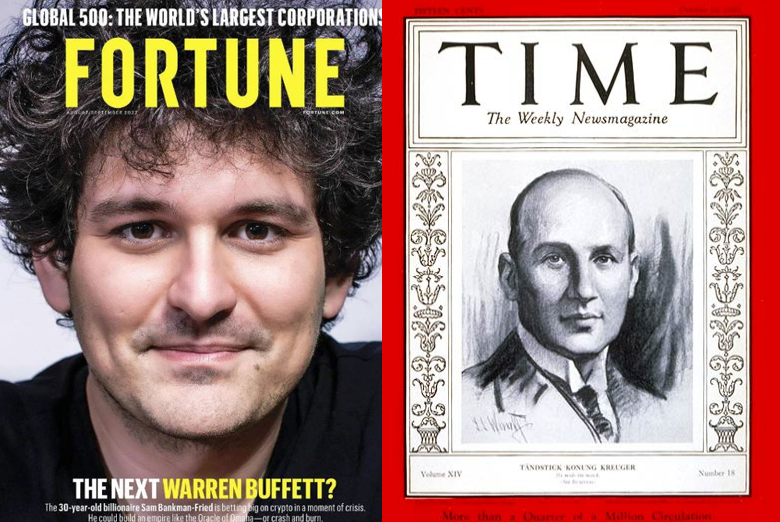
Sam Bankman-Fried vs. The Match King - A Wealth of Common Sense
The similarities between Ivar Kreuger and Sam Bankman Fried.
A Wealth of Common Sense
139 points · by Amorymeltzer · 4y ago · 147 comments
Meritocracy isn't a full on illusion, but we also don't have enough data and transparency into modern power structures.
There was no downturn when Theranos collapsed. These schemes all eventually break down and tumble upon their lies.
Worldcom also collapsed in 2002. I don't think it was related to the Tech Bubble if I'm remembering history correctly.
But the business cycle is what really clears even the most clever ones out.
It's just another power structure in the end, one that favor a kind of elite over another.
The Wikipedia pages of all of these people only relates to their relationship to FTX, they aren't running US fiscal policy.
Which reminds me, I need to update my LinkedIn profile. I wish I knew what to post. This is all I can think of:
Day 1: here's my coffee cup <photo> Day 2: didn't sleep well, oh well Day 2: here's my coffee cup <photo> Day 3: feeling refreshed, thanks certa Day 4: interesting stackoverflow discussion <link> Day 4: here's my coffee cup again <photo>
That sounds about as interesting as watching rocks break down into dust. I get the "what" of social media engagement, but I don't understand the "how". If I did, maybe I would've gone to MIT.
You would think the immense reach of the Internet would allow for greater emergent wins, right? Larger network, larger opportunities. Their goal may not be monetary foremost, but their creativity is channeled into those projects.
I guess if we want it, we develop our capabilities to leverage the next opportunity. Without waiting, we create our own luck. Unending practice, making and learning and repeating. Maximizing the luck surface area, as they say.
But it may not happen on our usual timeline. It may happen in the hours between sleep and work, when we're staring at our bookshelves or bookmarks and thinking, "I really gotta do this thing."
I'm baffled you'd pick this hill.
AFAIK, her dad is the chair of the #1 economics department in the world![0]
[0] https://economics.mit.edu/people/faculty/glenn-ellison
Edit: And her mom (?) is also in the same department [1] with industry connections in pharma/ecommerce.
[1] https://economics.mit.edu/people/faculty/sara-fisher-ellison
And you think SBF will escape accountability due to his connections? He won't
If you think those connections helped him get VC funding, I can assure you they help a lot of people and most do not become multi billion dollar frauds. The fact that he is an upper class white guy is the important part, the rest is you just reading way too much into this.
Later I found out that she was the kid of a VP who also worked there. Must be nice to have well-connected parents
Sure enough, his last name is Tyson. Daddy is chairman of the board. He went to Harvard undergrad and Standford MBA (got in purely on merit, I'm sure). Then it looks like he worked all of 2 years in investment banking somewhere before ascending to the throne of leadership.
It's like they barely even tried to make it look like a meritocracy. Where is the fiduciary responsibility? Seems like an easy shareholder lawsuit.
[0] by this I mean, any drudgery work that falls by the wayside. Not demeaning, just not necessarily exciting
Give them something interesting that could make for a great VP demo that you’d want to work on if you had the time to do, but are too busy working on actual deliverables.
Interns also get to meet the exec teams and usually the CEO. It’s a great place to be!
His father was a senior executive and so he knew he would get a seat on the equity trading desk no matter what, so he didn't care about us. I hated that guy, and I hated him even more because I knew his career would be way more successful than mine would ever be.
The finance industry (and surely other industries) have this concept of "pedigree" that values some people more than others. It's bad for the organizations because poorly qualified nose-pickers get promoted as they coast by in life, while others who are working hard to improve themselves and add value will either get passed over or used as pawns.
Another question to ask... Is the person where they are because of their parents or in spite of them?
People "investing" into a cryptocoin because "value goes up" weren't being part of a meritocracy what so ever.
There was never any true value to FTT. Hell, there's barely any value to BTC or ETH as it is and its been 14 years of looking for a valid use case. The little value it has is in black market, and perpetuating fraudsters like SBF.
Sitting around with $100,000, doing nothing, and hoping to get $200,000 or more later isn't really a meritocracy at all.
I hope so. The past 10 years have been absurd IMO. I am of the opinion that returning the Fed Rate back to "more than zero" has begun to unravel a lot of these "money goes up" schemes.
Now that money actually costs money to borrow (up from 0% to 3.75%), you can't just keep borrowing for infinite amounts of time and hoping for the best. You actually have to be doing something substantial with the money: building factories or buying servers or using R&D funds to hire programmers to make new things.
"Line goes up therefore I buy" is one of the _LEAST_ "meritocracy" things I've ever seen in my life. Be it crappy stock from some companies, or cryptocoin.
----------
I want cryptocoins to return to the days about solving financial problems in new innovative ways. Can we go back to talking about how to use 3-out-of-5 bitcoin wallets to implement new protocols of exchange and/or escrow? When did we become so focused on "number goes up" and "inflation hedge" and "have fun staying poor" ??
When the damn coin can do something that physical money can't do, and when people build businesses on top of that trick, that's when we move forward as a society. Not just this weird hype-fest, buying out of stadiums (Miami Stadium / others), or buying out Superbowl ads.
You can literally look at the Top line audited Revenue.
Can companies be overvalued? absolutely, just like how it can be massively undervalued (e.g META)
crypto, gold, art are asset classes that don't produce anything. So, you have to find other suckers to pay higher. But all three is based on scarcity. So, it is a supply/demand philosophy (vs cash generating assets like Bonds, Stocks, Real Estate). At least BTC/ETH/Art/Gold has natural supply limits, so the only unknown is demand. How do you induce demand? By telling stories about the asset class.
Art lends itself to natural storytellling. What about Gold and Bitcoin? The charlatans and hucksters and persuaders quickly figured out that "hating government" is universal and scales very easily. So peddling Gold/Silver became easy in the name of government and Gold performed the role of this anti-government asset class for quite a long period.
The initial internet adapters, Gen-Xers also leveraged internet (zerohedge, infowars, dredge report) to amplify anti-government/elite hate and peddle gold. This worked pretty much till 2012.
But, 2012 onwards Millennials started to take control of the internet narrative and buying Gold wasn't easy on the internet. So, they latched on to this new anti-government asset class, BTC.
The era of influencers and social media accelerated Crypto story-telling culminating in peak viral story telling in 2020/21 due to the pandemic (combined with unprecedented free money both for the rich and poor).
Cryptocurrencies are here to stay, thanks to it scalable narrative about anti-government with 8 Billion Total Addressable Market.
However, BTC maximalists should be wary about BTC as the one-true asset class. As wealth concentrates among the 0.1% of BTC holders, and poor environmental impact story around BTC, newer generation may revolt and rally around another poor-man cryptocurrency (like Dogecoin or something else).
The system goes wrong when they lie about that value or business model (fundamentals) to some degree (sometimes crossing the border of legality), wanting inflated valuations, and because unscrupulous investors want just that they pile on and support the bluff.
But in this case we're talking about cases where there's never even intended to be any such value.
He never had $16B. That was just bad reporting.
He owns a large stake of FTX, which turned out to be worth zero, and he owns a large state of Alameda Research, which turned out to be worth zero as well.
He has some other assets, but according to reports, he also has a lot of debt.
His real net worth could easily be negative. That is lower than that homeless guy living under the bridge.
[^1]: https://www.bloomberg.com/news/newsletters/2022-11-10/sam-ba...
Oh puh-lease. Trump's net worth was supposedly -8 billions in the 90s. He used to say that "the homeless living across Trump Tower is richer than me".
It's BS that people blurt out. This guy will never be a homeless living under the bridge
The biggest issue is that he stole money from his customers. Not people who had the means to due real diligence.
You can say this about many, many companies.
> Sadly this won't be the wake up call that we need to bring back some sort of meritocracy
What date range are you pointing to here for these good-ole'-days, when meritocracy was real and class, race and connections didn't matter?
Genuine question: are we 100% sure that this society was ever meritocratic? How would we measure `meritocracy` so that we can compare year-to-year and decade-to-decade?
Meritocracy is a measure and some sort of idealized concept used for comparisons.
Please someone define meritocracy and describe how that will save us.
Here is a definition I googled: "a ruling or influential class of educated or skilled people."
SBF seems to fulfill the requirements. He went to MIT and studied physics and was a quant at Jane street (He was literally born on Stanford Campus to two Stanford professors). Logic being that if you score high on tests and go to a good school then you are up for the task. There are even papers that state that the higher your IQ the more moral you are. If you work yourself to death than you have earned the merit (he even claims to have slept in his office). He is even a vegan and a committed altruist. You could not get much better on paper.
All of these criminals have merit. Liz Truss and Boris Johnson all read at Oxford. The supreme court of the US are mostly from Yale and Harvard. Trump went to UPenn. Many of the people scamming us today work really long hours and have gone to really good schools.
I think this tweet really explains how he was able to raise a ridiculous amount of capital so easily - https://twitter.com/vinaygaba/status/1591822398894247946
Are you sure we ever had one?
Let's go a step up the ladder and blame ZIRP/LIRP for forcing liquidity into a market with nowhere for it to find a real return.
I think most of their "market making" was probably using connections to do pump and dumps of various coins.
activities like this made huge gains but since the BTC peak a lot of the same activities have been burning a lot of capital and then you end up needing recapitalization
If you interview me, I can tell you I made a ton of money selling used condoms to developing countries. It won't make it true.
We now know he has, how shall I say it, a complicated relationship with the truth.
Hopefully, an enterprising investigative reporter or two will spend some time researching the topic.
Or do they just do some light work, like a 12 year old school boy does for his class presentation at the last minute, and turn in their stories and move on to the next story?
> a few years ago the New York Times made a weird editorial decision with its tech coverage. Instead of covering the industry with a business press lens or a consumer lens they started covering it with a very tough investigative lens — highly oppositional at all times and occasionally unfair. Almost never curious about technology or in awe of progress and potential. This was a very deliberate top-down decision. They decided tech was a major power center that needed scrutiny and needed to be taken down a peg, and this style of coverage became very widespread and prominent in the industry.
(https://web.archive.org/web/20221103220819/https://twitter.c...)
> People might think Matt is overstating this but I literally heard it from NYT reporters at the time. There was a top-down decision that tech could not be covered positively, even when there was a true, newsworthy and positive story. I'd never heard anything like it.
(https://twitter.com/KelseyTuoc/status/1588231892792328192)
Fawning hagiographies are one extreme of a spectrum. A top-down decision banning _any_ positive coverage is the opposite extreme. What journalists should do is look at the facts and then decide the tone of coverage, which will result in a mix of positive and negative coverage.
You think the media wasn’t going to write glowing reviews?
Honest press is vital to a healthy society. It is not wrong to hold press and journalists to higher standards
https://pacfe.org/images/meeting/100914/the_crazy_eddie_frau...
Like a lot of frauds, the ‘crazy Eddie’ fraud is periodized into phases were first they tried to understate income (to avoid taxes) and then later overstate income (to increase the value of a public company) and then had to work harder and harder to hide the fraud until…
https://en.wikipedia.org/wiki/Ivar_Kreuger#Financial_innovat... ("Financial innovations and financial engineering")
    Many frauds start out as a legitimate business or idea that simply gets taken too far through some combination of greed, loose morals, and overconfidence. Once the ball gets rolling, money begins pouring in, and a certain amount of power is obtained it becomes difficult to stop the train.

    People will do just about anything they can to ensure the money and power continue indefinitely.
Because people get wrapped up into cults of personality. And Silicon Valley has mastered the art of reality-distortion-fields.
1. You have decided to reject rational criticism in favor of cynically taking apparent gains.
2. Your mind has a reduced capacity for rational criticism because of the euphoria of a situation.
I think it's pretty hard to say what's happening in the moment, and after the fact it will always look like #1 to the general public.
> People will do just about anything they can to ensure the money and power continue indefinitely.
> When technology moves forward by leaps and bounds, as it did in the first part of the 20th century, people prefer betting on the future more than betting on the past.
From comments on this thread : > Us plebeians get a rare view into how business success commonly happens (a network of people force it to happen).
WeWork is a real business. Over inflated initially but it's still alive and delivers a good product.
FTX was smart money and a huge scam. Definitely a major indictment of the VC industry and major tech capital allocators over the last 2-3yrs.
Empowering people good with math is not much different than empowering people good with religious screed. They’re still fallible meat bags.
We keep buying into ephemeral gibberish. When one of these smart people can themselves rewrite immutable laws of reality and literally move planet, I’ll be impressed. Reading a machines manual and making it do is not that impressive.
Someone like SBF is a "trusted" figure, and he just destroyed that trust between himself and all sorts of people. Everyone looks like a fool for touching SBF now, and they are going to be pissed.
Sequoia Capital is already erasing SBF from their webpage for example.
And I think the political donations will actually have almost no beneficial impact now. Because he is going to be broke. They already have his donations and he is now tainted and likely broke going forward, so they have no reason to be loyal.
Humans run on stories, and good storytellers who know how to wash each others backs rise to the top of the food chain.
> Which brings us to Sam Bankman Fried
Sounds actually a lot more like Elon Musk. But I get the comparison - public companies are a lot more regulated and in the open now than back then so it's not a good place for this kind of fraud. Crypto on the other hand is.