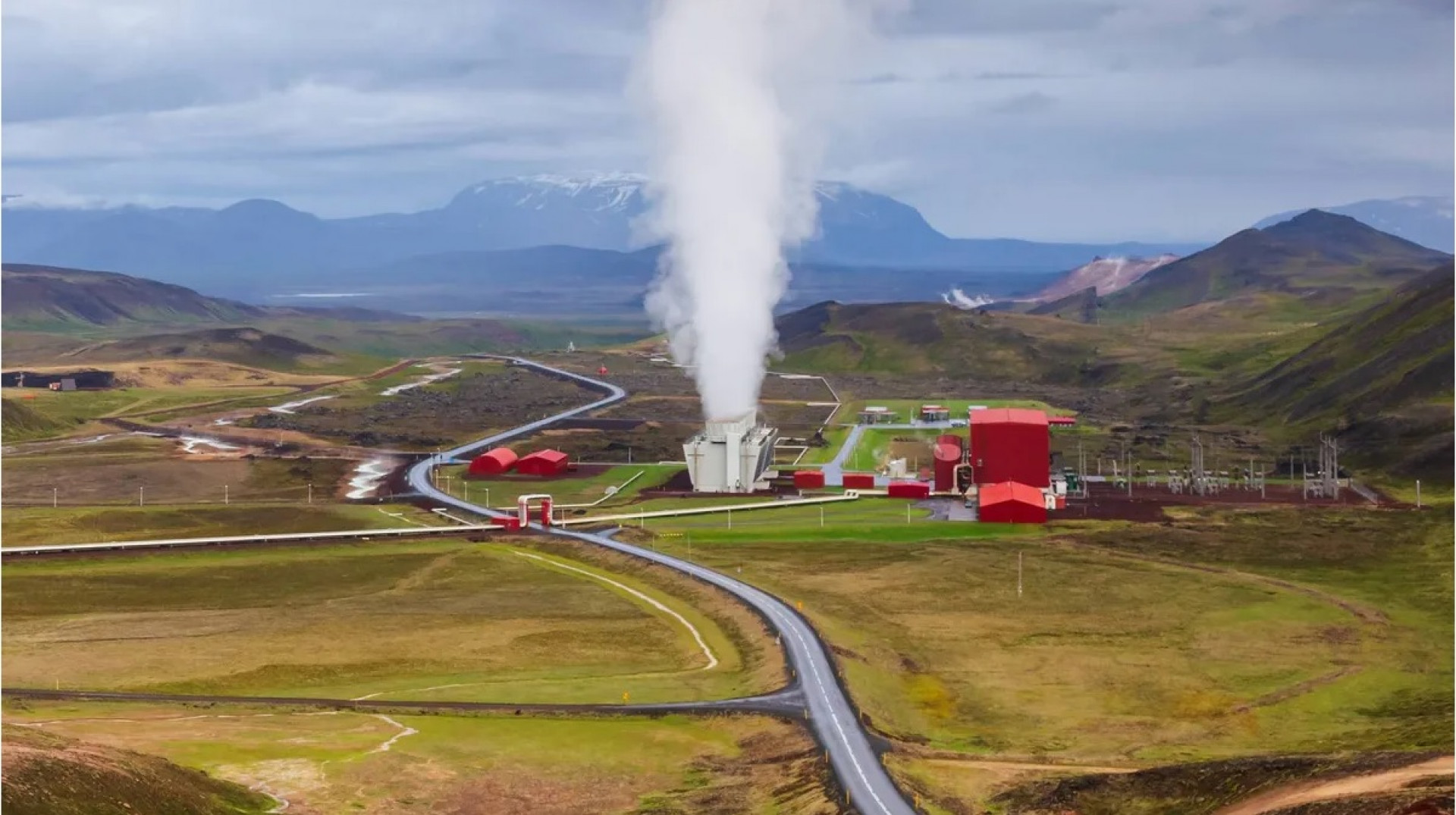
Digging 10 miles underground could yield enough geothermal energy to power Earth
A geothermal power company 'is developing technology to blast rock with microwaves to potentially drill the deepest holes on Earth.'
Interesting Engineering
166 points · by hhs · 4y ago · 186 comments
"To scientists, one of the more fascinating findings to emerge from this well is that no transition from granite to basalt was found at the depth of about seven kilometers (4.3 mi), where the velocity of seismic waves has a discontinuity. Instead, the change in the seismic wave velocity is caused by a metamorphic transition in the granite rock. In addition, the rock at that depth had been thoroughly fractured and was saturated with water, which was surprising. This water, unlike surface water, must have come from deep-crust minerals and had been unable to reach the surface because of a layer of impermeable rock"
Maybe they can use global warming dollars to renew these deep borehole projects around the world, as I suspect there is new geological science to be discovered as observations appear to deviate from theory:
"Because of higher-than-expected temperatures at this depth and location, 180 °C (356 °F) instead of the expected 100 °C (212 °F), drilling deeper was deemed unfeasible. The unexpected decrease in density, the greater porosity, and the unexpectedly high temperatures caused the rock to behave somewhat like a plastic, making drilling nearly impossible"
Core drilling is quite different from well drilling which would be used in this case.
Sorry for many questions just can't find much info on actual field truth (just generic info on theory of operation).
Diamond core drilling tho is basically a cylinder shaped drill bit attached to a hardened drill rod that is attached to a rod string (groups of 3m pipes). Everything is basically done in 3m lengths, mostly for transport reasons. When your drilling you work with the rods in bundles of 3 so 9m lengths. I worked mostly on UDR 1200's and a prototype surface rig that there were like...3 built? partnership between a few big companies. That rig was the one that could do (estimated) up to 3000m or so. Deepest I worked on was 2200m. Drill bit sizes if your interested in looking them up that we worked with are BQ,NQ,HQ,PQ. So external diameters ranging from 60mm with bq (core size of 36.5mm) to PQ @ 122mm ext. and 85 ID. We worked all manual by hand so PQ with a drill barrel weighing like 50kg was our limit. Shaking core from 3m HQ drill rods nearly broke me the first time I did it.
The drill barrels have a inner tube that is the core holder/lifter that hangs like a few mm from the spinning bit at all times while drilling, these are 6m long. After you have drilled 3m, you clamp the rod string so its hanging from the drill rig and add 3m until you have preferably 6m drilled. Drilling stops, you pull back on a wireline that is holding the core tube to engage the internal clamps on it and haul up your 6m of core. A empty tube gets sent back down, you add another 3m rod to the string and repeat the process. While this happens the full core tube is orientation marked, shaken out and cleaned and re-assembled as it comes out of the hole in core trays. ^^^^ Everything above is if things go to plan. Rough ground, broken bits, hard ground, loss of water return all kinds of things can cause problems and make runs stop, go short, loose rods, drop core, require bit changes, cause equipment to overload and break so on. Been a few years since I did it but I do kind of miss the work.
https://www.youtube.com/watch?v=DUMftmjpdNg This is a video of after a bit change. they are pushing rods back down the hole to hit the point where drilling stopped. They are moving real slow. 111 rods roughly to 1000m. Worst shift I had was 16 ton of rods moved. >1000m down, started shift pulling rods for a bit change, bit snapped a tooth after we got it back down in under 5m of cutting and had to come straight back out. Hell of a night. If your lucky you have 3 to a rig (driller and two offsiders) if your unlucky its just 2 on a rig. No breaks. You eat while you drill.
https://www.youtube.com/watch?v=VF3_TqN6AQA This video also covers the whole basics pretty well.
The drill string is a chain of threaded pipes.
There is tons of good information online, just search for oil well drilling on YouTube.
This stuff is nuts, https://amcmud.com/product/amc-cr-650/ Have sent pallets of the stuff down hole. Few 500ml scoops of that and you can turn 5000l of water into some crazy thick mud for bringing up heavy cuttings. Worst experience tho copping a face full of dust when dosing it tho, gets in your eyes. Takes a ridiculous amount of water to wash past the thickening point and get it out.
But it took me a long time to appreciate something odder; We're living on a giant fission reactor [1]. The Earth's core isn't hot because it just hasn't cooled down in the icy void of space. It's actively producing heat. Our gravity acts upon the heavy elements, which sink through the molten iron and silicon, to the core, where they become fissile.
[1] https://blogs.scientificamerican.com/observations/nuclear-fi...
This article doesn't say anything surprising; the news is that these guys calculated how much heat is produced.
> Enter Quaise, which “is developing technology to blast rock with microwaves to potentially drill the deepest holes on Earth.
ie. there's a new, untried at extremes, bore drilling technique.
The calculation of heat production from earths core isn't new here, and nor, sadly, is any demonstration of a bore hole at a 10 mile depth.
They do acknowledge the deepest convential borehole so far was 7.6 mile (at some considerable effort at no small expense).
Yes, I'm aware how the neutrino velocity measurement supposedly confirms it. But I don't think the scientific community has accepted it at large.
edit: ah, just read the title of the link posted in the top level comment. apparently it's "half of the heat" :)
The extremely long low loss underground mm-wave waveguide would seem to be their first problem to solve.
Edit: https://publications.mygeoenergynow.org/grc/1034509.pdf is okay and on page 5 of 16 in Fig 2 you can see how they propose using purge gas down the waveguide segments to keep it clean.
Once you've done that, the rest is pretty straightforward: boil water to run a turbine. Actually I'm 100% sure people are talking about converting coal plants in place with deep geothermal.
Also,you put back the water you pump up, so it's literally a closed loop. What environmental issues are you talking about? The mud?
Drilling that deep is not easy. Directional drilling equipment is very expensive, and heat + pressure take a toll very quickly on such equipment. Directionality is important as boreholes are rarely straight an it is entirely possible to drill a borehole in a U shape accidentally. Drilling requires high pressure pumps to clear the face of the drill bit, and the cut material must be returned out of hole. That's one hell of a compressor or mud pump. Below a certain depth rock behaviour changes from brittle deformation toward more plastic (and explosive) deformation, to eventually plastic deformation entirely. Groundwater pressures can collapse holes. Deformation can collapse holes. The rock grinds back at drilling gear. Equipment can become stuck and difficult to dislodge. Holes eventually collapse and partially close on their own, requiring casing of the hole. To case, drill a section, retrieve gear from down hole, slide casing in, replace Drilling gear, repeat for each length of casing. It can be quite different per hole, and per rig setup. Some rig setups permit casing in place (this is more a drillers specialist area than my own).
Then, there's the issue of keeping the hole open long term. Hydrothermal activity tends to dissolve minerals in water. Minerals tend to crystallise out inside boreholes and pipes over time, like hard water in water pipes in rural areas, constricting flow.
What is being proposed is difficult and requires an extreme amount of maintenance through its life cycle.
Precisely. Calling a plumber to plug a leak or remove a clog 10 miles underground is astronomically expensive.
I'm not saying that it can not be done. It probably can, but I feel that the article was a little naive.
I suppose that I should say something about injecting high pressure water into the earth. At this depth you are interacting with tectonic forces. High pressure water can unlock existing forces resulting in earthquakes in a manner similar to the quakes triggered by fracking.
In summary, there is a cost for everything. There are few, if any, silver bullets capable of solving major problems.
I'd argue that there are silver bullets for major problems, but once we find them the problems stop being major.
- Sewers were a silver bullet for sanitation
- Many medicines have been silver bullets for many diseases
- Printing press for information distribution
- Telegraph (and later Internet) for fast information distribution
- Rail for moving stuff
Where do you get your misinformation from? This seems to be a widely held false belief.
"At any one geothermal field, however, the temperature of the geothermal reservoir or the fluid levels/fluid pressure in the reservoir may decrease over time as fluids are produced and energy is extracted. Produced fluids can be re-injected to maintain pressures, although this may further cool down the reservoir if care is not taken. Over time, it is commonly necessary to drill additional wells in order to maintain energy production as temperatures and/or reservoir fluid pressures decline."
{ Cooling of the area. New area. New hole } Loop.
(Unfortunately, it turned out to be a fraud.)
Actually, if you think back, the hole in the ozone layer was captivating environmentalists and so was acid rain. Remember the photos of Scandinavian forests of fir trees stripped of their leaves? Remember the moratorium and then ban on CFCs (Chloro fluoro err thingies) and how the Arctic was errr fixed?
Our cars used to run on leaded petrol. I can still remember the odd yellow coloured verges of the A303 (UK, SW England). If you were headed west to go on holiday to Devon or Cornwall, you would see quite a few laybys with a stall flogging strawberries. Mmmm mildly lead flavoured!
Yum!
Nowadays we have rather odd weather to deal with and a massively reduced biodiversity.
I also remember nuclear fusion and being told by some chaps at the JET in Oxon that NF is about 25 years away. I also had the joke about NF being 25 years off explained to me in around 1998.
NF is still roughly 25 years away but actually I think it really is, give (or don't bother to take) say 25 years.
I am not a nuclear physicist and nobody I knew at the time was, either, though personally I thought it was one of those too-good-to-be-true things, and sure enough, it was.
My larger point, however, was that there was a lot of pushback from environmentalists who, when faced with a solution to the energy problem, looked for a way to stop it.
I can understand geothermal energy in very high latitudes, like they do in Greenland, where Sun energy is scarce, and lava is close to the surface. On most of the earth, geothermal energy is much harder to get than solar.
At these depths, the walls collapse regularly. It's like drilling into jello
Are we already capable of harnessing enough to power anything actually serious and industrial, rather than a small household with some consumer electronics and lightbulbs somewhere like California, where heating isn't even an issue?
[1]: https://earth.stanford.edu/news/lessons-pohang-solving-geoth...
https://en.m.wikipedia.org/wiki/Plasma_deep_drilling_technol...
> Geothermal power exploitation in Yellowstone, however, is illegal by act of Congress—the Geothermal Steam Act of 1970 (amended in 1988). This act requires the Department of Interior to preserve and monitor hydrothermal features, like Old Faithful, in units of the National Park Service, and there is a good reason that the law exists. In many places, including California, Nevada, Chile, New Zealand, and Iceland, geothermal power production has altered the behavior of nearby hydrothermal features. There is still quite a lot we don’t understand about how water moves beneath the surface in the Yellowstone area, and it is likely that even geothermal development outside the Park would impact features within the park.
https://primerfieldfoundation.org/issues-treated
He cites three papers on Cell, Nature. The one on Nature does not seem to be related to this "array of magnets"
https://static1.squarespace.com/static/54d7e4ece4b0a551f3b3a...
Fusion already powers the planet. We just need to build out the solar panels and wind turbines to collect as much of it as we care to find uses for.
It’s a shame the article doesn’t seem to mention what those temps are.
Imagine if we solved this problem and over the scope of 40 years the whole world just went geo and dumped Oil, Solar, Nuclear?
Someone posted a more informed comment on Hacker News about 2 months ago. The idea is that if you drill to 5 km deep, let's say, you find very hot rock. But once you extract the heat from that rock, new heat is very slow to come because rock is a good thermal insulator. So, you'd need to produce secondary holes. Lots of them. In the end the math just doesn't work out by orders of magnitude.
It just costs more than wind and solar. Same as nukes. Unlike nukes, geo was once competitive without heavy subsidy, in places.
If you plan to drill the holes yourself, you have a lot of work to do. Drilling is expensive, and a single hole will not get you a lot of heat after the initial honey moon period.
You'd probably have a job getting the permits to do it deliberately.
They thought the US had enough land that it would take 20 generations to settle (it took 2).
That being said, we should probably still do it. Seems like a slower death route.
It is, instead, cheap concern trolling. Worry instead about money diverted, from building out wind and solar that actually address looming climate disaster, to chase wills-o-th'-wisp.
We need to focus on base load replacement, not intermittent “feel good” sources.
And how do you plan to keep your hole open? Rock flows at that depth.
You don't need to drill 10 miles to get to geothermal temperatures in Iceland, nor in Yellowstone. But you might in Ohio, or Ireland.
While it is a concern if we produce a lot of extra heat, I think the main issue is being able to expect the heat to leave into space. Which is why most of climate change science focuses on greenhouse gases and not heat produced by machines.
And regardless, capturing them takes a lot of energy and unless we have a clean source (such as geothermal for example), that means that we will be releasing more greenhouse gasses than the produced amount of energy will capture.
Any energy releasing process (nuclear, fossil fuel with ccs, geothermal) is bounded somewhere around 10-20x current energy use by running into direct thermal forcing.
PV produces less waste heat depending on where it is installed so has a slightly higher limit, but both solar and wind have pretty severe land use limits you run into at 20-100x current global energy.
Basically, everyone can have enough energy to flourish, but it's time to reign in growth and maybe dial it back a bit from US levels of consumption.
>> Finally, Houde said, geothermal is “the perfect energy source to take advantage of the largest workforce in the world, the oil and gas industry.” That industry has “11 million jobs in the US alone, and a skill set that is exactly what’s needed for geothermal to rapidly scale.”
Digging deep holes for geothermal guarantees the industry a future at this scale when the move to electric inevitably happens. The alternative is for them to pass up the opportunity and solar, wind, and nuclear to eat their lunch.
Kola already reached 76% of the way there.
I guess the idea is that since we're imagining things that don't exist anyway, we could assume the panel is made of invisible pixie dust. But at least for me, drilling a ten mile hole is intuitively easier to envision.
Maybe that's ill-informed on my part, I don't know, but it's why the idea is appealing. It instinctively seems like a feasible task.
https://en.wikipedia.org/wiki/Ouarzazate_Solar_Power_Station
Lots of room there.
Largest solar park in the world = 57 km2, cost 1.3B$. Check.
Total cost of a solar panel the size of california, with the help of the most intricate indian technology = 9.6T$
1. No, there is absolutely no hint of any danger of extracting too much heat, no matter what random problem you make up. Really.
2. A 10km deep hole gets you 1/600th of the way to the center of the planet, much less than e.g. the skin of an apple or the enamel on a billiard ball. So, it would tell you nothing about stuff deeper, never mind bollocks it.
3. Geothermal energy is not a major growth sector even where heat is right near the surface. Geothermal, like nukes, costs too much to ever be competitive again.
Wind & solar cost less already, and get much cheaper every year. There is no need for, or value in, more expensive alternatives. It is a good thing that solar and wind are simple and uninteresting.
Places where both wind and solar do not suffice can continue importing fuel, as they do today, indefinitely. Eventually, it will be synthetic, or delivered by transmission lines. Tropical solar farms will synthesize ammonia for export.
Now maybe we don't think we'll actually make it as a species for that long. But we should think about the risk, this time around.
Also, said "dynamo" has been running for a few billion years. We've no concept of how long that is. No mental model. Im sure the the planet will be just fine.
I hear the phrase a lot, "the planet will be fine". Sure it'll continue to be a ball of matter that orbits the sun a few billion more times, so in that regard it'll do pretty fine as a planet. That's not what people are concerned about when they say they're worried about Earth though.
[1] https://en.wikipedia.org/wiki/Earth%27s_internal_heat_budget
[2] https://yearbook.enerdata.net/electricity/electricity-domest...
Internal heat generation is estimated by Davies and Davies (2010) to be roughly 47 Terawatt. With a surface area of 5.1 × 10 m^2, this translates to roughly 0.1 W/m^2.
CL4P-TP comment:
"The earth produces 20TW[1] of thermal energy from radioactive decay in the mantle. This is the amount of warmth that the earth generates, so it should give us a ballpark idea of how much heat we would need to remove from the earth in order to make an impact on the earth's internal temperature. To summarize the heating situation under earth's crust, the existing heat comes from two sources in ~equal parts: radioactive decay, and leftover heat from the earth's creation[1]. Lots of heat hits the earth from the sun but gets radiated back out; It doesn't really have anything to do with internal temperatures[1]."
"As far as I can tell from that wikki page: Current heat in the earth: ~50% radiation, ~50% leftover Internal heat budget: Geothermal Power Consumption + 47TW transferred from the mantle to the crust and beyond[1] - 20TW generated from radiation = Core cooling rate Core cooling rate without geothermal: 0 + 47TW - 20TW = 27TW
The world consumed 22,000 TWh in 2017[2]. That means an average power consumption of 2.5TW.
If all of that was geothermal, we'd be increasing the cooling rate of the earth's core by about 10%."