Telling It Like It Is
In Plain English
jeffreycarter.substack.com
113 points · by rmason · 4y ago · 107 comments
Very few of us are really denied that chance, except soldiers risking desertion. Justice must account for the genuine ability to walk away, versus bad faith. On the matter of Blutkitt, in his excruciating account of "Ordinary Men", C. R. Browning notes that even the members of Battalion 101 had a genuine (no bullet in the back) chance to walk away.
Do today's white-collar bandits and digital fraudsters have a realistic chance to turn their backs on wrongdoing they encounter? Of course. But at the cost of losing a network of rich and influential friends. Are there examples in tech of people taking a courageous stance? Definitely. Roger McNamee is one random example who must have burned a few bridges when writing "Zucked: Waking Up to the Facebook Catastrophe".
A large well organized group is required to keep such things in check.
There is no dearth of people (esp in the US) who will take stands and call out bs. But that's not enough.
Indeed. The past two years may have much to teach us about the kind of measures, and unpleasant sacrifices of the economy, needed to neutralise such problems.
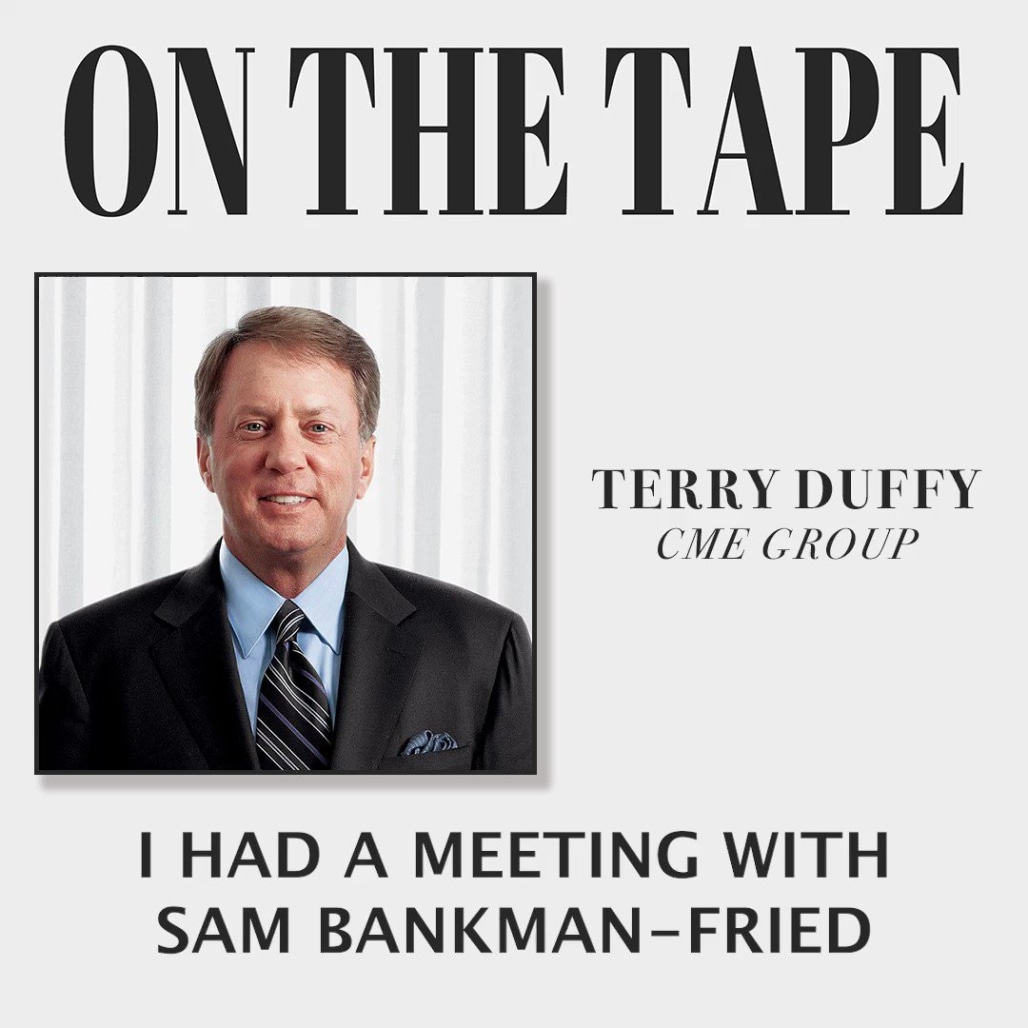
What was SBF's proposal, then? Bringing the existing retail crypto model to … non-retail crypto trading? That doesn't seem very risky; if anything, it seems to considerably reduce the risk that a counterparty fail to deliver, because the exchange already has the asset. Obviously there's the risk (as we have seen play out numerous times now) of the exchange itself failing to deliver, but I don't get the sense that that or anything like it is what Terry Duffy or Jeffrey Carter were concerned about.
ELI5 what's the big deal about "on-the-run clearing"?
I only found an article about it from the author himself: https://jeffreycarter.substack.com/p/on-the-run-clearing
I read it but I still don't understand what's so wrong with it.
1) cascading liquidations as forced selling pushes prices down and triggers yet more forced selling
2) not every person is going to be able to monitor their positions 24/7, so they will get wiped out as they sleep (e.g. a farmer hedging their crop wakes up to find they lost all their money because the market temporarily dipped in price overnight)
It is not only collecting margin, settlement, and paying/collecting from accounts. It's also risk management. For example, CME and ICE have created proprietary algorithms that calculate the level of risk in a market based on open positions, daily liquidity, width of bid/ask spreads, and daily market movement of the future and underlying cash prices. SBF was basically talking out of his ass when he wanted every 30 seconds. In a volatile market, that would break the market. Price discovery would cease. Bid/Ask spreads would be super wide. Currently, there is a role for brokers to play by qualifying customers. I will tell you 99% of the VCs I interacted with and almost 100% of the entrepreneurs didn't truly understand clearing. Check out Bitnomial.com if you want to see how it is done in a crypto market the way it should be done. They went through at least a three year process at the CFTC to become a designated contract market in the US where lots of crypto exchanges have gone to Bermuda simply to avoid regulation.
Has the FTX fiasco not yet revealed to you that the exchange doesn't always have the asset?
This is not bravery. Its cowardice in the form of ex-post bluster.
It’s pretty strongly worded:
> FTX’s Proposal is glaringly deficient and poses significant risk to market stability and market participants.
Granted, he didn’t publicly call the guy a fraud. Avoiding libel lawsuits is probably a good habit for a risk manager.
He also says it is important for marketstakeholders and the CFTC to investigate the clear conflict of interest (between FTX and Alameda).
And he ends saying that even though he is for innovation, he says that innovation which is found to increase risk unacceptably or fails to protect consumer is against the law.
Pretty good read IMO.
1. Radically different from the current one, and
2. Good
Not impossible it’s true but I’d say the onus is to prove that, given the source and given the current system functions well enough
That could be puffery of course. But I have worked in several fields. A big advantage I bring is that I have an outsider's perspective and experience from a different domain ("Hey, why don't we try it this way?"). But a very big disadvantage is that when exploring something I find out that people often have thought of it and don't do things that way for good reason. For me that means I look before I speak.
A lot of the bomb-throwing suggestions of crypto revolutionaries is similar, and I have no reason to believe SBF was any different. In fact there's good reason to believe that SBF and his colleagues lacked adequate perspective, from their statements, their actions in retrospect, and frankly because of his MIT background. I'm also an MIT grad and was also an arrogant know-it-all into my late 20s (at least!) and am simply lucky that I got a few things right along the way so people were still talking to me by the time I grew up.
[1] Libel is written defamation; slander is oral.
Also, the more memorable mnemonic (at least IMO) is "slander is spoken, libel is not".
Most people, even rich people, do not carry much cash in their pockets…
Does it only count if he puts out a really mean tweet in your book?
With a meme of pepe sbf or higher value pepe.
This, right here. If someone sells you a stolen car, that car is not yours as it was not the thief's to sell. The police will eventually come take it away and they will be right in doing so.
Vs. the vague and amorphous "money", which so easily flows from being bits in a computer here, to marks on a sheet of paper there, to bits in some other computer... The emotions of the neutral human observer don't stick to it nearly so tightly. And a huge number of politicians, business exec's, lawyers, and other "friends" of white collar crime are naturally quite resistant to the "you should give it back" notions of the little people...
Cash that’s been paid out from a bankrupt company can be clawed back by the bankrupty trustee. Usually this only applies to payments made shortly before the company goes under though.
Quite true. And I've not followed the details about SBF's schemes...but it sounds like he's different from Madoff in three important respects, all of which seem likely to make claw-backs less viable:
- Diverting funds to cover trading losses at an allied & now-bankrupt firm. If Madoff had (say) directly lost $1B by buying some stock which then fell in value, would there have been any possible claw-back on that $1B? I'd bet "no".
- Lots of funds were "laundered" through various sorts of crypto transactions. Anything "crypto" is probably a far greasier pig, to try to wrestle the real money back.
- Layers of corporate structure, HQ'ed in an offshore tax haven. IANAL, and certainly not a lawyer qualified in tax haven corporate securities law, but this sounds more like a gold mine for the lawyers than good news for the victims.
The Democratic committees raised $853M in the 2022 election cycle, compared to $805M for the Republicans. If they had to deduct $50M next cycle to account for the illegitimate funds, it wouldn’t ruin them.
Elizabeth Warren gave back money she got from the Sackler family (owners of Purdue Pharma and primary operators of the opioid crisis).
The Sacklers donated mostly to Republicans, but AFAIK none of them returned the money.
It's interesting and encouraging if $40MM is a major donation. Billions were spent on the midterm; if $40MM is "major" than most of the money came from small donations, which is how it should be.
Source? opensecrets lists SBF as having donated $36M to democrats and only $240k to republicans.
https://www.opensecrets.org/elections-overview/biggest-donor...
One thing to expect political parties and nonprofits to reject donations up front from unpalatable people, another for them to bail out ripped off speculators with long since spent donations.
Makes the others look worse.
The faster they took to twitter to tell everyone how they sniffed out a rat when they were offering to give him billions or were being offered billions - the less likely it is they "knew all along".
Ever wondered why all these crypto companies are in the Bahamas or Virgin Islands and not on the Zuidas in Amsterdam? The weather? But you just can't beat the zeitgeist.
At the time, lots of people said something at the time. Later on, yeah, "nobody said anything at the time."
https://www.theonion.com/man-who-lost-everything-in-crypto-j...
Anyone that's in crypto still is asking to loose it all. I don't know why, maybe it's getting their jimmies rustled, but I know that all the signs have been blaring for years now.
There is plenty of crypto is a scam that get upvoted, and piled on by the crypto is a scam crowd. Its almost a meme on hn at this point to get upvotes just write "crypto is a scam"
It's not even a complex multi-layered obfuscated fraud, it's practically out in the open, yet will still be a "how could we have known?!" Situation once it collapses (i.e. wealth transfer complete)
>yet will still be a "how could we have known?!" Situation once it collapses (i.e. wealth transfer complete)
"Tether is a scam" accusations are well known and has been around for years. As a quick reference, the "Bitfinexed" account (on twitter) has been around since 2017. It's certainly not comparable to FTX which seemingly imploded out of nowhere.
In any case, a good number of people have been loudly pleading with the world to be not just skeptical of FTX, but of all of these insanely valued crypto companies - they're often dismissed as haters.
DH1. Ad Hominem.
DH2. Responding to Tone.
DH3. Contradiction.
DH4. Counterargument.
DH5. Refutation.
DH6. Refuting the Central Point.
http://www.paulgraham.com/disagree.html
I see my parent as a mixture of DH 0, 1, and 2. No chance of sniffing 3 or above.
>Sometimes when there is a process or an idea that isn’t being used, the reason it isn’t being used is that it sucks.
Well? What was the reason? Invoking chesterton's fence is very patronizing to the reader.
I think this is supposed to be a casual conversation between people who share a point of view.
It absolutely is a media failure. It exposed how corrupt some outlets are, in insidious ways. The media built a positive image of SBF and FTX without ever doing serious investigative job because he was giving to the right people... and still, when FTX scam scramble, instead of apologizing the same media continued to be lenient toward the fraudster trying to spin the scammer as some idealist who just made bad bets, when he was already deep into his scam.
> Journalists don't have the privilege of looking deeply inside books and how company conducts it's business, but auditors have.
Many people in Crypto and finance had already figured out FTX business model was some sort of scam, the media and their glowing reviews of SBF weren't interested in hearing them, because SBF was being too generous about donations...
I don't know why investigative journalism suddenly seems so 'hard' these days, but I'd assume it involves just following the money for the most part...
To make this all about “telling it like it is like we do on the trading floor” is trying to force an angle that is simply not there. The better point hidden in the article is that journalists don’t really grasp the material they’re covering, and as such are incapable of asking critical questions.
That's not how I recall it. Levine asked SBF to describe yield farming and SBF went on his (in)famous thing about boxes, practically calling them out as pyramid schemes (but without mentioning any specific names). At no point was FTX referred to as a ponzi scheme.
What actually happened was FTX was reliant on these "assets" to get loans even though they were just an exchange that should have just been passing them off to counterparties.
> I think of myself as like a fairly cynical person, and that was so much more cynical than how I would have described farming. Like, you're just like "well, I'm in the Ponzi business, and it's pretty good!"
You can listen to it right here:
Specifically, Levine's words:
People on Twitter now are like “he admitted that FTX is a Ponzi!” but of course that’s not true. He conceded a certain validity to my claim that some crypto businesses — not his — are Ponzis. He is just in the business of trading their tokens.
In fact, I came away from that conversation bullish on FTX and Bankman-Fried.
Reference: https://www.bloomberg.com/opinion/articles/2022-11-10/ftx-is... (paywalled)
> Matt: (27:13) > I think of myself as like a fairly cynical person. And that was so much more cynical than how I would've described farming. You're just like, well, I'm in the Ponzi business and it's pretty good.
> Joe Weisenthal: (27:27) > At no point did any of this require any sort of like economic case, it’s just like other people put money in the box. And so I'm going to too, and then it's more valuable. So they're gonna put more money in, and at no point in the cycle, did it seem to like, describe any sort of like economic purpose?
https://www.bloomberg.com/news/articles/2022-04-25/sam-bankm...
Short sellers and people that bitch about things are either heroes or completely marginalized entities (without any reputation to uphold).
Also, IDK why you expect "the system" to warn you about fraudsters. The entire premise of crypto is that it's unlimited, ungoverned finance - which also means unlimited fraud opportunity. So many reputable people warned about this general problem. Like - this should be even more common than it is, because it's ridiculously profitable and kind of legal!
True, but a lot of modern cryptocurrency businesses have been spending a lot of marketing $$$$ on buying a veneer of legitimacy.
Smart investors know that just because they've got reputable investors, famous board members, favourable press coverage, celebrity endorsements and a sports arena named after them, doesn't mean that This Time It's Different.
But I can understand why a naive investor might fall for the marketing.
https://www.ft.com/content/eac0e56c-f30b-4591-b603-f971e60dc...
"Levine:
I think of myself as like a fairly cynical person. And that was so much more cynical than how I would’ve described farming. You’re just like, well, I’m in the Ponzi business and it’s pretty good."
Dateline April 25.
For those interested I think the clip is in an episode of the Odd Lots podcast with both SBF and Matt Levine.
That's not quite how it went. Matt Levine wasn't especially negative of him, just found it wild. And they were talking talking more about him being in the Ponzi (in a sense) business more so than him running a Ponzi scam specifically.
That said, here is Matt Levine’s article on why tradfi’s approach to clearing and settlement is different from that of cryptoland:
https://www.bloomberg.com/opinion/articles/2022-06-01/crypto...
People guessed SBF was a fraud, they were right, but it was still just a guess. The same people guessed USDT was a fraud when it de-pegged by 2.5% last week, they were wrong because it was just a guess.
Other people guessed the opposite in both cases with inverse results.
What we need isn't to argue over who the best guessers are. Or form teams of guessers. It is to stop guessing and actually verify some things for once...
No, they’re not.
Their website used to say "Our reserve holdings are published daily and subject to frequent professional audits", for years. This was a lie, intentional deception for financial benefit. They're still promising they'll get around to it eventually (https://www.pymnts.com/cryptocurrency/2022/tether-audit-prom...).
2016: https://archive.ph/mVPmL
2018: https://archive.ph/9UMhd
They got caught moving money around to temporarily pad their bank balances to "verify" their cash reserves. https://ag.ny.gov/press-release/2021/attorney-general-james-...
> In the face of persistent questions about whether the company actually held sufficient funds, Tether published a self-proclaimed ‘verification’ of its cash reserves, in 2017, that it characterized as “a good faith effort on our behalf to provide an interim analysis of our cash position.” In reality, however, the cash ostensibly backing tethers had only been placed in Tether’s account as of the very morning of the company’s ‘verification.’
> On November 1, 2018, Tether publicized another self-proclaimed ‘verification’ of its cash reserve; this time at Deltec Bank & Trust Ltd. of the Bahamas. The announcement linked to a letter dated November 1, 2018, which stated that tethers were fully backed by cash, at one dollar for every one tether. However, the very next day, on November 2, 2018, Tether began to transfer funds out of its account, ultimately moving hundreds of millions of dollars from Tether’s bank accounts to Bitfinex’s accounts. And so, as of November 2, 2018 — one day after their latest ‘verification’ — tethers were again no longer backed one-to-one by U.S. dollars in a Tether bank account.
Both of these are clear-cut fraud.