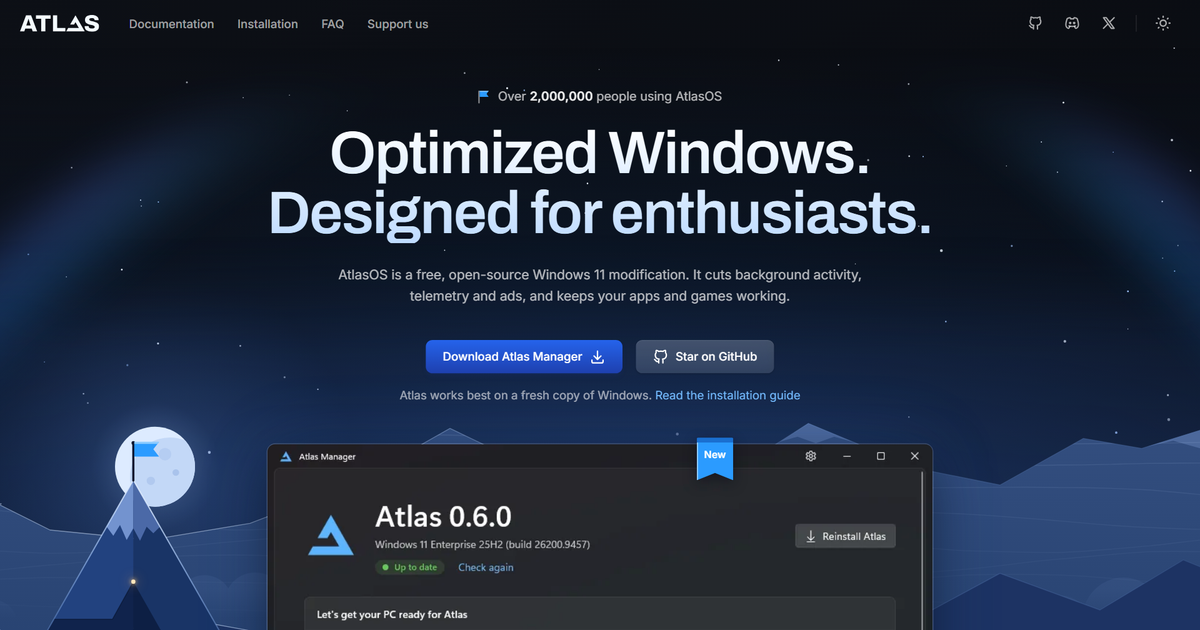
AtlasOS | Optimized Windows for enthusiasts
AtlasOS is an optimized Windows experience for enthusiasts and gamers, with stronger performance, better privacy, and cleaner defaults.
AtlasOS
86 points · by newswasboring · 4y ago · 134 comments
Effort ? That repo consists of a few Windows Registry tweaks and some bundled 3rd party installers. Not exactly ground breaking engineering that could have been better deployed to improve SteamOS/Linux....
The bloatware is minimal, mostly removable without adverse impacts and the UI has improved markedly. Windows 11's support for TPM root of trust is a great step forward, and the settings screens actually feel very logically laid out now.
Winget, while not anything revolutionary if you're coming from Linux or even Mac/homebrew, is decent - and fills out a big missing piece for technical users that have missed this functionality.
I don't see it as a sinking ship at all, but maybe I'm being really naive (and I mean that sincerely).
Oh fuck no it hasn't. The UI is actually what's stopping me from upgrading to Win11.
Win11 is trying to be macOS with its UI, and that's a bug, not a feature, because I fucking hate everything about macOS's UI.
I hate multiple windows from a program coalescing into a single icon on the task bar. I hate the task bar not including text from windows. I hate that I can't have a task bar on multiple monitors. And I just generally hate how flat everything looks. What I hate most of all, is that Microsoft has decided to go the Apple way and disallow you from choosing what you want it to look like. There are no options to make it look like it used to.
IMO, Windows UI peaked with Win2K. When I used Win7, I used the classic theme. I use Win10 now, and use WindowBlinds to skin it to look like Win2K.
The one thing you’ve called out that I can’t refute is that the option to customise it to the win2k look has been taken away, but I imagine it gets harder to maintain the further they move from those metaphors (e.g. you already needed to use WindowBlinds on 10).
I really like the new UI. The window snapping is far better than it’s been previously. It takes quite a bit from macOS, but I think they’ve left the worst parts of macOS out like the horrific monstrosity of a settings screen and the janky mess of a permissions system.
Windows is what most gamers use and need
It is far easier to limit your ad experience, and have a dedicated windows gaming machine than it is to switch to linux for gaming.
For instance: VR on Linux is still a shit show, with only one company kinda supporting it and not doing a very good job of it at that.
By contrast, XP was very customizable. I used to like BBLean.
https://www.protondb.com/explore
This is a list of games (by default sorted by popularity) and their compatibility with Linux. Some games work great, but there are major games like PUBG and Destiny 2 that don't work at all. Some major games like Apex Legends require tweaking to work.
If you're a hardcore gamer, then you need Windows because the games need Windows.
Though this may slowly change over time since Valve put out the Steam Deck which runs Linux.
NVidia and AMD usually design their GPUs together with Microsoft, OpenGL and Vulkan then play catchup with extension spaghetti until some subset of it gets available as standard feature.
And then there's all the utility programs removed, like Paint 3D and Calculator and that thing that lets you view SMS on your desktop. It's not like those impact performance at all - they're just trying to reclaim every last byte of disk space.
They even disable the Xbox game overlay. I guess they just assume none of your games will be from the Microsoft store.
This is not a system designed for gaming. This is a system only suitable for gaming. It is incompatible with a great deal of Windows software (why would you disable Unix socket support?), and a great deal of non-gaming workflows, and disables most of the security measures on the system (even UAC dialogs - any program asking for admin gets it automatically). The only kind of person I can think of that wouldn't regret installing this is someone dual-booting to use Windows for gaming and Linux for everything else.
They have a flag to effectively disable the store and UWP apps[1] so yeah, that's a safe guess.
[1]: https://github.com/Atlas-OS/Atlas/blob/a356ba84b52131d2130a6...
This is just a "break my apps" script.
One of their blog posts talks about “Process Count” in Windows task manager. Apparently there’s a whole community who are into stamping out Windows processes? Amusing.
> Throughout my time within the tweaking community I have seen an uncomfortably large amount of people who care WAY too much about their process count in Task Manager and break core functionality for a lower process count.
I can’t wait for the next wormable Windows exploit with all the un-upgradeable boxes out there
The great thing about proprietary software that comes with spyware is, you can never be too sure.
It removes things such as: Windows Defender
It also removes "Restore Points & System Reset", so I guess that when it breaks you have to do a fresh install.
Source: https://github.com/Atlas-OS/Atlas/wiki/1.-FAQ#13-whats-remov...
A very significant portion of my family tech support has been about Windows Defender grinding systems to a half by keeping disk IO constantly at 100% in laptops with HDDs.
I'll grant that kind of sustained checking is what you need to combat malware on Windows. But it damn well does have an effect on the overall system responsiveness.
(
) I did a q-n-d check; 1.3M events, and almost 300K were AV/Malware.If it's grinding the system to a halt, there's something else already quite wrong.
If it would be aimed at making old computers useable for office work longer, then it might make sense but not on a computer used by gamers.
haha, gave me a good laugh. thanks, but no thanks.
Who only uses their machine explicitely for gaming?
“TPM (Trusted Platform Module), Windows Defender”
There’s some bullshit hand-waving about “security” on the GitHub landing page, but what are they expecting people to do - install Norton?
I wouldn't touch that with a ten-foot pole.
Though EVA raises another problem with this whole trend of ISO distributions over distributing the tweaks and install steps — it's trivial for a malicious actor to impersonate any of them and distribute a build full of exploits:
> The custom ISO from the previous project is discontinued so please do not ask for it as it has been recreated with malware.
The social, and typically decentralized, nature of the distribution means the only way to know a legit build is to already be inside the community distributing them. If you're not in the community and get hacked, nobody cares anyway.
That's why I'm surprised AtlasOS has such a big presence, and uses GitHub to host their ISOs - they're kind of asking Microsoft to hit them, maybe in hopes of raising their profile.
[1]: Several channels offer roundups and reviews of different ISOs with links buried in video descriptions or subtitles, such as https://www.youtube.com/channel/UCSyKK_dtmNzCyp0O8TLVHAQ
Trillion dollar company can't be bothered to optimize their OS properly, or perhaps their workforce is not skilled enough
They are already missing out on the handheld console market, it's all about linux/android
I'm personally happy about it, the worse microsoft becomes, the better the competition becomes because it helps new actors emerge and proliferate (macOS, android, linux)
It's not that the trillion dollar company can't be bothered to optimize the OS, it's that each division within the company needs to justify their own existence, and if they can sell a Candy Crush promotion in the start menu at the cost of some customer goodwill, that might be an ephemeral, unmeasurable $10M loss to Microsoft as a whole but a $1M profit, clearly described by a graph going up and to the right, and a promotion....for the middle manager who foisted Candy Crush on all of us.
The problem is that LSTC is not available through retail channels. If you're interested in this because your startup wants to sell a Windows-based hardware product, buy a prebuilt system from OnLogic or similar.
Apple had time to properly transition from PPC to Intel to ARM with their own chip, develop new experiences from Smartphone to Tablets to SmartWatch, Microsoft failed at all of them, including SERVERS!!, something they took for granted for decades
So no, you can't just say "they have LSTC wich is a non bloated windows", no, the tech remains the same, the problems remains the same, they even lost the embedded market... c'mon
Windows is being operated as if it was a students weekend school project, but he prefer to go play outside with his friends instead, friends that are now grow up adults with a beautiful house, smart kids and beautiful wife, microsoft is stuck with that hooker that try to sell him some qualcomm drugs
Unfortunately unless you have old hardware (on which win7 would be fine) then you can't run older ltsc/b anymore as they don't support dch etc.
Case in point: my Ryzen laptop requires new uwp for the realtek audio because apparently signalling input change on headset detection is hard, it won't detect headset and the only way to change from headphones to headset is in the uwp app, which is quite ridiculous but that's the windows world we live in now.
Also many of the "tweaks" mentioned in that repo are likely to break service imaging so if you do update, you'll end up in a perpetual updating/rolling back cycle.
That’s what happens when you’re immune to typical market forces. Why invest money in things that give value to consumers when you can just exploit them? It’s not like the government is going to protect them, and the decades of anticompetitive behavior you’ve managed to get away with means that you don’t have any real competition left to worry about.
2. How did they get the source code for Windows?
3. How do they handle games that require newer DirectX versions?
4. What are the actual gaming performance improvements, if any?
I'd stay far away.
When I was a kid I remember poring over all kinds of stuff to make my games run well on the family PC. CCleaner, Disk Cleaner, Disk Defragmenter, turning off a bunch of Windows services and processes in Task Manager, and... there was one other questionable program I can't recall, that disabled a bunch of things when you ran it, then re-enabled it when you quit. I had Malwarebytes and SuperAntiSpyware, and tweaked the registry a bit, IIRC.
My point is, it takes a lot of work to understand what can be turned off to squeeze out performance, but it sounds like something that benefits the user.
[1]: https://atlasos.net/downloads
[2]: The download URLs are GitHub release assets distributed via https://objects.githubusercontent.com/
Disclaimer
By downloading, modifying, or utilizing any of these images, you agree to Microsoft's Terms (<https://www.microsoft.com/en-us/Useterms/Retail/Windows/10/U...>). None of these images are pre-activated, you must use a genuine key.
⇒ it may avoid legal issues, but I wouldn’t guarantee that (are third parties allowed to even distribute the unmodified Windows ISO?
https://torrentfreak.com/removing-annoying-windows-10-featur...
Discussion: https://news.ycombinator.com/item?id=23486887
Complaint text: https://github.com/github/dmca/commit/e6911fbf79c67c6f9e834c...
You can check:
https://en.wikipedia.org/wiki/BartPE
https://en.wikipedia.org/wiki/NLite_and_vLite
https://en.wikipedia.org/wiki/WinBuilder
You can also find customized failed build of Windows like Neptune, Chicago, Whistler, Longhorn etc. ISOs.
One example:
https://www.betaarchive.com/forum/viewtopic.php?t=44187
I guess Microsoft thinks that ultimately, it gets people acquainted with Windows and even loving it.
Edit: They actually already have instructions on how to use their scripts with a windows image downloaded from microsoft website [2]
[1] https://github.com/Atlas-OS/Atlas
[2] https://github.com/Atlas-OS/Atlas/blob/main/src/README.md
> You're permitted to only use official images provided by MSFT or authorized partners (VAR or reseller). You're not permitted to use a random image found on the Internet to start your customization (even with a valid license key).
> You're not permitted to share copies of the original media, or any customized images you make. You can deploy images on behalf of another party who already owns a correct license for their own internal use.
> Bottom line: You're allowed to modify a clean image if you own a license. You can't redistribute it, but you can share NTLite presets, scripts or instructions that allow other licensed users to perform the same work. Everyone must have their own OEM, retail or volume licenses.
EDIT: They appear to be claiming "educational use"/EU 2009/24 protection, which, well. Good luck.[2]
[1]: https://www.ntlite.com/community/index.php?threads/is-it-leg...
Anyway, Titus also has a guide on making a "custom Windows ISO" using NTLite.[3]
[1]: https://github.com/Atlas-OS/Atlas/blob/main/src/Atlas_20H2.x...
[2]: https://github.com/Atlas-OS/Atlas/blob/main/src/AtlasModules...
I always kept optimising my Windows.. disable auto updates, disable heartbleed, disable indexing, etc. I tried to find the source of every microstutter or fps drop.
I am not sure when the shift happened, but it seems gamers don't value performance anymore like they did in the zero's and nineties.
I actually love this build and will try it out. Even if it only gives me 4 fps more, it's a win.
I feel like GPU frames cost like 3x CPU frames these days.
It's obvious when you play games on a laptop with integrated graphics. You can tweak every in-game setting to the bare minimum and/or try to stop every service that's running outside of the game, and none of it makes a significant difference, because the core bottleneck is that there isn't a dedicated GPU.
The other big bottleneck that existed 10+ years ago is that people still used spinning hard disks. Now we almost all have SSDs, a big chunk of load time and source of slowdowns due to background processes is gone.
The main focus for today's competitive players is not throughput, but motion-to-photon latency and its consistency (consistent frame times, constant input lag). Both improved greatly in recent years from thoughtful tweaks such as limiting your FPS to avoid GPU queue congestions, and due to software developers finally paying attention (NVidia and AMD introduced several low-latency tricks into their drivers, Microsoft also did lots of scheduling-related work). Hardware also got substantially better with latency.
what
I guess Excel isn't technically a game.