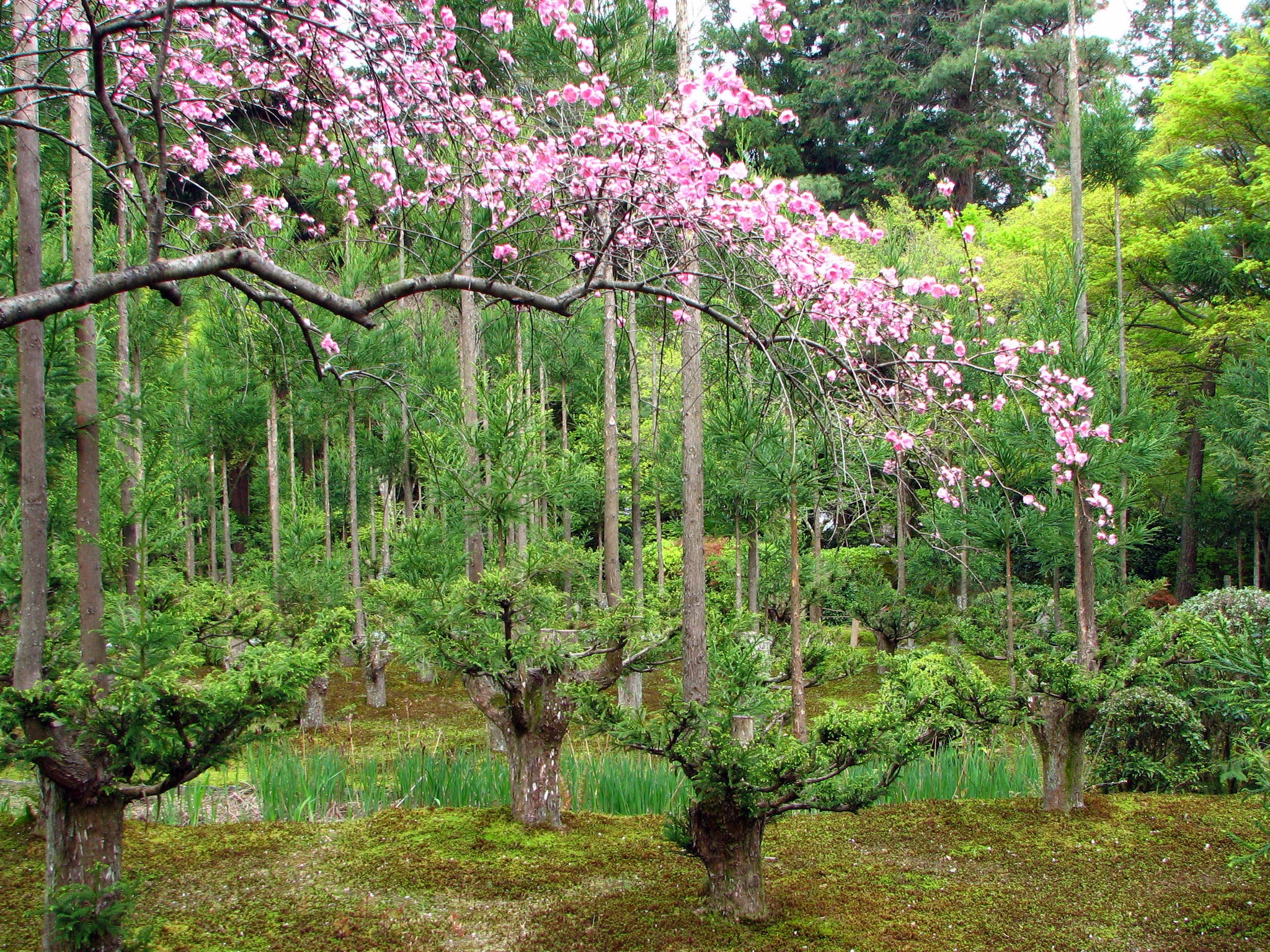
Ancient Japanese Technique To Produce Lumber Without Cutting Trees
Discover the ancient Japanese Daisugi technique and its connection to Meiji-era jewelry, artistry, and timeless craftsmanship at DSF Antique Jewelry.
DSF Antique Jewelry
660 points · by CHB0403085482 · 4y ago · 198 comments
Timber framed construction in Europe was nailless (wooden tree nails permitted) but the mortice and tenon joinery of Japan is in another league. Maybe European Gothic cathedral roofs come close, little else would.
Japan modernised in the modern era, it's industrial revolution was comparatively recent and it remained feudal far longer than Europe (Russian serfdom aside)
There are probably more continuous family heritage firms in Japan practising some art (brewing, soy sauce, woodwork, coppicing) than anywhere else. Can you name a European family concern doing the same thing continuously since before 1600? I can't name any Japanese ones but I wouldn't be surprised if there were many. Institutional enterprises like Oxford university press exist since deep time, but in Japan it would be a continuous lineage of printers continuing to use woodblock printing (maybe alongside hot type or photo typesetting)
Farming does remain in the family but European farming practices have modernised since forever.
Pretty sure it's the same in most European countries. My guess would be the oldest ones are located in Italy.
Your part of Canada might truly be somewhere with no indigenous presence
To be fair, Anheuser-Busch is older than several iterations of Germany.
It’s odd to think that not only time before you existed, but it was packed with people who had more or less the same issues and concerns as you do.
Pithy german comment sounds like your friend has a bit of an inferiority thing going on.
Eh. I'm not sure I'd call it appearance only. In some parts of "the West" (notably the Roman Republic and early Empire, but it went on a for a long time after that) adult adoption as a succession/continuity-of-business mechanism was commonplace.
Notable Roman examples include the _first two emperors_ (Augustus/Octavian was adopted by Julius Caesar, Tiberius was adopted by Augustus. Tiberius also had both an adopted and natural son; given that the adopted one was adopted before the natural one was born, he was the heir, giving some indication of how seriously this was taken. (Ultimately they both died)
Even in medieval and early modern Europe, legally adopting apprentices etc wasn't uncommon.
This is the same mechanism that business succession planning reduces risk. Failure to train and groom new talent for leadership roles is a good way to ensure a company dies with its current staff.
That's why the kids aren't interested in taking it over. It's not a route to generational wealth for anyone who has regular middle-class opportunities, as much as it's a route to being busy all the time, and having nothing to show for it at the end of the day.
Businesses that actually have real prospects frequently get taken over by the kids. The family shop/bakery/restaurant is rarely one that has them. You don't want to be doing all the work in a line of business where the prevailing pay is minimum wage.
EDIT: They are! (kinda) The London Bell Foundry are fighting to save the original site and keep it running[4].
There's a few old surviving family businesses in the UK though[2].
If you want really old and still operating I would look at the Livery Companies of the City of London. They're not family businesses obviously but the oldest, Worshipful Company of Mercers[3] got its royal charter in 1394 but existed for long before that. How long ago? No body knows for sure but at least 12th century.
-
1. https://en.wikipedia.org/wiki/Whitechapel_Bell_Foundry
2. https://realbusiness.co.uk/the-oldest-family-businesses-in-b...
3. https://en.wikipedia.org/wiki/Worshipful_Company_of_Mercers
The joinery in traditional Japanese construction is remarkably impressive in its craftsmanship. I've heard it was born from a combination of expensive and poor quality iron for nails (although the same could be said in European construction - hence the phrase, "dead as a door nail") and the desire to be able to relocate Shinto shrines without damage (which required joints that could sustain serious loads without nails or glue). The ingenuity of design, and craftsmanship in their manufacture is something to behold. You can stare at a joint, chiseled by someone hundreds of years ago from fine hardwood and appreciate the care and expertise put into it.
I wonder sometimes what we build that people look back on and will see the same quality of work.
Large ancient style Nails are a poor choice for a building which over the next 50 years is will experience a 100+ earthquakes. Joined wood is a mechanical connection which would require a house to be disassembled from the top down. The wood would sooner rip than come loose.
Edit: also joinery is not dead. Even modern Japanese houses have most of their connections a joinery. Then reinforced up with nails, cross braces (wood and now metal), and metal pins. Every dozen or so years Japan adds a new method for further earthquake proofing wooden homes.
Stuff built now is expected to survive a Shindo 7 earthquake. Japan has only had 8 Shindo 7s in the past 100 years.
The oldest (family-held) one in Germany is "The Coatinc Company":
https://de.wikipedia.org/wiki/The_Coatinc_Company
The oldest non-family owned one is "Staffelter Hof", in operation since 862:
The Japanese practice of adopting adults to continue a business also blurs the line here. Is selling off the business to someone else enough to maintain continuity? How about operating at the same location? What if the original structure is rebuilt?
That's a bit exagerated. There are a lot of fields in Europe which keep traditions since the Middle Ages. Sure, the difference is the amount of people doing it, but it is still there.
Centuries old breweries in Germany, Czech Republic and Poland. Traditional tweed weaving in Scotland. Stone cutting and stained glass apprenticeship through "brotherhoods" in France. That is just on the top of my head. The only difference with Japan is that those markets have already shrunk to modern needs and those markets already went through centuries of heavy modernization. So one really traditional european company serves the market like tens would in Japan.
But the traditional know how is still there.
E.g. if you look at this pic of a fig tree, you can see that it looks almost identical to the Japanese technique:
https://static01.nyt.com/images/2021/10/10/realestate/06gard...
https://www.lowtechmagazine.com/coppicing/
And since we're talking about doing cool things with trees, I just wanted to mention that LTM has more interesting articles slightly "adjacent" to this topic, like this one about a half-forgotten technique for growing citrus trees in climates with freezing temperatures:
https://www.lowtechmagazine.com/2020/04/fruit-trenches-culti...
They even have printed books covering all their articles...those will make excellent x-mas gifts for some friends of mine.
If you're into hardwoods like musical instruments or fine furniture there's an appreciation you grow for the character of these woods. And a moral quandary with the sourcing of it. It seems impossible to find a sustainable method to source the material. A lot of what we make today will seem impossible in the coming decades.
Grenadilla trees in particular are suffering due to over harvesting and poor oversight in the markets where it is sourced. It is prized for woodwind instruments - and the day is coming where it's only going to be economical to use recycled polymer composites (which have many benefits besides commercial) over true solid wood instruments. If we could sustainably turn these trees into fruit trees harvested over centuries it would be a great service to nature and the industry.
That is not the property people need everywhere timber is used. Perhaps the finger board of a violin needs to be hard. The wooden bed of a scaffolding (and they are still wood in the uk) lorry needs to be tough and durable. An electric guitar body needs a certain density.
Coppice poles are not good for any of these things.
This is completely overlooking the sheer size of the earth and the sheer numbers of people/tech devices it would take to guard them from poachers.
We can guard some trees (and some animals) from poaching, but it really is beyond us to guard them all, even if they don't move.
It will probably take state-sponsored forestry research to figure this out.
And your second point is valid too - we shouldn't underestimate the internet's ability to give niche subcommunities a chance to flourish even when people are physically far apart.
This is a hack to circumvent the no lumbering rule. As far as im aware, similar rules never were applied in europe, just all things chopped down, and then some state forrests and macchia.
Can't find this word in any English dictionary I checked, what does it mean?
I'm also fascinated by how Japan apparently had it's own Bauhaus period, some 600 years before the west did.
[1] https://www.discogs.com/release/1251099-Various-Satori-A-Tri...
I also found this bit [1]. So there really seems to be a connection between Sukiya-zukuri and Bauhaus:
> In 1954 Walter Gropius, founder of the Bauhaus visited Katsura Detached Palace and was so struck by it that in 1960 he co-authored Katsura: Tradition and Creation Japanese Architecture with Kenzo Tange.
(Though the book quote in the article seems to be about Zen gardens, which reads to me as maximally un-Bauhaus-like, so not sure if the style really was a direct inspiration for Bauhaus.)
The art school existed from 1919-1933. So if he went to Japan in 1954, obviously it couldn't have been an influence.
Fun coincidence nevertheless.
https://en.wikipedia.org/wiki/Coppicing
I've not only seen the results but I've actually pulled the wood out of their dams by hand when I disassemble them to prevent them from flooding my driveway. It's not that hard to do so long as you keep the water level low. Once the water level gets high they get a lot more productive because they can easily float large amounts of wood.
Is it enough to contribute a noticeable amount to the modern timber industry? Or is it more of a "huh that's cool" conversation topic?
This is the same question with renewable energies.
The answer is that maybe, just maybe, the "modern X industry" is unsustainable and we should strive to be more frugal/efficient
Japanese forests are currently suffering an intense demand and are overexploited.
A large part of the cuts are undeclared or under-declared, and clear cuts are not rare.
Undeclared overexploitation of mountain top forests has been one of the determined causes of some catastrophic landslides a couple of years ago.
@dang would it be possible to update the title in order to convey the meaning that it is one fabulous technique used in Japan, without letting believe that it is the technique used in Japan?
Dang, that's a shame.
Trees are incredibly resilient organisms, and producing products like this from them is such a great lost art.
14th century ancient? bah humbug! There's evidence of coppicing in the UK from about 6500 years ago.
> The practice of coppicing can be traced back to Neolithic times (4500 BC). Neolithic wattle trackways in the Somerset Levels are evidence of sophisticated coppicing systems which produced rods of exactly the same size. Archaeological evidence shows that coppice products were used for numerous rural needs throughout the Bronze, Roman and Saxon periods
https://www.conservationhandbooks.com/woodlands/a-brief-hist...
It seems like this ancient practice can not fulfil Japan's timber demand.
Need more mutations!!
15 meters?? Seriously??
Sidenote/tangent: why put a chat modal on a blog? I don't get it. It takes up valuable mobile real estate and I'm sure the desktop UX is not improved.
Articles like this about Japan make me feel a bit weird but I kind of wish we were better at fetishising our own produce and practices like we do with the Japanese.
Yes. If not coppicing, than a million other things. It's also not any different than seeing romanticized articles about distilleries in Scotland or Iberico ham or a million other things that we see targeting Americans. The US being so relatively young doesn't get romanticized passed-down-through-history articles written in Europe, but they get plenty about modern American exports like Hollywood, etc.
People like learning about things that are different and it's easy to draw eyes if you add a bit of mystique around a subject that people won't be particularly familiar with.
Was this article was paid for by the Japanese government? I doubt it. The website appears to be that of a business that would like to sell you things, which seems a likely enough motive for them to post articles on just about anything.
You might be interested in Cool Japan[0], which is part of Japan's "overall brand strategy". This sort of national marketing is not unique to Japan, but their various campaigns are a noteworthy successful example.
I would also imagine our government, the UK, promote our culture via the BBC too. I believe it's called "soft power".
I'm OK with it. I actually seek out these sorts of programmes on both NHK and the BBC 'cause I like seeing master craftsmen at work. Anytime I see some guy in London making clocks by hand with a Cowells lathe or a bloke and his son working a hammer in an Osaka forge I'm happy.
> The syndrome is characterized by a number of psychiatric symptoms such as acute delusional states, hallucinations, feelings of persecution ... derealization, depersonalization, anxiety, and also psychosomatic manifestations such as dizziness, tachycardia, sweating, and others, such as vomiting
uhhh, what?? just from being disappointed in a place you're visiting? I had to double check the link to make sure it wasn't some satirical site.
Paris is dirt, aggressive, expensive, with horrible customer service. All things Japanese city has and would never think to include in a tourism pitch.
Japanese Tourists expect Paris to be a Regular (Japanese) City + Romanticism. What they get has no romance, and a city even regular French people consider rude.
i.e. do mental people visit Paris or does Paris cause mental illness?
How I feel when my favorite bakery in Paris is out of pain au chocolat.
I don't see it in the wiki article, but I wonder if this happens with other cities/locales? And surely this can't be something that only people from east asia feel?
Norway was looking for new salmon markets in the 90s and came up with the idea of salmon sushi
https://www.mentalfloss.com/article/501693/how-norwegian-sal...
Kirin beer was started by a Norwegian brewer in 1869.
Not quite but there is a fair bit of interest in UK culture to a point where there are “England fairs” in department stores and malls time to time.
That being said I’m also kinda sick of people using Japanese words instead of direct translation for some reason. Kaizen and Ikigai comes to mind.
I can understand that though - without the translation, the terms become more specific in English usage. Take Kaizen, or Continuous Improvement. Specifically using the Japanese term shows what sort of continuous improvement you're doing. I notice, however, that it's also apparently a trademark....
Yeah but I find it weird that the meaning of kaizen is now different in that specific lean or whatever context when kaizen just means improvement in Japanese.
Come to think of it, There are many English words that Japanese people use that now mean something different, so I guess it’s just how things are :p
I think I’m just annoyed at these types of articles that puts Japanese words everywhere they can.
My wife likes watching a lot of British YouTubers in Japan and it’s made me want to see more about how the Japanese view British culture.
https://www.ukft.org/hankyu-great-british-fair-2021/
Another fair ran by department store this year:
https://www.mistore.jp/shopping/event/nihombashi_e/british_5...
I’ve never been to one so maybe looking up Japanese YouTubers might be your best shot for this topic.
Except thay Japanese most likely read about London with its exchanges and culture and not about coppicing. Maybe some Scotland pastoral images, since it also sells hard liquor.
They might get confused since Copic is a popular brand of art marker there.
I had to check but apparently the name is because they're designed to work with copier machines, not from this. (https://copic.jp/en/about/history/)
In the Japanese photo, it looks like there are trees growing out of trees. In the UK, a dying bush is growing out of a stump.
Japan like the UK and US is a cultural superpower. When you're able to wield that much soft power no money ever needs to change hands.
Isn't it interesting, how most of the history of East Asia just has label "ancient" slapped onto it in pop-culture?
Hell unlike most western culture, Japan didn't really get their current system for naming individuals and families until the 1870s.
But as to why all these practices in Japan that date past the Meiji era are considered "ancient", one of the major parts of the restoration was the systematic centralisation of Japanese society and standardisation of practices. This resulted in a lot of practices being more or less outlawed with the surviving practices that weren't officially sanctioned by the central government surviving solely due to rebellious/non-compliant individuals secretly preserving their practices throughout the Meiji era.
Into the late Taisho and early Showa era, the threats of violence from the central government were removed and the stigma around these "outlawed" practices faded, allowing families to publicly practice their "non-standardised" crafts.
This is more or less the reason behind the seemingly endless quantity of "ancient crafts" and "secrets passed down through generations". There was a systematic attempt at eliminating non-conformant practices for a good ~40-60 years. That's at least a few generations who grew up fearing retribution for practicing their family traditions.
There's also a whole orientalisation/fetishisation of Japanese things and concepts. The same applies to the broader east asian and greater asian cultures.
Interestingly enough I think the Scandinavian countries moved from a patronymic system around the same time. My hunch is that this is due to globalization of the era and increased international/interimperial interactions.
> Isn't it interesting, how most of the history of East Asia just has label "ancient" slapped onto it in pop-culture?
At least in China, they freely refer to that time period as being "ancient" (古). "Ancient" is probably any time up to the early 20th century.[1]
If you want to emphasize that something is really ancient, you can use 上古.
[1] I asked Baidu 什么时候算古代 ("what time counts as 'ancient'?"), and it turns out I was wrong. The answer is "before 1840".
The standards for "ancient" are simply relative to your own cultural history. A 200 year old building in the US is ancient - a 800 year old building in Germany is also ancient.