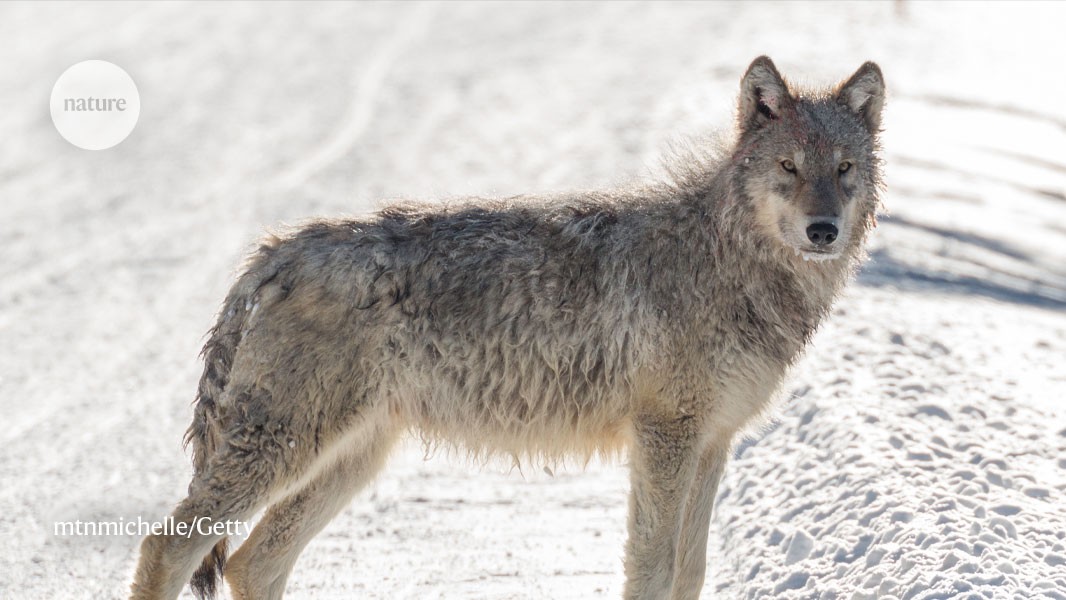
Parasite gives wolves what it takes to be pack leaders
Study is one of the few to show the behavioural effects of Toxoplasma gondii in wild animals.
nature.com
211 points · by gscott · 4y ago · 179 comments
Another apocryphal story is cats carrying Toxoplasma Gondii make some people really like cats. So maybe mad cat lady syndrome is treatable with drugs :)
Who knows what super-systems we are unwittingly a part of. That seems an interesting area for big-data + AI hypothesis synthesis - we may find new explanations or even whole new branches of behaviour in psychology.
>The team looked at 256 blood samples from 229 wolves, which had been carefully watched throughout their lives, and had their life histories and social status recorded. Meyer and Cassidy found that infected wolves were 11 times more likely than uninfected ones to leave their birth family to start a new pack, and 46 times more likely to become pack leaders — often the only wolves in the pack that breed.
E.g. perhaps aggression makes them more likely to eat infected animals and also more likely to challenge for leadership.
The data was collected over nearly 27 years, the link to the full open access paper is in the references; https://doi.org/10.1038%2Fs42003-022-04122-0
Not saying it can't be the case. But the linked article is bad (ok, I should have seen that coming), and there's a lot left to disprove before the conclusion can be drawn. Yet the reactions already want to test politicians for infection, as if there were no leaders before cats were commonplace, and as if it isn't known to be bad for pregnancy.
"All the leaders are secretly infected by parasites".
Sounds like interesting sci fi movie premise.
What people might find unpalatable is the idea that parasitic infection could determine so fundamentally political beliefs and ideology, but consider that the idea of not cleaning your hands directly led to disease was considered literal insanity (see the tragic history of Ignaz Semmelweis) prior to germ theory. Sometimes it's the smallest catalysts that cause the largest changes. For the want of a nail...
Correlation or causation?
> Wolves infected with a common parasite are more likely than uninfected animals to lead a pack, according to an analysis of more than 200 North American wolves1. Infected animals are also more likely to leave their home packs and strike out on their own.
From Wikipedia, Toxoplasmosis Gondii ( https://en.wikipedia.org/wiki/Toxoplasma_gondii ):
> Although under-studied, penguin populations, especially those that share an environment with the human population, are at-risk due to parasite infections, mainly Toxoplasmosis gondii. The main subspecies of penguins found to be infected by T. gondii include wild Magellanic and Galapagos penguins, as well as blue and African penguins in captivity.[78] In one study, 57 (43.2%) of 132 serum samples of Magellanic penguins were found to have T. gondii. The island that the penguin is located, Magdalena Island, is known to have no cat populations, but a very frequent human population, indicating the possibility of transmission.
From Werner Herzog's Encounters at the End of the Earth ( https://www.youtube.com/watch?v=x7kdDeGXUjI ):
  HERZOG: Dr. Ainley, is there such thing as insanity among penguins? I try to
  avoid the definition of insanity or derangement. I don't mean that a penguin
  might believe he or she is Lenin or Napoleon Bonaparte, but could they just go
  crazy because they've had enough of their colony?

  AINLEY: Well, I've never seen a penguin bashing its head against a rock. They
  do get disoriented. They end up in places they shouldn't be, a long way from
  the ocean.

  HERZOG: These penguins are all heading to the open water to the right.
  But one of them caught our eye, the one in the center.
  He would neither go towards the feeding grounds at the edge of the ice,
  nor return to the colony. Shortly afterwards, we saw him heading straight
  towards the mountains, some 70 kilometers away. Dr. Ainley explained
  that even if he caught him and brought him back to the colony, he would
  immediately head right back for the mountains. But why?

  One of these disoriented, or deranged, penguins showed up at the New Harbor
  diving camp, already some 80 kilometers away from where it should be.

  The rules for the humans are do not disturb or hold up the penguin. Stand still
  and let him go on his way. And here, he's heading off into the interior of the
  vast continent.

With 5, 000 kilometers ahead of him, he's heading towards certain death.I was under the impression that it wasn't so much that people considered the idea insane, as that they hated Semmelweis and were therefore strenuously opposed to anything associated with him.
Why would you want someone who does not want to do a job do that job?
If you are interviewing someone and that person said “I don’t want to do this job” would you hire that person?
Which is why it's helpful to have as many (what I refer to as…) "power traps" in a society as possible: coaching, teaching, leading an HOA, leading a PTA, etc.
I have nothing against these endeavors, you must understand, but my view is that a person spending time acting as a judge for a dog show is less likely to pursue becoming an actual judge.
Or advertisement
edit: and as the one below me already alluded to, your statement exists on a physical substrate whilst culture exists abstractly thus invalid
Listen, you! I was born here. I raised a cloud of children here. My ancestors came over here on the sandwich.
One of my favorite episodes.
> :s/reptiloids/parasites/g
Well, their field of work is called poly-ticks...
Joking aside, it makes sense to me that higher risk behavior on the host’s part would increase a parasite’s spread, since some of the energy that drives risk also increases the rate of physical interaction with the world; like a free roaming particle with a lot of momentum on a substrate. It is good to see more research looking into this since this seems to be low hanging fruit compared to possible compound effects of t. gondii influence on society.
It's good research but there is a major caveat I didn't see it in this press release.
Before they answer questions like yours they need to have tracked when infection occured.
Simple conundrum are wolves who are infected with t. Gondii more likely to leave their pack? Or are wolves that leave their pack more likely to get infected?
Similarly for pack leaders. It might seem obtuse to ask for this but it is important to disentangle somewhat cause and correlation.
In humans it's theorised to increase risk of car accidents (based on a french study monitoring speeding and traffic rule obedience).
>Given the correlational nature of the study, observed patterns may not be causal; for example, higher risk-takers could be more likely to be both entrepreneurial and exposed to T. gondii [...], thereby driving the correlation.
Remember that while it might sound amazing that a parasite could steer higher cognitive functions towards something as abstract as being more entrepreneurial, there is no practicable mechanism suggested so far and until someone figures out if it is even possible, all these studies are to be handled with care.
I can see how press departments could claim that they’re only doing their job, but it’s potentially unethical and dangerous.
I thought we now believe that wolf packs are purely family units - mother, father and their cubs. There's no alpha wolves leading a pack of other male and female wolves, just stray wolves and family units. So a wolf pack is only comprised of the leader and its cubs.
So, in conclusion, if the vector has requirements, the infection will try to make the host capable of fullfilment.
If the infection needs sugar, the mitochondria, will make the amobea crawl to algea.
Mitochondria are a bit special in that it's mutually beneficial, but the same could be said about the above cold virus, if the other symptoms are mild enough.
It could be that infection with T. gondii is sometimes the difference between simply having a predisposition towards schizophrenia and actually developing the symptoms. Pot use in the late teens and early 20s can have the same effect. It doesn't cause schizophrenia, but it may be a trigger than leads a genetically predisposed individual to develop the disorder.
(I'll get my coat.)
Toxoplasma gondii : https://en.wikipedia.org/wiki/Toxoplasma_gondii
Risk factors for human infection : https://en.wikipedia.org/wiki/Toxoplasma_gondii#Immune_respo...
So "also, Grey Wolves" -- the "also" is redundant, since it's about the same wolves both times, and the finding is the same.
It seems periodic, and i'm not kidding. (kinda like Jodi Foster in Contact with the headphones on)
Not this time, but usually it's a revelation about the protozoan with mice being fearless around cats, or about humans living with cats, with associated proposals of drama, perhaps to drive pageviews.
...
> Up to one-third of humans might be chronically infected.
That is certainly an interesting research vector...
Genuinely curious, why aren't we doing an annual anti-parasitic or something given the drugs are relatively benign?
Maybe when aliens visit us they will say, no, step aside humans, we are here to talk to the true leaders of the planet. Bring out your microscopes.
Perhaps it is impossible to distinguish stupid boldness from real vision without complex communication.
Wouldnt it be highly preferable, from the parasites side of evolution, that only the males, that have parasite infection will be able to breed ?
Toxoplasma trying to create their own empire probably.
“Can also infect humans”
Well that doesn’t give me nightmares at all.
And most of them die for that.
Two titles. Same article; just without the starry-eyed documentary lens
How does it know what gene to promote? Its hard to beleive that such "primitive" organizm promotes exploration and risky behavior in number of different animals.
I'm off to find a parasite, wish me luck.
Behavior science is sensitive to interpretation, in my view.
It's a human bias to see human concepts in other species.
Once one can accept to take a step back, ask questions and maybe understand that politics and culture can often shape our perception of how things work, that's when it becomes possible to observe with a fresh look.
I often have tried to criticize the myth of the alpha male, but I often crash into people who seem so entrenched in their own normed vision of the world.
Please read this: https://en.wikipedia.org/wiki/Social_dominance_orientation
It's pretty eye opening, it goes beyond conservative politics. It explains how people want to believe dominance is a real thing.
> Infections with toxoplasmosis are associated with a variety of neuropsychiatric and behavioral conditions
> Research on human vaccines is ongoing.
I say 5 years before we have a moral panic about this
That explains so much...
>Among professionals attending entrepreneurship events, T. gondii-positive individuals were 1.8× more likely to have started their own business compared with other attendees (n = 197). Finally, after synthesizing and combining country-level databases on T. gondii infection from the past 25 years with the Global Entrepreneurship Monitor of entrepreneurial activity, we found that infection prevalence was a consistent, positive predictor of entrepreneurial activity and intentions at the national scale, regardless of whether previously identified economic covariates were included.
"The association of latent toxoplasmosis and level of serum testosterone in humans" (https://www.ncbi.nlm.nih.gov/pmc/articles/PMC5994116/)
>Comparison of testosterone concentrations and control groups showed that testosterone concentration in study group was higher than that in control group with statistically significant difference.
"Toxoplasma gondii infection enhances testicular steroidogenesis in rats" (https://onlinelibrary.wiley.com/doi/abs/10.1111/mec.12042)
>Testosterone, a testicular steroid, is known to reduce fear and enhance sexual attractiveness in males. Here, we show that Toxoplasma gondii infection enhances expression of genes involved in facilitating synthesis of testosterone, resulting in greater testicular testosterone production in male rats.
Sure, why not.
It's widely known for many years now. Twenty years ago there was a huge report about it on German public radio. The article I looked references research from the seventies.
It's been a strange philosophical point to me that catching a parasite that really wants to be in your cat can alter your personality and unless you are a pregnant woman the medical system ignores it.
We don't have any way to undo whatever the parasite did while it was active. It's probably possible to create a vaccine, but the full impact in humans is still being explored and a vaccine for a pathogen that's been with us mostly unnoticed since cats have been with us isn't a high priority.
I'd also say decades of research into the effects of T. gondii is explicitly not the medical system ignoring it. It's the medical system being aware of it, but there aren't any great solutions at this point.
I'd also like to point out the difference between difficult to define risk-taking behavior in adults vs. miscarriage, blindness, neurological issues, and hydrocephalus among other risks to a fetus.
It may have had a similar control group and could be relevant. It could be that individuals with more of the parasite are more likely to become entrepreneurs still.
Not just wolves. Toxoplasma infection also "may make people look more attractive to the opposite sex": https://www.earth.com/news/parasite-makes-infected-people-lo...
Is this because it increases risk-taking behavior? Who knows, but it's interesting that something with potentially significant health drawbacks may have enough benefits that it's evolved to coexist with us (up to 50% of people carry it).
Overall, it looks increasingly like microbes shape our behavior and emotional health: https://www.science.org/content/article/evidence-mounts-gut-...