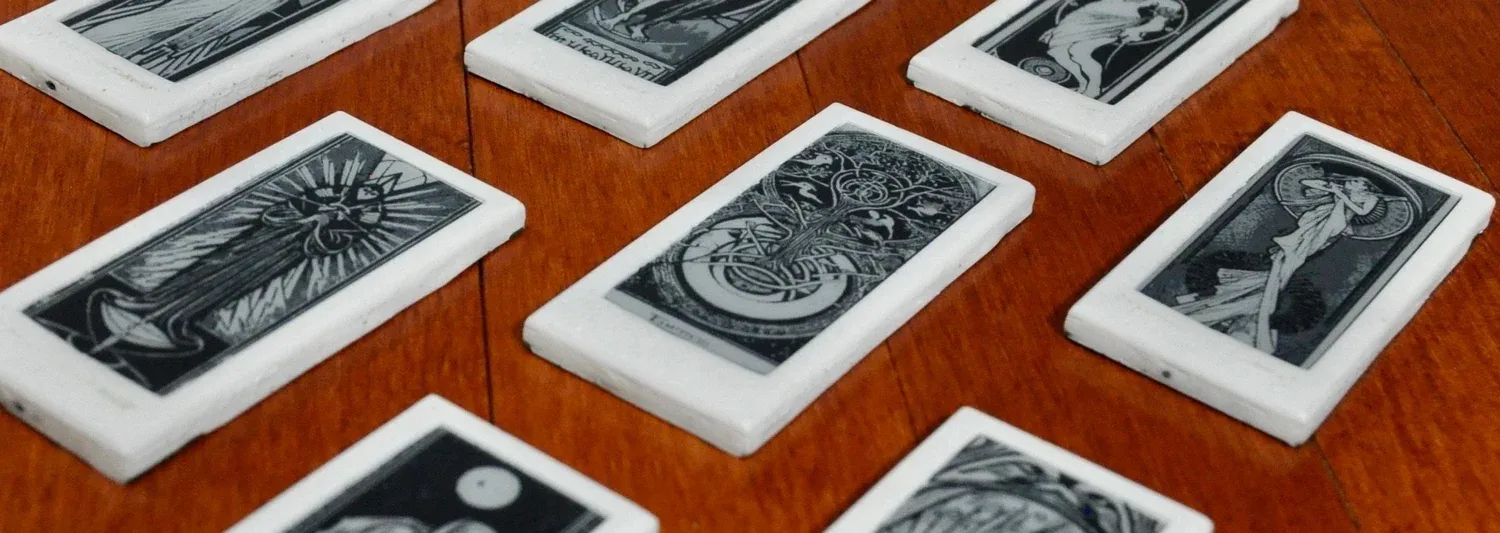
Introducing Wyldcard — Wyldcard
Introducing Wyldcard, a new paradigm for tabletop gaming, trading cards which can magically change as you play.
Wyldcard
1149 points · by jonahss · 3y ago · 291 comments
In 2014, I was holding a stack of iPhones and thought to myself:
"Hey, if I had each phone display a playing card, I could click a button and they'd shuffle themselves"
Right now, each card costs me about $20 each, but with only a bit more scale, I think I can get that down to $10.
In doing this project, I learned how to design electronics and circuit boards. I learned Rust and wrote my first driver, I upped my CAD skills, 3D printed, and did my first resin casting. I generated the images on the cards using stable-diffusion.
HN always seems to appreciate new uses for e-ink. Thought I'd share :)
If you're thinking of mass-production might be worth reaching out to one of those manufacturers; you can buy in bulk if nothing else (but I'm sure they'd be open to customizing it a bit - maybe some branding on the plastic molding and whatnot).
Huh, the battery lasts for ten years? I wonder how many refreshes you get for that. Maybe I should just be using those.....
He's a friendly guy, he'll help you.
I’d love to find cheap e-ink tags that can just receive a picture over some cheap wireless protocol and display it.
You can search for NFC ones on the same website, they're a few bucks more.
There are also Bluetooth variants which is more friendly to hacking at home (update over the air from farther away) but those look pricier.
I'd really like a $10-20 epaper display that I could update wirelessly on very low power, there are so many fun projects that could be done with that. There are a few dev boards that almost hit that price point but software support is really bad in my experience.
The 4" ones (close to paper tag size) are $20.
Since I just want this to come to fruition, I'll explain what my intended launch strategy was. I'm a developer (just a contractor, not owner) of Tabletop Simulator and do some stuff in that community where there's an overlap between physical tabletop and digital. My plan was to launch a card game (largely designed) and the e-ink cards simultaneously via Kickstarter. However, before that, a digital implementation of the game on TTS. Basically as much as I love this idea, I couldn't see it being monetisable on its own unless you can bring the cost down significantly. It also didn't seem like a defensible business on its own. But if the product is a game that uses said functionality, well, that'd be just swell.
Anyway, congrats, this is awesome!
Adventure card games,[2][3] which blend tabletop RPG and card game mechanics to play through a story and often rely on mutable and custom third-party or player-created cards, are another niche that could rock programmable cards. They don't rely on collectability or random card packs - everything to play comes in a base set, and expansions take the forms of additional classes or adventures. But they can be tedious to set up, card mutability means marking and smudging cards or sleeving them, and using third-party or player-made cards usually requires getting them printed to fit into the deck seamlessly - programmable cards can dodge all of those issues.
1: https://www.youtube.com/watch?v=8ZLXSmq9s1A
2: https://www.strangeassembly.com/2019/review-pathfinder-adven...
3: https://play.google.com/store/apps/details?id=net.obsidian.p...
Kind of like the Blinks game system, these little hexes with colored lights in them that each have a separate game in them and can 'teach' the other hexes they connect to.
One of the Blinks Kickstarters: https://www.kickstarter.com/projects/move38/blinks-smart-boa...
What does epaper get you that paper doesn't? A microprocessor and persistent state. RFID cards on a board game might be a good middle state for most cards. Scan them as played. Build gamestate or dynamics to be populated to epaper.
Epaper would be good for storyline branches, timeline progressions, evolving characters. Make them traveling characters being owned by different players. Differentiate them from becoming a static scoreboard that could be represented on a single tablet.
When watching TV shows that have cool card games, like Yu-Gi-Oh, it seems like the game doesn't have rules, but instead the kids reason about the characters by looking at the pictures. Weird unexpected stuff happens all the time, I was thinking about how to implement that in the real world.
For example, imagine a vampire card that has its eyes closed. You try using it, but it doesn't do anything. But, you notice that when you play at night the eyes are open and now it's a powerful vampire!
So you can do time-based mechanics, I could add location-based mechanics. You can also make the cards do different things based on what other cards are in play.
> When watching TV shows that have cool card games, like Yu-Gi-Oh, it seems like the game doesn't have rules, but instead the kids reason about the characters by looking at the pictures.
This is basically how it worked writing-wise in the original Duel Monsters series (though the characters acted like these were mostly all known effects/interactions), after that came GX where they toned down the creativity and mostly used real effects, then in Zexal and afterwards I think they stuck almost entirely to real effects with occasional exceptions.
When they released the real-world Dueling Monsters card game, they tried to keep the rules consistent with the manga/series, but changed them in places to make a more playable game. Ex.: there is an upper limit to the damage you can do with the Berserker Soul ability.
If you're into this sort of thing, I highly recommend checking out Inscryption, it has some really fun twists on this idea.
For what it's worth, the actual Yu-Gi-Oh trading card games has rules and the anime uses a very loose interpretation of those rules.
For instance in MTG day/night cycles were featured in the original werewolves (I want to say innistrad), location mechanics can be continuous effects on lands or ETBs, likewise for reaction to other cards in play.
[1] nsfw https://shop.kingdomdeath.com/collections/in-stock/products/...
Yeah, it's a weird in-between. I don't think a game publisher would take a risk on it, but neither would silicon valley VCs.
Kickstarter would be my bet too. I was going to put this project down for a little while and start a "real" startup though.....
By the way, I've been following your posts here for years! I'll trade you cards for candy!
That said, this might be a good "real startup." The problem domain seems modest (e-ink playing cards) but... could be a bridgehead to interesting territory.
These might be designed/used as playing cards, but it's actually a computer with lots of little portable screens. The actual thing is general, a proverbial "computing paradigm."
These are playing cards, but could be concert tickets, conference badges, security doohickeys... They can open a door, clock you in and display your in/out status. If you want to go full "SV Pitch:" these cards are money. Transfer 69 FTX coins onto a card at a secure terminal, and pay by handing it to the hooker. A casino could give you one of these to be your wallet.
Solutions looking for problems sometimes find them. See apple/msft.
Nah. Part of the strip club experience will always be showering the strippers in dollar bills... and why would you do regular payments for hookers with a special token?! Almost all credit and debit cards (=EMV cards) already can do this by NFC and you can also use watches and phones for this, the problem rather is:
- sex workers are pretty much banned from conventional payment methods and networks because sex work is illicit in many countries and even where it's legal, many sex workers prefer hard cash because chargeback fraud aka "post nut clarity" or actually stolen credentials is so common
- whenever you start a new payment scheme - because you are doing precisely this! - you WILL have to follow banking laws and regulations: customer identification, anti-smurfing and other money laundering measures, compliances for data protection, reports to banking authorities... an insane mess to do right. Of course, you can also hope to do a Bitcoin... but given the penalties if you are ever caught by the authorities, it's not worth it.
You might still try for the latter. Especially if you can think of ways to make the business bigger.
Can intro me to anyone? email me: jonah@wyldcard.io
I was thinking, very possibly, if I found some angel investors who also love boardgames.....
If we're talking business models, the one which immediately comes to mind as appropriate is that of a gaming console. Sell the hardware (e-cards, maybe a mat?) at a loss, then sell games for it at no marginal cost. Let other people build games for it because hit games are what sell platforms.
Since this essentially a portable gaming device, consumers may compare it to e.g. a Nintendo Switch - if you undercut the Switch and you have a blockbuster title or two, you could have incredible product on your hands.
Presumably the lucrative economics of trading card games could be applied here as well...!
I think I'd need funding for that though, can't bootstrap a platform without that first blockbuster game.
My son was really into it for a while, but they included betting “credits” with the game that weren’t nearly as fun as normal chips would have been.
I took inspiration from Yu-Gi-Oh, Card Captors, Angelic Layer...
Given the current limitations in the system I would go with a monster battler game with a starter set of just 2 cards which would be yours and your opponents monster and then add a selection of power-ups/abilities these could be much cheaper components that could be played on the base station for an effect. These could be swipe cards or even just resistors basically anything that can be measured by the base station. With this hybrid system you could get the cool evolving over time monsters as well as lots of pieces to play with. Lots of scope for cool and hidden interactions. (Ideas taken from digimon tamers)
---
Sample game idea: CAKE DECORATION game - players have to try to decorate as many cakes as possible. Requires 10 cards.
One card is the 'design recipe' card and never leaves the base station. It shows an amount of ingredients, ex. "1 cup of buttercream, 3 shakes of sprinkles, 4 squirts of whipped cream".
Players start with either 3 blank cards or 3 random low-amount ingredient cards.
On a players turn, they select from three cards: each card is an ingredient, an amount, and a modifier. So cards could be "1 shake of sprinkles (2x)" "2 squirts of whipped cream (+1)" "1/4 cup of buttercream (+1/4)" (could make variations or add other kinds of things that might go on a cake)
The player draws a card, base station detects which card is missing, and the other two ingredient cards increase in amount based on the modifier value displayed on the card. ex. "1 shake of sprinkles with a 2x" will fully complete the recipe if not drawn for two turns (because 1 x2 x2 = 4 shakes, which is enough for the recipe)
With 4 cards in their hand, if the player can pay for the whole recipe, they win the round and get a point. On win, new recipe appears and all cards in the winning players hand and on the base station get rerolled to new low-amount ingredient cards. Score could be displayed on the margins of the recipe card.
If they cannot pay for the recipe, the player places a card back on the base station. And their turn is over. (Should ingredients be re-randomized when replaced on base station? Should that be a player decision whether to reroll it?)
First player to decorate N cakes wins the game.
---
I think something like this could make for a viable game with a low number of cards, but could be more fun with a greater number (17 ideally?) which would allow for 3 active recipe targets (+2), using the 4th slot for another ingredient and displaying recipe as a disconnected piece(s) (+1), and larger hand sizes (5 -> +4) to allow for more complex recipes
An interesting game design question is how random you want the cards to be? Fair random would probably be viable, but since the 'deck' can know and make decisions based on the state of cards not connected to the base station, you could deal unfairly if less randomness would make the game more interesting or fun.
I'm glad you kept the total card count low, that's a limiting factor because of their price and size.
I'll try it out!
In terms of product development, I think the best path would probably be to create or find an opensource game engine for cardgames and have a nice development environment plus API where a dev can write a game for the engine that either runs on a PC or runs on the cards, with no code changes required. (PC support makes debugging and iterating on game design much faster.)
Ah yeah, I think the game design community mostly uses tabletop simulator and one other such program for testing out ideas. Being able to deploy to both is a good idea.
Product name: "Tabletop Simulator Simulator"
Obviously not eink, but exactly that kind of card game exploration.
so a 6 person game, 12 of these + 5 ~ 17 of these ~ $450 ~ about the cost of real nice chips and cards...
Instead of the iPad in the middle you could use a TV screen, too, but then you can't directly interact with that via touch screen.
That said, you can play poker with a deck of cards and a pile of beans.
But yeah, I'm looking for something somewhere between Poker and an iPad.
See my other comment, a lot of interesting mechanics are available.
I'd sell you a poker set if you want to impress your friends :D Email me: jonah@wyldcard.io
For holdem, you ideally need a plinth that can "deal" cards upside down. Maybe it's more general to have a plinth that can update cards in either orientation.
Congrants jonahss on your art. Thanks for sharing.
In terms of making a game with them, I think a design where the pins are on the face of the card may be useful. I want to be able to 'draw' a card without knowing what is on it.
Certainly can be useful with pins on the back (and I totally get how this orientation is probably more size-efficient), but I think front pins would be more 'playable'. Maybe a design could be achieved with holes that pass through all the way so it can be written with either orientation?
Being able to 'power up' an existing card in the upwards orientation could be really cool for situations where you kind of want 'counters' applied to a portable card. Could have a base-station that allows you to 'add' the qualities of one card to another target card, or 'evolve' a pokemon, etc.
That would work. But you can also make that work with current hardware (I think): you just need a delay between pressing the button and the screen changing? So that the player can press the button, pick up the card, and five seconds later, it's revealed.
So in a way, you could "leave" traps or powerups on spots on the base, and your character activates them when it lands there.
(obligatory: 'you've activated my trap card')
Maybe I should raise the priority on that.
Definitely I'm into the idea of evolving, or breeding cards like pokemon. Powerup or 'combine' would be cool too.
This isn't an actual game, but I'm thinking it would be great to pick a card face up that's "red" and be able to make a decision to turn it into "cyan". Others could pick "green" and "blue" face up, but can click a button to turn it to something else, and then the game resolves itself when everyone reveals it. Like if everyone can discuss and if everyone reveals the primary colors everyone wins.
I'm sure there's interesting game mechanics you can come up with when you give a decision to the player.
Additionally, I think this could make an interesting programmable suite of games. You don't have to sell just one game.
Ah, the cards have buttons next to them on the base. I figured they could display icons on the card next to each button (each spot on the base has 3 right now). I call it the 'ATM' style UX.
For example, perhaps a game that has a general flow of: players have their cards, there’s a central base station, but most play is not digital. Maybe they somehow battle their cards, they can go around and battle people as much as they want, but their “moves” are tied to the switches and when they use a move, they flick the switch off (wonder if it could be made to actually get stuck in position, to provide physical feedback indicating that the moves are “used up.”)
Then, when they want, they go back to the Pokécenter — I mean, oops, base station. It recharges their abilities (unflips the switches), maybe runs some “level up” logic, etc etc.
I mean, this quickly started to stretch credibility as far as the mechanism goes, but the idea of giving the players/game designers a couple bits of state that they can toggle away from the base station might allow more asynchronous type games.
It seems the big assumption everyone's making in the comments is that the displays will just stay there on the electronics box. The reality is that you can refresh the display and then take it back into your hand. You could even trade it with other players while disconnected.
Furthermore, these displays can be refreshed hundreds of thousands of times (some can do millions) and therefore can last a lot longer than regular cards. They're also stupidly cheap in bulk! Example of a cheap NFC-powered one: https://www.aliexpress.us/item/3256803070283516.html (not the best example since it's kinda thick but you can get much thinner ones around the same price).
You just need to come up with some example games that take advantage of the trading dynamic. Also, if you're up to the engineering it would be neat if you could use one epaper "card" to modify another one. Much like how in many card games you can add an "enchantment" or "modifier" style card on top of another to give it additional capabilities.
I also recommend adding a cover or shutter to the cards so that they can be refreshed without the other players seeing what it is. Once the card is back in your hand you can move the cover out of the way and see what you got. Alternatively, you could make it so that the cards refresh their displays upside down. That way you can refresh it without anyone seeing what's there.
A few comments have mentioned being able to refresh the cards while upside down, or covered by another. Maybe my next prototype can put the contacts on the edges and have them wrap around or pass through, so they work on both sides.
That will be a bit more complexity for fabrication, but sounds like a fun project.
For anyone curious, the symbol made by the contacts is the Tree of Life from the kabbalah
Magic the Gathering has a monopoly on fantasy, and the cyberpunk genre is played out. Plus I want the inner-workings to be somewhat mysterious.
I had a lot of fun thematically laying out the contacts. For example: Keter is VCC and Malchut is GND
Beautiful
I don't think traditional board games would be interested unless you got the price down very very low ($2/unit or less).
I think you could make something happen if you marketed and packaged it as a "board game console" though. Like a fixed number of cards and larger boards, plus some sort of base station or phone app that'll flash everything to the starting state of a game of your choice. Then people buy new games digitally from you, same as a modern video game console.
(I'd be interested in the game dev facing API and writing some games for such a thing, so let me know if you're pursuing it and we can swap contact info.)
When the pandemic started, it seemed like there was an opportunity to build games where you still are participating in physical space, but certain aspects of the game are shared across a network and then transform back into something that occupies physical space. I thought that could be something like AR but your cards open up other doors.
It would be fascinating to have a deck that shares cards in multiple distant places, with people playing the game from far away but connected through your cards.
Adding an element of time delay to the synchronization of the deck would be fun too.
Please provide a way to follow along on your progress, like a mailing list! Such a great project.
Should have added that call-to-action to my post; *facepalm
Your idea is kind of like the hologram chess that Ed plays in Cowboy Bebop
You have your local deck and player, and then the actual board is on TTS
May I ask what e-ink displays you're using?
Good Display GDEW029T5D
I wasn't really watching the images in the demo video, so at first I though he was transferring one image to another. This made me think it would be really cool if there were exactly one way to get a new image on your card: put it on a device that swaps two cards. You'd get a new image, but they'd lose theirs. So you'd actually have to commit to trading.
I guess that sounds a little like NFTs, but hopefully without the douchey scamminess.
I thought it'd be so cool if all the cards from one town look one way, and they're different the next state over. So when you go on a school trip, you can pick up cards not available in your area.
> Mystic Vale uses the innovative "Card Crafting System", which lets you not only build your deck, but build the individual cards in your deck, customizing each card's abilities to exactly the strategy you want to follow.
You would probably want to go with fewer cards. But something like a deck builder could work.
Can you file a patent for something like this? If you can, then I would explore that option.
Very impressive!
I want kids to be able to play at school or at camp, so didn't add any connectivity. Plus I'm trying to stay cheap. But I can imagine adding bluetooth to the base or to your phone or something. Then I can go all "BILLS PC" and let you store your spirits on the cloud, let you load them in and out of cards, etc etc.
Except I don't want to turn it into an online game. Computer games are awesome, I think it's lame to emulate physical cards with a computer, a'la' Hearthstone.
The trick would be an easy interface for writing to them. They don't have batteries, so you need to send all the power to them along with information.
I forgot to add: very interesting project and amazing to see the fruition of your efforts!
There's a thin and flexible e-ink display I could use instead, but they're $20 each instead of $4. I agree they're a bit chunky in this form :)
I agree the docking station detracts a bit from the naturalness of just playing on a table.
I decided to build what middle-school-me would have wanted to play with. I took a lot of inspiration from Yu-Gi-Oh which has the same docking station concept (just executed much better, where you wear it on your wrist).
I knew no Rust at all before starting. Yikes was it frustrating to learn a completely new language. I had to go through the whole rust book, not skipping any basics, in order to get there. I also assigned myself a homework assignment to get used to the concepts. See the other blog post on wyldcard.io/blog
Honestly, by the time I got to the finished prototype, I could have just done the whole thing with Javascript. Although intending to use an SDM32F7 for the finished project, it was really convenient to use a raspberry pi for development. Using VS Code, I could program remotely on the pi from my Mac and iterate really quickly.
the awesome-embedded-rust[1] repo was very helpful.
TBH, embedded rust really feels like it's not ready for hobbysists who aren't embedded experts already.
Questions:
Do the cards contain any battery? I’m wondering if they have always-running CPUs in there, or if all the compute happens in the base (and then it just writes to the screen).
I guess color eInk would probably be cost-prohibitive, huh?
Yup, you called it. The cards are totally passive. Just the screen and an eeprom memory chip, no battery.
All the compute happens in the base.
Color e-ink way too expensive for now, but if Wizards of the Coast wants to invest 100MM we can make em in color, thinner, and flexible!
100% makes sense. eInk is so frustrating sometimes, I wish somebody had an application that used a bazillion of the things so they’d get some economy of scale going. You are just going to have to make these things the next Magic to solve the scaling issue.
> Yup, you called it. The cards are totally passive. Just the screen and an eeprom memory chip, no battery.
Sensible way of doing it.
For a game like Talisman, your player token could the the card. It would be nice to have the pins inside the game board, though, so that you could just place your token on a special location, and an event happens. This would require a powered board, though, which kind of detracts from the idea that the games could be played disconnected.
I think the reason I was able to buy these e-innk displays so cheap is that they're the exact size of grocery store shelf price tags.
But let's say all trading cards in the world were like the e-ink ones you invented, and then somebody came along and said, "I printed 52 trading cards on glossy card paper, in vibrant color. They are 1 millimeter thick, weigh practically nothing, and cost about a penny each to produce. The drawback is you have to shuffle them in your hands".
The paper version would be a massive upgrade in almost every sense.
>The cards also contain a memory chip, so they can store stats, moves, and keep changes and status effects from one game to the next. ... >I think these cards have the potential to unlock a new paradigm of tabletop gaming. They are rooted in the physical world, but can implement complex game mechanics run by a computer.
e.g. Magic The Gathering has a TON of modifiers - +1/1 counters, etc - and this could live-update and keep track of those in a physical/offline setting.
Lots of possibilities here!
If they took off and were produced at scale, we could definitely do color, and make them thinner and flexible as well!
Good Display GDEW029T5D
jonah@wyldcard.io
Sorry for adding more work. :)
https://www.hackster.io/news/the-inkplate-2-is-a-tiny-self-c...
You think I should patent? Isn't that going to cost me like 20 grand? Plus if Wizards of the Coast really wants to, they can work around my patents somehow.
If I could patent for only a couple thousand dollars maybe I would..... But I WANT other game developers to use this idea. Just, if they want to skip ahead, they can work with me, I'd be happy to share.
I do think it's cool enough to be worth spending a few $K to consult with an attorney, though, especially since you've taken it this far. Mistakes made early in the process of commercializing something can have disproportionate effects later on.
If it does turn out to be patentable, you have up to 1 year to file after first public disclosure (IIRC), and that clock is now ticking, for better or worse.
From a long time ago I'm trying to build a e-ink magnet for the fridge with relevant updated relevant information about some school programs.
But I haven't really found a cheap e-ink display.
Edit: I see that you answered it:
>Bought off Alibaba, I think they're so cheap because they're designed for grocery store shelf price tags. Good Display GDEW029T5D Where do you get yours for $20?
But you need a base station to update them, and a way to connect to your network to upload images/text.....
If you email me your address, I'd be happy to send you one for your fridge :D
Think I should do it?
How low you think the cost per card can go?
edit: elsewhere you quoted $80 for the base and 3 cards so if that's your target it seems more reasonable. but 3 cards is also too little, maybe a kit with 5 cards is better
Turning 90 degrees... maybe I could do some magic with magnets.....
The best advice I got was "Read the datasheet"
The biggest step for me was deciding to spend money on experimenting. With a budget, suddenly it was fun to order stuff, buy tools, try things out.
Rust Book was the best for learning Rust.
Things like DnD roleplaying games or Megagames could both use something like this.
I'd personally be interested in both those applications, what kind of wireless communication can they do?
I was going to post about it on some game dev forums next, any suggestions of where I should post?
They don't do wireless as of now, they have to sit on the plinth to get an update. There are options for how to add some form of wireless connectivity.
I'd be interested in continuing the conversation, I'll send you an email, or email me: jonah@wyldcard.io
I'll look into using a demultiplexer, because maybe then I could afford the pogo pins.
Mostly wanted to inspire something new.
That's why I wanted to get this concept out there, to inspire the next thing.
Bought off Alibaba, I think they're so cheap because they're designed for grocery store shelf price tags.
Good Display GDEW029T5D
The cards themselves are completely passive and unpowered. Base does everything.
If you are willing to spend even more, you could bundle the card circuitry with the silicon embedded in the e-ink display already, and there are FPC e-ink displays. So it'd be about half the thickness of a credit card and flexible!
(at that point, we'd need to change the plinth interface, probably go for NFC like people are mentioning in these comments)
You could actually have a characters 'hitpoints' accurately reflected instead of having to keep track of, ala Hearthstone.
Are they some sort of pogo pins?
These prototypes are running on a raspberry pi, though I wouldn't want to put them into production like that.
Since I only made two, it was easier just to keep it on the raspi for now.
Btw that’s a great project OP. I really love it.
Too late! He completely missed the NFT boom. These could have been the definitive way to deliver NFTs. The device would check in with the blockchain, and only if the owner of the device and the owner of the NFT matches would it display.
1. For a Linux user, you can already build such a system yourself quite trivially by getting a 3D printer, designing and printing your own cards, and making your own circuit boards. From Windows or Mac, you can then just use whatever you made on Linux.
2. It doesn't actually replace physical cards. Most people I know e-mail cards to themselves or host them somewhere online to be able to play games, but they still carry physical cards in case there are connectivity problems. This does not solve the connectivity issue.
3. It does not seem very "viral" or income-generating. I know this is premature at this point, but without charging users for the service (not buying, but also playing with the cards), is it reasonable to expect to make money off of this?