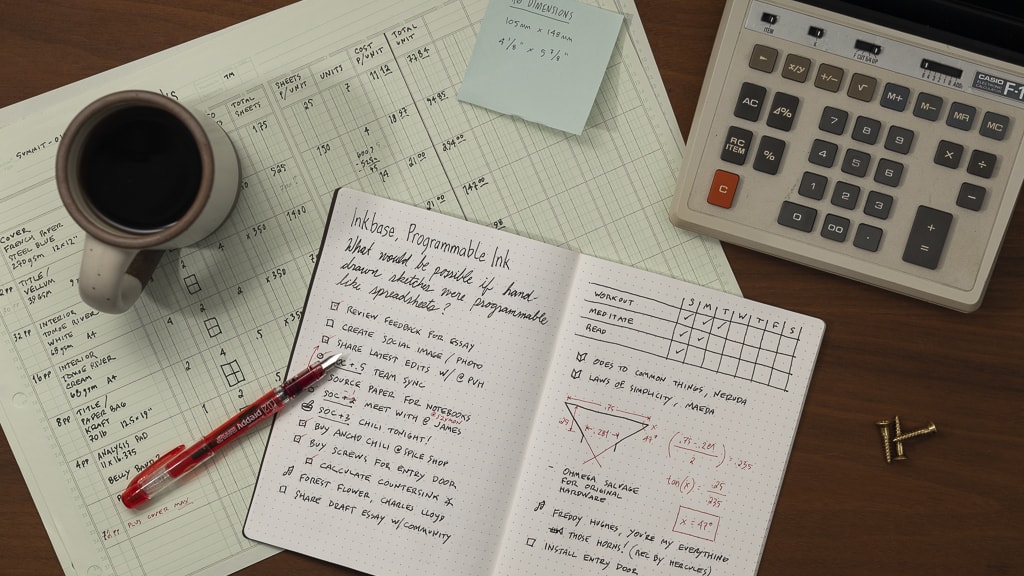
Inkbase: Programmable Ink
What would be possible if hand-drawn sketches were programmable like spreadsheets?
inkandswitch.com
675 points · by infinite8s · 3y ago · 83 comments
For me there is something really powerful in drawing freely with a pencil and not being constrained by the way tools (Figma, etc) make you think.
Anyhow side project is here if anyone wants a quick way to do wireframes and add in logic, components, etc - https://roughups.com
Specific lesson on using data here https://roughups.com/learn/boxes
If one could write generic code, and if the properties of the inked objects were exposed to the runtime (i.e. corner points, stroke/fill colors, rotation, etc.) your app would be really close in functionality to the linked project.
My ultimate aim is to get it so that you can actually publish a sketched app to the App Store… whether apple would accept a scribbled app or not I don’t know!
Since you have a whole section on learning:
One thing I've noticed is that, at least on physical whiteboards, most people I've worked with weren't comfortable with their handwriting and drawing skills. Even when everyone agrees that "rougher is better."
For them I used to do a quick hands-on workshop back at Pivotal Labs. It was called "Whiteboard Hacking" (please don't judge ;) for which I also published a free small manual.
The manual with a bunch of exercises is still here for anyone who feels overly critical of their handwriting and drawing skills: https://publish.obsidian.md/alexisrondeau/Attachments/Whiteb... .
> Building larger, more technical software systems in Inkbase becomes extremely difficult for many reasons, from the poor ergonomics of typing with an on-screen keyboard
Nobody has really solved the ergonomics problem of being able to type on a keyboard and also sketch, and have the entire system be portable and friction free.
Though I cannot imagine it working within the confines of the keyboard HID API.
With non-defective keyboards (and non-spazzy hands), the key presses on a keyboard are non-probabilistic; that's not the case with handwriting, where a large amount of the information regarding how to interpret text comes from the surrounding characters - including those that follow.
You'd need to deal with the shifting probabilities of text input, and without introducing user noticable latency or triggering an excess of events.
It doesn't sound impossible, but it wouldn't be easy either.
My experience with every hand-writing recognition facility since has been it has got worse, more opinionated, and is probably tied too tightly to grammar and spell checking - rather like what I call "destructive texting" when predictive typing on mobile devices constantly auto-replaces words after I've typed them without me noticing until a message is sent!
[0] I still have it although not powered up in a couple of years!
Whiteboard use in real life is a combination of speech and sketching.
Writing on Obsidian and sketching on excalidraw (both with mouse and stylus) and inserting the resulting image via MD is a nice workflow for me. I like it.
The ones that fit as part of a case seem ideal.
Might not be as portable, but certainly more comfortable.
1. If I put the pad on the right of the keyboard, then I can type normally, but I am writing at an awkward angle. If I put the pad right in front of me, then the keyboard is too far from me, and can't type fluidly. There is this continuous tension about where to place them.
2. Pads use bluetooth or wire to connect. If I use bluetooth, then my headphones must be wired. So there is a tradeoff there. Headphone are necessary for meetings.
3. There are the non-screen sketchpads, and the screen ones. The non-screen ones require a lot of hand-eye coordination (because you have to look at your monitor while drawing on the pad). They are not as stress-free as paper. The screen ones would help a lot more, but now you have two screens showing the same thing. The pad screen to draw things and move them around with your hand/pen, and the monitor to show you what you type. Kinda stupid.
Well, why not use just a ipad-like-tablet and both draw on it and type with a keyboard. Because drawing requires the surface to be flat, and keyboard require the screen to be verticalish so you can easily see what you are typing.
Any experience with https://drawpile.net/?
Recently entered the iOS/ipadOS world and still having a lot of trouble adapting, but are you suggesting that the ipad can only connect to one bluetooth accessory at a time? Or that the bluetooth connection become unstable when too many devices are connected?
It gets worse since touch screens are actually pretty imprecise so I end up using a 3D mouse for viewport manipulation and a regular mouse for precise navigation (nested menus!) on top of the pen and keyboard. At least one of the input devices is considered lost at any given time.
Visual scripting could be a good start. Unreal's Blueprints are really good with their UI and they provide plenty of usability. Perhaps if you could draw your own nodes with the properties you want, this could create the missing link for a truly hand drawn visual programming language.
On the other hand, maybe a specialized programming language optimized for that could work. The blueprints idea seems like a good concept to start with.
A full programming language would be interesting but pretty alien. As someone who for whatever reason tends to end up with lots of super/sub/subsubscripts (sometimes with multiple dimensions in each!) — variables with, like, more than 6 letters are basically a nightmare when writing by hand. I can’t imagine writing at least with typical variable names, by hand. Although maybe a programming language that looked more like prose would be possible.
This is helped by the fact that inkbase has a domain-specific language, which does not have to be generally expressive, and where often short snippets are to be written.
Despite of how much computers have revolutionized every aspect of our lives, they're awfully primitive at being educational. Think about it: our best online knowledge resource is the equivalent of a classic encyclopedia, with static text, and some multimedia features. There are plenty of free lectures available, but they're limited to video recordings and text. Content is rarely interactive, or presented in a way to guide learning via experimentation. There are some worthwhile resources that do this right, but they're either not very accessible or mainstream.
Imagine where we could be as a civilization if operating systems were built with education in mind. I'm not smart enough to design such systems, but having seen what some of the brightest minds in our industry have come up with decades ago, I can't help but feel underwhelmed, to say the least, by what we have today.
Your post brings 2 thoughts to my mind:
1) I disagree with your characterization of "our best online knowledge resource". I assume you're talking about Wikipedia, sure that's one way to characterize it (albeit not the most genuine IMO). But Wikipedia is a tiny part of the picture; we also have YouTube (with millions of creators from all cultures/languages/fields), Khan Academy, the Internet Archive, your local library, and countless other resources. That's the beauty of the internet: it's decentralized. No centralized service can fulfill every single knowledge need because knowledge gets formed when an individual has to integrate multiple sources of information and reconcile it with their experience of the world (sorry, fans of Young Lady's Illustrated Primer; it was always a literary illusion). Otherwise it's not much more than just regurgitating propaganda.
2) Ultimately, software doesn't really matter for education. What matters is that kids have a physically safe (heated/cooled, with access to food, clean restrooms, etc) facility, and are under the guidance of teachers who are in an environment conducive to quality teaching (eg classes of reasonable sizes, administrators that don't micromanage them, etc). I've seen this "we just need the right interactive software to fix education!" fallacy so many times amongst tech people. Sure, in the hands of competent teachers who have the above, tech & software can enhance learning. But it's not the fundamental piece. And many, many schools (in the US and in many "developed" countries) lack those fundamentals. If you want to "imagine where we could be as a civilization", that's where you have to improve things.
Sorry, I know "it's not about the tech, it's about the people and basic physical environment" is a terribly boring answer for a hacker. But spend some time teaching, or building fancy software that ultimately doesn't do much for student outcomes, and I suspect you will observe the same.
In fact, most of the things shown in those demos can be done today - perhaps in more narrow ways, but fundamentally we have collaborative document editing, video chat, complex live drawing tools, multi stream video editing, handwriting recognition, etc etc etc. All operating at scales that could only be dreamt of in these early days.
What it brings to my mind though is that software doesn’t exist in a vacuum. Writing software requires many hours of human effort, maintaining it even more so. Sustained, focused, organized human effort requires funding of some sort [0]. Software exists to solve problems, and in our globalized capitalistic economies, it means the value of software does not lie in reaching some paragon of pure academic composability/extensibility, but in solving concrete problems for people while meeting some arbitrary costs/tradeoffs.
This is why those “tools for thoughts” demos seem to always rehash the same ideas and get stuck circling around the same drain that Engelbart & Kay & friends charted 50 years ago; in the meantime, some industrial company you’ve never heard of is paying a few consultants big bucks to come up with “boring” Excel spreadsheets that are just as much “tools for thought” as anything else that humans use.
Now, am I satisfied with this state of affairs, and would I love to see what models for writing and maintaining software could exist in a non capitalistic culture? Absolutely not, and absolutely.
But that seems to me to be more the root cause of why we’re still chasing the Engelbart mirage over half a century later, rather than some fundamental/conceptual “progress” to be made.
[0] and speaking of funding, it is interesting to look at what funding environments those open ended “tools for thought” projects tend to come from; more often than not academia, or in the case of ink and switch, an independently wealthy PI. Places directly connected to money making ventures, like Xerox PARC or MSR, are short lived, and few and far between.
That's not a coincidence, as modern OSs were inspired by those demos. But isn't it a sign of a lack of progress the fact that the pinnacle of modern technology is the fact we can do the same things shown 50 years ago _slightly better_?
Why haven't there been equally revolutionizing ideas in HCI since then? We have better screens on smaller computers, perfected tapping on glass and haptic feedback, but what we can do with all this technology is awfully limiting.
Add to that the invasion of advertising in every facet of computing, perversing incentives for companies to develop technology that benefit humanity instead of exploiting it, and in many ways we've regressed.
XR seems to be the next step forward (itself not a novel idea either), but so far it seems that it will be ruled by the current tech giants, which is far from enticing.
Not quite the same but there was even a commerical vector illustration app that tried to add a bunch of "smart" programmable features back in the early 90s. It failed: https://www.google.com/search?q=intellidraw+adlus
Of course that doesn't mean someone won't get it right and compelling eventually. Me, I'd guess it would take some serious ML and maybe voice/gesture recongintion for it to really work for more than a few geeks.
Thanks for sharing!
To be honest, this is something I'd be willing to pay a lot of money for...
Also, I can imagine something like this would be very valuable when applied to language learning, especially for languages with ideograms
And since I noticed the authors are possibly reading...
This is simultaneously the most amazing thing I've seen all month... and I watched people send a rocket around the moon ... amazing and yet deeply deeply frustrating to read.
This is the same deeply frustrating, irritated feeling I have when I'm searching for answers to a problem and read an academic paper that talks about some algorithmic innovation or software improvement that does one thing or another that might help me solve my problem, and the entire paper is about the process and the results, with a tiny summary of the changes, and not a damn line of source code... and it really grinds my gears. It feels like I've been jerked around, my time wasted...
But through all that negative emotional stew, these two apps... Inkbase and Crosscut look positively magical, I wasn't kidding, its the most amazing thing I've seen in the last month, and possibly all year... and the idea that the authors appear to have no intention of turning either of them into actual products... that all this will (unlike Tydlig) be impossible to show other people face to face... how computers and computing can be different than spreadsheets, math, and computer code... Having read and now re-read both pages, I saw no clear reference to the future of either project, beyond highlighting what interesting aspects of future work in other projects they have taken away from each of these...
At the end of the day I know that magical things like this often on arise because the developers have complete freedom, the ability to design everything without any outside pressure, no product growth to worry about, no user feedback to answer to, no help document to write... but at the same time, every time I come across something like this, which appears so complete, so far progressed towards being a product, but just put on the shelf... It fills me with weltschmerz.
So now I have a brand new copy of https://museapp.com/ ... some weltschmerz... and the rest of my days work ahead. :-/
It's hard to predict where this work might eventually lead (that's the nature of research) but I will just say that we continue to explore the space and we have another piece we'll be sharing soon.
It’s not a hardware problem — pretty much these same demos could have been done (we did some of them!) in 1990 with much more primitive devices. It’s more that we haven’t found the underlying model to build on to get beyond simple demos.
I wrote a much simpler demo back in 2018 using the Apple Pencil + OCR to compile Swift code: https://twitter.com/NathanFlurry/status/980501243377344512
It's essentially just a glorified Swift AST and in no way competes with the efficiency of a traditional keyboard, but 48h of hacking scratched enough of that itch I had to build a VPL.
However I still think they'll have to pry my pencil and paper out of my cold, dead hands (:
Maybe I'm biased, since I've been drawing a fair amount from a young age, but as I watch these videos, and with every other technology like it I've seen, I can't help but think: "Oh, that would start to annoy me pretty quickly."
Maybe someone who grew up with a technology like this, and had a Vim-like relationship with the system (so they knew with confidence how it will dynamically act) would be able to do some really impressive stuff, though.
Neat!
The RSS feed is a good long-term bet, and in the past we have posted on Twitter at @inkandswitch.
As someone who loves working on paper to design the structure of a system, the conversion to boilerplate structure has always been a laborious structure. Any way to move from a drawn UML type diagram to a basic class structure would be an improvement.
But no doubt I would try to see how it goes. Great work !!!
It's at the top of the article. It's even bolded to catch your eye.
https://writing.wisc.edu/handbook/assignments/writing-an-abs...