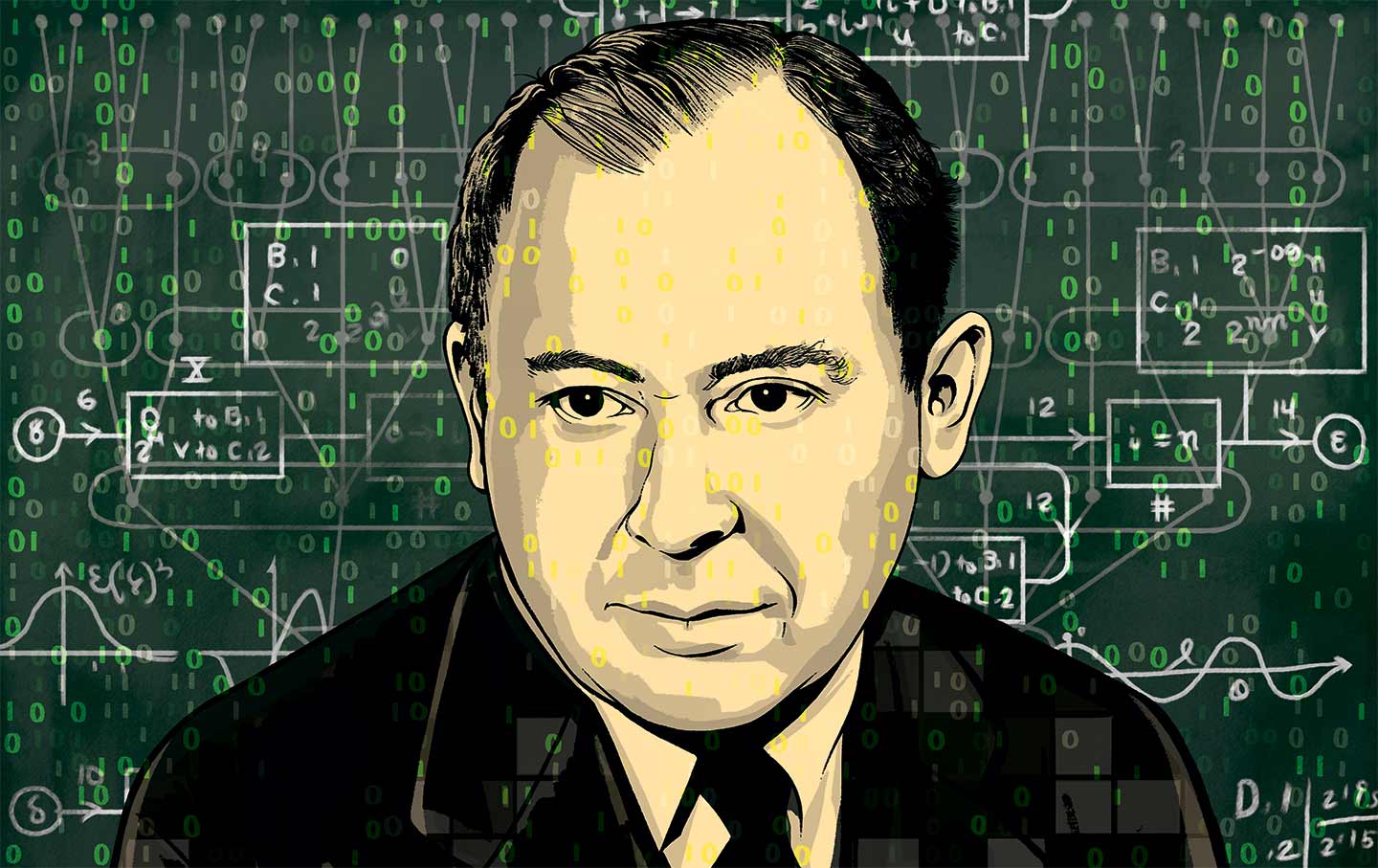
The World John von Neumann Built
Game theory, computers, the atom bomb—these are just a few of things von Neumann played a role in developing, changing the 20th century for better and worse.
The Nation
155 points · by benbreen · 3y ago · 65 comments
It is the best sorting algorithm though. It is the most elegant, no weird edge cases, and stable.
He and his colleague are credited with the design of the algorithm… suppose it is possible they drew general inspiration from how people might sort something by hand.
That combination isn't very common. But I wouldn't be surprised if somebody invented it 2 or 3 millennia ago either.
Radix sort works only for small-ish integers, but not well eg for names that you want to sort alphabetically. Nor for floating point numbers or even large integers.
>"This is most evident in his treatment of von Neumann’s pioneering work in the social sciences, the 1944 book Theory of Games and Economic Behavior, written in collaboration with the economist Oskar Morgenstern."
politics, or do people have natural a bias towards giving attribution to a lone genius?
To even hint that he is somehow undue the reverence he is afforded is wrong and any exploration of his work would easily dispell such notions.
This part is intriguing: > In his Theory of Self-Reproducing Automata (published posthumously in 1966), von Neumann went even further, describing the conditions under which, with no more than eight parts (four structural and four dedicated to logical operations), complex creatures could emerge capable of executing any type of computation and even of replicating themselves.
Von Neumann machines are a fun part of science fiction. The phrase "Hegemonic swarm" from Iain Banks comes to mind.
I agree that war, both cold and hot, is a non-zero sum game. That's why things like temporary ceasefires can work at all. Or Geneva conventions.
Where Turing asks if a machine is intelligent, if it plays the Turing Game well, Von Neumann asks how such a machine should play to do well at the Turing Game, or any other parlor game for that matter.
On another note, Von Neumann is surely put on a pedestal. I believe such sanctification to be natural. What is unnatural, is that in more recent years, whenever the name of Von Neumann is brought up, someone inevitably pops in the comments here to describe our hero of science as a genocidal maniac.
On the MAD development, you have to realize that the USSR also had very smart mathematician minds working on this. So yes, it is as much a physical arms race as a mental/psychological one.
https://hn.algolia.com/?dateRange=pastYear&page=0&prefix=fal...
After Von Neumann the world might have produced several other geniuses, but the amount of knowledge required to excel in so many different fields is now so huge that I can't think of any such person.
And I'm not even talking about the cloning. Is there really, among the 8 billion of us now, no one who is at least half as brilliant?
I think there is, but they fall out all the time.
My good childhood friend is such a person - a prodigy child whom I heard about thanks to his achievements in math contests years before I met him in middle school. Of course he did great there because everything was just so simple to him.
Something went wrong mid-college and he never realised his potential to the fullest.
I think there's a lot more randomness to which of the potential von Neumanns will shine than we would like to admit.
You'd expect for any of his kids to be outstanding, but not earth-shatteringly so. And looks like that's about right if you look up his daughter [1].
[0] Check out his "known for" section in Wikipedia! https://en.wikipedia.org/wiki/John_von_Neumann
[1] https://en.wikipedia.org/wiki/Marina_von_Neumann_Whitman
People greatly underestimate just how effective children can learn. They're basically capable of absorbing as much information as you can pump into them. It's a delicate balance making sure they learn enough basic human operating stuff in addition to everything else, but the results can be remarkable.
I remember hanging out at camp with a kid who loved board games. Especially probability based ones, such liar's dice and Dominion, but also more general hidden information games like Stratego. Kid was undeniably a prodigy, and he kicked my ass every time. I had just graduated university with studying CS and Physics, this kid was looking forward to starting kindergarten in the fall.
https://www.americanheritage.com/prisoners-dilemma
> "In 1950 Life magazine quoted the great Hungarian-American physicist John Von Neumann, co-father of both the atom bomb and the digital computer, advocating immediate pre-emptive nuclear war against Russia: “If you say why not bomb them tomorrow, I say why not today? If you say today at 5 o’clock, I say why not one o’clock?” He was hardly alone. Generals and members of Congress were making the same arguments..."
The fact that all this is getting swept under the rug in this article, as well as in the obviously habiographic bibliographical treatment that it references, doesn't bode well for the future of scholarly historical research in the USA. Past treatments were far more balanced.
Unless there's context I'm missing, I don't see how this says what you're saying. When I read this quote, I take it to mean, "if you say you want to bomb some time in the future, how do you rationally justify not doing so sooner?" It sounds like it's just an argument about strategy, that if bombing is a foregone conclusion, you're in a better position if you do so sooner than later.
just imagine how many conflicts of the 20th and 21st cenntury would have been avoided, if Russia was denied nuclear superpower status.
Russia has been blackmailing the free world with nuclear weapons for the last 70 years.
One theory for the rising internal discord in the USA's public sphere is we no longer have "The Communists" as our convenient "The Other". For purposes of scapegoat, rhetorical foil, and cast of usual suspects.
What is "Liberal Democracy" without "Communism" to push against?
For better or worse, we're now finding out.
The MIT Press page says it's now out of print, but it gained a lot of notice when it appeared, and must be in many libraries.
My own conclusion from Von Neumann's opinions about this is that genius in science and mathematics does not provide any special insight into other kinds of problems, such as arise in politics, military strategy, social issues, or ethics.
It is a cautionary tale that, when dealing with humans and complex systems, these rational abstractions that assume perfectly spherical cows should be heavily discounted. The world is too complex to fit it into a mathematical model you can solve analytically.
So do you think the world would be in a better shape today, if the world would have listened to Neumann and had its nuclear war?
The characterization of starting a nuclear war as genocidal is very acurate, no matter how "noble" the intentions were. Stalinist sowjet russia was hell on earth, but nuking them would have just made hell spread and worse.
Von Neumann was clearly a genious. But when you leave out the dark details, it just becomes cult like glorification. I don't think, there should be a disclaimer everywhere he is mentioned, but in a praise article like this, it should be included.
The grandparent is misquoting von Neumann and taking his remarks way out of context. von Neumann was part of a presidential commission from 1945 that came up with policy recommendations for the post-nuclear age. They accurate surmised that Russia would get the bomb, and that this would lead to what we now call a Cold War, with all the downstream ramifications like constant geopolitical instability from proxy wars. They were 100% right on the money. Niels Bohr called it the "complementarity" of the bomb. It was really remarkable how much they figured out from an understanding of nuclear physics, their experience in the war, and some rudimentary game theory.
They also knew about thermonuclear bombs. von Neumann was instrumental in doing the theory to show it possible during the Manhattan project. A prediction from the commission was that the inevitable outcome of Russia getting the bomb would be a nuclear arms race to develop more powerful bombs, faster delivery vehicles, and hair-trigger firing mechanisms. They predicted nuclear brinkmanship, and the removal of safeguards. They knew it would only be a matter of time before real events, or accidental mistakes led to a nuclear exchange between these two powers. And the longer you waited, the more devastating this would be.
They came up with recommendations: a nuclear non-proliferation treaty with allowances for mutual inspections. A revival of a league of nations to settle disputes. A mutual-defense treaty whose members would be permitted access to Anglo-American nuclear weapons for defensive purposes only. All of these would come to pass eventually, but at the time they were completely rejected (except the UN, although it came to serve a different purpose) by Truman and Churchill. The idea of Russia developing a bomb on a short timescale was seen as ludicrous. The idea of a "Cold War" was science fiction.
But in 1950 the Soviet Union had just detonated their first atomic bomb some months before. They still had a ways to go to ramp up production and make it a practical, deployable weapon. They had the bomb though, and would no longer be willing (if they ever would have) to partake in an arms reduction, mutual defense non-proliferation treaty. The Cold War was suddenly real, and ramping up. Bohr and von Neumann were proven right.
The US had not yet developed the thermonuclear bomb, so the bombs they had were like the weaker ones dropped on Hiroshima and Nagasaki. These were powerful weapons, no doubt, but not fundamentally any worse than the kind of devastation that was already normalized with the firebombing of Dresden, Tokyo, and other cities. Just more compactly packaged. So there was a very brief window where the invasion of the Soviet Union could have happened and would have been successful. How many would have died depends on how long it would take to force a surrender. Certainly hundreds of thousands, likely millions.
So now we get to 1950, and what von Neumann is saying is essentially this: "Look, you political half-wits hacks failed to take action when we warned you five f@&$ing years ago that this would happen, while there was still time to have peaceably avoided this mess. Now millions will die in pointless proxy wars fought between client states in the decades to come, culminating in an eventual nuclear exchange that will kill billions, destroy world civilization, and maybe even the entire human race.
"Or, hear me out, we can put a stop to this right now with a preemptive invasion of the Soviet Union. Millions will die, but millions are going to die anyway, and we will possibly save billions. Stalin kills millions of his own people anyway."
He didn't use those words, but that's a summation of what his argument was at the time. Once again, this advice was rebuffed. The politicians didn't want to start a war the public wouldn't understand. Better, they thought, to kick the can down the road. He then countered with the quote in the grandparent post, which is essentially saying "No, kick the can and you get a bigger mess. Settle it now and fewer people have to die." Better to rip that bandaid off.
It's a calculus of death. But that's no different than the logic that went into bombing Japan to prevent an even more devastating invasion of Honshu. It is sickening and abhorrent, but not necessarily wrong, and it is not genocide.