67 points · by doener · 3y ago · 145 comments
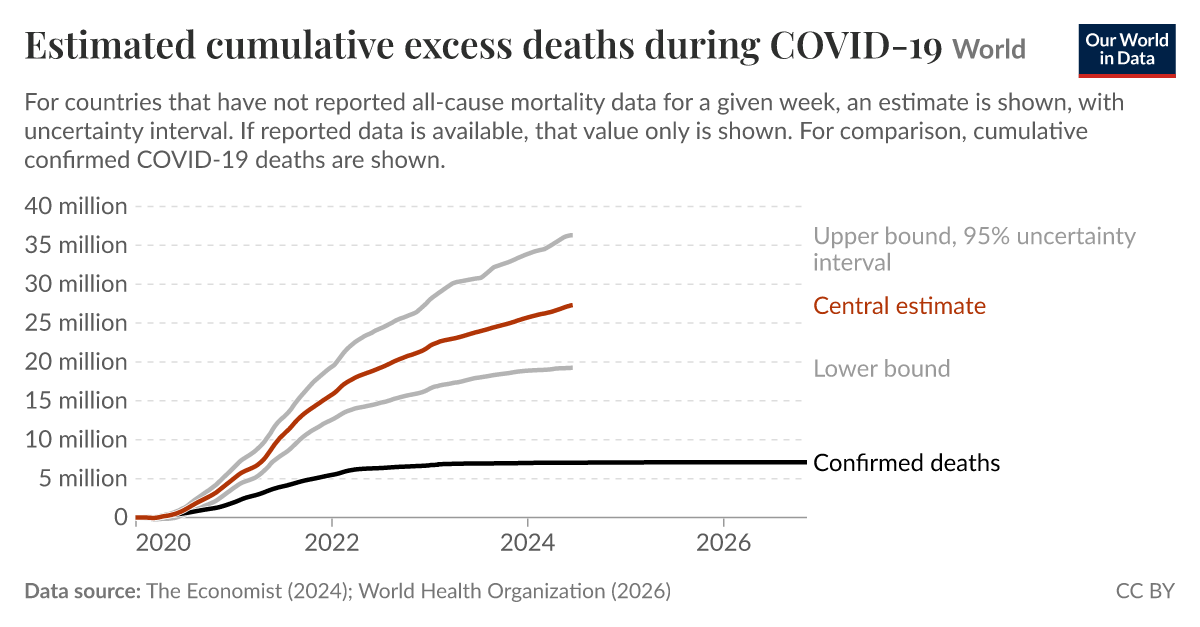
That makes excess deaths valuable in the case of COVID.
https://catalyst.independent.org/2021/03/24/americans-misinf...
You say "normal people" as if not having co-morbidities is more common. But large swathes of the population are old, obese, have asthma or some other co-morbidity.
They then and still are trying to push vaccines on cohorts that absolutely do not need them (see numerous EU countries who are not doing this).
On top of that, they managed to convince many US citizens that vaccines prevented transmission as part of their efforts to force vaccines on everyone. Go check some past HN threads for a wild ride!
Bonus points are awarded for obesity being a major risk factor that we’ve done 0 to address post Covid despite the absolutely massive benefits we’d see from it - Id wager far outstripping masking or vaccinating. Externalities for thee but not for me, I guess.
Did they ignore them, or were they just not devaluing the lives of the sick and elderly? If 10,000,000 people are dead that would otherwise be living, standing up and saying "but they were old or fat!" has a kind of asshole sting to it, no?
> They then and still are trying to push vaccines on cohorts that absolutely do not need them (see numerous EU countries who are not doing this).
Vaccines aren't just for the people that get them. They are for the people around them as well. I'm a perfectly healthy 35 year old, but I visit my 90 year old grandfather often, and live in a community with many elderly. If the vaccine makes me less likely to transmit, that's good for everyone, whether or not it matters much to me in isolation.
> On top of that, they managed to convince many US citizens that vaccines prevented transmission as part of their efforts to force vaccines on everyone.
They do tho. Maybe not 100%, but to a degree they certainly do.
> Bonus points are awarded for obesity being a major risk factor that we’ve done 0 to address post Covid despite the absolutely massive benefits we’d see from it - Id wager far outstripping masking or vaccinating. Externalities for thee but not for me, I guess.
Not even sure what you're saying here.
* X stabs Y, and Y immediately dies. Simplest case, X is responsible for Y's death.
* X stabs Y as part of a surgery. Y was predicted to have 2 months to live, but instead dies on the operating table. X did not murder Y, even though they were the cause of Y's death occurring on that specific day, rather than 2 months later.
* X stabs Y as part of a mugging, and Y immediately dies. Coincidentally, Y was predicted to have 2 months to live, but instead dies in the mugging. X did murder Y, even though it was the same difference in total lifespan as the previous example than 2 months later, because the intent matters.
* X stabs Y as part of a mugging, but it only requires some light stitches. While Y is driving to the emergency room, they are killed in a car accident. X would be liable for causing injury, but wouldn't be liable for the death, because it was an unrelated coincidence.
* X stabs Y, and Y later dies of blood loss at the hospital after refusing treatment for religious reasons. The defense argues that this should be counted as manslaughter instead of murder, because Y's refusal of treatment breaks the chain of causality between the action and the eventual outcome. The judge disagrees, as "defendants must take their victims as they find them."
These are all hypotheticals based on my layman's understanding of the law, except for the last one, which occurred in the case of a Jehovah's Witness who refused blood transfusions for religious reasons [0]. This became more of a ramble than I intended, but I definitely agree that causation is tricky, and "cause" could be any of "action with a causal link", "immediately preceding cause", or "deviation from a just world that initiated a causal chain", and would lead to vastly different statistics depending on the definition.
https://bmchealthservres.biomedcentral.com/articles/10.1186/...
> An early response to Covid-19, including borders’ controls and a strong test and trace capacity, could improve epidemiological surveillance and minimize excess mortality, with stringent and lengthy lockdowns not providing a significant benefit.
As for the cited part of the conclusion, this is silly in practice. Obviously not letting in any infectious case would be much better, but when that happens, which always does in practice, the stringent lockdowns are only solution left until you get everyone vaccinated. So it's like comparing apple to orange.
[1] https://www.economist.com/graphic-detail/coronavirus-excess-...
And the part about a strong test and trace capability is obviously nonsense. That didn't work in any of the countries that tried, except previous perhaps in China where the government is able to exercise a level of totalitarian control worse than any virus.
It's disappointing that this kind of unrealistic garbage makes it though peer review.
All in most of the impact of Covid 19 so far seems to be 84% disabled, 12% excess dying and 4% directly dying from the acute infection. Most of the impact is after the acute infection has passed.
1 in 400 people are (estimated) excess deaths during the pandemic. This is not the same thing as claiming that all of them were in fact killed by the disease itself.
An incredibly novel infectious disease that kills older people at an intensely meaningful rate is clearly the driver here.
For 2016 that's 1 in 1300 people in the US, a first world nation with world class medical infrastructure.
I wonder what's the worldwide figure? And what % of it overlaps with that 1 in 400?
Even when doctors and hospitals weren't enforcing it, many people were putting off non-critical medical care because they didn't want to go into the hospital or doctor's office and risk getting exposed.
Fewer people being treated, and fewer elective procedures being performed means fewer chances for error.
One exception of course would be ER/ICU staff who were so stressed, overworked, and understaffed that I wouldn't doubt if the number of mistakes in those places increased to some extent.
Of the countries that I have looked at, Sweden is perhaps the most interesting, as the figures tracked closely together until the beginning of 2021, and then diverged rapidly over the next few months.
Another significant factor was the complete elimination of flu as a byproduct of COVID countermeasures (zero recorded flu cases or deaths for about a year). Flu came back in from overseas (with a vengeance) when the restrictions lifted.
Even so, it saw much higher mortality rates than its neighbours.
10 people die every year per 1000.
During this covid it had been 11 people per thousand per year.
Of course an almost unquantifiable and continuing tragedy for families everywhere.
You’d expect that you’d see a reduction in deaths over the next ~10 years (when those people would have died from other causes).
"simply"?
I think I get what the parent comment was going for (i.e., that it only moved the date of death a little bit, as opposed to how the death of an otherwise healthy child would imply a date of death that moved a lot), but it's a weird way to say it.
Does it upset you the UK government values a year of human life at about 30,000 GBP?
It was an invitation for clarification about what you meant.
How would you distinguish Covid from, say, murder, which also accelerates deaths by X years?
It's true that if the death rate is higher now, then the death rate may be lower in the future, but I'm not sure that's a useful way of thinking. If the death rate were 100% now, then the death rate would be 0% in the future. It all balances out, right? Except, that's not the way it works, because the dead never get their years or lives back.
We're all mortal and will eventually die sooner or later. But in most cases, later is much better than sooner.
I'd also mention that you probably wouldn't appreciate having 30,000X GBP stolen from you.
Not meant to pick on you, this is a common thing I see when certain topics are discussed but it does not benefit the discussion at all.
Then again you will have excess deaths because of mental health problems that covid causes, medical problems because medical care was not available and etc. These would not equalize.
And Africa as a whole practically unaffected.
Also, largely these countries are much hotter and more aerated / outdoors places. So, comparisons are not particularly helpful.
https://en.wikipedia.org/wiki/Years_of_potential_life_lost
Perhaps a more useful metric, since so many more older people died from Covid.
People asking for estimates that fit their agenda is quite predictable, but those estimates aren't very useful. Anyway, your point stays, ignoring the huge amount of estimates produced, and asking for them later is quite a bad posture.
Confirmed: 4009 • Upper bound, 95%: -22,912 • Central: -127,918 • Lower bound: -246,089
(due to say, traffic accidents, work accidents, other respiratory diseases that were also suppresed by increased hygiene, etc).
The end result; overall lower rate of death than usual, and a chunk of the deaths that did occur due to COVID.
So you catch covid, recover, then get hit by a bus. Covid death.
Meanwhile some countries report next to no deaths, also clearly not correct. The reported data is clearly close to worthless and yet it suits too many people's purposes to use it.
"You are asked to start with the immediate, direct cause of death on line Ia, then to go back through the sequence of events or conditions that led to death on subsequent lines, until you reach the one that started the fatal sequence."
Seems unlikely that someone getting hit by a bus would be listed as a Covid death. I would be interested in your source.
https://www.cebm.net/covid-19/public-health-england-death-da...
The "got hit by bus after positive test" group is so small it's negligible. E.g. in my country, there have been more covid deaths in two weeks than traffic accidents during the whole year.
Because of the variation in testing practices, excess deaths is the only reliable statistic we have now.
Strangely, the two measures only diverged from July 2020. It could be that:
- the initial strict lockdowns prevented deaths from more diseases
- some later deaths were caused by COVID indirectly (without it being registered as the cause)
There's not a whole lot you can do to alter the effect a virus has on a human body (at least not immediately after discovering it), but you might be able to learn a lot from the effects of various types of government intervention, what helped and what hurt, and make plans that reduce the negative effects the next time action is needed.
What we should be dealing with is the millions, maybe even a billion worldwide that will have long-covid for the rest of their miserable existence.
They're alive but the quality of life is just gone, likely forever.
We saw this with the original covid, SARS-COV-1 in 2003, many never recovered.
What? I don't think there is any data to suggest that 1/8 of the world population has long-COVID or that they have a miserable existence. That's quite judgmental to say about someone also.
> They're alive but the quality of life is just gone, likely forever.
Forever? How do we know? So many people recovered from long-COVID. Everyone is different, there is no data to suggest that people will have lasting symptoms forever.
Not going to get into a pointless argument here about it, there are already many studies showing at least 10% of people who get covid now have long-covid and it's decimated the workforce.
https://www.brookings.edu/research/new-data-shows-long-covid...
Long-Covid deniers might be the worst of all because the suffering is very real and they don't "get it" until it's their turn, and then it's too late.
Nice new epithet.
> Convenient isn't it that they still don't have a test to detect and prove long-covid, forget treating it.
This sounds like you're a conspiracy theorist. Not only are you condemning everyone by making up a new epithet, you're couching it all in your conspiracy theory that they're hiding evidence of long covid?
For people with long covid we're going to deny it's real, deny healthcare, blame them for their financial consequences, give no support, then offer suicide.