Brave debuts privacy-preserving ads in its search engine | Brave
Starting today, Brave Search will feature privacy-preserving ads as part of a global beta program.
Brave
169 points · by jarsin · 3y ago · 290 comments
> Ads are a key part of search engines, helping to facilitate the free and open exchange of information on the Web, and to connect users to helpful products and services related to their search terms.
Is just non sequitur for me. It's said in such a smooth way, in such a gaslight-ish way, that your tempted to just accept it.
But it actually makes no sense to me. I get what ads are key to: revenue, keeping the lights on, that sort of thing. But I don't see how they increase the free and open exchange of information on the web. If I sat down with a troubled couple who was having a hard time communicating, I wouldn't periodically interrupt and say "let's pause a moment for an ad. I think that's going to really open up a better and more free exchange between the both of you."
I also don't understand how it is helpful in helping me connect to products and services in a helpful way. An index (yellow pages) of what's available would help me search for a product. A rating system that wasn't gamed might help me make a selection that was best for me. But ads? We inherently distrust that we're being swayed/manipulated by them. I need to update the insulation in my attic, so I'm in the market to get some newer insulation. To wit, I've called a number of people I know who are in the insulation/builder business to get their information. Not a single one said "well, here's my opinion, but what you really need to do is check the ads, they're going to be your best source of information about how to proceed."
Couples counseling isn't free, maybe with ads they could be.
I mean obviously not, but only because a professional counselor can only see about 8 couples per day while a search engine can serve several billion.
Brave is saying it in a very PR / marketing speak way, but I get the underlying point. Instead of funding our service with your own money, let some big companies fund it in exchange for your attention.
The unspoken issue (well it gets spoken on HN a lot) is that your searchers no longer become your customers. So it's advantageous to improve your service for the sake of the advertisers to the detriment of the searchers, at least until a threshold that would make the majority of them quit. It only benefits "free and open exchange of information" for as long as that also benefits the advertisers.
What's worse, if you pay for YouTube Premium or Kagi, you're effectively paying for your content twice. No wonder, poorer people can't afford that.
I guess you could frame it like this: "Company are overcharging us by insane amounts anyways, so at least some of that money goes back into something useful through ads."
Its truly more than walletshare and tremendously mentally taxing or can destroy your financial wellbeing if unchecked.
How is this true with YT premium? There are no ads if you pay.
The big companies are not magically getting their money out of thin air, you are still paying with your money, just indirectly through the share of the ad budget included in the price of everything you buy. Some of the money gets lost on the way to pay the marketing people, some of the money goes to the web sites. But it is not enough that they now have your money, no, you also have to look at the stuff the marketing people made with your money in order to see the content you payed for. And this is still not enough, they also want every last bit of information about you, so that they can annoy you in a more targeted way. And last but not least, there are no real incentives that the ads represent the product objectively but there are incentives to overpromise and manipulate you.
Ads can only pay a couple of dollars at most. That's one of the problem with ads: they don't scale. You can only sell cheapish stuff using them; you can never increase your price above a certain point. It's very much a broken form of monetization in many ways.
I'm going to take a short break from our session to tell you guys that this session was sponsored by NordVPN, the only VPN you'll ever need. Co-sponsored by Raid Shadow Legends, an amazing MMORPG that you guys should really give a try.
For the most part, the economy doesn't need a lot of ads in crowded markets: the brand of soft drink or toothpaste you buy isn't going to vary substantially, and any deal-breaker in a certain brand is one you'll pick up on without an ad.
But the stuff you didn't even know existed is where ads can add something. Word of mouth doesn't always give the answers you need, especially as the subject matter becomes more private, sensitive, or trade-secretive. Some of the answers can be found by asking directly, but in many other cases, you need an introduction. Opting to keep some degree of advertisement in your life - in spaces where you want to "keep some feelers out" - could actually be a benefit because it means you will learn just that new things exist.
The downside is that you may think the new thing is what you need, and it isn't. But that's probably most of consumerism. So your read on it will come down to whether you are "ad-optimistic" as I stated up front. An ad-pessimist will assume that nothing sold could be useful enough to bother listening to the pitch.
1. Ad-free premium search is already an option with Brave Search, and the ads in the free leg we just launched are privacy-preserving, but none of this proves the "free and open exchange" claim. The "free" part was intended to mean no-payment-required, because many can't afford and some find ads useful. The "open" is thorny and should have been separated: all engines have biases even if algorithmic, from the Web they index if not how they weigh and measure inputs to their indexing.
2. Some folks do find ads useful (I do, on Google especially as its organic results have declined in quality since the old days, but even in the old days). These users will probably prefer the free leg on this basis, and that's what the last clause of this overlong sentence was trying to get across.
We will do better in future posts. I hope the privacy-preserving nature of search ads is clear too -- if not, please reply and I'll take back your feedback there too.
Is the premium search ad-free in the sense that no user-derived data is utilized or extractable for advertising purposes?
Or is it ad free in the sense that no ads are displayed to premium tier users, but user data can still be an input for ad measurement, conversion, and modeling?
If you opt into the Web Discovery Project (it's off by default and a separate setting; only in Brave), then your queries and clicks across all navigation are turned into anonymous data by dropping any with enough entropy to suspect they bear personal data, dropping IP and headers, and otherwise ensuring record-unlinkability. See
https://support.brave.com/hc/en-us/articles/4409406835469-Wh...
and
https://github.com/brave/web-discovery-project/blob/main/mod....
Because Premium Brave Search has no ads, it's not useful _per se_ for ad measurement, conversion, or modeling. But I took your question do mean "do premium search queries and outbound link clicks feed into the search engine?" -- they do. But no ads, and no way to model directly how an ad would perform, beyond the big data benefit that all search engine use to help ad sales and matching.
Last thing: with off-by-default (opt-in) Brave Rewards user ads (push => new tab on click), the matching agent is in the browser, inactive until opt-in, off upon opt-out, and you can clear its history. Confirmations and revenue shares via Chaumian blind signature protocol (Privacy Pass uses same crypto alg). No server-side ad matching at all. Same for Brave News (for ads and all feeds, everything).
With search ads, matching is server-side (after the edge proxy that drops IP etc.) based on only the query, device, country, and timezone. Anything more personalized, we can go to client-side matching and ad insertion. I hope this helps.
> "Advertising funded search engines will be inherently biased towards the advertisers and away from the needs of consumers”
That was from 1998, and obviously it's possible they were wrong, and today's Google (as well as Brave) are right that ads are actually integral to search. But, I don't think so, personally.
> But I don't see how they increase the free and open exchange of information on the web.
Depending on the niche it can be far more expensive to be on the first page of search results through long term SEO efforts than shorter term, campaign based PPC (paid ads) efforts. This is particularly true for search terms where it may not be known how valuable a top 5 or top 10 position is. It could take months or years and a ton of cash to rank for certain things through SEO efforts alone, only to discover the traffic isn't worth it.
Alternatively, you could test that with PPC and discover quickly and far cheaper if you should spend your time and money trying to rank for something. This then gives smaller voices a chance to amplify.
Let's give a more real-world example, like say a search for 'fine dining restaurants' in Oakland. We'll use ad-ridden yelp as our example [2]. My expectation is that if quality restaurants are being given voices is that the sponsored list should be filled with Michelin starred or at least bib gourmand / equivalent restaurants. Instead the entire first page is sponsored breweries / bars and a burger joint (on a non-adblocking test browser). I have to scroll down to the initially-hidden search results to see Commis at #3.
[1] https://doi.org/10.1086/676333
[2] https://www.yelp.com/search?find_desc=Fine+Dining+Restaurant...
This is what "tech" companies are seeking to prevent. If the user has no idea of what's available, then the "tech" company can "suggest" its advertisers' products and services. "Recommendations" are supposed to be technologically indistinguishable from "search". Gaslighting indeed.
But don't believe me. Get it from the horse's mouth. Read Google's brief in opposition in the Gonzalez case.
https://www.supremecourt.gov/DocketPDF/21/21-1333/229391/202...
Google wants the US Supreme Court to believe that recommendations systems and search engines are the same thing.1 If the justices were born into the world of Google, Facebook and now TikTok, that argument might work. But a majority were born before the www existed. The difference between search and recommendations is obvious and significant.
"Tech" companies, which produce no content themselves, want to recommend whatever gets "eyeballs", so they can keep the lights on by selling online advertising services. Popularity is the all-important metric. They want to run websites that serve hundreds of millions of people, relegating the rest of the web's sites to brief tangents, temporary distractions. Why. Because those conditions are optimal for advertising. For a variety of reasons, they are unable to satisfactorily filter, curate, censor, etc. the content they collect from others.
This only works as a lucrative racket so long as the "tech" company cannot be sued for the content they take from others and use as bait to lure in users to be targeted with advertising. Generally, the preaviling interpretation of Section 230 has effectively prevented such litigation.
If that interpretation changes, it could spell the end of this enormous racket. Big Tech would not be able to continue to profit from user-generated content by steering web users toward what is popular and creating large audiences attractive to advertisers. Smaller websites that produce their own content could again become relevant.
In the past, I have had personal projects where I create an alternative way to explore the www, using a Yellow Pages type of process. IMO, the reason no one seems to care about this area anymore2 is not that such projects are infeasible or too challenging, it is that there is no financial incentive to pursue them. Big Tech sold out the web. Big Tech has sought to portray the web as a 100% commercial network. It has thus become a sewer of low quality "content" and try-hard advertising, while the data collection, tracking and ad serving apparatus purchased with all that wasted ad spend is state of the art.
1. Because there is precedent that suggests 230 protects search engines. There is however no precedent that suggests it protects "recommendations".
2. I was recently looking at the original sources for WAIS on a simtel mirror. All the pieces were there. The www had so much potential. At least Brewster Kahle went on to do something useful, the Internet Archive. I still sometimes use z39.50 today to do searches on library databases. To me it represents a time before advertising infected computer networks and eventually the internet.
Yes. I’m thinking about some ways to do this for specific niches. I suspect it will need to be non-profit. For revenue, I’m leaning towards something like affiliate links. Basically, third parties can pay to offer a generic way to take action on a particular thing. The site may provide several similar options, but by paying you go to the top of the list.
Since the main value of the site is documenting the thing, the monetization is strictly supplemental.
That is not true. Majorities in Dryoff and Force did suggest that 230 protects recommendations.
But there were also dissenting opinions in each case.
They literally are the same. Recommendation systems just search using an embedding of a under instead of an embedding of a textual query.
Why do you think a yellow pages of websites, with literally millions of results/pages, in alphabetic (?) order would be usable?
Surely, you want some sort of ranking, filtering, reordering, etc curation?
Do you google businesses to get their phone number, or do you whip out the local yellow pages directory and start flipping through its pages hoping it’s up to date…?
You may not know of a tree cutting service until you look there.
You may not know where to get a car part until you look there.
Having ads riddled throughout the internet is one thing, but having a directory where ads are supposed to be is another.
Yes billboards are annoying, that doesn't make classifieds equal.
(oh and you could just pay $3/mo or not use the service if you have no use for classifieds)
Oh right. They are a negative user experience and bring revenue in without providing any value (possibly negative value) to the user.
Nothing groundbreaking here, but lets not pretend this is anything but a money grab.
They can be a negative or positive depending on the ad and when/where you see it
Some people love to see new products and ads show those.
(Just wait until you become a small business owner and get to experience the advertising landscape from the other side.)
On a bigger note, monetizing search without ads seem to be a pretty tricky business model. Especially if you want to move beyond being a niche product; even an average HN reader would be hard to convince to pay for a regular subscription, so with the general public I can't imaging the hassle.
What are other ways search engines could monetize without taking money either from users or from people that want to show something to them?
I just go with a search engine I pay for that doesn't offer any ad-supported stuff (kagi.com). That way, I'm directly supporting the service, and they have zero incentive to start showing me stuff that other people are paying for me to see and which I definitely don't want to see.
A strong countervailing force (in some markets) is competition. If Google had more competition (both in terms of a independent search service and access to be the default search option in browsers) they might have to start caring more about the search experience and privacy.
Companies change. When the leadership/guard at a company changes, or with enough investor pressure, policies can easily change from benevolent to a money grab.
You can, at least for Youtube - the premium offering is ad-free. In fact, that's the only reason I subscribe - not the content - because my entire family uses my account or is part of my Google "family" to bypass YT ads. Worth the (ever increasing) monthly fee.
My guess is that this only exists to foil Netflix, and if Netflix didn't have an ad-free service, Google would make this option cost a lot more or remove it entirely.
ad-free =/= surveillance free.
No, it's free of YT ads but countless creators embed ads in their videos, sometimes of pretty shady businesses (see recent Established Titles controversy).
The only way to get rid of all YouTube ads doesn't cost anything (uBlock + Sponsorblock). And if I pay for content I prefer to do it via Patreon, because why would I reward YouTube for constantly acting against the interests of users and content creators?
NPR comes to mind.
With private companies, at least there's some visage of a separation from state influence although we are seeing the lash back now with Twitter.
Google search has been crippled by ads. Sometimes people just want nice stuff and a search engine that wasn't designed to mislead (https://www.theverge.com/2015/11/20/9768350/google-ads-searc...) and where the amount of money paid doesn't dictate what is easy to find would be a great asset to everybody. No company has risen to give us a powerful search engine that isn't also a cesspool of marketing bullshit so it would be reasonable for people to seek an option that serves the interests of the public.
No thanks, I'd rather not use money coerced from innocent citizens for making a web search engine. Let's use that money for the smallest possible set of limited services.
Well sort of. You can pay them for YouTube Premium and watch videos without ads. I might pay for an ad-free Google Search but I have developed an almost reflexive habit of ignoring the ads on Google Search anyway. It's much easier to just look past them in the search results, as opposed to when watching a video where you have no choice.
And I'm sure they are surveilling me regardless.
A good search engine, also uses Google results I think.
I'm not concerned about ads because I literally never see them.
And uBlock blocks the tracking.
Do you not use uBlock Origin? https://chrome.google.com/webstore/detail/ublock-origin/cjpa...
Especially with Manifest v3 looming which would kill modern ad blockers, I see no reason not to use Firefox. Sure, Brave and other Chromium browsers might say they'll fork Chromium, but how long will that last, really? It's no joke to maintain a fork.
[0] https://en.wikipedia.org/wiki/Brave_(web_browser)#Controvers...
"Brave's controversies" are not really about Brave.
Brave as a company is not above criticism and should be harshly gone after for their mistakes when they do anything less than perfect with regards to privacy or anything else. I think they've done over 90% of things right, but have screwed up a small portion of the complicated stuff (new browser, new online advertising models, and search ecosystem) they're trying to pull off. And yes, they've made a few errors along the way.
That said, the "Brave controversies" are not actually about Brave's real merits as a company, but are mostly about a long-standing grudge regarding Brendan Eich's political beliefs. A certain crowd will not give Eich an inch to ever succeed and will continuously rip even the most minor and inane issue solely to destroy what he represents.
I'm really sick of people pretending that the "Brave controversies" are actually about Brave as a company and not overwhelmingly about the larger ongoing culture war that's been waged.
Which of Brave's controversies listed on Wikipedia aren't about Brave because they are about Brendan Eich's political beliefs? I have no idea what his political beliefs are, but while I can accept the possibility that they may put Brave under additional scrutiny the problems people have had with Brave are real.
I think it'd be wrong to dismiss their controversies as being purely the product of a "culture war" even if some people's hate for Brendan might help promote awareness of those same controversies.
Not everything is a conspiracy. Sometimes it's just people deciding the thing you like isn't good enough for them.
Oh fuck off. To add on to the comments of others, Many of us _do_ care about his "political beliefs". If you're in the tech industry, you're in one of the most queer industries of all time, and some (and sometimes, many depending on where you are) of your colleagues are likely to be some form of queer.
Just being a supporter of Prop 8 would have been a political belief. Actively donating money to fight for it is hate. Additionally, donating to Ron Paul is just proof of bad taste, but donating to Pat Buchanan, a known homophobic, antisemitic, white supremacist candidate doesn't just make it "oh his political beliefs is that gay people aren't cool, teehee" but veers straight into actual fucking hatred.
So, yes, fuck Brendan Eich as a person, _and_ Brave as a company has done a lot of things that make it truly untrustable.
https://www.theguardian.com/technology/2014/apr/02/controver...
- Brave uses Chromium and uses better isolation and sandbox than Firefox. Especially on Android.
- Brave has Adblock built-in natively. It's written in Rust, so Manifest v3 will not affect it. https://github.com/brave/adblock-rust
- Brave is profitable on itself and not dependent on search engines money like Firefox.
Not saying it's the best but I decided against Firefox because the technical and financial foundation looks better on Brave for me.
There's no telling when Brave are going to decide it's time to monetize and start compromising themselves and their users.
There was never any reason to expect this to happen, but it did - and exceptionally rapidly. I absolutely agree with you that there's no telling when Brave will start going the other way and compromise all that they currently stand for. And that's okay. Because if, or probably more accurately when, that day comes - I'll be moving onto whoever the next "Brave" might be.
And the cycle will continue.
> Brave is profitable on itself and not dependent on search engines money like Firefox.
Brave is still dependent on Google even more than Firefox, I agree that Mozilla must seeks multiple sources of revenue but if it was easy maintaining your own engine Brave would do it.
1. Chromium stops being FOSS.
Brave, Vivaldi, Edge continue to exist. The only difference being, Brave is now a fork that exists independently and has to do security patches on its own.
2. Google stops funding Mozilla.
With 90% of the revenue gone, Mozilla as we know it would cease to exist as a corporation.
So no, Brave's dependence on Google is not a life and death situation for the whole company.
[0] https://github.com/uBlockOrigin/uBlock-issues/issues/338#iss...
[1] https://github.com/gorhill/uBlock/wiki/uBlock-Origin-works-b...
Anyway, there's already a manifest 3 version, swap uBlock Origin for uBlock Origin Lite and experience the changes yourself.
Firefox promised multiple times that they're gonna deviate from manifest v3 on that front, so only uBlock Origin (proper) will only work there.
> They took creators' money while ostensibly "collecting" it for them
They did not. In the initial days, they did not have the feature to block unregistered creators from getting donations. When Brave was informed about it, they made sure that creators who registered can claim their tipped tokens and for the rest, they refunded the tokens to users.
The fact that you think they'd want their tokens back, when they themselves give them away to Brave Rewards users every month is kinda weird. Not only did they refund the tokens but also got them to the registered creators.
> and they inserted their own affiliate links when you visited certain sites
They had a URL auto-complete bug in the system and it was an opt-in feature but the bug replaced the whole URL instead of suggesting links. They fixed it in a day, before the news even got out. The PR is there on GitHub but people love to bash them because of a bug that happened when Brave wasn't even 6 months old at that point (iirc).
> I mean, when you have your own "Controversies" section on Wikipedia, you know there's something wrong.
So does Mozilla, your point?
> Sure, Brave and other Chromium browsers might say they'll fork Chromium, but how long will that last, really? It's no joke to maintain a fork.
Brave does not depend of manifest v3 for adblocking. Their Ad blocker written in rust is much low level than Ublock. They'll just be fine.
> I see no reason not to use Firefox.
but I do see reasons to not use Firefox. How about performance? Memory management? Loading speed? Dev tools? Webkit?
Here you can find the research: https://brave.com/brave-saves-batteries/
Or were you okay with giving them your real email address?
I feel uncomfortable potentially having my searches linked to my real email and/or name.
This is really what prevents me from using them. Although the search does seem to be superb.
They have a browser with a normal adblocking function.
They serve ads themselves, and use these to fund services like Brave News, Brave Talk and Brave Search.
They have an option for the browser to use the OS's toaster popup system to show you ads at predetermined intervals. If you sign up for this, Brave will use a part of their ad revenue to buy BAT from the open market and give it to users who watched these toaster popups.
They have a tipping service where content creators, commenters on eg. Twitter and websites can be tipped with BAT. The people who got tips now have stuff Brave regularly buys from the open market with their ad revenues.
So they serve ads on their own services same as anyone else, they just build them to be privacy respecting. The tipping service + toaster popups combo is intended to replace some of the lost revenue from adblockers like Brave Shields and uBO nuking most ads since most ads are tracking driven. But ads on websites are never replaced, just blocked the same way uBO blocks them, with the same filter lists.
In other words, Brave seems to be doing the right thing here by promoting its own products in the same way that any competing product can.
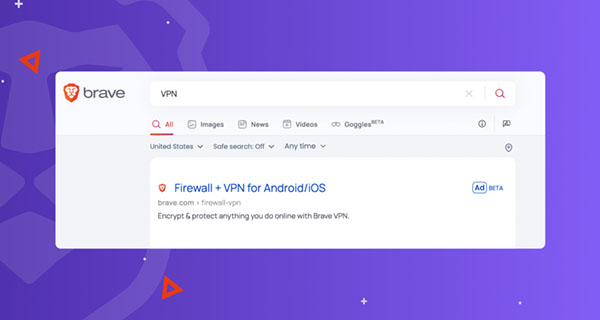
They do not do this in reality. When you search for VPN, the results are organic.
During this beta phase, Brave Search users will see text-based ads in search results. However, during the beta period, Brave users who have opted-in to Brave Private Ads and are using the latest version of Brave will not see Search ads, since these new ad units are not yet eligible for BAT earnings. We’re actively working to integrate Brave Rewards with Brave Search, and hope to make Search ads eligible for BAT earnings in the coming months.
Small motile cells in many species are used in a reproductive strategy very much like ads.
Tee-hee.
TBF at least it's better than the status quo of the late 90's to early 2000s, when the revenue model was malware and actual viruses rather than ad supported.
Back then we called software that phoned home to check for updates spyware and it was to be avoided. The very idea that a random offline program on my system would know when I was connected to the internet, and would be collecting my IP address was unacceptable. Now it's standard practice.
The revenue model back then was shareware. You get the software, it mostly works, and you send a check to some PO box to get a full version. It wasn't terrible. I don't remember too many companies outright shipping malware and when they did people were rightly pissed off (Sony's rootkit, or BonziBuddy for example)
What we had were lots of ad filled websites hosting shareware and it was often the ads that were infecting people, although some sites did inject malware into the downloads.
Well... If they try sell you a product, it is harmless. But with selling an ideas and manipulation of masses, that is diferent story. I guess propaganda is a right definition.
In the case of Brave (and every business), somebody’s got to hand money to someone in order to keep the lights on.
Like Apple and AdBlock, the stance is that they want to sell their own ads in the spaces where they're blocking other people's
The blocking system is a stance against privacy invasions, not advertising itself.
I feel we finally have a privacy respecting browser normal people and tech enthousiast can use, and it puzzles me how it's painted here. let's stay objective
if you don't like the web3 stuff or the blockchain based rewards don't use it. But the web3 space is booming and brave has been nice way to interact with it.
Is it?
Blocking other companies' ads and posting their own ads instead is unbecoming and also reminds me of AdBlock Plus.
None of the other Big Tech companies do this.
Seems quite reasonable! in the end someone has to pay the bills after all...
Even my Pandora subscription feels like I'm getting ripped off since I really only ever listen to the same songs anyways, and the app is a dumpster fire. Netflix/Disney+/Hulu/etc also suck since they just feel like I'm wasting money due to feuds between companies that having nothing to do with me. I have a Proton Mail subscription, and it's okay, but extremely overpriced for what I'm getting, while a cheaper mail service would potentially get my emails blocked from the big service providers because they think I'm a spammer. There are also apps that are requiring me to pay a monthly sub while offering nothing in return for it just because they can. My workout tracker app for example is exactly the same janky mess it was ~2 years ago, yet I've been paying $4/mo for it!
..but Kagi? It works great, it works reliably, and it works for me.
They also have their own infra and team to support.
I wouldnt call myself a search engine poweruser, but based on my usage, they are definitely losing money on those subscriptions.
> You must use results you obtain through the Services only in Internet Search Experiences (as defined in the use and display requirements) and must not cache or copy results. (https://www.microsoft.com/en-us/bing/apis/legal)
It's really unfortunate Microsoft doesn't provide a free API that require users to display ads, or at the very least make their ad network accessible to all.
Pass for me but maybe someone will be interested
Also, idk if I'm grandfathered in to an old price or anything, but my subscription is $10/mo.
Kagi is good if you haven't tried it. Best search engine I've used in years IMO and I've tried them all.
The question is whether this is better than Google's offering ... to me it sounds like it is so long as the results stand up to scrutiny.
Brave's USP always seems to have been meaning the web work practically without profiteering and maintaining a strong user privacy focus. It always seems to have had payment for content as a part of their model, and so payment for search seems to fit well in that framework.
I admit it does seems to be a climb down for those who see Brave as "free + no-ads".
I imagine their idea here is that "ads aren't bad if they respect privacy/don't weaken security", but I'm thinking most Brave users are going to disagree.
This, by definition, is not "fully private."
The future is ads everywhere, paid or free, doesn't matter. More revenue out of every user with little effort, shareholders love this stuff.
Though I guess it's no different than dvds having ads after you paid for them.
- Buying an $1200+ iPhone that doesn't come with an adapter.
- BMW charging you $10+ bucks per month to turn on seat heaters that came with your already expensive car
- Mercedes 0-60mph acceleration booster "unlock fee" for $1200/year
- Tesla woes with frequent "upgrades" locked behind paywalls.
- The ironic micro-transactions in Mobile games. When summed up, they are only "macro" with millions of bucks coming in every day. This has infested gaming outside Mobile as well. I'm not ever gonna touch console gaming again.
Craigslist has indeed done very, very well. They've maintained a useful service, ad-free, for decades. Made a ton of money doing it, too.
The reason the giants are giant is because they are driven to become giant by people and investors who want to become billionaires.
EDIT: LibreWolf Browser: A custom version of Firefox, focused on privacy, security and freedom. https://librewolf.net/
ungoogled-chromium: A lightweight approach to removing Google web service dependency https://github.com/ungoogled-software/ungoogled-chromium
It blocks almost all ads. It has a simple button to turn ad blocking off when I need to use websites that don't work with ad blockers. I don't need to fiddle with an extension.
I can use it on android without effort.
This is about brave search, which I have never used.
I don't use the brave homepage, so I never saw the homepage ads that folks complained about.
HN seems to hate Brave for some reason. But it has worked perfectly for years. I don't care if it's perfect privacy -- not sure I ever felt Brave promised that.
I have never heard of the browsers you mention. I tried to use Chromium for a while, but you have to find distributions that include basic features and it was a hassle. Not a big hassle, but made me stick with Brave.
I think some if the hate comes from people who would like to see more variety in the browser market. At the moment we're heading to a single dominant force of chromium based browsers. And history has shown what happens when an entity holds all the cards and there is less choice.
1) Allow Firefox to send technical and interaction data to Mozilla
2) Allow Firefox to make personalized extension recommendations
3) Allow Firefox to install and run studies
4) Allow Firefox to send backlogged crash reports on your behalf
I understand they're selected by default so they're collecting data on many unaware users, but for anyone on HN, I am confident they have probably deselected all of them.
I don’t know enough about the technical details about building a search engine, so perhaps this isn’t feasible because the algorithm and the index need to be tightly coupled to each other, but my hunch is that it would be beneficial for the web if there were an open street map of search indexes.
Disclaimer: I work at Brave.
Really more than anything else, I think about how important search is to the open web/maintaining a healthy internet. And by that, I mean that I don’t think having one dominant search provider is a good thing.
There are a lot of small upstarts that I’m happy to use such as brave/ddg/etc, but given the fact that many of those use bing as a backend I am left wondering how viable they’ll be in unseating google/bing (I know brave maintains its own index, which is a big plus).
Unrelated, it would be cool to be able to self host an actual search engine (not talking about privacy-focused front ends like Searx -- but I'm grateful for projects like it) without having to store petabytes of data. Is there a self-hostable search engine alternative that doesn't just use another backend search engine service like Bing?
I think paying for content / services is the only way out of.. this. This thing we're in where Advertiser is King. This ecosystem that breeds dark patterns and skews all discourse towards the uninformed and adversarial.
The article's title sounds too pressreleasey to me, which is a form of misleading+linkbait in its own right, so it was a legit title to rewrite, given HN's rule ("Please use the original title, unless it is misleading or linkbait" - https://news.ycombinator.com/newsguidelines.html).
Looking around the codebase, it's filled with eyebrow-raising things like direct integration with specific crypto exchanges. Heck, it still has a whole automatic affiliate fraud feature present in the code, but disabled by default.
The truth is, the mission statement is not commercially viable, because it was always trivially achievable as a non-profit project.
I don’t use Brave search very much but it seems equivalent to duck duck go and its results are ok.
You stated your opinion, but you forgot to add your reasoning.
They're doing craptons.
Brave blocks third-party ads, not all ads.
So why do they give their product away for free? To lure naive/optimistic people in so they can be exploited later? Why should a company like that survive?
Does that mean “can’t” or “promise not to”.
> Ads will give users the option to use our independent search engine with ads that don’t track them, or to sign up for ad-free paid search
Are you willing to put your money where your mouth is? Or do you expect software companies to work for free? (Presumably not the companies you work for).
> A lot of angry comments in here, but the post says there's an ad-free paid version,
People in the comments here who have expectations that products be free, but also not include ads, are a continual problem with the discourse around this stuff. It's quite tiring and repetitive. Brave is even giving you the option to opt out of ads by paying a very reasonable $3/mo. I'm not sure what else you could ask for -- ads that don't surveil you, and the option to pay a reasonable amount to opt out of them.
Can you expand on this? According to the article the ads are privacy-preserving but I'm open to hearing otherwise. There's not a lot of detail in the article.
My question to somebody who understands this more than me, by collecting query, country, device type, is that enough info to identify users?
Doesn't Brave automatically get User Agent strings, too?
I find the wild, anti-competitive cross product "synergy" the big tech companies are employing just as concerning as privacy violations.
(E.g. Google search pushing Chrome and other services, Chrome sync logging users into YouTube, Android, Windows pushing One Drive, Apple music not paying the Apple store tax, Facebook harvesting WhatsApp data etc.)
Brave joining those practices leaves an ugly taste.
I think the answer is yes, since I am yet to see a Brave ad.
I guess it does not. How far will they go though? Will uBlock in Brave be able to block the ads?
Let me guess you use Chrome?
>Let me guess you use Chrome?
Speaking of trash reddit comments...
Edit: Not sure why people are downvoting this. Brave announced the BAT in 2017 and they outlined their plans for an alternative ad network then. https://twitter.com/AttentionToken/status/844929203438964736...