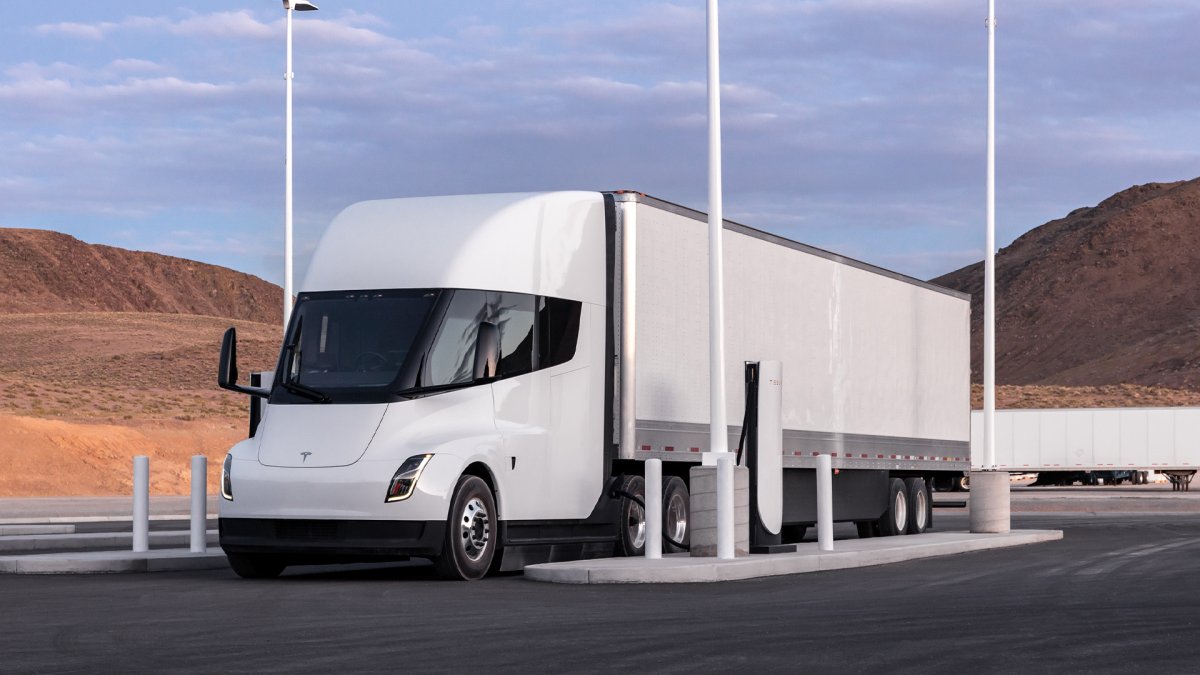
Tesla Semi’s Enormous Battery Might Weigh 11,000 Pounds on Its Own
The first Tesla Semi has been delivered to Pepsi with a range of roughly 500 miles. That takes a lot of battery power to achieve.
The Drive
51 points · by ourmandave · 3y ago · 74 comments
Anyway, the claim by Musk that they can achieve 1.5kWh/mile is reasonable, and fits in with my calculations here: https://selenianboondocks.com/2017/11/tesla-semi-part-1/
The vehicles that they delivered did not use all the available aerodynamics tricks that their prototypes did, and uses duals instead of super singles, so it also makes sense it’s only achieving 1.7kWh/mile right now.
Note that a ton of people claimed a 500 mile electric semi with a full load wasn’t feasible. This proves that it is. (The jersey barriers they pulled weighed about a standard 44,000pounds.) The Toyota hydrogen semi has only about a 300 mile range and with fuel an order of magnitude more expensive.
So if I read [1] right, some kind of average price for electricity used in the transport sector in the US as of September 2022 was 12.48 cents/kWh. That would mean that the 500-mile trip costs 500 * 1.5 * 12.48 / 100 = $93.6 in energy.
If that includes hauling tens of thousands of pounds of cargo, that sounds rather a lot like it would make transport powered by electricity commercially sane, right? Nice.
EDIT: I hadn't read the article much; it seems the current power value given is actually 1.7 kWh/mile, so that increased the price to 500 * 1.7 * 12.48 / 100 = $106.08. Not a huge increase, obviously.
https://www.eia.gov/petroleum/gasdiesel/
Let's use $5/gallon.
According to random website https://motorask.com/semi-trucks-mileage/
> On average, semi-trucks get around 6.5 miles a gallon
But according to https://www.motorbiscuit.com/how-many-miles-per-gallon-do-se...
> Transporting freight from one location to another isn’t cheap. We all pay so much for shipping because semi-trucks are gas guzzlers. In the early ’70s, it was estimated that the average semi got about 5.6 MPG, but that amount has increased slightly. In 2014, new semi-trucks were required to get 7.2 MPG on average.
Heck, let's use 10 MPG.
500 miles ÷ 10 miles/gallon x $5/gallon = $250.
So even with liberal estimates in diesel's favor, unless my numbers are way off, electric comes out way ahead.
6.5mpg - I just Googled average MPG for a fully loaded Semi, could be wrong.
$5.313 - Most recent highway diesel price (https://www.eia.gov/petroleum/gasdiesel/). I'd expect this is high due to fleet discounts and such.
That is the question. I am very curious if that includes cargo and if so how much weight. I suspect it doesn't include cargo. If it doesn't include cargo, diesel trucks will be far cheaper
If you're looking at historic fuel prices ($3/gal diesel [1]) and what modern trucks are getting (7-10mpg [2]) with loads. You're talking ~$150-$215 for a diesel truck. Plus you have fuel everywhere (less infrastructure costs), quicker refuels, easier repairs, etc.
The cold and time will also siphon off the efficiency of the battery powered trucks. Colder climates will see a 5-10% drop in efficiency in winter, and that'll grow over time. Making it less cost effective in northern climates.
The only way this truck makes any sense would be short-haul (single day round-trip deliveries) and government subsidies IMO. Plenty of market, but not quite where it needs to be.
[1] https://agtransport.usda.gov/Fuel/Historical-Diesel-Fuel-Pri...
[2] https://lonestarclassictruckclub.org/average-fuel-mileage-fo...
Tesla also released a video[1] showing a time-lapse of a fully loaded truck going from Fremont to San Diego fully loaded with no charge stop. (The trip does include a 30 minute bio break as required by law.)
(Tesla has typically done better than their peers in overall battery specific energy as well as energy per mile.)
Being able to run different kinds of small 20-80hp generators at their max efficiency RPM would be great. And if it were a reasonably sized module different folks could compete to make different highly efficient generator packages running on gas, diesel, CNG or LNG, ammonia, DME, hydrogen, ethanol, or whatever.
[1] - https://www.pge.com/mybusiness/environment/pge/fleets/
[2] - https://chargedevs.com/newswire/los-angeles-fire-department-...
That said, the main utility for hybrids is in stop&go situations where gas engine has to operate over a large RPM range and energy is essentially lost in stopping. In case of big rigs I actually agree that you need full electrification (or maybe ammonia/H2 engine IFF conversion efficiency to carrier is high). We 'just' need to get the battery energy density up 30-40%. Quite doable IMO.
It doesn’t solve all emissions problems like NOx and other particulates but it’s a good step and likely we will be seeing both electrified trucks for short hauls and carbon capture for long hauls and for more efficient reuse of existing vehicles.
And you’re only making a marginal improvement in CO2 emissions. All the synth fuels are much more expensive than electricity.
If the exception to cruise is only 0.1% then I agree it's dumb to consider. If it's 10% or more and the emissions during non cruise are significantly worse, it could end up accounting for 30-40% of total emissions instead of just 10%
Fleet vehicles like this are exactly where it makes the most sense to have a stop and swap strategy for refueling, especially when so much energy needs to be transferred at once. Though that is lessened by the size of the battery since they could argue it gets recharged during a mandatory rest period.
That also means the batteries must be carried like cargo. That'd add a lot of extra weight.
This is kind of a "the entire industry is dumb" assumption.
I mean, sometimes industries are dumb, and there are certainly people driving oversized vehicles on the road right now, but if you can find places to optimize vehicle weight outside of the engine/transmission/fuel you're replacing with batteries/motors, that applies to regular old semi-trucks; if you can make a semi-truck weigh 5000 lbs less without compromising on its design parameters, you can make every other semi-truck on the road more fuel efficient and save like 6% of your fuel costs, while also allowing you to haul bigger loads than competitors' trucks.
Everyone making semi-trucks is interested in that, not just Tesla.
I'm fairly confident some of the rest of the industry could get a comparable weight if they started from scratch and they optimized for EV only. But that's two assumptions that don't currently hold.
So, 10,000+ pounds for the power pack alone is a sizable chunk of the maximum allowable weight, and could potentially eat into the allowance for cargo, more so for restricted routes like older inner city bridges with tight weight limits and the like.
[0]https://www.jdpower.com/cars/shopping-guides/how-much-does-a...
[0]: https://afdc.energy.gov/laws/11682
> NGVs and PEVs may exceed the federal maximum gross vehicle weight limit for comparable conventional fuel vehicles by up to 2,000 pounds (lbs.). The NGV or PEV must not exceed a maximum gross vehicle weight of 82,000 lbs. (Reference Public Law 116-6 and 23 U.S. Code 127(s))
e.g. a CAT D8T bulldozer weighs in at over 80,000lbs all on its own and they are often trucked around as a complete unit, so you're looking at 20-35,000 more for the trailer and tractor to haul it. Heavier pieces of equipment like D9's (108,000#) or D10's (145,000#) are generally 2-3 loads of chassis/tracks/blade&attachments.
Apparently the highway patrol would camp out in the industrial/shipping areas and watch for compressed suspensions/bulging tire sidewalls on big trucks as a monthly fundraising exercise.
Obviously there's a business incentive to move as much as you possibly can at once...
There were about 10-12 concrete barriers as load in the demo each weighing 39,000lbs. So the weight being carried is around 40ishK lbs. So rough approximation - half the weight of the truck is load and half is the truck itself.
I don't work in the industry. I just observe three things:
1) the weight variance of a semi encompasses the amount imputed to the battery
2) 3,000lb of weight can be saved by not having a diesel engine plus another 2,000lb not having fuel. (Both of which will be in the total gross weight of the semi) some of which will of course be replaced by electric motors.
3) it's a speculative weight. It might also not weigh that much. Might is doing a lot of heavy lifting.
A fourth point: trucks routinely travel partly empty because of weight distribution issues. Not every TEU is full.
Logistics is fascinating. TCO is the closest most computer scientists get to "how can owning a Mac be cheaper than owning a Windows PC" but logistics does this almost every sum. Weight and carry capacity may not be the sole deciding factor here when a semi is worth $500k and has a 2nd hand value and is a finance decision with tail costs and operation costs.
A full semi can have 300 gallons of diesel which itself is about 2000 pounds, so we're down to a 9,000 pound difference.
And some percentage are short haul, which are often not even near to fully loaded. Could be as high as 40-50%.
I believe the laws in America are much looser so the effects there may be far greater. I believe US truck drivers can drive for up to 12 hours, so if these were widespread you would imagine US truck drivers may be getting more and longer breaks than if they were driving ICE.
Summary of EU Driver Laws for anyone interested: https://www.gov.uk/drivers-hours/eu-rules
I think 45 minutes is enough to get closer to 300 miles of additional charge than 100.
Also, it’d require dumping a lot of heat. I talked to a contractor who once helped make the Nikola One heat exchanger, and he said it took as much power as a Nissan Leaf powertrain just to cool the dang thing.