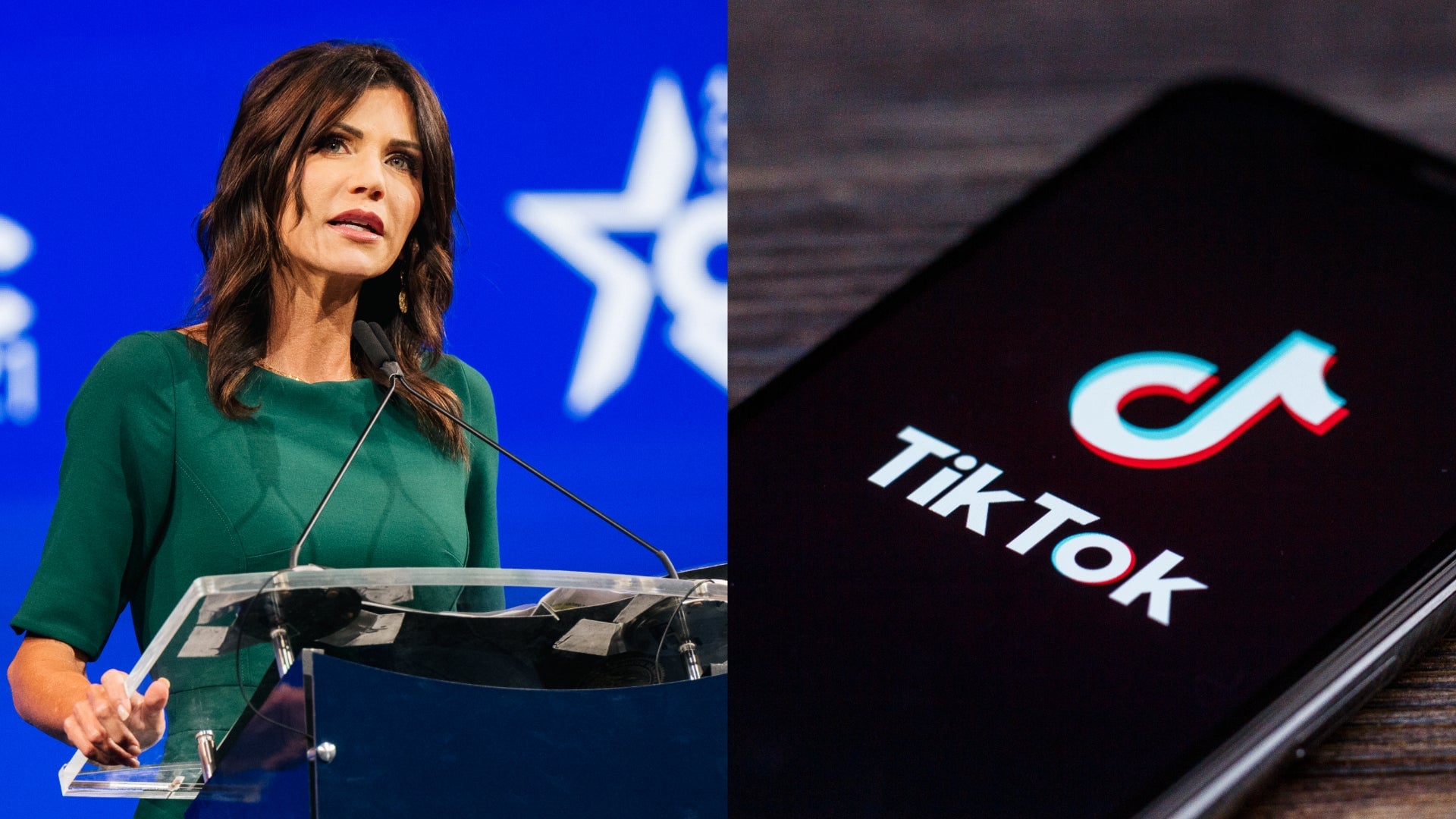
South Dakota Bans TikTok From State Government Phones
“South Dakota will have no part in the intelligence gathering operations of nations who hate us,” said Governor Kristi Noem.
Gizmodo
443 points · by KomoD · 3y ago · 291 comments
One minute video that explains: https://www.youtube.com/watch?v=Hus9fWz0RRk
Further reading: https://www.opindia.com/2022/07/tiktok-china-engineering-oth...
https://www.china-briefing.com/news/china-passes-sweeping-re...
https://www.deseret.com/2022/11/24/23467181/difference-betwe...
CBS 60 Minutes Interview with an IT expert just 3 weeks ago: https://www.youtube.com/watch?v=0j0xzuh-6rY
I also design productivity systems as part of my job, and found that watching TikTok in the laziest way possible can be an outstanding part of such a system.
We are long past the Horatio Alger bootstrapping days where we condemn procrastination and laziness out of hand. And yet Chinese government culture continues to try to speak with that always-on productivity-porn voice--fine, let them do it, see how it works out. They love to wax poetic about theoretical human machinery without giving attention to a reasonable duty cycle concept.
And keep in mind that they are simultaneously blocking a lot of that E-word they hate: Expression.
We now have much more deep, nuanced experience with productivity that exists and outperforms outside of that context.
IMO TikTok is better feared (if that's the lens) for the more rational, non-propagandistic reasons.
America could easily do what China did here: enforce regulations on what kind of content social media companies can show minors. Just banning TikTok won't prevent Instagram from running the same playbook on Reels, it's not like Instagram has been the standard for teen mental health in the past 10 years. Douyin isn't educational in China due to the goodness of their hearts, it came from regulation.
The issue is, good luck trying to enforce any sort of corporate regulation in the US.
The Chinese get the version with government enforcement of science and patriotism.
Freedom vs. Dictatorship.
Similar thing happened to G4 tech TV.
By the late 00s/early 10s it was all Pawn Stars and American Pickers.
Interest in drier, more educational content is less for every human society I know of.
Having a publicly funded TV network goes a long way to producing good content.
This survey showed a growing number of people who want to be social media stars[1] as fewer want to pursue STEM. I can't picture a healthy society that makes this decision. You can't shun important roles of society collectively and then hope everything works out.
[1]: https://www.businessinsider.com/american-kids-youtube-star-a...
When I was 12 all my friends wanted to be rock stars or professional skateboarders. I seriously doubt the causation between what children want to be in the age group of 8-12 and what they grow up to become.
I think in reality, preparation for STEM takes years. It helps to have an education that fosters interest at a young age as well. I am specifically questioning the priorities of the US's view of education. As I said, we rely heavily on H1-B and have very large foreign populations in STEM degrees. Social media may not be the cause. What matters is that there clearly isn't early interest. Early interest translates to having more graduates. As I posted elsewhere, there is a clear difference in what degrees foreign students pursue in the US (more STEM) versus what US students pursue. This seems like a difference in values that I think we should examine.
Huh? Anecdotally, I have never heard this sentiment before.
foreign students accounted for 54% of master’s degrees and 44% of doctorate degrees issued in STEM fields in the United States in SY2016-2017.
We rely on tens of thousands of H1-B visas per year to fill STEM roles which has been debated for years. We have accepted we have to import people to sustain our economy. I am questioning the merits and sustainability of these views and whether Americans have a unhealthy view of education. We certainly hold these visa holders to higher standards than ourselves. Why?
I don't blame the foreign students for this, but it's important to understand what's really driving the current situation.
Yes I work in BigTech and I’m one of only a very few native English speakers on my team and probably in my wider department. I never look at my coworkers and think if it weren’t for them I would be making even more than 3x to 4x the median income in the US.
Even on the corp dev side, after 3 or four years and one job hop, you can make twice the median income in any major city in the US.
1. Chinese children prefer STEM content and the algorithm is providing that to them.
2. It's enforced by the Chinese government or someone who believes this kind of content will benefit the Chinese future.
In the case of #1, this is a cultural issue and we have no one to blame but ourselves.
In the case of #2, which I believe is what most folks who say this are suggesting, I can't imagine why children would then proceed to download the app, use it for hours a day, only to learn science and math. Sure, some may enjoy it (as some in the US would as well), but a vast majority of that market is going to reject this and delete it from their phone. In fact, we have this in the US -- we have educational TV shows, you can visit a library on your free time, etc, but kids don't do it-- because they're kids.
https://www.cnet.com/culture/tiktoks-china-equivalent-limits...
Except for the part where that law would end up being declared unconstitutional, and rightly so. Then again, if TikTok has no US ownership, perhaps it would pass constitutional muster. 1A doesn't specifically mention US citizens or US-owned corporations, though, just that that government shall pass no laws abridging the freedom of speech, so maybe not.
There are plenty of laws forcing companies to engage in certain kinds of behavior. The latest I've seen is the beer manufacturing / distribution / sales breakup as a result of the post-prohibition policies. Manufacturers can't distribute, distributors can't sell to consumers and so-on.
I think people might not tolerate such govt interference, but assuming it's law I don't think it'll be unconstitutional.
Perhaps a distinction without a difference
The first could be viewed as a attack vs. the latter is a mere choice of the states involved.
In China, all companies with more than 50 employees are legally obligated to have dedicated Chinese Communist Party representatives overseeing, according to Harvard Business Publishing (https://hbsp.harvard.edu/product/R1403J-HCB-ENG). Social media companies? They probably have tons of mandatory representatives guiding the system. ByteDance also had a "nominal" 1% ownership taken by the Chinese government, which then got 1 of 3 board seats supposedly from that investment (https://www.washingtonpost.com/technology/2021/08/17/chinese...).
So you have a company which is absolutely at the size where dedicated CCP representatives are mandatory, with a board seat possessed by a representative of a state-owned enterprise. How much separation is there, really? Add to that, TikTok has been censoring the Uighur genocide, Tiananmen Square riots, Falun Gong, so forth despite not operating in China, as well documented (https://www.theguardian.com/technology/2019/sep/25/revealed-...) and (https://www.codastory.com/authoritarian-tech/xinjiang-china-...). If you censor things in non-Chinese nations to please the Chinese government, plus the earlier facts, you're controlled.
Finally... putting that together, it is safe to say TikTok is under substantial control of the CCP. What does every Chinese student, and almost every Communist Party leader, learn in their schools (for being a communist leader has mandatory education in many things, including lessons taken from the fall of the USSR, to avoid such a fate)?
"The supreme art of war is to subdue the enemy without fighting." - Sun Tzu
I think a narrow set of outlooks is bad for the general population.
If you think TikTok deliberately prioritizes dumbed down content then why does Facebook or Fox news also do it?
TikTok is a private company that wants to make money. If it could make more money by showing Chinese audiences more trashy content, it absolutely would. And in fact, it does show a great deal of mindless content in China.
However, as is well known, China has recently been trying to regulate children's use of the internet (e.g., time limits on internet gaming). If companies were already willingly doing what the Communist Party wants, the Chinese government wouldn't have to pass these new regulations in the first place. And guess what happens when the government passes these sorts of regulations? Companies immediately start looking for ways to skirt them.
> legally obligated to have dedicated Chinese Communist Party representatives overseeing
No, at least legally, these committees have no oversight role in private companies. Companies with over 50 employees are required to allow a Party committee to organize and meet, but it doesn't have a role in management.
There are far too many grand statements nowadays about how China works, coming from sources that don't actually seem to be very familiar with the country. There is a very strong tendency in the West now to view everything about China through a paranoid lens. The truth is usually much more boring.
In this case, the truth is that Douyin (TikTok in China) has plenty of trashy content, but that there's more government regulation than before.
I'll also say that Instagram is just as much trash as TikTok, but it's our trash instead of china's.
Infinite-scroll short form trash content is this generation's trash TV, yet more addictive.
And you won’t believe me when I say this, but in US-China diplomatic terms, an official saying a technology “allows them…if they want to” to perform influence operations means they already are.
As further corroboration, Andrew Schultz revealed earlier this week on the PBD podcast that sources at the State Dept confirmed these influencing operations were happening in the US via TikTok
I am quite critical of TikTok, of people who have it installed on their phones, and as someone who unfortunately has Instagram for certain reasons, I see the same mechanisms of hypertracking and attempts to push addictive mind-melting entertainment and softcore porn to people.
I am unaware of legitimate critique's of Chris Wray as head of the FBI, but that's besides the point, I suppose. At least we have a comedian on a business writers' podcast to tell us about it.
That western notice-me-culture has been obvious long before TikTok was a thing - consider reality TV, early YouTube, and the fact that several serial killers apparently murdered for the media attention.
Our own culture treats education as something that's not really that important. We promote sports stars with little to no educational background to ivy league universities. Hardly a teenage movie does not take a dump on 'math class'. Our kids are being told to dream and find their passions, but no-one considers them a failure if they get a D in the sciences. The student who excels is not praised societally, but shunned as a 'nerd'. Where 'hustle culture' exists, it is not seen as a way of achievement, but as a way to greater wealth, and almost always unpleasant.
Why then are we surprised that educational content does not perform well in the West?
As for the second link's part about TikTok promoting sexual confusion: Was it TikTok which started that discussion, or was it celebrities who made alternative sex/gender assignments cool (much like they made smoking cool in the 1950s), supported by pro-sex/gender-divergent activists? Imagine the backlash should TikTok decide to ban these topics from their platform.
My suspicion, which is mostly just me thinking out loud and is based on no real evidence, is that folks are (a) largely desensitized to stimulation due to aggressive "marketing" (in the loosest sense of the word - whether ads, click/viewbait, or other quasi-exploitative attention-grabbing things); and/or (b) have observed that, culturally, a lot of "dumb shit" is mainstream enough (in terms of critical mass within their social microcosm) to warrant conformity, and thus may be a preference that is adopted for identity or inclusivity purposes. Similarly, it may be seen as a pathway to some form of success or recognition (see: IG/YT influencers, tiktok fads, etc).
I'm sure other, much smarter folks have actual evidence or have performed studies (and I would be interested in learning more), but based on my personal experience, the above seems to hold true, generally speaking.
I'd say it depends on the politicians themselves. I'd say populists don't mind the people's stupidity and misery at all, because they turn that into an advantage for themselves, by very publicly providing, or even just promising, a short term relief for them. In this way, systemic issues like the welfare trap or wage slavery give them opportunity to inflate their popularity by organizing handouts, or by redirecting the people's misery to outgroups, such as non-heterosexuals, people of color, immigrants or other marginalized groups like people with addictions.
If you want to verify it yourself, go to China, open Douyin. Plus, the story makes internal sense - for example, pornography and the kind of soft-core porn, heavily revealing clothing, and so forth that appears on TikTok is actually illegal in China. Post it, you'd get it censored and removed.
Your opinion on reputation is just that.
I've seen China blamed for a lot of things, some legitimate, but they didn't force Americans to pick the Kardashians over engineering degrees. American public discourse is becoming that Eric Andre show meme except it's "why did China make me do this"
Tiktok is called douyin in China.
When I just went to douyin.com, the first douyin was entitled "the role I play in your life is too vague." That douyin showed a beautiful women eating yogurt as her jacket was perpetually fallen off her bare shoulder. The second douyin was a rap video that showed a women modeling various clothes in different environments.
There are government regulations in China that censor and disallow twerking content, but I didn't see any stem videos, either.
https://www.forbes.com/sites/emilybaker-white/2022/11/30/tik...
But usually the biggest problem is how to get a Chinese phone number. In China, most apps require you to register with a phone number (+SMS verification), which is your de facto personal identity number.
Back to the topic, I can confirm this for you. Douyin is also serving shit to Chinese children and the Chinese government do "regulate" them. And of course, between STEM content and shit, most Chinese children I have met (well, genius do exist), prefer shit.
The more stupid things you look for, the more stupid things you see. Its the same in the us as it is in china.
https://www.china-briefing.com/news/china-passes-sweeping-re...
It is not clear to me how universally these regulations are enforced.
My skepticism requires that I go there? This is a different definition of skepticism than I was previously aware of. During the Cold War, I was skeptical of many of the claims about the evil Soviets. I did not have the opportunity then to visit. Was I not a proper skeptic?
No idea if it is true but I think the US and Canada do not need foreign "help" in this department. Dumbification of the average Joes and Janes is a wet dream of every politician and big corps and thanks to advanced tech it is becoming more and more.
You can't really prove that. They have their own influencer culture that looks just as vapid as ours.
The China distortion field
Anything normally would be laughed at would be considered dead true when comes to China...
Use your f*king mind...
When they deployed wfh, they used mfa. They banned Google authenticator out of the view Google can't be trusted. But told people to search the app store for any other mfa app. They one my wife found makes you wait for an ad run before it displays the code. It sometimes crashes and is generally terrible.
The point being banning certain apps seems far more political than well thought out.
TOTP is a standard (https://www.rfc-editor.org/rfc/rfc6238), so I don't see how that wouldn't work.
TOTP is a standard, so anyone can implement it.
This is just a way to get the governor’s name out there as a VP candidate. Taking an anti-China stance sounds tough and decisive. She was pretty good getting her name out during COVID.
The recent protests in China have been suppressed by the CCP.
No doubt there are close to zero protest videos on TikTok.
There are protest videos on YouTube - though anecdotally YouTube management is attempting to suppress them because Google is tightly bound to China.
The question is, does it matter if protest videos are shown or hidden on social media? Can the videos shown on social media influence world affairs?
Howso? Google, YouTube, and Docs are banned over there. Their biggest stake is really just Android.
> no there was no revolution in progress.
Who said there was?
https://www.reuters.com/technology/foxconns-zhengzhou-plant-...
Fresh off the presses, courtesy of the paper of record:
https://www.nytimes.com/2022/12/07/opinion/xi-loosens-up-it-...
Some tidbits:
"The government’s response, though, does not, of course, address the larger yearning for an end to autocracy."
"Those brave protesters have changed China’s national policy, and their broader yearning for rights can no more be extinguished than a virus; someday the Chinese Communist leadership will have to respond to that very human aspiration."
If the scale of the protests were laughably small and of no concern to the CCP, it could just be a coincidence that China announced their scientists have determined Omicron has ‘reduced pathogenicity’ [1], as a pretext to relaxing restrictions.
https://www.readingthechinadream.com/deng-yuwen-on-xi-jinpin...
This is not your usual "'free press'" fare and it is noteworthy for the both the designation of China under Xi as "totalitarian" and also its optimistic prediction of a new wave of democratization globally.
What excited the press (...and those whom you imply) was probably that anything happened in Xi's China, and that it happened in multiple places, and that CPC was not entirely successful in suppressing it even while having near total control.
So what is extraordinary about these protests -- something apparently very new in China -- is that they are directed at the cult of personality directly. I just did a google search to see if there ever were demonstrations in China against Mao during his reign. Xi's political game is role-playing some sort of Maoist / Stalinist state with him as maximum leader. He even publicly dismisses former grandees in front of foreign press. How did these Chinese dare to directly call for his removal in protests?
> Yes, there were reasonable protests against zero-Covid measures, no there was no revolution in progress.
"Finally, to borrow an image from Liu Cixin's novel The Three Body Problem, we should be psychologically prepared for Xi's totalitarian rule to enter a dark forest. Xi will rule China for at least another five years. But we should not be too pessimistic. No matter how long Xi stays in power, as I argued above, it is unlikely that another Xi Jinping will emerge after Xi steps down. The good news is that the hassle of fighting the pandemic with the zero-tolerance policy has awakened even more people. When social discontent reaches a tipping point and everyone believes in regime change, then change will come soon."
Any new contender would have to build out very quickly.
There are likely thousands of apps on every major app store with apps whose sole purpose is to fish out data from users and sold to different criminal or governmental entities.
That being said: I don't see why any government device should have access to any social media.
In the context of any other kind of trade relationship would it be acceptable for China to get unfettered access to foreign markets whilst blocking all access to its own?
I don't feel like its controversial to say that social media algorithms can be designed to manipulate people, or that this capability is especially dangerous in the hands of a hostile state. It seems to me like TikTok is ripe for weaponization in any future conflict between China and any other country.
Whataboutism would be saying it’s ok to abuse users on behalf of totalitarians not equally criticizing anyone who does so.
(At least with Twitter they had to bribe a Saudi lol)
Tik Tok, like anything run by the Chinese or other totalitarian regimes, is not very respectful of autonomy or freedom of expression, but I still want to know what went down at my old NGO after I was forced out -- I had thought the CEO worked for the Russians or something, she was so effective at destroying the organization like one of the sabotage guides I used to read in middle school on textfiles dot com, but one day I pop over to LinkedIn and she ended up working for Wal Mart, and the general counsel ended up at Tik Tok as people on Signal would do literally anything but connect me with a decent job but tell me the weirdest shit like "The Mayor of Albany beats his wife"
(Apparently one of my friends may have given their phone to some now dead FBI agent around the time I renewed my passport and loudly declared presidents last 8 years max and switched from learning javascript and CSS to learning Python and Metasploit.)
Anyways, Tik Tok sucks, Facebook sucks, all social media sucks. Delete your accounts and learn the value of verbal conversations in a room with NPR cranked to 11 on an analog radio you built yourself in a 3rd floor walkup with the door bolted and barricaded.
(Or maybe the above is disinformation... reader beware, you're in for a scare!)
China has rules that apply to all social media apps operating there, including rules on data storage, data sharing, and moderation. Those applications are not willing to follow those rules, and so aren't allowed in China. TikTok is willing to follow those rules, so is allowed.