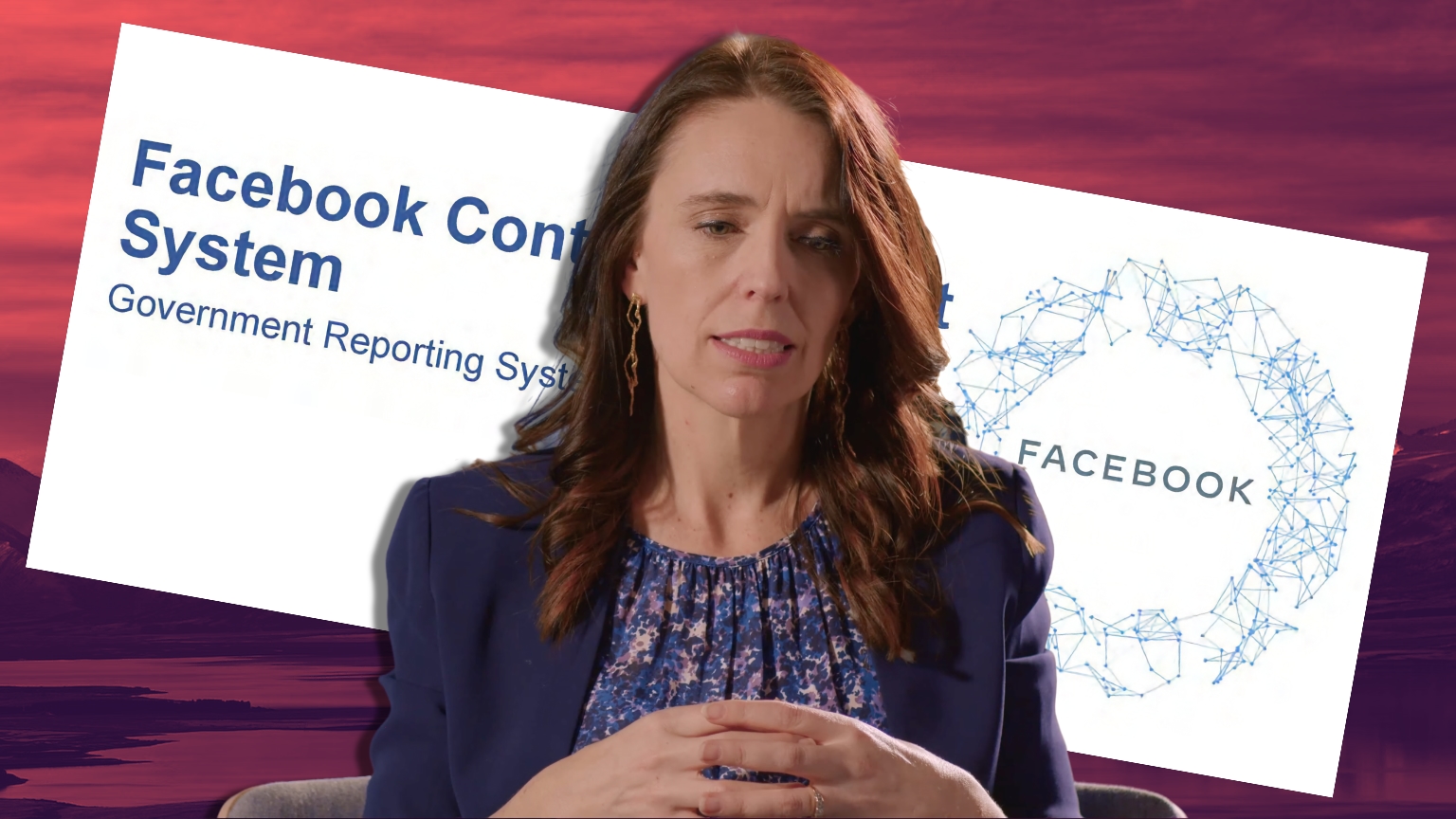
New Zealand Admits It Has Direct Access to Facebook Takedown Portal Where It Can Flag Content for Censorship
The censorship-loving government has a direct line to the tech giant.
Reclaim The Net: Free Speech, Privacy, Digital Rights
272 points · by mikece · 3y ago · 146 comments
They already have an internet filter which blocks access to certain domains/ip ranges/etc. [2]
Of course they would require similar abilities once Facebook came to their notice by broadcasting a terrorist's murder spree. [3]
It would have been "You are selling to New Zealanders. We will have the ability to censor information passed to NZ IP addresses, or we will block the IP range, your choice."
[1] https://en.wikipedia.org/wiki/Classification_Office_(New_Zea...
[2] https://en.wikipedia.org/wiki/Internet_censorship_in_New_Zea...
[3] https://en.wikipedia.org/wiki/Christchurch_mosque_shootings
(I used to submit for classification for adult content for distribution in NZ or streaming in hotels)
Edit: so HN wants Twitter moderation and censorship but a country censoring videos and text books is a big no no.
I have no big problems with websites limiting what users can post (HN is also ding this!), but I have big problems with politicians having ability to for example take down content criticizing them.
Content that should be made illegal to post anywhere at all is in my opinion extremely rare, and basically all censorship system should censor less. Sadly, some things needs to be blocked and once system exists it inevitably gets misused.
Not sure what the proper solution is.
Therefore, they'll help set policy for what needs to be taken down, but a politician will not be able to take down content, they may request the censor office does this, but they won't be able to force them or do it themselves.
NZ is an outlier in the world, but it is a very strong liberal democracy. It has very low levels of corruption, very high levels of public confidence in government, very transparent ways of operating, and very strong media and public participation to hold the public sector to account.
Other countries might abuse this system, but I doubt New Zealand is.
Is this a hypothetical? Because plenty of content on FB criticising New Zealand's politicians.
Moderation is blocking content when the sender wants to communicate something the receiver doesn't want. Censorship is blocking content that both the sender and the receiver want.
Gmail running spam filters is moderation. The government blocking you from sending emails to journalists is censorship.
Except when it isn’t. All media content goes through classification and censorship in New Zealand. You cannot air anything on tv without classification.
My comment was on the processor of classification and censorship that occurs during the classification process.
> Moderation is blocking content when the sender wants to communicate something the receiver doesn't want.
Then Twitter, Facebook, etc do not have moderation teams. They have censorship teams. Because they are blocking content people do want.
You might disagree with Trump. But removing his tweets and banning him is censorship as people do agree with him and do want his content.
There are always trade offs but I think we are better off with zero censorship. What are we worried about? Will we become Jihadists after seeing a Taliban post? Are with that impressionable that anything we see sticks in the brain as truth? If so, perhaps we should try to solve the root problem.
These definitions don’t work, because there is always some (possibly extremely small) population that wants the content, ergo you could say all moderation is censorship to some people.
Between this and the matt taibi twitter discussion, the conclusion is that Americans overwhelmingly are for censorship of " the otherside", but wants to do it in such a way that it can't be called censorship. It's not that they don't want censorship, but they don't want to do it in a transparent way in which a government entity/clerk hands in a takedown request to fb/twitter, instead they want embedded partisan operatives operating through backchannels to takedown content they don't like in absolutely opaque fashion. The point is to claim - "see it's not censorship" even though the end result is the same. All it matters is how it looks like, not what it is.
It could be "send to the front of the moderation queue." or, it could be "ban it immediately globally".
People's perception also probably depends on how far they believe a ban applied to Facebook extends. Does it extend to NZ only, or worldwide?
If I were designing this system:
1) Upon receipt of a ban request by a governmental org.
2) If legally required, immediately ban it to all IP ranges inside of that country/region - there is typically a SLA with penalties here, e.g. 1hr in EU.
3) Send it to the front of the moderation queue.
4) If it comes back marked "not allowed", ban it globally.
That way, the legal bans only apply to the smallest allowed region, but we then take that as a strong hint that it might not be allowable on the platform in general.
That allows us to operate in Saudi Arabia, France, Germany, New Zealand and the US, each country with different things considered "illegal speech".
If some readers think this is NZ deciding for the world what Facebook publishes, they will have a very different response to someone who thinks the takedown only applies in NZ.
What I don’t like about some moderation tool on Facebook is that we don’t know what is moderated, by who, for who, and why.
I saw someone else say there should be a registry of sorts for moderated content so it’s visible which I think is good. (The moderation not the content itself)
Yes, of course? I can choose not to use Twitter but I have no choice but to submit to censorship.
Yes, that's actually very sensible.
I wish companies in the free world would unite to choose the latter option, and so force New Zealand to choose between giving in and allowing freedom of speech, or having their Internet become as useless as North Korea's.
> "If you have something that you don't want anyone to know, maybe you shouldn't be doing it in the first place."
If what the gov is censoring is so important then they should publicly post a list of everything they censored (Google's public DMCA list is a good example). They have nothing to hide right? If it's for the public good then the public should have the option to see what they were being protected from.
In the Tarrant case we do know: the manifesto (not too hard to find) is about equal parts polemic and roadmap/planning document. The video recording is from a helmet-mounter camera and basically looks like a first person shooter video, except that all the targets are fleeing civilians. It's not impossible for people in NZ to see these materials; academics, journalists and so on can apply for permits to obtain and possess the material. Absent that, possession is, as I understand it, a crime, but one with a very low chance of being caught. The primary intent of the law is to have a strong sanction to prevent people distributing it and inciting similar incidents in the future.
I'm not convinced that forcing the materials fully out of circulation is a foolproof preventive strategy, but it certainly creates barriers to the acquisition/ collection of such material by wannabes, and collecting this sort of material is definitely A Thing among other mass shooters, who are quite a bit more social than most people imagine and have an online community of sorts.
So the free speech argument generally goes along the lines of 'we don't know what we don't know, allowing the free flow of ideas is the only rational way to ensure freedom of life and the discovery of new ideas without inhibition.' But from NZ's point of view, they definitely don't care for a repeat or innovation in the practice of massacres, and the surviving relatives and neighbors of the dead presumably don't care to see the murder of family and friends become a an entertainment commodity or be weaponized by trolls who use the material to traumatize them further (please, let's not pretend that this doesn't happen). And they've balanced their prohibition with exceptions for serious analysis and study with a straightforward application process, albeit a subjective one that is administered by bureaucrats rather than a mechanical system.
So there's a concrete example, with come added context (sorry, it's late and I'm not at my main machine so I'm not going to dig up a pile of links/documents to flesh it out to article quality). So, should we accord any weight to those considerations, including the exceptions, and if not why not?
Well great! Let's find out all the judgements of the secret courts, all the top secret info, where our money is going, etc. Government works for us right? I don't want to be nannied, I want the truth. What's sauce for the gander is sauce for the goose.
Why should the government have privacy but the individual not? Very asymmetric no? Whenever the government does something wrong, we likely don't find out at all, but if we do we have to go to its courts or legal system to get it addressed. It, on the other hand, can fine us for vices where no one is harmed.
Frankly it’s disappointing the amount of people on HN posting knee jerk reactions about this article who also have no idea about New Zealand’s politics. Worsened by the irony that they are themselves living in countries with greater censorship than New Zealand (and at least New Zealand is transparent about such matters. Which is more than can be said for Britain or America).
Consider it a spectrum.
Also the Office of Film and Literature Classification lets you look at the classifications for everything online (including stuff that is banned), IIRC with a reason as to why it was classified the way it was.
The NZ Government would have won that argument.
"Facebook refused to honour and respect our laws. They prefer to distribute illegal content, so we have turned them off at the border."
You may disagree with censorship, or with what should censored, but most western countries still have censorship laws and media companies need to honour them.
If you disagree with the laws in your country, go out and change them, that's what democracy is all about. But you don't get to change other countries' laws.
Companies like Facebook/Twitter/etc that want to provide international services need to actively honour ALL the laws in the countries that the operate in - those laws may be contradictory, if a movie can be shown in country A but not country B needs then they need to make sure that can't happen or else they are in legal peril - having a portal that a country can use to declare what is illegal in that country is probably a great idea, the alternative is for say Facebook having an employee who spends all their time monitoring the output of a country's censorship office.
Such a portal can be abused, obviously we don't want governments just banning random stuff they don't like, rather than the process of an independent process like NZ's Censor's office, equally we probably don't want to publish the things that are being reported ("look over here, that's where all the child porn is"), I think this is a difficult are - perhaps we should make what's reported here open, but only in categories without giving URLs/details
For example: In Brazil the constitution says you have free speech and the right to criticize government officials...
Yet the judiciary branch, although often they rule it is free speech when someone criticize lawmaker, will happily say it is NOT free speech when someone criticize a judge.
Cue most recent elections, not wanting to enter in the merits of who deserves to be president, but one obvious case of abuse of office happened when the supreme court ruled that a retired member of the court should be censored and that reporting any news about this subject should be censored too, all because that retired member explained the technical legal details of a past decision, and the supreme court decided that even though everything he said was factual, correct and true, it "could be used for misinformation" and thus should be censored.
I'd challenge you to show where the NZ Films, Videos, and Publications Classification Act allows censorship because of a particular political point of view
The only political point of view I've noticed that was censored under that particular act (based on 5 minutes of perusing Wikipedia) was supporting euthanasia, which is illegal in NZ
Are they clearly documenting how many times what content is being exactly censored why and then transparently publishing that to everyone ? Is the publisher of content on social media being notified they are censored in NZ ? Do they have a right to appeal ? How will they appeal if they don't get notified ? Is the appeal process simple and inexpensive enough for independent content creator to avail ?
For censorship to work, the system of censorship should be very objective, clear and transparent and with avenues for inexpensive recourse.
NZ and all commonwealth countries which have similar systems are not close to that. These are system as you say were not designed for social media so have no business censoring social media unless they have adapted ( which they have not). Inefficient bureaucracy also suppresses free speech not just conservative or authoritative regimes.
Why? Because the jurisdiction of foreign countries ends at their border.
My products are sold globally but are probably illegal in many places. I don't give a flying fuck about complying with another countries laws. For example, one of my businesses is illegal in China, do I self censor it to prevent having Chinese customers? No, if any Chinese break the law using my products - that's on them, it's their choice, I give them the power to do what they want.
Facebook does operate in NZ but it's unclear whether this company is responsible for the public facing product, or is just reselling advertising from a seperate company. It could be dissolved tomorrow and nothing would happen because NZ isn't going to block Facebook like Iran or Egypt.
The NZ government has no legal or defacto control over what happens on Facebook.
That train of thought hasn't worked out well for a lot of business people running, say, online gambling that violates US law, while based in Bermuda. They often get detained in transit through the the US.
If you want to operate in a market, you have to obey the laws of the nation governing that market. Otherwise, you don't get to.
It's straightforward.
Again, as I said above, countries can pass their own laws - that's what gives them the legal right to do stuff - equally Facebook is free not to do business in any country they like
So that way governments could still use these tools where appropriate (because sometimes there is a good reason for censorship) but journalists/lawyers/activists would still be able to see what is being censored with a little effort which would allow journalists to provide transparency.
This could allow for government to still censor but keep the public's trust about how censorship is used.
that is a bare minimum, but insufficient by itself
Maybe the "misinformation office" should follow some kind of law but isn't directly managed by politicians.
I'd rather just have a public website available to anyone to view but updated through the normal channels. Last thing we need is another bureaucracy.
> Most other governments haven’t admitted that they have access to these portals. However, last year The White House did admit that the United States (US) Surgeon General’s Office is flagging posts for Facebook to censor.
> The Intercept’s report on this Facebook content takedown portal claimed that several other United States (US) government agencies have access to the portal, including the Department of Homeland Security (DHS).
> Documents released as part of 2021 lawsuits suggest that the California Secretary of State’s Office of Elections Cybersecurity (OEC) also has access to the Facebook takedown portal and a similar type of portal on Twitter.
Given the overall tenor of the articles on reclaimthenet.org matches the others, would love to know who funds it.
Well, it was not part of the question so why should they disclose more details than necessary. Pointless sentence
> Please provide the number of Facebook posts your department has accessed through the portal, or at least an indication of the scope of interference.
It's a Pandora's box that cuts both ways.
This seems a reasonable compromise after the NZ experience with the Christchurch shooter where immediate action to take down the stream would have been appropriate.
This is what came to mind for me: https://www.webworm.co/p/fakenews2
Sure, some shadowy entity (probably connected to Putin and also secret Nazis) are waging hybrid warfare on New Zealand because Jacinta is so progressive and young and a woman, and that's why she needs the ability to take down any facebook content (critical of her authoritarianism?), also something something covid and mass shootings. Just screams hysterical ultra left wing fear mongering conspiracy theory.
Therefore, you can have freedom of speech but you can't live stream a terror attack, which is what happened. A foreign terrorist live streamed an attack on Facebook.
Despite this, NZ ranks as the second freest country in the world, and has much less censorship than other countries like the US who don't even crack the top 10.
I’m a New Zealander and fully support the blocking of that murderers content.
If that ever changes - we'd notice - and we'd make people aware of it.
I would be wary of a government telling me that a horrible terrorist attack has taken place, that a video exists with clear evidence of who did it and why, but that I'm not allowed to view it or show it to others.
I'm fine with facebook removing it.
There are plenty of problems in NZ but our democracy works better than most.
I guess this isn't too surprising if you've followed the China/Apple thing.