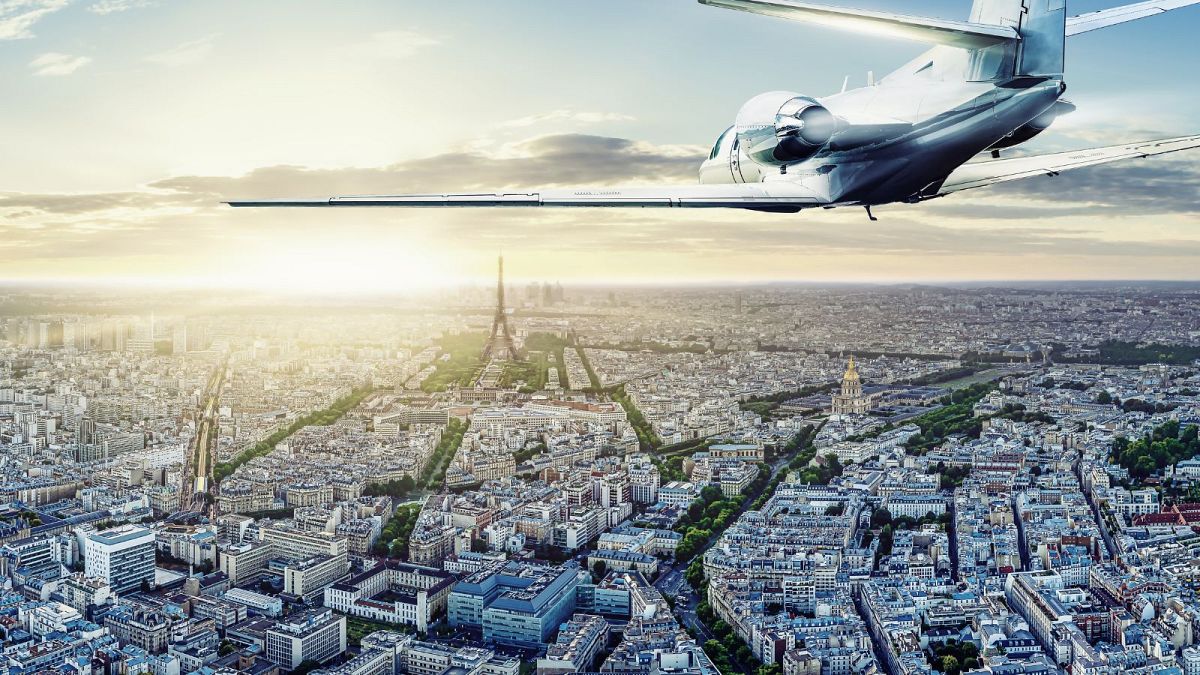
Short-haul flights are now banned in France thanks to new law
The idea for the ban originally came from a Citizens' Assembly.
euronews
99 points · by Manheim · 3y ago · 146 comments
Paris - Lyon by airplane: 1h15 plus travel to and from airport, plus security, boarding etc
Paris - Lyon by train: 2h30, city center to city center, no security checks. This might actually be faster!
Personally when traveling between London and Paris I choose the high speed train. It's usually more expensive but just the fact it removes traveling to and from airports (especially in London!) adds so much comfort that you realize the extra £50-70 are totally worth it. The overall travel time is also comparable.
Sure, you may have an easy access to the airport outside the city centre, but people in the city centre, which constitute a bigger number, have a worst access. And people who are not in the city centre but on the other side also have a worst access to the airport than the city centre.
The comment you answer to is still very relevant: it is true that in average using the train is not as disastrous as one could think (so the disadvantages are compensated by the advantage with regard to environment). The fact that it is not advantageous for every one is trivial and not really relevant.
The public transportation too the city center is better in european cities than driving. Sample route is charles de gaul to the train station.
Government induced free market distortion under pretense of ecology concerns is just what it is, bullshit, and a bad French habit.
edit: I know France Switzerland trips aren't affected by these laws, it's just an example.
In terms of time, the train is a direct TGV that takes 3¾ hours, while the plane route means taking a train for ¾ hours, waiting at the airport for at least an hour because of security, flying for 1¼ hour, wait for another half hour at least to get out of the airport, and then spend at least half an hour getting to where you actually want to be in Paris. It takes just as long, but probably longer if you want a decent safety margin on the airport.
And that excludes the simple fact that we all have a responsibility in reducing our carbon footprint, and that for most us who have the means to travel taking a route that may be (but isn't in this case) slightly more expensive and take slightly longer is the least we can do if it is the greener alternative by far.
1: Just an example of a journey I took myself, by train.
That's a difficult personal choice to push on people when the super rich are traveling by private jets, fuel for international air travel isn't taxed (because bought in duty free zone technically), etc...
People want legislation for all, not just fake moral that only applies to the middle class and lower. I believe the fact that this law will affect private jet trips is a reflection that politicians are aware of this and starting to feel the pressure.
Reminds me of Caroline Lucas, when asked about her air travel, saying there should be a focus on taxing aviation fuel.
What this all amounts to is travel should be restricted to the wealthy.
https://en.wikipedia.org/wiki/Kerosene_tax
However, as of 2018, commercial kerosene consumption is currently tax exempt under the legislation of all member states of the European Union.
The overriding market distortion, which trumps every other variable here, is the zero value given to any environmental externalities coming from air travel.
In addition, both CH and FR have massive governmental subsidies for their national carriers and the operation of their airports.
Which is to say:
you’re swimming in free market distortions so deeply you’ll never come up for air … and you’re decrying this one ?
Seriously: grow up.
Yes, the evil government is propping up BIG TRAIN because they hate planes!!!
Dude, instead of mocking me and sounding like an ass, learn your history. 20 years ago in that country, it was impossible to go from Region to region by bus, you had to take the train. You couldn't do Le Mans Paris by bus because bus operators were not allowed to sell inter regional trips. It's the EU that forced France to allow these. You're damn right the french government is once again rigging the game in favor of the SNCF.
This is often true. But - not always. Depends on which endpoints. Sometimes it's speed, sometimes convenience, sometime price.
> free market distortion
1. Markets are not free. They are based on violent coercion of private ownership of land, factories, service providing corporations etc.
2. Markets are always "distorted", in the sense that they don't just occur naturally.
3. I can't say for certain whether this specific measure is appropriate or well-intentioned, but - emissions need to be reduced drastically over the next several years; and not just in one sector of the economy. So in _some_ way, people do need to change their habits in favor of using more carbon-frugal modes of travel.
Why take away a choice from people?
https://www.easa.europa.eu/sites/default/files/dfu/uam-full-...
https://siecledigital.fr/2021/10/28/laeroport-de-nice-souhai...
Reminds of when someone says "this recipe only takes 20 minutes to make!" and they fail to mention you have to spend whole day shopping for ingredients, do some prep the day before and then spend half a day cleaning the kitchen afterwards... oh and then if you actually cook it for 20 minutes, chances are it will be barely safe to eat and would need much longer time.
Or, keep essential ingredients for good and favorite recipes on hand generally, clean pots and utensils in the middle of cooking (usually very possible during pauses and wait times) and cook properly. Most foods can indeed be cooked perfectly in 20 minutes and with a bit of practice it's easy to create great 20-30 minute meals without any of the hassles you describe,unless you're one of those people who barely bothers to ever cook or keep a thing at home and even scrambled eggs with toast require a trip to the grocery store and bakery first.
If they did want to do something for the environment and fairer competition between transport modes they should tax aviation fuel and airline tickets. Regardless of distance and destination.
However, if we want to be impactful then we need to start building massive storage infrastructure and grow renewable sources so that we can curb down emissions from energy production using coal and gas.
Everything else is a drop in a bucket comparatively speaking (even ICE to EV transition is relatively small in comparison with Electricity related emissions). More so if EVs are charged up from Coal/Gas Electricity sources.
[0] https://ourworldindata.org/uploads/2020/09/Emissions-by-sect...
they pick the most miniscule and most visible / inconveniencing regulations so that they look like they care about the environment, while actually doing nothing.
As a personal anecdote. My family decided to drive instead of fly over Thanksgiving. We saved about 1200 kg of CO2 even though we had to drive 12 hours. Clearly some savings can be made by forcing alternate means of transportation.
Does anyone know what's going on with no nonstop flights anymore?
Another thing to consider is the airports themselves. It's impossible for new carriers to introduce new routes in many instances because the airports cannot accommodate any more planes. Air traffic has gone from around 2B travelers per year in 2004 to 4.7B in 2019 [2]. I'm willing to bet terminals, gates, and runways have not gone up 250% in the same time period (it's likely air traffic has increased more in developing nations relative to the US, but I'm sure the US still accounts for a fair amount of this growth).
Personally speaking, I have never had more than 1 connection each way to anywhere in the US. I only fly major carriers and live near a decent sized international airport. I also travel any day or time, depending on which flights I like best, not necessarily the cheapest flights. It might be a worse experience if you're always shopping for the cheapest flight.
1: https://www.businessinsider.com/airline-mergers-and-acquisit... 2: https://www.statista.com/statistics/564717/airline-industry-...
I live on the east coast and within 45 minutes of 2 major airports. I just did some quick checking. Following are examples of the number of daily non-stops available from them:
San Francisco - 11 Las Angeles - 13 Dallas - 17 Seattle - 9 Portland - 4 Chicago - 33 St Louis - 9 Denver - 14
I fly to Little Rock, AR a couple of times a year. There are no non-stop flights but a quick search showed over 40 1-stop options from just the airport closest to me. Not all of those are going to be combinations most people want to do or are cost effective but if you throw away 1/2 if them that is still over 20 options. I also fly into Albuquerque, NM a couple of times a year. From my closest airport there are 58 1-stop options. If I drive 75 minutes to a further airport there are 4 non-stop flights to Albuquerque per week.
If you live in or near a smaller city served only by regional flights and are flying to another smaller city served only by regional flights than 2 stops will be necessary but 4 seems excessive.
I too am curious as to the shift.
The time difference and regional/hopper flights catering to "commuters" who need to fly early morning and late evening doesn't play well with the time zone changes, so you can either have a bunch of hopper flights with full day layovers at each airport, or you can catch an early morning long haul flight from a major hub airport to another major hub airport.
In fact I think I just saw an article (can't find the source) that talked about post pandemic the US domestic flights were much more focused on large volume hub-to-hub flights as a way of serving pre-pandemic customer levels despite understaffing.
It's possible that in the US you're seeing that as a consequence of few available pilots and their resistance to change (hub and spoke has been around forever in the region)
I took that flight several times earlier in the year and it was always pretty close to capacity, so sort of hard to understand. I guess the most likely thing is that they were trying to eliminate the direct flight to the middle airport while maintaining service there, but screwing over the majority of your customers seems like a bad way to go about that.
400 mile drive, no trains.
*except the rich
So this is another measure to widen the gap between the rich and the pleb - when the pleb's travel gets restricted further, the rich can enjoy private jet hopping undisturbed - which gives them advantage over the pleb as they can get to places even quicker.
If we are serious about climate, then there should be no exceptions for the rich, in fact they should be leading by example.
” France is also cracking down on the use of private jets for short journeys in a bid to make transport greener and fairer for the population.”
”Transport minister Clément Beaune said the country could no longer tolerate the super rich using private planes while the public are making cutbacks to deal with the energy crisis and climate change.”
This is a soundbite designed to calm people down. If there was a "crackdown", they would have listed steps taken to ensure the transport is "fairer".
When government is saying they are "cracking down" - using quite emotionally loaded word - is precisely to cover up the fact they do nothing.
If they really wanted to make transport fairer, they would have banned short private jet trips too. There is no excuse to not do that. None.
I'm sure this is a misunderstanding. With a small donation for the party, everyone will be happy.
Back to the topic though, a ban on short flights doesn't sound right to me. I'd feel better if the flights were made more expensive with higher taxes or perhaps even a new tax altogether
They do nothing. Words have no bearing if they are not backed by actions. There was no excuse why they shouldn't ban short private jet trips too.
France bans short haul domestic flights in favour of having to prop up SNCF
https://en.wikipedia.org/wiki/Kerosene_tax
However, as of 2018, commercial kerosene consumption is currently tax exempt under the legislation of all member states of the European Union.
We french are really kings for disturbing markets because of ideology. used to be socialism, now it’s eco-bullshit ()
(
) eco bullshit looks just like environmental activism, except it makes 0 environmental impact, is 100% about politics and can destroy economies in less than 10 years.There was no natural markets there anyways, the airports are paid for by local taxpayers, only really big airports make money.
But that's not how we french like do it, because it sounds too much like "laisser faire". Politicians want to show that they've acted, they like to spend money and regulate, it makes them feel warm and fuzzy inside.
I believe it is now time for citizen to ask a little more than just a "it's good for the environment" slogan, whenever state are starting to highly regulate and destroy parts of our economies. Such as serious scientific assessment on the real, numbered impact expected. Hint: it's not going to happen, because this airplane traffic obviously is totally negligible compared to the country CO2 emissions.
I'm a bit sensitive myself, and apologies if I sound harsh, but HN has a permanent anti-regulation erection and seems to attract know-nothings who love to argue that all regulation is bullshit and the free market will fix everything, every time an article on a government intervention or policy is posted. It drives me bananas.
I'm the first one to criticize pseudo-environmental policies, and Germany was indeed a mess due to pseudo-environmental policies. But the state of french nuclear infrastructure is not due to ecologists, it is very stupid to think it is, because it does not make any sense.
The different french government were all way more pro-nuclear than than in other countries, and french nuclear technology was always considered by them as a source of pride. The state of the nuclear infrastructure is a mix of plenty of things: short-term vision from the french politicians (as usual: results of investment take time and they will not be in power when they will come, so what's the point), overconfidence ("we have the best tech, I'm sure it will still be the case in 10 years, let's invest in other stuffs instead"), privatization (the picture would not be as it is today if EDF was not struggling economically because of the shoe-horned privatization that forced them to sell at loss), loss of know-how, ...
One example of how ridiculous it is to blame it on ecologists is when we talk about running nuclear plants. Their situation is very dire. Yet, how can it be the results of ecologists? If they were able to influence the decisions regarding the power plant, they would close it, not pass laws that say "let's decrease checks, let stuffs get corroded, let make the worker condition even worse". Obviously, if the ecologists were able to influence things that led to the situation of running power plants, they would have done things totally differently in order to reach their goal way faster.
Sorry, but you've been massively overtaken by the Germans. Better luck next time.
I can't understand how wind and solar will provide power 24 hours day.
https://truecostblog.com/2010/05/27/fuel-efficiency-modes-of...
Flippancy aside, in most cases the transportation mode has a relatively similar rate of emission. The problem is the number of miles travelled.