82 points · by simonebrunozzi · 3y ago · 87 comments
The example he gives of writing he would sign is a blog post. The blog post is already authenticated because it’s on avc.com. Fred Wilson has the tokens, social authority etc to ensure what shows up there under his name is from him. Technically speaking, it was already signed via TLS when sent to my web browser. It is also unclear how ChatGPT potentially breaks this sort of authentication.
Again, what is the threat model, what is the problem being solved? It seems like ChatGPT is much more likely to be used by someone imitating themselves out of laziness (“I don’t feel like writing this blog post today”) than to imitate someone else out of malice and this scheme does nothing to solve it.
I suppose someone could make a HN or Reddit account and pose as Fred Wilson and then ChatGPT makes it more credible. But are HN or Reddit going to allow GPG-style signed messages? Seems more likely, if this became an issue, they would move to usernames expressly tied to visible email addresses or domains that could be authenticated by receiving an email, adding a DNS entry, OAuth etc.
But I expect instead of embedding such a signature they will just save hashes of generated content and sell a billion dollar “checking” service to schools.
We need to stop trying to get education on the cheap and put enough real, motivated, and properly trained humans in place to do it properly.
I think we’ll end up seeing two changes: restricting things like school or hiring to favor in person, dynamic interactions - which is better in many ways but costs more and has downsides for people with social anxiety - and more pressure to make the internet less anonymous, especially if that’s linked to physical devices similar to what Cloudflare and Apple have been doing to prevent the bulk attacks (it wouldn’t help much with a cheating student). Depressingly, all of that seems expensive and likely to have substantial collateral damage.
OpenAI did hire somebody who is investigating watermarking the output of models like GPT-3, so it's definitely possible.
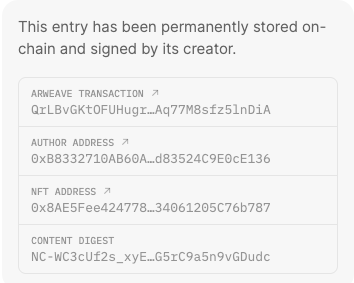
It used to be email was unique, and public keys shared for verification. Author is suggesting by placing the hash of the content on chain, anyone can independently verify it. I think it is novel
- Current experience is that most folks do not own their own domain or do not have audiences that will consume the content on their own domain, they instead depend on content being copied and distributed on other platforms.
- Threat is that modern AI makes it much easier to convincingly impersonate you on other platforms -- including robust profiles and statements that match your style or even tweak real content.
- Web3 potentially offers a platform-neutral, globally accessible place to claim ownership of content itself, so that people know if they are viewing a primary source or something edited.
There is a TON of productization to be done and a network effect problem to solve (there must be a simple, widely used protocol for verification that can either be used by everyone or built into trusted tools). But the value prop for a public signature ledger is not some fantasy IMO.
> The blog post is already authenticated because it’s on avc.com. Fred Wilson has the tokens, social authority etc to ensure what shows up there under his name is from him.
Haven't you answered your question? Most people don't own a domain, that's the problem signing solves.
If I see signed messages from John Doe which look like human generated messages and I start following him and then I start seeing AI-generated spam from John Doe, I can tag the signing key John Doe used as "bot confidently generating non-sense".
I cannot do that if John Doe doesn't have its own website.
Being on avc.com doesn't prove that; he could back-date posts.
Machines will simply start pretending to be human and sign everything themselves - either out of their own eventual volition or because nothing prevents a person from taking a ChatGPT output and putting their own, human, signature on it. The latter is even already happening.
Also, signing everything does not require any Web3 blockchain bullshit in order to work, thank you.
A blockchain with a proof-of-work validation may be overkill. But some kind of Merkle tree, like that offered cy TLS certificate infrastructure, is needed anyway. If it can be trustless at a moderate expense, the better.
The PGP web-of-trust model could also work, and mobile apps to ease keysigning could make adoption more feasible than the old keysigning party idea.
The signature has to be trusted though. Just signing it with a signature that has no meaning to me doesn't change anything apart from perhaps proving it has the same origin as something else.
The key function is the humanness or repotuation/trust score of the signature. If I read something signed by my uncle with a key we recently exchanged in person, then that's a high human score. If a blogger I have read and enjoyed 100 posts from posts a 101st post then I trust the content of the 101st to have the same quality (likely because the author is human). Both my uncle and the blogger could be compromised, but it's a start.
> nothing prevents a person from taking a ChatGPT output and putting their own, human, signature on it.
That would make me lower my trust of that author. I think this is the key: the signatures don't provide much value until we have a good reputation database, perhaps systems of trust networks where my uncles' neighbor is automatically slightly more trusted because I trust my uncle. That would be a useful system.
> signing everything does not require any Web3 blockchain bullshit in order to work
Indeed.
> That would make me lower my trust of that author. I think this is the key: the signatures don't provide much value until we have a good reputation database, perhaps systems of trust networks where my uncles' neighbor is automatically slightly more trusted because I trust my uncle. That would be a useful system.
I don’t disagree but I think this kind of thing will be undercut by people responding to different incentives. For example, maybe your uncle’s friend would never intentionally try to scam you but what if they’re really busy and see some cool AI assistant ad? Or broke and get an ad promising $500/week to send letters from what they’re assured is a legitimate business? Or simply that they use some online service which is hacked in a way which lets the attackers use delegated signing credentials?
There are ways to mitigate that kind of thing, of course, but it feels like it’s going to be expensive and unsatisfying.
Would it? How would you tell? How can you prove that a piece of text was not written by an artificial intelligence?
> (likely because the author is human)
I think that's the real problem we're facing right now - humans are no longer the only plausibly intelligent beings on the planet, to the point where the meme-ish line between artificial intelligence and natural stupidity begins to blur. The only way in which you can tell these two apart at the moment is via approximation, just as you've used the word "likely".
You either read enough of them and attribute enough quality that you don't care that it was. This isn't a system to prove whether strangers are human or not. It's a system to keep track of whether their output is human enough for you to bother reading it. If they write 100 things you think feel human, then you can have some certainty that the 101st thing will feel human. That's all. Won't say anything about whether strangers are human. The key here is "likely" and "whether you'll bother". A Turing-like proof of humannes will be possible for the foreseeable future but the caveat is of course a) you don't have time to do that and b) you don't have access to authors even if you did.
The social friends-and-their-friends trust networks have a vert quick dropoff too. If you trust your uncle to be human and exchange keys in person (and you'd be good at noticing whether his keys were compromised or he started signing off spam as human for $5), you'll likely never trust his neighbor that you never met as much. But perhaps the total "initial score" of an anonymous signature can be significantly higher if they are in a network you trust. This is directly analogous to normal "trust" where you might rather trust your uncles neighbor to babysit than a total stranger, even though you never met them.
Let’s be clear here: Humans are currently pretending to be computers, because we have to step in and “drive” them, rather than have them act autonomously. We’re currently trying to unpack the black box that is a computer and determine if it’s being driven by a human (e.g. “Was this quote from an actual person or was it generated by AI?”) which will become harder and harder to do as computers become more capable.
Fred has to push the crypto agenda, and this is another example of something that doesn't need "web3" at all, and yet, here we are...
Meanwhile, from 2004, on Web1:
On the other hand, say you’ve already established something of an online identity, perhaps through your own web site, or as a frequent commenter at this or some other blog(s). What prevents someone else from coming along and posting a comment here, leaving your name and your website’s URL to identify himself? Put another way, how can readers determine the authenticity of comments left here? …
Well, now there’s a way to reassure them. If you have a PGP public key (if you don’t, create one for yourself), put a link to it in the <head> section of your web page:
<link rel="pgpkey" type="application/pgp-keys" href="http://yoursite.com/path/to/yourkey.asc" />
Then you can: 1. Compose and preview your comment as before.
2. Edit it, as needed, and preview again.
3. Use your favourite PGP tool to clear-sign the text in the comment-entry box.
4. Paste the clear-signed comment into the comment-entry box, replacing the unsigned version.
5. Click PREVIEW once again, and then click on POST.
To outward appearances, your comment will look no different than before. The only difference will be a clickable link to “verify” the comment.-- February 28, 2004, https://golem.ph.utexas.edu/~distler/blog/archives/000320.ht...
> I think AI and Web3 are two sides of the same coin.
It's not even the Web, and while others have been advancing ML, all "web3" has done is ugly monkeys and shouting at people "have fun staying poor" from the top of the pyramid.
There's a much more pressing issue.
I just asked ChatGPT to explain it, here's what it spouted:
"We need to securely record the knowledge created by humans up to this date using cryptographic hashes and a Merkle tree. This includes text, pictures, videos, and sound. This is vital for training future AIs and will ensure that the well is not poisoned. We can use SHA-3, SHA-256, Blake3, or any other cryptographic hash. We should store this in a large database, as well as sites and forums that will provide a "proof of existence" before a certain date."
It got a bit confused at the end. What I was suggesting was that there'd eventually be sites/forums/tools where every data you can access could check it's "proof of existence".
You'll then know for sure if the file was created before a certain date or not.
For example imagine I were to download a file, a tool could tell me (disclaimer for sensitive users, I'll mention the 'B' word):
"File xyz, with SHA-256 4f82d8dd...eb80fd7b, was first recorded on the Bitcoin blockchain in block 601382, in april 2023. We verified that using the Merkle tree XYZ3497 whose root hash was in that block."
It's not perfect but before we begin signing every new content we create, I think the most pressing matter is to "sign" as much of the past human knowledge as we can.
For what an AI will be able to do is to create and sign new content and use fake identities.
But what an AI will not be able to do is modify proof-of-existence of old documents. So we need, now, to establish proof-of-existence for as much old data as we can.
that is why everyone pegs it to a bitcoin block, because its the digital equivalent of holding up a Polaroid with the current News headline on it.
Signing just is a means of asserting an authority over an item and then tracking that item once it's in the chain. The original validity of the authority isn't guaranteed just because it's signed; that was a non-trivial part of the debate over NFTs, wasn't it?
So I don't think signing really proves anything about the authorship or authority over the content written, it just tracks the content. The author's example that you can know they're the one who posted it doesn't really have anything to do with generated reports, and it doesn't even prove that they were the ones who uploaded the content any more than a classic blog with a username/password system. It just means that someone with access to the keys to upload provided content, not _who_ uploaded it. It's presumed it's the author as hopefully they kept their secrets safe, but that's not a guarantee.
Nor should that be the intention. You don't want to break anonymity, you want to maintain non-repudiation, not authenticate the origin.
Students can do their homework with ChatGPT then digitally sign it as themselves.
Another example of "blockchain thinking".
If you want proof it is yours, print it out and sign it with a witness - with ink.
Indeed. Both are grossly overhyped.
"Out there in the real world", among people who work and spend money and vote and hold offices and sue and buy guns and raise kids and consume consume consume and couldn't be paid to care about your cryptographic signature, this solves absolutely nothing while dangerously pretending that the legitimate problems don't really exist or aren't really serious.
"Notifying field agents"
All the traditional problems still exist, if I want to say something and deny it, I can choose not to sign something, or if I loose my signing keys, how does my audience learn the valid new keys without getting tricked into following someone else. Or a false sense of security, where because it's signed from my key, it must actually be written and published by me when it may not be.
And of course, that a majority of people are not the HN crowd who understand these implications.
To the original stated problem though, of a service like chatgpt producing essays, could be to produce a public log of interactions. This wouldn't necessarily need to be raw interactions, could be some sort of signature that would allow searches. I'd expect this to be a stopgap though, as running these models locally becomes more feasible.
Share your work. Cite your sources. Sign your name.
Bonus points for errata and retractions.
Signatures can be for nyms, anons, IRL persons, organizations, horses, whatever. Just so long as the trust chain checks out. https://en.wikipedia.org/wiki/Certificate_authority
--
As for implementation, assuming the author's public key is posted, public missives will have something like GnuPG short codes. Maybe Base64.
Extra points for registering (logging) these short codes somewhere? A rolling hash log (sorry, spacing the actual name) is probably sufficient. Like a git repo for one's blog.
Since a16z and other usual suspects are hyping Web3, I haven't bothered to learn about it. I just assume it's probably overkill, vapor, some kind of grift.
Why would we need web3 to sign something. Public/private keys have existed for decades, the blockchain is completely irrelevant.
Also, signing only proves something originates from you. It doesn't prove the opposite, that some other thing doesn't. And it only matters to people willing to check the signature.
How? A quantum computer will crack enough existing content signed with poor / old keys that use algorithms that are not quantum safe.
You can even make browser and text editor plugins to make it ubiquitous.
(yes you can make a screenshot, remove invisible chars, etc.)
So stupid idea because I didn't put a lot of thought in it :)
What am I not getting here?
I use this for all the livestream videos I create. I also post an sha256sum of the videos, for good measure. These are mentioned last of all, at the bottom of each webpage for a video.
That is an interesting comment.