392 points · by nixcraft · 3y ago · 89 comments
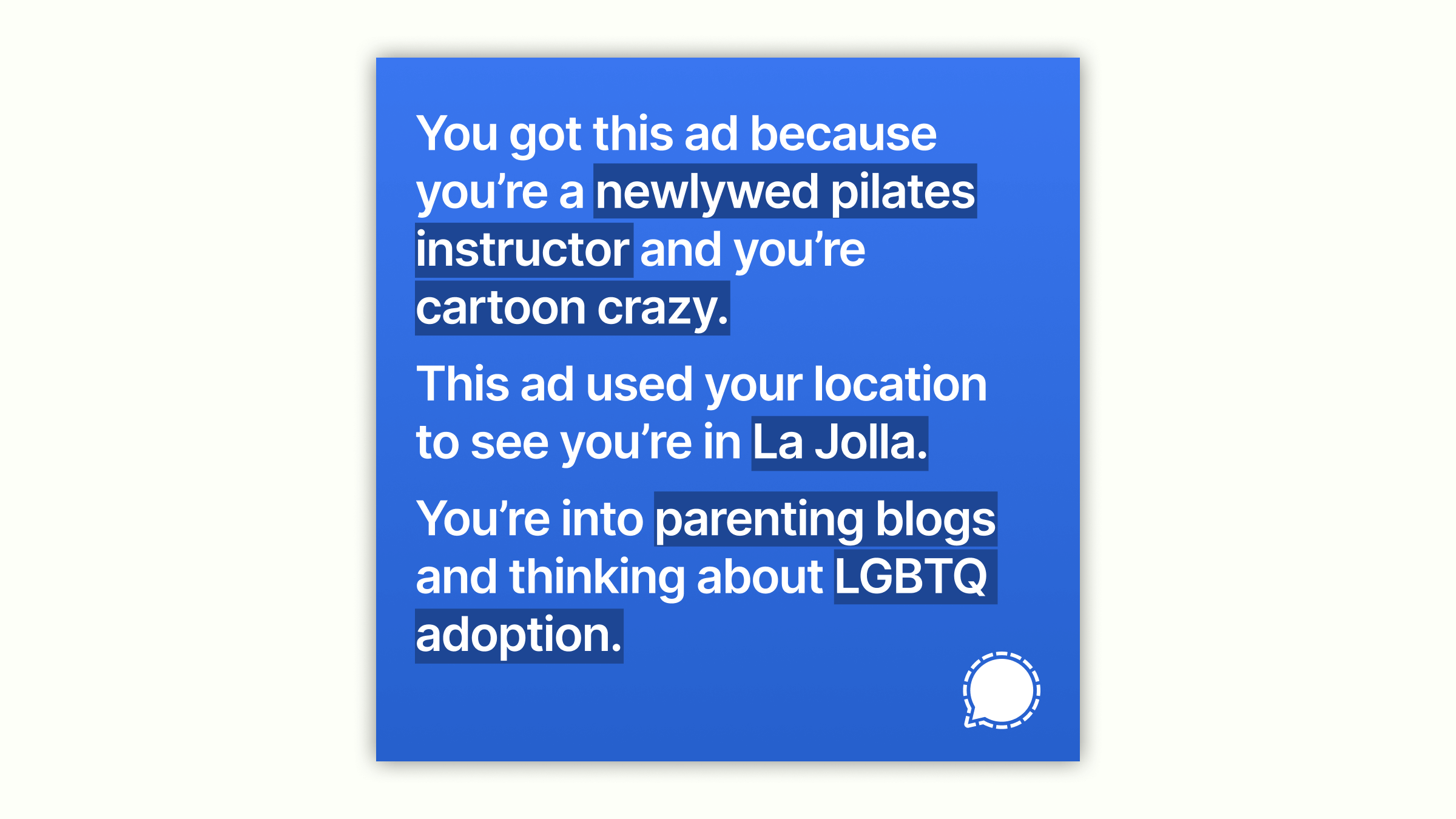
> Joe Osborne, a Facebook spokesperson, responded on Twitter on Wednesday saying the screenshots are from early March “when the ad account was briefly disabled for a few days due to an unrelated payments issue.”
> Osborne added: “The ads themselves were never rejected as they were never set by Signal to run. The ad account has been available since early March, and the ads that don’t violate our policies could have run since then.”
This is from: https://www.cnbc.com/2021/05/06/facebook-and-signal-are-figh...
Either way, it's a great publicity stunt by Signal.
> We absolutely did try to run these. The ads were rejected, and Facebook disabled our ad account. These are real screenshots, as Facebook should know.
The only screenshot I can find shows a disabled account (not any rejected ads), and also seems to support Facebook's side of the story (you can see a banner in the background saying something about their "current balance", which would imply what Facebook said was true).
If you’ve ever seen tee shirts and similar products in ads that say things like “This Kansas City redhead likes their coffee with whiskey” or some other uncanny specific junk, thats how this works.
There is a whole new category of products based around these ads. I don’t know what they’re actually called actually, but it was on HN sometime in the last year. They’re usually tee-shirts and other “made on demand” products, and they use the magic of software to generate images for the ads, and products that produce to a ton of permutations, and target ad demographics that fit all of description. The products aren’t real until someone clicks the link, and then software knows which ad you clicked and generates it for that permutation.
The whole idea that the un-canny match will be enough to attract buyers for the novelty, and they eschew the inventory risk by just printing on demand.
I built an ad engine for Kink.com (NSFW) which had ads placed on even higher traffic sites like PH. I built the original pixel tracker for Marin Software, and @stickfigure and I built GearLaunch, which was the backend that sold those t-shirts you're talking about.
Needless to say, you don't see as many t-shirt ads any more because FB cracked down on it... not because of the targeted ads, but because it became a copyright infringement game and it was easy to block the people creating the ads (and shirts) as they were all outside of the US (ie: Vietnam). That and thankfully FB didn't want their wall to be all ads for t-shirts, lol.
From the article (https://www.cnbc.com/2021/05/06/facebook-and-signal-are-figh...):
> Signal countered on Twitter that it “absolutely did” try to run the ads. “The ads were rejected, and Facebook disabled our ad account. These are real screenshots, as Facebook should know.”
I'm not saying Signal's side is necessarily true, but you're making an affirmative claim that Signal is performing a "misleading publicity stunt", by taking faith on Facebook's narrative as true.
*edit: posted the wrong link
They didn't have to run the ads or even be truthful about being blocked. Fact is, they would have been blocked and the ads are indeed targeted. All of the details in those ads, are true.
Even if FB doesn't collect the data itself, any time you shop online, you get added to buckets and those buckets get shared when the seller uploads the target data back to FB and then the process starts all over again.
They would have denied the ads anyways. The cited FB spox is news not for adding facts but rather for its laden speciousness.
"The accusations are untrue, but I think they would have been true, so that's basically the same thing."
Complain about these ads being banned when it actually happens, not when Signal lies about it because you think that's what Facebook would have done.
Sometimes manifestly unjust laws are challenged via an index violation of the law with the specific goal of getting the law thrown out.
If Facebook were not shy about their algorithmic approach there would be nothing wrong with these ads.
Not so much "...ads that were designed to be banned..." but ads designed to test an hypothesis.
Just so we're clear on this: Experimentation on human subjects without consent and informing them is an ethical violation. It truly doesn't matter how justified you think your particular research question is, or how small you would rate your ethical transgression.
[0] https://www.wired.com/2014/06/everything-you-need-to-know-ab...
>In English, the pronunciation of ⟨h⟩ as /h/ can be analyzed as a voiceless vowel. That is, when the phoneme /h/ precedes a vowel, /h/ may be realized as a voiceless version of the subsequent vowel. For example the word ⟨hit⟩, /hɪt/ is realized as [ɪ̥ɪt]
For words beginning with h and where the first syllable is unstressed (historic, hypothesis, but not hitter, happy) it can be appropriate to use "an" rather than "a" as the associated indefinite article.
I guess I don't really agree. The goal of an ad is to get new customers, not test hypotheses. If it was designed to test where the edges are, they wouldn't be blogging about it. I believe they tested the edges so they could find something that crossed the line, and then get publicity for being banned. But that's a question of intent, so who knows. Maybe they really thought this would be an awesome campaign, and are making lemonaid out of it getting banned.
When I watch broadcast TV, I hate seeing ads for mattresses, kids toys, menopause medication, home appliances.
I want to see ads for camera lenses and cool sneakers.
I understand that unfortunately ads are here to stay, but I'd like to see more context-based ads (like on ddg), they seem to be a good compromise for me: they still serve ads, I can still ignore them and they don't profile me.
Also I really dislike the idea that some people are ok or even prefer being tracked across the internet because they want to see ads for some whatever thing they like.That is some dystopian level thinking.
For me, it's:
1) No ads
2) No ads
3) No ads
I accomplish this via a bevy of ad blockers, VPN, and custom DNS settings
If somebody is willing to go to some scam website and enter arbitrary PII, they've already been compromised, regardless of Facebook's involvement.
Instagram ads Facebook won't show you - https://news.ycombinator.com/item?id=27040470 - May 2021 (177 comments)
[0] https://twitter.com/signalapp/status/1600559887742009345
https://thenewinquiry.com/taxonomy-of-humans-according-to-tw...
This ad [0] was created 6 years ago showing more than the ads in the article.
As a consumer, I don't click on ads at all, I don't watch video ads, and basically don't impulse buy anything.
And working with companies over the years, our marketing departments didn't really know how or why to do this level of targeting.
I don't think it is, it's mostly bot traffic anyways...
> and worth the trouble?
...but companies are paying $$$ for it and it's very easy to setup/run their campaigns and give them the "engagement" reports they ask for. I think everybody with half a brain understands it's a big game of moving money with very little real world/real people engagement
It's obviously not in Metas best interest to be open about their data collection practices, but that's the entire point of this campaign, that Meta/Facebook/Instagram can only exist with intransparency.
Now I’m interested in my own data. Are those companies required to offer a means to download your own data?
Did anyone do that and if so, was it readable?