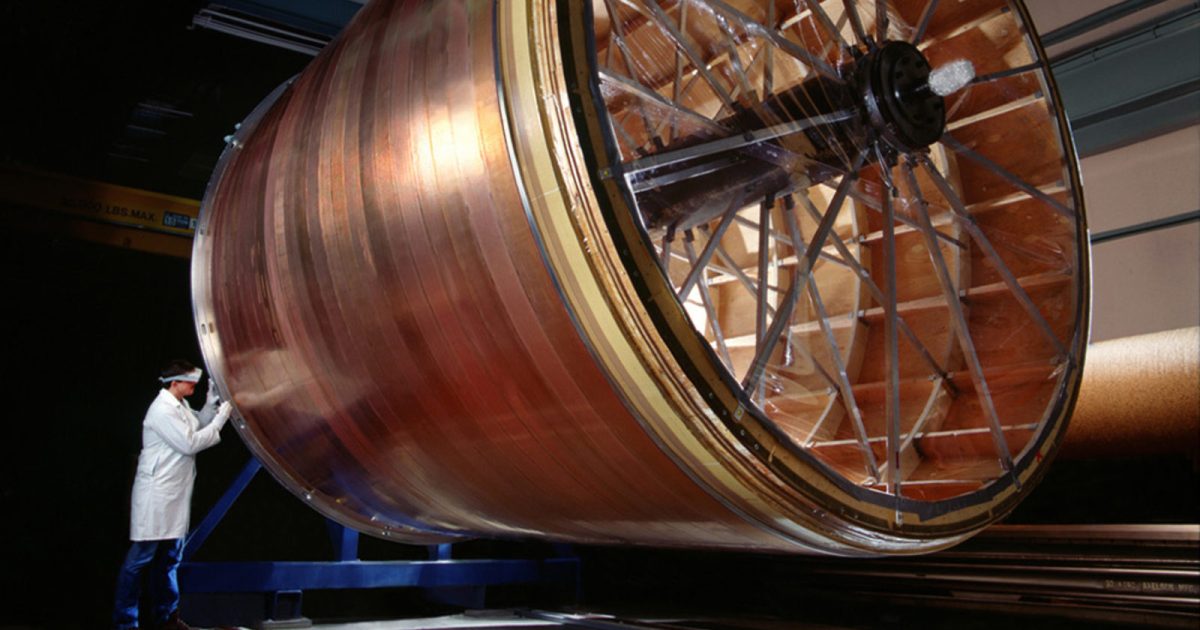
Dark matter's "nightmare scenario" looks more likely than ever
Our great hope is that today's indirect, astrophysical evidence will someday lead to successful direct detection. What if that's impossible?
Big Think
123 points · by spekcular · 3y ago · 177 comments
It's a common pattern with crackpots as well, that they focus on "big" but easy to understand things like special relativity, which doesn't involve more math than you learn in high school. No crackpot ever revolutionizes condensed matter physics or statistical mechanics.
Although the bullet cluster should be a clear indicator as well, the rest of the evidence of DM appears much more subtle to a layperson.
Anyway, cosmology is a weird topic which not only HN reveals tons of arrogance over. Lots of misplaced skepticism. (Probably similar to the Covid topic.)
There are infinitely many mathematical systems that could describe "reality" all with divergent behavior in the parts of the system we haven't observed yet. Trying to make authoritative claims by analogy to coincidentally correspondent mathematical systems is foolhardy and vain.
We have crackpots proposing that the Earth is flat.
It's the curse of being clever. People believe that since they're clever and were able to be successful at what they do, it must be that all other topics are similarly easy. And with easy access (via the internet) to the most basic introductions for lay people to any topic, the Dunning Kruger effect really kicks in.
The more clever you are, the easier it is to fall into this trap. example: "Buy twitter and solve all its problems myself".
Well, the memory of water still has a lot of support, as the scientific explanation for homeopathy. Lots and lots of crackpots here.
I would not call this crackpot, but it took an awful amount of time for some to let go cold fusion.
As for statistics - my personal hell is when I have to read some biology or biology-like document and there are numbers that are tortured to make them sing the way they are expected to. I do not even talk about economy, psychology, sociology and other similar ologies.
These people are effectively asking about these objections. Perhaps many of them are phrasing it differently. But, with exceptions, I think people tend not to be angry or vitriolic. At best they are frustrated. Just treat these remarks as questions.
It might be annoying to get the same questions repeatedly, but that is a fault of wider communication about dark-matter.
Everything we see in the Universe outside our own galaxy is static. We don't have enough parallax to actually perceive objects (stars) moving outside our galaxy. Ok, there's an exception, people were able to perceive the movement of one star in one of our satellite galaxies in 2012. That's about it. So, when people talk about galaxy rotation curves, that's based on a sample of one, our own galaxy. Actually, we can plot galaxy rotation curves for other galaxies, but based on indirect evidence, such as the redshift. How accurate is that? Come to think of it, we can't estimate directly the distance to any galaxy beyond and including the Andromeda galaxy. But again, we can estimate indirectly. Only that estimation is based on a stack of estimations each with its own uncertainties.
Now, if you work in the area, stop me right here and tell me you went through that stack of estimates, and check all the uncertainties, and are confident there's no potential error anywhere.
Because, as an outsider, if I do a bit of Bayesian estimation, and I have to choose between the dark matter and the possibility that everything that can be explained with dark matter is actually a result of estimation errors, I'm somewhat on the fence. Every year that the hunt for dark matter brings nothing I'm more inclined to think there's a different explanation out there. Like the frame dragging explanation discussed in [1].
[1] https://physics.stackexchange.com/questions/618981/has-frame...
I'm not a cosmologist, but I have a degree in Physics. I won't be able to fill in the details, but all your objections sound pretty basic and unfounded even to my semi-amateur ears. About the cosmic distance ladder (as if parallax were the only way. I guess we don't see Earth's curvature either), about how to propagate errors (literally learnt in the 1st week of Physics. Those bars around the scatter points are literally the error bars, and we propagate them from start to finish). And even about the scientific method itself. No one can claim "there's no potential error anywhere" in anything.
And most importantly, which was my original main point, galaxy rotation curves are not our only evidence.
BTW, I would encourage you to look at how fossils are dated. To me it sounds kind of similar in spirit to how distances are measured in astronomical scales.
For example, here's a quote from the book "An Introduction to Modern Cosmology" by Andrew Little (third edition, published in 2015, page 70):
It is just about possible given present observations that this matter can be entirely baryonic, since this is marginally consistent with Equation (9.3). However, many models based on low-mass stars and/or brown dwarfs have been excluded adn it is probably difficult to make up all of the halo with them. A popular alternative is to suggest that this density is in some new form of matter, which is non-baryonic and only interacts extremely weakly with conventional matter.
In their textbook you'll find that galaxy rotation curve studies are spectroscopic. That is they are keenly interested in the relative redshift in the 21 cm neutral atomic hydrogen lines (among others like H2 and CO molecular lines) at the limbs of edge-on disc galaxies, and adapting that to spirals and other disc galaxies that are tilted away from edge on. [Binney 2e sec 6.1]. Practically invariably the relevant lines are relatively redshifted and relatively blueshifted at the limbs, leading to the interpretation that generically there is equatorial spin in disc galaxies.
In elliptical galaxies there is practically no equatorial spin to speak of; instead the spread of relative redshift across the face of the elliptical is interpreted as blobs of hydrogen gas moving radially, that is sinking deeper into the galaxy or rising out of the galaxy's depths. It is also useful to study a wide range of absorption lines given that the clouds are backlit by a galaxy's worth of starlight (and sometimes a quasar), in a process which grinds out surface densities.
These relative redshifts do not depend on cosmological redshift (the whole galaxy, or its whole cluster, is cosmologically redshifted identically for all practical purposes, so the opposite limbs in discs are affected similarly). It is also not sensitive to an isolated galaxy's peculiar motion within a cluster. It may matter for merging galaxies.
We can also look deeper than disc limbs and ellptical surfaces. Optical interferometry is highly sensitive in this application, and provides direct evidence of the motion of the various sources of emission and absorption lines from various gas clouds, dusts, and even starlight. The Large Binocular Telescope does some work in this area. Radio interferometry is useful for looking into the bulk motions within the more central regions of galaxies and clusters; dust obscures optical signals but millimetre signals cut through.
The investigated starlight is bulk and while the interpretation depends on assumptions about the bulk stellar chemistry of an observational target (maybe metallicity varies slightly in different parts of an elliptical which might have a history of galaxy mergers) there is in no way a dependence upon any single star and its meanderings through its galaxy. We're interested in the light generated by ~billions of stars, not the positions or momenta of single stars, mostly because we just cannot resolve the latter with current technology.
> as an outsider
You seem interested in the topic. Learning how observations are made (and the history of them) is probably not inaccessible to you given your comments here. Whether that leads you into any sort of conclusions about the structure and evolution of galaxies is up to you, but I think textbooks will be better for you than whatever ultimately led you to the stackexchange link in your comment. (I did notice however that the Ciotti preprint discussed later in your link cites Binney & Tremaine multiple times, as does the Ludwig paper in the stackexchange question).
Okay now do climate change and climatologists.
And most people just don't bother to read the article at all it seems. No better than reddit.
Changing gears, though, and trying to be more useful, if you want more coverage on this topic there's a note in Peter Woit's blog:
https://www.math.columbia.edu/~woit/wordpress/?p=13232
Points to another blog which attacks the "nightmare scenario":
https://tritonstation.com/2022/11/29/the-angel-particle/
I don't particularly buy that a gravity-only interacting particle "is not physics". If that is what exists, that is what exists. And we've already detected it via dark matter observations. So it is physics. What we can't do is ever really prove it other than by exclusion, but if we racked up a thousand years of failure, we'd have to accept that it was real (hopefully by then not dogmatically and we'd let any kid who wanted to tilt at windmill to go for it).
And Woit links to a paper on dark matter being only a right handed majorana neutrino, requiring no real physics beyond the standard model (plus three right handed non-interacting neutrinos): https://arxiv.org/abs/1803.08930
And links to a comment on that in John Baez's blog:
https://golem.ph.utexas.edu/category/2022/12/neutrino_dark_m...
http://backreaction.blogspot.com/2017/01/the-bullet-cluster-...
Another big problem is that all LCDM predictions (MACHO/WIMP) were disproven but it still remains a theory. Now we need energy too high to use in universe.
It's eerily similar to Phlogiston theory that at one point was considered to have negative mass.
There are more laws of Physics waiting to be discovered. At least two big ones from what we currently observe.
*) Except gravity.
I think this is why people get frustrated with the DM story. It's not the evidence that points to that. It's the lack of evidence that points to that. Specifically speaking, we keep hypothesizing limits on interaction in the hopes of finding it below some threshold but keep pushing those limits back. A multimodal observation would be clutch, but we keep confirming that a multimodal observation can't happen.
I fail to see how dark matter could ever be falsified. The best potential replacement would be a theory that's simpler, but even then dark matter would probably explain the same observations.
The second question is: Is dark matter even matter if it only interacts via gravity? Wouldn't it be better named a property of space-time? That is, dark matter is a name for a recursive property of gravity?
* The right primordial abundance of different elements
* The amount of structure in the cosmic microwave background.
* The rotation speeds/velocity dispersions in large number of galaxies
* Large scale structure/The amount of clustering of galaxies.
* Gravitational lensing observations.
And much much more.
It is certainly true that there are individual cases that look challenging for Lambda CDM paradigm (CDM stands for Cold Dark Matter), but it is also true that anything that has to do with galaxy/star formation is immensely complicated as it involves a lot of physics at a variety of scales, so I do not think it there is a strong case against CDM. (there are currently some tensions with the Hubble constant measurements and some other cosmological parameters between different techniques, and it remains to to be seen whether those are systematic errors or point towards some modification in the theory).
Comment on the article itself. I think at some point I would be fine with dark matter being essentially a computing trick, i.e. if the behaviour of the universe is well reproduced when we add gravitationally interacting but not interacting otherwise matter. It would be up to theorists to see if somehow that can be written as some sort of extra-term in Einsten's Equations and show we don't really need an actual particle. I think there is a possibility of that, but personally I still think it's more likely there is a particle responsible for dark matter.
No, he's correct that each galaxy does need tuning. Specifically, the amount of DM and it's specific distribution is tuned to match each observation, which is what the OP said.
> but it is also true that anything that has to do with galaxy/star formation is immensely complicated as it involves a lot of physics at a variety of scales, so I do not think it there is a strong case against CDM.
I think this "strong case" for LCDM is often oversold. See this review of the evidence for LCDM compared to modified gravity:
From Galactic Bars to the Hubble Tension: Weighing Up the Astrophysical Evidence for Milgromian Gravity, https://www.mdpi.com/2073-8994/14/7/1331/htm
This is simply not true.
No cosmological theory tries to explain why each star is in its exact observed location. They try to predict the statistics of galaxies, star formation, etc.
If you run a simulation of the universe, beginning with very simple, random initial conditions, and then run physics forward for 13 billion years, you get a universe that statistically looks almost identical to our own. You get the same mix of spiral and elliptical galaxies as observed, clustered together in the same way, with the same star formation history, etc. You don't get exactly our universe, with the Milky Way exactly here and Andromeda exactly there, because you begin with random starting conditions. However, you get a universe that is statistically identical in most ways.
Note that this is not the case for Milgromian theories. So far, no one has managed to create a theory without dark matter that can achieve this. Alternative theories generally get one or a few things right, at the cost of getting a whole host of other things wrong.
It's not that astrophysicists a priori like dark matter. It's just that dark matter is a very simple paradigm that explains a huge number of phenomena with only a handful of free variables, and none of the alternatives work so far.
Not true. The LCDM predicts the DM distribution with a typical DM profiles, and then the amount of baryons is heavily dependent on star formation, etc. Therefore each galaxy of the same luminosity will have somewhat different dark matter halo. Those are not tuning parameters at all.
Regarding the linked article, it an article written by proponents of MOND and is not objective. That is fine, but at the moment I don't believe MOND is a serious alternative, and the majority of the astro community would agree. Just the fact that MOND still requires dark matter anyway to reproduce CMB is major problem for it. But if someone develops the version of MOND that has equal predictive power to LCDM, I'll be happy to accept it, but we are not there.
...and? If we look at the way a star wobbles, then tune the amount and distribution of planets around it to fit, isn't that just science?
DM can be falsified perfectly well. If the rotation curves of all observed galaxies behaved as predicted by Newton, there would be no DM and every reasonable physicist would consider DM falsified. DM simply passes a lot of falsification experiments.
If DM interacts purely gravitationally, then yes, considering it either matter or an artifact of space-time is merely a matter of preference. Simply move the DM part of the energy-stress tensor on the other side of the Einstein equation.
Differentiating it from MoND or similar theories will then be based purely on how well the theory fits.
However, while I'm only a cosmologist and not a particle physicist, I find the implied assertion by proponents of MoND, that the existence of non-interacting particles is impossible, questionable. Why shouldn't there be heavy particles that don't interact electromagnetically, like a heavy neutrino? Or particles that don't even interact weakly? Or at least, why should their abundance be low compared to baryons?
Edit: Regarding falsification of DM, it's not like DM isn't challenged anywhere. Like I mentioned above, we should be able to compute the abundance of galaxies of certain sizes (dark or not), and the dwarf galaxies are coming up short. It's called the dwarf galaxy problem and poses indeed a challenge to DM, albeit not as much as DM alternatives in the mind of most cosmologists. They think it will be solved eventually as our understanding of galaxy formation improves, but who knows, maybe it's the first glimpse at something bigger. https://en.wikipedia.org/wiki/Dwarf_galaxy_problem
I think this is a strawman. MOND proponents don't discount that some observations are better suited to a particle, they just assert that the particle dark matter sledgehammer is vastly overused, and that modified gravity has been unusually successful in cases where it had no right to be if gravity acts as it does under GR.
For instance, this review [1] of the astrophysical evidence by a MOND proponent makes a good case for MOND + sterile neutrinos. This review also covers numerous falsifications of DM, so if you're correct that DM can be falsified, why did these falsifications fail to convince the majority?
[1] From Galactic Bars to the Hubble Tension: Weighing Up the Astrophysical Evidence for Milgromian Gravity, https://www.mdpi.com/2073-8994/14/7/1331/htm
Because they are cherry picked. In the big picture, for every area where particle DM struggles, you will find a dozen datapoints where MOND struggles. Physicists are also wary of approaches like MOND+particle DM, because it just introduces more parameters which you can arbitrarily tune to explain data. It feels like every week someone comes with a new model that fits certain edge cases better, but doesn't actually tell us anything new or could act as a reasonable guide for future work. You can imagine it like fitting a polynomial of degree N to N data points. Yes it will fit perfectly, but that doesn't mean it's a good model. This is just sophisticated curve fitting to generate papers and not good science.
> DM can be falsified perfectly well.
I recall hearing that DM was attempted to be falsified based on gravitational lensing. Is that correct?
> If DM interacts purely gravitationally, then yes, considering it either matter or an artifact of space-time is merely a matter of preference. Simply move the DM part of the energy-stress tensor on the other side of the Einstein equation.
Would DM as matter not have inertia, whereas treating it like an artifact of space-time would leave it without inertia?
> Differentiating it from MoND or similar theories will then be based purely on how well the theory fits.
A simple question here would be: do all galaxies of similar size have the same amount of dark matter. If so, then the uniformity of dark-matter would need explanation. If not, then I think something like MoND would have a hard time explaining why these similar galaxies rotate at different speeds.
If it's purely gravitational then that implies infinite density and infinite force for any matter that occupies the exact same space.
The concept of a particle that only interacts via gravity is straightforward. Consider neutrinos, which only interact via gravity and the weak force. Trillions of them pass through your body every second. Take away the weak force interaction and add some mass, and you have a dark matter candidate particle.
> I fail to see how dark matter could ever be falsified.
You’d have to explain what should be done about that. It could nevertheless be a correct theory, and we might one day verify it more directly.
Naive falsificationism is an almost useless principle at the frontiers of modern physics. We’re long past the days when you could run some simple experiments and come up with a clear yea or nay. That’s living in the 19th century, basically - which admittedly, many people still seem to want to do.
Well, there should be something that follows from the assumption that there are huge amounts of particles that only interact via gravity. What's the prediction that this model makes? If it doesn't make any useful prediction, it's pretty much worthless.
> That’s living in the 19th century, basically - which admittedly, many people still seem to want to do.
I think this attitude is inappropriate. The scientific progress made with 19th century methods, and that includes most of the stuff discovered until the 1950s, is massive. Maybe scientists should focus more on a clear nay or yea? I mean, the LHC is certainly a significant achievement, but compared to the detection of gravitational waves or even just exoplanets it doesn't seem to deliver as much bang for the buck.
Well, first, LHC was "unlucky": they could have observed a lot of new particles if they would have been there. It feels unfair to say "this experiment that looked at X and had 50% chance of seeing something was a waste of money because they haven't found anything, this experiment that looked at Y and had 50% chance of seeing something was not because they saw something": both experiments are as worth a try. LHC still have observed the Higgs boson, which is still quite a big thing. LHC has also constrained a lot of theories (seeing that a particle predicted by a given theory is not there is very useful scientifically).
But more importantly, I have the feeling that the notion of "bang for the buck" is pretty different from a scientific point of view and a layman point of view.
For example, you mention exoplanets. Scientifically, those are really not a big deal. We already know that planets can exist, there are 8 around the Sun, so finding others around other stars is really not a big deal: everybody was expecting them to exist and knew the only reason they were not seen yet was the limits of the technology. One could even argue that using money to detect things that are pretty trivial is in fact the worst delivery of bang for the buck. Don't get me wrong, this is still nice to see them, but it's the same level as pentaquark (discovered at LHC).
It is sometimes surprising to see the public/media reactions to discoveries. I'm still not sure why layman people were so excited about gravitational waves but not much about the tau neutrino.
To a layman like myself this implies both that the things being studied then are both unprovable and not potentially of practical use or significance. I certainly am not saying that is the case, but rather am looking for more informed opinions to the contrary.
The cynical side of me feels like study of something unfalsifiable is as the study of religion. A poor investment for public funds.
As I mentioned however, I am seeking opinions here to the contrary of my gut reaction as my gut is often dumb and reactionary.
The other, related point is that modern physics' frontier is in the quantum world and thus way outside layman's intuition, common sense, or reasoning. Even experts are struggling.
All zebras have stripes. is my hypothesis. I observe 100 zebras and I see they have stripes. I see 10 million zebras and I see they have stripes. There is no amount of observations I can make to prove my hypothesis. However if at any point in time I see a zebra with no stripes, I have disproven my hypothesis.
So anything that is in actuality true, is not falsifiable and also un-provable. In short, some statement about our universe can be true, but we can never absolutely know for sure whether that statement is actually true.
Basically your comment isn't logical because you're saying we shouldn't study anything that is true because it's unfalsifiable by definition.
In addition to falsification, Science can make statements that are vague and UN-definitive. Un-definitive claims include causal claims and correlative claims.
Correlation is A and B are casually linked directly or through some other source. A maybe causes B or B maybe causes A or maybe a C is causing A and B. Causation is A and B are directly linked causally. A causes B.
Science can make the two claims above but such claims are made based off of a sample. If the sample is bad or biased the claim is also bad and biased. Given that we live in an unknown universe of which any sample we extract can only be of finite size out of a potentially infinite size it makes both correlative and causative claims un-definitive. The sample can never fully encompass everything. This is the reason why in science, nothing can be proven.
So in short science can definitively falsify things, and in a vague sense it can make statements about correlations and causation. The later two, though undefinitive can be used to say something about some topic of the universe that is true. But it can't say anything definitive and we can never know for sure.
Because Falsification is limited to things that are false, so much of science doesn't actually use it even though it is a definitive metric.
>As I mentioned however, I am seeking opinions here to the contrary of my gut reaction as my gut is often dumb and reactionary.
The GP is kind of the one that's not too bright. You're definitely a layman but you ask the right questions. GP is not a layman and he's suppose to know certain things and not say what he said. He's very opinionated and makes broad statements without addressing nuance. So don't worry about it! You're not dumb!
GP is utterly wrong. Falsification is still used on the frontiers of modern physics, though much of it nowadays is just correlative results, but if one such correlation is shown not to hold at all, it becomes a falsification. In fact, EVERY single experiment in modern physics is an attempt at falsification. And when the falsification fails... a correlative result is presented as the final answer.
But note, even a falsification is not clear in certain cases. This is because our scientific observation tools have limited accuracy. Most of the time we just assume the observation tools are 100% accurate. But at the frontiers of modern physics the observation tools are so bad that the tools themselves yield probabilistic answers. So while in science falsification is still very much used to clearly discard theories, in modern physics, a negative result is not indicative of a clear cut falsification.
Of course same thinking can't easily be applied to things that are not always true, like social behaviour. Part of the reason the replication crisis hit so hard in the social sciences.
And of course this is not really as absolute as I wrote above. No field works like this all the time. But it is a good guideline. If falsifiability is completely ignored, then a concept really is nothing more than a religious belief and should be considered as such.
BTW, Popper did not publish in the 19th century.
This occurs because most science is not the "the frontiers of modern physics". But even then, falsification in the frontiers of modern physics is still a useful tool.
Originally dark matter was hypothesized because of galaxy rotation mismatches. This allows for mapping where 'dark matter' should be. One falsification of dark matter that was tried is gravitational lensing. If there is indeed extra curvature of space-time in these galaxies, then they should bend light-rays, Potentially showing the same galaxy twice.
This was tested, and confirmed. Hypothesized dark matter, as detected by galaxy rotation, causes the expected gravitational lensing.
I suppose another potential falsification is by 'moving' dark matter through a gravitational tractor (very heavy mass with rocket engines) and then detect the resultant change in gravity. You could attempt that detection by gravitational lensing, orbit velocity, or perhaps something else.
Despite all this, dark matter still feels like our theory of gravity was falsified, and instead of concluding the theory was wrong, it was attempted to add random parameters to the theory. Its not like there is a better theory though (I believe MONS has trouble with explaining gravitational lensing), so perhaps this is a problem of PR much more than a problem of science.
As for the second question, for dark matter to be matter, I think it suffices if it has mass and inertia. My gravity tractor detection idea tries to work with that.
Edit: also see this: https://medium.com/starts-with-a-bang/7-independent-pieces-o... from a different reply in this HN discussion.
> I fail to see how dark matter could ever be falsified
I don't think science cares. Frankly if you could back up your opinion with some actual reasoned argument, it would be a better post.
Theory implies they found out what it is.
We still call it Newton's law even though we know it's wrong. We still call it Born rule even though it's one of the most tested things we have. We still call it the standard model even though it's the thing that works better than everything else. We call particular Lagrangians in Quantum Field Theory "theory" even though we know it's just a toy theory which doesn't describe reality. I mean, "toy theory" or "toy model" is a thing.
Physicists aren't nearly as nit-picky as internet commentators when it comes to this topic.
Not in any technical sense I can think of.
Has anyone considered modeling the effect currently explained via dark matter as a new kind of force or field? Like a distinct force generated by mass and its relationship to space time?
This wouldn’t be modified gravity but a proposal for an entirely new force whose effect is what we currently explain with the “fudge factor” of dark matter.
From the rough picture I do have of dark matter this force would be one whose relationship to distance is different from the usual inverse square law that governs forces. That would be weird but maybe no weirder than particles that can never be detected or MOND.
Of course we don't have a quantum field theory for gravity, so the above is hand-waving away a HUGE issue of what that new field would be like, how its particles would act, etc, since we don't even know what the quantum gravitational field is like and what its particles are like (assuming such a thing even makes sense).
They even think about dark chemistry: https://iopscience.iop.org/article/10.3847/1538-4357/ac75ef
Didn't have much support last time I checked.
Ah, yes, we also need to have some sort of bound energy, to balance Einstein’s equations. So, geons! https://en.wikipedia.org/wiki/Geon_(physics)
Hamlet
William Shakespeare
My understanding is that based on observations of what can be seen galaxies move as if there's move stuff in them??
If you hypothesis that this extra stuff is dark matter but can't detect it, how do you know it's real?
How have you ruled out all the normal stuff that doesn't give off light or stuff we can't see at the distances we're looking over? Like planets, rocks, dust, etc. Couldn't that stuff, which to my mind there would be vastly more of than stars, make up the extra gravity?
I'm aware I might be talking complete shit because I'm completely ignorant of the detail here. I would love an understandable explanation as to why that's wrong.
Yup [1]
> My understanding is that based on observations of what can be seen galaxies move as if there's move stuff in them??
Yup [2]
> If you hypothesis that this extra stuff is dark matter but can't detect it, how do you know it's real?
It produces certain effects in various different enviromennts or domains, which lends more support to that hypothesis. By certain different domains, I mean like Galaxy and cluster dynamics, gravitational lensing around galaxies and clusters and the precise fluctuations seen in the cosmic microwave background, these are all very different regimes but all seem to support the hypothesis of extra mass which is not interacting electromagnetically.
> How have you ruled out all the normal stuff that doesn't give off light or stuff we can't see at the distances we're looking over?
There are research efforts to look for exactly this kind of stuff; Massive compact halo object (MACHOS). However they don't see enough of it to account for the observations we see in galaxies and galaxy clusters. [3]
[1] https://lss.fnal.gov/archive/2022/conf/fermilab-conf-22-180-... [2] https://en.wikipedia.org/wiki/Dark_matter#Observational_evid... [3] https://en.wikipedia.org/wiki/Massive_compact_halo_object#De...
https://kipac.stanford.edu/highlights/using-gravitational-le...
I don't know enough about the found examples of gravitational lensing to know whether all possible arrangements of black holes that could have the same effect, have been considered and found lacking. But I presume so.
https://en.wikipedia.org/wiki/Primordial_black_hole https://en.wikipedia.org/wiki/Massive_compact_halo_object
I just looked up what would happen in that case, and it sounds really bizarre:
> Nevertheless, a PBH would have a notable local impact, Rahvar notes. “The passage of a black hole could melt a cylinder along the interior of the Earth with a radius of almost 10 cm. After a short time, this tunnel would freeze,” he explains. In theory, this would produce a distinct metamorphic fingerprint of the passage in the rock record. But given that we might expect only eight of these to have been produced in the Earth’s lifetime (one on each side of the planet per collision episode), “I would expect that such a geological trace is difficult to detect,” Rahvar concedes.
https://physicsworld.com/a/concerning-primordial-black-holes...
If the repeated failure to find tangible evidence of something in the physical universe isn't evidence against its existence, then you're no longer doing science, but rather playing some religious game
https://news.yale.edu/2021/12/16/black-holes-and-dark-matter...
I think the first paragraph could be rewritten better as:
"Dark matter puzzles us. Einstein's theory of gravity, plus known matter and radiation in the Universe, including particles and antiparticles described by the Standard Model, cannot explain cosmic observations. We need an additional gravity source - dark matter."
(My credentials: my fingerprints are all over one of those (pilot) experiments.)
https://en.wikipedia.org/wiki/Expansion_of_the_universe https://en.wikipedia.org/wiki/Observable_universe
Eventually we'll have moved so far away from everything that we'll start seeing less and less (granted, "we" likely won't be around, our planet having long since been incinerated when Sol dies).
[1] https://en.wikipedia.org/wiki/Modified_Newtonian_dynamics#Ou...
If that is correct, does it not immediately invalidate MOND?
… but that’s just proven to be very very difficult. Evidence for dark matter comes from a wide range of observations, and while it’s pretty easy to come up with relativity replacements that could explain things like rotation curves nicely… other observations, from lensing and colliding galaxies like the bullet cluster are, just, well, messy.
Pretty much the only alternative is MoND, and judging by the how well it fits the observations, it's not better.
Until there’s an actual convincing alternative, that indeed is not as apparent as you make it out to be, that would be pretty terrible for a lot of physics.
The gravitational discrepancies we have already, but without an explanation or observation, they’re not very satisfactory.
Appealing to your own ignorance doesn't actually strengthen your argument.
Well the overall tone of your comment is pretty crummy but this is absolutely not true. You got this exactly backwards. Dark matter is just missing mass that is being observed. It doesn't patch any model, because physicists don't know what it is or what it is made of. But whatever that mass is, it is there, because all the standard ways that we observe mass, it exhibits. So it would instead be a leap to "patch the standard model"--whatever you mean by that--with these other "better alternatives" (I assume you mean MOND? No dice there, doesn't explain gravitational lensing).
To paint this idea with other example, if you were to figure out mass of a world, but the world was just an image reflecting off a surface of water, then they would focus only on the light particles coming off the surface and ignore the water. At some point they would come to realize that something big is missing. They could find out the value for how much it should be. That’s exactly the case with dark matter I’m quite sure. Space is like water they ignore.
But I don’t know anything, really (sorry to hear if that’s a problem for someone). Why there is possibility to comment on these articles anyways?
This is not a case of "progress by funeral" like, say, the Alzheimer's situation also on today's front page. The linked article is a good summary.