91 points · by jakecopp · 3y ago · 194 comments
The comment about the crossing times being too short is spot on, often they are too short for me as a healthy young person. Trying to cross when you can't move as quickly must be a total nightmare.
Sydney has a few crossings where instead of particular directions being open to pedestrians, the whole crossing goes green for pedestrians and red for cars. This seems more efficient to me, and safer since cars aren't moving at all when you cross - often you have to share the space with cars turning left when you cross. I wish we had more of these.
The flashing red usually starts pretty soon after the green, you usually can't cross entirely on a green. It doesn't mean the person was slow or jumped the light.
Some other nitpicks: As a car, you have to wait until everyone is finished crossing. You can't just sneak through the middle, or cut just behind someone.
Unrelated to lights but tangential, you have to give way to all existing traffic when entering a road. That means if you take a turn, and someone is crossing the road ahead of you, you have to wait. They couldn't know you were about to barell around the corner, and they are under no obligation to hurry out of your way. No stress, you will be gone in seconds.
Because cars can always turn through a crossing, this causes near misses and mayhem all the time, but I find generally that a lot of people don’t notice or just accept the car-dominance as a natural thing.
When the kids were small we taught them about these dangerous intersections calling them “surprise-red-man” crossings (sounds better in Swedish).
I’ve never been able to work out the logic of why the flashing green man should disappear on exactly those roads where they’re most needed.
A big strong person weighs 100kg and is made of soft meat and can deliver close to 1hp at peak performance. A car is made of steel, weighs twenty times as much and has 200 of those horse powers constantly. That's why.
This is also why car drivers respect trucks on the road.
Don't mess with things that can trample you is basic human instinct.
Where I live in the US, red countdown timer means "don't start crossing".
---
These are called "pedestrian scrambles", and I like them a lot more too. I do know there's a few in the Sydney CBD, but I don't recall them being marked particularly well that they are a scramble.
The ones in Oakland (picture below) are very well demarcated, and a study found them to reduce vehicle-pedestrian conflict though did increase the amount of people crossing parallel to traffic when the signals indicated "don't walk".
Picture: https://weburbanist.com/wp-content/uploads/2012/05/crossings...
One argument I saw somewhere (I can't remember where) is that if there are enough people to make a scramble worthwhile (and you don't care about car throughput) - you probably shouldn't have any cars there at all!
This comment covers some of the downsides: https://www.strongtowns.org/journal/2018/11/27/a-pedestrian-...
The UK doesn't allow left through a red, so a green man means no cars will (legally) come at you.
The UK roads have lots of things that are annoying (and lots of good), but that's a good call in my book, even if it means cars at a red can't turn left even if the side-road crossing is (apparently) empty of pedestrians.
An intersection in Honolulu near where we usually stay when we visit just recently (in October) switched to "pedestrian scramble" mode, and it's amazing. This intersection was excessively annoying, because previously one of the four possible crossings inexplicably disallowed pedestrians entirely, so if you wanted to get from "our" corner to the opposite one (where there's an often-visited ABC Store), you'd have to wait for three pedestrian light changes to get there. Honolulu is annoyingly pedestrian unfriendly (traffic light cycles are very long and favor cars), so it could previously take 4-5 minutes to make that simple crossing.
This is a feature, not a bug. With the setup of "two 1 way streets feed into a scramble", crossing safely on a "do not walk" is trivial, with only a single direction to look for many of the most common crossings.
I walk, I cycle, I drive cars, I drive buses and the occasional truck. From every perspective I should welcome this setup in many, many places.
Oh cool, thanks for sharing! The ones I've seen in Sydney are hardly marked at all, often just some signs and diagonal green men.
In general, when I visit Singapore, I feel like a second class citizen in comparison to cars. A lot of long waits at crossings, or unnecessary private cars in crowded areas. From the design of the city (and society), it looks intentional.
one of the features i loved moving to London: there's no "cars turning AND pedestrians crossing the street". yes, it does add a bit to congestion, but makes things more safe when walking, as well as when driving (and yes, i do both in London).
and it's still weird travelling thru places that don't have this.
4-5 minute traffic light cycles (a given light switching from red to green takes 4 minutes) are pretty common now. I think the idea is that they want to intentionally cause traffic jams to encourage people not to commute (public transit is spotty, and not improving).
You could claim that the 60 seconds per green maximizes throughput, but if you look at intersection utilization during rush hour backups (what percentage of the time is at least one car moving through the crossing?), you'll see that it's often well under 50%.
Really, they should have a "I need extra time to cross the road" button, and just time the automatic walk cycle for a fit 50 year old.
The idea that the "SF Bay Area" has a single way to design light cycle times is ridiculous. Each intersection is governed by a local city department that has its own guidelines around light placement, times, signal priority, signal synchronization, speed tables, etc. There's also added nuance around whether a particular road at the intersection is deemed a collector or an arterial. It's a fascinatingly complex topic but gesturing at the "SF Bay Area" and making a conclusion is senseless. Moreover most Bay Area cities are playing along to some level (some areas more than others) to Vision Zero plans which very much prioritize pedestrians over drivers.
As you say, it only prioritizes pedestrians, which basically means that the 99% of the population that doesn't live less than 5 blocks from work is screwed.
Should we do that for every single cycle, even when no pedestrians are present?
Many cities in this area do exactly that. I once had a 35 minute "normal route" commute that only took 15 minutes once I figured out how to do it in a third more distance, but by only making right turns at traffic lights.
I don't drive, but now I skirt around the outside of downtown when cycling because avoiding those intersections saves me ~10 minutes.
In Vancouver the light cycles are super fast, and it keeps things moving for everyone. They have the right idea, and there isn't much room for slack, you gotta be quick.
I frankly don't give a damn about car traffic; cities are for people, not cars. And I say this as someone who owns a car and drives it often enough. (Again, outside the city, sure, ok, things are different, and you really need a car to get around. That itself is another city-planning failure, but that's a separate issue.)
Presumably this means the beeping of the signal for visually impaired people. Why not just keep the automated walk signals, but only enable the beeping when the button is pressed? This is how it's done in Toronto, and there are highly readable signs at each button stating this.
As the previous comment states it might be a good idea to simply leave the locator pings but only make the walk sound if the button has been pressed
Video of the sound for reference: https://www.youtube.com/watch?v=B0cz1XW9QvE
How do blind people even know about these signs, let alone read them?
* Lights adjacent a shopping centre needing to be pushed after 6pm (or is it 7pm?) even though the centre doesn't close or die down in activity till 9pm
* Having to press buttons at each side of an intersection unlike the cars (e.g. for a North South movement a car arriving from either the North or the South will get a cycle, but for walking people if you arrive at the North East Corner and see someone at the South West Corner you need to press two buttons to get both sides lit, even though it doesn't affect cycle timing
* Minor roads crossing major roads that cross major roads stay green all the time for drivers, but not for walkers (but did prior to the pandemic). You need to press the button and wait 20-30 seconds or in some bad cases wait press the button to cross the major road as well to force a new cycle and then get your green after 90 seconds.
Frankly Sydney is streets ahead as it least its not a secret. But still as other commentators might point out, I've seen in suburban Tokyo to cross a major road signs saying "Between 11pm and 5am press this button to cross the road. If you are blind between 11pm and 5am press this other button to cross the road with a beeping noise".
isn't that like 10 mins cycling?
You always do. The damage you can get from a simple balance loss, or worse, when falling on a car or a curb is scary. Wear your plastic hats to protect your head people!
That's because safety is cool, although some people do prefer the brain damage option.
Some of the pedestrian route isn’t really bike accessible too, as stairs are involved, there are alternative routes of course, but some can be considerably longer.
Edit:typo
I moved to Melbourne a few years ago and the infrastructure, elevation and culture is much friendlier towards cyclists.
Drivers there are also turn into homicidal maniacs as soon as they spot a push bike.
In Sydney, however, those aren't the exception.
Sydney, home of the ridiculous parking signs: https://www.abc.net.au/news/2019-03-21/quiz-sydney-confusing...
Best strategy there is just read the no stopping/clearway first, then if you can stop, stop and read the rest!
This is a silly thing to be upset about, but just … why would they have done that? It's so stupid.
People used to not using the buttons during the day may not remember to use them at night. They may not even be able to see the labels at night, since (unlike any actual road sign, at least in the US) they aren't even retroreflective. This is likely to cause confusion, leading people to cross without a walk signal.
So this will disproportionately endanger people walking at night--which is already the peak time for driver-inflicted fatalities.
If they can't see the labels at night so what? They use their daytime experience of expecting it to be automatic and wait awkwardly for nothing... or they push the button and the light changes eventually.
IMHO the biggest problem here is that the label doesn't meet the usual standards for road/pedestrian signage. In particular, "real" road signs are retroreflective so that you can see them easily under streetlights (or in car headlights). This is particularly important for signs that are only relevant at night. (Semipermanent signs should be made of a sufficiently durable material, which this...is not.)
SURELY one always looks out for traffic, even if it is green for you!
This already happened months ago in my city, I hardly even noticed.
It's a reasonable assumption because you don't need to push the button to get a pedestrian signal unless the intersection was designed by a carbrain.
From observation, quite a few people do. Once modern cars with automatic braking become common, probably most people will
They do it because they don't give a shit about traffic signaling, period. They are the same kinds of people who run red lights.
They don't do it because they think that somehow stepping into the road is going to magically activate the 'WALK' light.
Any stats on that? I thought that daytime tends to have more total incidents, but that is usually when the amount of traffic peaks too.
Edit: From https://www.lhd.com.au/lhd-insights/australian-road-death-st... it would appear that 3-4pm in the afternoon is the most dangerous time. Peak traffic and possible fatigue effects.
No one is just walking into an intersection as if the 60 second timing cycle is their circadian rhythm. There are also hard to miss sounds queues that go with the pedestrian signals.
There are no shortage of city intersections worldwide where the buttons are placebo and people b manage just fine.
You may recognise Australia's parking button sound from a sample in Billie Eilish's hit Bad Guy, I've linked a video at the end of the blog post!
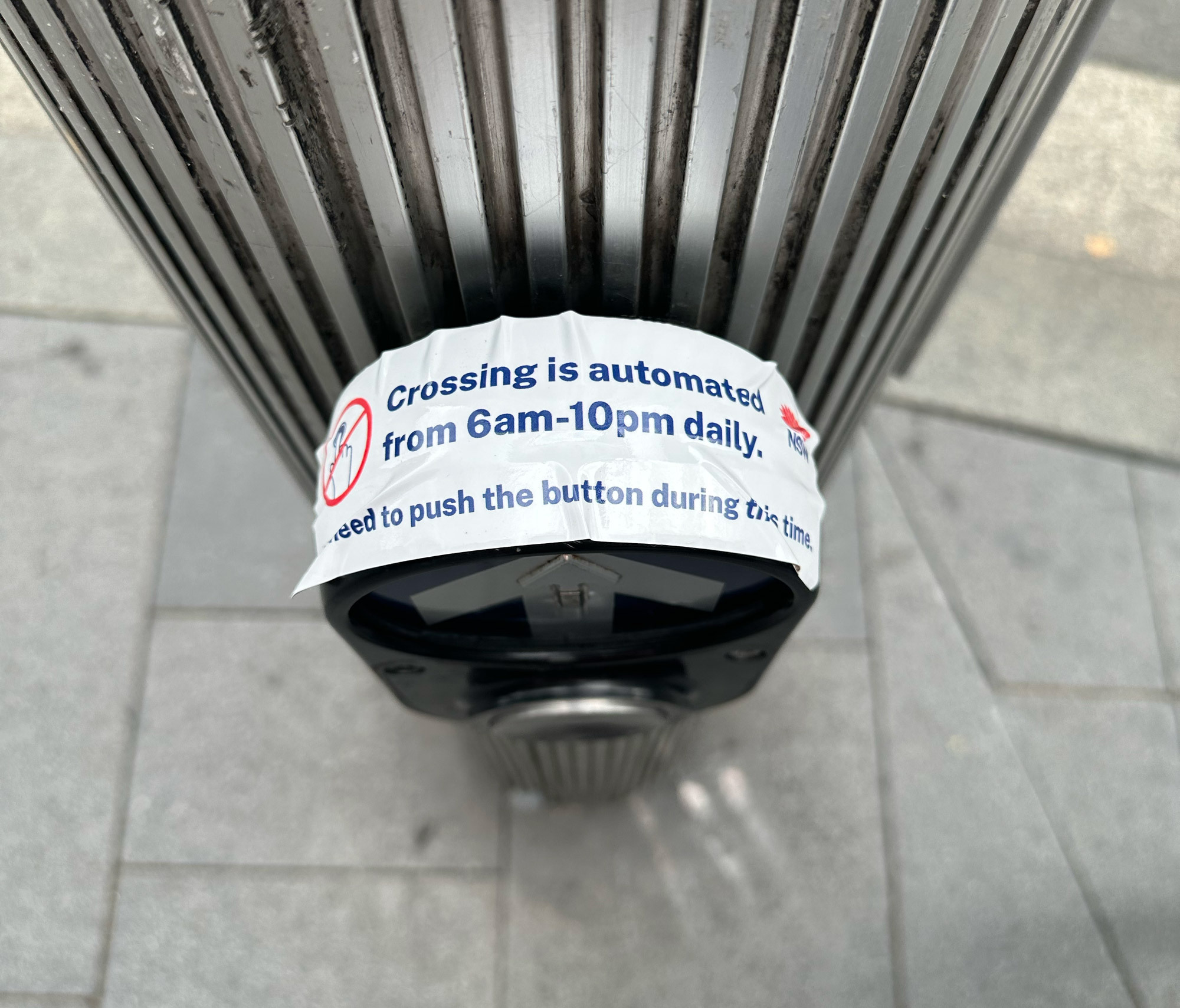
"Between 6am and 10pm" means from 6am to 10pm. I.e. what the text on the sticker says.
"Between 10pm and 6am" means from 10pm to 6am. I.e. what the blog post mistakingly says.
There is no ambiguity in what "between" means when talking about hours of the clock.
When I was in Sydney it reminded me more of an 80s arcade game :)
This allows less stops for cars at night. At night on high traffic roads the lights stay green until someone presses the walk button, or a car arrives at an intersection.
Your best bet is to get into the habbit of always hitting the button. If you're worried about virus transmission, then use your elbow.
Which is better for the environment, and for the sleep of residents adjacent to the road. From that perspective, it seems like madness to suggest that cars should be forced to stop and idle repeatedly during the night on the offchance that a pedestrian might be waiting to cross. A pedestrian idling for a few minutes (assuming they require the guidance of the "green man" and are unable to assess the safety of crossing themselves) has much lower impact.
I don't know how we can align economic incentives to make this happen though. Maybe we just need to wait for a self-driving car startup to go bust and release all their code to the public domain.
So for me the sticker reads: "we are too incompetent at programming" :).
My other thought: "these don't look official, someone private has made them for a joke".
It's only enabled between certain hours, so it's already creating confusion, but those hours also happen to be the hours people are likely to be drunk, it's likely to be dark so they're more likely to be hit by a car, pedestrians are more likely to not notice the beg button, etc.
If you are gonna have the beg buttons, have them all the time, so it doesn't just end up creating more confusion.
The only reasons the buttons were removed was because of paranoia over COVID spread through surfaces. This was done hastily so they made the simplest change possible, adding the walk to every cycle.
Now they've had time to program it properly they can let trucks and heavy vehicles through more efficiently at 10pm-6am. How many pedestrians are around at these times?
Absolutely maddening. They should never use whatever company they contracted to design those again
I do remember Edinburgh as very pedestrian hostile: At nearly every interesection pedestrians had to wait for a felt eternity.
(Both observations pre pandemic.)
Instead of anecdotal data cities should be obliged to publish statistical waiting times according to a standadized model.
(I don't live in Australia, but you do occasionally see them in America.)
The button gets mounted on its own post if there's not a traffic light pole in the right place to piggyback off.
I'm a late boomer, you're more likely to be run over by a bus than booked for J-walking here.
Merry Christmas.
"what were they thinking?" is what pops in my head. Am I alone in this?
Also Sydney's crossing buttons are notably reliable. They last for decades and have been adopted across many other Australian cities and, IIRC, overseas somewhere.
They're really unreliable.
Isn't forcing people to press this button a huge risk to catching Covid? I wonder how many people will die because of this change
Finally