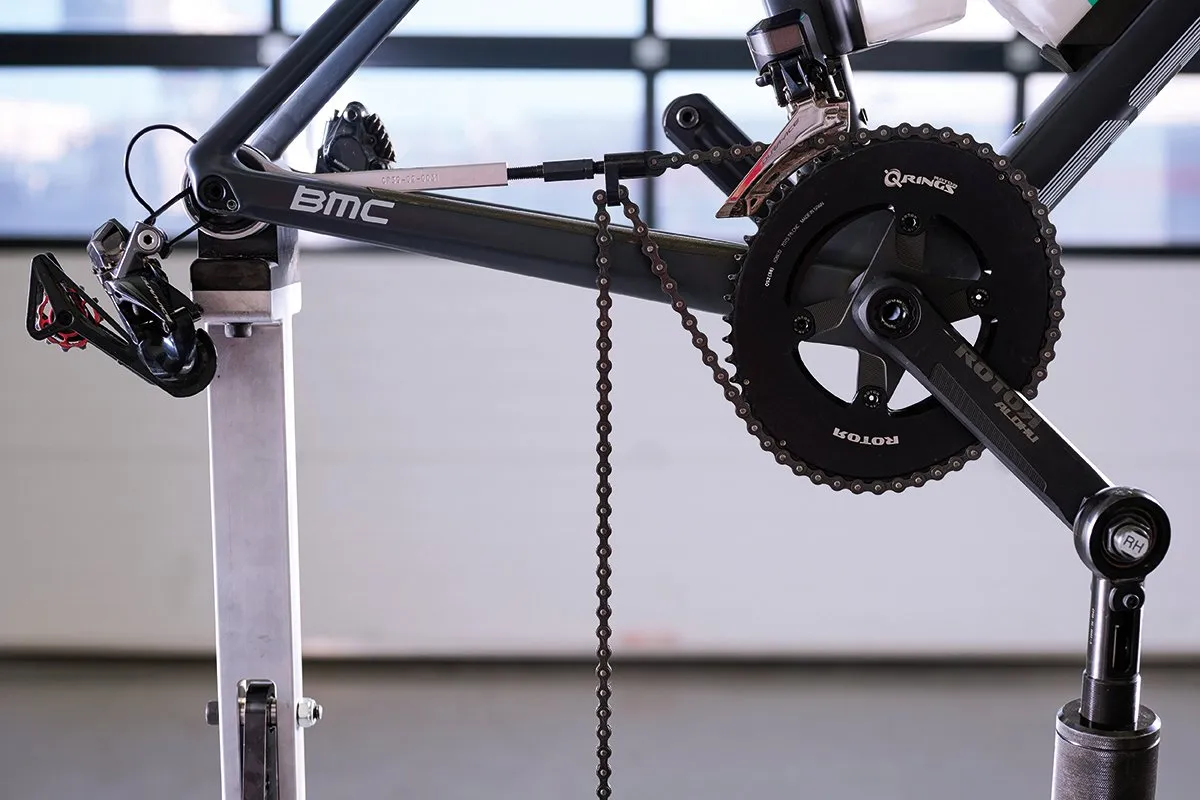
Bike frame stiffness: Why it matters and all you need to know
When it comes to cycling performance, stiffer means better. Or at least that’s what the bike industry marketeers would have
Cyclist
126 points · by giuliomagnifico · 3y ago · 225 comments
The points the article makes about torsional and lateral tension helped me understand better why I prefer steel over carbon. I've always described it as "feeling more in-sync" with the bike. For example, the subtle instinctive biomechanical action of putting more weight down on the outside pedal to re-align the wheels when you start to understeer just feels great, like you're "one" with the bicycle.
One guy was going over railroad tracks and his handlebars just came off. Not what you want in the middle of a cat-1/pro peloton.
It was a break that I would have noticed much sooner, had I regularly inspected it, because the other side was half broken off.
The funny thing is, I play in a band, and when I told my story that night, 3 guys in the band offered to weld it.
Yikes! Fork failure is the stuff of nightmares. I'm glad you're okay.
Among the participants of a local riding club in my area, I've met two people with custom titanium frame builds who told me that their frames cracked within a few years of use.
Anyway it’s weird because it doesn’t look broken on a weld, very rare situation, titanium should last forever.
Anecdotally, and I know the cab material is not the only difference, my RAM 1500 is leaps and bounds more comfortable and pleasant to be in than my F-150. The RAM has a steel body, whereas the F-150 is very light/rigid aluminum. The steel cab does much better with absorbing the energy/sound from the road.
"they are welded, not brazed. [...] There are necked-down parts that fit into the top tube and down tube, like internal lugs."
I'm sorry, but this is BS. I don't think you can fix double/triple butted tubes easily, and even if you could, I wouldn't trust them any longer.
I once owned a steel-framed Italian road bike, made around 1985-1990. I bought it cheap because neither I nor the seller knew at the time that it was a real pedigree race bike, which meant lightweight tubes and probably quality steel (I don't know what it was made of, but the whole bike weighed in under 10kg with pedals, which for an older steel framed bike is excellent).
Then I crashed it, I went straight into a lamp post at around 20kmh. It was not a nice experience on myself, but the bike... the fork was bent backwards so that the front wheel went past the down tube. The top tube was bent, dented and bashed and cracked, almost unrecognizably. It was clear from the first moment that no-one will be riding that frame again...
...until a guy turned up to "buy" the frame & parts (I gave them away for free). Guess what, he just needed the lugs and he built a bamboo bike from them! That's how you recycle for good.
There are great bikes of very different materials.
I owned great bikes in steel, alu and carbon. My most comfortable and efficient road bike was made of carbon, the less comfortable made of crude 4130 steel tubing while some other steel bikes were really nice to ride but not as comfy as my current carbon bike. Reason is mostly because these bikes had that old school italian geometry with very short chainstays and couldn't accept tires bigger than 23mm.
I've seen steel bikes bent into unrepairability while I've seen carbon bikes shattered into several pieces then repaired and rebuild with very little difference in ride feeling after the repair for a tiny fraction of the cost a custom builder would ask to replace steel tubes on an existing high end steel frame.
I'm still trying to understand the talk about over/understeer and how the bottom bracket is involved. Are you saying you put down more weight on the outside pedal on each rotation of the crank as you're going through a turn?
Also, isn't there some wasted energy going into flexing the frame that should go into the road?
I have an Allez Sprint from a few years ago - it's aluminum alloy with carbon forks+seat, but the joints are welded a few inches away from the joints instead of right at the joint. The result is a stronger bike and an extremely responsive ride that I enjoy for rides <50m miles. You'll feel everything in the pavement, which is both a good and bad thing depending on your preferences.
For longer rides it's hard to beat my old-school fully lugged steel frame on flat routes, but the added weight usually isn't worth the tradeoff for me.
This is a quality modern steel tube set:
https://ciclicorsa.com/shop/columbus-spirit-tube-set/
A frame will retail to at least 4x times as much.
I rode a boring old aluminum 6061 GT for a couple of years back in ~2010, and I now own a Cannondale CAAD12 aluminum alloy frame. I ended up putting it full-time on trainer duty. I thought it was stiff, and the overall "feeling" was crisp. If I were feeling uncharitable I might say it's harder to control. I hear the CAAD13 frames improve on ride quality.
I've found it very difficult to find a non-steel bike that offers the same ride characteristics that I've become accustomed to. And honestly at this point I don't have a lot of time and incentive to keep trying different things when I feel I've found something that just works really well for me.
older aluminum frames have a reputation for feeling harsh, but it's not because they're made out of aluminum
They were super harsh because they were aiming for stiffness, and the material allowed them to do that.
For example, in a touring bike, you might prefer steels robustness and softer feel for long hauls. Some people might prefer carbon for it's lightness. It's all down to choice, neither is objectively better.
A racing bike should flex vertically but not horizontally.
Also need to stop talking to other cyclists online. "Oh yeah 100 miles is easy", not for me it isn't.
Anytime someone asks me bike buying advice, my only reply is “go to your local dealer and talk with them”. That relationship and taking a few test rides are far more important than any spec on a sheet.
Shops that cater to commuters and transportation cyclists are very different from ones that cater to hardcore road or mountain bike riders.
And he gives no dammn if this is cheeting according to some condescending self righteous hole of excretion. Did not even hear about those poor people. He just likes to move more and that's it.
Similarly entertaining, leaving work one day when a dude in Lycra on a $3000 racing bike blew past me with hardly a glance. ...And then looked completely flabbergasted when I caught up with him and said "Hi!" at a stoplight a few miles down the road, riding my mountain bike and still wearing slacks and a button-down from work. Like, I may be a fatass, but I've been doing this every day for 15 years and my calves are solid rock.
I must get back into it.
I was a very casual and just enjoyed riding until I started getting into touring. You're right not to care, at all. Unless you are a professional or are riding competitively at high levels, you will always do better by losing a little bit of belly, focusing on technique, and having more miles on the road. Weight will not be the difference maker.
I would come back from a tour on my steel Surly and just whip by people with 7k+ bikes in Central Park on a regular basis. It was the miles and nothing else.
Rolling resistance and comfort matter. I never went less than 23mm and I wouldn't even do that today, I'd go far wider 28mm or 35mm. Being comfortable keeps you on your bike longer and the longer you're on your bike, the more fit you'll be and happy - since you're riding a bike for longer.
Your instincts are good, have fun.
You don't care about "weight in grams" for each part.
You can get good exercise by lowering the assist level. You can raise the assist level for tricky parts or to get back to the car.
But the best part is getting TWO electric bikes - it lets you take someone with you, optimize for fun and minimize things like different ability or fitness levels.
I tried to be a hardtail purist, and quit mountain biking because it just sucked. (Local terrain is all huge rocks and drops) Years later tried a full suspension carbon- whoa, mountain biking can be type I fun??
I tried to be a commuter purist, favoring simplicity, durability, and reliability. Riding my hybrid is un-gratifying and soul-sucking. Tried a racy road bike, awkward as hell. Tried a nice gravel bike, oh my god I don't want to stop pedaling!
It's worth spending a little more to get the bike that feels good for you to ride.
The one thing where I suspect mass might matter is in the wheels. It's a huge difference between getting a heavy wheel spinning and a light one, and at least for commuting/recreational usage, most of that will be bled off as heat anyway.
Not really. Bikes don't have a battery to store reclaimed energy, if that would even be a thing. Maybe you go a bit faster on the downhill; I wouldn't call that reclaiming energy.
> Mass doesn't matter as much as people used to think.
On a flat road at a constant speed, mass doesn't matter (except for the slightly increased rolling resistance). With speed changes (in situations with sharp corners for example, or if you want to accelerate fast to escape from the bunch or to catch someone else) or in hilly/mountainous areas, mass does matter.
For recreational use, spending lots of money for shaving of a few grams here and there is not worth the effort, that's true. But a few kilograms more or less do make a difference.
> Hence no modern bikes being made out of drillium.
Modern top-of-the-line road bikes for climbing are already as light as allowed by the UCI. It makes no sense to drill holes in such a bike: you wouldn't be allowed to use it in a race.
What does this mean? A downhill gives your legs a rest if you coast but it's not going to restore all the energy you burned going up the hill. And if you're riding sportily (not even a race necessarily), you'll still be pedaling the same amount of watts downhill. You'll just be going faster for the same amount of muscle power.
> Mass doesn't matter as much as people used to think. (Hence no modern bikes being made out of drillium.)
Modern bikes are getting lighter and lighter.
> The one thing where I suspect mass might matter is in the wheels.
Yes, in terms of ROI by unit weight, lighter wheels are the best place to start.
My recommendation for those getting into it, decide the type of riding you wnat to do, figure out a budget and try bikes (new and used) in that budget for the one you like.
For what it's worth, my main bike is a steel "gravel bike" with fairly beefy tires, disk breaks and no suspension. I take it most places I have taken my full suspension mountain bike when riding in the bay area.
I've never considered anything but a steel frame (most common), in the realm of $1000 or less fully built.
Sure, I desire more. But we're talking about 10% satisfaction improvement for my (our) needs. And I definitely will splurge on a new bike soon, but only because I have money to burn.
I am contemplating a $3-500ish fitting with all the latest tech and a trained expert. That feels honestly worth it for anyone because it will likely save you injury.
Gears/derailleurs I have a tough time with.. even nice ones seem to need constant adjustment so I ride a single speed now and feel like I discovered a bike secret.
I'd spend on fit, frame, seat, tires as a min bar to be picky about.
It sounds like waste of money for something people feel like they should be able to judge themselves, but bikes aren't shoes. The issues often develop only after some hours of effort. If You're a beginner, chances are the flexibility of Your back / hips / joints will be the most limiting factor.
Elite athletes are a different species from you and me.
OP said racing bike not road bike. I agree commuting on a nice road bike is awesome and the comfort/endurace category of road bikes is great for that (e.g. Specialized Roubaix, Trek Domane, etc.)
I wouldn't want to commute on an all-out race bike though. Too stiff, too uncomfortable geometry.
My point is that more people buy racing equipment for cycling than do skiers for skiing. It is more obvious that a straight sidecut on a long stiff ski won't be fun, than it is that a low stack height and high seat will hurt your neck. You'll see a loot of kludges to fix these decisions: adjustable stems, steering tube extenders, etc.
The bike I personally spend most time on is a steel frame, but I've never once asked myself a question of "is this stiff / bouncy" enough. When I started having issues with too much road vibration giving me a mild case of cyclists palsy (temporary mild paralysis of ulnar nerve), it was due to the surface I was riding on (gravel) and the distances / times. Solution was adding suspension stem to the handlebar.
To me, the "steel is real" argument speaks about the general durability / repairability of the frame. But AFAIK, modern CroMoly steel butted tubes aren't "that" great for welding or cold setting either (to be debated). IMO the famous road repairs of 90's adventurers who had their cracked frames repaired by no matter what farmer with a stick welder in the midle of Kazakhstan are simply long gone now.
Personally, the thing I watch for in a bike frame first and foremost is the geometry and the actual personal fit (ideally by a professional fitter).
The number one issue I've seen most beginners have related to bike frames is simply being too optimistic on their abilities and spending thousands on frames that they simply don't have the mobility and flexibility for.
If you start with a bike model that is already known to be mushy and try to ride a 60 or 62cm size it's going to be even worse. When I still rode I chose a frame that some other club members characterized as 'harsh' but they were riding something more like a 56. Even a couple inches makes a huge difference in leverage.
The real reason a frame should not be optimized entirely for stiffness at the expense of everything else is material fatigue. A frame that maximizes stiffness is a frame that puts its materials under more stress. So if you dial up the stiffness all the way, you'll get less longevity and eventual stress fractures or worse.
What most riders think of as stiffness/springiness/feel in their bike comes from the flex (or lack thereof) in their tires, seat, seatpost, spokes, and the harmonic response of their frame to vibrations from the ride. That response is actually a key part of subjective rider satisfaction, I think because we subconsciously feel more in control (because we can feel what the bike is doing better) when the vibrations are more pronounced.
I once rode in the Gong Ride (Sydney to Wollongong) and, determined to set my bike up as efficiently as possible, pumped my tyres up to 120 PSI. The bike felt incredibly fast ... but my testicles went numb.
1. Wear cycling shorts and pull your boys up so that you're not sitting on them when you ride.
2. Don't put so much weight on the saddle. The saddle is not a seat, it's meant as an extra point of control to lean the frame. Put your weight on the pedals. Also, is the saddle at the correct height?
I ride tires at 115 PSI daily and have never had issues with numbness anywhere on my body.
This is about the seat you are using and the time you are spending on it, not the stiffness of the frame or ride.
There is a reason why male seats have cut-outs. You just need to find one that works for you.
https://www.youtube.com/watch?v=5f8PGpKUKro
i guess it makes sense when this article is talking about road bikes, but in MTB and gravel bikes, where geometry is so much more malleable, the geometry plays such a huge role in stiffness, almost independent of material.
you can have a crazy stiff steel bike (e.g. kona honzo esd) or a crazy compliant carbon bike.
https://gravelcycling.wordpress.com/2016/07/07/steel-the-dif....
The obvious benefit to steel for me is the reliability and repairability. Ride quality can also be different depending on surface, steel is better at dampening vibrations then aluminum on gravel surfaces. Although carbon can obviously be quite nice, and you are seeing it used in tough ultra distance rides like the GDMBR. That said your wheel choice, and seatpost, will have a bigger impact on ride quality then frame material as far as vibration. Generally speaking the weight of your bike is going to be most noticable on climbs. How noticable will also depend on your gear range.
This video about titanium bike myths discusses some of the points I outlined above in further detail.
And then you had Serotta, who before they switched to titanium, made steel frames that were not just double-butted, but they also spirally ground the butting to maintain most of the torsional stiffness but lose a couple more ounces of weight.
I recently switched my indoor trainer from my aluminum frame to and old carbon frame and found it much more comfortable, which I think is from the less stiff old carbon allowing more movement.
I wasn't aware of bottom bracket stiffness, but seems to make sense that single speeds tend to feel better for me if the bottom bracket can be simpler and stiffer?
On lo-end carbon frame bikes you will find alloy bars and seat posts, which is silly.
Sure, if you like weird rubbing to show up under load (e.g. steep climbing) that isn't there normally.
Frame stiffness double blind test: https://www.renehersecycles.com/what-is-planing/
https://www.renehersecycles.com/the-biomechanics-of-planing/
https://www.renehersecycles.com/expert-discussion-on-frame-s...
https://www.renehersecycles.com/myth-4-stiffer-frames-are-fa...
None of the pictures are labeled, and they only show one setup: pressing the pedal without sitting on the seat, without holding the handlebars, while both wheels remain in plane. I'm not sure if it's even possible to keep both wheels in plane when pedalling on a moving bicycle, if only due to pressing on the handlebars.