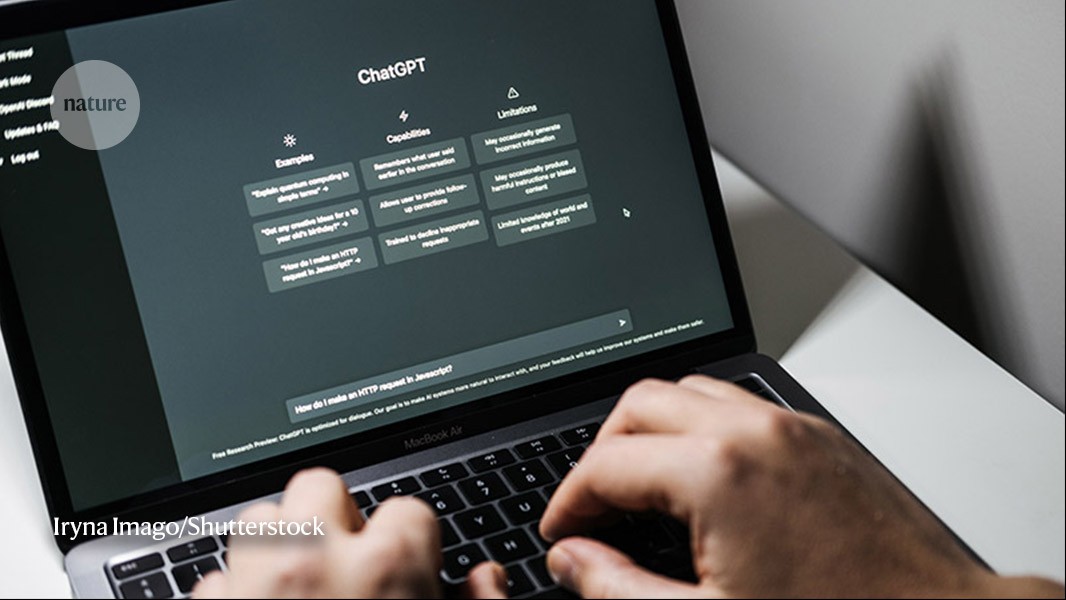
ChatGPT listed as author on research papers: many scientists disapprove
At least four articles credit the AI tool as a co-author, as publishers scramble to regulate its use.
nature.com
55 points · by sohkamyung · 3y ago · 49 comments
Suffice to say, the authors’ cheap strategy has worked. The medrxiv preprint has an impressive view and retweet count. Expect a flood of ChatGPT authored papers.
[1] https://www.medrxiv.org/content/10.1101/2022.12.19.22283643v...
> “An attribution of authorship carries with it accountability for the work, which cannot be effectively applied to LLMs,” says Magdalena Skipper, editor-in-chief of Nature in London. Authors using LLMs in any way while developing a paper should document their use in the methods or acknowledgements sections, if appropriate, she says.
It's interesting that ChatGPT feels more human so we're more likely to anthropomorphise it, like list it as a coauthor.
Authorship is supposed to be for intellectual contribution. If LLMs get good enough to start identifying weaknesses in my methods section or suggesting novel analyses to answer scientific questions, then maybe I’ll reconsider my view
Though there’s still the argument made in this article that authors should be able to take responsibility for the work, which under our current legal framework programs can’t do
Very soon you'll be able to tell an AI to "write a vampire romance novel", "design an Earth observation satellite", or "compose a symphony in the style of Beethoven", and the result will be plainly superior to what any human engaging in the same pursuit could produce. At that point, the whole "sentience" debate will fall apart, along with much of society as even the smartest humans are made essentially obsolete.
This overdramatises a simple, obvious amendment to copyright via case law. No debates around sentience. If a human didn’t create it, it isn’t IP.
"MovieGPT, make me an epic fantasy film trilogy that's better than Lord of the Rings, with myself as the hero."
How could intellectual property possibly matter in a world like that? Nobody is going to still read books or watch films made by humans, because AI-generated stuff will be much better, much more plentiful, and even cater to individual desires.
This is a perennial prediction. Absent substantiation, it’s hard to take it seriously.
> "MovieGPT, make me an epic fantasy film trilogy that's better than Lord of the Rings, with myself as the hero."
This output isn’t protected. The Lord of the Rings is. We shift to your AI paying when it references the content and move on. Nobody likes licensing fees. Magicking them away isn’t a solution.
While the output is "entertaining", it's not like you can compare it to actually good films. Netflix will never make something like The Godfather. What they make is like food without nutrition. That's fine, everybody likes sweets once in a while, but it won't keep you alive.
Of course I can't prove Netflix is doing this, but the argument would still hold true for AI generated content.
This is the same with ChatGPT.
Also, after the AI shutter button is pushed, there are a lot of human decisions made to refine the output. In the SD realm, people are sorting through hundreds of image outputs to find the gems amongst the nonsense.
You still wouldn't say that DJI was the cinematographer.
Will the quality devolve?
Why complicate things? Why not just "be a human"?
Its worth noting that global patent offices have rejected AI listed as the inventor on patents - this has gone through trial and appeal an been heard by a panel of five judges at the highest level, who struck down the idea.
Patents require a human inventor.
https://www.nexttv.com/news/court-ai-systems-cant-create-pat...
Could, for instance, one teach an AI to come up with the concept of a screw[0] from training it on inclined planes and nails? Or at least, everything but screws/bolts, and any other form of rotary inclined plane. If AI can come up with a former novelty, there is no reason AI couldn't come up with a new one.
[0]Undeniably an invention, if trivial now.