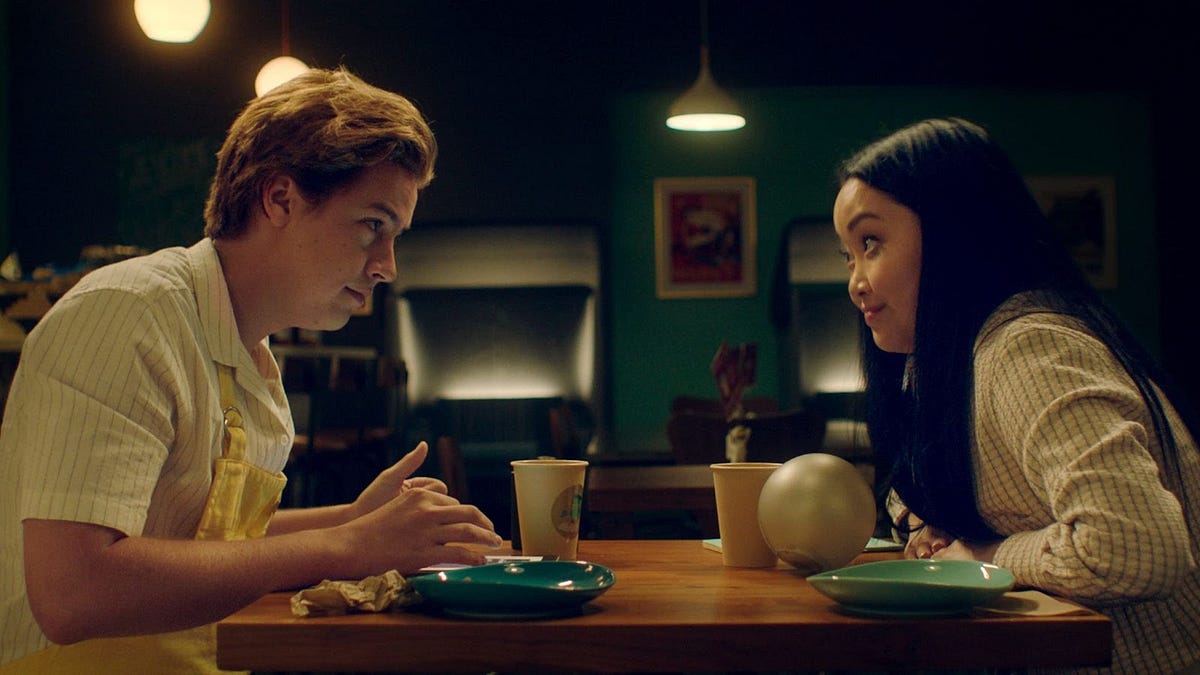
#132: The contagious visual blandness of Netflix
And how to treat it
haleynahman.substack.com
471 points · by _gfwu · 3y ago · 460 comments
There's less people in the background as extras, less people making background scenes or setting up. It can mostly filled in by production technology if necessary.
Some movies just seem so empty, and they look "cheap" if you see it in this angle. Some big hollywood production like for example Passengers where there are barely more than three actors visible in the whole film. I've noticed there's a lot of these hollow/empty productions with very few actual actors visible, and they are rather lifeless.
The GoT show runners appear to have totally misunderstood that, and threw the suspense and world building stuff under the bus for creating moments of interpersonal drama. But the drama and actions increasingly made no sense vs the buildup of the previous seasons.
Who are the white walkers? What is the rest of their history? What are their goals? This was the big driving mystery of the show, and they simply decided to wrap it up in a single big battle with no further revelations.
That totally removed the payoff a lot of people were waiting for. Much like Lost, it became clear there's no actual coherent mystery.
Maybe GRRM deserves some criticism for not having things wrapped up himself. But mostly I think the show runners just totally misunderstood what was driving the earlier seasons.
I feel like that is many movies now. The worlds are small and the consequences / events are just there for the primary actors to respond to and seem entirely disconnected from any kind of universe.
Massive events happen just for the sake of having a hero mug for the camera. But no consideration otherwise.
At this point in the Star Wars universe I expect the regular people of the universe would realize that ALL force sensitive people are more trouble than they are worth… but no the people of the universe show up, say dumb things, die (or don’t show up… literally nobody at times) at the appointed time for really no reason that to give the heroes or villains something to do.
Maybe the EU novels have such stories, but I haven't read those.
Greenhouses…would be a very rare luxury for a rich few, and would offer minimaly supplement for them; also, heating them (IRL, with coal) would be prohibitively expensive in labour, fuel, and fuel storage.
Everyone was too busy suspending disbelief or distracted by their phones/laptops to really notice. I gave the show the benefit of the doubt until the end of Season 4, when Tywin Lannister would have come in and eliminated Joffrey - his family's success relied on installing a competent king to keep the throne, not a useless brat coddled by his incompetent kids.
But then rewatching it for the second time, the lack of causality was apparent in Season 2. There's a reason stories don't generally kill main characters, and that's because viewers invest in them. If they do kill a main character, there has to be strong point that leads to even more character development. But once you see through the charade, the whole series is revealed as a series of vignettes that imply awesome character development, without ever actually doing the work to bring it to fruition. The show was able to coast in pop culture until season 8, when it was no longer possible to ignore that the characters weren't going anywhere.
I thought they would have taken a step back and applied more massaged production to HoD. After all, this franchise had an outsized amount of upmarket interest, only to crater at the end to the point of completely falling out of the zeitgeist. But rather, it seems like they continued the same tack of not really having a good story and filling in gaps of time in place of showing character development - like the episode where all the actors switched out and everyone is just older. Classic GoT!
There are so many different side characters who only have two lines, but each of them were cast with care and feel like real people who are living through their day and intersecting with John McLane. I love this movie for it.
https://www.youtube.com/watch?v=8RVVJmuoAQ4
On the other hand, I just watched Michael Bay's Ambulance, which is a prolonged police chase through downtown Los Angeles and the only people who seem to be on the street are criminals and dozens of police cars. At no point are we in touch with anyone who isn't directly contributing to the story. The reality is that downtown LA is packed full of traffic and the story would have taken a very different (and interesting) angle if it reckoned with the fact that getting through the traffic is it's own game.
Die Hard With a Vengeance, however, acknowledges this reality and comes up with some very creative scenarios for our protagonists to overcome, and it makes for a far more compelling movie as a result. It feels far more realistic, even in a movie as heightened as this.
You might like “To Live and Die in LA”
I hadn't thought about this before but you're correct and it even extends to the antagonist. As they are unravelling his plot, they come up with the question of "how do you drive that much gold through New York without anyone noticing?".
It's a very interesting perspective.
There have been others that are great examples of it being odd. The TV show The Good Guys was shot on empty streets in a dead part of town because of low budgets, and it comes across that way. Was the crew so small that they couldn't send a couple of the grips or PAs to walk down the side walk? Another of the low-budget examples I like is in Queen of the South's first season, they used the production's grip truck as the bad guy vehicle in an episode. Maybe it was the pilot? It was just one of those hung head in shame moments for me
Compare/contrast an episode from season 22 which aired in 2022 vs season 1 which aired in 1990.
There are scenes in the original that have like a 15-20 people on screen doing a highly complex choreography for a crime scene with different actors playing uniformed cops, detectives, evidence specialists, witnesses, bystanders, just every one that you would expect to be in such a scenario in real life.
And that's just one scene. There are many more with unique locations, with remarkable shots on location outside and inside buildings -- all with many more people on screen.
Now they barely have 20 people in the final court room scene when the original seasons used to have 50+ people just for the background, let alone the 12 jurors, 3 lawyers/judge/defendant.
I agree with your general comment but in Passengers it was really central to the overall plot and premise. It's not a good example of this phenomenon.
I don't think this was drive for budgetary reasons, that film clearly had a huge budget looking at the visuals.
As for money, Hollywood should be much less dependent on 'A-listers' and tap unknown talent. This will also make the 'A-listers' cheaper and stop this annoying thing where you see the same faces in every movie, often cast more for the name than for best fit to the role.
You might not like the premise but the film would lose its impact without it.
It's not a typical "because cheap" scenario where other characters are cut, here it's an integral part of the plot.
I wonder if they simply think background details aren't important when viewing on a 6" screen.
Are massive set pieces with hundreds of extras just not economically feasible anymore?
Maybe that's true, but for Passengers, no extras is an integral part of the movie plot. Anything else would make 0 sense.
And they pulled it off rather well.
This isn’t actually a new problem. I guess the new part is this:
> It can mostly filled in by production technology if necessary.
I saw an interview with the director of the 5th (I think?) of the original Planet Of The Apes movie, Battle for the Planet of the Apes. (It might have been a DVD extra, I don’t recall.) It’s supposed to be a war between the humans and the apes, but they didn’t have the budget to hire enough actors, so they had to rely on using particular angles of the camera and various props to make it less obvious how few people there actually were in the movie.
Later I saw a review of the movie Jumper which is also supposed to have a war between normal humans and humans that can teleport, basically. The review was talking about how there didn’t really seem to be that many people involved in this supposedly worldwide war.
[1] https://en.wikipedia.org/wiki/Stalker_(1979_film)
Is it empty? Is it cheap?
But your point highlights the opposite: merely having fewer people in the scene to save money without considering what it actually takes to make it work. Even Blum gets this right; these bigger productions have no excuse except laziness.
And in my case it's led to me simply watching less video, because it's boring.
It's just the industry converged onto the same recipe book - some of that is cost cutting, some is just massive amounts of A/B testing throughout the years.
Demand leads to optimization, which in turn leads to convergence and less varied supply. Which is kind of paradoxical, considering the low barrier and creative freedom available with today's tools. And yes, it really started to happen somewhere in early 2000s, not just with movies and the looks but with everything related to visual entertainment, from games to illustrations.
all shots are conformed before they are graded. That means that they shoot a macbeth chart every time they change the lighting, allowing for people to make all the shots look the same before they start to fiddle with the colours.
Not only that, but you can micro adjust the colour of these lights to suit your needs, which means you can have much richer colours on set and not worry about colour cast.
if it was such a burden on the film maker, and limited artistic expression, then we'd see holdouts for tungsten lights (in film making). When was the last time you hear someone in film go: "yeah, these filament lamps are so much greater than LEDs, so much more real."
If you're on location then you can have >5 times the amount of light for the same power/heat budget. No one is going to sniff at that.
Anyway, the first thing you do when you get film/footage in through the door is conform it. you need to have everything at a base grade before you can add "artistic colour" to it. so subtle difference in colours are always obliterated.
https://www.thespax.com/nba/the-nbas-ongoing-three-point-rev...
https://www.vox.com/culture/22840526/colors-movies-tv-gray-d...
There's another article I can't find on it.
It's got nothing to do with netflix. Digital is not to blame either, but it's certainly a catalyst.
It mostly has to do with insecurity surrounding digital and the bizarre idea that saturation is trying to 'emulate' film, (when color timing films was always just been about trying to emulate reality).
You can correct most of this problem with a decent media player. Just play a film in VLC and touch up the saturation and possibly the contrast in the effects settings.
It really doesn't take much adjustment to makes a film that once had a depressing palette suddenly half decent. I can't tolerate watching films through sunglasses so do this pretty often.
It really is a fashion. I've seen an advert for grading software that had a famous photographer casually showing the viewer how he ruins his pictures with this process of desaturation. I've no why people think this looks good, but it is deliberate.
I asked the cinematography reddit once why people do this and got a lot of incoherent responses about how saturation is just trying to emulate film and that it's just how 'new' things should look. Apparently many new filmmakers experience of reality has been through tea-shades on an overcast day. It beggars belief.
It looks like a cheap gaussian blur filter applied in post production and adds to the fakeness. This is probably due to the optics in some of the latest Red digital cameras, but it's still not convincing. Kinda like 48 vs 24 FPS.
A higher refresh rate is simply an objective improvement. I don't care that you associate it with bad soap operas.
"Impressionism is objectively worse than realism. Look at a Van Gogh painting, there's hardly any detail. It looks coarse, and grainy and the brush strokes are so wide I can hard tell what's what. Starry Starry Night would be objectively such a better painting if he had just reach for a finer brush and included more detail. Adding more detail would have made it far more realistic, and thus objectively better"
You see your premised is founded on the false pretense that realism is the goal. The Cinema frame rate of 24fps (while not chosen to achieve this, but by a happy accident) happens to be at that perfect balance between too choppy and realism. It's just off from reality enough to trigger that "impressionistic response" in our brain. The same thing that happens when we look at a Monet painting. Out brains find impressionism appealing because it's specifically not what our eyes see in the real world. It's an interpretation. It's someone else's view of the world. More detail is simply not the goal.
24fps Cinema is impressionism.
No one is saying that filmmakers couldn’t use lower frame rates as a deliberate stylistic device, similar to how 12 FPS can be used in films now (or black and white, or out of focus images, etc.), or even that all films previously shot in 24 FPS would be better if the frame rate was doubled with no other stylistic changes.
But for the kind of movie that's supposed to take place in a world very much like ours? The kind where it's just a camera filming actors in a street or whatever, and there's no intentional impressionistic art style? An "impressionist" frame rate is totally inappropriate in such a context.
EDIT: I'd actually be very interested to know why people are downvoting this comment. I'm accepting that there can be artistic merit to low frame rates, but I'm rejecting the idea that impressionism should be forced on art which isn't trying to be impressionist. What's objectionable? (I see the comment is in the positive now, it was at -1 when I wrote the first edit)
Type 'art' into google, how many pictures are impressionism, 1 in 10?
Pick a movie at random, what are the chances it's made in 24 fps? 99.9%?
Why do you thin TVs have motion smoothing? Because, we, normal people, are sick of you impressionist-obsessed people controlling everything.
I also like my wine expensive and with nice labels.
Or is impressionism the only valid art form?
Also -
> happens to be at that perfect balance between ...
Yeah na, it's just what you're used to.
The first Hobbit movie set me against 48 fps for this reason. The weapons on the characters backs bounced around as if they were made of foam -- because they presumably were made of foam. 24 fps hides this imperfection and lets your brain fill in with a more appropriate interpretation.
The same bugs me about rerenderings of 90s television at higher resolutions. The sets suddenly look fake -- because they are -- but in standard definition you simply can't tell.
Any improvement in media fidelity must be accompanied by a complementary improvement in set/makeup/prop design to avoid this problem. Problem is, at a certain point -- this extra work simply surpasses what is relevant to tell a good story, and is left undone -- and high fidelity reproductions belie this shortcoming.
But 24fps restricts the director to certain types of shots, and I think the statement of preference for 24fps is mostly a result of that. Scenes where the camera is mostly still are the ones that focus on the actors and their acting. This is well known enough, I think, that it is basically an implicit statement of preference toward the acting and shot-framing aspects, and away from the technology/action/sfx aspects of film-making.
The former focus is generally seen as more prestigious and artistic so it isn’t surprising that there’s a subset of the population that prefers it. It also isn’t that surprising that that population is over-represented in the movie-discussion space. However it seems that the latter group buys more tickets!
I’m willing to buy into the idea that lower framerates cause our brains to “fill in” details and thereby improve immersion by some impossible-to-measure metric, but let’s not pretend that’s why 24 was chosen. It was chosen because 30 or 48 or 60 would cost more to shoot.
Display tech is also a big factor. It took me a little while to adjust when I first got an OLED TV. The lower response times of LCD give it a sort of natural interpolation between frames, but OLEDs are fast as hell and you can absolutely see the difference.
It may or may not have been a coincidence that 24 divides 120, potentially simplifying the design of electrical devices (lighting, motors) powered by 60 Hz AC; I don't know enough about the technologies involved to say.
It's not a video game, you're not in control, so the standards are different.
In a high CGI film, like Avatar 2 for instance, where the entire film is mainly CGI, then shooting in 48fps has an advantage and looks much better. You simply have more clear information on the screen per second that way, which helps for 3D and for CGI detail.
The only issue really is that camera movement needs some experimentation to get right. Some movements in 48fps are too quick or too smooth and this makes them jarring to general audiences who are used to 24fps. Actors also move a certain way for 24fps (they slow down certain motions for instance), so they'll need to fiddle with that as well in 48fps.
It's worse in some movies than others. I don't know all the photography lingo, but from what I understand it looks worse when the shutter speed is high, giving each frame a very short exposure and therefore little motion blur in each frame. With longer shutter times, each frame has more motion blur and therefore a 24fps pan doesn't look nearly as bad.
It's called "shutter angle," see e.g. [https://www.red.com/red-101/shutter-angle-tutorial]. The angle, as a fraction of a full circle, is the fraction of the shutter time that the frame is exposed to light. Larger shutter angles give more motion blur, and smaller angles give a more stroboscopic effect.
When shooting on real film, an obvious complication is that the set lighting has to be well-balanced for the chosen shutter angle. A dim scene can't easily be shot with a small shutter angle, and a bright daylight would overexpose a large angle.
Special effects, including postprocessing trickery, are almost the opposite. The default state of a render is to be perfectly sharp and to exist outside the flow of real time, and both focal and motion blur are deliberate additions.
Digital sensors are in theory compatible with arbitrary "shutter angle" equivalents, but your phone's video camera is more likely to set the shutter speed as necessary for auto-exposure.
24 fps feels best to me. Better than 30, 15, 16, 12, 6, 4. Better than 60+. Even slightly better than 25.
Those numbers may seem odd and random, but doing a lot of animation using various framerates, 24 matches up with reality more closely than other framerates to me. Might be subjective, who knows. But when I'm noticing persistence of vision, for running, cycling, driving, I like 24 fps.
Pans & scans & tracking shots & dolly moves & steadicams, and how they convey motion via the aperture & ISO speeds & f-stops, will determine if the images will have more blur, or be sharper.
In Saving Private Ryan, Spielberg made the settings be super sharp so each image has no blur and is in great detail, to give the sense of like, kinda being on edge and your focus is super sharp to your surroundings. I think Chris Doyle in Chungking Express does some crazy open-aperture stuff with super low frame rates, creating a kinda like, trippy surreal staccado blur, sorta kinda on the opposite end of the spectrum of what Spielberg did.
I dunno. I'd only go for other framerates if projects demand it. But 24 feels great to my eyes because it seems to feel the most natural in persistence of vision in motion.
The current trend is higher refresh screens. All new phones support 120Hz, and next generation MicroLED TVs will support at least 240Hz. MicroLED TV and phone screens have practically no refresh rate limit (nanosecond response times[1]), so they can easily be made to update at the limit of human perception (1000Hz or more[2]). The only bottleneck is that we are waiting for better HDMI or DisplayPort bandwidth.
Another trend we are seeing is vastly improving AI upscaling (and interpolation). We are not necessarily far from the point where the filmmaker can no longer make the choice for you, and if you want to watch a Nolan classic at hundreds of FPS, you can simply run an AI frame interpolator to do so with very few visual artifacts. See NVIDIA DLSS for a current real-time example of both AI upscaling and interpolation for video games[3].
Related to the AI improvements are improvements in compression. This is not really something that is seen yet but the level of semantic understanding that AI algorithms have should let them far surpass traditional "dumb" (manually human-programmed) compression algorithms. This will make you realistically able to store many 16k 12-16bit 1000FPS+ HDR films, and can also be used for increased transfer bandwidth efficiency.
Lastly is the impact of VR technology. Immersive viewing experiences, like watching the Avatar movies in 3D with VR goggles, are vastly more immersive at higher frame rates. As VR tech becomes better and more widespread this is another incentive to provide high frame rate media to the public.
[1] https://www.pcgamer.com/samsungs-new-microled-tvs-are-five-m...
[2] https://blurbusters.com/blur-busters-law-amazing-journey-to-...
[3] https://www.nvidia.com/en-us/geforce/news/dlss3-ai-powered-n...
For what it's worth, I think 24 fps looks a lot better on my DLP projector—which has basically zero motion smearing—than on a standard LCD. (This is also assuming I've set my projector's refresh rate to a matching 24 hz.)
But I do agree higher frame rates are better.
Panning shots typically only last a few seconds.
Imagine Spider-Man: Far From Home in 24 fps, except it transitions to 48 fps in the Mysterio illusion scenes. Granted, this would spoil some moments in the movie, so it's not the perfect example.
I wish Avatar: TWoW was entirely 48 fps, OR it handled transitions better, like keeping it consistent across entire scenes.
This depends on the TV, of course, but I prefer 24 FPS over the soap opera effect.
The more granularity you are provided, the more accurately you can discern the natural or unnatural properties of the things you're looking at. The movement of a lifeless prop goes from "oh wow that was creepy" to "oh that is a piece of plastic with some paint on it". Our ability to discern what things are is pretty strong.
When everything is rendered down to (or shot at) 24fps, the film gains a slightly more dreamlike or fantastical feel. This supports the ability to suspend disbelief, because your imagination fills in the rest, and the aforementioned granularity is not there to betray how much fake stuff there is on set.
Increasing the framerate is not an objective improvement, because the factors I mention are factual, and will not be considered an improvement for all types of films. The more the film experience matches reality, the more glaring any deviation from that becomes, thus breaking the suspension of disbelief.
Put more frankly, when I watch a film, I do not want to see how the sausage is made. I want to be "tricked" into believing what I'm seeing is plausible, and high frame-rate (alongside super-high resolution) is a factor that makes that less likely to succeed.
Like, high frame rate is fine if I'm watching, say, a documentary. It will look utterly stupid and uncanny-valley-triggering when I watch some sci-fi space adventure with tons of computer-generated elements. It was horrible watching The Hobbit at 48fps, and made it WAY harder to see it as a fantasy world. It looked more like "these are actors walking around on a set", and I couldn't shake that perception for the entire film. Again, this is demonstrably not an "objective improvement", it basically sabotaged the experience for me.
You can really start to see this when watching older movies (say, 30 or 50 years old) in HD. These movies were never intended to be viewed on a 16:9 1080p or 4k screen. A good example is Wizard of Oz (1939) or White Christmas (1954). -- the whole movie just feels like a set. You can clearly see the makeup they are wearing.
Even older shows like Seinfield or Friends can have this kind of feel. These were always intended to be shown in 4:3 480 on some crappy CRT. Not 16:9 at 1080p...
But damn HFR really looks terrible. Maybe 30fps or something might be optimal.
The Hobbit and Gemini Man looked awful to me.
100% that's your TV, or media player making the mess, not 24fps.
https://www.youtube.com/watch?v=5SSU-s0AUH0
This is an example of judder, matching the refresh rate to the frame rate gets rid of it.
It’s part of the 24fps look, and film makers need to be aware and avoid it as best they can. But judder is definitely a thing at 24fps.
The shutter angle (how much of the 1/24th of a second the film/sensor is exposed for) also makes a difference. The larger it is the more motion blur you get, but it looks smoother. The lower it is the less blur in each frame, but the more obvious the judder as they’re played back.
You don't think having 2x the visual data is better independent of experience?
> Obviously there are 2x the visual data because there are 2x the frames, but that's borderline tautological.
Isn't any straight forward application of a dictionary definition borderline tautological?
The classic Super35 frame size is more akin to APS-C in digital photography, whereas the new top tier cameras use full frame sensors, which are 1.5x larger in diameter.
The larger the sensor, the more bokeh you get, with a shallower depth of field.
Modern tech for focus pulling allows for extra shallow depth of field even if the actors and the camera are moving. Something that would have been mostly out of focus footage 30 years ago can be easily shot with a small crew.
Large aperture photography lenses and large sensor also means much better low-light capabilities. Which means you can shoot with less studio lights, in a much lighter setup with less crew, less planning etc.
Blurry backgrounds also allow for cheaper sets.
Which means the cheaper the production budget is, the more likely they'll go with shallow depth-of-field shots.
And we the viewers will inevitably connect the cheapness of production with these visual cues.
In contrast, when an older movie had shallow depth of field scenes, those were expensive shots that had to be carefully planned, and painstakingly executed with "flawed" optics which gave them a lot of character.
I complained about this with a group of friends the other day and it seemed I was the only one that even noticed it. I feel like I'm taking crazy pills here.
Sure, when you focus on something the background is a bit blurry. But on some modern movies, EVERY shot has a bokeh background. Like, imagine sitting down for dinner, you focus on your sandwich and suddenly the plate and table are blurred and out of focus. It's exaggerated to the point where it seems more unrealistic than if they hadn't done any post-prod.
E.G.: "Why 'The Mandalorian' Uses Virtual Sets"
And yeah, it's the effect of some anamorphic lenses.
1: edit, I guess it's mostly about having to stream it over the internet
I took some screengrabs of The Serpent Queen on Starz, here: https://imgur.com/a/pAfcZg1.
It's actually an excellent show, with good production values and plenty of good cinematography, but the overuse of digital vignetting drives down my enjoyment. Sometimes it's used to darken an overexposed sky (an ancient trick; Kubrick's opening scene in Barry Lyndon famously uses it, and it looked bad then, too), but it's evidently also an attempt to add depth and to highlight the characters in the center of the screen in post rather than during filming; it's just lazy filmmaking, and I see it constantly.
I don't like the use of anamorphic lenses since I find the corner distortions distracting, and I generally dislike the use of super widescreen aspect ratio that a lot of filmmakers use (4:3 is often a much more natural format, especially for less epic dramas), but at least this is an artifact of the technology used and one that goes back half a century or more.
But what do I know. This article opened my mind to compare and contrast between movies. I was not one to critic video, but watched for the story.
A simple example is backlit subjects on a cloudy day. We aren’t even aware the subject is backlit, but a light meter will reveal multiple stops of difference.
The result is a “real” photo frequently doesn’t actually look like your experience of the scene, and the photographer needs to do the work your brain is normally doing for you. Poorly done, it does look fake. This is where photography (or cinematography) becomes art.
Instead, it sometimes seems like the dynamic range is compressed to just fit mostly everything on an SDR display? Do directors not pay attention to dynamic range anymore and then just “fix” it this way in post? Surely the old timers at least would still how know to do it.
The recent game of thrones spinoff had a lot of scenes with terrible grading, where they'd clearly done something wrong in the grading pipeline - maybe accidentally squashed the entire HLG range down into SDR before exporting to PQ.
The grading on Wednesday was quite good. They had a number of technically challenging lighting scenarios that they pulled off quite well, and the output was properly mastered PQ.
It's possible studios don't actually care about this because, form what I can tell, most viewers don't even notice stuff like this.
Movies never looked like real life, They had a butt tonne of artificial lighting. even up to the 80s outdoor scenes routinely had artificial lighting to get better exposure.
Examples that come to mind right now:
1. Scene in The Batman where Bruce and Selina have a moment in the under construction tower at golden hour. Maybe some other scenes in that movie too. 2. The entire opening sequence in Thor: Love and Thunder.
Most TV camera setups were about lighting and the needed amount.
Since a few years cameras are so good, we have almost real blacks and real whites sometimes even in the same frame and its naturally filmed and does not look like total shit. We have crazy aperture sizes and we use them and there is the often coitized gaussian/blur backgrounds. We have very sharp images even with very bad lightning conditions so some movies are very dark.
I think like the younger ones are already very used to it and wonder about "how odd old films look".
Case in point: House of the Dragon. The beautiful sets and costumes are all hard to enjoy when it's all drab blue and orange. Take a look at the picture:
https://www.theguardian.com/tv-and-radio/2022/sep/15/house-o...
This happens in movie after movie after movie.
Its similar to the unimaginative western boring shit color palette that exists in Windows, Apple and Android permeating all software guis across the world.
Yep. Modern movies have become the cinematic equivalent of Corporate Memphis.
By drenching everything in one monchrome color gradient it is also easier to hide bad set design, costume and VFX. Doing a crystal clear shot with a steady camera, full color and a believeable effect is much harder to pull off (and thus: more expensive).
Technically nothing speaks against doing any other style of lighting and coloration, but then you cannot hide behind the colors and then you have to think a bit more deeply about color schemes than "blue=calm/depressive" and red/orange=aggressive/dangerous".
But Netflix is not in the business of producing motion pictures that are deep, Netflix wants to crank out as much content that people watch as possible, for the least budget possible.
those films were mostly grain.
But as other people point out, the grade of a film has been a deliberate choice for over 20 years. None of what you've seen has ever been natural. but now its a bit more obvious.
I.e. obviously worse. Much worse.
That late 80's film is set up at daylight in a brightly lit joint. So that cameras could actually record it. The other scene is in a dimly lit dining room with directly visible light sourcee (that don't saturate). You can bet that 80's film could not have captured this kind of low-light high-contrast scene.
However, it's pretty much guaranteed that both the old and new scenes mentioned in TFA have a _ton_ of extra lights and flags just out of camera. If anything, the article is pretty naive in assuming that they just walked up to some diner and started filming using available daylight.
The final episode of Midnight Mass comes to mind. And much of The Vvitch. Both aren't totally ideal -- they can be difficult to follow at times -- but I think they use the range to convey chaos and fear of the unknown in a meaningful way.
Curious if anyone has other examples of this pulled off well.
But another important factor was that movies couldn't be too dark because tvs couldn't reproduce them properly.
We all now have devices that can display the full SDR and HDR is becoming more common.
Filmmakers were forced to shoot and deliver bright images. So now the pendulum has gone to the other side. It's probably going to stabilize at some point.
There is certainly more versatility in what you can create in post production with digital but the base look of what is captured is more beautiful on film, and this is the same with photographs. Look at high quality old images captured on film, they blow most digital images out of the water. Much higher dynamic range and depth of colors and contrast.
This is why Tarantino, Nolan, and P.T. Anderson still only use film. I think this is most glaring with the mid to low budget range of films that can't make up some of the ground with production techniques and post. Old 80's and 90's mid range films on film look so much better especially in night scenes.
Quality photography paper has about 10 stops of dynamic range (which is why the zone system for composition and printing goes up to X). While the negatives themselves may have slightly more dynamic range, there's also the clarkvision page[1] indicating they, in fact, have less dynamic range. This makes sense: you have less area to work with, and need to get something done with bigger grains because of light and time constraints.
You may well think it looks better, but more information it captures not. More noise, yes. Bleeding artifacts you like, sure. More information, no.
I think this is more about overall production aesthetic/budget/execution, than a film v. digital.
In the hands of a sufficiently talented team, film does not look better than digital, because digital can be made to look just like film: https://www.polygon.com/2020/2/6/21125680/film-vs-digital-de...
Digital cinema can 100% emulate film like look if they wish to add rendering artifacts.
You could just as easily watch Casablanca and proclaim "black and white produces a much better overall look than color".
Because the frames are going to be digitized, right? Nobody’s arguing that optical printing and editing by splicing reels of film together produces better looking results than digital workflows, surely?
Gandalf's makeup and nose pores taught that to the moviegoing public.
Motion blur is a more common example.
Film tends to deal with that a bit more gracefully so you don't get white centers on colored point lights.
Additionally, film does not have more dynamic range than digital. Take the latest sensors used by the Arri Alexa cameras for instance, they have a range of 17 stops. This is better than regular 35mm film. [1]
[1] https://www.arri.com/en/camera-systems/cameras/alexa-35#2730...
However if you ask them, they will tell you that vinyl is objectively better, that faithful-up-to-the-Nyquist-limit digital reproductions sound "cold" and "mechanical", that digital doesn't have the dynamic range of analog, and that nothing can come close to capturing the sound of a live performance except an AAA recording and mastering process to vinyl disc.
It's the same with Tarantino. To him only 24fps on grainy flickery celluloid is cinema; the newer technologies are cold and lifeless and they hollow out the performances.
>“Whatever you now find weird, ugly, uncomfortable and nasty about a new medium will surely become its signature. CD distortion, the jitteriness of digital video, the crap sound of 8-bit - all of these will be cherished and emulated as soon as they can be avoided. It’s the sound of failure: so much modern art is the sound of things going out of control, of a medium pushing to its limits and breaking apart. The distorted guitar sound is the sound of something too loud for the medium supposed to carry it. The blues singer with the cracked voice is the sound of an emotional cry too powerful for the throat that releases it. The excitement of grainy film, of bleached-out black and white, is the excitement of witnessing events too momentous for the medium assigned to record them.”
― Brian Eno, A Year With Swollen Appendices
But in both cases, if you get your photo in the viewfinder before you get in the camera, digital always comes out better in the end. There’s simply so much more information captured, and you can in fact get more stops of DR with digital than with film.
Edit: To add to the above, I use a light meter and check DR in post processing. Film is usually good for 8-9 stops of DR (depending on film type) and is better in overexposed scenes with bright lights. Digital generally gets 12-14 stops of DR and handles underexposed scenes better at constant ISO.
Another factor is that in dark scenes due to finer grains, digital is capable of running higher ISO in producing recoverably usable photos with denoise filters (Nik’s Tools). On my current rig, ISO 3200 is usable, on film typically ISO800 is the max I would run, there are a few good ISO 1200 films though, but they are black and white. ISO isn’t directly analogous between film and digital, but it’s close enough for the purpose of this comparison.
Roma is as beautiful as anything shot on film, Amelie from 1995 is as teal-orange medium-shot photo filter as anything on Netflix. The Crown is often beautiful because of impressive practical lighting effects.
[EDIT: Amelie is from 2001, I mixed up the date with the same director’s City of Lost Children from 1995]
It looks like City of Lost Children was graded by Yvan Lucas via an analog process called ENR. Subsequently, Amelie was the first digital coloring he did, and, since it was before LUTs, his analog experience was crucial.
https://www.digitalmediaworld.tv/post/2917-colourist-yvan-lu...
The problem is, just like with CGI which has gotten pretty good at modelling light transport, it feels off because it's too clean and clear. Digital it's too good at capturing reality. Film introduces a bunch of artefacts and limitations that 'look' nicer than accurately captured reality. In part this might be because most of us grew up watching cinema styled that way, in part because it leaves more room for the brain to compensate for those limitations with imagination.
With the advent of easily available stylisation AI trained on film, we should see digital close that gap any time now.
For instance, the ARRISCAN film scanner goes up to 6k for 35mm. They could go higher, but there's no point.
https://www.imdb.com/title/tt11271038/fullcredits/?ref_=tt_c... it might be shot on film, but its graded digitally. So the argument doesn't really apply here. The colours you see here are a choice made in the DI stage.
> film produces a much better overall look than digital.
no, not anymore, that hasn't been the case since about 2010. (no ignore RED cameras, they are terrible at colour) All the (big) films you've seen since about 2007 and all the films since 2012 have been graded digitally (apart from maybe a mike lynch film) This means that the colours are not because its film, but because of a choice made by the Director of Photography, or producer or director. The thing you think is a filmic look is mostly digital. Yes, that includes films that were shot on film, like the Noland batmans.
Yes, that means even the film you saw at the cinema on a film projector was graded digitally. it was just lasered out to film and printed for distribution. Also, the other bit to remember is that new prints look much nicer than old prints. Old prints look like shite, dirty, scratched and sometimes washed out.
"real" film shot now is nothing like the grainy stuff of 25 years ago, it has a far higher dynamic range than then, and much smaller film grain. Its just that digital film cameras are now even better and more consistent. This crossover happened in about 2012.
Digital is easier to work with in low light some productions will try and save money by cutting back there. Can't really do that with film w/o it being painfully obvious.
Steve Yedlin has dedicated decades of his life to ultimately prove [1] that digital and film can achieve the same exact look, save for the fact that digital is infinitely easier to deal with.
More freedom in post allows more freedom to do things audience may or may not like but I don't think it's technical limitations holding things back anymore.
Similarly I'm a bit dubious on the LED lighting comment by the anonymous redditor. Yes LED color rendering used to be pretty horrible but these days it really doesn't have to be. all the major LED manufactures have high end white parts for color critical applications and even color mixing is actually good now with the advent of phosphor converted broad spectrum colored LEDs.
All this stuff increases the available creative space but at the same time it might not be easier to find the good stuff in a larger space
The sensitivity curves of Kodachrome 64 and presumably 35mm film stock much more closely match CIE 1931 effective bandpass curves and results in much more accurate color.
However, most this can easily be fixed in post with modern tools. Almost all of what you are seeing today is artifacts of the Director/cinematographer/editor's artistic choices and not the acquisition tech.
Film vs digital seems very similar, with a greater degree of “natural processing” happening in film.
To add one more data point to all the other sibling comments, Vince Gilligan (a self-described huge fan of film) talked on one of the Better Call Saul podcasts about how they did a blind test, and the consensus was that digital looked better. This was around five years ago.
However, all post-production happened in standard definition, so all special effects, editing and colour correction would have to be redone, which is incredibly expensive.
They did that with TNG, but since those blurays didn't sell enough, they didn't bother doing the same for DS9/VOY.
This is a persistent myth, but false. DS9 and Voyager were shot on film, like TNG and TOS. TOS was also edited on film, TNG and later were scanned and edited on videotape. This makes it much more work to remaster TNG and later shows for HD, which was done for TNG but not later shows because the TNG sales plus the perception that the other shows wwre less popular and would sell less made it not worthwhile from a business perspective.
Or maybe they are just old and incapable of adapting anymore.
There is a saying: "Physics advances one funeral at a time". Meaning that you need to get rid of the old-timers which are preventing the field from advancing.
Why should a movie about near future technology tie itself to scenes one recognizes today?
This edges on shaking fist at cloud.
Every once in a while I come across a Netflix US thing, and it feels like having grabed something of a direct-to-DVD sale...
I rotate every few months through streaming services and none what's new like a locust swarm. Haven't subscribed to Netflix in over six months, but can't find enough to justify subscribing again.
It wasn’t until I started watching “Stuntmen React” videos on Corridor’s channel recently that I realized people are even still doing stunts. The footage in modern movies is so massaged and strangely well lit that it feels fake to the point that it might as well be the CG as I’d assumed it was.
You’re not getting the visual benefit to justify injuring these poor stunt people when it doesn’t even feel realistic at the end. Needs some grit, some imperfections. The things that made Jackie Chan’s early work so amazing.
They just don’t feel like they’re really happening, so there is no weight to it.
As someone who knows a lot of stunt people, I'd just like to point out that the benefit is not in injuring them, it's in the effortless action scenes. But yes, a byproduct of the action are the injuries.
We really need to credit stunt people better. They're the most likely to actually lose their lives during filming. Hence why some are pushing for a stunt category in the Oscars: https://movieweb.com/best-stunt-oscars-needed-why/
To my point though, the “effortless action” is the problem, the final product of all this work and effort feels effortless in that it feels floaty, fake and without consequence. You don’t watch a modern fight scene and get the visceral reaction older things bring.
Some time later I saw the "Stuntmen React" where they went through the scene, and it suddenly all made sense: that whole scene, the chase/fight on the overpass, was almost entirely practical stunts.
Video and audio are being compressed to exclude noise and 'purify' the primary signal to make the product pop (something that's also making TV ads feel very unnatural today). But this isn't new of course. For decades, postproduction and direction of film and TV has been simplified and its primary signals boosted to make more impact. The cost, IMHO, is that acting has taken a back seat to visuals and background audio, creating the zombified chesspiece actors of today, which are also a big part of this “uncanny valley” of all forms of video. The result is expressive subtleties present in our remaining great actors (who are now age 60+) like Judy Dench or Daniel Day-Lewis are absent in nearly all actors under age 40, unless they got their start in stage or outside American media, where the practice of overproduction has not been as rampant.
I think what we're seeing is simply the viral spread of special effects, digitization, and overproduction into all of media, with video simply suffering its effects last.
It’s quite interesting that Japan anime are adding more movie-like look and feel by adding complex scenes & backgrounds (see, e.g., a Dec 2022 anime series, Chainsaw man), whereas Netflix goes the other way around. It’s said that animes are trying to gain more mainstream recognition in overseas markets this way, although it’s adversarial to the relatively low budget in an anime as well as the way they are created.
I think Netflix vs traditional movie has something do do with expectations on the screen size to watch, TV vs in cinema. It’s about information density. There are media specifically tuned to be watched on smaller screens, i.e., phones.
I used to advocate simplicity in artmaking, largely influenced by East Asian art style and also tech advertising and interface design at the early 2010 era. But as I grow up, I started to appreciate complexity, texture, imperfection especially after I moved to NYC. This has become so much so that a empty-esque room makes me uncomfortable, not organic, not homecoming. Wonder if this has something to do with age and audience also.
The Netflix are tuned to the younger generation vs traditional movie tuned to the older. And there is also that Netflix tuning to overseas markets that are unfamiliar to American audiences.
There is much to be discussed under this topic, but here are some sporadic thoughts of mine.
It reminds me of David Lynch telling people to stop using their phones to watch films: https://www.youtube.com/watch?v=wKiIroiCvZ0
Contrast that with, say, Beverly Hills, 90210, which aged remarkably well for a 30+ year old series. It too gets rather self-serious at times, but the acting talent was really good and well-directed and they play their parts with a sort of relaxed, open California swagger that makes them seem honest and likable. 90210 has some interesting cinematic choices as well: the colors appear saturated but both the video and audio are soft and fuzzy, for what I guess is sort of a wistful look that seems less like how things actually happened and more like how the main cast's older selves remember it happening.
Some exceptions exist, of course. Stranger Things is incredibly well acted and goes for 80s verisimilitude, right down to authentic Tandy props and making the bedrooms look like they came out of E.T. with the lighting and set decoration. I Am Not Okay With This has a real honest feeling to it as well. They shot on location in Brownsville, PA, and really tried to capture the feel of the town in the background.
Would you say the finished product has more visual flair than the trailers indicate? It may be they intentionally picked shots or changed the trailer footage to fit in with the brand guidelines.
Just getting to watch David Thewlis as John Dee stealing every scene he's in and seeing what Gaiman managed to do with his second chance at doing 24 Hour Diner is easily worth the price of admission. Add to that the pitch perfect recreation of The Sound of Her Wings, and the surprisingly well done Dream of a Thousand Cats and Calliope and you have show that more than makes up for some of its missteps (I thought the collectors convention didn't work anywhere near as well as it did in the comics for example). If you don't want to watch the whole thing, I recommend giving episodes 4-6 + 11 a go.
Things you might like:
A, B, C, D
GREAT MOVIES:
B, C, A, D
I have not seen any of these films
I would be much more inclined to agree with that if every fucking movie in the past twenty years wasn't also using the exact same gold-cyan two-color palette: https://tvtropes.org/pmwiki/pmwiki.php/Main/OrangeBlueContra...
It's just lazy. There's nothing interesting about it. Because every movie has a digital color pass applied now, they feel obligated to do something with the color, but they have no idea what, so they just do the same thing over and over.
Second, the orange / blue contrast is more of a film trailer / film poster thing than the actual films themselves. Most people will agree that trailers and posters are more purpose fit to marketing than art
Third, it's not just a lazy trope, it's also because contrast is useful, and alternatives are not as easy to work with. Pink and purple don't fit most natural contexts. Orange has fire and natural light hues. Blue has the sky, water, and is a good way to imply darkness without the content actually being dark and hard to see (when contrasted with orange).
Fourth, it's really not every movie. That's a lazy exaggeration. Googling top movies right now I see fewer than 1 in 10 movies has this color scheme on their promo image if we're willing to extend it generously to bright blue and yellow. Specifically Devotion (white, blue yellow); Emily the Criminal (blue/gold); Spiderman No Way Home (Blue, Gold, Red). It is also true for 0 out the top 10 shows and 0 out of the top 10 movies in the us currently shown on the netflix homepage (although netflix will swap these around for different viewers. I think I've seen some Glass Onion thumbnails that are bright blue/yellow).
You really should watch more movies. Colour has found new popularity after Spiderverse
For a contemporary example that underscores this point, check out "All Creatures Great and Small" https://www.pbs.org/wgbh/masterpiece/shows/all-creatures-gre...
However you feel might about Refn’s work - he is kind of polarizing - bland would be the last word you would use to describe it.
So I think the problem is less about formats and technology mr more about artistic vision, skill, and execution. There is a lot more content being produced now, and thus a dilution of top talent.
On social media I saw one interesting argument: the current generation that is producing the shows grew up watching GoT, and lost touch with how soap operas used to look. Until recently, Brazil used to sell soap operas to other countries ("The Clone" was a bit hit). By creating content that mimicked USA's tv shows, they lost the uniqueness of its content. Maybe something like that is happening on Netflix as well? People watched GoT/CSI while in college and now we have blandless everywhere.
Google translated article: https://translate.google.com/translate?sl=auto&tl=en&hl=pt-B...
Every note is perfectly in tune and on time. Every drum hit is perfectly on the grid and even acoustic drums are typically layered with samples of perfect drum hits.
Fewer analog instruments are used in favor of synthesized sounds.
Some of this is aesthetics, but much of it is profit driven.
I don’t think it’s my, or anyone’s, place to say if it’s bad or good though.
If anything, I think we’re just unfortunate to be living in a time between organic analog and digital that’s so good it’s even more organic than analog.
30 or 50 years from now, I think this will all be sorted out. Music will be super easy to make and will sound like musicians in a room like the good ol’ days. Movies will feel rich and deep and real. Video games will finally not feel like Doom with higher resolution.
Of course, then people will long for the simple days of the 2020’s when movies, music and games were so much better.
I've noticed that I like movies that are shot with the blue filter (or atleast thats what I call it) - everything has a tinge of blue (the filters are almost closer to blue-grey; something like #374358). For some reason, I have noticed that, to me, they also turn out to good movies. Example would be Margin Call[0] (though in some scenes the blue is mixed with a golden hue which actually makes it look nicer); another one is The Grey[1].
not sure if it's based on this https://www.youtube.com/watch?v=5hYlF3YIIjA
but there's an evolution toward neutral (colors and textures imo)
the post 20s are anthropologically mind boggling..
But one example isn't a counter argument and I agree with OP's assessment. I just figured it was a production trend in general these days, with some outliers.
I'm watching Snabba Cash right now on Netflix. The settings are gritty, the lighting is raw and creative, the colors are splashy and true. It looks great.
Does it matter? It's a clean backdrop for a story.
Location shooting exposes production details to universal public view.
These two professions are usually underrated but they usually make or break the show.
80s had so many talented art directors/set decorators but it seems Netflix is currently incapable of attracting similar talent.
I guess she missed the opening shot of Seattle?
I find the rest of the piece as insightful and perceptive as the first paragraph.
The director is the same that made Malignant, which was also set in Seattle.
P.S. the real reason M3gan felt empty is because most of the gory parts were cut to achieve a PG-13 rating.
https://www.polygon.com/23546390/megan-sequel-release-date-u...
But is the synopsis, background actors and set designs cost money and effort, so we didn't bother?
> But every time I watch something made before 2000, it looks so beautiful to me
No, the author is confusing nostalgia with aesthetics.
Heat for example is a great movie, fun story, good suspense. It looks ok, but its colours are all over the place. you don't notice it, because its an old film and old films should feel like that.
The quote:
> Tungsten allows for more accurate color in camera but LEDs are cheaper, cooler, and more convenient. So the solution is to film on a nice digital camera and fix the color in post.
very much nope. None of the stuff you've seen in films since about 2005 looks like it was shot. No film ever gets to screen without colour correcting. In fact every setup will have a macbeth chart film so that they can conform the colours so they are consistent.
More over, film is colour corrected in 16bit log, which is way more colours than most of us can observe, and a fuckton more dynamic range than can be displayed.
yes shite LED lights have worse spectral response than tungsten, but its fairly easy to correct for (hell if you are good enough you can film under sodium lamps and make it look good. )
but ARRL lights have full RGB, with loads of effects that were not possible before. I as a mere mortal can light a room like the Holywood golden age for <$1000(but not with ARRL lights, because they are $5k each). For the big players, you can do something ridiculous like this: https://ymcinema.com/2022/09/26/lighting-a-desert-magnificen...
> Another user mentioned that shooting on film required a level of forethought, planning, and patience that digital simply doesn’t
Yes, it also means that you can't take risks, because every foot of film cost a fuckton to process, you have to rush it to get developed, then view the rushes, print the stuff you like or re-shoot. reshoots are very expensive. If you miss a shot, then you are fucked, because it'll blow a hole in your budget.
digital allows instant playback, much less reset, and longer shooting in much more challenging lighting situations. For example Barry lyndon could be shot without custom lenses.
Digital allows multi camera shooting, meaning that you can get much better acting from everyone, because a "two shot" takes half the time.
So to the meat: "all of netflixs looks the same"
No, you are looking at fashion. Colour and feel of a TV show is completely under the control of the producers/directors/DoP. They colours you are seeing are a conscious choice. When the next Coen brothers movie pops up, you'll see a rush to have warm, low contrast rich colour movies again.
Marvel movies look like that, because they chose to.
Marvel Tv series look like that, because it was a choice.
They respond to fashion, which means that at the moment shit is dark and grundgy, because thats what's in.
Black and white will come around shortly.
TL;DR: the author is talking shit about stuff they are making assumptions about. none of the data there is accurate. Its just a reworked classic: "everything was better in the old days, the youth don't put any effort into the craft" which given that this is literally the tail end of the golden era of TV is utter risible bollocks.
Percieve.
Sorry for nitpicking
But regarding nostalgia and colours I can tell you a personal anecdote:
I first saw Blade (1998, yes, that one with Snipes) on a pirated VHS copy on a not new Funai recorder on a 14" SHARP TV.
It was a dark, grainy film, blue on black, with occasional red and white splashes. Visually it was close to Sin City.
Years later I stuck on it on a public TV. It was so bright it's almost made sense for Snipes protagonist to wear sunglasses everywhere - it was bright as day even at night scenes.
I can't watch "a proper" Blade, but not because it's quite a shitty movie (it's fine for it's niche) but because I first saw a dark, noir-like action film.
And we watched Babe (1995) on that set too, but I needed to constantly correct the tracking because the video was out of sync all the time. Years later I found about Macrovision and years after that I put two and two together.
"It's actually, specifically, about how movies these days look. That is, more flat, more fake, over-saturated, or else over-filtered, like an Instagram photo in 2012, but rendered in commercial-like high-def."
The "2012 Instagram filter" was pulled from the same playbook as the popular movies of the 2000-2010 era. However, the author isn't arguing that this trend has been taken too far; just stating that everything looks bland and the same. Of course, it does. Only some movies are original and try something new because audiences like familiar things. Successful visual storytelling methods are recycled just the same as scripts.
When comparing "When Harry Met Sally" and "Moonshot" the author says,
"... The latter is more polished and "perfect," but to what effect? It looks strange, surreal, both dim and bright at the same time. Everything is inexplicably blue or yellow, and glows like it's been FaceTuned. Meg Ryan and Billy Crystal, meanwhile, are sitting in a downtown New York deli that actually exists. The image is a little grainy, the lighting falling somewhere in the normal daytime range, and they look like regular human beings. ..."
One is a science fiction film the other is set in a New York deli. So they both don't want to evoke the same feeling in the setting to the audience.
I had to stop reading when the author said,
"At the risk of using an anonymous Redditor as an expert, lol, I found a comment under a thread called "Why do movies look so weird now?" that captures a lot of these same complaints:"
Then she goes on quote the Reddit comment. LOL right? The Redditor's comment was a single paragraph and summed up the author's entire point of view. She just went on to write a longer post that failed to say anything additional. Read the Reddit comment she quoted and skip the article.
I think this is pretty clearly the author's thesis--movies now look a certain way and they used to look characteristically different. I think the main point is that the author (and apparently hundreds of people here) find the current visual style really lacking compared to past stylistic movements. They aren't refuting the historical existence of the trend as much as the current character of it.
"I've changed/am unhappy now, I don't know why, a deep introspective look into my life is difficult, therefore older movies are better and I'll find a way to justify that"
Partly this the fault of Apple. They championed the idea that UI is an artistic expression and therefore 'configurability' and 'customizability' is akin to heresy. This view has now infected many existing products.
Part of the reason why many companies jumped on this bandwagon is also because 'customizability' is hard(er) to build in, and certainly more expensive to maintain.
It's also harder to A-B test with so many variables. If tests aren't statistics significant, the value of user analytics and UX experimentation decreases from a "% lift" perspective. It's harder to know if a feature change or a user defined config had a causal relationship to some other metric.
It may be the A-B testing tail wagging the dog.
"How to turn autoplay previews on or off"
https://help.netflix.com/en/node/2102
On mobile:
1. From the Netflix app home screen, tap the profile icon or More
2. Tap Manage Profiles
3. ...
I contacted Netflix support, and they basically said, "Sorry. That doesn't necessarily actually stop them. We can't share anything about whether we have plans to change that."
It has been like this for years. I don't know if it's a glitch with my account or if they are doing it on purpose. Neither possibility makes me a happy customer.
I suspect that the answer is ads. The Netflix app is an ad billboard on your phone and TV. Also, copyright and DRM.
Edit: I wonder if draconian copyright laws are ultimately to blame here. Nobody is allowed to provide such a service. This is getting a bit off topic though since this article is specifically about content aesthetics.
That said, we are sort of there. Google can tell you where a show is streaming and I think Apple TV displays shows from different streaming services. Just not to the point anyone that wants to can build one.
And quite possible the ads-driven version, but I’ve never looked at that.
Maybe someone is paying Netflix to suggest this movie (edit:content) to you ?
But maybe it can be that it is public knowledge and I'm one of the ten thousand who doesn't know? If so, do you have a link?
Nope, it was just a thought. Sorry if I came off as implying shaddy things. I agree with what you wrote and it would be surprising something like that had been going on for years without anyone noticing (or revealing it).
I suppose it'd be less expensive to advertise a show outside of Netflix UI.
Which is why Apple withholds fabulous amounts of detail in their financial disclosures.
So nobody's paying them, but Netflix effectively pays more (in the long run) to show you third party content and would prefer you watch content they produce for a one-time upfront cost.
They push you towards exclusive content because it's what differentiates them from the competition.
1. They've decided to have a single interface for every device and Netflix supports a lot of devices. So it basically can't have any features that require more than a d-pad input.
2. They want to obscure the fact that their catalogue is really quite small. That's why are very limited manual filtering options and no advanced search. You'd very often get 0 results.
3. They're still in the "A/B testing can solve anything" and "we must optimise for engagement!" phase and haven't realised the problem with that. They probably A/B tested showing you stuff you'd already seen, found it increased engagement and said "ok it must be good".
A/B testing. The product org has always been driven by A/B testing, which means it sometimes finds a local maxima which they then stick to. They've also been driven by keeping things simple, both for the user and the developers. Having a single interface means the user gets a consistent experience (ironically broken by having so many A/B tests) and also means that testing on the backend is easier, because you don't have a geometric explosion of combinations of settings to test.
The fewer settings there are the fewer things to test when you want to change something.
> Why would it be bad for me to turn off autoplay for trailers?
Because A/B testing has shown that overall it's better for customer retention. They're willing to give up some users in exchange for the gains they get from having it on.
> Why can't I say "never show me this show again, I'm never going to watch it"?
Because people lie to themselves. A lot of people will say, "Schindler's List is an amazing movie!" and keep it on their watch list, but yet never watch it again, and then will say "Jackass 3 is the dumbest shit I've ever seen" and never put it on their list but watch it 15 times. People's intentions and actions don't always match. Netflix used to have a way to remove stuff from being shown, and then get calls into customer service from people who had chosen that button asking how to get the movie back because they actually want to watch it.
> And why, in this age of AI, and they still putting white text over a white background?
While you could fix this with AI, it would take a heck of a lot of computer power for a relatively small fix for few people (not a lot of people use captions). You'd have to review every film with every set of captions. That's a lot of hours of AI review.
> That last one, especially, made me say "do people at Netflix eat their own dogfood"?
When I worked there, most everyone watched Netflix every day. In fact, the only thing we didn't dogfood was the billing system because we all had free Netflix, and then when it broke, they gave everyone an $8/mo raise and told us all to sign up for paid accounts so that we could test the billing system with different billing days and different payment methods.
But very few that I knew of who used captioning. Most people don't like it and find it distracting. So when there were captioning errors they were usually caught by customers.
The majority of people watch TV and movies to be mindlessly entertained, not to be enlightened by some high-form of art. Netflix and Disney+ is just fine for this crowd.
You're not going to write an article and convince anyone their movie watching habits are wrong.
It's like UX - once you understand it a bit, you see things everywhere that can be improved. You can't help it.
https://variety.com/2023/tv/news/netflix-subscribers-earning...
I know a few people very proud of their DVD collection, and they have rare stuff you simply won't find on Netflix. Many of them make rips of the DVD so they have a backup in-case the DVD rots and is unusable (actual thing that could happen).