308 points · by bndr · 3y ago · 270 comments
How someone behaves during contract negotiations is an indicator of how they'll behave generally. If you can't start building that trust right out of the gate... Red flag. Even if they're not trying to be devious and are simply being naive or sloppy.
It has gotten to the point where I take any contract put in front of me as a statement of how the other party does business. If they contract is all one-sided to their benefit and/or has crazy escape hatches for them and/or penalties for my side, it's best to just walk away, even if it costs a lot. I've tried to negotiate such clauses into something reasonable, and it is just a waste of time. They've told you how they do business the first time — believe them the first time.
When I write contracts, I make sure that they are mutual, down to the structure of every sentence and paragraph. E.g., "Both parties shall treat confidential information with the same care as their own confidential information..." in an NDA for prospective joint development. I'm not the only one, and I've seen that sort of approach many times ('tho less often that I'd like). Those are the kind of people/companies I want to do business with.
Avoid the former like the plague that they are. You'll save yourself a lot of trouble.
Contrast that to the open source pattern of making the license a header in the source files. You interact with the license by making common sense assumptions unless you need to know a detail, in which case you open a source file. Likewise you interact with the software by running on common assumptions unless you need to know a detail, in which case you open a source file.
The click-wrap "agreements" are all bullsh*t "adhesion contracts", and in that context are virtually unenforceable.
That said, yes, I will strongly prefer to work with software that doesn't have such nonsense when possible. E.g., I've used LibreOffice for decades to avoid M$ office (which I can also watch family & friends who are stuck from work just become increasingly annoyed at how bad it gets — strong correlation).
And yes, I do save myself a LOT of trouble by avoiding online-only or unnecessarily online software, keeping as much as possible to locally-running software. No, I'm not going to use your online project management, or charting, or whatever, unless I can get a direct benefit from the online aspect that is not otherwise available (e.g., simultaneous team editing, etc.)
If they are making an obvious effort to tie your hands, it is because they lack the confidence that their product is good enough to willingly keep using it. Once again, you should believe them the first time they tell you.
I signed another lease recently with more sane rules and enjoyed living there a lot more than I enjoy living at the other place.
The way they treat you when you're interviewing is the best they will ever treat you.
Are they rude? Ditch 'em.
Do they stare at your resume like it's a pile of dog doo? Ditch 'em.
Do their interviewers interrupt you while you're answering their question, to ask you another one? Ditch 'em.
Do they ignore your personal needs (water, bathroom, etc.)? Ditch 'em.
(and as you said, do they give you lengthy contracts to sign with onerous provisions? You know this by now.)
I'd argue that the best thing we can do is to not just make generalizations about what is OK to sign or not. Confidentiality agreements and non-competes are fine if they are narrowly focused, fair, and your compensation is sufficient to make it worth the restrictions. Because that is what a contract really is - a balancing act between obligations and limitations put on yourself contrasted with benefits (money) given to you in exchange.
So an absurd non-compete is fine if they pay me a lot of money for it. An confidentiality clause is fine if they pay me a lot of money for it.
This becomes critical when looking at all the recent layoffs. Most severance packages are exactly this type of contract - confidentiality and other restrictions in exchange for your severance pay.
Should you sign? Maybe. Maybe the severance pay is worth it. Read the contract, understand it, and make a choice.
My employment lawyer friend is fairly certain that if a FAANG tried to enforce a noncompete without a garden leave clause, they could be sued for triple damages, where the damages would certainly include the minimum required garden leave, and that if the enforcement attempt resulted in a job opportunity being aborted you could probably also include the full vesting schedule of your next employment contract in the damages (which, again, gets tripled).
[1] M.G.L Chapter 149 Section 24L:
(b) To be valid and enforceable, a noncompetition agreement must meet the minimum requirements of paragraphs (i) through (viii)...
(vii) The noncompetition agreement shall be supported by a garden leave clause or other mutually-agreed upon consideration between the employer and the employee, provided that such consideration is specified in the noncompetition agreement. To constitute a garden leave clause within the meaning of this section, the agreement must (i) provide for the payment, consistent with the requirements for the payment of wages under section 148 of chapter 149 of the general laws, on a pro-rata basis during the entirety of the restricted period, of at least 50 percent of the employee's highest annualized base salary paid by the employer within the 2 years preceding the employee's termination; and (ii) except in the event of a breach by the employee, not permit an employer to unilaterally discontinue or otherwise fail or refuse to make the payments; provided, however, if the restricted period has been increased beyond 12 months as a result of the employee's breach of a fiduciary duty to the employer or the employee has unlawfully taken, physically or electronically, property belonging to the employer, the employer shall not be required to provide payments to the employee during the extension of the restricted period.
I think it’s boilerplate in big company contracts there, but extremely rarely enforced, because IIRC the amount you have to pay is the comp for the job you’re blocking.
When I had a contract like that, I occasionally fantasized about getting a FAANG job and being paid in full to not take it, but in reality that would never happen unless you got caught in a spat between rival executives.
As an engineer, I have seen a lot of contracts with bogus non-compete clauses and never seen one that would hold in court. So the employees are technically protected but still subject to psychological warfare (threats when you plan to ignore an illegal clause).
Another consideration is whether the contract can be enforced and your legal recourse if the counter-party attempts to enforce an invalid contract clause. This is particularly true for noncompetes.
A better piece of advice than "never sign" is to simply find an employment lawyer and discuss the ramifications of the contract prior to signing.
More importantly, I would also happily fight them in court if it came to that (and retire on the triple damages).
I'm thinking of some of the other clauses:
1. "one-sided termination clause": Every contract in an at-will jurisdictions without a guaranteed exit bonus contains, implicitly or otherwise, a "one-sided termination clause". I have never seen a contract for "normal working stiffs" that contains an exit bonus, and I've only ever worked in at-will jurisdictions.
2. IP assignment
3. Confidentiality agreements with broad language
And I'm free to work on other stuff or have a side business. People in the company disagree on how much of that needs to be disclosed, though.
Yes! This is a particularly true for most software engineers. I have a friend who is a doctor whose contract says that if quits, he can't practice medicine within a 30-mile radius for 12 months. His only option would be to move to a different area, take a job with a horrible commute for a year or to wait it out. On the other hand, as a software engineer, I've never been in a situation where my thought is to move to a direct competitor. My skillset is broadly applicable to many industries, and it wouldn't be strange to do one gig for Home Depot, the next one at Google, followed by a role at Tesla.
The entire concept of going to work for someone else is that it's supposed to save you a lot of trouble having to sell your services on your own/run your own business. If it has become so much more profitable for doctors to leave and start their own practice then they should be doing that because you're not paying them enough! You're not "making good" on your end of the bargain that we offer in civilized society.
Going from Google to Tesla? Sorry, they're a competitor in driving cars. Spotify? They compete in streaming music. Microsoft? They compete in search. Apple? They compete in cellphones. Telegram Inc? Google does instant messaging. Garmin? Google does maps. NCR? Every heard of Google Wallet?
Moreover, it doesn't prevent unreasonable entities from having their retained lawyers draft scary letters. Most people just sign the boilerplate, hope for the best, and try not to poke sticks into wasp nests if they can avoid it.
After all, we make promises all the time that are unenforceable, but we keep them.
If one party holds all the cards in a contract negotiation it's never truly being negotiated in good faith in the first place. Furthermore, one could argue that without having an expert on contract law right then and there available to answer any questions about any given contract means it falls under a "lack of capacity" for basically anyone who isn't a lawyer.
Employee agreements often fail in courts because of:
- Duress
- Lack of capacity (e.g. due to overly complicated legalese *specifically written to be hard to understand*)
- Undue influence (e.g. company says they'll hire someone else if you ask to get the contract reviewed by a lawyer before signing)
- Misrepresentation (e.g. job was described as "X" but turns out it's "Y")
- Non-disclosure (e.g. candidate was not told job would require purchasing products or services sold by the company itself or a partner)
- Unconscionability (e.g. some term or terms in the contract are so unfair that it cannot be allowed to stand... Like a non-compete that says you can't work within 50 miles of your former place of employment if you leave)
The "usual one" is unconscionability: Employers have unfair bargaining power almost all of the time and judges and juries are easy to convince of this. Also, these sorts of things don't usually make it to court unless there's something ridiculous in the contract. What's interesting is there usually is something ridiculous in every employee contract. It's just that those ridiculous things aren't usually the part of the contract a company is trying to enforce so they don't come up as often.In fact, that scenario is so dishonorable that in some states you can ask the court for triple damages if the employer tries to enforce the noncompete
Whether it's a small startup that's using a generic contract they've gotten from the internet or their lawyers, up to massive corporations, they're all going to include semblances of some of these points. Probably for different reasons, but the points will still be in there. Startups and small companies might be more flexible to work with you on changing parts, but still the legal headache of changing anything is often far greater for the company than just passing on you and looking for another candidate. Infinity moreso for big companies.
My experience is biased towards technical roles (like most on HN), but I've worked for startups, big companies, and as a freelance contractor. It's the same stuff in most contracts. Obviously my experience is not indicative of 100% of companies and I'm sure I'll have people chime in saying they had success getting company X to change some of their contract, but it's overwhelmingly not going to happen. So to treat these points as 'rules' instead of 'points to be aware of' is a bit too hardline of a stance to take in my opinion.
Contracts are entirely negotiable. If there's a job you want, but the contract contains an objectionable clause, tell them that you're willing to accept if they strike that clause. If you're at the point in the hiring process where they're showing you the contract, that means that they've sunk resources into you that they don't want to throw away. And the fact that these clauses are boilerplate, as you say, works in your favor, because nobody involved in the hiring process consciously chose to put that clause in and they probably don't really give a damn.
Yes but I think I didn't convey my point enough. Nobody involved in the hiring process cares, and if it's a good company they probably agree with you. But this standard contract is what they paid attorneys good money to comb over with a fine tooth comb for liability, and eventually sign off on.
Very very very few companies are going to go pay Expensive Law Co. (TM) $500 per hour to review changes to the contract just because _one_ potential hire who still might not even accept the offer says they won't accept if that's in it. It's way out of most recruiters or engineering managers that you might be interfacing with to make that happen, not to mention making their life way harder. Heck even a startup CTO might balk at having to go spend more on legal.
I have had clauses similar to the "we own everything you do 24/day" one and I've pushed back on all of them. Every time, the response is "yes we totally understand but we have no power to change the wording in this contract we use for every single employee" and it just comes down to a gut judgement call on my part on if I feel they will actually screw me over on that point.
Again to emphasise, I totally agree logically with author's and your points. But it's simply not realistic to approach job hunting that black and white unless you're comfortable being out of work for months until you find the perfectly-flexible-enough company.
Really it depends whether you’re negotiating from a position of strength and and can walk away, if you are changes like this become possible, if you are not changes are more difficult.
> Very very very few companies are going to go pay Expensive Law Co. (TM) $500 per hour to review changes to the contrac
If they are already hiring "Expensive Law Co." then most likely they have them contracted anyway. Even with big corporations, there was never an issue with this. They were always happy to send my changes to their legal team for review and also allowed me as much time as I needed to review and consult my own legal team (if I had one). It is in their and my interest that the contract describes the relationship in a way we both want and it is fair for both sides.
> "yes we totally understand but we have no power to change the wording in this contract we use for every single employee"
Had that too. Just be persistent and firm. "I can't sign the contract with these clauses in." 100% of the time they would eventually change their mind. It may be bad for them that the clauses will be gone, and they need to show their employer they put up a fight and also it would be much worse to lose resource that otherwise was ticking all the boxes.
I'm sure some people have negotiated these things but I've tried multiple times - to shorten noncompete lengths, to remove the "anything you do on our machine is ours for all time" stuff, etc - but never had any success.
The response there is "Well you aren't a lawyer either, and mine said it needs to go".
As others here have said, crazy clauses can go. One key point, make it clear it is about unduly restricting right to income in the future, without wanting to screw over anyone.
This is why a second response, such as "Well, if you triple the salary ... maybe" makes a point here.
Some contracts literally make it impossible for you to work in the future, in your field. That means 'gimme retirement salary on exit' minimum.
(Such broad clauses are rarely enforceable, you can't prevent a person from working at all, but... )
I've successfully negotiated contracts several times in the past. Even once at a big company (that I knew was desperate :). As long as what you're asking for is reasonable they'll usually make the change unless it's a really big company. In that case they're not going to bother and just tell you to either sign it or go to work somewhere else. They know they have plenty of leverage and there's always someone else they can hire.
Noncompetes I've been fine with, because they were always quite niche companies, and the wording was something along the lines of "don't join our direct competitors for a few years", and that seems ok to me. I will grant that it gets more complicated with megacorporations that work on everything though, as their "competitors" are roughly everyone.
I've had a very negative experience, where I also asked, and they basically said "sign it or GTFO". So I did the latter, and I'm very glad I did.
Which is the other piece of the puzzle - lawyers are really good at knowing when they actually have power and when they do not. Unfortunately, when they don't truly have legal power they resort to bullying. So if you are being bullied to sign a contract, that usually is a red flag to stop, really look at things, and figure out why they are using that tactic. You may be in a better situation than you think.
In the tech industry, yeah, but there are industries that aren't so employee hostile where you can find better contract terms. I'd have to say in my experience, the tech industry is one of the worst when it comes to the malicious application of employment contracts. Apple is especially egregious with forcing interviewees to sign expansive NDAs; the Dilbert cartoon is spot on by making them dress like Apple store employees.
I somehow doubt that Vail Resorts has a non-compete for their lift operators to go work on another mountain (although now that I think about it VR is pretty terrible so this might have been a bad example)
The noncompete agreement prohibited Mr. Meier from hiring any of Intermountain’s employees, from janitorial staff to ski lift operators
https://ag.ny.gov/press-release/2022/attorney-general-james-...
Also, fast-food employees: https://news.ycombinator.com/item?id=28702468
I recently left a company where, when I was hired, I had agreed in "Appendix C" not to recruit any of their employees away from them for a period of 12 months after separation. When I actually separated after more than two years, the "Appendix C" they wanted me to sign and presented as the one I had agreed to at hire now said 24 months. I told them I was happy to stand by my original agreement of 12 months, but I had no incentive to extend to 24 and would not be doing so. They sent me one with the right number and I signed.
Their story was that, in the two years since I'd signed, they changed Appendix C and had "accidentally" given me the one that pertained to people who had been hired after me under the revised terms. I'm willing to give them the benefit of the doubt, because why believe people are malicious when they could just as well be careless?
In the Clerky boilerplate employment docs, used by many YC companies, the employment agreement contains a Termination Certificate along with a clause that says something like “upon leaving the company you agree to sign the Termination Certificate in the appendix”.
So technically, in the case of Clerky’s boilerplate docs, you agree to sign the termination form before employment even begins.
FWIW the termination certificate I’m thinking of is a very simple 1 page agreement basically just acknowledging to the company that you have returned all company IP, hardware, etc to the company and agree to continue to abide by the original employment agreement. It doesn’t really add any additional obligations.
I suppose the benefit to the company is just a reconfirmation that you are aware of the terms of the original agreement and that you’ve followed through with basic duties such as returning confidential data, hardware, etc to the company.
That said, many employers have additional severance agreements that can add lots of additional expectations such as non-disparagement clauses, but that’s typically only done in exchange for additional severance the the company isn’t legally obligated to provide you (in which case you can absolutely say you won’t sign the agreement if you want to forgo the severance payment)
I was leaving of my own accord, so no severance involved, which was why I told them I was happy to stand by the terms I'd already agreed to, including signing the termination agreement, but I wouldn't be signing a document that contained new terms.
Some wrinkle of "the law" probably works that way?
I would happily sign a 1 page document that said, "I acknowledge that I have been reminded of my obligations under the document signed April 1, 2004 and been provided with paper copies of said agreement."
When your job is to be careful, being careless is nothing but malicious.
I sincerely don't think there was malice involved, certainly not at his level, so I just treated it like that.
HR never knows what to do and usually just never gets around to replying to the email.
I didn't have any issue with the agreement I had already made. I just wasn't willing to change it as I was voluntarily leaving and they weren't offering me anything to change the terms.
I'm not even 100% sure I would have noticed it except that my new employer required disclosure of any restrictions I had, so I disclosed the 12-month non-recruit from the previous company. It was fresh to mind.
The two companies are in the same general industry, but do not compete with each other.
It would really depend on the job, of course. I didn't really care about that one, and didn't see myself ever wanting to work with that founder again, so I didn't make any effort to be "nice" in any way. If I ever left my current job, I would make sure to stay on the best of terms. I would be annoyed if they paid me $1 to not work for a year, but I also know they would never ask for that.
For those who like named things: https://en.wikipedia.org/wiki/Hanlon%27s_razor
Funny how their "carelessness" always seems to benefit them at our expense.
Better, just don't sign anything when leaving without sufficient new consideration. If they really want to five you a reminder of what you signed when you joined, that’s what copiers are for.
It happens.
Weird.
That doesn't sound unacceptable to me. It's not that I'm that strict about e.g. reading personal emails etc. on my work computer, but if it's some side hustle, be it for money or for fun, I think it's honest to take your personal machine for that.
If I gave you a pen and you wrote some story with it, then could I claim the rights to that story? I think not.
Companies do include policies about how their equipment is to be used and for what and they do include how they think about ownership usually in your employment agreement or principles of employment policies. To write those off because “hey it’s only a generic piece of equipment” is perilous.
I suspect how you think about the analogy changes if you write the story on company letterhead or if you used the company car for your catering side hustle on the weekends.
We have a policy that states, "company equipment can not be used for personal use". As without this company equipment can not be tax deductible. However, in the UK at least, it is a matter of economic policy whether a company makes any effort to in-force.
Thus I hit on what a I thought was a neat solution. Which was to deem it a sackable offence to expend any resource whatsoever including time or materials to identify if company property had been so used.
If you "just give" me something without any conditions then no, you could definitely not claim that story. But if you make that pen, your property, available to me explicitly only for work and nothing else?
It's your property, not mine. I only have whatever rights you grant me to it.
Let's leave aside whether the law (in whatever country) permits such a one-sided contract, and ask - should it permit it? There are plenty of contract terms that are illegal (i.e. not backed by law), such as usury [1] or various anti-competitive practices, because their enforcement is seen as either unfair, or a detriment to society, regardless of whether they were entered freely. Contracts are not and should not be above the law.
If I used the company computer to access a dating-website, then could the company claim ownership of my firstborn child, if that was in the contract?
If a laptop is like a pen, what about a high end graphics workstation? What about a small server? Internet bandwidth is a cheap commodity, can I run my site from work? Electricity is basically free (I charge my personal scooter at work), what about a small Bitcoin miner?
More seriously though, there are frequently restictions of the use of office equipment (or business equipment in general). Businesses will often overlook it if it is not a problem, say if you need a photocopy of a rental contract. They have the discretion to say no if the privilege is being abused, say if you started printing hundreds of pages a month for personal use. The misuse of pens is rarely seen as an issue since they hold little intrinsic value and are routinely replaced.
Should they be able to claim the rights to something you produced with their equipment? In most cases, no. I'm not going to say in all cases no since there is always going to be someone who pushes the limits beyond reason. (Say a person develops a piece of software with a company computer to sell on the side. Can that be construed as the business indirectly financing the development of the software by providing hardware and/or software tools?)
In general, it is always a good idea to do personal stuff with personal equipment and business stuff with equipment supplied by the business. I'm sure the coworkers who are searching for the missing pens will thank you for doing so.
Is anyone really running their side businesses from their work laptops? That seems crazy to me.
Safer that way.
If I write code using some company computer, then the most they could do is charge me for the damages, i.e. the power used or in the worst case I would have to replace the computer.
When I was in grad school, a professor in my department left to take a job at another university.
The beancounters demanded the return of the department-issued computer he'd had...in 1985.
Of course, that was many, many computers ago, and what almost certainly happened was that he'd transferred the machine to a grad student or whatever when he got a new one, and they'd just lost the record of the transfer (or never entered it in the first place). Still, he had to go through a week or so of back and forth before they were convinced that a) it was unreasonable to expect him to account for a computer from decades ago and b) even if he did still have the 1985 computer, it wouldn't be worth anything like their book value any more. They actually wanted to charge him the original 1985 price for the "missing" computer!
I guess the moral there is to keep your own careful log of what happens to any company property that's been issued to you.
It is completely unreasonable as a blanket statement.
My employer's laptop, my current client's laptop (I'm in a consulting branch of a large corporation), and my personal laptop. Pre-Covid I lugged them on airplanes every week.
I enjoy HN for many reasons, one of which is to encounter approaches and perspectives that I would not ever even remotely consider. I would not use my employer's laptop for personal, let alone a side-gig purpose, with a 10 foot pole. It's not mine, I have no control of it, I have no visibility into what is being monitored nor how it is used, where the data goes, what I should install on it, etc. Employer has full legal right to request it back this evening, do whatever forensic examinations they want, and have interesting questions or claims on anything they find.
Yes laptop is a tool, but it's such a complex multipurpose massively powerful dangerous tool, that even if we try to make a claim "Pen and Laptop are legally the same as a employer-provided-tool", I find the surface area of a Pen minuscule compared to the surface area of a laptop and everything I can do with it / put on it.
It's not your equipment, you didn't buy it, you can't just do whatever you want with it. It's like being given a company car but going on a 3,000-mile roadtrip "because why should I have my own car if you gave me this one?"
It's not remotely unreasonable to expect someone not to use their employer's equipment to make money on the side, especially for something like a laptop which over the course of what a developer earns in 4-5 years is basically nothing.
I personally find your position unreasonable: that you should be entitled to use property that is not yours how you see fit, because it’s more convenient to you.
In reality, any sane organization wouldn’t punish you for reading the news on your work computer, but to assert you should be given access seems unreasonable to me. You’re paid to do a job and they provide some tools for you to use to complete that job.
It was one of those posts that stuck in my head because it makes sense. There may be an overriding reason why an employer is likely to tell you to take the contract as-is or walk, no matter how much they want you to join. You may think that you are super-valuable engineer, and maybe even the hiring manager, but not if your negotiation is likely to hold up the due diligence of the investors' exit.
https://www.joelonsoftware.com/2016/12/09/developers-side-pr...
Even if a company decided, “oh gosh, we don’t want to own the 5:00-9:00 inventions,” they would soon get into trouble. Why? Because they might try to take an investment, and the investor would say, “prove to me that you’re not going to get sued by some disgruntled ex-employee who claims to have invented the things that you’re selling.” The company wants to be able to pull out a list of all current and past employees, and show a contract from every single one of them assigning inventions to the company. This is expected as a part of due diligence in every single high tech financing, merger, and acquisition, so a software company that isn’t careful about getting these assignments is going to have trouble getting financed, or merging, or being acquired, and that ONE GUY from 1998 who didn’t sign the agreement is going to be a real jerk about signing it now, because he knows that he’s personally holding up a $350,000,000 acquisition and he can demand a lot of money to sign.
The above is an IP example, but non-competes may be the same (regardless of if they are enforceable). Q:"What is to stop everybody resigning after we announce the merger and working for the senior manager the next day?" A:"Every employee has signed one of <<these>> and most will be scared of the threatening lawyers letters that we send."
The point still remains. There is sufficient contractual legalese that is backed up by threatening lawyers letters that stop some or most of the staff leaving and going elsewhere. That is enough for the deal to go through.
I've agreed to some terms because I didn't actually care whether they were enforced, because I was pretty confident the company couldn't or at least wouldn't do anything about it, or because my life circumstances didn't supply the luxury of choice.
Understanding the potential consequences and "why those may be bad" is useful, and prodding companies/governments to move away from that stuff is awesome, but "don't do that" isn't necessarily an option in many (most) contexts.
My lesson here was: Never take a relocation package that has the company sorting your housing and travel, just ask for a large signing bonus instead.
Nobody should sign a contract where they can fire you and charge you relocation costs; that is not employment but a scam to prop up relocation companies!
If you quit, then it's 50/50 in my mind. My take is that I don't want to be liable anything for quitting; the signing bonus is literally a bonus for signing the contract, not an obligation to do a certain amount of work. Salary covers the work. But I'd probably take a signing bonus that requires some tenure to not have to pay it back. Spend the money after that period. (Relocation is different to me because the disruption in your life is what they're paying for. If you don't like the job, your life was still disrupted. You're not asking for them to unrelocate you.)
The relocation management company racked up a bill I would have never incurred if I allocated the money myself.
In 2011, when Microsoft bought Skype for $8.5 billion (that’s a B), some former employees and executives were outraged when they found that their equity was worth $0 because of a clawback in their equity documents.
“The only mention that the company had the right to buy if he left in less than five years came in a single sentence toward the end of the document that referred him to yet another document, which he never bothered to read.”
https://stockoptioncounsel.com/blog/standards-ownership-cant...
https://www.forbes.com/sites/dianahembree/2018/01/10/startup...
For example a one year non-compete after separation might be unreasonable by itself, but coupled with one year of full severance pay is a different story, although there is still the "what am I supposed to do with my time?" issue.
If you are a founder/early employee with significant equity then a non-compete clause when being acquired will likely be acceptable to you.
I had a previous employer threaten to sue me for this after a couple friends followed me to a new job on their own accord and despite having signed nothing of the sort. One strongly worded letter from a lawyer though and they dropped the whole affair.
If you leave for a managerial role, can you hire me if I make first contact with your new company? That seems causal, but also easily circumvented.
If I had followed this advice, I would have missed out on one of the best jobs I ever had. So, just YMMV.
Cheers, Vadim
Work for hire clauses are totally normal for certain kinds of work and no sane company is going to want you contributing some relatively inconsequential portion of a creative project unless the contract makes it clear you won’t claim to own it all later.
Same goes for the idea of never signing an exclusive distribution agreement. You would tell someone not to have their book published by a major publisher?
The rest mostly have nuance too. The various forms of non compete and NDA agreements are clearly unethical for entry level workers and would be essential for any high level CEO gig, or principals in a corporate acquisition
Also big companies are conservative, and they don’t care about your demands. If you don’t have a track record and want to do business with big companies you might have to sign some crazy stuff. Your other option is to not get enterprise business, and for the most part it doesn’t really matter it’s fine to sign some stuff and get paid.
The answer to this stuff is it depends.
They will sell you on something saying they will deliver it and a truck is coming through your area soon, etc., then the sales guy will call at dinner time and say oh by they way your delivery is ready to ship out we just need you to sign something real quick and you're good to go. Then after you sign they will point to a clause in the contract that says they are not actually responsible for delivery and they won't deliver and you have to actually come pick it up. It's essentially a scam, and I'm unsure how they stay in business that way (I suppose people who work with them just know that's the deal and go into it knowing that), but it's one of those things that is a hard lesson to learn for having quickly signed something without fully reading it.
https://www.bbb.org/us/va/virginia-beach/profile/modular-bui...
Didn’t see the particular one you mentioned. It is amazing companies like this can get away with so much crap.
Well, it all worked out well. The personal projects I was working on and protecting paid beyond that now...!! Hahah.
Then it becomes an exchange of paper rather than sitting there with a highlighter handing it back and forth between, you, the recruiter, HR, and legal. I sign your contract, you sign my rider with everything I care about.
A couple jobs ago, my signing bonus and equity were revocable (so I'd have to return the bonus) if I was fired for cause. Somewhere in the contract they'd also used the term "[quit] for good cause", which introduced me to it. I came back and ask for the term to be applied to many more places - if I fired them as an employer for cause, I'd explicitly keep the signing bonus, and accelerate my vesting.
It ofc never came up; they were great to work for, even if in the end it didn't work out. They very much took great care of us when the endeavor was shuttered and we were all let go; so to the top comment's point, the vibe of the contract matched the vibe of the gig.
Edit: It's apparently a nationally recognized term, but depends on state law to define:
I signed an “Employee Handbook Acknowledgement” which says “I understand and agree that the handbook is not a contract of employment, or a promise or guarantee of continued employment”
The “handbook” contains statements like “company owns all employee creations and IP ,etc etc etc”
It’s ambiguous enough to seem to apply to side projects.
What is your opinion of this? Sounds like they want their cake and to eat it, I can’t see how this is legally enforceable.
My concern is that there's a nefarious double-standard here in which they can say explicitly "this is not a contract" but if it were to go to court then legally it could be considered a de-facto contract since it has a signature.
"Everything belongs to your employer" clauses seem scarier to me although I have never seen them enforced either. But if you are making your employees sign those you should know it will likely kill their motivation to work on side projects, which will make them less competitive and motivated at work.
And yes, if you're making a 6-7 figure decision (which you often are when you sign an employment agreement as a software engineer), you should at least have an employment attorney give it a look through.
I've gotten resistance on this kind of thing once before; did a face-to-face with the person with the power (the board member acting as the temporary CEO) and they pretty much just wanted a vibe check that I wasn't trying to screw them over. Next day I got the contract back with all the alteration I'd asked for.
(I’m fine with it because it’s a small, and not particularly interesting, industry. Plus, I’m in a DevOps role: none of our five or ten competitors are going give me a bag to have me build CI/CD pipelines.)
In reality, I never bothered arguing about these. I trust they aren't enforceable and I don't even fear having to pay the legal process should the megacorp try to hold the damn thing against me. They are that unenforceable.
> To be honest, I always assume good faith from people who offer me to sign some documents
Sure. And most people asking you to sign documents are doing so in good faith. But the contents of the documents themselves overwhelmingly bias toward the interests of the organization who wrote the contract.
Additionally, while the party asking you to sign may be doing it in good faith, they may not be the ones who end up pursuing enforcement. A contract should be evaluated based on its contents and never based on your trust of the individuals you are negotiating with.
I left my old company and wanted to start a competing business in a different vertical in the e-commerce space. What actually stopped me was the privacy and inventions and non disclosure agreements.
Pretty much it prevented me from using any know how I learned while at my last company and disallowed me from using any of the same suppliers and marketplaces to buy and sell on (of which there are few in my business domain).
In my experience, these types of agreements can be the actual thing that stops you from doing your own thing.
"section blah blah does not apply to residents of the State of California."
So 49 other state residents are getting a bad deal but California residents are getting a better deal, yet the company is doing just fine. Hmmm Maybe that section isn't needed anywhere?
iirc one of the clauses stated that I would make myself available to the employer to perform work for them on an as needed basis in the three months after quitting the job but the amount of work over that three months would never exceed 2 weeks in total blah blah blah.
Another one was something like agreeing make myself available to participate in legal disputes etc.
I asked them about examples of when these clauses had been enforced and what did that look like in practice etc? They remarked the first one was mostly done after hours etc. I just couldn't fathom why the heck any old regular engineer would sign off on a clause like that, but was told that "everyone signs it and we're not changing it".
Knowing I had the legal right to get any employment contract reviewed by a lawyer, I did exactly that. Good move indeed. The clauses were bad enough they tripped my BS meter, but the lawyer pointed out further BS in some of the vagueness of the wording. I think one example was the clause stating you had to make yourself available to the employer for work on an as needed basis after leaving the job had a sentence indicating that if you needed to travel you would bear the cost and/or there was something about a rate or amount of money that just was totally unspecified. She also rightly pointed out if you had another full time job you had just signed a contract for, you couldn't execute both contracts without being in violation of at least one of them and if the split with ths whacko employer was not amicable then they could absolutely have you over a barrel.
I got my lawyer to tell them to remove those things, and that's when they pulled the offer. It was a bit of a shock and quite upsetting to me at the time. During that phone conversation with the recruiter where he told me they were pulling the offer he revealed that a previous employee had stolen the source code and tried to set up a competing product and wound up in a legal dispute with the company, so the fact that I was "already getting lawyers involved" was a "red flag" to them. If you're paying careful attention you'll notice the absolutely circular logic of that absurd reasoning!!!! Anyway that at least explained sme of the weird, nonsensical, heavily defensive clauses, though not all of it.
Anyway I dodged an absolute bullet on that one.
in most cases, its too technical for them to understand. i recommend avoiding employers if you're money motivated.
How do you propose to go at it in said scenario?
Whenever I had meetings with Google and went to their offices they had this sign-in process which is essentially a NDA while you are there. I always declined it.
It caused consternation in only that they were not used to anyone doing that.
Non-competes are legit if they are narrowly limited in time and scope. It's perfectly fine for a company to demand that if they hand over their proprietary know-how to you, know-how that has cost them years to acquire, you won't take it to the competitor across the street. And no, an NDA is not enough to protect them. They own this information, not you, and no, you can't take it.
NDAs are legit for obvious reasons.
Work-for-hire clauses are absolutely required. If a company is paying you, they own what you create on company time and company equipment. No, you can't take it and sell it elsewhere. It's perfectly fine for you to resist signing a clause that says they own what you create offsite (so long as it's not related to your day job), but a company cannot continue to operate if employees can take what the company paid for.
This never happens. For software developers, most "proprietary know-how" is awful in-house inner platforms that work like shit but you're forced to use it because otherwise some senior vice president would have to admit he made a bad decision 9 years ago. The companies who try hardest to protect their trade secrets are exactly those companies with the dumbest secrets. There's absolutely no risk to the company that their employees will take their competitive advantage to some competitor "across the street".
What actually happens is that the company uses this as a prison fence to keep their employees from being able to leave when they treat them like shit.
> If a company is paying you, they own what you create on company time and company equipment
You're misrepresenting what those clauses say. Those clauses actually say "literally anything you ever do from the time of signing this document until the time you quit, we own, if we want it." If you draw an idea for a new fusion reactor on the back of a napkin late one night in a bar, your company now owns all rights to that design, and you are never allowed to do anything with it, ever. Yes, that's what they say. Yes, they're bullshit. That's why everyone hates them.
> If you work for a software hub, any SaaS app you build over the weekend will belong to the company, regardless of whether you do it with company property or not — as it's related to the company's business.
Also, I'm not sure what to make of this claim:
> Belonging to the company means everything, not just the IP — the revenue, the code, and the good vibes.
Isn't this assumed, for both employment and contracting? If you're writing code for someone, then yes they own the code, the associated IP, the revenue they're going to generate with it, and the "good vibes". Which one of these things would an employee or contractor think he's entitled to?
It's never about making the money back, is it?
When he cancelled he was informed he’d actually been on a reduced rate based on an expected 10 year subscription, and as he hadn’t stayed 10 years, the price had actually been $60/month, so he now to pay a one-time fee of $10/month for every month he’d been with them, in order to be able to cancel.
Or, if he couldn’t afford that or didn’t want to pay, of course he could withdraw his cancellation and keep on paying his $50/month fee.
No, many little independent gyms have caught on to the behavior too.
There are a few gyms that don't, but these tend to be based on personal training or snall group classes. That personal attention means they are more likely to end your contract for you if you are not attending as they need a good reputation to justify the high price they have to charge everyone.
If you know what your are doing in the gym you don't need the services of the more expensive ones, so canceling will be hard.
They rely on the fact many members will go less and less each month before reviewing and cancelling, so they get paid for 5-6 months.
Another candidate gets an offer and sees the non-compete clause (which is the same across all of Acme Corp's 10k employees) and asks for that to be removed. As the hiring manager, what do I do? My boss leads a division but doesn't have authority to change boilerplate contracts. Neither does her boss. So we need to go to Legal. But who do I reach out to there? The company's general counsel doesn't have time to deal with this. So I guess I start emailing around? Who do I go to who actually has the authority to change this? It becomes too much of a hassle and I turn candidate #2 away. Oh, and by the way, had candidate #2 signed the contract, they would have been banned from working for any other company whose business is primarily selling Fancy Widgets to people named Bridgette who have 11 fingers. It probably wouldn't have been an issue anyway.
My point is that people sometimes overthink this. Yes, non-competes are bad. I'd argue that they are immoral and certainly bad policy. But not every non-compete is created equally and sometimes maybe you'd be better off negotiating for other things that might be easier to negotiate on and would be more useful anyway. If you are a software engineer, it's often unlikely that you'd find yourself working for a direct competitor anyway.
So you think about this for a minute, and go back out and go get an offer from an ad company (in the digital space). And again TechCompany comes back and says "No you cant work there, they are a competitor! We do ads too!" And you come back and are a little pissed now, and say "I have never worked on ads in your company before, I have no idea what that is all about, I don't have access to any of that stuff! I am going and stuff it!"
TechCompany now comes back and says "well we have an army of lawyers, we have already sent a letter to their legal department saying we intend to sue." This ad company is small and does business with TechCompany, and doesn't want to upset them or get into a long and expensive legal battle. They rescind your offer...
You now look at what else is out there... healthcare? probably not... they have some forays into that too. Insurance? ok maybe. A consulting firm? The options are just... small.
This by the way is not some completely fictional scenario. These agreements are meant to intimidate you and make it more difficult for you to leave. I had an egregious noncompete put on me, that essentially said I could not work in any business the company was involved in (which was ever expanding- though in the financial space), and at first they wanted it to be a fixed payment for not working, which while the number was equivalent to about 6 months of my base salary (which was only half of my total compensation roughly), I knew people at that firm that had been there 15 years. That number they signed was now paltry. They relented and said it could be based on base salary for that year, but that was it. I swallowed the bullet because I liked the company otherwise and the pay was great. Later I renegotiated my comp toward my base salary to make sure I was taken care of if I left.
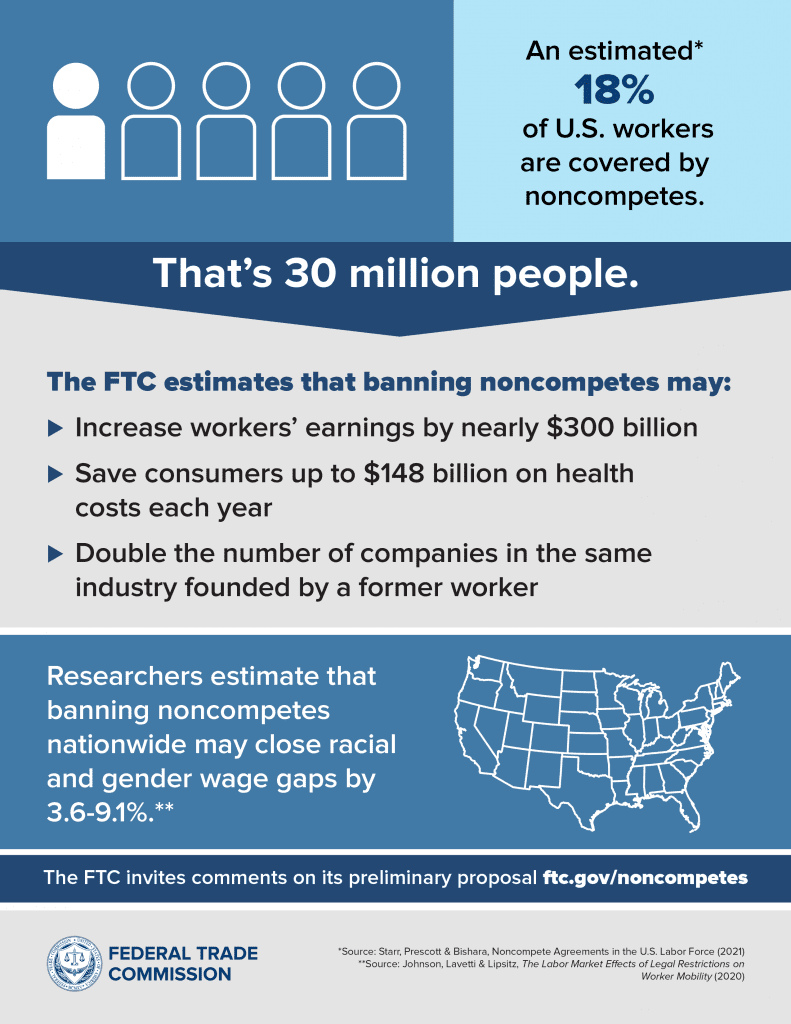
Anyway, the specific details in my situation don't really matter. My wife has also been bent over by a non-compete in a similar fashion. You need to read this thing thinking about the worst case possible scenario if the company wants to bend you over, and nothing less. Taking these lightly puts you at risk of a world of hurt. My wife had to step back and take shitty jobs for 2 years because of a bad noncompete (for a place that she worked at for 4 months before she was let go after a re-org) and her compensation pretty much halved during that time- we talked to a lawyer, he said yeah you will probably win in the end, but it might take a year, a lot of money, the outcome is uncertain, and no one is going to want to touch you while the case is ongoing. DO NOT take these lightly.
If you don't feel your interests are taken care of, don't sign the contract.
If you don't feel the other party interests are taken care of, DON'T SIGN THE CONTRACT. In my experience, whenever the first rule is not met, one side of the contract will not be happy. Good, long term relationship requires both sides of the contract to be happy with it. Don't waste time on business relationships that are broken from the start.
If the other party says they put this or that because legal needs it or because it "is a common practice", explain the above ("the contract is there ...") and if they can't understand it -- don't sign the contract. People will not want to change their standard contract because it is a hassle (it has to go through legal, etc.) but will frequently do it if you present reasonable argument.
If you know FOR A FACT that stuff is not enforceable, it is up to you how much you want to risk. If it is written in the contract it will pretty much fall on you to defend yourself and it may be long and costly. You should probably not sign the contract.
Understand, what it is they are buying from you. Are they buying 8h of your time every day, or are they buying 24/7, your soul and your family? If demand more than you are willing to sell -- don't sign the contract.
What if they pay you flat a flat rate regardless of how many hours you work and allow you to take as many vacation as you want? Be warned they might own all of your time. It is a business decision but make sure you are well compensated for it.
If the non-compete would severely cut your chances of getting more business, don't sign the contract. Non-competes are fine as long as they are making sense and are not wielded against you to force you in a servitude. If you are a web developer it might be ok for them to ask you to not develop apps for their direct competitors while you do business with them. But if you are backend developer specialising in banking applications, preventing you to work for another bank will be severely limiting your chances of getting another job -- which would most likely be another bank because they value your experience in the field.
If the contract requires you to pay damages in certain situations -- make sure the rate they are paying is high enough over market rate and your needs to cover your risks. I try to not sign those types of contracts although in some places those damages are almost mandatory to show that you are in fact a contractor (if you don't take responsibility for your work you are just an employee).
Work for hire of copyright and IP is standard. That's what it means to work for a company: you aren't working for yourself, you're working for them. You should look closely to make sure you can do a side hustle but other than that this is a little foolish.
I also disagree that contract negotiation means all that much. Certain lawyers are assholes but other people at their company might not be.
So the company owns the poop I excrete into the toilet at 2:00 AM on a Saturday night? The company owns the Crayon drawings I make with my child in the evenings? The company owns the poetry I came up with in a fever dream after some weird drugs? You say "you're working for them" like it implies some indentured servitude, where I'm living in the company town and they get to say how I live my life. I'm doing some scoped job for them in pre-defined hours for a pre-defined purpose, and for everything else in my life, they can get fucked. Honestly, your inhumane attitude is why people hate lawyers.