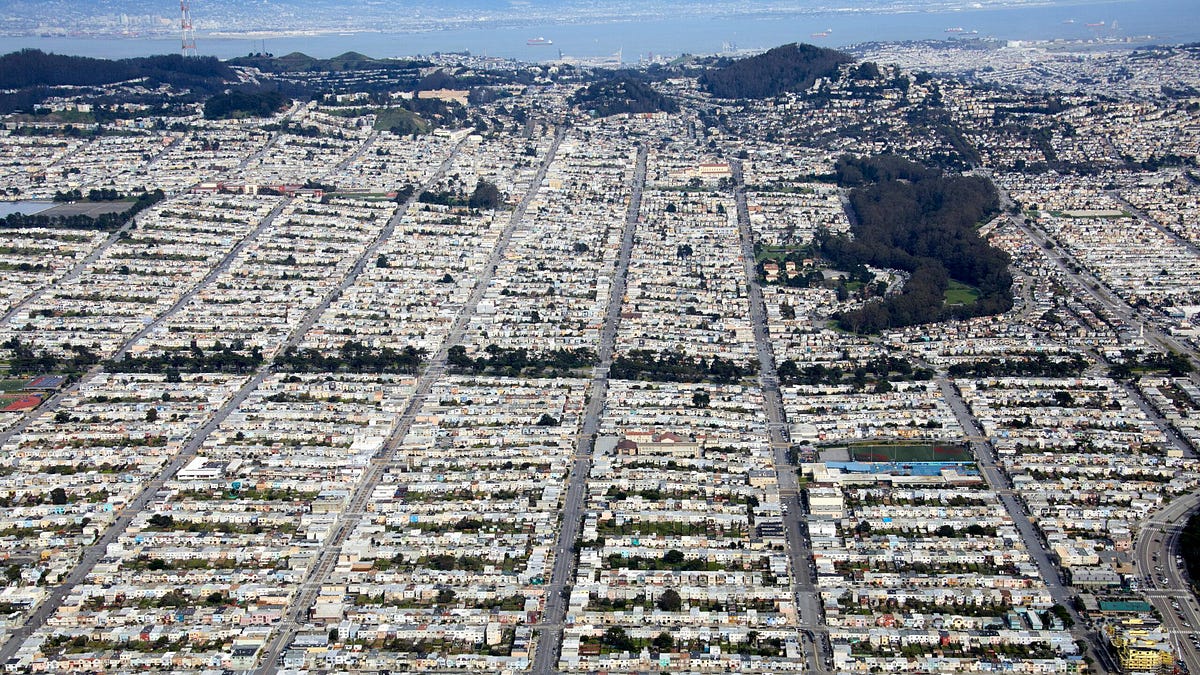
Bay Area Cities To Lose ALL Housing Zoning Powers in 2 Days
Old law proposes to turn the Bay Area's zoning system into something like Japan's in just two days.
darrellowens.substack.com
886 points · by yboris · 3y ago · 1229 comments
Remove zones alone, and HOAs will get areas into legally binding covenants that are also just as tough as their current zoning regulation.
To solve the US density issue, localities have to be severely restricted in what they can block, but we also have to look at the bigger picture: What is making people want to restrict their neighborhood to extremely low density suburbs? The answers are very uncomfortable.
Are they? Isn't it possible that people who live in beautiful neighborhoods with mature trees, nice big yards, and low traffic streets that are safe for kids to play around, want to keep them that way for primarily those reasons?
Of course their desires alone shouldn't be the final word on proposed changes to codes, but implying that all of these homeowners are primarily driven by prejudice is a pretty big leap given the many obvious benefits of the status quo for them.
I imagine you could take almost any demographic and put them in a low density neighborhood with big yards, trees, low traffic, and neighbors that they've known for decades, and they're going to resist change.
Actually, suburban streets are significantly more dangerous than urban streets, in terms of number of children killed, as a fraction of both population and miles driven.
> Motor vehicle traffic was the leading mechanism of unintentional injury death among children aged 5–13, with the rural rate (3.1) twice as high as the urban rate (1.5)
> Motor vehicle traffic was the leading mechanism of unintentional injury death among children aged 14–17 in both urban and rural areas; the rate was 2.5 times higher in rural (12.5) than in urban areas
https://www.cdc.gov/nchs/products/databriefs/db421.htm
> cul-de-sac communities actually have some of the highest rates of traffic accidents involving young children. In fact, children in suburban communities are five times more likely to be killed in a pedestrian accident than urban children.
https://www.lewisandtompkins.com/motor-vehicle-and-public-tr...
> City streets safer than suburban roads, study finds
https://whyy.org/articles/study-city-driving-often-safer-tha...
> Cul-de-Sacs Are Killing Us: Public Safety Lessons From Suburbia
https://usa.streetsblog.org/2011/06/07/cul-de-sacs-are-killi...
Basically how things were built pre-WW2?
* https://en.wikipedia.org/wiki/Streetcar_suburb
* https://www.youtube.com/watch?v=MWsGBRdK2N0&t=68s
The Oh the Urbanity channel has a video on the (misguided) idea that "urban living" = Manhattan / Hong Kong apartment blocks:
* https://www.youtube.com/watch?v=BCmz-fgp24E
Examples (Streetview):
* https://www.google.com/maps/place/125+Hampton+Ave,+Toronto,+...
* https://www.google.com/maps/place/50+Geoffrey+St,+Toronto,+O...
* https://www.google.com/maps/place/70+Jackman+Ave+Toronto,+ON
See also:
* https://www.youtube.com/watch?v=cO6txCZpbsQ&t=9m28s
Fifteen minutes pedalling in one direction is downtown Amsterdam, fifteen minutes in the other is farm land.
Because they were so close to dense housing, they also had the added benefits of public transit and being walking distance to several grocery stores. Much better than suburbia in my opinion.
Yes that is absolutely something people want. You can get that in cities if you give up on yard and instead share with parks. That said, some of the reasons people want it are uncomfortable.
Some people don’t like change and moved somewhere based on how it looked in <year>, understandable, but change is a part of life especially as our population grows. Streets that are safe for kids are common in many parts of the world, in many different city structures, not just suburbs. So the “family friendly” myth about suburbs isn’t true.
Regarding uncomfortable truths, if you go and listen to some of the town meetings, you’ll walk away with a couple points, of varying degrees of prejudice.
Some people simply want it to be “exclusionary” to keep prices up, and to keep themselves feeling special. Those people in town meetings may suggest paying for affordable housing in another town to keep theirs as is.
Some people will say they don’t want affordable housing because “we all know that those people bring crime”. This can be a varying degree of prejudice, whether it’s low income people or racial minorities, but invariably someone always says it.
Cars are currently two tons noise and pollution machine. It's no wonder why people feel unsafe around them.
You could restrict traffic to only bicycles and pedestrians combined with mixed zoning.
Also, lawn mowers....They're extremely loud.
You mean like all the medium-density neighborhoods of San Francisco? American R-1 suburbs are a nightmare for kids, and that's why you never see any kids outside there, tell me how this: https://www.google.com/maps/place/Menlo+Park,+CA/@37.4562493...
, in one of America's most expensive suburbs, is any sort of safe for kids.
Low traffic → Less cars driving
How do you get less cars driving? People need realistic options. How do you get those options? Density to support transit and Density to support having businesses close to everyone's homes so they can just walk or bike. Car-dependent suburbia IS the problem, and the more of it you have in the city the bigger the problems of traffic and unaffordability get.
Finally though:
> want to keep them that way
Look, don't get carried away. Unless a very significant block of homeowners in your beautiful leafy neighborhood are itching to sell, you have literally nothing to fear. Maybe when a large mall is demolished a mile away from you, someone will build something other than single-family tract homes. Big whoop.
*Nobody is coming for your suburbs with bulldozers* just because "SFH" might not be enshrined as the only way anything can be developed.
You're describing European cities, there. That is literally how I grew up in a big city, and we were lower middle class at best.
I'm from the Netherlands, and for the first 24 years of my life have lived in lower working class neighborhoods, 3 in total. Low income families, people on wellfare, the like. In this case all white, so it's not a racial thing.
All of these 3 neighborhoods were awful. Relatively high crime, vandalism, the public dumping of trash, alcoholism, very loud music blasting, shouting, just general anti-social behavior.
The biggest quality of life improvement in my lifetime is that eventually I was able to afford living in a good neighborhood. Middle class to a bit above it. Families, stable citizens, civil, considerate, sane. The piece of mind this gives is invaluable. This is just one step up the ladder, I'm by no means rich.
It's not elitism. It shouldn't be a high bar to feel comfortable, safe, and not constantly frustrated by obnoxious people, or the spaces ruined. But at the same time we should acknowledge that this "bar" is strongly correlated with class. For obvious reasons, in the lower classes more people have what I'll categorize as "social issues".
And here's the thing. It's a rotten apple dynamic. Perhaps as little as 5-10% of the inhabitants are responsible for all this shit, yet the entire neighborhood becomes unlivable because of it. The real issue here is that these rotten apples are not addressed. Because it's near-impossible to address. The behavior is petty crime at best and often merely obnoxious and anti-social behavior. You can't put people in jail for that and they have to live somewhere. This is already the lowest end, there's nowhere else to go.
So the positive here is that it's not racism (in my example), and not even classism. 90% of people in the lower classes are decent and social people. The real issue is the inability to deal with the 10% that is not. The dysfunctionals and anti-socials wrecking the place.
I'm sure that each has their own story, but I'm not going to suffer my entire life at their whims. I've done plenty of that. You could say that this "prejudice" is very much grounded in reality. Sometimes you need to a reality check.
It’s all about kids.
Without kids in the picture sure, go ahead, make cities look like Coruscant from Star Wars.
The instant you have kids you see how important open spaces safe enough for unstructured minimally supervised play are. Without spaces like this all you have are kids drooling on Roblox and YouTube all day. There’s nothing for kids in an urban core.
Those spaces don’t have to be undeveloped or even outdoor but I have yet to see a city successfully create an environment safe enough that I’d let my small daughters run around.
So while I agree that zoning is dumb and complicated, I also think it’s important to understand where people are coming from.
> but implying that all of these homeowners are primarily driven by prejudice
This is a good example of why being coy rather than explicit is bad for productive discussion. Bigotry of its various forms is certainly one possible uncomfortable answer to the question. But there are others, like crime, or the effect of local property-value-to-enrollment ratio on school quality, or plenty of other problems that systematically occur in American cities.
NIMBYism is by no means the exclusive domain of homeowners in low-density neighborhoods. Even when it comes from them, they are often concerned with developments that are not actually in their neighborhoods — their trees and yards not being in jeopardy. There's a fundamental distrust of the overall process of development that animates anti-growth sentiments not only in middle-class neighborhoods but also in, for example, the Mission.
For one if zoning laws change tomorrow no one is going to bulldoze those neighborhoods on Thursday. So everyone already in their "safe" neighborhood will remain "safe". Except in rare circumstances no one is going to build a 10-lane expressway behind that tract of "safe" houses.
Second you've got to be realistic about the socioeconomic factors behind those "safe" suburbs.
The small, often winding suburban streets are largely impenetrable to buses and completely immune to light rail. This means public transit often used by "those people" (for whatever local definition of "those") is inaccessible from inside the "safe" suburban housing tracts. This is exacerbated by many suburbs lacking sidewalks. Inaccessibility of public transit was a design criteria for early suburbs preventing anyone that could afford a house but not a car from moving to them.
Suburban streets are extremely dangerous to kids (in fact being hit by a driver is the leading cause of death to kids under 14).
You know what is safe? Walkable cities, pedestrianised streets, speed bumps wherever cars do drive inside the city, etc.
In the end it should be their right... but... what happens now, is that they underpay for the infrastructure and services they get.
This. Houston has little or no zoning and is terribly sprawling and car-centric. Despite the lack of zoning, in most neighborhoods you can't just build whatever you want because of restrictive covenants. Developers build massive car-focused single-family-only developments and load them with covenants that prevent anything else from being built on the property after it is sold.
We moved from Manhattan an hour north into a rural area. Our town clears our road continuously during winter, while are property taxes are low single thousands. We get three trash pickups per week and other trash removal services included.
We woefully underpay for those services.
It seemed to me that you could double the population density of that kind of neighborhood by replacing a single family lot with a 8 story tower every other block and filling in an occasional duplex, triplex or small apartment building. Such a neighborhood would be different but still pretty nice by most people’s standards, you can see neighborhoods like that in L.A. or São Paulo.
To be devil’s advocate though I’d say there are larger scale reasons why people might conclude that ‘California is full’. One is that the population density of California overall is about the same as Germany even though most of California is uninhabitable or massive farm fields. Certain regions of the coast are highly populated by U.S. standards even if they are nothing like Hong Kong or Singapore. The linear pattern of dense development means the radio spectrum is utilized like nowhere else in the US such that there are more OTA TVs channels in LA than some cable plans.
California struggles with water and any population addition would require adding more infrastructure of all kinds. It could be more highways, it could be more public transit but it has to be paid for. And the US is a country that spends 10’s of billions to duplicate a train station in NYC or run rail from Bakersfield to Fresno. A reasonable person could very well try to gum up the gears in that machine no matter how they can.
You might say that more population means more economic activity and more tax base but I am not so sure. A lot of it seems driven by inequity and monopoly power. Google and Facebook could not double their revenue by doubling their hiring in California and it is not so plausible that the next big startup in the U.S. would be able to accomplish what they’ve done. There was a time you could dream of selling a company like WhatsApp to Facebook even if going public was not in the cards but the monopolists would hate to have to spend that much to defend their positions and surely try to shape the environment to prevent that. (Now from Genshin Impact to Tik-Tok innovation in social/entertainment is happening in the PRC because that economy is more open to competition.)
And you could probably maintain or even increase the amount of ground-level "yard" space per capita even while increasing population density. Of course it would need to be parks that you share.
Like treat HOA as a commercial entity for purposes of trash, water and sewage. (HOAs are, de facto, incorporated organizations). Tax land under the roads as plain land.
As for localities - they should be mandated to reassess property values every X years and distribute infrastructure maintenance costs appropriately. I now live in a rural area, and I underpay taxes for the services I get... while smaller houses in town overpay.
Like cleaner air, safer streets, less traffic and a better place to raise a child and/or dog with backyards and privacy.
So, you ban cars from streets and allow only pedestrians and cyclists. Next, you allow local amenities to pop up so you don't feel the need to get a car out.
The suburban pattern of development as it currently exists isn't the only way to facilitate the quality of life you're looking for.
So, like in European cities.
Single and duplex zoning was a great deal for cities and close suburbs because they are operationally efficient - less services are required; fewer parks, fewer schools, fewer calls for fire and police service. It’s a good deal for people because financially it has been historically better to own a building and land vs rent or buy into coops.
For existing, pre-1990 low density urban neighborhoods, retrofitting medium density housing is usually a shitshow. Why?
- The areas of were detached houses that usually have yards, no parks, fire stations, etc.
- Because of healthcare and tax policy, it’s very difficult to run the types of small businesses that are needed to support an urban lifestyle. Boutiques, restaurants/bars and similar
- Because there are no local amenities, people still need cars, and there’s rarely enough parking to meet demand.
- Schools are tied to geography, and changes in school assignments are impactful and traumatic to families.
- Developers usually get tax credits for including street level retail, but have no financial incentive to rent them as tax policy pays them to do nothing.
If you look at functioning urban environments like NYC, you see it all over the place. I grew up in Brooklyn and Queens. As small retail fades away, major big box scaled retail moves in. The neighborhood 20-40k sq ft grocery stores of my childhood (Key Food, Finest, A&P, ShopRite) are being displaced by bodegas at the low end and big developments on the high end - which drive demand for cars and exclude people relying on transit.
You can only fix this stuff with fairly radical change, that will be very painful for lots of stakeholders.
> Because there are no local amenities, people need cars
Seems like the definition of inefficiency
> - Developers usually get tax credits for including street level retail, but have no financial incentive to rent them as tax policy pays them to do nothing
Damn
In a typical average HOA neighborhood:
* The HOA pays for landscaping of all the common areas like green belts and parks within the tract. If you don't have an HOA, you either are benefiting from your city choosing to locate and maintain those kinds of amenities right by where you live, or you just don't get any of those.
* Obviously one of the big ones, the other main HOA budget item is pools, clubhouses you can rent cheaply for parties, tennis courts, etc. For rich people they don't care since they have their own pools, but it's a great boon to people not rich enough to have a pool to have easy free access to one that isn't crowded and is close to home.
* They, in theory, fine you for outwardly living like an absolute slob or selfish jerk. NOTE: In practice nobody cares about most of these little rules, like mailbox color or a patio chair left on your lawn, unless you're acting wildly outside the norms. The rules are there to let them enforce them selectively on the person who's making everyone miserable.
* They regulate architecture and paint color. This may be my least favorite because it seems like we shouldn't need this, I have taste and why should I have to submit my stuff for approval to these jerks? But really, this is only there because there would be SOMEBODY who would paint their house an absurd garish color or build a giant ugly addition in their front yard or something that looks wildly out of place.
There are also HOAs that place a lot of weird restrictions on what you can do. It really depends on the HOA, some are good, some are very bad.
That said, for the place where I personally am in life, a HOA is bad and I refuse to live in one.
You cannot buy without being a part of the HOA.
At a high level, anyone can sue you to enforce a deed term, as long as the organization/person with an interest is around to do it and knows to do it. As an easy example, a long time ago people added racist stuff to deeds, but those family descendants no longer enforce it. HOAs don’t die like people and collect dues so they don’t run out of legal fees.
You can try to get dead HOAs removed from a deed, and you can try to get a living HOA removed from a deed. Obviously one is a lot easier because it doesn’t fight back. You can also get the residents to vote to dissolve an HOA. Some HOAs expire after so long if the residents don’t renew.
TLDR you can’t buy the house without agreeing to the HOA.
To get at what your really implying though, what's wrong with maintaining some degree of cultural homogeneity in a neighborhood? It's a good thing in that it makes for high trust communities.
If I'm in a city and and I own one of these houses, it's clear economically that wanting to limit building multi-unit housing near me enhances the value growth of my property - because you can't build nearly as many SFH as you can apartments. I'm sure racism and fear of the other is still an issue (I'm from the south, I know it's an issue based on personal experience) but it's far more economic imho today. The end result is the same, people want to hold on to what they see as part of their "intrinsic value" in their neighborhood setup.
This argument never made sense for me. Being able to put more units in the same space drastically increases the value of the land. It of course reduces the value of other things like having towering buildings around your 2 story home which blocks your view. In this sense, home owners need to turn to zoning to prevent that despite it being detrimental to their land value.
Most of all people want exclusivity. Only having a handful of neighbours is something that is hard to buy. It's easier enforced through regulation.
Established neighbourhoods push for regulations to keep people out.
In the past it absolutely was for racist reasons. Today more likely economic ones. Apartments means renters which means less wealthy people. Exclusive detached home areas are pretty much guaranteed to have a high floor of wealth.
That’s just urbanists smearing people with innuendo about racism to advance unrelated policy goals. It’s actually ironic, because one of the major population trends right now is “black flight” to the suburbs.
People, especially families, like low density suburban zoning because it’s convenient. I live in a pre-zoning code suburb with houses packed tightly together. People are always fighting over parking spots, contractor trucks can block people into their parking spots or block the road, etc. There’s a lot of retired people, and they complain about families with young kids moving in due to the noise. (And these are white and white adjacent kids too.) My parents refused to move into the subdivision, and instead moved nearby to a 1 acre plot surrounded by trees where they didn’t have to interact with their neighbors.
Because it's actually what many people want. They want a house in the quiet suburbs that they can sell in 30 years for much more than it's worth. This is obviously all because nearly everyone alive that can vividly remember a time before WW2 are dead. All they know are car-centric architecture. And we all know how much people love change.
Sooner or later this will collapse disasterously
They need a way of keeping out black households without violating the legal prohibition on an HOA saying "no black owners".
(1) Minimum parking lot size requirements (as others mentioned). Commercial properties are required to have X amount of parking spaces available.
(2) Political issues and how money gets invested: despite public "protests" (maybe more like "kvetching"), there's continued investment in freeway expansion / car-centric infrastructure due to lobbying/other political efforts instead of public transportation.
Our sprawl is more due to (1) and (2) rather than lack of zoning regulation.
But also to Houston's credit, things are slowly (SLOWLY) getting better.
This one irks me the most. we have 8 parking spots for every car and giant shopping malls are surrounded by parking lots that take up twice their size and are 50% empty for 95% of the time (more if you count night time)
Japan has strong national zoning laws that are very strictly applied. The biggest differences are the zones allow for a looser range of outcomes than the American ones, and the zoning approach is not controlled by local government (which often is NIMBYs)
Rent has gotten so outrageous that this is a good thing now.
My place overlooks a freeway. I really, truly dislike that freeway. But one thing I do like about it is the noise that it makes, even at night. I find it very hard to fall asleep in silence.
Oh and I should mention that most of the units in my building do not face the freeway, and therefore, those who prefer quiet can also get that, even in the same building.
I read an article a year or two ago (maybe posted here?) about Japan's zoning laws and they just make sense.
- Rather than dozens of categories, there are just 4 or 5 in increasing amounts of annoyance (e.g residence -> retail/office -> manufacturing) and areas approved for one level can always be used by lower levels.
- The laws are uniform nationally.
- Zoning decisions get made at higher levels (prefecture or national?) so they can consider what the whole region needs, and get less NIMBYism / maximize-my-near-term-property-value-ism.
I don't recall whether they even have the distinct single-family versus multi-family dwelling categorization that seems to cause so much of the housing supply shortage in the U.S.
Houston technically has no zoning laws, but it has a combination of other laws that end up behaving similarly to exactly how zoning laws work. Giving you a link to City Beautiful which works as a great primer.
Aesthetic judgments aside, seems like a winning strategy for housing affordability?
It's easy to have cheap housing when you ignore common sense and just build wherever. (Also, part of the expense for LA and SF is that we have earthquakes, and our buildings have to be built to withstand earthquakes. For example: a 5.4 earthquake in 2011 caused over $300 million in damage on the East Coast. A series of CA earthquakes stronger than that in 2019, including 6.4 and 7.1 quakes, only caused a few thousand in damage near the epicenter. A 5.1 earthquake earlier this year in SoCal caused so little damage that most people slept through it and only know it happened because the news reported it. Note that each "magnitude" is about 30x difference in strength, so the 6.4 quake was 30x stronger than the 5.4 quake, and the 7.1 quake was nearly 900x stronger.)
Houston has had a stable population (per square mile) over the past decade and has a median income of ~$50,000. Sacramento has had the population per square mile increase by ~15% in the past decade and has a median income of ~$71,000. San Francisco has had the population per square mile increase by ~9% in the past decade and has a median income of ~$126,000.
In Houston, we have what is effectively zoning. It's just that we do it at the neighborhood level. You want to go into the museum district or third ward and develop x, or y, or z? No problem. So long as the neighbors agree with you.
Hint: Once they gentrify to the point of being called "The Museum District", they will definitely not be agreeing with you.
I saw someone above throw out a figure of 3 or 4 hundred k as a price point and I had to chuckle. If all you want to do is build a low-rise for workforce housing? Yeah, this neighborhood wouldn't care if you had the money or not. Piss off peasant. The people in the Museum District no longer wish to reside in proximity with your kind. Some neighborhood get togethers you almost get the impression that people would like to put gates to the city at all the 610 exits. Keep the riff raff out. And don't even get me started about what I hear from friends behind the gates down Sunset.
In Houston, the zoning is way worse than in other cities. Because people can literally stop anyone they want. No city council permission necessary.
Houston is a huge urban/semi-urban sprawl, the kind that used to be popular in LA a few decades ago. Dallas is similar, Austin gets that way outside of its downtown, San Antonio does also but at least has a much more interesting urban core. It always seemed you get what you pay for in Houston, there isn’t anything wrong with that, but many people don’t want it.
The outer loop of 99/Grand Parkway nearly encompasses D.C. and Baltimore [2]. Commuting from 99-adjacent (e.g. Sugar Land, Cypress, and the Woodlands) to downtown is common enough. I've seen Katy to Baytown for months while working on (oil & gas) projects. Same goes for Midtown/downtown to Baytown to work in the refineries. Trying to serve an area of that size with any sort of transit is not easy, regardless of density.
As Houston continues to grow, it's going to continually max out arterial road capacity. Even Katy Freeway backs up every day despite being 20+ lanes at its widest [3]. All of those cars have to go somewhere. And you're devoting so much valuable real estate to dozens of lanes for a few hundred thousand commuters. Not even the reverse commute will save you [4].
I have another post that mentions my optimism about Houston suburbs eventually providing more transit and density [5]. It's silly that your choices of hosing are single family or stranded apartment buildings adjacent to the highway [6]. The inability to convert some number of homes into 2 or 3 apartment buildings on the same lot like this [7] seems less disruptive than 5+ unit apartments.
Fundamentally, both are much easier than providing increasingly-distant suburbs with power, water, and highways. Hopefully Houston can start embracing this before prices become as ridiculous as other regions.
---
[1] https://tcwp.tamu.edu/wetlands/wetland-loss/ [2] http://mapfrappe.com/?show=64047 [3] https://en.wikipedia.org/wiki/Interstate_10_in_Texas#/media/... [4] https://mobility.tamu.edu/mip/corridors-pdfs/houston/HOU-22-... [5] https://news.ycombinator.com/item?id=33567501 [6] https://www.google.com/maps/place/Brea+Luxury+Apartments/@29... [7] https://www.apartments.com/43-hooper-st-worcester-ma/9rsxk34...
Houston, which also has loose zoning, looks totally different because most Texans want to live in suburbs and drive cars.
In other words, zoning laws are generally an expression of what the majority of people already wanted.
I can tell you for sure that in most parts of California (and most of the rest of the USA) the majority of people want to live in a detached single-family home that they own, and prefer driving cars to public transit.
People who prefer a denser arrangement are an especially vocal minority on the internet, but if you put it to a vote, you'd end up with pretty much what we have today -- the fact that people wanted them is why they got built in the first place!
Certain types of housing are illegal because people don’t like them, and voted to ban them! Zoning laws don’t just magically appear out of nowhere.
They key is that they don't do Euclidian, or exclusive zoning. You can build housing in almost every single one of their (iirc) fifteen different zoning designations.
So to US norms, this feels like "no zoning," but it's still restrictive in many ways. Just not in a way that says "only housing here" or "no housing here." (again on that last one, in the vast majority of cases, but not strictly speaking all.)
Suburban sprawl is fine and coming from NJ, going to a place where it doesn't exist feels very strange.
My brother lives just outside Charlotte - outside of the airport and city proper, you hit what I would consider rural areas within roughly 20 minutes.
It's a thing...I guess?
For people that like the quiet living they can live in a nearby town (Duvall has around 10,000 people living in the town), the density of the town means you’ll probably be close to a grocery store and other amenities, and probably even a bus line or a commuter train to the nearby city if you need to commute to work. Meanwhile the countryside is open for everyone (including city dwellers) to enjoy.
It feels like sacrificing this for boring monotonous suburban sprawl (as is tradition in California) benefits nobody while ruining a good thing many have.
Palo Alto has fought these rules and I'm glad they will be enforced. When I first moved to Palo Alto in the early 80s it had a very progressive climate: a couple of SRO buildings, lower average income than some of the neighboring towns, a lot of social support programs, and decidedly un-fancy retail. But the flood of gold-seeking people who showed up for the dotcom boom allowed the real estate interests to seize control of the city council and in general made the town much snootier. The SRO hotels turned into boutique hotels and a lot of long term residents were ejected. Well those assholes are reaping what they have sown, thank goodness. Perhaps we'll recover some of the chill experimental vibe thanks to an influx of new people.
I hadn't realised the housing shortage issue stretched back decades. It sets an interesting context for Prop 13 (basing the tax base on the purchase price, not generally on assessed value) since the zoning rules were so exclusionary. Basically, shows that the State's tax difficulties are themselves the consequence of exclusion.
I wonder how this will work outside the dense areas. For example, Calaveras county has a shrinking population, but the main sources of jobs and taxes is construction. With no constraints on construction will there be a small boom in new development, tearing down virgin forest in order to make empty developments?
China has a lot of options for cheap housing, none at all legal, but rule of law isn’t really a thing there so just keep things quiet. In Beijing, you can rent a windowless sub-basement room for a few hundred kuai a month, mold is an issue, but it’s better than other options. Waitresses also often crash on the floors of the restaurants they are working in, so the windows are all blinded over in cardboard after closing time. This is all working poor, it is really hard to be a vagabond in China because the social safety net just isn’t there for it (and you can’t just crash under an overpass because the police are already in to that).
Probably? I live in Michigan, which (with the exception of two spots) has no meaningful limits on construction. Even the cities that technically have-and-enforce zoning, waive all the rules constantly anytime a developer asks.
And yes -- it means developers can build almost anything they want, almost anywhere they want. (Truly anything, I live next to a 15-story concrete castle apartment building that a developer built on what was once a trailer park).
Unfortunately, it does not mean you get lower cost of housing (prices here are still astronomical, and while they look cheaper in comparison to California, is only because of the severely reduced income locals make -- prices are still at record-all-time highs)
But it does mean, developers routinely cut down entire forests or farmland for new suburbs anytime they'd like. If you want a house made of sticks and cardboard, we have loads and loads of them for 'just' $450k. Years worth of 'inventory' here.
Are you taking into account the inflation we've experienced? If the mental anchor against which you compare this "all time high" is 2015, for example, then we've seen over 20% inflation. Over 33% inflation since 2008.
By these numbers, up about 78% since 2008 and 2015, which almost matched.
Up 50% since the previous peak in 2005, so yeah all-time high.
Ah, the good ol' Grandville castle.
It boggles my mind every time I drive past that someone decided to spend tens of millions to build... whatever the hell this is. https://cdngeneral.rentcafe.com/dmslivecafe/3/610177/DJI_018...
You don't believe in supply and demand? I'm not saying you have cheap housing. I'm saying you would have more expensive housing if there were fewer of them, the same way GPUs are more valuable when there are fewer of them.
Induced demand is a thing, as (and much more common) are demand curves that are flat enough that shifting the supply curve to the right by some large fraction of the current market clearing quantity has no discernable effect on the market clearing price.
Real life supply and demand involves more than the simplest Econ 101 illustrative examples of the general direction of the ideal relation.
The bad outcome is the rich who are looking for alternate investments will buy up all the labor and materials and build construction for themselves and will build rentals. That's the bad outcome.
The awful outcome, and likely outcome is that the labor and materials will be bought by newly formed real estate companies that will build rental property that is ugly and expensive - because they control the market more and more as they merge into 2 super landlord companys.
A lot of people I know in Colorado found this out when their homes burned down. They had the structure insured for like $500,000 and found out that rebuilding their home that was built 20 years ago would cost around $1,000,000.
A friend recently had a multi story addition put on his house, and of course additions always cost more because there's some amount of demolition and working on an existing site, so the new footings have to be underpinned, etc. It's also a large kitchen and the existing kitchen space had to be demo'd and rebuilt into a new, basic room. The upstairs connected to a hallways but there was some work. Anyways, the cost, all in was over $500k. Even if he didn't use Marvin windows, Wold appliances, nice cabinetry, etc it would have been like $400k. And yes you can go lower. But don't be fooled. A lot of the cheaper construction you see is not only made with awful materials and lazy/inexperienced tradesmen, but is also track housing or similar no modifications allowed type things.
The building occurring downtown is insane. I haven't seen anything like it since the booms in Shanghai and Dubai.
You are confusing cause & effect here.
I think that I'm missing something here unless there happens to be an infinite supply of people looking to move to your city.
I'm not sure what you mean by tax difficulties, if you mean the state has trouble raising revenue, that's certainly not the case. CA is running a large budget surplus right now. If they only relied on property tax it could be an issue, but they also have an income tax, so the revenue outlook in CA is pretty good right now.
The nice thing about property taxes is that housing prices change slowly, even in boom/bust cycles -- essentially they are coupled to a dashpot. While income, especially in California with a progressive system coupled with most of the high earners paying cap gains, leading to large swings (further influenced by the Fed).
Also property taxes are the main source of municipal and school funding; with property taxes artificially pulled low, the state needs to step in instead. In addition, the structure of Prop 13 discourages people from moving which reduces the availability of housing stock.
Prop 13 wouldn't be so bad if it excluded commercial buildings (including rental properties) and didn't have the huge inheritance loophole. But neither of those is likely to change.
The reason I mentioned the coupling between prop 13 and exclusion: Californians voided all restrictive covenants in the 60s, which lead to more selective zoning restrictions; Prop 13 came from conservative southern californians and (due to the stickiness mentioned above, including a retroactive valuation reduction and the inheritance loophole) locked a lot of "those" buyers out of the existing neghborhoods.
There's a "homesteading exemption" for taxes on a primary residence. This means your property taxes can't shoot up massively if your property suddenly gets more expensive.
This pushes even more of the property tax burden onto investment properties, which sounds good to some in theory, but one affect it has is that rental properties are investment properties. So rents go up a lot. This means renters end up paying a lot of property taxes, which is, uh... a surprising outcome.
Prop 13 is IMO the biggest problem that California faces, because it’s the most intractable to solve (it would be political suicide to try to roll it back now that so many people are paying way lower taxes than they would without it) but is also a major contributor to a lot of other problems in the housing market. I can think of ways to roll it back slowly, but let’s be real, people will freak out if they think they’ll have to start paying 5x what they currently pay in property taxes, even if it’s after they die or in 20 years from now.
https://taxfoundation.org/state-property-taxes-per-capita-20...
California property taxes for $1620 per capita, which is average. How does this translate to “so little tax from property”?
IMO Prop 13 is at the root of a lot of dysfunction in CA, but personally I hate it because these extra income+sales taxes put a lot of tax burden on new residents and young professionals.
Mountain View has much more around the San Antonio Shopping Center where it's starting to look like SF.
I'm wondering if there will be random developments that will sink property values because big city blight comes with : homeless camping, property crime, and so forth.
Palo Alto is unique in California in that it is/was legal to dwell in a vehicle because it wasn't criminalized since the law had to be rolled back due to a Ninth Circuit ruling about another law in LA.
Prop 13 uses assessed value, but only allows unlimited assessment increases at sales, some other non-exempt transfers, and a few other qualifying events, otherwise, the year-over-year increase in tax basis value is limited to 2% or the rate of inflation, whichever is lower.
But, also missed in most discussions of Prop 13, is that it capped property tax rates at 1%, which (even before considering the value missed by the assessment cap) is not only way below the common rates prior to Prop 13, its way below the national average effective property tax rate.
Prop 13 isn't a result of exclusive zoning, it is—like exclusive zoning—a measure that protects status quo elites at the expense of everyone else.
> For example, Calaveras county has a shrinking population, but the main sources of jobs and taxes is construction. With no constraints on construction will there be a small boom in new development, tearing down virgin forest in order to make empty developments?
Neither Calaveras County nor any city therein has a noncompliant housing element, so “no constraints” due to builder's remedy is not an issue. OTOH, other places in the state getting more housing is more likely to accelerate Calaveras County population loss.
Prior to these changes, so much new housing was forced into the urban-wildland interface that entire neighborhoods regularly burned in our seasonal wildfires. The hope is these rule changes will force cities that use land inefficiently to densify rather than encourage more sprawl.
The developers still have to abide by construction laws - safety, and I think environmental impact. All that’s released (AFAIK?) is the zoning-based “no” from cities (and when within a certain distance from public transit hubs, maybe).
https://darrellowens.substack.com/p/yimby-triumph-in-califor...
That article doesn't mention it because that's not correct. It's not tied to transit.
[1]: https://www.theatlantic.com/ideas/archive/2021/03/signature-...
And if the pressure for a statewide emergenct declaration on the housing crisis bears out, well, a lot could happen without legislative change.
I suspect they have a plan for an absolutely massive high rise behind my house that they will be submitting at 8am tomorrow morning.
My neighbors are going to be pissed.
There is a massive amount of demand for housing in California that is being choked by restrictive, ruinous zoning. Meeting that demand is going to take some big buildings.
[0]: https://www.planetizen.com/news/2022/12/120313-first-full-bu...
A high rise in the middle of a popular suburb is an easy way to do that and does exist in many parts of the world.
https://www.valuepenguin.com/mortgages/historical-mortgage-r...
You're right though, I'm sure they'll do as little as they can to get their project approved and stay approved while waiting for cheaper money.
I wonder what the repercussions of this type of uncontrolled building will be.
An overreaction to a frustrating situation usually doesn't end well.
There are good reasons to have construction permits, so growth can be planned. There's also endless ways cities abuse the permit process. But the good reasons still exist.
If developers are allowed to build without any limit, who is going to be planning for all the requirements external to the new building? Water supply capacity, sewer capacity, traffic flow into and out of it, new schools required, etc?
Developers are happy to build a building, sell all the units and leave town with the profits. But additional units do generate additional support needs from the city infrastructure, is anyone considering these needs if a developer is allowed to build anything they like no matter how big?
* Clearcut wilderness to build more suburban homes
* Don't build more homes, just stuff more people into existing homes
* Let the excess population live in cars or on the sidewalk
* Cull the excess population
It's also more efficient greenhouse-gas wise, as suburban sprawl means more driving to transport goods.
And 'affordable dystopian' housing? Only 20% of the units are required to be affordable. Who knows what private developers will come up with to maximize their profits. So, dystopian? Probably. Affordable? Just a little.
Guess who fits that demographic? Young single people and young couples who go out. The average middle age crank needs a house without shared walls and space.
There are individual preferences at play here. No one chooses a high rise, it's just more affordable. The exception is amenities, doormen, other services.
We just went from democracy to oligarchy in this case.
If the new housing represents a net increase in people, then the developers are filling unmet demand. It’s not that different from restricting the supply of milk and getting angry that milk producers will make more money when those restrictions are lifted. Yeah, they will, but only because there is more demand for their product than they were previously legally allowed to satisfy.
Developer margins should actually decrease when zoning is more permissive anyway. Right now in SF there is a whole cottage industry of “facilitators” and direct graft/corruption making it hard to build housing unless you know how to work the system.
While it’s absolutely true that developers can cut corners, I personally don’t see them as any more evil than any other business.
This is the same reason why there's a persistent myth that homeless are bused in from other states or whatever (when in reality, 70-90% of them were in homes in San Francisco before going on the street). It absolves people of blame
At this point the market has been so perverted by entrenched interests blocking new development that I would be okay with a dictatorship of developers for a solid decade. It might be enough to dig us out of the hole we're in.
Seriously, I don't care if developers are "greedy". "Greedy" describes every business and most people!
“It is not from the benevolence of the butcher, the brewer, or the baker that we expect our dinner, but from their regard to their own self-interest. We address ourselves not to their humanity but to their self-love, and never talk to them of our own necessities, but of their advantages” ― Adam Smith
That is an interesting question. In many cases people here are advocating that the locals don't get what they want, so that "the rest of society" does.
Hint: Developers don't have power over communities, rich homeowners do.
They make something that people would like. Calling that "power" is extremely unhelpful.
https://oregoneconomicanalysis.com/2021/03/16/who-benefits-f...
I think his profit margin must be okay.
In practice, coming from CA, I am 100% onboard. It's a mess of red tape and bullshit lawsuits.
So instead we have this dumb system where every city gets a target number from the state and can choose where the housing goes, as long as they can show they meet the target. "Local control!"
Most of them are choosing really dumb spots - Orinda is trying to put 200 low income homes on a freeway shoulder near the Caldecott Tunnel, Palo Alto has two Caltrain stations but is trying to put all the new apartments near the 101 freeway.
you make it sound like it is a bad thing.
Near the freeway and in walking distance of downtown is one story, near the freeway and next to absolutely nothing else is another. https://eastbayforeveryone.org/wp-content/uploads/2023/01/20...
And as the state government has said -- cities can still plan their own growth! They just have to plan some growth rather than none, which, obviously, is the sticking point.
They are able to plan their own growth, but they aren't able to refuse to grow. Or at least, not through zoning; being located where potable water or sewer/septic are at capacity is probably still valid to restrict new building.
Also, the "builder's remedy" specifically avoids EIRs of almost all types, including traffic and parking.
The City of Monterey has a page[2] describing this as well as a published wait list [3], with the first project having submitted in 2003.
I don't know if they deny construction permits, but you'd have to be pretty foolish to actually construct residences that can't be legally occupied because they lack potable water.
[1] https://www.mpwmd.net/regulations/water-permits/water-meters... [2] https://www.monterey.org/city_hall/community_development/pla... [3] https://files.monterey.org/Document%20Center/CommDev/Plannin...
Personally, I would say that lots of low-density communities do remain low-density. And generally, that's because people don't want to move to them.
But if you're a small town in Northern California, one of the most desirable places in the world, saying "we want to remain low density" is basically saying "we got here first, so it's ours -- nobody else gets to have this!"
And I think that's a fundamentally wrong way for us to organize our places. Desirable communities shouldn't be able to keep out people who want to come in, just because they want to stay exclusive.
But I don't think that's a settled point, and there is a lot of nuance to basically every adjective I just used.
For one, California is split up into many smaller towns/cities in large metro areas, so each having their own policies leads to locally-optimal but regionally-suboptimal policies of trying to get as much commercial development as possible with as little residential development as possible. This is a direct contributor to gentrification (if you are “lucky” and able to soak up the commercial demand without increasing residential supply, you’ve created a mismatch between jobs and people in your area), ghettoisation (the people priced out of where they were before have to go somewhere), traffic (people have to commute into their jobs), and affordability (even the bad communities can’t increase housing much because they have the weakest tax base, plus all the restricted supply where jobs and taxes actually are).
The right solution to this problem is to recognize the whole local-optimization problem and make it so every municipality has to solve the problem at once, to prevent the adverse selection of solving the problem in only one municipality. Which is what the state of CA is doing.
This could also be addressed from the other side, which is a complete political non-starter, of trying to limit job growth. Obviously nobody wants to do that. But the problem by and large is not just that CA has a lot of low density communities that want to remain that way, but also that those low density communities are creating more jobs than they can house.
Places like Gilroy and Morgan Hill will probably be mostly left alone in this, and this will probably apply downward pressure on their housing prices, making it more affordable for people to live in low density neighborhoods, while not having a 3 hour commute from the central valley.
Obviously developers could target those cities, but they would probably start with more desirable ones first.
I personally love low density living, and I live on a 9 acre lot as a result. But, I can't keep my neighbors from subdividing their lots. Locally, my city (in WA) has places that would be better suited to higher density living and places that are not so well suited; but city council drags their feet on all new construction, so we're not meeting state growth targets here, and I suspect we'll eventually end up with something like described in this article. That would be unfortunate, IMHO, because increasing density in a desirable place to live is inevitable and I think it's better to have (expanding) pockets of high density rather than greatly mixed densities. It's easier to add 30 residences where there's municipal water and sewer than to extend municipal water and sewer 2 miles to a new project site where neighbors are on private wells and septic, which doesn't tend to work well for a 4 story condo building.
Looking at this abstractly, buying a plot of land grants you ownership over that plot, nothing more. So on what basis should an owner of one plot be able to dictate what others can do with their own plot?
Scaling up to a community, what % of plot owners need to share an opinion for that opinion to outweigh the property rights of disagreeing plot owners?
To my knowledge, the relevant collective management levels recognized under law are municipal, state, and federal.
Where does "community" mean anything beyond being a manufactured scope of convenience for NIMBYs? They can't get the entire city to agree with them, so they draw an artificial boundary where the majority agree with them and call it a neighbourhood.
And it's a sort of collective coordination problem, too. People can move from city to city, and if a city decides to allow lots of new housing, they'll get lots of new people, which not only increases density, but also lowers rents in other cities by a little bit, while not lowering the rents/property prices in their own city by as much as they would if inter-city migration weren't a thing.
So when a city allows more housing, it benefits other cities. It's best if every city does this -- but because the incentives are a bit messed up, most cities in California have decided to "defect" and block construction. (There are other reasons -- people with the most free time to attend city council meetings and run for positions in local government are much more likely to be landowners or landlords, so they are over-represented, while renters are under-represented).
If every city and town builds a some more housing, you can get a much more drastic increase in affordability than if only some are shouldering all the burden, without massive changes to any one place. Which is why I think it makes sense to handle this at the state level.
Housing near job centers is a scarce resource, we shouldn't put up with people hoarding housings anymore they we would put up with someone hoarding water during a drought.
As such, any power your local community has to govern itself is just largess from its state. When it stops governing in a way that the state approves of, there is nothing preventing the state from stepping in.
I'm not proposing allowing a chicken processing plant in a residential area, but it's no one else's business if you want to build a duplex on a lot you own.
Otherwise it's a tyranny of the majority over the minority (of property owners) that want something not low-density.
If a landowner in a low density community wants to build high density housing on their property, why should the city be allowed to stop that?
So either you go right wing and you have no right to restrict developers on land they legitimately procure
Or you go left wing and you have no right to impose (?accidentally...ish?) racist, classist, and generationalist zoning results on people.
Or you go centrist and point out that population growth, livability, and cost for practically everyone is raging out of control because of zoning laws.
Now, that's all policy reasoning on idealistic grounds, which of course matters not at all! The real political calculus is rich (landed) vs the young / middle class / poor (priced out).
Also the whole idea behind the suburban experiment was the idea that it was a finished state. That there was absolutely no need to densify or plan for growth, because more suburban land could just be annexed.
I think it should really be decided at the metro area level. Since job markets exist at that level, having housing decisions there avoids the problem where a city benefits from a booming economy but refuses to provide housing to anyone participating in that economy, shoving that responsibility onto the other nearby cities.
They should, but they have very few incentives to do a great job, as they're funded either way.
What US city has actually done this though? More often than not, their councils are stacked with NIMBY types that let growing pains fester forever.
I reject this principle. Cities are not sovereign.
A real city is better when you can walk to things near where you live, like offices, doctors, restaurants, etc. You get that so easily with housing on top, businesses below. And businesses interspersed with the housing. It just works.
Maybe half the houses and apartments in the city were built to last 30 years. They are literal tear-downs and should be replaced. It's that simple. There are lots of valid points to debate here but crap houses made of rotting sticks just need to go.
If nobody wants to sell, nobody wants to sell.
But eventually...
Change will happen, people would gladly pay a normal Bay Area house cost to get 1/10 of an Atherton house and live in that school district
School districts/boundaries being so unequal is at least partially the result of zoning policy that makes it harder for people of less financial means to move into affluent areas.
I saw a counterexample living in Munich, just in the sense that the differences between neighborhoods in apparent wealth were much less stark than in the US. Almost everywhere looked vaguely middling, very few places looked obviously rich or poor. And so it's no surprise that the differences between public schools was lesser too.
And how about estate sales? Are the out-of-state heirs going to care to who their parent's property is sold? Or are they just going to go for the top dollar?
This "hack" is apparently used in famous "no zoning" Houston to keep exclusive neighborhoods exclusive (https://kinder.rice.edu/urbanedge/houston-doesnt-have-zoning... )
Virtually every affluent residential neighborhood in Houston has strict private deed restrictions — and, remarkably many of those deed restrictions can be enforced by the city. That’s why River Oaks, Houston’s wealthiest neighborhood, doesn’t have apartment buildings or office buildings in the middle of the neighborhood.
https://www.cnet.com/culture/george-lucas-to-build-affordabl...
But on the other hand, the coalition of rich neighbors could organize a counter-offer to buy out neighbors who want to leave. A bit like lands are bought up by conservation groups to prevent development. Put a price on how much you want to preserve your neighborhood.
They could even buy out the developer who purchased a spite sale, unless there are deed restrictions in that sale. Most developers are also doing it as a business, not for idealism, so it there ought to be a price point where they see it is more lucrative to fold than to go forward with the building project.
I'm not sure I understand the economic effect of something like this. At first blush it almost seems like the same feedback loop as land value taxes. But, it also creates a game-theoretic scenario where the coalition is pumping up the price of their own neighborhood and increasing the potential gains for the next defector, at which point the values could rapidly unwind if the coalition loses its way.
You really do not realize how big (or small, rather) apartment complexes are. 100-unit building is the size of 6-7 single family homes (or maybe 3 McMansions), and maybe twice as high. It would barely be noticeable in such neighborhood.
See this for example: https://ctexaminer.com/2021/10/23/100-unit-apartment-complex...
" There’s a lot of questions still unanswered, though. This will all be legally challenged since we’re in new territory with the HAA. Many developers still can’t believe it and aren’t sure to propose nor have readied capital to propose projects. Other builders since the Santa Monica news appear quite excited to build apartments in exclusive, expensive enclaves they’ve always wanted to. There’s a political question too about whether HCD will let substandard housing elements through just to not anger cities and incite backlash. "
Very likely the 'political question' will not be limited to 'whether HCD will let substandard housing elements through'.
I do wonder if anti-trust could be applied against such a "don't sell" pact, especially if it was successful enough to capture an entire town. Probably not, but that sort of anti-competitive behavior should most definitely be illegal, with stiff penalties for those who participate.
Then, they get approved.
Then the city gets it's zoning laws in place and regrets the approval of your massive ugly development.
But then you go to the city with an offer... Send in a new, more reasonable plan. If they approve the new plan, great. If they don't, you're gonna build what they originally approved, and they hate.
Same energy as states who pay for their homeless to come to California and then blast hit pieces about how terrible California is to live in.
California NIMBYs still have enormous autonomy through CEQA. It enables any individual to contest developments for years, obligating developers enormous sums of money and time to study "environmental impacts".
Last winter, the law was expanded through a ruling in Berkeley. If a development adds a sizable number of people, it can be seen as an environmental impact and denied.
Development will remain costly, time consuming, and ultimately as unpredictable as the law allows. Wealthy and well connected developers might get by, but it won't be a Japan-like situation. For those wishing reform on an "environmental law" it will be a lot more politically costly. We'll likely get another Houston situation where "no zoning" doesn't imply what it should imply.
https://www.theatlantic.com/ideas/archive/2021/03/signature-...
https://calmatters.org/commentary/2023/01/how-environmental-...
As for CEQA, here's what a local law firm has to say: "In particular, the intersection between Builder's Remedy and California Environmental Quality Act (CEQA) remains untested. Jurisdictions may try to use CEQA to regain discretionary authority over Builder's Remedy projects. Whether that tactic will prove effective remains to be seen, given that CEQA may not be used to do that which other statutes prohibit. Pub. Res. Code, § 21004; CEQA Guidelines § 15040(e)."
https://www.hklaw.com/en/insights/publications/2022/10/build...
https://www.yimbylaw.org/law-journal/does-it-matter-that-ceq...
20% affordable housing projects are exempt.
To people who are freaked out that this is going to turn into the opening scenes from Pixar's "Up", more often than not, in suburban areas, this will just result in a few dwellings per lot, imagine 2-3 town homes on what is now a .25 acre single family lot.
That said, a "missing middle" program is a really helpful thing to help cities get their Housing Element into compliance so if you think there is a place where this density would be helpful, send a comment to your city council and cc HousingElements@hcd.ca.gov.
As an example, I live on a multi-dwelling lot (effectively town-homes without shared walls) in a predominately SFH neighborhood. It's very high density by California standards, but it's quite desirable and not apartment-block style living.
And to some degree, the citizens have been right, when fighting individual projects. Delay a project long enough, and the financial incentive to build can be eliminated, so the developer moves on. Frivolous, baseless lawsuits are a great way to do that. But when it comes to fighting the State, there is no financial incentive to disappear and make the State stop fighting. There is only the law.
25+ architects for all kinds of firms submitted 5-unit designs to us, and we'll showcase them at the event!
It'll be a fun opportunity to meet likeminded property owners, architects, YIMBY advocates and developers. The event is open to all, just buy a $10 ticket. There will even be kebabs. Check out https://zoningholiday.com
The level of bureaucratic creep that has been imposed on property owners is actually unbelievable to me. I obviously understand some regulations (you can't built a chemical processing plant in a residential neighborhood, obviously), but cities have creeped themselves into all-powerful overseers.
Most cities now have the power to tell you what kind of house you can build, how you can paint it, how you can landscape it, what kinds of cars you can keep in your own driveway, what you can do in your leisure time on the property etc.
It is insane.
I honestly hope there is a property-rights case that abolishes all of this. If I own the property, then it's mine. If I want to collect old VW busses and park them in the front yard, I don't care what effect this has on my neighbors property value. This is my home. If you don't want to deal with living near other people, move to the country.
The reverse could also be said - if you don't want to deal with people deciding together that they want their community to have certain guidelines, move to the country. You can do pretty much whatever you want in rural areas without significantly impacting your neighbors.
People living together in a small area do get to decide together what they want that area to be like within reason. Creating some guidelines to create a desirable, pleasant and safe environment for them and their families is totally reasonable and has been the historical norm for most of the history of civilization.
Of course things can get out of hand and over-reaching. If the people decide together to change it though, they can. I don't think the solution is just nuking all zoning regulations from orbit.
It has to be, because the in-group, i.e. the people already living there don't accrue the cost as that falls on the out-group, the people who need to live there (job etc) but cannot. Its the essence of a "f** you i got mine attitude"
If they want more rentals and more density, they have the power to vote for people who can make it happen. Instead they vote for people who talk a lot about preserving the character of San Francisco.
I think the "community" can also extend to something as large as California. If California as a community decides it's in the best interest of that community to loosen some zoning restrictions in particularly high demand areas, fine. Do it with thoughtfulness and as much respect for existing owners' interests as possible while still accomplishing the desired objective. That's similar to a smaller community deciding to change the rules to account for some new undesirable behavior of certain community members.
I and many others who don't live in the Bay Area see ourselves as an in-group relative our out-group -- the people who have to live there.
Don't want a skyscraper in downtown SF? Buy the plot. Can't afford it? Sorry, you're getting neighbors. You shouldn't try and bog them down with a nightmare bureaucratic process of shade measurement and bird counting.
It's a good thing.
All people want is to live in a quiet and a nice place after all.
Why someone who doesn’t even live there but has a bigger buck should decide?
Shouldn’t this be the message to a suburban homeowner clinging to the past? Move to the country. Buy land around you. Don’t tell others what they can and cannot do on property you don’t own.
Yes, for the duration that you (and your crew) can defend it.
I totally agree that "people living together in a small area" can pretty much do what they want. The only issue is when that starts to screw over other folks, and when all the other small areas get together to do the same.
Then it's pretty reasonable for the state to go "you can't just never build houses. That's a decision that screws the rest of the state" and enforce that decision
Totally agree. The state or larger city, etc. is also a community that should be able to make rules that promote the welfare of the great majority over the objections of a small minority, as long as they take care to not harm the small minority unnecessarily. I just think the solution is thoughtful modification of existing codes, possibly forced by larger jurisdictions, and not just a free for all where almost anything goes as was proposed by the parent commenter.
This argument ignores 100 years of research in game theory and development economics. No community is an island, okay except Alameda, but even they are a component of a wider metropolis. The way you set zoning laws and transportation infrastructure influences who comes into and passes through your community — no municipality in the core of a metropolitan area can ever truly behave like a single community organizing its residents' lifestyles.
So you see, for example, an attempt to increase the total property value per resident because it leads to a better school district. You see attempts to block new developments and transit stops because relative popularity may transiently increase the local cost of living, even if it benefits the affordability of the metro as a whole. You see militarized police departments who realize they can't outrun crime but they can certainly outrun Emeryville.
None of these are the products of a community of people democratically deciding what kind of lifestyle fits their particular interests. They are the choices of a faction jockeying for status in the desperate power struggle that characterizes the great modern balkanized American Combined Statistical Area.
And they did. The decision by the people was to "nuke" current zoning regulations.
What about those of us who actually want to live in cities? The only way cities come to be is incrementally; if an already-settled place cannot intensify then cities cannot exist.
If the city booms, land value goes up. E.g. Manhattan. Trying to keep your small suburb a small suburb isn't maximizing investor value.
edit: to responders, yes I'm aware houses have other value. My comment is in response the parent comment that specifically addresses investment value protection aspect.
If instead my neighborhood is converted to apartments or high-density condos, I might not have the capital to take advantage of those opportunities but my single family house becomes undesirable in that zone. I am forced to sell to a developer in order to maximize return. I probably still make money, but it might be less then I could have made in the other scenario, and I am unable to use the house for my own residence up until the time I need to liquidate.
So its not necessarily illogical.
If you're already 5x leveraged into a single asset in a single location whose value is wholly outside of your control you don't need the extra risk of redevelopment
E.g. I have a friend whose area has become extremely popular for city people and prices have gone up a ton over the past couple years.
Their father owns a bunch of property in the area and sits on a bunch of local board, and specifically lobbies to block housing development to protect their "future" that's locked up in these properties. (Mostly SFH in suburbs.) It's an explicit goal for some people.
As long as demand is high, b/c of mostly immutable factors, schools/weather/job opportunities etc and people have the money to spend then prices will go up if you keep housing supply low.
Now with large corporate ownership in residential real estate the problem has gotten worse as houses are investments not places for people to live.
At best, single family zoning preserves the value of a (depreciating!) house to a limited extent.
Supported. Individual property owners rarely have external zoning power.
0. https://www.whitehouse.gov/cea/written-materials/2021/06/17/...
Sure there are a few buildings that are historic and should be preserved, but the vast majority are only old, and have no other historic value.
I don't like that we have to have laws like this in society anymore than you do. But you're kind of ignoring Chesterton's fence here.
I've lived next to places like you're describing, and I don't mean trash heaps like you see in rural parts of America, though I've lived next to them, too. I mean collectors who simply fall behind on preventative maintenance for mundane reasons. So I don't care until I'm forced to... Which is typically when the rats show up.
Actually we have oil derricks in the middle of residential neighborhoods in Los Angeles.
Source: Grew up in Texas surrounded by mostly harmless pump jacks and then moved to Louisiana in Cancer Alley.
https://www.latimes.com/environment/story/2020-03-05/deserte...
Modern epidemiology also enables really accurate tracking of the increase in asthma and other health problems near wells:
https://www.usnews.com/news/cities/articles/2021-06-02/urban...
In either case, the fact that zoning laws aren't stopping this but are taken as seriously as laws of physics when it comes to apartments shows that they're mostly a scam
Houston has both petrochem refining and chemical plants with people living in "sacrifice zones".
I'm assuming you are U.S. citizen and not super familiar with the common law; apologies up front if that isn't the case.
Property law principles in the common law are vastly more complicated than this. There are all sorts of ways that your right to use real estate as you wish can be affected by past practices, hazy conventions, etc. Check out "easements", "mineral rights", "air rights", "adverse possession", and the sometimes elaborate processes of establishing title and specific property interests in particular jurisdictions.
And many of those limitations are logically prior to U.S. specific legislation around zoning, restrictive covenants, etc.
In my experience, the city regulations around what you’ve listed are always sensible. It’s the HOA regulations that tend to be kooky and capricious.
In short, shortcuts, or more charitably, miscalculations. They really thought they had enough margin to work with but obviously that wasn’t the case.
Lots of people disagree with this! There are tons of chemical processing facilities that pop up near my neighborhood, particularly rail car cleaning.
Can smell a different chemical every day depending on what they’re spraying out of the rail cars.
La Porte, TX
Pasadena, TX
Lake Jackson, TX
There are both new subdivisions and new processing facilities going up all the time. ProPublica ran some big articles on it, absolutely skyrocketing cancer rates around here.
You can get darn close in some places. I mean, in Texas, residential damage and evacuations from chemical plant explosions are practically routine. I live in a neighborhood surrounded by biotech labs, which tend not to blow up, though we do joke a bit about being zombie-apocalypse-ground-zero (also, every available developable lot gets sucked up by a new lab project). And of course, in some rural areas, the proximity of farms waste lagoons and low-income neighborhoods is a serious issue.
See also: Charleston, West Virginia.
Locals sometimes call the Kawawha Valley "Chemical Valley."
Kids growing up learn different lyrics to The Mickey Mouse Club:
  M - I - C — Methyl isocyanate!
K - E - Y — It's why we evacuate!Because the plants always got built on the outskirts and then the outskirts expanded.
The same thing used to happen in the formerly industrial parts of CA before CA kicked out most of its heavy industry over the decades.
These two at least make some sense. The former, landscaping restrictions, can be used to prevent people from creating groundwater issues or flood risks, and the latter... no one wants a neighbor in a residential zone keeping broken-down trash cars out in the open.
Some things have to be regulated even in a relatively free society because otherwise the potential is too high for greedy or stupid people to ruin everyone else's life.
But rules based on "it doesn't look nice"? That seems both subjective and ridiculous. If someone has garbage on their property and it's blowing into yours, that gives you a right to complain. But if you just think their property is ugly for whatever reason, well, maybe don't look at it? What made people think they should have any say over the visual appearance of what someone else owns?
Do those neighbors care what I want?
Even so, today's trash car that does not look posh can be a tomorrow's restored historical car that does.
I've lived off-grid in the desert, and I've seen certain people become 'garbage collectors' - a few cars turns into 20+, with all the associated junk. In the desert, nobody really cares - but you'd be crazy to move in next to one of those junk yards.
It's not going to ruin anyone's life, but it's definitely not nice. It depends on the community and circumstances I suppose.
People have limits. While some people push those limits too far (in either direction), there are times when those limits are realistic.
Yes, society probably won't crumble if we cave to your whining and regulate your pet issue of the minute but regulating in this manner is like littering in the park, if everyone does it the park is ruined.
If people are poisoning the groundwater or creating other "off their property" problems then fine them accordingly. If they aren't then screw off. None of this "the thing you want to isn't already on the approved list so you have to go through an onerous and expensive process of proving it won't hurt anything" garbage.
I disagree, and I think this sort of nonsense is a cornerstone of why society is crumbling. People don't look at their homes as homes they look at them as temporary investments that they hope to sell to somebody else for more money in the future. People don't end up investing (in the societal, emotional sense) into their communities and their homes because they recognize that they don't really own them.
Give the rights back to the people to own their homes and they start to care again. Tell property investors that I'm sorry, but actually you might have to deal with a guy who doesn't give a shit about weeds and likes to work on his car in the driveway next to your investment and maybe houses stop being such a safe speculative vehicle.
That's a pretty ironic comparison, because laws against littering are exactly the sort of quality-of-life regulation that you seem to oppose.
Hahaha the GP is misattributing the issue. These are usually HOA strictures, and HOA will require green lawns in the middle of a desert.
For instance, this is west des moines, Iowa: https://www.wdm.iowa.gov/government/public-services/communit...
Terms like "Junk and debris in the yard." get tortured to mean almost literally anything. Also 10" of weeds can grow in a matter of days after a rain.
So free.
What justifiable reason is there for this?
Other cities and states have worse problems with drug use but don't have problems with homelessness because housing is more affordable there.
Many (most?) of these types of rules are imposed by HOAs made up of property owners, not the city.
This is a transfer of power from the people, that is democracy, to the oligarchy.
> I don't care what effect this has on my neighbors property value.
That is such an awful attitude and a big problem of what is wrong in the country today. We live in communities and communities agree to certain values. It's about well more than just you and what you want to do.
For a bit of background, a big problem with housing in the US is that people became property owners and the whole system became financialized so the voters became incentivized to oppose housing to increase the value of their own homes. They also voted themselves massive generational tax breaks (eg Prop 13).
The net effect is that almost all the polices you see around this are demand side, making it easier to buy a home. Why? Because this increases values. It's ineffective and everyone knows it. They just don't care.
But what CA is doing here is one of the first large scale supply side policies with actual teeth and it's great to see. These cities have really fucked around and are now finding out. You see the same tactics too. Complaints about "maintaining character" and focusing new housing on poorer areas, which are both exclusionary and discriminatory policies.
Well-intentioned laws in CA have been effectively weaponized to fight more and new housing (eg CEQA). Approvals processes can take years and really add to the cost. Even things like parking minimums are intentionally used to kill higher density housing (eg in LA).
The builder's remedy mentioned here bypasses all local zoning and allows a court to approve plans. When Santa Monica fell out of compliance it saw approvals for thousands of new units. I really hope this happens in much of the Bay Area.
What I find particularly disheartening is many self-identified "progressives" are the biggest NIMBYs. Denying people affordable housing is state violence.
Edit:
  RHNA: regional housing needs allocation
  SANDAG: San Diego Association of Governments
  SCAG: Southern California Association of Governments
  ABAG: Association of Bay Area Governments
AMBAG: Association of Monterey Bay Area Governments(We usually do this ourselves, but I find the details here a bit disorienting and don't have time to concentrate on it)
This is a confusing situation! confusing to me at least.
Concrete example: does your SF apartment have poor insulation? Single-pane windows? Creaking floors which are not level? In continental Europe, _that_ would be your low/medium income housing. Instead it's full of tech people because they have nowhere else to go.
And no in-unit washer dryer.
And no dish washing machine.
And no living room because it's been converted into a bedroom to be able to make rent.
And slow Internet that's from a provider with notoriously bad customer service.
In my local community (rural area) the county changed zoning laws on people's residential properties. It's a damned nightmare. You can't rebuild a home or get approval for anything. According to the wording of the law, the county can sell the trees on your property (and you have to allow any heavy equipment on premise to allow this to happen) and they can supercede any water rights you have (water is not scarce here like in the SW). To be clear those last two points haven't been used...yet.
The funny thing is that this happened along class lines in a 'progressive' county. Richer people have MUCH more forgiving zoning and many live right down the street from poor people who essentially don't own the land they live on anymore. The equity they used to have was wiped out almost entirely because nobody wants to buy their property due to zoning (!). Think they can get a loan now? What do you think happened to property values for the rich people?
I'm honestly surprised somebody at the end of their rope hasn't gotten violent about this, it's outrageous.
A lot of this goes back to the 70's IIRC where Gov. Tom McCall passed a law to limit land use, which was great. Nobody wanted the sprawl you see on the East Coast or in parts of California, it's why Oregon still has a lot of nice areas with small farms and communities instead of shopping centers. Also of concern was, say, timber companies doing a harvest and then selling the land for a housing development or something -- this would also be terrible. Unfortunately, some more activist counties used this to deprive people of property rights which they bought into, I know there was a huge legal dispute over an issue along these lines just outside Portland in the 90's. We also had a ballot measure that was on tge books for about a year or two which would compensate land owners for lost value due to zoning changes, but that was thrown out pretty quickly.
I'm not exactly sure how we got such clear class divides in zoning and if it was intentional or not, but the effect is black and white.
Also of interest is how different counties handled permitting post-wildfires in 2020. There are many wildfire victims from my area who have been unable to rebuild because of permitting issues and what appears to be intentional obstruction by the county.
A side note, I don't know any displaced wildfire victims that received the hundreds of millions in federal aid sent our way. FEMA didn't approve any loans even though hundreds of structures were lost in a poor rural area -- but they were happy to provide water and WiFi, which is...something.
Essentially it's a slow-acting imminent domain without compensation.
> HCD reviewed SF’s housing element and said it “largely compiled” with the state’s rules, even though it was heavy on promises. As such, SF will not be subjected to the builder remedy on Wednesday.
(But it's an interesting piece in general and you should read the whole thing for important context!)
LOL. It's things like this that let me know how old I am.
Apparently there's nothing _preventing_ mixed-use buildings. But are there incentives?
Having residential buildings on top of commercial ones is the secret for walkability in many European cities. Grocery shops and other small businesses are usually very close to where you live.
I know the old jokes of 'in the UK 100 miles is a long way, in the states 100 years is a long time' et al.... but this is stretching even that understanding of 'very old'. It goes on to mention laws of the 1970's, I guess that is time immemorial. 'Before the war' said a commentator, what is that, Classical Civilisation?
https://substack-post-media.s3.amazonaws.com/public/images/d...
Reminds me of this movie quote
> I'd like to share a revelation that I've had during my time here. It came to me when I tried to classify your species and I realized that you're not actually mammals. Every mammal on this planet instinctively develops a natural equilibrium with the surrounding environment, but you humans do not. You move to an area, and you… multiply and multiply until every natural resource is consumed. The only way you can survive is to spread to another area. There is another organism on this planet that follows the same pattern. Do you know what it is? A virus.
Everywhere needs this.
NJ is unusual in that we have many small towns. The large builders learned how to take advantage of these laws and built legal teams that can easily defeat the lawyers representing the small towns. And the small towns don't want to risk millions of taxpayer dollars on a litigation with a small chance of winning.
And the town always loses in the court of public opinion. The towns try to argue against forced over development, but the large builders change the narative to the town being racist/classist/greedy, etc. If you go to the K Hovnanian site and look at the map of their developments, NJ is full of red dots.
I don't understand that statement along with the photo. That is a high density neighborhood. The houses are very close to each other, many are double story, and I don't see many green areas in between.
Did I miss something?
It would work, you just wouldn't be happy with it happening In Your BackYard.
> Areas within a short walk of a rapid bus or light rail line — including stretches of Ocean Avenue, Geary Boulevard and Taraval, Judah and Lombard streets — could see developments 55 to 85 feet high. In other areas close to major bus lines, developers would be allowed to build unlimited density within existing height limits. Virtually everywhere else on the west side, up to four units would be allowed on every lot.
https://www.sfexaminer.com/archives/how-will-san-francisco-s...
Feb 1st is the deadline and court challenges need to see their way through.
Is the homeless problem due to the cost of housing? Or is it moreso due to fentanyl?
https://www.newscientist.com/article/2356643-we-can-reduce-h...
Private market housing in SF will not get most of the very visible & mentally ill off of the streets, this likely requires services and some level of compulsion.
> Over the course of the book, the researchers illustrate how absolute rent levels and rental vacancy rates are associated with regional rates of homelessness. Many other common explanations—drug use, mental illness, poverty, or local political context—fail to account for regional variation.
For example, in NYC, more than 95% of the homeless are actually sheltered (whether in the city shelter system, or in other temporary situations like doubling up with friends or relatives), and more than 80% of homelessness is situational rather chronic. 30% of homeless families have at least one employed adult. 60% of all shelter residents are families.
Most spending on combating homelessness is invisible to us; and most improvements in affordable housing are going to have little impact on the (predominantly) male, drug-using and/or mentally-ill street sleepers.
SF/LA has numerous programs that will give you housing if you're homeless. The issue is that many of the homeless refuse to take up these programs and insist on staying in their tents.... because they're mentally ill.... because of drugs.
> And Wiener’s law SB 828 reformed RHNA so that the numbers had to more accurately gauge for population demand, lack of vacant housing and household formation which increased housing requirements tremendously. Places like Beverly Hills went from being required to build 3 homes over 8 years in the previous RHNA cycle to 3,000 homes now post-SB 828.
As someone who is generally anti-woke, stuff like this is sobering. Laws drafted by woke politicians aimed at achieving woke buzzwords ("equitable impacts") led to something really excellent.
A great argument for "the cunning of reason".
How did this authority come to be in the first place? How did cities magically get this authority to dictate how people should build. I imagine such laws didn’t always exist, how far back does this stuff go? Likewise how did states get authority over the cities on local matters that have to be obeyed?
https://en.wikipedia.org/wiki/Zoning_in_the_United_States#Or...
How does this work for resales? Do them limit what the owner can sell for or to who the owner can sell to?
If you are concerned about access on your property, you can purchase a height easement from your neighbors.
But I'll only believe it when I see it.
I assume it's stopped in some way before any substantial amount of housing is built. I hope I'm wrong, but I just can't believe California will allow it.
US planning is really abysmal and detrimental to quality of life, and it's nearly impossible to get people to even realize it because of car brain.
I'm hopeful that we can adopt eco-districts in some area and start to turn this around, but it will be a 50-100 year project to correct US planning.
> HCD reviewed SF’s housing element and said it “largely compiled” with the state’s rules, even though it was heavy on promises. As such, SF will not be subjected to the builder remedy on Wednesday. Shockingly, only a few other Bay Area jurisdictions can claim to keep their zoning as of writing this: Emeryville, Redwood City, and Alameda city.
SF zoned a bunch of the Richmond and Sunset (which aren't really "IMBY") for high density, sounds like. So no, this isn't going to radically change anything for SF.
I'd still prefer to tackle the motivations for NIMBYism (namely: by using land value taxation to discourage or outright eliminate the treatment of land as a speculative asset) rather than the symptoms, but tackling the symptoms is infinitely better than doing nothing at all.
The problem is the current zoning laws are too individualistic. If let's say 20% of a block is ok to sell and allow high rises, if the building fits and meets neighborhood regulations they should be allowed to build it. In cities where you can do that, that usually convinces 60% more of the block into selling and moving out, since higher density housing zoning raises land prices. If you don't want to because you are in your last years, yeah that sucks. But you know what also sucks? Having to rent from slumlords or have 15 roommates in your prime while trying to contribute to society as a professional because your city decided to be a retirement community funded by commercial lease taxes from greedy tech companies.
You should expect rent to fall though, multiple studies (https://www.econstor.eu/bitstream/10419/224569/1/vfs-2020-pi... | https://docs.wixstatic.com/ugd/7fc2bf_ee1737c3c9d4468881bf14...) have shown that increasing rental units lowers rents.
The math of this: a lot with 1 unit, worth $1m today, becomes a lot worth $3m and 10 units on it. So the cost per unit is $300k; unit price goes down, but value for the original land owner goes up.
> Alternatively, 100% affordable to moderate income residents where rents don’t exceed 120% area median income.
If the median income is $50k, using arbitrary number for example. 120% is $60k, so rent can be $5000/monthly. Is that right?
Would be exciting to see this flip switched because it would help resolve some debates at the very least.
Clearly the housing market in Japan is dramatically different than that of North America and it would be very interesting to see if it is indeed the zoning that is the dominant reason for this difference.
Many have pointed to the zoning as being the core thing that induces more affordable housing in Japan, and hand in hand with that is the notion that if we adopted a more Japanese style zoning that we'd see some of our housing problems solved, but there are many other differences between the housing economy of Japan and NA than just zoning.
If we more closely mirror Japanese style zoning and we don't see the same results, it means there's more to it than just the zoning.
With efficiency being in homes being stacked, more stress and disruption and crime come from low quality and control in walls/floors especially in regard to soundproofing.
Still, the accusation that California should "do what they purport to believe in" still has quite the bite. As the 5th largest economy in the world it should be possible for California to demonstrate a reformed health care policy that is more in line with other developed countries but has not been able to. Just my $0.02.
Does that mean they can build in parks and open space?
Yeah that ain't "very old"
CA doing something good for once and walking-the-walk.
But the prospect of a long lawsuit or a long decision will be enough to kill nearly all Builders Remedy projects in the coastal zone, as it would jack up the risk of success far too high to pay for the profits, most likely.
This will be an interesting experiment. Nothing makes progressive people conservatives more quickly than threatening their housing values.
San Francisco frantically sought to avoid this, especially since HCD drew extra fire on the city and announced a special investigation into the slow housing approval process of San Francisco’s political system. The first ever housing investigation of its kind. Supervisors in the city cried they were being targeted and bullied by the state — but it worked. Fearing total loss of the highly sacred power to approve housing in San Francisco, the Board of Supervisors, the Planning Department & Commission, and the political activists of the city assembled quite a radical (but potentially lemon) housing element. One that proposes to upzone corridors in SF’s wealthier and lower density westside, something that was long believed to be politically impossible a year or two ago.
HCD reviewed SF’s housing element and said it “largely compiled” with the state’s rules, even though it was heavy on promises. As such, SF will not be subjected to the builder remedy on Wednesday. Shockingly, only a few other Bay Area jurisdictions can claim to keep their zoning as of writing this: Emeryville, Redwood City, and Alameda city. "
It's difficult to tell who's backing what.
If you want to end homelessness in California build affordable housing everywhere and hire the homeless to be go-fors on construction projects.
There is absolutely no reason that there should be sub five story buildings in downtown San Francisco when there are people living on the street.
Imagine if people could start building these cool buildings from AI: https://www.bloomberg.com/news/features/2023-01-31/architect... but for large scale residential housing. You could have a whole new generation of architectural firms building the future of urban living.
Oh and we just figured out how to make Roman concrete https://www.popsci.com/science/roman-concrete/.
You have no idea how exciting this is.
Who covers the new costs for high-rise firetrucks, crews, and training?
What about high-pressure water supply for upper floors and high-capacity sewage management for the suddenly increased, ahem... effluence of these new living spaces?
What about suddenly dumping another 2,000 cars into a neighborhood without parking and traffic management for everyone leaving and returning at the same time? (magical thinking about mass transit?)
Surface and sub-surface infrastructure costs remain the hidden barrier to expansion and they can't be wished away. Real zoning is about managing capital investments and leveraging infrastructure for dual use where possible. Yes, it can be used for evil, but at the root, zoning is actually about central social management of scarce infrastructure resources.
So, I guess, hooray? You've unleashed a bunch of capitalist land barons who can now ignore local citizen oversight of their countryside and capital infrastructure spending?
You may not be happy with today, but the impact of this change is not well considered and I suspect the 7-year wailing will come from every optimistic constituent whose childlike expectations were obviously never possible through simple inspection of the proposal
The home of ironies like "Let's build affordable housing" and simultaneously "not in my back yard". You can replace "affordable housing" with other things, like improved electrical grid power lines, or water storage reservoirs, and so on... and so forth...
With neither of these percentages being 50, it sounds to me like this policy ensures gentrification.
Yeah, sounds like California.
Homeless people are an annoyance but so is extremely dense housing to the point that local resources and infrastructure are overloaded. In addition, I'm skeptical that the new housing developments will even resolve the homeless problem, as its not really targeting the root cause of the issue. Most of the homeless aren't keen on helping themselves, either. You'd have more luck shipping them off to coal mines to work than this, I reckon.
If you don't build then as people get richer they buy second homes, put homes on Zillow, merge lots into one and your population gradually thins out.
But trying to control what your neighbors do? Sorry but property rights end at the property line.
Should really be 'Yes In Your Back Yard' activists, not 'yes in my back yard'. Few of these 'activists' want to be sardined in with new, noisy neighbors in reality.
How are the utilities infrastructures going to cope with all these extra water and effluent issues? California is pretty old and rickety underground, especially the SF sunset district. You can probably add smelly to noisy in these 15 minute car less city areas.
San Jose is mostly zoned single family homes with lots of parking, yet there's plenty of traffic. Maybe it's the ample space devoted to parking and driving that's the real problem, as it forces you to drive.
I think the next step is providing more services closer to people in these upzoned areas, as well as good transit to commercial centers so they can opt out of driving entirely.
Higher density areas don't solve a single problem. They make areas less desirable. They displace wildlife (less green areas, because WE NEED MORE HOUSING). Pandemics love density.
Higher density means more people, more local spending power, more local businesses, more demand for workers that translates into more demand for people and thus again yet again and so on and so forth. There's no end to this cycle.
The answer is less population, not more.
Regarding wildfires, what we really need are more goats. Armies and armies of goats. https://www.nationalgeographic.com/animals/article/goats-may...
They think that, as Santa Monica did, cities will quickly file compliant housing plans and get their zoning power back, with very few (compared to need or current size, not past pace of new development) builders remedy units, and after this initial round, cities won't play chicken with the law anymore.
No magic, just incentives driving city planning priorities.
The thing is that in order to expand infrastructure, you need
- public pressure and demonstrated need for that expansion
- tax dollars to fund the expansion
and the quickest way to get both of those is... to build more homes and put people in them. I don't think there's any magic involved, just time and necessity.
No, the maximum property tax rate is much less than the 1978 rates under Prop 13 rate caps, which is the reason Prop 13 led to local government being dependent on state funding transfers.
You mean taxed based in full value for the first year, then decaying (as a share of full value) thereafter, because of the Prop 13 assessment increase limit to the lower of 2% or the rate of inflation. But maintenance cost increases over time aren't capped the way prooertt taxes are, even if property taxes were adequate to initially maintain infrastructure.
If a city still refuses to comply, they will just be shooting themselves in the foot.
But I do have sympathy for people who move to a location or community for the aspects of that location or community and want to preserve that. It's immature to not consider that. We're also essentially just setting goal posts for what development is ok or not ok and I do think this will give further rise to private developments and incorporations that can't legally be challenged here - i.e. more gated communities.
There is real harm done, and it is anti-democratic in some ways to take state or national laws and have those supercede (micromanage in this case) local building rules or regulations. For example, where I live you have to go through local neighborhood zoning review to do things like change your door or even tear down or modify your home. We live in a historic neighborhood. Previously the government in the 60s or so wanted to tear it down and build a highway through it. In this case, the local community stopped the government from imposing a monumentally stupid new construction which would have "increased GDP" and whatever other simplistic bullshit economic metrics people use.
Certainly with that being said this doesn't also blanket excuse local entities from being "anti-development", but we probably shouldn't throw the baby out with the bathwater. If a community neighborhood is walkable and charming with cute little shops and maybe mountains nearby or a university, guess what? It's just expensive. Develop somewhere else. Otherwise when a big corporation or the governments wants to come through and "increase land value" you will just have to do what they say with no recourse.
You could just as easily argue it's pro-democratic because it lets the State break the power of the local, petty gentry to keep people from moving in.
You can of course argue that things are or are not democratic. That's part of my point. Overriding local, more direct democracy (in theory) could be anti-democratic in my view. But doing something like having highly restrictive zoning laws such that you keep certain people out seems probably anti-democratic at best and prejudice almost certainly.
But you can make cases for both. For every "We don't like the zoning because it keeps the place expensive" there's "we don't care what the residents want this toxic waste dump has to go somewhere.
Your theory is bunk, that's my point. What pits people against each other are exclusionary housing laws that the wealthy use to keep poor people separate from them, not the words we use to describe that choice.
> But you can make cases for both. For every "We don't like the zoning because it keeps the place expensive" there's "we don't care what the residents want this toxic waste dump has to go somewhere.
No you can't, because the people who promote exclusionary housing laws always want to solve the issue by putting the toxic waste dump where the poor live. Never mind that the wealth in their community is directly correlated to generating the toxic waste in the first place. When a wealthy elite foist all of their externalities on the masses, that's oligarchy baby.
It's fine to hold that as your ideal, I'm not a purist, but don't claim that's democracy by any modern definition.
No, it's really not.
There's nothing fundamentally anti-democratic about higher government overriding lower government. Often, deciding rules at a lower level doesn't work well, and this is a good example of that.
Deciding housing density at the neighborhood or city level has been an abject failure, because every city is incentivized to benefit from the metro area booming job market while not shouldering responsibility for housing all the new people coming in. Pushing that burden onto the other cities is irresponsible, but that's what they all try to do, with the result being that hardly any cities build sufficient housing.
It'd probably be better to decide this with a metro-level authority rather than the state, but the state is still better than the city.
> It'd probably be better to decide this with a metro-level authority rather than the state, but the state is still better than the city.
What about if the state of Ohio overrides Columbus' gun restrictions? (ex)
What if the state of Nevada mandates cities provide 2 parking spaces per dwelling?
You're just picking and choosing when the "higher" government overrides the "local" government. When you agree with it, it's good. When you disagree it's presumably still good right?
> Deciding housing density at the neighborhood or city level has been an abject failure
It's been a failure for one simple reason, which is what we build car-only infrastructure. You can't build density and car-only infrastructure. It won't work.
> What if the state of Nevada mandates cities provide 2 parking spaces per dwelling?
Those are bad because the ideas are bad, not because they're "anti-democratic".
> You're just picking and choosing when the "higher" government overrides the "local" government. When you agree with it, it's good. When you disagree it's presumably still good right?
You're shifting the argument. I was talking about anti-democratic or not, not good or bad. Just because a law was passed democratically doesn't mean it's a good idea. Please try to stay on your own topic.
Easy example: we are going to put a highway through this historically black neighborhood because the interests of the residents must be balanced with the economic interests of the state and the jobs created by new highway construction.
And now we have lost those neighborhoods and we're dependent on cars.
I think this is a sort of obvious effort at a form of gerrymandering - if the assumption is that the residents of higher-density dwellings are more likely to vote Democrat on average vs the current home owners, spreading high density housing around districts (vs concentrating them in the already-super Blue cities) locks democratic control over those districts with more probability/certainty.
There are obvious concerns being raised about - traffic, ability of utilities to handle the extra density, school capacity, not to mention wishes of those (like me) who explicitly chose a suburban lifestyle for our family - when viewed through the cynical electoral lens these concerns aren't relevant to the decision which optimizes for power concentration at the expense of everything else.
No idea if the same dynamics are at play in Cali.
I get the point you're making and it's not illogical, it's just what do you prioritize? In many situations honoring the existing relationships and the wishes of people in it is the more humane choice.
When your dad married your mom, he locked everyone out from marrying her. We honor the exclusivity of their relationship even if there are like 5 single guys in town. We don't force your parents to let 5 additional men into the relationship because it's not fair that they are locked out.
Why should your dad have some special status with your mom - why "finders keepers?" But in reality, we honor that because we understand that forcing equity here would be horrific.
Obviously I am making assumptions about your fam and that's just an example, and obviously your marriage is an even more intimate topic than the nature of your town, but you can see the continuum I think. If I upended my life to live in a certain type of town, it's very turbulent to have that town completely change by government decree.
Also - there's no finders keepers here. Like 20% of my town is families that moves from the city during covid. There's constant turnover as older folks move out and younger families move in. What stays constant is the nature of town - those who want that nature move here, those who don't, stay in NYC.
So, it's a little bit of this, a little bit of that regarding gerrymandering. For example the article talks about Atherton getting high-rises. Those apartments would probably be occupied by transplants from another city like San Francisco, and those voters would be more familiar with the "left" Democrats and maybe turn Atherton less conservative (which is honestly not that hard, it's a city that's literally against public transport). The units those people vacate on San Francisco would get squeezed in by lower income voters upgrading their living conditions which is something very functional to the current SF government. That's just a theory of course.
In my opinion most of this more aggressive stance at fixing the California housing emergency is motivated either by true commitment and vocation, which is not hard to find regarding housing since the situation is really bad. In the case of Wiener he's been doing this for a while and sounds like a true believer. Of course some legislators supporting this may just be thinking about using it as a platform to run for executive or federal positions, but honestly looking at the track record of most people pushing this you can see they legitimately have been tackling hard problems in all of their political careers.
NIMBY has caused so many issues that I'm not sure the people who already live in a place should have this much power. They bought the land their property sits on and nothing else.
> if the assumption is that the residents of higher-density dwellings are more likely to vote Democrat on average vs the current home owners
Citation needed.
> There are obvious concerns being raised about - traffic
You know the great thing about higher density areas? You can have effective public transportation. Low density zoning connected by highways is the main driving force for traffic.
> ability of utilities to handle the extra density
It's much cheaper to do that versus low density.
> school capacity
Might require more schools. Or larger schools since one can serve more people. Certainly easier to do than having many schools spread across a large area.
> not to mention wishes of those (like me) who explicitly chose a suburban lifestyle for our family
You should book a trip with your family and visit an european country, with their walkable cities. And then come back and let us know if a suburb – which you can only reach via car and people are mostly inside their houses because there's nothing to do outside – is really preferable to a city where you can actually walk around (and, for kids, actually socialize)
(I am the person you're responding to.) I grew up in Europe and then lived in NYC. So I am extremely familiar with this model. I am also someone who chose to live in the burbs once we had kids.
In Manhattan, my neighbors had ~0 kids on average. In my current town, my neighbors are by and large former NYC residents who have ~3-4 kids on average. Very clearly people with kids are choosing the burbs, despite plenty of experience with the other model, and I expect that most of my neighbors have been to Europe plenty. We know the options.
Also, have you ever been to Europe outside the big cities? You need a car.
And also also, do you have kids? I was much more enthused about city life before I had a family, now I get it.
The only solution is to build more homes. It doesn’t get more complicated.
Note, these homeless already live here and are entitled to vote. Putting them in a home won’t change the demographics.
That said, I’m generally not in favor of radical housing and zoning reform. I think there are middle path solutions. But it’s not a gerrymandering induced issue, it’s an extreme homelessness induced issue.
It will let more people afford to live close to one of the world's great cities though, instead of moving to a lower opportunity area like Jacksonville.
I don't get your math. If the town is very closely split as many of NY suburbs are, they may go 49/51 red or blue depending on the year.
2% a year is 8% growth (ignoring compounding..) between two presidential elections. That's enough to lock in the outcome if you can predict that incoming residents are bluer or redder (in this case, bluer) than the existing given how close it is.
Generally speaking in the Northeast there's way more inbuilt density so this is less of an issue imo.
Things are so spread out over here that trains literally don't exist.
I think the idea is that people are choosing how to live. When I was younger, I chose to live in Manhattan because that made sense for work and dating. If Manhattan was rezoned to single-family homes, I'd be pissed.
Now I chose to live in an a medium density area (.15 acre lots, way less dense than the city, much more dense than the 2 acre lots in other towns) because of the lifestyle it affords. We know all our neighbors, the streets are quiet, etc. Everyone who lives here owns here. Everyone in this town chose this town for these attributes.
To stick in a high-rise here despite the desires of every resident would be the "artificial" thing. In the city, you can always build higher and nobody can really object to the extra density because that was always part of the equation.
edit: I'll happily take any downvoters on a 10 year long bet that California will continue to see a net outflow of the wealthy and continual growth in crime absent a flip back, however temporarily, to Republican rule at the state level. Easy bet.
I would be very happy if Sunnyvale/Santa Clara started to look a bit more like seoul.
All of these can look like they fit in the neighborhood too quite easily.
It has many issues, but the modern tall buildings in Mumbai are amazing and are the solution to many of their issues.
If the US would start to build new buildings like Mumbai or Singapore more Americans would realize just what luxury and space a condo could have!
Mumbai needs more walkability (through super blocks and such), better trash etiquette (more trash cans - especially for the middle classes new fascination with dogs), and it needs 1000x more livable square feet.
The “toll” to be on the bridge is the cost of ownership of motorized transport. Wealth segregation by neighborhood is also a thing. This segregation is executed similarly to how it is in North America or Europe.
FWIW, in Mumbai they differentiate a bridge to be road over water and a flyover to be road over other road or residence.
If you want your own undisturbed 10,000 sqft domain, like a British lord of old, you can move to Idaho. Or pay a huge premium to compete for a limited pool of available low density land.
Unfortunately, I have first-hand experience with this. The state decided to build a (very) small bridge over a creek in my neighborhood. The purpose of the bridge was to make it easier to get to the highway. None of the residents wanted this bridge, but it was built any way. After the bridge was built, Google Maps started routing people off the highway during rush hour, creating gridlock and heavy traffic. As a result, you can't leave your house between 7-10 and 4-6. Walking on the streets is dangerous as drivers stuck in gridlock become increasingly aggressive towards pedestrians. And don't even think about trying to drive somewhere. It takes 30-45 minutes just to drive a few blocks.
The irony is that this "shortcut" doesn't save any time. Google Maps routes people from the highway into town up until traffic is so bad in town that it... takes just as much time as the highway. So the beauty of this small town was destroyed for literally no reason. Property values have begun to decline as it is no longer a desirable place to live.
Of course, prior to building the bridge, the state ran "traffic studies" that indicated there would be no impact to traffic in town. They had no incentive to really study the problem, however, as there are no consequences for them if they do a bad job.
But reality is more nuanced than that; the cost/value of apartments will go down, but the cost/value of single-family houses will go up, as there will be interest in buying the latter and turning it into the former. Land values will go up; rent and condo prices will go down.
"The study finds that the upzoning increased property values by 15-23%"
http://theadvocatecornell.com/2022/02/03/does-upzoning-work/
Good.
Treating increasing unaffordability as a good thing is an insane part of American culture. We didn't celebrate car prices going through the roof during the pandemic, and neither does it make sense to celebrate skyrocketing housing prices.
The ideal price of housing would be zero, same as other products.
Your argument is basically that we should start salting farm land to decrease its value.
Destroying wealth because you've lowered the price of goods and make them more accessible, is not the same thing as destroying wealth by actually destroying the utility of something.
If I made a super food replicator that halved the price of food permanently, that would destroy much wealth in the agricultural sector, and it would still be a good thing for humanity as a whole.
Truth be told, the value of the land itself in these cities, I don't think will change very much. The value of the property on top of that land though, that'll probably change, as the total housing supply increases.
The long term solution of housing being cheap is obviously superior to the long term solution of housing prices doubling every generation until nobody but the very wealthy can afford to buy a home.
My parents own a home in the bay area, so it does actually indirectly affect me. But so did leaving the bay area because it was insanely expensive (and similarly, almost everyone from my graduating class left too).
Good. Housing is way too expensive, and people who have the luxury of owning housing, especially in California, could stand to lose some small percentage of their wealth if it means we can better provide a necessary part of life to someone less wealthy.
Also, ironically, the town has excellent train and bus coverage. Most don’t own cars. And if they do, they use them seldomly. We all moved here because we don’t like cars and wanted a place with good mass transit. Now all those benefits are gone.
When people want housing change, I think they really want to transfer some of the wealth from landowners to other people. But in my case, no wealth was transferred. It was literally destroyed. Everyone is worse off.
Just out of curiosity, may I ask roughly where you are?
I hope we can agree that the common enemy here is cars. The cities have spent most of a century fighting homes for, among other reasons, the belief that more homes means more cars (which isn't true if your city isn't horrible, but almost all American cities are car-choked hellscapes).
So far as I'm aware Builder's Remedy should not mean more roads being built. Hopefully, it eventually leads to car infrastructure like parking garages being removed in favour of housing.