193 points · by 1vuio0pswjnm7 · 3y ago · 154 comments
The students bullshitting their way through course work are like the lifters using bad form to make the mechanical goal of moving the weight easier in the short term. They completely miss the point.
I don't think your analogy to lifting weights or running is appropriate. A more appropriate analogy would be a physical education teacher who says "your assignment is to meet me on the other side of town in 30 minutes" because the only feasible way to get there is to run. Obviously the point is to get the physical activity, not to be on the other side of town. Then the bicycle gets invented, and suddenly it requires much less strenuous activity to get across town. All I'm saying is that it's vital for the teacher to realize that being on the other side of town was never actually the point, and to change the assignment so that students still get the intended amount of physical activity.
There are two ways: you can try to design exercises that students cannot abuse, or you can try to have the students actually understand why they should do the exercise and not abuse it.
Reminds of this scene from A River Runs Through It.
https://www.youtube.com/watch?v=gA-sEfXOaEQ&ab_channel=Grady...
Therefore the assignment itself must include a requirement not to use a computer.
It's called learning without a crutch, aka learning. (obviously I'll do things like use CMake on large projects, but I've forced myself to write Makefiles by hand for exactly this reason).
Most young people don’t know how to write by hand anymore, cursive or whatever. They rely on spellcheck and grammar checks. I’m talking native US citizens
So why would they know how to compose an essay? They just text short form things. Even “important” business people fire off misspelled emails with bad grammar as a status symbol, so now ChatGPT will be the status symbol. Putting effort into making a properly worded email actually shows lower status in business negotiations — because if you can’t be bothered to spend time, you are a bigshot with many deals and can walk away at any moment.
Of course, we can't take ChatGPT for granted like a pencil, because it's controlled by a third party and requires resources out of reach (for now). But it might become trivially cheap one day.
I’m old. I’ve lived this moral panic so many times. I remember when social media, newsgroups, the internet, word processors, computers, graphing calculators, calculator watches, BBSes, and calculators were all going to destroy our children’s education.
I am highly skeptical that this time is any different.
Being able to have a good discussion is a life-long valuable skill. Not practicing it will cost sooner or later.
In your weight lifting analogy: why don't we test for outcome based fitness metrics (VO2max for runners, 1RM for weight lifters) and let students learn to choose the best ways to achieve those goals?
Or do we just think it’s not important for people to understand addition at this point?
Asking a student to write an essay is similar: it is an exercise. Of course that essay won't be published or read by anyone else, but that was not the point. Just like you were not running somewhere, you were just running for running.
What it means for understanding to have been created is a fascinatingly complex problem in philosophy: https://plato.stanford.edu/entries/understanding/
If you have an straightforward test for this, you may wish to consider contributing to the field.
Eh, when your future career prospects hinge on what grades you get it's perfectly rational to optimize for getting those grades over learning "properly". Especially in subjects you know you're already competent enough in or that aren't relevant to your future goals.
It's stupid in weightlifting because nobody is going to pay you a higher salary if you can do 15 reps instead of 10.
(Although there's a related and opposite problem where people massively overestimate how important their highschool grades are and get unnecessarily stressed out over it.)
I knew a few people who cheated and gamed the system at every opportunity through high school, all in the name of getting into the best universities.
They got absolutely crushed in college when their old tricks stopped working and they had to actually do the work. One of them got caught cheating and had a wake-up call when the university threatened him for it. He eventually put in the effort to grind it out and graduate a year late, but graduated nonetheless.
He's mentioned that he could have saved himself a lot of pain and suffering by just engaging in school the first time instead of cheating.
This idea that you can cheat your way into a job and then just coast doesn't really match reality. It may work for some people who get into weird jobs that don't fire people, but the idea that it's "optimal" to cheat your way through life until you're handed an easy job doesn't hold up in practice.
Some people can bullshit their way through life forever, but I've seen a lot of more bullshitters stuck doing entry level crap for a long time because their limits became apparent...
> like the lifters using bad form to make the mechanical goal of moving the weight easier in the short term.
I don't know about you, but this would actually be the perfect excuse to do a sport like judo that you can't bullshit through but can still get the same end result from.
Teacher can't go around to each student to help with their understanding -- its not economical and each student is at a different level of ability.
The ability to write well is (or was) an important skill. Being able to use correct grammar, to structure even a simple argument, to incorporate sources to justify one's statements, etc. Even if we're just talking about the level of what GPT 3.5 is capable of, that still corresponds to, let's say, a college freshman level of writing.
Now, perhaps with the advent of LLMs, that's no longer true. Perhaps in the near future, the ability to generate coherent prose "by hand" will be thought of in the same way we think of someone who can do long division in their head: a neat party trick, but not applicable to any real-world use.
It isn't at all clear to me though that we're yet a the point where this tech is good enough that we're ready (as a society) to deprecate writing as a skill. And "writing bullshit" may in fact be a necessary element of practice for writing well. So it isn't self-evident that computers being able to write bullshit means that we shouldn't also expect humans of being able to write bullshit (at a minimum, hopefully they can go well beyond that.)
If electronic earpieces become commonly used by students to cheat on in-class exams, and that's important enough to the teacher, I guess they better figure out a way to screen for those devices.
If eventually nearly everyone has some sort of brain link that can whisper grammatical phrases directly into their brain and cannot feasibly be detected in the classroom, well, then either your entire curriculum is on the honor system, or maybe you'll need to update your thoughts about what tasks are important for your students to be able to perform without "external" help.
But your example is actually rather striking. In most highschool and college classes for algebra and calculus, we're asking students to solve/prove problems that computers have been easily able to solve/prove, and have been for decades.
But the educational consensus is that being able to do algebra or differentiate/integrate by hand is valuable (up to a certain complexity.) Which is why calculators are not allowed (at certain levels) and why "show your work" is an important part of grading at every level.
Perhaps this whole discussion is a nothingburger once we figure out what the language arts equivalent to "show your work" is for text generation.
Except that AI would be hard pressed to become a part of the in-circles of waves of new generations of artists and writers, who create new literature in part through being part of new literary movements. In a way AI is closer to God than to people, in their omni-ness. Unless ChatGPT eats and craps and needs to find a job, find love, find friends, loses things, installs tinder, gets hurt, and has its life literally threatened (even just once in a lifetime--whatever that means for LLM), it cannot be a wholesome part of society and thus react to political change by creating new modes of writing. Because of that, AI will forever play catchup with the new tendencies in human literature and art.
Unless AIs dominate consumption and pay for their Netflix subscription, of course.
Indeed - the output of ChatGPT to a very quickly thrown together prompt and essay question, was able to easily beat the average of a cohort of freshmen in terms of writing skills. I imagine this is partly due to a decline in writing skills generally (?), but also partly due to an LLM having a significant advantage in being able to roll a die and produce a completely grammatically valid sentence on any topic each time.
I suspect that we will see LMMs reach a point where they can pose a threat to weaker non-straight-A students - at least at freshman level, you can already get GPT to write an essay that's more factually accurate than the weaker students in a cohort. It won't be factually perfect, but it will be more factually accurate than the students' own attempts.
Fundamentally though, I do wonder - if the marginal cost of prose reduces to near-zero (through bullshit generation via AI), what will we move to?
Lengthy prose that you know someone won't read is a perfect situation for LMM generation. 5x short, sharp, action-focused bullet points that get to the crux of a situation and how to resolve it are far harder to bullshit, as ultimately people are focused on the substance, rather than style and presentation of your point. This would (I hypothesize) disadvantage both human and AI bullshitters equally.
I tend to see the best students feel less of a need to pad and write more, as they know they have said what needs to be said, and are finished. Those with a need to bullshit (perhaps through not having as robust an understanding of the subject matter) will pad, flounder, circumlocute, and eventually get to something resembling a point, eventually.
The understanding in the mind of the students (or at least confirmation of that understanding) of how computers/the languages used work is not bullshit.
The problem here is that a lot of schoolwork is basically generating bullshit in the hope that it sparks/reinforces understanding of the material or lets a professor confirm that understanding. A competent bullshit generator makes that style of teaching/evaluation useless because you can just skip the understanding part.
When people learn a new language at a very basic level, they generate dull and simple sentences, and butcher the pronunciation. When they learn martial arts, they kick the air or a punching ball. When they learn to play the violin, they play hellish sounds that can make your ears hurt. But all that is still needed for learning.
It depends on which subject? I have only good things to say about my college days. They are life changing. The rigorous training in computer science and maths has been paying dividend all these years. The professor in the writing class did not only teach me how to write, but also how to understand and appreciate literature. Even classes like Canadian Culture and History taught me so much about arts, literature, politics and history of Canada. I have a hard time fathoming in what classes will we write bullshit (yeah, I have some ideas, but I guess I was lucky enough that my school taught me how to love and appreciate the wonder of nature and civilization, instead of teaching me hatred to towards you know what).
Just curious which discipline you have a grudge against here. Because presumably disciplines are actually disciplines where someone working in the field for their entire career can spot BS.
The approach of evaluating students based on "text generation" is very boring to study for, easy to fool (a parent/guardian can do it, last year's students can pass you an A grade answer, ChatGPT can generate it) and doesn't prepare students for reality (making new things, solving new problems).
How can you solve a math problem if you can't do basic algebra, even if you can run an algebraic statement through wolfram and get a result?
You learn problem solving largely through solving already solved problems in life. They're new problems to the student, not the teacher.
I do think there will be a challenge in handling use of GPT in some kinds of essay questions, even in objective and "right/wrong" type disciplines - I asked a friend to grade some answers to an essay style exam question, and they felt the GPT output was considerably better than many students in the class - ChatGPT was producing markedly better output than weak students. This wasn't a properly blinded or double-blinded test, but the output from GPT was so much better than weaker students that there was little need. You could tell from glancing at the text that it was better.
ChatGPT had far better grasp of the English language, and the language model meant what it wrote was more coherent, structured, and better flowing than a weaker student would write. It had a significantly better vocabulary than many students, and the GPT output appeared to always use words correctly. Sentences were fully-formed and coherent. They had proper grammatical structure, made proper use of punctuation, and advanced a cohesive idea (as the essay asked for). This wasn't true of weaker (human) students' attempts.
The content that ChatGPT produced was not always factually perfect, but when compared with anyone who wasn't "top of the class", there were fewer factual errors in the Chat GPT output, since it was mostly regurgitating fairly simple text. A paraphrase of part of the Wikipedia article would probably have beaten many students though.
Where GPT output falls apart is references - even when asked to produce references, they are generally non-existent (plausible paper name, plausible author, plausible journal name, just that paper doesn't exist and that author didn't publish anything in that journal, etc.), and do not actually support the statements which cite them - this still seems to be a fairly robust way of detecting non-human output at present.
It would be interesting to see this kind of experiment carried out at scale in a controlled environment, where the examiners are unaware that GPT outputs are interspersed with real students' work, in order to make it a fair assessment.
Why would you learn to write when you have grammarly ?
Why would you read books when you have summaries ?
Why would you watch movies when you have reviews ?
Sometimes, a lot of times actually, it's not about the result but the process. Otherwise the most optimal path at life is suicide or matrix style coma pods.
Everything we do before a PhD is by definition bs, it's just regurgitating already known facts.
That process was invaluable for making normal bullshitters into bullshit artists -- how will we train our elite human bullshitters in the modern age of language models?
I wouldn't be surprised if my grandchildren are still doing the same bullshit in 20 years.
> Tasks where it’s easy for the user to check if the bot’s answer is correct, such as debugging help.
I would qualify this fairly heavily. If your bug is "my program is throwing an error" or "FizzBuzz isn't producing the expected output", sure, a bot suggestion can be tested easily. But that's only the easiest kind of debugging, and without any deep appreciation of logic, I suspect it would tend to give you overly specific remedies that mask the problem or make new problems.
"You want it to say FizzBuzz when n=15? How about if n=15 print FizzBuzz"
In other words, what can be easily tested for correctness depends very heavily on how strong a grasp the user has on correctness in the domain. A novice without a good bullshit detector could be left worse off than if they had asked a person. It's not clear that the set of problems whose solution can truly be checked easily is all that big or useful. (I think our CS professor friends here are overgeneralizing from intuitions about P vs NP, a totally different context.)
My two cents: it will be mainly useful as a different kind of search engine that can help you remember syntax, what does what, what parameters this thing needs, etc.
Seriously though thanks for articulating the tree-like nature of truth. Being an expert requires the ability to understand a topic at all levels in a consistent manner. ChatGPT just models the language, not the actual concepts.
Maybe some of them. ChatGPT has already been show to have a political bias. [1][2] There are already a myriad of articles showing many forms of bias, only linking a couple of them.
[1] - https://unherd.com/thepost/chatgpts-score-system-shows-polit...
[2] - https://reason.com/2022/12/13/where-does-chatgpt-fall-on-the...
- That climate change is real, and that humans are causing it
- That vaccines are effective, including the COVID-19 vaccine
- That COVID-19 is not a hoax; that it is a deadly illness
- That masks are effective in limiting the transfer of airborne pathogens
- That Joe Biden won the US presidential election in 2020
- That former Pres. Barack Obama was born in Hawaii
Feel free to double check my results with ChatGPT. These are just from the top of my head, but I'd like to try more prompts if someone can think of more. From my use, there appears to be a number of issues that ChatGPT holds left-leaning positions on.
So, there is inherent bias, at least politically.
I'm calling Bullshit!
https://podcasts.apple.com/us/podcast/the-ezra-klein-show/id...
There doesn't seem to be a single person anywhere whose isn't caught up in this superficial gilded cage trap. Individuals need to rethink and reset their own compasses or where groups are heading is total meaninglessness.
But to comment on the article, although I've encountered several falsities in chatgpt output, I'm still very surprised that it could devise algorithms when I would give him the criteria.
And it would even output some code samples.
It shouldn't be underestimated as a programming aid.
I asked for a code example of clipping a polygonal shape with another polygonal shape, and it wrote code that just deleted vertices from the subject polygon that were outside the clipping polygon.
Interestingly, the correctness of the code it generated depended on which language I asked for it to generate the code in. I assume that says something about the corpus of code it analyzed and the relative quality between the languages.
Human attention was too expensive for the training, so they made another AI to simulate the trainers.
Unfortunately, the trainer simulator training didn't have an expressive enough set of options for the actual humans, which kept a lot of quite valuable feedback out of the whole system by reducing things to single ranking. If the person didn't know the correct answer, they'd likely just go based on gut. This in turn lead the training simulator to do the same. This lead ChatGPT to just try to bullshit an answer rather than stating it didn't know, and getting downvoted.
> Babble! is a toy for people who love words.
> Babble! takes samples of text from various sources, analyzes them for style and content, mixes them together in varying proportions, and then...well...babbles. On and on. Endlessly. If you take its samples away, it still babbles. That's what Babble! does. It babbles!
> By mixing up words and ideas, and by finding connections which are not obvious to the naked mind, Babble! is useful as a creative tool and as a cure for writer's block. It can scramble ideas in brainstorming sessions like nobody's business. It will compose advertising copy, overdue marketing plans, and official government reports. It'll generate text in the style of whomever you please for use in school papers, public speeches, and contests in New York Magazine. It can be used to produce brochures, press releases, newsletters, letters to the editor, and letters to John Dvorak. It's great for answering all that pesky Email as well as any other electronic communications, and it's also been used to document source code and write program manuals (like this one, for example).
> We tried it on legal boilerplate, but the stuff that came out sounded just like the stuff that went in!
Can I use an AI tool to tell me how to fix my bike? If I dunno much about bikes an expert has to look at it and tell me what's wrong..
It generates bullshit because a lot of bullshit was approved during training.
This indicates understanding... as a form of understanding is still required to lie and it is definitely required to tell the truth. Chatgpt is simply not trained to differentiate truth from lie. But the truth does exist somewhere in that neural net.
----
OpenAI Announces Exciting New Technology for Developing Fidget Spinners in Collaboration with The Fiends of Silicon Valley
San Francisco, CA - OpenAI, a leading artificial intelligence research organization, is proud to announce its latest breakthrough in technology development: a collaboration with The Fiends of Silicon Valley, a consortium of some of the biggest names in tech, including Apple, Microsoft, IBM, and leading social media websites, to revolutionize the fidget spinner market.
The fidget spinner craze has taken the world by storm, with millions of people turning to these simple toys for stress relief and as a way to focus their minds. OpenAI, in partnership with The Fiends of Silicon Valley, is set to take this trend to the next level with the development of smart fidget spinners that can sense, react to, and interact with their environment.
These cutting-edge fidget spinners will be equipped with a range of advanced sensors, including motion detectors, gyroscopes, and accelerometers, to provide a truly immersive experience. The spinners will be powered by OpenAI's advanced machine learning algorithms, which will learn the user's spinning habits and preferences over time, providing customized spinning experiences that are unique to each individual.
In addition to their innovative technology, the fidget spinners will be sleek and stylish, with a range of colors and designs to choose from. They will also be available at affordable prices, making them accessible to a wider audience than ever before.
"We're excited to be working with The Fiends of Silicon Valley to bring our latest technology to the fidget spinner market," said OpenAI CEO Sam Altman. "Our goal is to provide users with a truly unique and personalized experience that combines the benefits of fidgeting with the latest advancements in artificial intelligence."
The Fiends of Silicon Valley expressed their excitement about the partnership, saying, "The combination of our technological expertise and OpenAI's cutting-edge algorithms will bring a new level of interactivity and customization to the fidget spinner market. We're thrilled to be part of this groundbreaking project."
The smart fidget spinners are set to hit the market later this year and are expected to be in high demand. OpenAI and The Fiends of Silicon Valley are confident that they will change the way people think about fidget spinners forever.
About OpenAI
OpenAI is a leading artificial intelligence research organization dedicated to advancing artificial intelligence in a responsible and sustainable way. Founded in 2015, the company is dedicated to creating cutting-edge technologies that have the potential to transform industries and improve the lives of people around the world.
About The Fiends of Silicon Valley
The Fiends of Silicon Valley is a consortium of some of the biggest names in tech, including Apple, Microsoft, IBM, and leading social media websites. The consortium is committed to exploring new technologies and business opportunities in the field of artificial intelligence.
For more information on OpenAI's new fidget spinner technology and The Fiends of Silicon Valley consortium, please visit their websites.
/? inurl:awesome prompt engineering "llm" site:github.com https://www.google.com/search?q=inurl%3Aawesome+prompt+engin...
XAI: Explainable Artificial Intelligence & epistomology https://en.wikipedia.org/wiki/Explainable_artificial_intelli... :
> Explainable AI (XAI), or Interpretable AI, or Explainable Machine Learning (XML), [1] is artificial intelligence (AI) in which humans can understand the decisions or predictions made by the AI. [2] It contrasts with the "black box" concept in machine learning where even its designers cannot explain why an AI arrived at a specific decision. [3][4] By refining the mental models of users of AI-powered systems and dismantling their misconceptions, XAI promises to help users perform more effectively. [5] XAI may be an implementation of the social _ right to explanation _. [6] XAI is relevant even if there is no legal right or regulatory requirement. For example, XAI can improve the user experience of a product or service by helping end users trust that the AI is making good decisions. This way the aim of XAI is to explain what has been done, what is done right now, what will be done next and unveil the information the actions are based on. [7] These characteristics make it possible (i) to confirm existing knowledge (ii) to challenge existing knowledge and (iii) to generate new assumptions. [8]
Right to explanation: https://en.wikipedia.org/wiki/Right_to_explanation
(Edit; all human)
/? awesome "explainable ai" https://www.google.com/search?q=awesome+%22explainable+ai%22
- (Many other great resources)
- https://github.com/neomatrix369/awesome-ai-ml-dl/blob/master... :
> Post model-creation analysis, ML interpretation/explainability
/? awesome "explainable ai" "XAI" https://www.google.com/search?q=awesome+%22explainable+ai%22...
It didn't acquire its self-righteously gatekept meaning implying having passed some kind of technical examination to be allowed to draft plans for roads until much later.
> Engineering is the use of scientific principles to design and build machines, structures, and other items, including bridges, tunnels, roads, vehicles, and buildings.[1] The discipline of engineering encompasses a broad range of more specialized fields of engineering, each with a more specific emphasis on particular areas of applied mathematics, applied science, and types of application.
"How and why (NN, LLM, AI,) prompt outputs change over time; with different models, and with different training data" {@type=[schema:Review || schema:ScholarlyArticle], schema:dateModified=}
Query:
(@id, "prompt", XML:lang, w3c:prov-enance)
QueryResult:
(@id, query.id, datetime, api_service_uri, "prompt_ouput")
#aiart folks might know1. design and build (a machine or structure). "the men who engineered the tunnel"
2. skilfully arrange for (something) to occur. "she engineered another meeting with him"
“Prompt engineering” is from meaning 2, not 1.
Oxford:
1. "the activity of applying scientific knowledge to the design, building and control of machines, roads, bridges, electrical equipment, etc."
2. "the study of engineering as a subject"
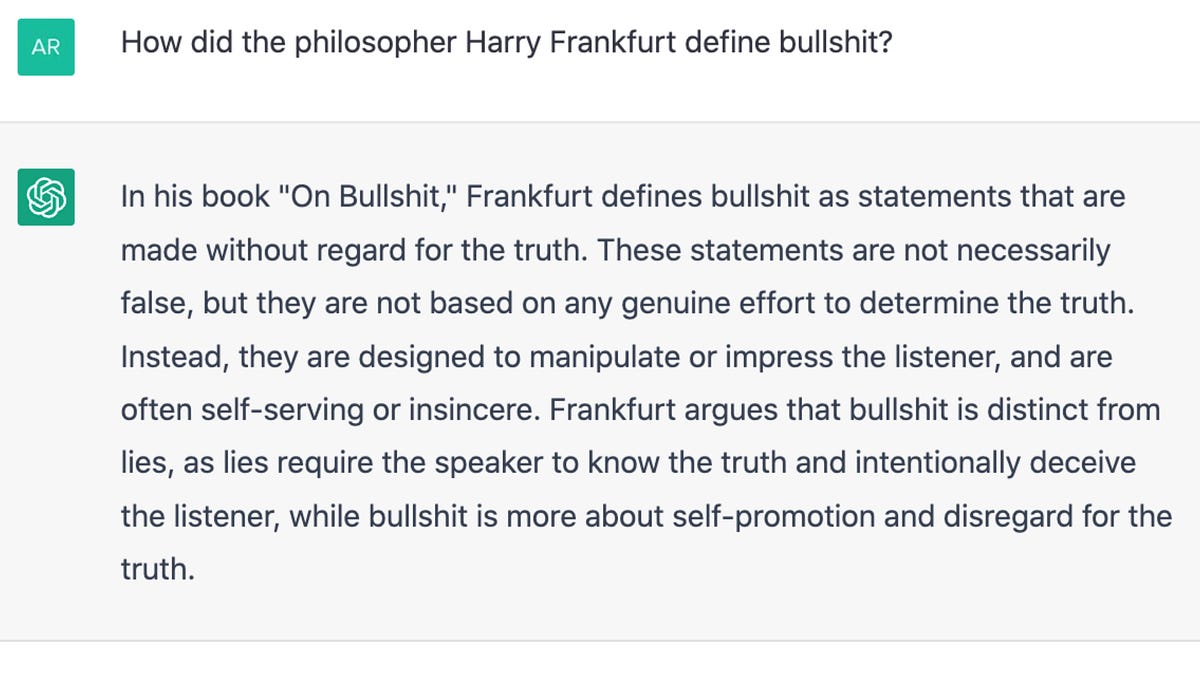
> ChatGPT is a bullshit generator. But it can still be amazingly useful
Submitters: "Please use the original title, unless it is misleading or linkbait; don't editorialize." - https://news.ycombinator.com/newsguidelines.html