Wind-Powered Cargo Ships Are the Future: Debunking 4 Myths That Stand in the Way of Cutting Emissions
Shipping accounts for one billion tons of carbon dioxide a year, almost three percent of global greenhouse gas emissions.
SingularityHub
49 points · by Brajeshwar · 3y ago · 66 comments
Anything the size of these is never going to be wind powered: https://www.scf.com.au/news-articles/largest-shipping-contai... , the sails/foils required to get adequate propulsion would be impossible to maintain.
So at best this tech is going to be for relatively high-margin goods where shipping time is at a premium but not so prioritized as to spring for air transport. Like old-school clippers. Maybe there's a niche there, and I guess every little bit helps, but I imagine the total impact on climate change to be minimal.
And the size of the canals (Suez, Panama) they have to pass through in some cases.
Edit: here's a good graphic showing max sizes for various types of ships https://en.wikipedia.org/wiki/Suezmax#/media/File:Ship_measu...
That's why even the article is telling that sail cargo ship projects are betting on regulation. If the adopted regulation is a cargo tax, we will use less and less oil. Of course, today we still need it and oil will be used to create new green solution. Even with a very high carbon tax, I assume there will still be use cases for oil because it is a really incredible material and energy source.
"The most versatile substance on the planet and they used it to make a frisbee. Typical of humans." Helen Cho - not very scientific but so truly mind-blowing.
Edit : layout for readability
The other scenario is interesting too btw: given that demand for combustion cars will be going down dramatically over the coming decades as countries regulate against them, the demand for petrol and diesel will also fall. Eventually, some refineries will shut down as there is no longer sufficient demand. That will also reduce the availability of these byproducts of refining and might eventually force shipping onto cleaner fuels as a side effect.
Open cycle gas turbines will increasingly being use to generate electricity because it can quickly come online when solar and wind power is insufficient. They burn diesel in many parts of the world.
The real loser is coal.
I suspect the last cracking reactors will be powered by abundant solar energy.
Phasing out oil as rapidly as possible is considered a victory
Not with that attitude it won't!
Dramatic change can happen faster than you think! The 3 social examples I use are smoking, fur coats, and social acceptance of LGBT people.
Fur coats went from consensus glamorous to shameful in about 10 years. Support for gay rights and marriage flipped like a startup hockey stick graph over about 5 years, and smoking went from everywhere to nowhere in about maybe 15 years.
These all happened almost as if by magic after decades of effort and for people working on the causes, the goals achieved still seemed like a lifetime away before they happened.
I understand we're talking global infrastructure, but I'm not going to discount the idea of a rapid transition happening.
For technology, look at the CRT -> flat screen transition. Now any CRT display is so rare that it will fetch a price immediately. Look at landline -> smartphone. Incandescent -> LED. Look at the disappearance of newspapers. In the sci-fi movies of the 20th century, not even fantastic fantasies of far off futures imagined a world without newspapers and now they are actually notable if you see one; you stop and briefly look as if it's some monarch butterfly fluttering by.
All these technological transitions happened in about a decade, from "only speculative people predicting it" to the previous dominant form being considered vintage
These changes, both social and technological are frequent and fairly common. I'm not foolish enough to put a date on energy transition but I'm not pessimistic enough to claim it won't happen in this decade.
Energy is bigger then everything I listed, no kidding. I'm arguing that train has already started and greenhouse emitting energy will become as rare as a landline, newspaper, fur coat, CRT, incandescent, or after dinner smoker within some number of not so many years.
It's okay if you don't feel like it will. If everyone could predict the future, we'd all be billionaires. I acknowledge I might be wrong and my opinion is fairly unique, but this is how I see things. No disrespect to you over our differences
We could see the end of the petrochemical industry in 10 minutes.
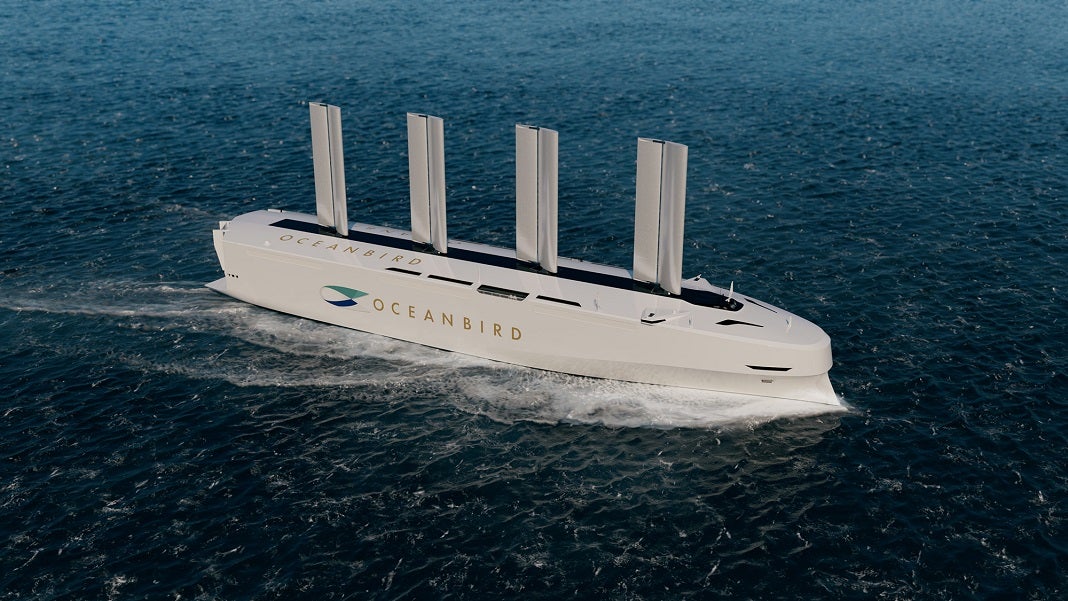
Orcelle Wind is a wind-powered Pure Car Truck Carrier, a type of deepsea Roll On, Roll Off vessel. It will be 220 meters and have a capacity for over 7,000 cars, but will also be capable of carrying breakbulk and rolling equipment. Orcelle Wind is a crucial part of Wallenius Wilhelmsen’s fleet decarbonization strategy and the ambition is for it to commence sailing in late 2026 or early 2027.
Orcelle Wind is the first vessel from the Oceanbird concept (see link below) for primarily wind-powered vessels. The concept shows that it is theoretically possible to reduce emissions from vessels by up to 90 percent if all emissions-influencing factors are aligned.
[1]https://www.walleniuswilhelmsen.com/news/worlds-first-wind-p...
Cargo movement is performed at large scales to optimize the cargo to non cargo ratio within constraints of implicit requirements like keeping things dry, not squished, etc.
Can a vehicle maintain a similar cargo to noncargo ratio with an ability to capture sufficient wind?
My alternative would be to go for nuclear powered shipping. I think a country with a higher tolerance for proliferation risks like France or Iran could really transform the world by civilizing the tech in that way.
Put the reactors on land where they can be properly guarded and operated by trained professionals. Use the resulting heat and power to manufacture synthetic carbon neutral liquid fuels for use by ships (and other parts of the transportation industry).
I also visualize a future where nations that are interested in somewhat more risk transform shipping with higher speed bulk vessels. Maybe it’d be a way for North Korea to get out of the axis of evil and make a positive change in the world. They already have some skills doing lightening at sea for various smuggling activities.
Regarding sailing, scale is not the issue. Rather what limitations port operations impose. Combining containers with sails are indeed a challenge. Thus, shipping companies are looking into hydrogen, methanol, ammonia or synthetic fuels.
We bult sail ships weighing 10 000 tons a hundred years ago. Switching the sails to rigid and using modern engineering principles and there's no issue going the x10-40 of that which are current ships scale.
The question of whether 20 odd folks of different nationalities can operate/maintain a reactor seems also to apply to sailing vessels. The change is maybe a matter of degree so is the continuation of current staffing practice more important than decarbonization?
They will likely slow down a bit compared to current vessels, but slow-steaming is already what everyone is doing. The most challenging part is both having the surface area and being able to pass under any bridges to the ports you want to enter, and have enough maneuverability to get through tight channels even when facing adverse wind conditions.
> The question of whether 20 odd folks of different nationalities can operate/maintain a reactor seems also to apply to sailing vessels.
How so? There is about zero 3rd party risk from operating a sail ship, a nuclear vessel can cause huge amounts of contamination if things were to go awry in say Long Beach.
> The change is maybe a matter of degree so is the continuation of current staffing practice more important than decarbonization?
Who is going to pay for the extremely specialized crew required to operate a nuclear reactor when you can take the same ship and put synthetic fuel in it?
A 100m wing span kite with a swept region of about 500m diameter is equivalent power to the engine.
Comparing potential staffing fuckups that will cost the ship owner half a million to potential staffing fuckups that will make a city uninhabitable is also completely facile.
If your fuel is comparatively cheap, there's no reason to slow steam anymore, and hull speed for a 400m long vessel is quite high. If your crew costs 20x as much but you're moving 5x as fast with half the fuel costs, it may pencil out.
For the rest it is all about cost. Your scenario can happen if the nuclear setup cost less than synthetic fuels, ammonia or hydrogen. But seems incredibly unlikely in the coming decades.
There's a Y Combinator supported company pursuing it.
https://news.ycombinator.com/item?id=21662056
3rd comment is from an employee. Big benefit being quick turnaround. Load 160 containers and start the ship rather than loading/unloading a few thousand while the other tens of thousands of containers sit on the ship doing nothing.
Kind of reminds me on the company trying to develop robots to build solar farms.
The basic technology of a small hydrofoil cargo ship probably would have worked, but the construction, maintenance, and fuel costs would have been huge. Plus hydrofoils don't do well in heavy sea states. And if it collided with a floating hazard like a lost shipping container or a big tree trunk while foiling then the results could be unpleasant.
https://www.sciencedaily.com/releases/2003/12/031210074720.h...
> More aerosols emitted into the atmosphere may lead to cooling," Allen continued. "But if these aerosols are able to combine with other compounds and ultimately form clouds, it could have a warming effect. There's a complex balance between warming and cooling."
"Ninety Percent of Everything" by Rose George
Exceptional, in-depth, dive on cargo shipping, and a bit about how insanely bad they are for the environment.
Sails would take up a good chunk of container space. Maybe could do something like slide containers under the arch for sail.
The old sail vessels are basically all sail.
Are we violating conservation of energy here? Why or why not?
* These are wind-assisted ships, not 100% wind-powered ships. They save some (maybe quite some) fuel when the wind is favorable and the sails are engaged, and use conventional diesel power otherwise.
* Rigid surfaces make more efficient sails than soft fabric-based sails, so somehow smaller area is required.
here’s a small windpowered boat sailing https://m.youtube.com/watch?v=nr7g-03iclA
You can also use more powerful wind from high above the sea. This article is on using high altitude kites for power.
https://www.maritime-executive.com/editorials/sailing-into-h...