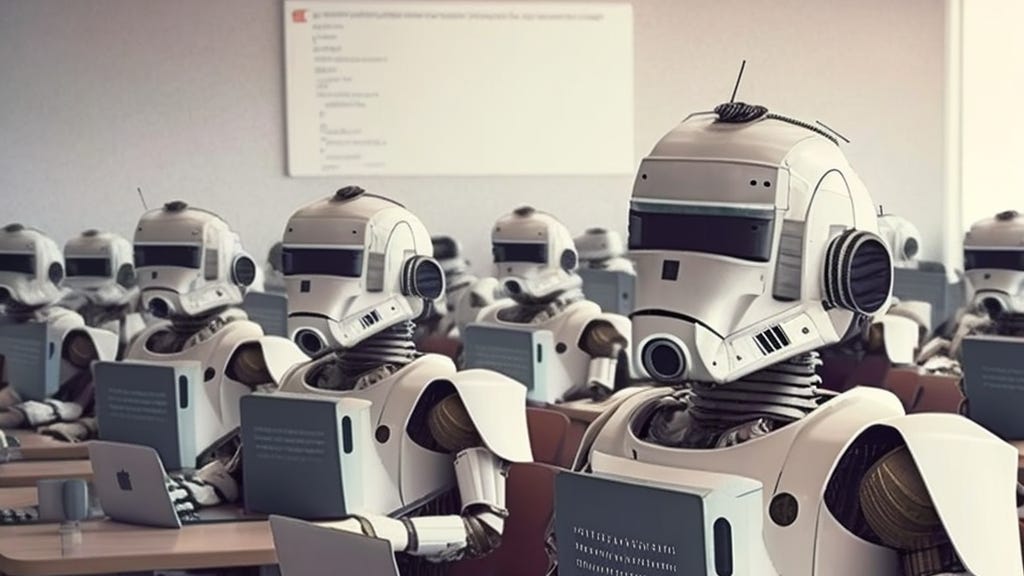
My class required AI. Here's what I've learned so far.
(Spoiler alert: it has been very successful, but there are some lessons to be learned)
oneusefulthing.substack.com
185 points · by alvis · 3y ago · 173 comments
We live in a world of emails and slacks and documents and text messaging. Literacy matters. Writing clearly matters.
What I would actually do with this is not use GPT to write your essay, but have GPT write a flawed essay and ask the students to rewrite it. Fix the logical fallacies, tighten the language, check the facts, etc.
There is also benefit in the opposite - automating your editorial role. Have the student write an ok essay, then rerun in through the AI to clarify, or to raise questions about ambiguity, word choices, general background knowledge assumptions, etc ...
In practice I expect both styles will be be used to produce superior human-augmented writing.
I was helping my son with his homework. He had to write an essay about why the gender of the protagonist might be female (although this is never mentioned in the short story). Fortunately for him, ChatGPT knew the story and was happy to write an essay with arguments. [Btw, according to him pretty much everyone in class routinely has the AI do their essays]
He was about to send this essay in. But as we were admiring the prose of the computer (which is much better than either of can), we found out that some of the arguments actually didn't make much sense. So we went to through a rewrite exercise like in the article, improving the essay and our understanding of the issues.
Next time I see her, I'll urge the teacher to adopt a similar approach as in the article.
Writing those essays will become trivial and irrelevant and be replaced with more interesting tasks with the assistance of AI.
I always think of Star Trek; instead of long-division math questions they will learn skills like “computer, if the trajectory of this rouge planet is reversed and we assume that is was ejected after some massive explosion, calculate the possible causes based on previously observed similar events and report the top candidate cause and confidence interval”.
An example from my academic field: instead of biased, unreproducible research papers we could publish: [1] raw data, [2] hypothesis context, [3] model, [4] seed. The output result can be read based on your own AI chatbot preferences but the conclusion is consistent and reproducible.
Essays are so static. I think a debate format where you are immediately challenged on your arguments or asked to elaborate would give a much better idea of how well the student has mastered the material.
But I think many professors who don't accept AI as a writing aide would say that it doesn't satisfy the assignment and is worth zero points.
2. He involved me, and we're making this a great learning experience.
3. Face the facts. This goes really fast. If you don't use an AI, your essay is going to be at the bottom of the heap. I'd estimate that out of the 35 essays, maybe 25 used AI for assistance.
>your essay is going to be at the bottom of the heap. I'd estimate that out of the 35 essays, maybe 25 used AI for assistance.
This is absolutely a terrible attitude. Who cares about the "top essay" if they're all AI generated. None of the 25 students are good students, and unless they will fail into a good job at daddy's hedgefund, you will simply not become a proficient adult letting chatGPT do your homework for you. The entire point of writing essays is to formulate opinions and thoughts and defend them. I understand school sucks and sometimes you have to write essays for things you don't care about, and that is a problem. But, at some point, you need to learn how to write if you want to be a professional. Not doing so just means you're holding yourself back for reasons I don't quite understand.
Every developed country has a general path to education because you want well balanced citizen and not ultra specialised tools.
> 3. Face the facts. This goes really fast. If you don't use an AI, your essay is going to be at the bottom of the heap. I'd estimate that out of the 35 essays, maybe 25 used AI for assistance.
Why didn't you write his essay before AI was a thing ? They'd be on top of the heap.
Why don't you pay a cheap freelance copywriter for like 1$ an hour to write the essays ?
The goal of education, especially at that level, is to build your basic skills, not to perform and deliver
If you tell AI to write a research paper, even in an abstract field like math or philosophy where experiments are not required, it's not going to actually generate new knowledge. That's the point of learning to write papers in school--evaluating the evidence, and proposing and supporting a thesis. The AI can output something that looks like a paper, but it doesn't actually have any coherent thesis.
I do think it will become more common to use AI as a typing aid (predicting next words/phrases), but having AI actually generate the thesis and arguments of the paper is not doing anything useful. That said, even if you didn't use it at all, I'm not convinced your paper would somehow be worse than all the others, it would just take longer to write.
I've already heard that schools think that chatbots are a crisis, they can't do essay hand-ins anymore due to this, but maybe there are different approaches where they can handle it. Maybe some think for example that they can see through it and grade down if it is an apparent problem for the handed-in text anyway.
I had a great assignment in college where the professor gave you all the materials required. You could only use the various articles/essays/news clippings he gave you, and you wrote an essay based on that.
Assignments that don't rely on the internet for research would do a much better job teaching the material and forcing students to read the material. Students wouldn't be able to SparkNote or ChatGPT an essay.
You can cheat all year if you want for homework &co, they're just here to help you get good for the monthly/yearly exams
I've witness several cashiers getting their phone out to calculate basic change. Things like 1 euros - 20ct
So yes definitely
When I was in high school (late 1980’s), there was a time each week for what they called USSR - undisturbed, sustained, silent reading (in retrospect, USSR is a strange acronym). They didn’t care what we read and there were no assignments associated with the reading material. The goal was to choose something you want to read and read it, 45 minutes at a time.
Edit: I just looked it up and it turns out it wasn’t a local thing. I had the acronym wrong though - it’s uninterrupted sustained silent reading.
http://ejournal.unp.ac.id/index.php/jelt/article/view/101466
The lesson you tought your son is far more valuable than what he could have possibly learned writing the essay as intended. AI is a tool he can use to augmentent his capabilities. But he shouldn't rely on it blindly. That's true for every technology (remember the Graphing Calculator on PowerPC Macs?).
> Next time I see her, I'll urge the teacher to adopt a similar approach as in the article.
Don't. This gives your son a competitive advantage over the kids who will simply turn up what the AI wrote (and get a 0) or spend too long writing their own essays.
In what competition?
>He was about to send this essay in.
Why would you encourage your child to use ChatGPT like this? "Everyone else is doing it" seems like a great argument for NOT doing it yourself as those kids are going to seriously lack critical thinking skills in a few years as they offload that work to AIs.
The Washington Post and Associated Press use AI to generate articles. In the real world, only results matter. Using technology isn't cheating.
The solution is not to make students manually do what AI can do perfectly well. Instead, give them assignments that are too complex for AI to solve unassisted. Raise the bar so high that a ChatGPT generated essay will earn them a C and they need to do substantially better than that to get an A.
That assignment was made with a goal of getting students practice doing careful reading, thinking and analysis, getting them to do a certain quantity of "repetitions" as exercise in that; the essay was just a token to signify that the exercise was done and get feedback on its form. And as you say, "only results matter" and the result obviously wasn't achieved if this was written by an AI. It's like having a weightlifter come in to a gym to repeatedly lift barbells with a crane - he's getting no results out of that.
Maybe so but that's not what is currently happening.
It may be, and this part horrifies me, like using a calculator. I remember when they first became affordable, and at that time, the same horror. And from what I've seen, that horror came to fruition, as I see younger(20s to 40s) adults sometimes struggling with simple math.
EG, if the power is out, and manually handling change at a cash register.
Yes, there is intelligence, but also the honing and application of the same. And calculators reduced some of that.
Now enter chatgpt. Here goes the ability to hone arguments, forge essays, etc, etc. Gone!
Imagine when everyone gets a brain link, I bet all long term menory will fall into ruin, too.
>Now enter chatgpt. Here goes the ability to hone arguments, forge essays, etc, etc. Gone!
It's just not the same. If you take an essay prompt and just paste it into ChatGPT and then paste the output into your homework submission what skill exactly are you exercising or learning? There IS value in having to think about a problem and make a coherent argument in text form and you certainly lose that if you never practice it because you just let ChatGPT do it. At least with some of the current models, e.g. ChatGPT, we can't even be sure of the veracity of it's outputs so not only are you not learning any skills you can potentially output blatantly false information as well.
AI is there, and more of it will come. The best you can do as a parent is to help your children to use it correctly. I'm pretty sure that using it correctly will help to improve the critical thinking, and will help children to express themselves in a better way (by virtue of example, or correction, etc -- possibilities are countless).
New technology doesn't mean people will regress.
It doesn't always, and the value of different skills change over time... But where horse riding is pretty well obsoleted by the alternatives, unassisted writing and the associated cognitive skills are unlikely to be. It's a good idea to be concerned with potential regression there.
> like this
This is the key phrase. There are ways to use LLMs to help with both research and writing that don’t involve surrendering your own part in the process.
Research with LLMs is often much better than search engines for surface level information. You should accept nothing that they say as truth, but they will often turn up names, book titles, etc that you can follow for more information.
Editing with LLMs is great - they were born for it. “What is a more expressive way to say ‘Lincoln’s presidency was a time of great change for the United States’?”, etc.
Seems all they learned was to improve the questions to feed the bot, not ant critical thinking skills.
From there the only logical step is to have AI be a generally accepted tool in everyone’s life like we have smartphones now. The extremely long term view on this is the lack of need for education at all as soon as we get the future AGI version of chatGPT directly plugged into our brains.
It's not that they got so good the skill became irrelevant, but that they changed so none of that works anymore. All the other major search engines followed suit. Now when there's something I could have found that way, that's not coming up with a naïve search, I just... can't. :-/
Anyway, yeah, maybe there is actually some valuable skill required for this? But I agree that skill in operating new technology probably doesn't hold its value for very long.
https://acoup.blog/2023/02/17/collections-on-chatgpt/comment...
Likewise, nobody is going to give a damn about your school essays except your teacher. It's the practice of synthesizing information on your own that important.
However, upon rereading the article, it does seem to say that the focus was on using the tool and prompt engineering rather than using it as a tool for extending students' own cognition.
The cognitive dissonance is wild to me, and I think approaching AI as a tool to be embraced is much healthier.
I guess writing for class has always been about the process and not the result. Nobody has ever wanted to read an essay written by a student. But, the process of writing the essay is useful; collect sources, read them, distill down the important points, join the points with sentences. ChatGPT is all about the end result. Assignments are about the process.
If they can't do basic arithmetic, there's no way they can understand the actual concepts underlying math, or have any type of number sense (and they don't; though, granted, neither do most of their elementary school teachers). It'll be absolutely horrible if they have no idea of how to craft a coherent argument, or deeply think because ChatGPT just spews out something (and who knows if it even gives factual answers; they'll never know to check). Couple this with other issues arising from over reliance and overuse of smart phones and we're setting ourselves, and them, up for a grim future facing serious existential problems (.i. climate change)
To some extent, you are probably thankful your elementary school teachers didn't let you use a calculator to do stuff like 2 + 2 = 4 or the multiplication tables. Doing that quickly without any tools is useful in the real world.
Similarly, you will often have to argue for your point of view in real-time; there won't be time to craft a prompt and ask the AI what it thinks. "Why should we do this your way?" "Why should we hire you?" "Why should I let you go with just a warning?" It all matters.
It can be useful to know how to use a tool, and can also useful to know how to do similar things without that tool.
Some people are here to learn basic skills they'll use all their lives, the other is here to do his job
Maybe he found beauty in that irony.
I have no doubt progress will march on. I was telling a coworker that I think humans will have symbiotic relations with AIs in the future, and he noted, we will be the heart and AI will be the brains. I think that sums it up beautifully.
It's both healthy and realistic. Let's be real - it's not going away. It seems like it's mostly/somewhat useful now. It's only going to get better. People undoubtedly will find a way to leverage the tool to make themselves more productive. If that's the case, we should (1) continue to teach the skills exhibited by the machine learning models and (2) help students gain mastery over the tools so they can be productive when they start to work in a world where their peers are already using them.
This piece explores that idea in quite some depth when it talks about the different approaches to working with ChatGPT to generate an essay.
I see a lot of people try ChatGPT once, get disappointing results (maybe they gave it a logic puzzle or asked it to do some math!) and write it off as useless hype. I think that's a mistake.
If I discovered a class I was planning to attend in academia was going to require the use of AI, I would launch a protest immediately. This is a violation of my human rights. If you're OK with using generative AI tools, that's your prerogative, but forcing me to use them is like forcing me to eat food grown with pesticides if I'm a staunch organic foods consumer…or possibly even worse, forcing a vegetarian to eat meat. Way-ay-ay out of line.
There is always a line to draw, why is this the point where you think it is important to draw a line?
It is totally reasonable to say "you may use AI tools in this class", or by comparison, "you must do research in this class, here are some ways you can do research, it is not cheating to use Google".
It is a very different thing to require the use of AI tools by someone who can competently write an essay on their own, or to require the use of Google by someone who happens to have a bunch of relevant sources bookmarked. That's moving from "can you do this" to "can you use this specific tool", and away from the actual point of the class.
Another example of this I can remember was requiring specific IDEs for some courses, which invariably led to a quarter of the class time being wasted explaining buttons in a now long-outdated version of Eclipse in excruciating detail, instead of any actual programming concepts or even Java-specific concepts.
But there are actual reasons to enforce the tool - in that case, so you can execute your code in a similar environment to your peers. It is specific, but that's the point of the restriction.
Just to take a top google hit on the subject: https://www.nbcnews.com/tech/internet/lensa-ai-artist-contro...
Apply that model to high school and you'll just have teachers desperately trying to cram lessons into the beginning of class, to make up for the fact that 80% of the kids didn't watch the lectures.
I like how they're taking a proactive approach in trying out what role ChatGPT and the like can play in generation and exploration of knowledge. I like the breakdown of the different ways of interacting with the tool, and the callout of how collaborative editing seems like the best out of the approaches they've witnessed. I also feel somewhat comforted by the remarks about how students engage with the output of the tools critically and fact checking can actually be a valuable way to interact with the material.
Personally I think I would enjoy this class - I like the openness to experimentation. I can imagine that _getting graded for it_ could be a frustrating experience though, I think with experimental classes that's a kind of thing for which there tends to be little standardization and it can be unpredictable how you'll be judged.
I think the issue with AI is that the average person doesn't understand how it works, and the problem is when somebody in a position of power becomes infatuated with it. I don't fear AI, but I fear bad-AI, or misused-AI.
Those who understand how it works know that its mostly Garbage In-Garbage Out
But on a more subtle note because conversational AI has this short feedback loop, much shorter than even regular search, I feel that it's something where people can level up quickly. I think there's going to be great value there.
Teaching how to use ChatGPT is exactly what I would advice against. There's no science behind it, except some knowledge that's based on personal experiments. It doesn't provide much educational progress.
I mean, one class for this would be OK. But basing all your classes on a tool?! Not in my class!
> As a result, the projects this semester are much better than previous pre-AI classes.
The use of the term "better" is concerning. According the blog, the subject of the class is "innovation". He is essentially praising the A.I. ability to innovate and not his students. If the object of school is to learn, what did his students learn about innovation and how was that measured despite ChatGPT? It reads as if his students learned about using and optimizing a tool and not the subject at hand.
The common argument for A.I. is that it will free humans to pursue more interesting and creative activities. The pervasive theme among many of these articles suggests creativity and thought to become a commodity, where the role of the human is to simply intervene and edit. Many architects are beginning to forfeit design to Midjourney, and editing the results. We need to ask ourselves: is authoring or editing more worthwhile?
I understand the importance of knowing how AI is being used in one's field, of being aware of it, knowing its limits, and, where applicable, knowing how to detect and counter it, but I'm not sure that simply considering it a tool in one's chest without first having some level of expertise in its limits is wise.
(I'm fortunate enough to work in a space where artisanal hand crafting is still the norm. The writing may be on the wall, but the wall is distant yet.)
In later years, we had to write reports on books everyone read, this strategy broke down. Cliff notes were a thing back then, but mostly I just skipped around through some chapters, talked with other students, and wrote the reports based off very superficial knowledge of the story with a few examples sprinkled in.
10/10 would use this to not have to suffer reading Shakespear or whatever the book du jour is, or whatever other topic I don't care about.
The analogy I like is that it's sort of like calculators: they were academically shunned at first, and are now an integral part of learning advanced maths. Sorry, Mrs. Kelly, but we did end up having calculators with us always after all.
Can something be pleasurable to read/view/listen to/etc., knowing the author of the work doesn't, for lack of a better term, have a soul? I don't know.
Perhaps this drifts too far into philosophy, but I myself find it adds something... more, knowing that a human being put their thoughts/feeling/heart into a piece of work. This is certainly, in part, informed by my theistic beliefs, but I recognize that others (like Sam Harris) wouldn't delineate at all between human thought processes and something like ChatGPT.
That being said, I would have to imagine some portion of people also feel something "other" about human connection that brings works of art/literature/music/film/etc. an undeniable beauty BECAUSE of their human-origin.
--
For me, at least, the important part of media I consume is how I feel about it. If an AI writes a sentence and a human later writes the same sentence, they have the same effect on me.
--
To me, what matters most about the media I consume is how it makes me feel. Whether a sentence is written by an AI or a human, it has the same impact on my emotions.
--
I wrote one of these. The other two are ChatGPT's rewording of the same idea, and a second rewording with "try to sound as human as possible". They are in an arbitrary order. Does one of them make you feel different than the other?
I keep going back to Stephen King's definition of writing as telepathy. The machine does not think.
That doesn't make it bad, it just makes it meaningless. I was able to use it to identify an obscure 90s B movie and that's pretty cool.
But in terms of actual meaning, you might as well be talking to a tree.
There's a long and storied history of humans who talk to trees and project deep meaning on their answers, so we're probably doomed to fall for the delusion anyway.
I find pleasure in looking at gorgeous natural landscapes: mountain ranges, forests, waterfalls, creeks, glaciers, the sky at night. I also enjoy eating fresh blackberries.
I enjoy them even though they don't have a soul or a human creator.
It helped me with my own prompts!