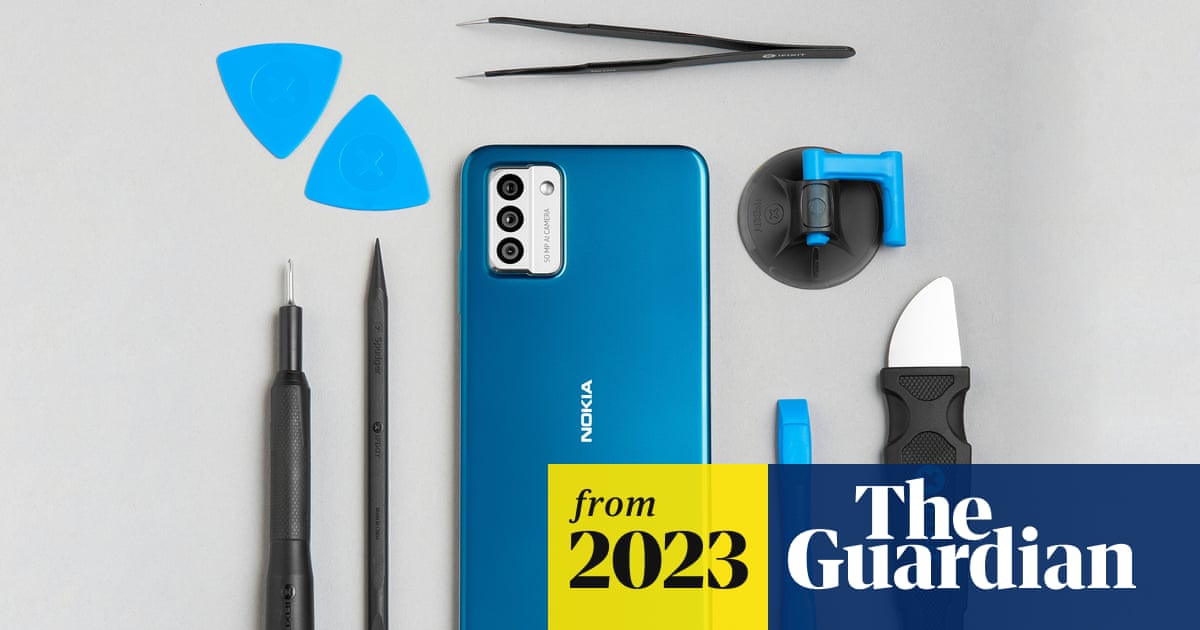
Nokia launches DIY repairable budget Android phone
Nokia G22 has removable back and standard screws allowing battery swap in less than five minutes at home
the Guardian
1792 points · by mmastrac · 3y ago · 1038 comments
But also...I think this would be hilarious (in a good way) if this (thankfully anachronistic throwback) repairability really took off and in the next 3 years Apple releases a budget / or premium( prolly premium? knowing Apple hehe ) set of products like a framework style repairable moddable laptop, and a "wePhone" that you can swap parts and mod. Truly I think there's a cool cyberfunk future in there somewhere. TikTokking teens showing off their latest phone mods, builds and hacks (and holoscreens). I mean they already "discovered" the flip phone and went mad. I think this is waiting to happen :) ;p
I bought an el-cheapo, small (really small) one (originally only to manage EU green passes) that (after that use was over) I started using as a "backup" phone when I cannot carry the (larger, heavier) "main" one.
It turned out to be not bad at all, of course within its limits.
The model I got was a King Kong mini, but I believe that in the last two-three years they made some two or three newer models.
The Power Armor 13 takes multi day heavy use to approximately what I've always wanted out of a handheld computer.
1. Budget:
- Basic processor/camera/space with 6 inch screen
- Basic processor/camera/space with 4.5 inch screen
2. Flagship
- High-end processor/camera/space with 6 inch screen
- High-end processor/camera/space with 4.5 inch screen
It doesn’t sell.
Just look at Apple’s sales and their cancellation of the mini. I’d love it to be the opposite so I didn’t have to hold on to my iphone 12 mini, but it’s just how things are. Most people don’t like smaller phones and would be a waste of resources to make high end ones.
I was an Android guy, but one of the top two reasons my newest phone is an iPhone is due to the small form factor (the other is longer support cycles). If Apple stops making small phones, my next one may well be an Android.
On consideration, capturing a niche market segment like this may be more valuable for Apple than it is for other manufacturers, as it increases the odds of getting them locked into your ecosystem.
It's also a bit challenging, since a powerful phone has higher battery/heat/etc needs and that is easier/cheaper to do in a larger device.
There’s perhaps a gap in the $150-$400 range, but used phones can definitely be found there, and I would bet that there are Android manufacturers that sell new phones there.
(All prices are USA and before tax, so other markets will be a bit more expensive.)
There is a very small minority of people who prefer smaller phones, but they make a lot of noise.
No one buys small phones - hence why iPhone mini was abandoned and most Android OEM's smallest models have at least 6.43'' screen
I would also argue that small screens are awful for consuming content nowadays. People with bad eyesight struggle with bigger fonts in a small screen, and publishers tend to try to fit more and more content in each screen. It's systemic.
I wouldn't. Most content is time wasting nonsense and ads.
> People with bad eyesight struggle with bigger fonts in a small screen,
My experience with Presbyopia is that a bigger screen is still impossible to read without glasses. Without glasses my only hope is to pinch zoom or browser zoom which works on both large and small screens.
And it will under guaranty for at least six months. The website guarantees a at least 70% of the orginal capable batteryu
That's what I have. Has a jack, a physical home button and back button, a microSD slot. Don't know your expectations but the camera is better than the expensive camera I bought in 2005. I am not ashamed of sending photos to any of my friend. Performance is fine. (Usage: I text, use Google Maps, YouTube and I browse without an issue)
I got the Google pixel 4a 5g and tbh couldn't be happier. Still, if the S7 was faster I would keep using it.
It's a fair bit bigger than my old 2016 iPhone SE, but it's actually smaller than the iPhone Mini.
The same generation iPhone - the 6S just got a security update a couple of weeks ago.
Related - I'm a huge fan of Airpods and only ever want to use my wired headphones with my laptop
All I know is when I want to pass the aux to a newer iPhone, I need a stupid dongle now, which funny enough doesn't work with the old one. And either phone's battery will last all day regardless.
- no headphone jack
- no SD card slot
- all come with ad-ware and un-uninstallable third-party apps like Facebook (except for Google Pixels, which don't satisfy the first two criteria)
Mid range is where it's at. Why pay $200 more for 256 instead of 128 GB when I can put in my 1,000 GB mircoSD card?
It's a shame that Fairphone went with the no SD card trend. I would have really liked to buy their phone...
https://www.gsmarena.com/results.php3?chk35mm=selected&sSIMT...
Ip68 is important. I went with xperia 10, and am positively surprised. Fits all the checkboxes and less undesired software than google. I don't have the mandatory search bar in the front screen!
Source: https://shop.fairphone.com/en/buy-fairphone-4 under specification/storage -> unfold the block "Storage" and under the main storage is : External storage capacity: microSD up to 2TB (SD 3.0)
Built-in storage is the next limitation, if you get past holding your huge-screen no-grip phone securely (like with a pop holder) and the battery that degrades exponentially f(time).
Great camera, great screen, headphone jack, microSD card slot too!
My display started failing after 4 months, when I was browsing intensely (and it was hot to the touch but I was using a pop holder), but they wouldn't fix it under warranty because they claimed the software caused the overheating. Screen replacement would have cost 70% of the device new.
That is when I started boycotting smartphones. I have a 7-year-old device (second-hand) and I do not use it for anything security critical.
I don't quite get the appeal of high end phones or of changing so frequently. What works, works.
I just wish:
* The battery was replaceable
* Moto didn't do stupid things such as break VPN functionality when they released the Android 12 upgrade. This was a failure of pre-prod testing that had to be corrected with a further update a few months later.
I was on your same boat until I actually owned an iPhone 12 mini. In reality, it sacrificed usability and battery life to achieve that small form factor. I had to bail on the phone because it was physically straining my eyes.
Our phones are basically pocket computers. That's why the screens are big. They're used for everything.
Here's the other thing about the 3mm headphone jack on phones: it's irrelevant to anyone with enough disposable income to afford wireless headphones. I personally own the second generation AirPods Pro, and to be honest they're completely mind-blowing compared to what we thought was possible on a technical level just 5-10 years ago.
Yes, I spent a lot of money on them. Yes, they are perhaps a disposable item considering how difficult/impossible it is to replace their tiny little batteries.
But would I go back to using wired headphones and getting them caught in a bunch of shit? No, not ever. No amount of dollar savings or latency shavings could convince me.
I still use wired headphones on my desktop computer, but that makes a lot more sense in that context. I'm not taking wires onto the train or the bus or the airplane ever again.
The reason budget phones like Nokias have headphone jacks and sometimes even microSD slots is because their customers will not pay for upgraded internal storage or expensive wireless headphones. On the other side of the market, companies like Samsung and Apple can upsell a lot of their flagship phone customers and give them a nudge by removing that port.
It's the same reason why you don't see a number of options packages on a Toyota that you can get on a Lexus that's based on the same vehicle.
Is the removal of the headphone jack a shady tactic? Maybe it is. On the other hand, maybe it's just an obsolete port for that market segment. If I am using an expensive gaming PC, do I need my graphics card to output to VGA or DVI? Of course not. But I might need that if I'm buying a PC to hook up to a 15 year old monitor in a school computer lab.
For desktop use cases they have the problem that you have to take them off to get up.
Well that and the struggle of finding half decent headphones that fit my needs (decent enough they wouldn't die in a year, but not so expensive i'm going to regret it if they get damaged or lost).
I still hate that I now have headphones that can die, but it is nice to be able to walk around listening to whatever without having to carry my phone on me while I cook/clean/whatever. Not what i paid for them nice....but it's something.
I wouldn't call that a niche when most models still have it.
I mean, I know why, but it’s crazy. As soon as I find a high quality standalone watch I’ll start to seriously consider not having a phone at all. Or perhaps just not an expensive iPhone.
Watches cover pretty much every use case I have with a phone.
I keep mine in Sports mode, which is basically just a smart watch , most of the time
I still have it, and don't plan on buying anything new until I can either 1. get an iphone mini with a usb C jack or 2. find a competitor that's similar sized.
I'm so so sick of these massive phones.
A sweet bonus would be if they also provided and fully supported de-googled image or at least had an option to download the de-googled image after accepting some disclaimers. Or perhaps even set up a public community for phone hackers to help them build said image i.e. crowdsource the work.
An optional large shell for a bigger battery would be a nice upgrade too. My current phone has a 10,000mAh battery and lasts a very long time after disabling background networking on most apps.
(I've similarly been wanting a FairPhone here.)
In the EU it's common practice to buy without a contract, whereas this is very rare in the US.
In other words, carriers have way more power in the US.
I did buy a newer phone a few months ago, but I'm keeping the S5 around as a spare. In fact my previous S2 is still working as well, but I don't think it receives updates (also it has no battery right now - luckily it can operate with just power plugged in).
Like xda? :)
Btw degoogling phone almost double battery life.
Just makes me picture Maggie Simpson
But to be actually on topic, supporting custom ROMs in order to extricate android from Google is my top priority when buying a phone.
If this phone gets lineageOS support then it may be the perfect phone.
I have an old Nokia smartphone. I barely use it as a phone; really it's just for 2FA, when the provider insists on SMS for 2FA.
An inexpensive Android device which is hackable and exposes GPIO pins would make an interesting robotics platform. If this device supports replaceable CPU, then perhaps it also exposes GPIO.
The tradeoff with replaceable batteries is if when you swap the phone loses track of time until finding a cell tower. Fine if in range but a risk when hiking far away, and might also propagate the wrong time to your smartwatch.
The best hope here is that this phone's repairability will attract a software hacking community to provide inofficial updates, but what a terrible thing to have to rely on. Besides: Phones by other brands like Pocophone are plenty repairable, being made for the indian market, and have good community software support.
The real next innovation for an Android device maker will be providing at least 5 years of updates (I'm well aware of the challenges involved, but these are not that hard, make it so).
We should have several decades of support for all cheap electronics at least…
Our stuff turns to trash because everything is built on shifting sand with no thoughts given to supporting it long term and for some reason we like it this way.
Do y’all not long for a future where you can get off the upgrade treadmill because the developer facing API is fixed? Not backwards compatible because that implies you ought to be moving to the next, like once it works you can call it done.
But new shiny thing! Alright, that’s great. Is it so much better that you want everyone in the world to throw away their old devices? Probably eventually but you’re daft if you think those kinds of events should be every few years. God can you imagine if we did that to cars? Sorry, Honda dropped support for your Civic, you can keep using it for a bit but in a year we’re gonna change the roads and it will be undrivable.
Many of the required updates to a device are security related, perhaps they could write said software better so that there are never bugs...but software is complicated now; millions & millions of lines or code and dozens and dozens of different chips. It's better to make phones much more recyclable than it is to make them last longer.
No. We want modern APIs that prioritize modern concerns, usable with modern toolkits and frameworks and taking advantage of modern programming principles. Even if we had an API intended for longevity, once its creators die we will tear it down completely and replace it with something that suits our newer-therefore-better tastes. For them it was the cornerstone of an industry's worth of innovations; for us it is but a millstone around our necks and must be replaced. I know this because I've seen it happen many times. Once the people who've staked their entire careers building upon $THING, and developed some truly remarkable software, grow old, up rises the chorus of people who are sick of $THING, who can't even fathom how anyone got anything done with $THING, who give talks at conferences about how $THING is fundamentally broken and how we should be using $NEWTHING instead. And these voices grow louder, their chants more thunderous, until it's generally accepted that $THING is a relic and $NEWTHING is the future. Even the things we thought would last forever -- POSIX, C, X11 -- are now, if anything, well past their expiration date.
This is how things are. This is how they must be. There is naught we can do but be like a Japanese person observing the seasons, contemplating, with some sadness, the constant change and the endless cycle of death and rebirth.
No other desktop OS works like that. Both Windows and MacOS sunset support for devices. Admittedly - after much, much more time than phone OSes, though.
> You're telling me these trillion dollar corporations can't match the quality of service of Linux distribution maintainers?
I mean, "quality" means different things. There's a reason the "year of the linux desktop" still hasn't arrived.
But yes - volunteers do things that corporations won't.
Do you? Or do you just say/write/comment that you expect that? Actual expecting would be refusing to buy a phone that didn't provide said updates. Otherwise it's just an HN comment, with no (real, physical, 'economic') role to play, certainly not that of an expectation.
This really should be from date-of-purchase and not date-of-launch as well. Otherwise you're leaving refurbished phones out in the cold too. We should be encouraging refurbishment and not giving those users a worse experience - if anything the law should attempt to favor them, they're doing the thing we want.
Requiring bootloader unlock when support ceases is another fantastic idea someone pointed out - and that one will hit Apple too honestly. But if you're not going to support the thing then at least let someone else do it.
I'm curious how much work honestly goes into these updates, though. How many patches do they maintain on top of Android that security updates would cause them to need to fix their patches again? Or how many parts of Android are even changed by those updates in a given month? I don't really have any idea of either proportion. How much money would it require us to pool to get one month longer security updates? One year?
May be something to ask Fairphone, they seem like the type of business that might be willing to share this for the purpose of pressuring the market to offer the support after a successful crowdfunding campaign.
pixels starting with pixel 6 have 5 years of updates.
Even this nokia phone has a 3.5mm port, why doesn't Google support it anymore?
> why doesn't Google support it anymore?
maybe preserve space for something else inside.
Apple’s update policy (and history) is one of the two reasons I own an iPhone (SE). The other reason being all the unremovable junkware I’ve had on Android phones in the past.
Next time I need to upgrade (hopefully 6+ years in the future), I will take another look at OnePlus.
Nice. Didn't know this. Got a 7 pro shortly after it came out; spectrum had a $400 discount on them.
Saying an iPhone can handle 8 generations of iOS updates is a bigger joke. I’m a cheapskate that somehow uses Apple phones, and I’ll let you know after 2-3 major OS updates the performance is always severely diminished.
My daily driver is a 2018 iPhone XS, and it’s about as snappy with iOS 16 as I remember it being straight out of the box.
My mom had a 3yr old mid-teir Samsung phone and tablet (combo deals they always sell) they both became unusable when it upgraded to the latest version of Samsung basterdized Android 2 months ago. But I'm sure Pixels are more similar to iPhone.
Sadly most Android come with vendor crippled software. Maybe the >2yr crippling is the goal for them.
My anecdote: I'm using an iPhone XS that has seen 4+ years of use across iOS 12-16 (5 major versions) and I haven't noticed any real consistent slowdowns. I've seen the occasional clear bug shipped where performance dips from time to time doing certain specific things, but these seem to be resolved upon the next update or two usually.
I think with newer ones, the OS updates are fine.
I just got a whole new phone out of a failed battery replacement for my iphone 8+ - my guess is the OS installation was just too damaged to accept the battery pairing process and it just flaked out, it was bootlooping and refusing to charge the battery. I got a refurbished 8+ in consideration, and it's actually great despite being a 5.5 year old release at this point. It's not the actual performance level of the phone itself that's the problem, they just tend to become worn out at a hardware level and the phone tends to become unstable. It was showing all kinds of weird software quirks (discord "send" button would fail to appear when posting a meme despite the image being in the send box, and you'd have to tab back and forth to a different server before the "send" button would show up, etc) and all of that vanished as soon as I got a new phone.
While I can't prove it, my opinion is it would have come back over time even if I did a factory reset, perhaps even worse. Because I had the same experience with my previous phone, an Android Moto G first-gen (Falcon), which I owned for just about 5 years exactly (early 2014-early 2019). The phone simply got more and more unstable due to bad flash/RAM and perhaps some glitching caused by the weak battery... first I'd have to factory reset once in a while, then the whole OS would need to be reflashed, finally the installs were being corrupted less than a day after a clean reflash.
The practical lifespan of the DRAM/flash in a phone seems to be about 3-4 years in my experience and by the time things hit 5 years they are so damaged they are unusable even after fresh OS installs/etc. The timeframe is identical for both my Moto G and the 8+, I bet if I'd continued to use the same handset for another year it'd have started corrupting itself even after a factory reset/etc. I don't know why that would be - whether phones are writing certain flash cells too much and they're burning out, or what. Obviously PC SSDs and DRAM can be fine for a decade.
I am very onboard with some degree of refurbishment being a critical element of long-term phone repair after these experiences. They start to go janky at 3 years, by 4 years it is becoming a problem, and by 5 years it is unusable. Even with clean software installs (factory resets or OS image reflashes), it just is not stable. The Moto G I could write off as a fluke, it was a cheap phone to begin with, maybe it was just janky. The 8+ failing in the exact same ways on a very similar timeline (about 6-12 months later due to higher hardware quality) says to me that DRAM or flash is just wearing out over time. If it was just battery performance problems then it wouldn't have failed to re-pair after a fresh battery was installed either.
Again, now that I've got a refurbished 8+ in like new condition, I can tell you it's still perfectly fine as a phone/piece of hardware, it's more than fine enough to run discord and apollo and gmail and banking and all the other things I do day-to-day. It's not the hardware spec that's the problem, it's a particular unit becoming worn and failing.
This also goes to show the importance of long-term software support... I have basically a new handset on 5.5 year old hardware. It will probably be 10 years old before I retire it. iOS is insanely good about that, I am still receiving full software updates at this point, although probably not for that much longer. Show me an Android phone with 6-7 years of feature updates, please. Most androids won't even get security updates for half of that. That is what keeps the e-waste down. I'm sure my handset will be diagnosed and refurbished and sent out to someone else for replacement too, or sent to APMA region for those customers, the circle of life.
I paid $725 for the phone originally (refurb) and $49 for the replacement, and I just got my third otterbox commuter for the replacement case, probably will kill a 4th one over the life of this handset too. So all-up I am expecting to be around $900 for all hardware expenditures for this phone for 9-10 years. Not too awful overall.
It would have been better if they offered slightly longer security updates in exchange of only letting you change the battery. Other things probably won't break anyway before the security updates stop coming in.
Nope, you don't.
It's just that somehow techies seem to have gotten this meme into their heads that an unpatched life isn't worth living. Can't update my phone within 1 microsecond of a patch being released? I guess I might as well just die. Much safer than risking the << 1% chance of getting malware on it, and everyone knows malware is worse than hell.
> The repairability sounds nice, but it is very irrelevant compared to the limited software updates.
I had an Android phone that didn't have OS updates for several years and... it was just fine. I was only forced to finally upgrade to get better reception on other bands it didn't support. If the hardware could keep pace I would've easily kept it with its current OS for another half decade, until apps just got so bloated that I couldn't use it anymore.
> Imagine buying a Windows laptop and only receiving three years of security updates
That's a bad analogy for so many reasons. Android's security is WAY more hardened than Windows's, your phone's apps (including your [likely] Chrome browser) would still get security updates, and even with Windows this isn't as horrifying as you're suggesting. (I've done much worse.)
Many people would buy a phone that will never receive a single update. The software it came with is the only software it'll ever run. And they're fine with that. They see software updates as an annoyance and I fully understand them.
I you look at that data then you can see that the oldest version with any significant usage is v8.1. But even that is quite low, and you might do quite well in not supporting anything older than v9.0.
But the apps still work and get updated and that for her and most people is enough.
It's not ideal and as she is not tech-literate, the day might come where she clicks on something which exploits an unpatched vuln :/
Malware can indeed be worse than hell. Have you ever had your bank account hacked? Or your email account broken into? Or your identity stolen and had to deal with dozens of credit cards being registered and then hit the limit under your name?
I’ve had friends (and family) deal with such things, and you know what? I’ll do anything to minimize the risk for myself, including throwing away an expensive gadget that can no longer receive updates for some totally arbitrary reason.
To be honest - as an older-phone user, that's part of why I never access email on my phone, nor my bank account. I see my phone as something that's basically insecure, and take into account (no pun intended) the possibility that other people will be able to access its contents.
I realize, though, that many old phone users don't hold this view necessarily.
I've never been to hell (I think?)... I suppose I can't assume you're the same, but I'm pretty confident I would much rather deal with, say, a stolen identity, than go to hell.
Most people's risk-tolerances including many life-threatening dangers they face on a daily basis... like getting hit while jaywalking, having their phone igniting in their hands and burning their homes down, dying in an earthquake, etc. If you can't tolerate the same risks as most other people, then great, you have lots of alternative options to choose from. It's not like Nokia is preventing you from imposing your will on yourself or your family.
This collective delusion is the main justification for SaaS which is what the tech industry in current year is dependent on .
Do you wish to hear the endless stream of CVE numbers that allow remote exploitation, including Wi-Fi and Bluetooth module vulnerabilities that don't even require an active Internet connection?
Have you ever tried to expose a new server to the Internet and watched the endless barrage of probing requests coming seemingly within seconds?
Have you been a target of DDoS coming from unpatched appliances and modems?
The only place for an unpatched phone is offline, within Farady cage.
It's a dangerous life given phones are now used for everything from banking and 2FA.
Laughs in Microsoft
How about 20 years?!
I have a laptop built in 2006, it runs Windows 10 and will be supported untill 2025.
It can also run software compiled in 1999! What platform can beat it, an IBM mainframe?
Microsoft is the gold standard! Its a shame they never get credit for the one thing they do well.
I was running an arm laptop, emulating a modern x86_64 chip, emulating an old i386 chip, interpreting a qbasic program unmodified from 30 years ago. Sound, graphics modes, input events - all of it worked perfectly. I didn’t try running it on windows, but I wouldn’t be surprised if it just worked there too without even needing dosbox.
Backwards compatibility on phones is a joke. Decades of phone software is totally lost to history, impossible to download or run anywhere.
The web isn’t much better because old websites go down. But at least modern browsers will still happily render webpages from the 90s just fine.
We need a good standardized phone and bootloader system so that software comes back into the control of users on cell phones.
It doesn't make sense for Apple to support devices that aren't even going to be able to run the apps that users want. Not many users are going to want to be using a 6-7 year old device when hardware is advancing and therefore the software is becoming more resource hungry.
The mobile phone business is very different. (But you may argue that that's the problem.) The HW manufacturers sell the SW bundled with the HW. As soon as they have sold the HW, the software is just a liability (while for MS it's a recurrent revenue!). Not only that, but the longer and the better the SW works, the less likely you are to buy new HW from them. (And since that's the only thing they are selling, it means the less likely they will see a revenue from you.) Now this may imply that the business model is flawed and maybe it will change as the market matures and people will stop buying newer and newer phones every year. Just like it happened to desktops and then laptops. (I'm typing this on a 7+ year old Thinkpad and the only thing I miss is +16GB RAM.)
Sure we have abandon-ware that requires a Windows 95 desktop or a Windows 2000 installation, but bringing a piece of actively developed Windows software forward through the version in the past 25+ years has been relatively easy.
I picked Linux/Unix and languages like Python 20 years ago, so it's a little late for me, but if I could go back in time, I'm not sure that Windows and C++ wouldn't have been an equally good choice.
A 2010 iPhone 4s can’t connect to any network in the US let alone a 2007 iPhone. Computers changed leaps and bounds in the first 20 years just like smartphones have.
Sure my 2010 Dell Core 2 Duo with 8GB of RAM can run Windows 10.
But a computer bought in 1997 couldn’t run the then current Windows OS in 2010.
And there still isn’t a coherent native desktop-app dev story for Windows. Even MS is using Electron for their own software.
One step forward, two steps back.
I've also a laptop built in 2006, it runs [any flavour of Linux I want] and will be supported indefinitely.
Those are from the release date of the phone, but I think they're doing roughly annual releases on that line.
Edit: Samsung also planned for longer device life - there's an option to turn on a battery saver feature that caps charge at 85%, which should significantly increase the years of service from the battery.
As the first 64-bit phone and the first phone with a proper Secure Enclave (TPM+biometric auth) it's received a lot of love from Apple.
I have a PC that I build myself over 9 years ago and run linux on. I upgrade hardware as needed but I will never have to worry about security update nonsense.
I don't think that's remotely true. People who buy budget phones are not typically the tech enthusiasts who buy new phones every two years. Instead the market analysis has likely shown that people are way more impressed by "repairability" than by "long security updates". Otherwise we would long have Android phones with security update durations similar to iOS.
> The Nokia G22 will cost from £149.99
And it's not a fair comparison either, an iPhone which isn't updated is a big security issue due to everything being so coupled to the OS, on Android it depends of the security flaw affected itself.
I'm not defending the poor upgradability to Android but they worked around that a lot.
A iPhone 14 costs ~1000 EUR where I am. If you expect to get 7 years of security updates out of it (I think that's what Apple says? Not sure, someone please correct me), then it'll be 142 EUR per year.
Three times the price, if you calculate it per year.
After three years of having this Nokia phone, you can buy the new model, have it for three years again, and repeat this in a total of 6 times (900 EURs, for security updates during 18 years), and you still didn't pay as much as you paid for the iPhone.
So with all of this in mind, seems to be a pretty OK guarantee, timeline and price, at least compared to the "flagship" smartphone that Apple makes.
It’s a bummer that this is normalized.
You still get the same amount of years of security updates though, if you buy the cheapest model from Apple or not.
Speaking about batteries, what would be nice if they added a setting that allows defining charging limits, e.g. like what we have on Lenovo Thinkpads. (You can specify both the upper threshold and also the lower one, so that charging doesn't start if the battery is above that level even if you connect the device. Which you may do to a phone even without wanting to charge, e.g. if you use it as a modem.)
This is what I see online, but this hasn't been my experience for any of my devices. My current phone is on year 5 with the same battery, and it's still very decent. I charge it every day to 100% and often plug it back in while it's still at 50%, so it's not like I'm being more careful than usual.
There's a cynical part of me that thinks that these kinds of numbers are put forward by the industry to feed the narrative that these gadgets need to be replaced regularly.
I had an iPhone 6s that I used for about 5-6 years before upgrading and giving it to a friend to use. I replaced its battery at about the 4 year mark, and as far as I know it’s still going strong. I wanted to upgrade it earlier than that, and I could afford to - but why bother when my phone already did everything I needed it to do?
3 years of security updates is a joke. The hardware easily lasts over a decade if you want it to.
When I bought the phone the battery was one downside I thought about but thought "it will probably be OK". I was wrong ^^ And due to its aluminum unibody construction you must remove the display to replace the battery, nothing I would want to risk on my daily driver device.
But if you think about it, it doesn't even work here. First of all, no one can tell you that your battery has a poor capacity, because you test it daily. And people are pretty sensitive to this issue, because we have tricked the manufacturers to create phones that have just enough capacity. (By requiring faster phones, larger, better screens and thinner phones. And not requiring a battery that lasts much more than a day.)
Actually that 'narrative' has the opposite effect: there are a lot of articles online that tell you how to enhance the life of the batteries. (Whether it's really needed or not doesn't make a difference.)
Regarding charging it from 50%: this is not something that hurts Li batteries. Actually it's better than allowing it to drain (or go into some unspecified low percentages, probably below 20 or 10). Charging to 100% is said to have a negative effect. I mean it probably wears faster than if you charge to just 85%.
Like Samsung Battery Protection? It limits charging to 85%. I would personally have used the 80% threshold, but after 2+ years of heavy use, the battery has held up quite well on this Note 20.
Swapping out the battery is a great improvement only if the device's lifetime is longer than the battery's, and my batteries tend to last more than three years.
(Writing this on my 5 year old phone that still has the original battery.)
My Nexus 5 still working ok, some problems started when apps started to drop support of the Android version, and that happens several years before it stopped receiving OS updates.
Don't want to downplay that will be great that OS updates should be longer that the current standard, but sometimes tech minded people here in HN thinks that a day after stopped receiving updates the phone is a useless brick ais not the case.
How does it work Android in this regard?
I guess it’s not like Windows where if my hardware is supported I can install the latest supported version?
I suppose it’s somewhat interesting in the industry difference between supporting hardware with updates as if it’s firmware, and supporting software with updates like an OS. (Not advocating for windows for anything at all BTW)
So, say your phone has old Android version x. You're fine until a security hole shows up, or your banking app says "Our app needs Android version x+1. Please update your phone.". Oops, not offered by phone. Install a custom ROM. Banking app says "This device is not certified and for your own security, we refuse to run on this phone."...
It's complicated with Android due to closed-source drivers, someone needs to create an installer for the specific phone model. The installation process is also more complicated than installing a new OS on a PC, but it's perfectly doable if you can follow written instructions. I recommend checking your phone's forum on XDA, you'll see what the community made.
Most poor people do have the skills to take their device into a repair shop to have it repaired?
It makes a big difference to the price of the repair if the device is designed to be repairable. Even better if it’s something a user can do themselves, such as replace the battery in a Nokia 3310.
Sorry, but can you explain this a little more. It's coming off as pretty offensive.
This is simply not true. At least in my country, poor people generally have interest and the skills to repair their devices (or to pay someone to do so, as it's cheaper than buying a new one)
If Nokia is serious about fighting e-waste they need to provide a longer lifecycle of updates.
Most of the issues I have (which is not a lot) are because I'm completely de-Googled, but you don't need that.
I really think that there are alternative ROMs today that are great, if your phone is supported. Hopefully repairable phones will be supported (at least Fairphone is great for community support, I find).
Because custom ROMs usually update to the latest Android version ASAP, which moves tons of things around all over the OS, and breaks a lot of stuff.
It's super annoying to update custom ROMs.
And frankly some people just want their phone to work most of the time, not to have the responsibility to install and maintain some pocket-sized server. That's also a reason against using custom ROMs.
That's not entirely true. There's plenty that bundle a custom kernel.
Browse some device-specific development topics on XDA developers for examples.
"security" is just used as an excuse, in practice there's very little in the way of remotely exploitable vulnerabilities. In fact the "security" of newer devices seems to be squarely aimed against the user, so make of that what you will...
So really, you've made an absurd comment. If the phone is to be usable past 3-4 years it must have security patches. Otherwise there will be a pool of devices which are still in use and easily targetted.
There already are, and the world hasn't ended yet...
It's your paranoia that's absurd (and what these companies are relying on to keep the masses under their control, so keep drinking the kool-aid...)
The fact that so many here are going on about updates and support, when in fact there's plenty of people who don't give a shit and the world works fine for them, just shows what a corporate-authoritarian shitshow this cursed industry has become.
https://nvd.nist.gov/vuln/detail/CVE-2017-5116
Fortunately, this was patched. Not sure if there are newer ones
The majority of Android devices will have updated Chrome and web view soon after the Chrome team released a fix.
Not surprisingly, it's another JS one.
I use JS whitelisting not only on my PCs for that reason.
If they wanted to make a truly repairable phone, they'd release the source code for all the binary blobs to enable the folks at LineageOS to continue to release fixes past the manufacturer's notional end of support period (which does not correlate with the possible lifespan of the device).
For some reason, hardware manufacturers have decided that their manuals are secret.
Of course, if you ban distribution of your product manuals, then only criminals that pirate your IP will be able to properly implement drivers for your product…
Man, if they put out a more modern piece of hardware that was designed on the same principle, I'd bye 5. (one backup and the others as gifts for skeptics.)
And I'd promise to say at least one sycophanticlly positive thing about Nokia for a year!
(sigh)
PS
I do realize that this in no way am actual response to the previous. I thought someone who might have an unbidden spasm of hope at the thought might have a better day if reminded of that one brief moment when an engineer's device made a brief appearance on the market's mass :)
I just checked and all resources I've seen puts the typical lifespan around this. I don't know what the distribution looks like though.
I bet the distribution curves change if you bucket the pricing points.
3 years is ok. After you buy it, they've made 100% of the money they're going to make in the transaction. They need money to come in to support such an effort
There's no reason outside of software updates why a 3-year-old phone can't continue to be used—mine is now 5 years old and works fine, and I only upgraded from my now 7-year-old phone because my brother had one that he thought he'd bricked that I resurrected. Neither phone is fast, but they're perfectly serviceable.
What I don't understand is why these updates aren't a solved problem. Desktop hardware manufacturers sell equipment that continue to be supported for 10+ years by Windows, and they manage to stay in business just fine. Why is it that a 3-year support window is considered normal in the mobile world?
Google sunsetting my Chromebox and Chromebook models has ensured I will never buy hardware from them again.
By not updating Chrome past a certain expiration date they make them worthless doorstops that suddenly can’t even stream from sites like HBO Max because the version number isn’t high enough.
At this point I consider Apple's commitment to long term support to be a key element of my loyalty to them.
Alas, Apple also supports some highly anticompetitive business practices (App Store exclusivity/tax, EMS/iMessage) which I do not want to support.
The two or whatever year cycle certainly shouldn't be forced by design.
I'm personally comfortable with it because I'm sold on newer and better features and my current phone is starting to get dog eared by then.
Probably the "right" thing to do would be to have a new "durable" tier for those who value lifespan and do not feel tempted by increases in hardware capabilities.
I also buy mid range. I can imagine being sour if I'm buying the high end over $1000 devices and see the same cycle
I am so sick of the whole smartphone crap. Google monopoly (well, there is Apple, but it's worse), unhandy sizes, electronic waste years too early.
Support seems to vary even between models though, so there's no guarantee support for continue as long for any others.
I guess tech people are way too much worried about security/software updates.
That's the funny thing. Security? I don't want updates and my phone is over 6 years old.
But the app developers usually threatens and holds my data ransom until I update. Some have the audacity to update upon any internet connection in direct contravention of my "no background data usage" policy on any connection.
Funny that.
However, you can run alternate Android versions and get security updates even longer, outside of security updates for component firmware.
It seems like people's wants and needs change with whatever the hell Apple decides to do.
If you have a 5 years-old never-patched Android, probably a student can go read disclosed security issues, pick one that they understand (or for which they found a tutorial online), and hack you. It's not the same thing as saying that your patched iPhone can be hacked by NSO, though.
The lifecycle of a distro release is about how long you can get security updates without feature updates. But when a release goes EOL, you just... have another update, but this time it will include new feature releases of applications and operating system components as well as the usual security fixes.
You also don't really need an LTS for this. In the past I've run installations of Linux for much longer than 5 years on distros that don't do any kind of LTS releases at all.
Meanwhile, my mom was just reminding everyone in my family that Android security updates stopping means they have to replace their phone more often than they would otherwise like to.
The architecture has been arm64 forever, memory and storage slowly increases but not in any way that really matters for an OS. There are specifically optimized apps to get the most out of the camera hardware and such, but if OpenCamera can handle all phone cameras on the market decently there's some level of API standardization and not that much to it. Some kernel drivers or wifi chipsets or something they can't be arsed to keep supporting? I really don't get why one couldn't theoretically just keep updating to the latest Android into perpetuity or why it's even an option not to do so.
Reducing cost and making it more repairable is a step in the right direction, but there is no reason why shouldn't get 5-6+ years of life out of a mobile phone.
The boot loader will probably be unlocked sooner or later. It should be open, but I think it's reasonable to expect either update support or unlocked booting, not necessarily both.
In a gook device, that is. You have to remember that most consumers do not want to know how their phone works or to become expert in its configuration. They just want it to work.
A compromise here would be to have an option to unlock everything, but with the understanding that by doing so you opt out of warranty service.
Is your iPhone's boot loader unlocked?
android doesn't require google services to work
The goal behind efforts like the Librem 5 or PinePhone is not to create yet another Android phone, which Open Source or not will strengthen the Duopoly of Google and Apple in the Mobile Phone Operating System market. The goal is to create hardware that can jump-start the development of a true GNU/Linux Mobile Operating System.
With its real world use case, it has brought great advances to Mobile "Desktop" Environments like Plasma Mobile or Phosh by motivating developers who could finally use their creations and improvements on a real phone.
Why is GNU important? toybox's coreutils is a good enough replacement. If you really wanted you could install GNU's core utils. 99% of users don't want to be messing with command line tools anyways.
Android already brought Linux as a mobile operating system to the mainstream.
On parent’s point, the Nokia g22 is 180 euros, the iPhone 11 at same capacity was 700 euros at launch. You can’t expect Nokia to contractually promise 8 years of OS updates at that price point.
To note, iPhone also don’t have 5+years of OS support promises, we’re just looking at the trend and assume that it will continue. I’d also expect this Nokia to have a bit more than 3 years of support time, we just don’t know how much.
My Samsung S10 5G is turning 4 in a few months, still receiving regular security updates.
This is not a high standard in the year 2023.
Seemingly battery replacement can still be done "in 5 minutes" but this still makes pop-out/on the road battery swapping unpractical. https://www.trustedreviews.com/reviews/nokia-g22
But then thickness and aesthetic "cheapness" is a secondary one.
A removeable cover and battery is always going to introduce a little bit of thickness, which on a thin phone is noticeable even if not major.
And then whether you have screws or the ridges for removing the cover, it just always feels a little "cheap". You can't get the same kind of rounded smooth glass or aluminum backing that wraps seamlessly around the edges.
And when people are comparing two phones in their hands, the one that feels more "premium" is often the one they'll go with if they feel they're already paying a premium price. This is an object they hold in their hand all day long. And if you live in a major city, it's really not a big deal to get your battery replaced after 2 years at an Apple Store.
https://3dnews.ru/assets/external/illustrations/2014/03/25/8...
https://mobi-center.com.ua/image/cache/data/Jiayu-G5S-MTK659...
Samsung Galaxy S5
https://www.youtube.com/watch?v=V1MDGQzNMYI
It's a thin, twisty rubber gasket held in place by a flimsy plastic back.
And in my experience with anything involving thin rubber gaskets, they degrade and just flat-out break incredibly easily.
E.g. with wristwatches, it's common knowledge that as soon as you replace the battery in a water-resistant watch, you shouldn't consider it water-resistant anymore. You might get lucky once or twice in recreating the same seal it had at the factory, but you should probably assume you didn't.
The back cover coming off accidentally has never happened to me.
Ah, the memories of classmates playing soccer with phones in high school... phones could run MSN, browse websites (without JS! The .mobi site owners were just forced to make sites lightweight), play Java-based games, had replaceable screen covers, honestly what more should we want? That it's now open source Android instead of proprietary Symbian is great, but slap a touchscreen on it for web browsing and upgrade it from GPRS to 4G or so, and theoretically we could just have nice things.
The way you could buy cases that replaced the back cover meant for a much thinner profile phone than the typical metal case wrapped in silicone.
Replaceable batteries are glorious. I never plugged-in my phone, just flipped the battery with one from the charger when I left the house. Instant 100% battery. Travelling? Just take a few charged batteries at a fraction of the weight of a power-bank and much more convenient.
How often do you need to replace your battery? Maybe twice in 4 years? What percentage of people keep a phone for more than 4 years? 5%?
Cant stop laughing thinking about it, luxurious homes with all the trimmings then have the whole family gather around the extension cord. Like on a construction site. Imagine guns worked like this. We can glue in the cartridge and you'd be able to shoot people for many years? 6 shots should be enough for 3 years when the software expires.
So it has fallen out of style. There is no market for spare batteries and using them as range extenders is not common use. It seems like an outlandish thing to do now.
I think I went through three batteries on my Galaxy Note 2 (first Android phone) before upgrading. Apps dropping support became a problem... nothing wrong with the hardware at the time where I felt forced to trash it. Anyway, carrying an extra battery for long travel days was not a weird thing to do. I also remember non-tech people having spare batteries for Nokias (when they became more capable; not when the only use was calling your mom to say you were going to a friend's after school).
Not exactly the same thing, but I have a Garmin heartrate chest strap with a replaceable battery (no charging) -- in the US the cover swivels open to change, but in Australia it requries a screw, for child safety rules. I Thought that was interesting
I'm not sure if any countries have similar regulations related to larger Li-ion rechargeable batteries.
That phone was waterproof but had a special ridge around the back panel.
Spare batteries can only be used with the phone, whereas power banks are standard and usable with many other devices if needed.
Also, small phone batteries usually don't come with a carrying case. They're fragile and you could accidentally short them.
This is one of the delights of the Moto z series phones because they have magnetic batteries that can be swapped on and off with your bare hands without even having to open up a battery cover or power off the phone.
I and tens of millions other people used removable back cover phones for years before the sealed phone became the norm.
Edit: Can anyone explain why they think that this is wrong? I am genuinely interested.
I really used user-removable battery phones for close to a decade. I found no issues.
I suspect it is this: > Only forced obsoleting by the company. No other reasons exist.
While companies do want you to buy the newest version every year or two, it is more likely that cost-benefit analysis tells them to build the way they build; they know they must release newer better phones periodically because the competition will do this also. But to support older phones has a cost, and at some point those old phones don't generate enough revenue to justify the cost of supporting them.
And then you can’t think of reasons for the downvotes?
I see a pattern, maybe?
Custom ROM from day 1 may delay the need to replace the battery.
> available for five years through ifixit
this is not the win-win it's touted to being vs a high quality phone that just works for 5 years.
Otherwise it'll be bogged down with bloatware and will be useless as soon as security updates aren't available anymore.
But if so, very nice :)
I'm actually excited for this. My family tends to shop in this price range, and you've got a lot of fairly interchangeable phones out there. It ends up being sort of frustrating because there's no obvious right choice.
Now you have a simple argument. You don't have to deep dive explain to Mom the difference between CPUs or manufacturer update policies, just "If this one breaks, it can be fixed without a huge production number."
There was a time when one of the (admittedly secondary) arguments for buying an iPhone or Galaxy S (as opposed to a cheaper alternative) was that the local fix shops had a lot of dead scrap units and could arrange for a cheap quick fix, while if you bought a Nokia or Umidigi, you were waiting weeks for them to get parts and it was probably twice the cost because they didn't want to work on a phone they weren't wildly familiar with.
Based on some superficial Googling, this phone's predecessor, G21 also comes without an unlockable bootloader.
Cool thing about 6.1 is that it's officially supported by LineageOS
- nearly indestructible
- well priced
- back pops out
Nokia is doing the most sensible thing to reuse these as its differentiator.
I understand people taking about the OS. But Nokia has little control over the software and it has also never been its selling point for me with Symbian, and later Windows Phone.
I sure miss their wonky phones with weirdly arranged buttons and their random quirks.
Or have they always just done design - like Apple - and someone else manufactured them?
And yes, I know some of you probably also do that.
Maybe I'm just a penny pinching old man
A search for g22 on nokia.com yields zero (!!) results. https://www.nokia.com/search/global/en/G22
I'll be shopping for a new phone soon and am interested in this model. But wow, they've missed a huge opportunity to capture that interest and let me know when I can buy!
Update: "Lo sentimos, algo ha salido mal. Comprueba la dirección de correo electrónico y vuelve a intentarlo."
OS updates also very short so this phone is quickly going to end up on LineageOS.
Phones are a tiny amount of waste. Trying to get a few extra years out of one is a microoptimization in reducing one's waste output.
Can you elaborate on that? Seems completely wrong to me.
- Sent from my Xiaomi A2 Lite (released 2018), currently running Android 13
Heck grapheneOS stops supporting devices shortly after google because they can't really offer full security coverage.
The amount of privacy abusive traffic was astonishing. Stopping it made the phone basically unusable. I hope some day a real open source, user rights focused OS can accompany something like this.
Third party repair shops told me it takes $100 to fix the USB C port, almost 1/3 the phone price. Needless to say I didn’t do that and the phone died shortly after only because it couldn’t get charged anymore. Switched to other brands and will never buy Nokia again.
Not exactly top-tier hardware-wise. But the Librem is running a mainline Linux kernel, so it will have a decade or more of software support and security updates.
Users can’t do board or component level repairs, and Nokia isn’t making schematics, diagnostic software and access to low level firmware that will be needed to independently repair this phone available.
User replaceable battery is nice, however every other component is reliant on a supply on parts being made available for the long run which is unlikely to happen since there will never be a healthy supply chain for niche devices.
I’ve serviced multiple iPhones replacing a battery and broken screens with no equipment other than what came in the kit (and an hair dryer) and not the Apple one.
Yes it’s a PITA but honestly they open easily with a hair dryer and a suction cup.
What is far more important on the “right to repair” front is long term software support which the lack of bricks far more devices than any hardware failures, a healthy supply chain and not DRMing components.
The former 2 is something that iFixIt always seems to ignore especially the first one the latter is something I that should be the focus of RtR legislation together with a guarantee for parts being made available for a period of X years from when the devices officially stop being sold just in the same way that car manufacturers and in the past appliance manufacturers were forced to.
The problem is with manufacturers. Encrypting parts, so simple part swap does not work. Or replacement screen for $300...
Apple is really really bad when it comes to repairability!
Apple isn’t that bad, and being able to find parts for 10 year old devices and actually having nearly a decade of software support makes up for it.
Ofc it would be better if they didn’t lock down parts further at least the screen and battery aren’t locked down yet.
I replaced a screen on an iPhone XS not even a month ago with a £30 kit from Amazon that came with everything needed including a new liquid protection seal.
Apple should definitely get flack what what they do but this pathetic attempt is just that pathetic this isn’t a way forward in any practical manner.
If you really think you’ll be able to find parts for this phone in 5 years then well I got a bridge to sell you. And not for nothing it will turn into a paper weight after the 3 years of software support period will be over.
And driving up the cost of repairs. If I want to turn off the thing that bricks the identification features, there's no technical reason why I shouldn't be able to do that- my device follows my orders, not the other way around.
Also the screen can be still easily reused and the rest of the parts can be salvaged for components that end up even in Apples own supply chain I suspect.
If your iPhone is stolen it will be in an electronics chop shop in China within a week.
EDIT: 3.5mm headphone jack too! Wow.
They wanted a barebones, no effort to catch up to top competitor phone, with more practicality, and everyday convenience in mind than putting in 10ghz CPU inside a phone.
We went for a year, and bang... Google probably seen client's PR, and banned Android phones without a superfluous gycoscope/accelerometer/etc stuff. We spent close to year on it.
I was fuming.
Going without a gyro or accelerometer is fine under normal conditions because you've got 2-of-3 so you can synthesize the output from the remaining sensor (my phone had synthetic gyro). But once you lose GPS fix you've lost your last degree-of-freedom and the only remaining sensor is the accelerometer, at which point the system goes into gimbal lock and the platform loses its fix.
It's on the level of a 2017 Google Pixel 2. I mean not bad but it' also £150/200€. For that much I'd rather get a used iPhone 11.
Also it's better because it has a physical keyboard :) Just IMO obviously :)
Recently got spare parts for mine such as battery and new charger port circuit. The manufacturer posts Youtube videos online on how to DIY it. Totally amazing IMO.
They couldn't get Android 13 in time? Seeing as it's already a major version behind, and 14 will be released in August 2023, you're really only getting another six months of software support (plus security fixes).
I'm not an Android dev but my understanding is that a lot of work has been put into making Android easier to upgrade major versions (eg, core functionality being split out into separate services). It doesn't look like that is translating into longer upgrade support, which is a shame. But I suppose that's why we're getting 5 years of security updates? (which is probably most important)
12 was easily the least stable Android I've ever used, and that's including three years of constant beta (sometimes nightly) use while I did Android development.
When I read the title I thought it was going to be a phone that costs <200€ and really just plug'n'play with all the parts. I was thinking of buying it just for the sake of supporting the movement, but now I'm just disappointed...
Was I expecting too much? I mean any repairability is better then none, but still this feels a bit too little...
That would be an opportunity for specialized boutique suppliers and probably for some innovation, even as a relatively niche market.
I have not seen much evolution in this space during the last 5-7 years, and I think the form factor is pretty much settled. Longevity and repairability are things we should prioritize, but ownership and customization are also important.
All of that could be built on standardized hardware, something close to the Raspberry Pi or Arduino.
I would not mind too much if the device was slightly bulkier/heavier in the end, I think we could achieve much better value.
Every mobile android device I've used through a desert summer has ruined its own battery from charging in the heat. It's basically a yearly replacement schedule if I stay through summers. Sometimes more often if I require the device and it's entirely useless with a swollen battery.
On top of that it comes with modern design, USB type C port, large battery (can easily last two days of moderate use) and fast charging (20W max).
What I've always wanted is a phone with swappable batteries and a tiny lipo that keeps the phone on for the few seconds it takes you to exchange batteries. Unlimited battery life without rebooting as long as you have charged batteries lying around.
Let's bring back the glory days of Nokia phones that stand the test of time.
Given that there are underlying standards for many of these components, I wonder if we might see the emergence of industry-standard de-facto form factors, at least for Android phones.
Bought Nokia 7.1 after it came out and it was a great phone
However, because of a chassis design flaw the charge port had excess leverage applied on it practically no matter what - had to replace charge port 6 times & battery twice over ~1.5 years.
Before that I had a Samsung Moto X Pure for idk how many years (got on release date), which I only had to replace an aged capacity battery once - no charge port issues to speak of (so it wasn’t me being excessively clumsy with the Nokia)
Swore off of Nokia after that experience along with a few other flaws in the phone… and I really wanted to like that phone.
Currently using 13 Pro Max as first Apple device & have been loving it.
Hopefully Nokia can make themselves look good with this phone, but it will probably take many years of good faith from them for me to ever reconsider
Also: I’ve been waiting on Nokias Withings watches to release their medical applications in the US for years now.
They could perhaps not get folks with medical issues hopes up if there is any reason something could be delayed for multiple years…
Yes I’d like a 2mm thick phone with 6 cameras I can replace every year. I’d like my phone to get closer and closer to toilet paper clogging the pipes of this planet.
That teardown is almost exactly identical to a Moto G30, and probably dozens of other budget smartphones with plastic cases and screws.
Parts availability was (and still is) great on the G30 too.
I could get one of these, add that to my laptop and a full frame mirrorless camera I bought recently. I could buy all of them for less than my daughters new iPhone. A proper computer, a proper camera and a smartphone!
i get that android is infested with malware. however, if people, even companies, can choose to stick with older versions of windows despite going out of support, regular folk who don't install random apps should have no issues with this.
also, not to disregard potential community rom support if this takes off.
I recently went though some frustration to root a Samsung handset - it required sorting through endless blog posts linking random executables from megaupload or google drive. Fragmented instructions on various forums; many incomplete or incorrect.
Which Android handsets best support rooting/jailbreaking by the vendor which provides a supported way to both unlock the bootloader and provide root access?
Size issues can be solved by sawing off protruding areas from back cover and duck tape (or 3D-printer). Thus you can have cellphone with swapable Lion AAA-cells for example.
Probably not, for that you need Nokia 1100 made in Bochum.
By the way: In 3 days iPhone battery replacement price will go up by $20, not such a good deal anymore. I can buy a budget phone at this price point.
If the camera on these is less crap… I probably still won’t buy it, because it has the same 3 years update policy as most Androids do.
But hey I might think about it harder.
edit: conversely, if fairphone ever ships with camera that’s better than 7 year old iPhone, then I’m game.
If your motherboard died... well that's unfortunate, but I believe it's not supposed to be the norm.
I, for one, am super happy with my 3+.
That is such a let-down! If Nokia is serious about sustainability, it needs to make it 5y+.
I get it, it is not easy. But with the proliferation of malware and exploits, after 3y (since release, not purchase) this phone is nothing but a liability.
In other words, updates are much less important on android than they are on the iPhone.
How do I determine which, if any, of these is fixed via the Play store update mechanism?
I'm on a Pixel 1 with Android 10. Last security update it got was from October 2019 which is about three years after the phone was introduced.
Is this supposed to be different on newer Android versions?
It started with the browser component many years ago, and has grown its coverage with each version. The limitations are mainly in the kernel, but they now even do graphics drivers this way (though that requires vendor cooperation, unlike everything else), but you wouldn't have that with Android 10.
This capability has steadily grown to cover more of the OS over time, particularly recently, so unfortunately, Yes, Android 10 does have much less of this ability then later versions.
I don’t know what comes through Play Store, only thing it tells me is that specific app was updated.
All I know is that my cell phone vendors tells I am not getting more security updates.
Consumers should not understand CVEs to feel safe.
So, while I see this as positive, I'll just wait a few years before I praise anybody.
But only 3 years of software support The bar isnt even low in this industry, its in the damn basement...
Wow, I remember when that was 5 seconds, and came standard on Android.
gsmarena says this g22 will have a 3.5mm headphone jack too.
They get as much credit as Apple gets for switching to USB-C to ensure legal compliance with that EU mandate: zero.
Doing it 5 years ago would have been brave, you don't get brownie points for complying with a legal mandate you opposed and fought.
So, after a year of use the cost of replacing a battery and the screen will be close the market value of a used phone. A lot of people will go for a new phone.
This definitely isn't going to be for everyone but, for what they're trying to do, IMO the numbers seem reasonable.
149.99 / 67.98 = 2.206
So the new phone costs >2x.
Also, why do you need to replace the battery after 1 year, let alone the screen?
That’s how consumers usually think about the benefits of a new phone I guess. Very few people care about sustainability.
I think much of the new phone-buying, Apple fanboys aside, is that carriers make it easy to constantly upgrade with "$0" upgrade plans (where you basically end up paying the full cost of the phone anyway.) Legislation to ban or shape this kind of advertising could be beneficial to reduce e-waste.
I have never had to replace a screen before, but I have bought new batteries to replace on my own. An easily replaceable one would be nice.
You were supposed to destroy the Sith not join them!
Nokia has been really great to work with. Their engineers genuinely want to make this phone easier to work on.
While hardware repairability is a pillar, it's only one of two and nothing without "software repair". Sadly even the ecodesign draft proposal (in the EU) goes soft on this topic and criticism of it (by eeb.org) still thinks only in "update duration" instead of the real ingredient of sustainability: software sources and ability to build it.
So, after three years either you will be lucky and it will be supported by someone else (read LineageOS and friends) or it will be seen and a security problem.
We don't need just hardware repairability, but also software support.
How original...
They have outsourced all the repair stuff to iFixit...
And that's why I stick to iPhones for long-lasting devices, those two major versions are a joke. Apple has the crown with seven on the iPhone 6S. When will someone make Android phones other than Pixels with non-abysmal software support? Yes, I know you can install alternate ROMs on your phone, but this is not what the general public does, especially with a phone at this price point. The average joe will definitely change his phone after three years when they cannot install whatsapp or messenger or their banking app anymore.
That said, kudos to Nokia for entering this market, I genuinely hope it will be profitable enough for them to keep it up!
Hyperbole much? That's a ridiculous claim. I've been sporting a "renewed" Samsung S10E since early 2021. There's still nothing it can't do. Prior to that I owned a Galaxy S7 since 2016! That's a 5 whole years without any phone issues on an Android phone. I turned on the S7 a few months back and after an update, all the apps still work.
not that iphone are any better. you have zero idea what you get on a new ios for old devices since the binaries are not the same. only thing you can be certain is the extra slow down loop
My point was that old Android phones "not working" after a few years is complete bs. The S10E was launched in March 2019 and still going strong.
EDIT: Looks like the S10E is still getting monthly security updates too: https://doc.samsungmobile.com/sm-g970f/xeo/doc.html
https://www.androidauthority.com/samsung-android-updates-114...
Edit: not sarcastic, 100% serious.
I have 5+ year old Android phones that have no issue with banking apps. I'm not sure where this rhetoric is coming from, but it doesn't align with my experience on Android.
Capital one/wells fargo requires android 8+. Citi bank 7.1+. (I stopped looking it up at this point). 8 was released in 2017. So assuming 2 years of major OS updates, that means roughly phones from 2015 can still work with it.
Also... even if the app stops working, you can use a web browser still.
Phone batteries die off long before this becomes a reality.
My local bank requires 9 or above
>Also... even if the app stops working, you can use a web browser still.
It's not uncommon at all for banks to have a website that's virtually impossible to use on mobile browsers.
I would not surprise if we'd gradually get longer software support on future phones as time goes on.
That belongs on https://twitter.com/shituserstory
I know it sounds extreme, but it's time to send the signal that it's not ok to force people to throw electronics to landfill because of shiny new APIs.
I only change phones when they die in some form, so 300 euros every 5 years on average is more than enough, I am not buying phones with laptop prices.
I have anyway access to Apple devices via project assignments in consulting projects.
Not really, and definitely not with more modern ones. I have an iPhone 11 from 2019. It was released with iOS 13. It is now running iOS 16.1.1. It is as snappy as the day I bought it. I'm considering a phone upgrade, but that's because of the improved camera, not performance (or even battery life).
My old iPhone 8 (2017) is still getting updates, and now is moderately pokey with nontrivial apps, but the OS is fine. And I get it with regards to apps, as the perf and battery improvements between the A11 and the A13 chips was pretty significant.
I mean.. that is (on average) roughly 2.5 years old. If your phone was expensive and is still fairly new, then it's not going to be affected by the stuff that pertains old, mid-tier phones, before it gets even older than those.
That's not an Apple/iPhone property but I find it fascinating, that they are able to sell it as such.
As you tell yourself, the iPhone 8 isn't its former self with its original iOS version.
Did you actually daily drive one? Because I did use an iPhone 6S for its full software support span (7 years) and yes, by the end of 2022 it was definitely the fastest kid on the block. But to run messaging apps, play music, grab quick pictures and scroll memes in the subway, it's more than fine.
IIRC, there was only one prominent case of that happening (slowing down noticeably), I think it was iOS 7 on the iPhone 4 but I might be wrong about that. And I think they fixed it a bunch in 7.1, so it wasn't even for that long.
But ever since then Apple really hasn't pushed updates that slow the phone meaningfully. Instead they gatekeep new features to newer models that can support it, which makes sense.
Ok. Sure Jan. I think the majority will take that slow phone in a heartbeat.
As long as the apps they use work ok I'm not sure the majority cares about updates security or otherwise.
Only rich people care about iPhones, or those that buy everything on credit.
Never used it though, my last 3 phones were all from Nokia. It's pretty much the only manufacturer that still releases new stock (Android One) models regularly.
(Excluding too-expensive-for-my-taste Pixels and some Motorolas I could never find in my country).
Hm? Writing this on g30 and Motos aren't popular here for years.
Edit: like I bought the cheapest Samsung last year and the experience is night and day.
Android One = nearly the same stock Android you'd get on a Pixel, no (non-Google) bloatware, no custom UI.
It was never quite popular, but if you scroll through the Wikipedia list of devices (https://en.wikipedia.org/wiki/Android_One), you'll see it's pretty much only Nokia nowadays.
Some Motorola models as well, but I couldn't find those specific models back when they were still new and I was looking for a phone.
The bottom line is I don't think this is solvable with technology. Google should have gotten much tougher with OEMs once Android got widely accepted.
The Android team is the one to blame, several times on Android Fireside sessions they have answered that they rather have the fragementation of the ecosystem where partners are allowed to experiment and come up with new ideas.
Well one of the ideas is to sell newer devices instead of free beer upgrades, with Google's complacency.
I still rather be on Android, because even with them screwing up Sun and leaving it to implode, I like that they push a managed OS no matter what.
Those that unaccept it and keep diving into the NDK with GL based UIs, always get a few scars in the process.
There are too many benefits for the OEMs to dump phones on the market and not update. No reason to care otherwise so far, sadly.
In fact running across that old phone is what convinced me to switch.
I usually get the latest and greatest from work every 2 years. Then I pay a nominal fee to get it for myself (because of taxes or accounting or something).
I get a new phone from the company, my old one goes to my SO. Their old one goes either to my kid or to mine or my SO's parents, depending on which part of the lifecycle they are at.
Can't do that with Android, the 5-6 year old ones would be so bad and out of date that I wouldn't want to be the one doing tech support for them.
Only nice thing on Android is the aftermarket ROMs since it's AOSP. Sadly from my experience the aftermarket ROMs for newer OS iterations arent polished or miss features that the OEM roms had.
The Google Pixel receives new android versions and security updates for a longer period of time than any other android phone, but that's fewer than the equivalent iPhone
And instead of talking about that, there are a series of threads about how an iphone costing 5 times as much and is famously difficult to repair is a better phone than this. Get a grip! Can we not have a least one conversation without Apple fanbois wading in?
I think you're off base about "trolling" in this and similar cases. From my perspective HN readers just like different things and have different opinions. I didn't see any trolling or manipulation in the current thread for example. Internet users are orders-of-magnitude too quick to jump to such conclusions.
I'm recently on my 4th Android smartphone in 12 years (Galaxy S, Moto G, Pixel 2, Pixel 7) and would be still on the Pixel 2 if not for lack of updates, as it's still completely fine hardware wise. I guess if I had been an Apple fanboi, I would've had at least 1 fewer phones in that time period. Really made me think this last time. Hoping my eventual 5th smartphone will have very long support and very good repariability.
There's a bug where location services don't work (and require a fix). Then my latest phone where I've installed reboots randomly one or more times per day. Both bugs are reported, and affect other users.
The camera app of LineageOS 19 was terrible, and wasn't able to handle the two cameras of one phone where I've tried it.
I will use it in order to make my phone last longer, but I don't have high hopes (and I'm not a big fan anymore).
But... it's not really Android's fault anymore than this is Samsung's fault. The phone itself is in a good condition. The battery holds the charge for almost as long as it used to when bought. Maybe I'm not a typical user, or have very modest use patterns that allowed this phone to survive this long. Whichever this is, it shows that it's not really a problem of Android (I don't like the system for other reasons).
Before replacing, I'm going to try to install LineageOS on it, and, we'll see, maybe I'll get another couple years out of it.
At the same time span, my wife burned through 4 smartphones. All of them died for reasons unrelated to the operating system they have (i.e. were dropped, stolen etc.) It's possible that being, in general, cheaper and more disposable, Android phones don't live as long as iPhones, but this doesn't mean they shouldn't or cannot live just as long.
Maybe in 2 more years…
As for hardware repairs should I need them… there are 3rd party shops. Dont care what Apple says about genuine parts or approved parts or whatever.
Also the top tier Samsungs are more expensive than iPhones nowadays
Does Google offer something equivalent to AppleCare for Pixel phones? I guess there's think like Best Buy extended warranties but I've never had to use one for a phone. I'm curious how it compares.
Yup, and the OTA updates with Tesla are also better than you'd get on a car that's 1/10th of the price. Isn't it just a little bit over-entitled to bring up any iPhone in a discussion about budget phones?
Newsflash: the vast majority of the planet can't afford to drop $1000+ on a mobile device.
I'm really embarrased by this (I've been a borderline Apple hater basically my whole life) but also acknowledge reality.
Repairability is more that once you buy it, you actually own it.
Apple does not support this model. Real repairability is when you can hack all components of hardware and software in your domain (which precludes hacking against cell towers, ISP telecom equipment, etc.).
In regards to longterm OS support, iPhones have been getting better and better[1]. 6-7 years is pretty darn good for the last batch to fall out of support (6+, 7, and SE). It'll be interesting to see when the next batch (8 and X) of iPhones falls off the cliff.
---
1. https://www.statista.com/chart/5824/ios-iphone-compatibility...
Might not matter to some.
Seems like you might call that “software repairability”
How so? Apple iPhones have one year warranties, are notoriously difficult to repair, and Apple charges an arm and a leg to "repair" them (usually by basically forcing you to do a trade-in and buy a new phone). Apple products will also quickly degrade over iOS upgrades.
For example, my iPad Air 2 can barely browse the web with no other apps open.
I think your parent was talking about OS support.
I'll never understand this brand loyalism/consumer mentality, and to what lengths Apple folks will go to promote, justify, and defend their purchase decisions.
This sounds like a really outdated opinion about Linux.
If you make a little effort selecting decently supported hardware, everything should work out of the box.
I actually use Linux (NixOS) because for my particular usecases, maintenance burden is lower than macOS.
If you want to go outside the walled garden of apple, even windows is better. Old software, incompatible software, weird software? Nope. USB->rs232? Good luck finding that kext, but it just works on linux, and the cd in the box has the windows drivers. Some weird vpn setup? Good luck. Need a non standard hotspot setup with wpa enterprise? Good luck.
So yes... if you just need a browser, sure,.... if you need anything more, as many people here do, then macs might not be the best or most flexible choice.
I’ve honestly got no idea what things are like in this space post-ARM-transition. I don’t really care, either. Historically though, there have been enough people claiming that the hardware quality of a MacBook is so good that it’s worth buying one just to run Linux on it, for it to be considered a ‘serious option’.
Are you sure that “promote, justify, and defend their purchase decisions” isn’t just code for “liking something that I don’t like”?
The undertones of this mentality are so gross and elitist.
There's also some individual differences, i.e. from what I've heard you won't ever be able to run something like the Xen Hypervisor as Apple didn't fully implement the Arm spec s.t. some opcodes are missing.
Statistically speaking, you’re probably of about average intelligence and just have delusions of grandeur relative to “modern Americans”, perhaps based on a fundamental misunderstanding about their thoughts, intentions, and motivations. Do you really think that people “really really really despise” choice in the market? Frankly the most impassioned and vitriolic view…the one that I’d say involves “really really despising” something, or someone, is yours.
I've heard way more Android users disparaging iPhones than vice versa. If anything, the fault of iPhone users is not even knowing or caring anything else exists.
I agree - upvote
I disagree - leave a comment
But to buck the trend - go Nokia, a phone like an x86 is a great thing for hackers and to break monopolies, fingers crossed it finds and connects with a large consumer segment
..but even so, it’s still a valid concern.
There's at least weekly Apple worship thread on HN, about laptop speakers, icons they did 20 years ago or other largerly irrelevant thing, that Apple apparently did kinda well. It's always full of people exclaiming that "Apple is so ahead of competition".
Really it's face-palm worthy.
This is cool, but it shows how bad the Android world is. The hardware is only half the picture.
Iphone just happens to be the obvious comparison.
I'm asking as someone who way back when had a nokia n900, did some android rooting, then when that got unrewarding essentially switched to "whatever is second cheapest at Best Buy at the time" and have had zero major problems doing pretty much all the regular life things (and this includes e.g. Pokemon Go with the kids?)
The n900 was from an actual Linux era. Versus Android which was a sideways port of Danger's mobile OS onto Linux, & unlike Maemo ignoring the entire Linux userland/freedesktop stack.
Aye. Almost like we shouldn't have a conversation about Android without mentioning the spyware and telemetry that both Android and IOS collect being more than enough reason to use Purism and other open alternatives.
#stallman_was_right
People that - especially in 2023 - make your argument, are tying technology choices to personality just as much (and quite likely way more) than any current “Apple fanboy”. I’ve got no doubt that your ego is tied up in your technology choices. You’re on Hacker News for crying out loud. Your impression of the “other team” is just particularly…outdated.
I agree with your sentiment but think we overestimate how much people value right to repair. This is some proof.
After all this time, perhaps it's more stockholm syndrome?
This is at best an out of the box marketing gimmick by Nokia to sell some phones.
It’s not “fanbois”, it’s just reality. HN isn’t the one that needs to get a grip here.
In other news my Ford is not as comfortable as your Rolls Royce, and my Sekonda watch is not going to last like your Rolex....
They could! And in fact, do.
OP, however, is complaining about the existence of the Apple comparison, which is simply unavoidable. I'm just responding that instead of complaining about it, move on to the discussions that float your boat.
No one tell my Timex! This thing's running for life
(Yes Fairphone have excellent score too, but they are basically ancient)
Buying a "budget" phone that has no guarantee of long term parts availability, OS upgrades, etc is certainly worth comparing to Apple's lowest cost devices factored out over the sheer number of years they offer support/service for. I appreciate the aspect of right-to-repair on this device and I'm not saying the device shouldn't exist, but it's the height of absurdity to think it wouldn't get compared to Apple's devices at some point in the conversation.
Hell, even conversations about the Fairphone end up drawing these same comparisons since Apple's recycling program is pretty good.