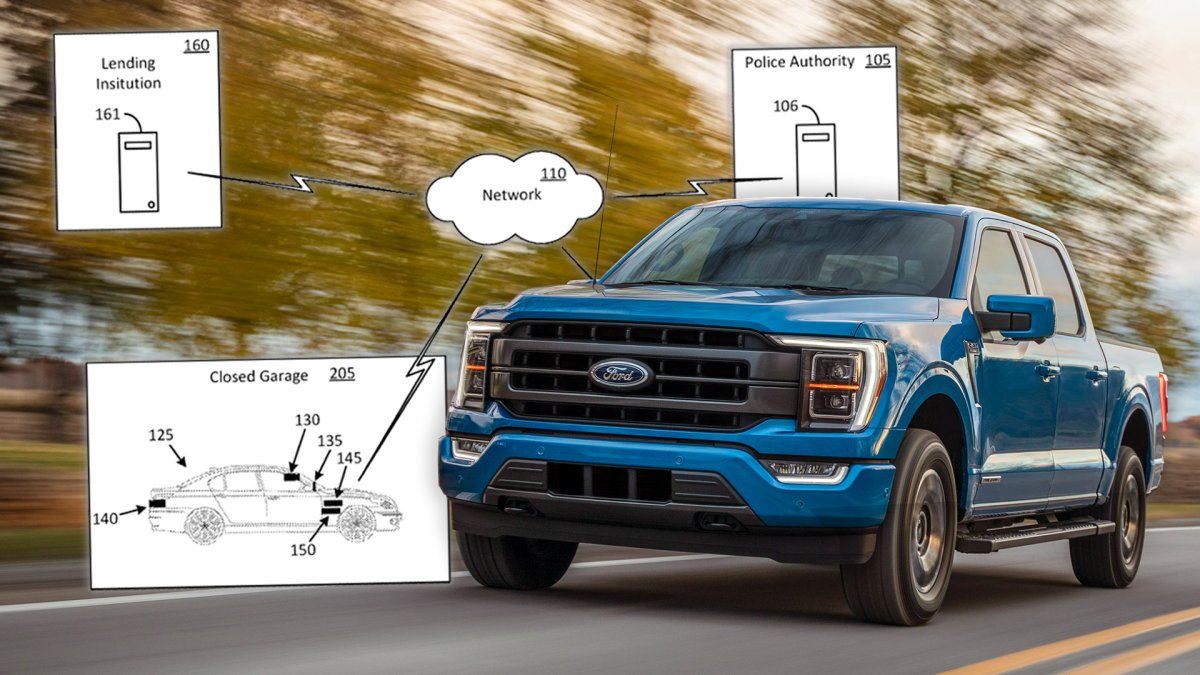
Ford Applies to Patent Self-Repossessing Cars That Can Drive Themselves Away
Ford's proposed system would allow your car to lock itself, disable certain features, and even drive itself autonomously to an impound lot.
The Drive
286 points · by MR4D · 3y ago · 544 comments
I'm pretty happy with the old, non-Internet-connected car that I drive. My phone already has all the smarts that my car needs for navigation and playing media and stuff. And from backup cameras to safer lane changing to full self driving, I can't think of a feature that I'd want to be built into the car and Internet-connected except for remote start (not sure I'd use it) or full-on "tell my car to drive somewhere without me."
This is a whole nother level of control loss. Not only do you not completely own the hardware but in the worst case scenario, the hardware can remotely be used to restrict freedom of movement or kill you and others.
I personally wouldn't recommend buying an electric vehicle unless it's extremely dumb or is capable of running an open-source and customizable operating system.
The problem is that EVs and traditional ICE vehicles are built very differently. In order to fit enough batteries, the batteries are usually built under the vehicle in what's called a "skateboard". You can't do that easily when retrofitting an ICE vehicle, so you end up sacrificing trunk space. Modern EVs are also much more lightweight and aerodynamic than ICE vehicles, and they can do regen braking. Without all of the modern EV innovations, you just don't get nearly the same range.
So yeah. You should probably get a modern EV and just crack the firmware to jailbreak it instead, which is likely to happen in short order. A challenge there though is that when it comes to autonomous vehicles, you're likely going to need updates to the map data on a semi-regular basis. You could also become liable if someone gets hurt and it's found that you tinkered around with your autonomous car's software.
[0] https://www.thedrive.com/news/42974/fords-281-hp-electric-cr...
Hackers have been able to compromise cars for at least a couple of decades, and while car manufacturers are getting better at securing their products, they are all pushing hard for further connectivity. This means apps and subscriptions for your car, new protocols that lets cars exchange information, and a huge reliance on cloud.
Source: first hand sources working in well known automotive corporations.
Its generally the same industry wide.
The idea of a vehicle repossessing itself does bother me. In the early 2000s I bought a vehicle from Mitsubishi, financed through them. At the time, setting up an automatic payment through them cost a monthly fee, so I set it up through my bank instead.
About 3 years later I got a call from them threatening repossession because I was three months behind on payments. I checked and every payment had been sent.
It turned out that Mitsubishi Motors East had transferred my loan to Mitsubishi Motors West, or something like that, and I had missed that. It was probably in one of the statements I never bothered opening.
As for security, while the automotive manufacturers are aware of dangers, and standards like ISO21434 https://www.iso.org/standard/70918.html are driving them towards better security engineering practices, there is a huge gulf between process/compliance/governance, and truly secure engineering practices as a core part of engineering culture.
Many/most of the people working on the on-board systems come from an embedded development background that doesn't include pervasive connectivity. That's a problem. They might check the boxes to appear secure, but they aren't necessarily invested in the process.
My prediction; there _is_ going to be a severe and widespread automotive security event which cannot be ignored, before that culture shifts.
Yeah that's a big Definitely.
I wish developers and consumers alike exercised a higher standard for software quality and weren't becoming increasingly tolerant of crap.
Eventually some hacker will decide crashing cars is fun, and I don't expect real security to happen before that. The same goes for medical equipment.
$5 says the hacker will be a nation state, and the "fun" will be an assassination that's hard to prove wasn't a glitch.
This is the world we're going to see soon.
Thats not the problem - the problem is you are / will not be the owner, you can never become the owner because the firmware is not for sale.
You are just a peasant that pays for the hardware and tne repair bill and is allowed to drive it unless you break one of the clauses in 900 page EULA
> One day, shortly before Christmas, an insect becomes jammed in a teleprinter, which misprints a copy of an arrest warrant it was receiving. This leads to the arrest and death during interrogation of cobbler Archibald Buttle instead of renegade heating engineer and suspected terrorist Archibald Tuttle.
A literal bug!
This exists and just serves to charge customers more money while blowing smoke up their asses, people want to believe they're better drivers than the rest.
I'm so happy with it that I will never own one that is internet connected, unless I can disable the internet connection in some way.
At some point you have to trust your kids to not be stupid. If you can't do that, you done messed up in raising them.
When he came out, he argued with the tow truck guys a bunch, but they kept hooking up his car and arguing back and couldn't be reasoned with, etc etc. My friend sat on the hood to keep them from towing it. The tow truck operators threatened to call the cops, so my friend called the cops instead.
Before the police showed up, an SUV showed up with some tow truck heavies with, no doubt, plenty of illegal weapons on them, just to spectate and make sure things went the way they wanted.
Once the police showed up, the story changed a bit, and all of a sudden he could get his car unhooked for a "drop fee" that was 2x the minimum tow cost, I believe (memory hazy here). It was the law in Santa Clara County, but of course, the tow truck operators weren't going to volunteer this information.
Lesson learned. If someone's about hooking up your car, get in your car and drive away, unless it's in the air already. Don't even talk to the thugs.
Police hires company to tow stuff away sure, but not "some random bumblefuck have right to do the police's job of "law enforcement"
> Owners need not ever be arrested or convicted of a crime for their cash, cars, or even real estate to be taken away permanently by the government. The government does not have to charge the property owner with any specific crime in order to seize the property, and must prove only by a preponderance of the evidence that the property is legally forfeitable. After property has been seized, the burden of proof shifts to the owner, who must prove that the property was not involved in nor obtained as a result of illegal activity [1]
The cops are far worse than some corrupt tow truck drivers. You have a fighting chance against a private company, but you'll rarely win fighting city hall.
I lived in a city that had it's own towing department. One evening, I parked in a spot that turned into a tow zone the following data at 7am. The next morning, I got to my care at 6:58am, and a tow truck was parked right in front of me with the driver enjoying a coffee. I quickly hopped into my car, put the key in the ignition, turned it, and....nothing. My battery was dead.
I got out, walked up to the tow truck driver and explained the situation. He backed up his truck, got out the cables, gave me a jump start, and I was on my way. I always wondered if a private service with possibly different incentives would have done the same.
Suppose someone decided my front yard is a good place to store their belongings and dropped a shed there. Should I be able to hire movers to dispose of the shed? Or the police should be my only recourse?
I share the feeling that towing companies can be abusive and that’s not right. I think a better response is to regulate the towing companies and provide remedies. For example, make abusive towing practices illegal with heavy penalties (eg. if they tow illegally, they owe you $1000 per day you lose access to your vehicle). If it’s unfair to tow a vehicle after two minutes, make that illegal.
This all reads like entitled driver behavior to me. Or dumb college antics that are best left behind.
-former car owner
You sure? GP:
>Before the police showed up, an SUV showed up with some tow truck heavies with, no doubt, plenty of illegal weapons on them, just to spectate and make sure things went the way they wanted.
Sounds more like thugs engaging in predatory behavior to me.
Isn't the whole point of a cul de sac that there isn't much traffic through it? Doesn't the cul de sac itself block traffic?
Because nobody strongly abuses this, it generally works fine and people go on with their lives around them. Even with the small neighborhood streets around Tokyo, you rarely see it being treated as an issue. At worst, if a truck is trying to pass, a quick honk will cause whoever is driving to rush out and move the car.
I do get disillusioned sometimes though, living in a society where people have a general level of respect for each other.
Couldn't help but get that in there could you.
A person can be both right and sanctimonious
She was hysterical after waking up and discovering the car was on the bed of a tow truck barreling down the highway.
I can't recall exactly how the tow truck driver was alerted of the girl in the back seat, but they brought it back and released it.
So yeah, humans in/on vehicle getting towed prevents them from towing.
Not likely, at least not without seriously damaging your car and/or the tow truck and you’ll have to pay for both. That tow truck hook is designed to pull your car down the road at highway speeds, you’re not going to just drive your car off it.
It depends. Wheel lifts are designed to have ratchet straps run through anchors on the side and over the tires to keep the vehicle strapped down. Your vehicle has it's own suspension and it can "pop" off the lift easily.
In "high risk" towing or repossession, you might see an agent lift a vehicle then drive off with it; almost certainly, they're going about a mile or so away to where they can safely stop and then strap the vehicle down properly.
Even then:
It's not that I'm afraid of missing a payment. At this point I would probably buy the car outright. But after the robo-signing debacle with BoA repossesssing houses that they were never party to, the mere capability renders the machine fundamentally untrustworthy.
I've said this a couple of times before, but I find it fairly astonishing that we don't have legislation covering what manufacturers are allowed to do to a product with embedded devices after a user has purchased it.
I want to be very clear - after I have bought a product, ANY CHANGE WITHOUT MY CONSENT done by the embedded software at the behest of the manufacturer is essentially breaking and entering (Computer Fraud and Abuse Act (CFAA)). They have the ability to stick a "little green man" inside the car, that should not absolve them of the legal repercussions of using it without my permission.
I don't believe that sticking a term/clause into a user agreement that is not negotiable is an acceptable way to deal with this situation.
This is rapidly becoming one of my strongest political beliefs. I think the concept of ownership is at stake.
My wishlist is essentially:
1. Devices that contain digital locks MUST provide all keys to all locks to the buyer at time of purchase. The user can opt into allowing the manufacturer to keep a copy, but they must be allowed to opt out.
2. Devices that require remote services must explicitly list all services and features that depend on those services. The user must have the option to opt out of remote services.
3. Buyers of devices that choose to opt out of remote services are revoking consent for manufacturer access to the device. Any future access by the manufacturer (at all, from updating code to reporting usage to remotely starting a car) will be considered a violation of the CFAA.
4. Manufacturers must justify why a feature requires a remote service. "Profit" is not an acceptable answer.
Man, do I have bad news for you about everything.
Basically - I want a simple contract that ensures that the device I've bought will continue working as expected (assuming no use of remote/internet connected features) and that the manufacturer is unable to enter my property and change how it functions after sale.
I don't find that particularly unusual. I think the unusual part is rather than manufacturers have this new ability at all. For the majority of our legal history it was either prohibitively expensive or downright impossible for a manufacturer to embed a device that only obeys the manufacturer into consumer products.
Now it's both possible and cheap, and I'd like to see some regulation regarding my rights to purchase a tool.
A small number of places are paying at least a little attention and beginning to ban the most egregious cases of this (ex: NJ considering banning car subscriptions with a specific call out to the behavior of BMW around seat heaters).
But this is going to become a tidal wave of consumer abuse in the very near future - I can fucking guarantee it.
Why would anyone ever sell you a product when they can rent it to you and let their "little green man" be the property manager for free? They won't - not unless they're forced to.
And while I think renting can be a useful way to acquire a product - I sure as hell think it shouldn't be the only one.
The only restrictions that the financer can put on your use of the vehicle are ones that you agreed to in the loan agreement. They can't just restrict your use of it as they see fit -- unless, I suppose, you were foolish enough to sign an agreement allowing them to.
The only restrictions I've ever personally seen have been a requirement to carry comprehensive car insurance for some minimum amount. And, of course, there's a lien on the car so you can't sell it without having the lien removed (typically by repaying the loan).
But you’ve also gotta be selfish enough to think that your pollutants don’t matter and that 1970’s era smog wasn’t a big deal. And you have to hope that older cars are still grandfathered in to pollution regulations and they won’t be subject to mileage limits as cars continue to emit fewer (or no) pollutants.
There will be a few high profile stories of cars driving off with newborn babies strapped in the car seat, then the tech will be banned.
Weirdly enough by patenting the business method, this makes every car mfgr OTHER than Ford much more appealing, so what we really is patent trolls as a service patenting really bad ideas to make sure nobody can implement them. I don't think Ford's new invention was intended to get me to buy a Toyota. Patenting bad ideas as a weapon is an interesting concept. Other than the obvious fraud issue, what's to stop me from filing a REALLY bad idea patent, then selling the stock short, then drumming up some PR, then closing out my short position at profit? At some point this is inevitable as "the internet" along with "the stock market" and everything else becomes more bot than human.
It seems like there has to be a market for something other than what we are getting. I'd like something that benefits from improvements in emissions/gas mileage but doesn't bolt on infotainment or phone integrations or networked everything. Zero interest in lane-assist technology. Preemptively saying no to any O.T.A. updates. I basically want what in 2023 would be considered a work-truck level of utilitarianism but in a form I can use to get my family from A to B, since throwing young kids up front on a bench seat in a work-truck is a no-go. It would be nice if it weren't actively ugly as well, but on this point I am negotiable.
I put cameras onto a box truck so I had reversing etc, but I used an 8-camera wired security system with video recorder and eSIM for that. The screen was optional but I found one that only had one button (to toggle views) rather than a "command console" type that by its nature gave full control over the security system. Driving around displaying the bumper-height rear camera on the screen was quite handy, normally it's a blind spot of trucks.
Likewise the GPS tracking system, I bought a stand-alone navigation system (you need a truck-specific one that you can at the very least type height and weight into so it doesn't direct you down roads you can't fit through), and obviously a separate anti-theft tracker (well, two, because the immobiliser also had one).
And of course there was a radio/CD player in the cab, no need to wire that into the one computer to rule them all that modern mobile infotainment systems have. I mean, "computers with wheels" or whatever the transport as a service companies call their devices these days.
Everyone is reselling the more or less same cheap Chinese units at insane markups. Firmware seems to be mostly identical. The tracking portals never have HTTPS. I haven't been able to find anything decent so far.
> It seems like there has to be a market for something other than what we are getting.
I might have a few small wishes, like I'd appreciate windshields and rear windows that quickly adapt to blinding headlights (or better regulations for highlights with actual enforcement), but cars have been mostly "good enough" for ages.
Maybe the Bronco selling like crazy will convince carmakers to issue "remastered" versions of previous cars, and maybe the remastering won't be "stick a 17inch screen in the center console."
https://www.bicycling.com/culture/a41119529/the-most-dangero...
what in tarnation
Funny how quickly an incredibly empowering technology became obscenely oppressive after they take the keys to the machine away from us. Sometimes I wish computers had never been invented.
Kind of surprised it hasn’t happened yet honestly.
https://interestingengineering.com/culture/hacker-attacked-y...
How about a million dollar cruse missile? Deal?
like an insurance company?
They came and repossessed it in the middle of the night. He offered to pay, and they wouldn't take a credit card, PayPal, Venmo, Zelle, wire transfer, or any other modern form of payment. No, he had to go to Western Union. Someone who's more up on this sort of stuff can explain that.
A week later I drove him to the parking lot where they take repossessed cars. I waited until he signaled that all was OK.
He was operating lawfully and you decided it was your job to enforce your justice. I don’t know, just seems wrong. I think it would have been more noble to take her in for the night or take her to a shelter where they can help.
But leave regular guys just trying to put food on their tables alone.
Zeroth, there really is no substitute for losing your home. Not being taken in for the night, not a shelter.
First, morality and legality are not identical.
Second, not doing something is a choice. Not acting and acting both have moral implications.
Third, systems are at times very good at pitting individuals against other. An employee can say "they are just doing their job"; meanwhile it is the organization structure that might strictly limit what authority the employee has. This can put the customer in the unfortunate position of having to raise issues with multiple layers of people, which takes away from their normal duties, before getting an issue resolved. A considerate customer might feel bad for "taking up" the first tier employee's time. This is by design. Think of car dealerships. I feel terrible for the dynamic of almost everyone involved there.
I haven't really laid out the specific connection, but I think you can see what I'm getting at. The car companies that hire repo companies probably don't empower the repo companies to exercise discretion. The people that build these corporate structures tend to understand human psychology and use it to their advantage.
Yeah, better they haul off the person's home over $50 and subject them to a minimum of hundreds in retrieval/storage fees. /s
Although somewhat rare, there are in fact tow operators who aren't pieces of shit and wouldn't do something like this in the first place.
Have you ever stood up for something? Anything? Have you ever told someone what they are doing is wrong / unacceptable?
Was that person doing his job or doing terrible things was a hobby?
I'm guessing they told him to get a Western Union money order, as those can't be reversed after they're cashed (AFAIK). Most modern forms of payment offer some level of consumer protection, as in they can be canceled or reversed. TBH a repo business might not even be able to get a merchant account for CC processing due to being a high risk business. Merchants that have high chargeback rates have to pay higher processing fees and can even lose their merchant account if their chargeback rate is too high for too long.
Ha, out of nowhere a use case for Bitcoin appears.
(although, yeah, you'd think GM Finance would have all that in most metropolitan areas.)
The days of cashier's checks being default trustworthy are long gone.
After 5 days, the check is discovered to be fake, and you have to pay the money. They're taking advantage of the payment lag.
"Yes, Western Union was legit and used by GM Finance to collect."
So, not a scam. Just ultra-conservative business practices.
It was not a scam, I know that.
(I don't know if he called the police or not, or what they would do in a case like this. Probably say, "Yep, sounds legit" and that would be the end of it.)
see above comment. Not a scam.
I find the story wholly believable, a lot of people who work in payments seem to be stupid and/or stubborn, and it might be the industry selects for those traits.
I don't see how a patent like this can be granted if we still generally don't have working self-driving cars. Even Tesla is getting forced to admit that "Full Self Driving" isn't really full self driving.
Can I patent a self driving car that runs over pedestrians so that I can sue any company whose self driving car does it that hasn't paid me a license fee?
https://pbs.twimg.com/media/EzmEZ9oXEAQOiY1?format=jpg&name=...
One exception that comes to mind is a couple of patents some physicist working for the US Navy created that probably aren't real technology. Anti-gravity devices and the like. Why they admitted those? No idea, but possibly this was done as part of some sort of hearkening back to the cold-war-era strategy of 'waste the enemies resources on a goose chase' kind of thing.
When you finance a car, the vehicle becomes collateral for a loan, but it belongs to you. A technology like this means that the vehicle still belongs to Ford, which means if something goes wrong with it, or if you get sciatica from their shitty seats, you can class action sue them into oblivion.
The reason we have laws is so that people have recourse to principle, whereas when you implement something like this in hardware (a car), it's dystopian vigilantism. I realize the largest future growth market for cars is in countries without reliable legal systems, and whose evolving governments will not hamper themselves the way the US did by guaranteeing individual freedoms, but this is why discourse about tech is important, as for every innovation, there's 100 scumbags like this inventor looking to leverage it to exploit people.
The title stays with the lender until all the payments are made per the loan agreement. I would not say the vehicle legally belongs to a borrower until they have possession of the title.
> The reason we have laws is so that people have recourse to principle, whereas when you implement something like this in hardware (a car), it's dystopian vigilantism.
The legal system is costly to use. Reducing the costs to repossess collateral would reduce borrowing costs, and ultimately help borrowers with lower borrowing costs because there is less expense towards repossession.
This varies a lot by state. A lot (most?) states the title absolutely goes to the purchaser but it has a lien attached that gives the lender rights of repossession.
> The title stays with the lender until all the payments are made per the loan agreement. I would not say the vehicle legally belongs to a borrower until they have possession of the title.
Maybe the confusion comes from the meaning of "owning". There are essentially three parts to ownership: the right to sell, to rent, and to use. A full owner has all three, but there are situation where they are distinct and the "owner" may be different depending on which aspect you consider. So when usage is considered, the borrower is the owner, the lender can't get into the car and drive, but when sales are considered, the lender can sell the car and get money from it, the borrower can't (at least not before the loan is fully paid).
This article is something like 5-10 years behind reality: Right now subprime auto loans are mostly enforced with GPS trackers that buyers are usually not made properly aware of, or even worse, tricked into paying for as an add-on pitched as being for their own benefit.
https://www.nytimes.com/2017/02/19/business/dealbook/gps-dev...
-
There are entire businesses built on selling poor people cars at truly insane interest rates, on payments they clearly can't afford, repossessing the cars on the cheap with GPS trackers, then selling then to the next poor person with bad credit.
This grift isn't new, but cheap GPS trackers and license scanners reduced the cost per repossession in a way that enabled these places to be signficantly more brazen about it.
Unfortunately the two prevailing takes I see on this are "they're subprime for a reason" as if they deserve it, and "well at least someone is still giving them a chance, you need a car in this country" (and of course some well meaning but ill informed people think you can just take public transport in every part of the country)
The reality is this is worse than nothing in many cases. Buy here, pay here have people pay more frequently so that they can repo a car within days not months of someone buying them. The process isn't free either, it's disruptive, and they'll continue to leech off the owner in collections.
-
Overall it feels like a classic case of short sightedness from society. Saying we should directly subsidized subprime people's access to affordable loans and cars would be a non-starter: It sounds like some bleeding heart charity case making the responsible pay for the irresponsible.
But then we'll all indirectly fund a much worse version of that when subprime auto loans start to implode (like they're probably already starting to with the interest rate hikes...) and we're all paying to pick up the pieces in multiple ways. If the bottom falls out the car market, well right now even middle class families are taking loans with insane terms that leave them underwater in a good market. The pain will trickle up and out from just subprime lenders and cars specifically.
In a country with very high firearm ownership it's actually dangerous[0]. From a quick Google search violence breaks out pretty often[2][3] in these circumstances.
[0] - https://www.nolo.com/legal-encyclopedia/car-repossession-law...
[1] - https://www.youtube.com/watch?v=ti0NHC6oVnk
[2] - https://www.jacksonville.com/story/news/crime/2011/03/02/rep...
[3] - https://www.fox4news.com/news/repo-man-shot-while-trying-to-...
FTFY.
Costs to borrowers could be reduced, which sounds like a nice silver lining to what most people would consider an anti-feature, but there's nothing that says the savings will necessarily be passed on to borrowers versus retained by the lenders instead.
Also I’m not sure you’re correct about the ownership and the lawsuits. Sure you can sue anyone for anything but why would this be any different from me leasing a car from ford and the same thing happening? That doesn’t seem to have been an issue for automakers so far…
For the record, this sounds like a dystopian nightmare to me. I’m not in favor of the concept.
Ford has a huge financing arm. And it will probably get bigger as interest rates rise, because they have more room to offer lower than market interest rates as a hidden discount without dropping the purchase price.
[1] https://www.ford.com/finance/investor-center/ford-interest-a...
I'm not a lawyer at all, however much of my work on privacy and security has been about reconciling technology architecture and implementations with privacy and other laws and regulations, and security architecture is about allocating risk between counterparties in a technology solution, so from that view, this could be reasonably interpreted as a predatory technology.
They are, in all other respects, the same as a traditional loan-based purchase.
Might need Steve Lehto to weigh-in on how much "ownership" there is in America.
Nothing prevents that from happening now, though. I'm also uncertain how reclaiming the collateral for the loan is any different in this scenario.
Granted, I think this is extraordinarily gross and consumer-hostile. Aren't there myriad of options on the table for reclaiming the vehicle? How often does someone "get away" with keeping a car, anyway? That's what the repossession industry exists for.
It seems like a good idea for stolen autos (at least until the car can be modded to remove the ability, so recently stolen autos). As long as there are enough checks to ensure that only the owner (or law enforcement with a warrant) can repossess the car. There just has to also be a requirement that the lease holder can't lawfully repossess without a court judgement.
No surprise the dark tactic is spreading.
Regular licenses for software you do "buy" can be retracted but that rarely happens in practice.
This is not true - In my state you don't get mailed the title to the car until after the loan is paid.
Is it not correct that the lending entity you use to purchase a vehicle is the party that legally owns it? The borrower has possession and right to use the vehicle, but the lender holds the title. That's why you get the title transferred over to your name once the balance of the load is repaid.
The reason they do that is because a lien gives them the ability to, within a particular legal framework, get ownership of the car if you don't pay your loan, prevent the title from being transferred to someone they don't trust, etc. It's basically just risk mitigation.
If they don't have the right to do that, it's theft, either way around.
What if you usually work weekends which is common for a lot of the jobs people who are missing payments might be working? In that case you would be out of luck.
You would also be out of luck if you are trying to get a side-gig or pick up a part time job on weekends to make ends meet.
This is what happens when people who have no money troubles make decisions in a board room. Completely out of touch.
"Buy a bus pass like the good poors, cash side work is evil"
-the people peddling these things, but using nicer words"
This technology in any car should be a violation of our rights. A corporation dictates when to access the vehicle remotely?
It’ll start with justifiable use cases. In a not too distant future, imagine something like:
* can’t access car during peak CO2 emission times because you got the cheaper monthly rate that uses a green subsidy to pay for the cheaper rate
* your incorrectly a suspect of a petty crime, your car is now inaccessible because Ford doesn’t want liability if you do something bad with their car (despite you cooperating with law enforcement)
* you’ve been categorized as spreading hate speech/misinformation/disinformation and that breaks our terms of service
I could go on, but you get the point.
This sounds like a feature that opens up a new avenue of potential financial engineering. If your car could enforce that it was in 'green mode' or didn't drive at certain times and you could get a subsidy or tax break for it, that might potentially be a good incentive to encourage more environmental friendly lifestyles and practices. That doesn't seem like a bad thing to me, I might not want to buy that feature but it allows for some interesting possibilities. The buyer would have to agree to some stuff at the time of purchase (or lease as it sounds like it would be) to enable this.
We should be mindful of potential unintended consequences of these things. There are some good frameworks in place though, despite what you're second point suggests, Ford has relatively limited liability in the case that their car is driven by a bad actor (cooperating the the police or not) the second that car starts driving on its own, for whatever reason, Ford has some liability.
I remember my grandfather being relatively upset at the idea of GM knowing his GPS coordinates when his Cadillac had onstar. Now there have been hundreds or even thousands of cases when OnStar has had a positive outcome on peoples lives after a crash or something, including times they've reported it before anyone else. His tune changed dramatically one time they remotely unlocked his car and remotely started it so he could get home when his fishing boat turned over and his car keys were at the bottom of a lake though.
Humans are bad at predicting edge cases. That cuts both directions. Machines should give guidance, not provide enforcement.
Hell no. It starts that way, and it ends with "you are not allowed to live".
In practice, not everyone might have the choice to just not buy that feature.
My thought process was that the inherent evils were already being discussed, so I figured I would point out something that I saw in the article which I thought was interesting but not already being discussed.
This is only slightly closer to a real-world implementation than a patent for asteroid mining, never mind commercial viability.
Mind you, I don't consider that a bad thing; this is pretty dystopian, but still.
Reduction to practice is absolutely a requirement of patent law in the US.
Perhaps the standard for "reduction to practice [0]" is a little looser than I'm imagining. I can't even see how this would be covered by sufficiency of disclosure[1] since the apparent non-existence of level 4 or 5 autonomy suggests that no person skilled in the art[2] yet exists.
If it isn't obvious at this juncture: IANAL.
[0] https://en.wikipedia.org/wiki/Reduction_to_practice
[1] https://en.wikipedia.org/wiki/Sufficiency_of_disclosure
[2] https://en.wikipedia.org/wiki/Person_having_ordinary_skill_i...
> Reduction to practice may be an actual reduction or a constructive reduction to practice which occurs when a patent application on the claimed invention is filed. The filing of a patent application serves as conception and constructive reduction to practice of the subject matter described in the application. Thus the inventor need not provide evidence of either conception or actual reduction to practice when relying on the content of the patent application.
I think we actually have a better idea of how to mine an asteroid.
I think the better solution would be to say "you registered the patent, you get credit for the idea, but whoever makes it first gets the legal rights to sell it" - then people get credit for idea creation and also for making it a reality. I'd ideally add that they have to publicly disclose the info as well but idk how that would affect R&D
But you probably do care that your self-repossessed car is now impounded for driving dangerously slowly on public roads.
But then again, I'm sure you can increase the speed to the average careful elderly driver.
Not if you want to have a quiet chat with the person who's been missing their payments..
Looking very far into the future, it's not hard to imagine that all cars are self driving by default with some highly-regulated exception, for purposes of safety, anti-terrorism, lobbying, etc. If that's the case central management seems like the next logical step. Citing reasons such as traffic flow, anti-terrorism, environmental management, disaster relief, anti-terrorism, etc.
The analog to what I’m saying would be something like disabling your legs and asking for permission to walk on a public sidewalk.
You can lose your license and not be allowed to drive anywhere, but you can still walk around - that's the whole rights VS privilege thing
Violating auto speed limits is a good example. Society can't enforce speed limits 100% of the time if it relies on the occasional state trooper with a radar gun. Therefore society sets the penalty very high so that the small risk of a citation isn't worth the benefit of speeding.
100% enforcement should have much lower penalties.
There are other problems with 100% strict enforcement, in that we don't even know what laws we have.
But the really dangerous people on the highway aren't typical speeders who might go say 85-90mph when the speed limit is 55-65 mph. In traffic that isn't dense and clustered, high speeds in and of themselves are not a big problem.
The really dangerous people on the highway are those who aggressively change lanes in dense traffic, weaving in and out of traffic trying to find the narrowest possible gap to slip through where no safe passing gap exists. This is much harder to objectively track and measure unless a cop happens to sneak up on the dangerous driver and sees them firsthand.
Counterintuitively, I believe that the highways are made far less safe from speed limits because this tends to cluster up all traffic together so impatient people (who are going to exist no matter what) are compelled to dangerously weave in and out of dense clusters of cars which is the most likely thing to cause an accident.
If you made one or two lanes available with no speed limit so the aggressive drivers could be free to have their way and don't have to interact through slow drivers, I'd bet that most problems on the road would be solved. You want to create a situation where impatient people don't have to interact with the slower drivers.
It's a dangerous job and I don't think they give the repo folks enough information. I recently had to run one of them off as the former property owners had renters that stopped making payments on their vehicle. The repo guy was highly aggressive and was yelling at my family members. I assumed he was just some nutjob and had no idea he was a repo guy aside from the fact he was driving a tow truck without any company logo. I assumed he was trying to steal my tractor since it's is an antique.
Penalties are set high because in the US they're enforced only irregularly. If the US moves to some kind of near universal enforcement, problems will occur because of that.
I used to be a big proponent of alcohol/drug test to prevent car starting, ideally I imagined the system would be with an absolute guarantee (mandated) the information stays local (just a hardware switch preventing ignition or startup). But I'm sad to say I don't believe in any more, so much abuse to mark people as 'tries to drive while under the influence' or making you pay higher insurance because you're often 0.5g instead of 0.3g.
I really want people to be prevented to drive killing vehicles under the influence (yes even my e-cargo). I know it would bring so many other problems, such as cost, tampering, bad sensitivity, etc. It doesn't make sense to me that we don't crack down more on this specific act.
Probably be better to just make cars do realtime verification of license status before letting someone drive ... but that's only better by comparison; people who never drive drunk will bristle at the heavy regulation.
A couple in Florida was killed yesterday in the hurricane, though they tried to evacuate, the storm meant that license verification servers were down and their Ford would not start.
Edit: Just occurred to me this is probably a theoretic future state
Money spent making the device not suck reduces profit. Nobody will care when you abuse your customers because your customers are convicted criminals.
Pretty much every company selling stuff that people need to use to not violate the terms of their sentence is like this.
That may be true. But it's also possible that measuring blood alcohol with breath tests is never going to work consistently for all people. Breathalyzers are well known for widely variable results between people who have identical BAC.
If it's meant to be used by everyone (I'm not thinking DUI recidivists, how many people have you seen rationalize driving after a drink or two or six) then make it usable by everyone.
I'm also extremely tired of people veering into the fucking bikelane while phoning, texting, hands off talking on the phone, and sometimes (to often) just 'checking' the damn cargo with my two kids inside. So they can get to work 'on time' and spend 15 minutes at the coffee machine. Dammit.
Make it impossible to interact with in a moving object, cut the data and phone, I don't have the answer or a patent but this is killing so many people for very, extremely selfish and stupid reasons...
But since we're OK for the road being some kind of far west, Dashcam it is...
Innovation today seems to have shifted towards serving the owning class.
I have a big enough philosophical objection to the concept where we don't actually own property and may only rent it from the government due to property taxes. Now we "own" phones we can't control, "own" cars that have features dis/en-abled over the air if you pay for them.
Product managers are brimming with innovative features and benefits enabled by stripping ownership away from the public/consumers. It reminds me of the Black Mirror episode where you pay for your toothpaste $0.05 at a time from a dispenser in your home when you want some on your toothbrush.
For personal property there is a production chain with labor that went into the item, but for land it's just out there and at some point someone decided they should be able to restrict what other people do in some area. If you see that it's not legitimate for a government to do, then by the same logic it's not legitimate for an individual - a government is just a collection of individuals acting together
I see the rights of government as secondary by default with exceptions meted out strictly as necessary. There exists a very limited number of jurisdictions where property taxes don't exist and land ownership is therefore real, so there's no philosophical/legal impediment to foregoing property taxes.
My theory is that as profits decline due to the tendency of markets to reach equilibrium with respect to products/services supplied that capital owners will begin to reintroduce pre-capitalist norms and practices such as landlordism as these can sustain revenues to their liking as you renter won't have any ownership rights to contest their actions. It means they can raise rental rates anytime in the majority of cases and then just evict you from or repossess what was rented. Kind of like feudalism but without the fancy hats and titles.
When was it different?
I think antique car restoration and modernization is going to be a great business to be in for the next 20yr or so. At least the demons in older cars can be propitiated with minor rituals like a fetish hung on the mirror or the occasional blood sacrifice.
This shit is going to lead to hilarious scenes of cars flocking places because of a node.js bug.
edit: i forsee "car leashes"; probably something in the nature of a parking boot so make sure the car stays immobile or becomes nonviable. And there's always the trick of jackstands and hiding the wheels at night.
I deployed Home Assistant as a building monitor and stuff a few years back. HA gains new super powers with each release.
I let it listen to the airwaves and when the funky new Bluetooth stuff came online, it now sees a lot more stuff. We also have a couple of Unifi APs. So HA can listen to 2.4 and 5GHz, we have Zwave and Zigbee dongles in it and Bluetooth.
It notices every car that goes past on two major single carriageways, when they advertise themselves. The roads are classified at around 30,000 cars per day each.
Also I see several toothbrushes (Oral B+) and a lot of lights ... a lot of lights. I've already started having a chat with my neighbours about IoT.
Cars are a bit of a worry ...
What needs to happen is better consumer protection to prevent americans buying cars on finance that they are never going to be able to afford.
The issue is that "Making finance accessible to low income Americans" and "predatory lending" are approximately two sides of the same coin. And so it is not politically popular.
Have they earned that reputation regarding automated systems, and how will they deal with false positive/bugs etc. when the wrong car is repossessed at the worst time for its owner ?
<< What needs to happen is better consumer protection to prevent americans buying cars on finance that they are never going to be able to afford.
I think you would have everyone and their mother fighting against this saying you need freedom to make stupid decisions. Even I am personally on the fence. You do need better protections, but you need to have an ability to make your choices ( and in US - not having a car is not really a valid solution ).
And, when someone does not pay as agreed to a significant degree, the more efficient that a repossession can happen, the better a deal can be offered to borrowers who do pay as agreed.
Japanese car dealerships have been this way recently, before the pandemic hit we tried to buy a new Honda Fit and had to buy a used one because they had none in inventory because, allegedly, the factory had washed away in a flood but they had a row of 50 CR-Vs made in the same factory. The dealer tried to push us into one of those.
The automotive press uncritically reports that American consumers are crazy about huge vehicles but what I've observed is that dealers are crazy about selling huge vehicles. Before the pandemic you would frequently see small cars were selling out as fast they arrived on the lot but dealers would have a sea of huge and expensive vehicles and be offering $8000 or so in incentives to sell them. If small vehicles were really unpopular it would be the other way around.
There are rumors that Toyota and Honda would love to kill the Corolla and Civic but the quality of those vehicles is so legendary and the attachment of owners is so fanatical that they know people aren't going to "trade up" but will be paying new car prices for high mileage vehicles.
I'd personally much prefer to make public transit that is so good that everyone uses it.
No amount of new features will ever convince me to buy a car that does this but the people who do buy them will undoubtedly be poor and marginalized and offered a great deal on their financing if they choose the roborepo car.
With a human tasked with the repo, at the very least even if "computer says no" to them, they have some leeway (even if it's slim-to-none) in talking to you about it.
Does autocorrect make Freudian slips?
Doing an image search for "ford model t plaque" yields some examples.
Political assassination via cyber attack/backdoor? ezpz, find a tree, accelerate into it, claim it was the car acting up.
Bug in the software? Sorry you're dying today because they wanted to repossess cars easier, your life is less important than protecting capital.
We're in a world where deregulation has planes either falling out of the sky or attempting to. I don't trust any soft handed regulation on cars without manual overrides.
My car has a push start, but also a manual transmission. I know if something goes wrong and my engine stops responding to the electric throttle I can just pop out of gear and coast.
Not saying they're super common, but as someone who writes software, I don't like the increasing dependency on software implementations of certain components that are fairly simple in their mechanical form.
On the political assassination front, wasn't there a story out about one such attempt or did I dream it?
LEOs are also notoriously corrupt and difficult to keep tabs on. Imagine police harassment when they have the ability to remotely shut off your car.
https://en.m.wikipedia.org/wiki/Michael_Hastings_(journalist...
But this isn't anything new. Buy here pay here places have been throwing ignition locks on cars for ages and shut off the ignition if you don't make payments. This would take it a step further, integrate it into the car, and add autonomous features to it.
Verse 1: I bought a brand new truck, shiny and so smart It had all the latest gadgets, it was a work of art But I got behind on payments, my bills just piled high And one day I woke up, to a big surprise
Chorus: My smart truck repossessed itself, it had a mind of its own It drove away into the sunset, left me all alone I should have paid my bills on time, kept up with the loan But now my smart truck's gone, and I'm all alone
Verse 2: I searched high and low, for my smart truck so true But it was nowhere to be found, no matter what I do It had GPS and sensors, it knew just where to go Back to the dealership, where it could be sold
Chorus: My smart truck repossessed itself, it had a mind of its own It drove away into the sunset, left me all alone I should have paid my bills on time, kept up with the loan But now my smart truck's gone, and I'm all alone
Bridge: I guess I learned my lesson, to pay my debts on time But it still hurts so bad, to see my truck's tail lights shine I'll never forget the day, my smart truck drove away And I'll always regret, the price I had to pay
Chorus: My smart truck repossessed itself, it had a mind of its own It drove away into the sunset, left me all alone I should have paid my bills on time, kept up with the loan But now my smart truck's gone, and I'm all alone
Outro: So if you're thinking of buying, a smart truck of your own Make sure you pay your bills on time, and keep up with the loan Or you might end up like me, with a broken heart and soul Watching your smart truck drive away, leaving you alone.
And broke. And not actually happy.
I can get into the nearest city and town just fine on public transport, and that's what I do. But public transport here is spoke-hub. If you want to go somewhere that is moderately far away from a hub, it becomes incredibly difficult (and expensive).
If you live in a city, and you never leave that city other than to go to other cities, then you absolutely do not need a car. Most other people do.
- Camping overnight is both illegal, and less comfortable than the hotel I was basing my hikes out of
I drove there, stayed at a hotel, and hiked out from that hotel every day. It was a very memorable trip. I then drove home.
The alternative would have been to get a bus to the train station (40 minutes), a train to the south of the park (2 hours), get a bus from the train station to another town (only 2 buses a day, morning and night, so we'd have had to leave home much earlier or lose a day), get another bus from that town to another town, then get another bus from that town to another town. All whilst lugging a large suitcase, camera bag & gear, and another backpack between us. The buses would have taken another 3 hours. Then if I needed to get home in an emergency, or otherwise leave quickly, I'd have to redo it all backwards, and hope I could make that twice a day bus.
No thanks, I'll just stick with my 1.5 hour drive from my front door to the hotel.
It fulfils the desire to go from point A to point B in relative comfort at relative speed, at reasonable cost that scales to the local economy. US market cars tend to have lots of extraneous features and not be suitable for rugged roads; less developed economies get models with fewer comfort features, but a more robust suspension for use where roads are more aspirational. Autorickshaws are common in some places and unknown elsewhere, etc.
Walking, biking, and public transit in a livable community is the only rational way forward.
I've noticed that the arrogant and condescending people who are most opposed to cars tend to be childless young urbanites with very limited life experience. The rest of the country operates in a completely different way, and votes accordingly.
My observed injury rate per vehicle mile, per trip, or per time spent, in a car is much lower than the same rates on a bicycle. Incidentally, my largest injury on a bike was due to street car rails, so thanks public transit for making the roads less safe for bicycling. I can't count the number of times I've tripped while walking, resulting in mostly minor injuries, but nevertheless more injuries than I've sustained in automobiles (not counting violence from siblings). Lack of safety restraints on public transit mean more minor injuries from sudden stops as well.
> Cars are too big and too heavy
Autorickshaws are much smaller, lighter, and more fuel efficient. Plus they're cute!
> Infrastructure demands are too great
Infrastructure demands for cars scale. You can use cars if you can get fuel to enough fueling stations and have cleared trees and other obstacles from paths. Pavement is optional but encouraged. Parking lots are nice to have, but any cleared space works. You don't get a lot of speed, and probably not much fuel efficiency, but it works. Paved roads are nicer, and they get built because they're useful. Of course, busses and bicycles like paved roads too (paving for bikes requires a lot lower standard too).
If you can't get fuel to fueling stations, there's things like wood gasifiers[1], although gasoline and diesel are much more scalable if the infrastructure is present.
> Walking, biking, and public transit in a livable community is the only rational way forward.
This would severely limit the scope of livable communities. Or at least significantly increase transit time for many to most activities. Those are all great options, when available and appropriate, but a lot of times it's not the best mode of transportation and often it's not even appropriate. The diversity of origin/destination pairs in most metropolitan areas of a certain size makes it very hard for most users to be served by direct public transit routes, and hub and spoke routing makes a lot of trips turn into first go 30 minutes in the wrong direction, then 30 minutes in the right direction, when a point to point automobile trip would be much less time.
I can't imagine some of my recent trips working well with public transit. Especially those trips where I'm carrying sports equipment for multiple people not traveling with me. How do you take three or four sets of hockey gear on a bicycle, or walking the half mile uphill from the bus stop to my home?
[1] https://www.amusingplanet.com/2022/02/wood-gas-vehicles-cars...
Our lawyers were pragmatic about it. They were very clear that the concept should be novel and plausible, and were willing to offer guidance and help with the text of the parent. It was neat, and I wish I’d taken advantage of it.
The inventor would submit ideas to the patent staff, if selected, spend an hour or so describing it to staff who write the patent application; the inventor reviews and clarifies, etc a couple rounds, and then it's submitted.
Go on, tell me that's not going to happen by the end of the decade at this rate.
But we will be stuck with it anyway, because of risk aversion. Any car that could have been repo'd at the click of a mouse but doesn't have the functionality will result in explaining to the boss why shareholder value was wasted in that individual situation. It doesn't matter that the project overall will be a net financial loss, just need to avoid that awkward convo with the boss for that one incident.
So we'll all eventually be stuck with this, and we'll all be poorer because of it. But at least risk will be lower and no one will have their feelings hurt at work.
AUTO: "Ok."
Then I realized this is meant for lenders. Ford has a credit and leasing company, which might be the actual target of this. The rest is superfluous.
It would be very unlikely any car company would have this "feature". It's just a litigation nightmare waiting to happen.
Such patents are among few other things useful for the company to convince investors that it innovates: "Look we have 100 patents in this area in the past year".
TLDR: bank has systems issues, thinks you are in default due to bugs, systems "robosign" legal documents saying you are in default, repo home, kick you out, swear to courts it is true, and basically get away with a slap on the wrist
"re"Possess? How about talking about Possessing in the first place?
Why do we have so much "garbage" parked on our streets, namely cars that are owned but not used?
Just like the American Dream of owning a home (and working 30 years to pay the money you rented to do that), or De Beers diamonds, or College, or whatever, there is a concerted effort to make you crave that thing and make that big-ticket purchase. Mainly to give into all the social pressure mechanisms.
The car manufacturer industry relies on this kind of stuff -- to sell more cars. And sometimes they dial it to an 11:
https://www.youtube.com/watch?v=xNzXze5Yza8
And the fossil fuel industry had relied for decades on colluding with them to make sure cars are locked into one type of fuel (fossil fuels). All your other appliances have long ago been able to take electricity -- so they can be powered by hydro, geothermal, solar, wind, nuclear fission, and even fusion as soon as it's enabled. But not cars, no.
And government of course worked hand-in-hand with industry to subsidize fossil fuels and delay electric cars and battery tech: https://vimeo.com/547118547
The only people that this article would alarm are those who believe they want to own a self-driving car. Most people would just time-share them, and self-driving cars would be operated by Uber (another hyper-capitalist company that currently takes 50% of all drivers' wages, but soon the robots will replace them so it won't be an issue).
And we would finally have less parked cars on the streets, open more lanes, and the cities can become more beautiful.
The full self repossession thing is just another use case for full self drive, which is complete fantasy land on the part of automakers.
So, it will do what every Ford I've owned since the 80s will do...
Verse 1: I had a trusty truck, my pride and joy Took me everywhere, never did destroy But times were tough, I fell behind Missed some payments, the bank declined
Chorus: Now my truck's gone, it drove away Left me feeling low, I gotta say I'm stuck here on this dusty land Holding onto memories of what I had
Verse 2: That old truck had a mind of its own But it always knew the way back home Now it's gone, and I'm all alone Sitting here, trying not to moan
Chorus: Now my truck's gone, it drove away Left me feeling low, I gotta say I'm stuck here on this dusty land Holding onto memories of what I had
Bridge: I should have known better, I should have tried To keep my payments up, to keep my ride Now I'm here, looking at the road Wondering where my truck has gone to roam
Chorus: Now my truck's gone, it drove away Left me feeling low, I gotta say I'm stuck here on this dusty land Holding onto memories of what I had
Outro: Maybe someday, I'll get another ride One that won't drive away, won't make me cry But for now, I'll just sit here and sing About the truck that was my everything.
Verse 1: Had a pickup truck, my favorite toy, Whiskey in console, feeling coy, Drove on dirt roads, feeling free, With a girl on the tailgate, in tight blue jeans for all to see.
Chorus: My truck left me, feeling stuck, Drinking whiskey in my blue jeans, feeling yuck, Miss the girl on the tailgate, her pretty look, Truck is gone, now I cry like a rook.
Verse 2: Fell behind on payments, lost my ride, The truck drove off, with the girl by its side, She wore tight blue jeans, hugged her curves just right, Now the truck and the girl are out of sight.
Chorus: My truck left me, feeling stuck, Drinking whiskey in my blue jeans, feeling yuck, Miss the girl on the tailgate, her pretty look, Truck is gone, now I cry like a rook.
Bridge: It was just a truck, I know, But its departure dealt a painful blow, I'll find a new ride and try to mend, But memories of the girl and the truck will never end.
Chorus: My truck left me, feeling stuck, Drinking whiskey in my blue jeans, feeling yuck, Miss the girl on the tailgate, her pretty look, Truck is gone, now I cry like a rook.
Outro: Maybe one day my truck will return, With the girl in tight blue jeans for all to yearn, Until then, I'll sip my whiskey and dream, Of the truck and the girl, a perfect team.
It didn't even mention a can of beer or shotgun
"My truck done left me and my cellphone said I'm broke"
HN used to bury Reddit-like comments a while back, but it seems the Reddit influence is becoming more and more accepted on HN these days, as I’m starting to see them more at the top vs. the bottom of threads.
If you liked my comment, please upvote and subscribe, and consider donating to my Patreon to have access to my future comments one day earlier.
Back on topic:
I find this hard to believe, what happens if it repossess itself by mistake? Gets in an accident on the way home during said repo? Especially since nowadays most Fords are just oversized trucks.
And why is this even a desired feature? Is the average Ford customer that untrustworthy? I’m curious what the expected amount of use for a feature like this is.
In any case, autonomous driving isn’t far along enough yet for this to be practical and out in the streets, so I wonder how it even got approval.
Please make it stop...
For instance:
i found hn throuh r/hackernews
> Write a country song about a guy whose truck left him. The first verse starts "My truck done left me and my cellphone said I'm broke"
Yes: your truck still ran away with your fishing boat and eloped on BLM land.
You get out of jail, your wife comes back, your dog comes back to life, you get your truck back, you get your farm back...
Taking a look at this now, for the first time in months. There's nothing in here about comedy not being allowed. It does discourage users from making comments like yours, though.
Shallow jokes to break up heavy conversations, like about our society slipping into a dystopia, are very human.