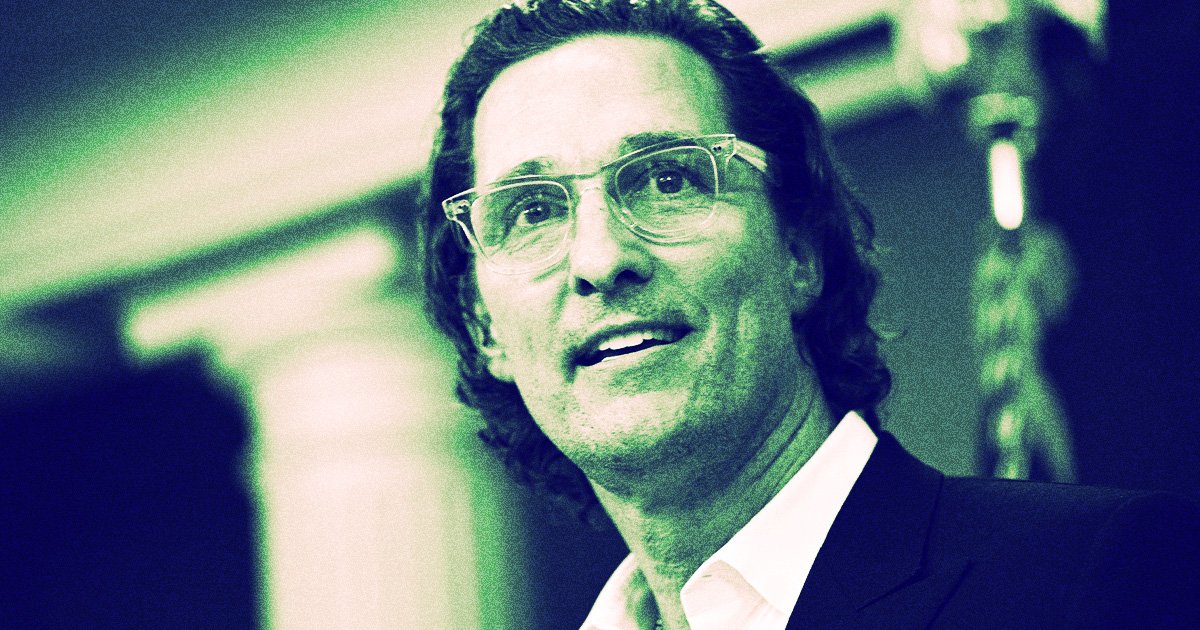
Company Lays Off 8,000 While Paying Matthew McConaughey $10 Million a Year
Salesforce, the firm co-helmed by the definitely not Hawaiian Marc Benioff, is the latest in a slew of tech giants to lay off thousands of employees.
Futurism
190 points · by ppjim · 3y ago · 187 comments
There's also little value in pushing this clickbait style journalism to the front page.
First of all, it is objectively incorrect:
> Per the WSJ, the company will be letting go of 8,000 members from its massive workforce
The layoffs they are referring to happened in early January. They are not laying off another 8000 employees.
Beyond that, they paid an A-list actor $10M out of their marketing budget not to "sit around" but to do a set of commercials (one of which aired at the Superbowl). Considering they exceeded all analyst expectations for revenue and profits in the last quarter, it's safe to say that some of their effort is working. Enlightened engineers don't like to admit it, but advertising works, and is a critical part of running any business.
The fact that they also decided that 8K out of the 25K+ employees hired during the pandemic were redundant has nothing to do with Matthew McConaughey.
> The fact that they also decided that 8K out of the 25K+ employees hired during the pandemic were redundant
Kinda odd how you attribute them "beating the street" more to Mathew McConaughey's presence than the work output of 8 thousand employees. Can you elaborate on why this is so clear to you?
In my years in business, it's nearly impossible to draw an accurate cause and effect line between marketing and sales. Too many other factors at work.
Or perhaps these Marketing departments are just really good at internal marketing of budget usage?
u sound like u get paid for salesforce-pr
Didn't the layoffs happen in January (the end of their fiscal quarter) and wouldn't they have taken the costs of those layoffs and subsequent severance in that quarter? So they recorded record revenue and profits _despite_ laying off people, not because they laid them off.
Do people who would be in a place to make the decision about their companies choice of CRMP really need to be marketed to in order to know about Salesforce? Seems like a wasted budget IMO.
That's not true. They announced 8,000 layoffs in January but they haven't executed all of that yet. As per the quoted WSJ article:
> In January, the company said 8,000 workers had to go. “It’s an unfortunate part that you have to say goodbye to folks who, in many cases, are your friends and you have relationships with,” Mr. Benioff said in an interview. “But, ultimately, the success of the business has to be paramount.”
> After an executive retreat in February, he proposed in a draft of a year-ahead strategy plan that the company rank employees based on metrics, including how much money salespeople bring in. Those in the bottom 5% would be routinely dismissed, according to a draft of the policy posted on the company’s Slack channel and described to The Wall Street Journal.
> The company has been reducing its workforce since November, when it cut hundreds of salespeople. In January, the company announced restructuring plans to lay off 10% of staff — roughly 7,000 people — and shed some of its office real estate.
> Since then, thousands of workers from that planned 10% cut have been notified of their terminations. Insider has also reported that remaining employees are feeling increased performance pressure, and some are being pressured to quit with severance offers that are not as big as those being laid off.
> Salesforce has not confirmed whether it has notified all 10% of workers included in the official restructuring plan yet. Insider previously reported that at least one person familiar with the matter said the company was evaluating last month whether it needs to cut an additional 10%.
Like everyone else in Tech, they over-hired because they were objectively in a different state of the world in 2021, which was possibly everyone's best year in 1-2 decades. Then 2022 rolled in, shit hit the fan on inflation, Ukraine war and a seemingly overnight massive hike in rates after being in negative yield territory for a while... guess what? Companies went back to the drawing board, stared at lower revenue expectations, higher costs, worse margins given operating leverage and decided they could do without X% employees to favor profitability over growth, since there's nowhere near the same growth to be had in 2022-23 as there was in 2020-21
Conceptually, I dislike layoffs as much as the next person... but keeping the same cost structure against deteriorating topline growth is just Bad Business, and that's how CEOs get fired and companies go under. Ask the owner of the pizza joint nearest to you and they're likely to agree.
All in all, unemployment is still at record lows so I'm incline to believe that laid-off workers are finding employment elsewhere, which is the good side of Capitalism.
It could have been worse, John... a lot worse
EDIT: Okay, economy hasn't technically crashed, but valuations are down, funding is down, and layoffs are up. Tech companies have a very different view of money now than they did 8 months ago.
https://investor.salesforce.com/press-releases/press-release...
This is businesses reacting to activist investors and trying to quash workers asking for better compensation. To the extent that the economy lags it’ll be due to layoffs affecting people who circulate their income more effectively than shareholders.
To be more specific, their adjusted non-GAAP profits are higher than expected. By GAAP measures they posted a loss for the previous quarter.
> “For the full year we delivered $31.4 billion in revenue, up 18% year-over-year, or 22% in constant currency, one of the best performances of any enterprise software company our size,” said Marc Benioff, Chair and CEO of Salesforce. “We closed FY23 with operating cash flow reaching $7.1 billion, up 19% year-over-year, the highest cash flow in our company’s history, and one of the highest cash flows of any enterprise software company our size.”
I feel like you're saying this with a negative connotation. Isn't that what the business is supposed to do? Run more efficiently, cut excess bureaucracy, make more profits?
Given that they are reporting solid profits on very large revenue volumes, I don’t think you can make the case that this was a financial necessity and the scale is too large to have had much detailed thought going into it. (And “excess bureaucracy” is cut by sacking the C/VP-level managers who built it, not the rank and file implementing those policies.)
Trades is seeing phenomenal demand for labor, where as white collar people are going to get pink slips esp. in the fields (finance, tech, commercial real estate management, refinancing/mortgage) that have boomed during last decade.
If employees wanted to be kept on even in a downturn, they should have negotiated for it, but I suspect the price they would have had to pay for that would make the entire prospect unattractive.
You just want to eat your cake, and have it afterwards too.
If the “terrible thing” you’re referring to is paying someone according to a contract signed then, yes, it’s an excuse for why they had to do it.
That’s literally how contracts work.
It'll take a while for a consensus narrative to emerge explaining the widespread tech layoffs.
Usual suspects are: post-pandemic hangover (over hiring), C-level & boards are feckless lemmings (copycats, groupthink), another round of revanchist Capital sticking it to Labor, profit taking by institutional investors, and macroeconomic stuff (end of cheap capital, blah blah blah consumer confidence, and so forth).
My personal theory: The MBAs couldn't think of anything else to do. They're admitting their growth has ended.
Cost cutting, including layoffs, happens in the absence of strategery [sic], plans for the future. So there's nothing to invest in. So they "return monies to their investors".
What's Meta's plans? Social networking and digital advertising have entered the top plateau of the S-curve. And it's not yet clear they can monetize their pivot to 3D porn (the Zuck's "megaverse").
What's Amazon's plans? It's now "Day 2". AWS is on autopilot and will continue to print money. If the rest of the conglomerate disappeared tomorrow, the share price would increase. There's nothing left in the B2C space to do.
As a counter point, Apple definitely has plans. IIRC They keep increasing their R&D. (And they didn't over staff.) So no layoffs.
All of this is downstream of that.
Sales force believed their business will do better with Matthew Mcconaughey as opposed to those 8k employees. They may be wrong, but it’s for them to figure out if they’re wrong.
I understand the argument that workers should not be disposable, and workers shouldn’t be fired at will, even with at-will contracts, and companies have responsibilities towards their workers. In fact, that argument is popular enough that most countries, including the U.S. until recently, gave workers and their unions privileges that wouldn’t be afforded in a different scenario. And if you want to argue that workers rights have been diluted far too much in with you.
My problem is instead of making this straightforward argument, when you’re trying to compare the firing of workers to spending on a completely different situation. There’s no possible way for an outsider to know what the value of having McConaughey sit around is, what the contractual details are, what the cost, both monetary and otherwise of splitting from him, etc is.
My response to this headline isn’t to be more sympathetic to the workers. It’s to wonder what the hell McConaughey getting contractually paid has anything to do with the poor treatment of workers by Salesforce.
You clearly buy into the idea that because salesforce has, within our current economic system, managed to gather to itself substantial economic resources, then it should be the entity that gets to decide how to deploy those resources.
If Salesforce is wrong (and there's a very, very good chance that they are), they have mis-allocated resources, but will face little if any penalty for it other than some opportunity costs that are of their own making.
> There’s no possible way for an outsider to know what the value of having McConaughey sit around is, what the contractual details are, what the cost, both monetary and otherwise of splitting from him, etc is.
The actual question is whether there is actually any way for an insider to know this either, and what penalties would be face if they make a mistake.
I'm fine with companies making a profit (I think). But I want them taxed in a way that removes their control over the bulk of these resource allocation decisions. Salesforce might (or might not) be very good at what they do, but they, like every other corporation (and essentially all individuals) have no demonstrated competence at resource allocation that benefits all of us. US$10M might not seem like a lot if it is roughly your annual salary, but there are huge numbers of people and communities that would be substantially aided via US$10M.
I respect the power of loosely regulated markets, and a highly entrepeneurial culture.
I also have respect for the power of participatory democracy to make better decisions than profit-incentivized corporations.
Do I think that the current US congress can do a better job than Salesforce in deciding how to spend US10M? Actually, probably yes. Can the current US congress do a better job than the entirety of all US for-profit corporations? Probably not.
Does that mean that there are no forms of non-corporate resource allocation decision making that couldn't do a better job. I believe that it does not, and that we should, as a society, seek out those other forms.
Though I think there is something to be said about companies spending money imprudently. It's never just that they're giving McConaughey $10M/year. Often times there's a slew of vanity expenses that aren't justifiable. I'm not saying that's necessarily the case with Salesforce, but companies spend a lot of money on things that have dubious ROI.
For example, GE advertised their smart electric grid technology during the Super Bowl and licensed the Wizard of Oz for it. That's a lot of money for an ad with very dubious ROI. Who is buying smart electric grid technology? A very small handful of companies who are going to have a competitive bidding process and are already going to be aware of their options. What was the point of this commercial? To me, the most likely explanation is executive vanity. They want their friends and peers to be impressed by their company and by extension themselves. If they're working on something invisible and behind the scenes, they aren't going to get the same recognition and acclaim.
Companies sponsor sports stadiums and sometimes you can't even really buy their product. Highmark sponsors the Buffalo Bills stadium, but most people get their insurance via their employer and don't have a choice. Xcel Energy sponsors the NHL stadium of the Minnesota Wild and most of their business is as the monopoly electric/natural-gas transmission provider in the area. Are they trying to convince people "you don't want to live off the grid! Life is better with electricity and heating!" And yes, these companies do have some amount of business that is consumer choice, but given how much of their business has zero consumer decision-making, it seems like their ROI on advertising and sponsorships would be terribly low. Consumers do decide on many things - what soda brand to buy, what smartphone to use, what clothes to wear, what car insurance to get, etc. However, we see companies spending lots of money on things that have really dubious justification - beyond the vanity of executives.
I don't know much about Salesforce and what they're spending money on, but I do think there's a reasonable question of whether McConaughey's $10M is part of a larger trend of imprudent, potentially vanity-driven spending.
> They want their friends and peers to be impressed by their company
You answered your own question.
So the question is: can 40-50 people bring more value than one person who can get the attention (for whatever reason) of large customers' CFOs?
I'm not one to defend the actions of corporate leadership most times, but it does look like Salesforce is doing what the market is asking for: bringing up profits.
And if we assume an average TC of around 250k per engineer, that's 40 employees of 8,000 laid or half a percent of the employees could have been spared by letting go of McConaughey instead. In case they're mistaken it seems a lot easier to hire 40 $250k engineers again then get McConaughey back after breaking a contract.
Meanwhile the company I'm at is just learning that publicly traded companies can't live off runway alone and that they need to become profitable (something they've never done) and please investors. The "leadership"'s failure to act is causing increasing stress in the company, and personally I'm finding it more and more clear they don't really know how to run a public company.
There are so many companies that look like what I described I'm not remotely worried about anyone de-anonymizing me over this info.
I would much rather be at a company like Salesforce right now. At least there's some evidence the layoffs were effective and anyone surviving, after the recent earnings, is probably already starting to feel more assured about their job. When layoffs do eventually hit me where I'm at now, even if I survive I'm not going to have much confidence in the future.
I guess this situation just universally sucks.
For example spent 54 million on commercials talking about supporting local businesses... provided local businesses 100,000.
https://i.redd.it/3vks4w3nddh81.jpg
Seems like so much in our society is smoke and mirrors these days.
I'm not defending the layoffs -- though I think all of us have known that the ever-increasing TC wars amongst big companies was unsustainable and that tech companies over-hired. And none of that is the people who were laid off's fault. At all. These were bad decisions on the part of management. But framing it as "chose to layoff X people instead of paying out a contract to Matthew McConaughey" is misguided.
The bottom line is that Matthew McConaughey did a better job of negotiating his contract than rank and file employees did and that's why he still has a contract. Obviously, he is in a position to argue better terms than rank and file engineers, but that's how this works. If his contract was renewed or reupped on, that would be one thing (and ultimately, that would be something for the board or shareholders to weigh in on), but we don't know the details about how long the contract was for and what the deliverables are, or what the ROI is.
Framing this in "this versus that" terms just doesn't make sense.
Just wow! What about ever increasing stocks? ever increasing returns on VC funds? You've gotta be kidding.
Do I personally regret not taking some of those insane offers when I had the chance (prioritizing pay over working in a position I know I wouldn't have enjoyed)? Yes, I do. But I also knew in 2021 and even mid-2022 that none of the offers that were going out were sustainable long-term.
https://trends.google.com/trends/explore?date=today%205-y&ge...
"Big Tech" could not maintain that forever.
Would at least not be objectively false, unlike the current title.
I’m surprised this got upvoted on HN.
Please don't pick the most provocative thing in an article or post to complain about in the thread. Find something interesting to respond to instead.
https://news.ycombinator.com/newsguidelines.html
The article isn't really about Hawaiian culture, nor is the complaint it is making about how Salesforce prioritizes its expenditures.
If that is already sunk money and they paid it to him before the layoffs than the article is off base.
But why is he at $10M not replaceable by some other celebrity who might do the work for 10x or 100x less? He has no special credibility around anything to do with Salesforce, CRM, or anything in tech.
It's more likely Benioff has a man crush on him and like the fact he gets to hang out with a famous movie star and pretend he's friends with him or something and can conveniently ignore that he's kind of buying a famous friend for $10M.
A really well executed ad campaign with a less famous, less expensive star might be far more effective.
Kim Kardashian brings in more "real value" to a clothing company than any one seamstress.
Welcome to marketing.
This kind of makes Kim K a safer play than a bad seamstress. As unless you go full Kanye a spokesmodel isn't going to tank a company.
The labor theory of value[1] is still a very popular belief. Even though it doesn't work very well if you poke it at all.
---
I'm going to assume no one here thinks this decision is so foolish that it will single handedly bring about the fall of Salesforce.
As soon as you stray into the land of "we should make this decision on Salesforce's behalf", you're straying into a "known-unknown", and acting as if it's obvious what the correct decision is is always the downfall of those who seek to plan society according to their morality.
If you said "I accept that I don't know if this was a good move for generating profit or not, but I still don't think it should be allowed", I might be more inclined to entertain the idea!
People aren’t arguing against the merit of advertising. The argument is against the specific case of a massive, already well-recognized and widely-integrated SaaS company paying a specific actor 10 million, while doing layoffs, and the benefit that actor brings versus those laid off.
If Salesforce just started, maybe the name recognition would make sense. My personal belief is that the company is too big already for it to matter. I also don’t think middle-aged CEO’s understand marketing as well as they think: every A-list celebrity advertising campaign I can think of has, from the outside looking in, appeared to go poorly (eg Coinbase).
Without knowing what any of them did, it’s obvious that none of them, nor in aggregate, brought any near the value to Salesforce as did one aging celebrity.
Anecdotally, I’ve never seen anything associating the actor with Salesforce in any capacity. Even those I know at the company didn’t know he advertised for them. (But capitalism!)
If true, then it is justified by the argument Benioff put forward and that this article seems to also agree with.
Plus for many companies, RSUs can be an additional significant fraction or even multiple of base salary.
So it's a lot of money, but would pay for fewer jobs than you might think.
It's also possible - I have no idea - that the marketing featuring McConaughy made more money in new sales than it cost. I assume this was the expectation for the deal.
This is for a good job. Temp agencies often pull about 30% of the total payment for each temp and permatemp they employ at another company. And they make a profit off of that overhead.
And I don't know about the jobs at Salesforce, but I find it odd that the person you're replying to assumed an average $125k per job. That's a really nicely compensated job, even if the $125k is total compensation, not just salary.
for one year
Anyway, long way of saying than general salaries are a race to paying as low an amount as you can to get someone of the needed skill, while CEO salaries are about paying more than strictly necessary due to the effect even a small difference has from your biggest productivity multiplier. And given that most people will never have the opportunity to enter a role where their pay starts being calculated that way, it’s unsurprising they find it unfair (even if it’s logical).
If they've ceased all marketing and just hope MM will take up the slack, it might be a dumb move. If they have too many software or back office or whatever people, the decision to let them go is completely decoupled from what they spend on marketing. It's not an either / or, it's different part of the business entirely.