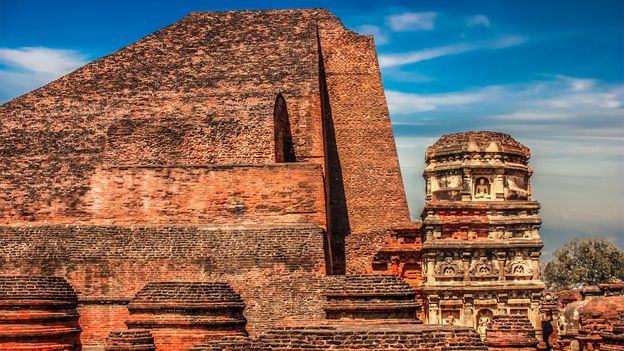
Nalanda: The university that changed the world
More than 500 years before Oxford University was founded, India's Nalanda University was home to nine million books and attracted 10,000 students from around the world.
bbc.com
302 points · by bobosha · 3y ago · 265 comments
The analogy i see is Arabs->later advancements(7th century and later) is the same as Mongols->later advancements(13th century and later). Both Arabs and Mongols were not inherently as "advanced" a civilization as the ones they conquered.
So any post Islamic Arab contributions to math would have to be stolen from India, using bloodshed - as if math is a treasure that can be lifted or looted or were existing amongst Arabs before Islam.
The modern USA is today a continuation of the Europe's printing press revolution.
"There were two brothers of Farghanah, men of learning, one Nizam-ud-Din, the other Samsam-ud-Din [by name], in the service of Muhammad-i-Bakht-yar; and the author of this book met with Sam-sim-ud-Din at Lakhanawati in the year 641 H., and this account is from him.
These two wise brothers were soldiers among that band of holy warriors when they reached the gateway of the fortress and began the attack, at which time Muhammad-i-Bakht-yar, by the force of his intrepidity, threw himself into the postern of the gateway of the place, and they captured the fortress, and acquired great booty.
The greater number of the inhabitants of that place were Brahmans, and the whole of those Brahmans had their heads shaven; and they were all slain.
There were a great number of books there; and, when all these books came under the observation of the Musalmans, they summoned a number of Hindus that they might give them information respecting the import of those books; but the whole of the Hindus had been killed.
On becoming acquainted [with the contents of those books], it was found that the whole of that fortress and city was a college, and in the Hindu tongue, they call a college Bihar.
When that victory was effected, Muhammad-i-Bakht-yar returned with great booty, and came to the presence of the beneficent Sultan, Kutb-ud-Din, I-bak, and received great honour and distinction."
1. https://archive.org/details/tabaqat-i-nasiri-volume-1/page/5...
Buddhism, the dominant religion of India circa 400AD (as per Chinese travellers), was already under attack from Brahmins who made it a key strategy to get royal patronage, set up the religious rules for society which heavily favored themselves and also focused on acting as confidantes to kings, leading to the elimination of Buddhism(focused on monastic life) from much of the Indian subcontinent even before Islam was founded.
> The so called "Gurukul" has never been found at any archaeological site.
Chariot were considered fiction until they were not[0].
[0] https://en.m.wikipedia.org/wiki/Rakhigarhi&ved=2ahUKEwjwktvM...
To be blunt: Islamic invaders to the Indian subcontinent were by and large iconoclastic, at best intolerant and at worst genocidal (by forced conversions, marriages, outright murder, etc) of the native Dharmic (read: Hindu, Buddhist, and Jain) population, and burned down, looted, and deconstructed Hindu and Buddhist places of worship to construct their own mosques on top of said ruins.
The India-Pakistan debacle today is an extension of a nearly millennium-long Hindu-Muslim feud.
The burning of Nalanda University (whether or not it is a 'university' is an orthogonal matter) is another facet in this feud. The decline of Buddhism in the late classical era in the Indian subcontinent—already on a somewhat downhill slope, due to Hinduism co-opting much Buddhist thought, and in general being more popular and accessible than the ascetic demands of monastic Buddhism—was drastically accelerated by the Islamic incursions into the Indian subcontinent.
The Ayodhya mosque-temple riots are another facet of this clash. Western commentators glibly say 'Hindus are anti-Muslim'. The issue in India is so much more nuanced than that; there is bad blood on both sides going back a thousand years. Islam cannot escape from these charges: the religion is fundamentally intolerant of non-Abrahamic ones, especially ones with liberal iconography (like Hinduism and Buddhism).
There is a reason why (most of) the oldest and largest Hindu temples are in South India, which mostly escaped from the period of Muslim rule relatively unscathed. There are (possibly apocryphal) stories about how the idols at several temples (such as the one in Srirangam, Trichy) were relocated to mountain redoubts to prevent them being stolen and melted down by 'the invaders'.
The destruction of Buddhist iconography by Islam (or its followers) continues to this day: the Bamyan Buddhas in Afghanistan were blown up by the Taliban in 2001.
Bhaktiyar Khilji burned down Nalanda University but there is a town (Bhaktiyarpur) nearby named after him! I guess this can happen only in India. Now if you try to change the name of the town it will be called anti Muslim move.
No it is overall. A lot of criminals have street names named after them in the west.
Oh, and the same Shivaji allied with the Muslim Qutub Shah of Golkonda to defend the Deccan homeland from the Northern invaders.
Fun fact: Indian laws are not the same for all religions even today. Muslims have their own version of personal laws closely derived from Sharia. This happens in a 'secular' country
Buddhist Viharas and Mahaviharas (Universities) like Nalanda, Takshila, Vikram shila were places of learning. So no they were not places of worship like Hindus do in their temples.
As a matter of fact more that 70 Buddhist Universities have been found till date.
Theravada as a word itself is relatively new, as the schools at the time had derived from either the Sthavira or the Mahasamgha (Mahasamghika) traditions. Mahayana itself had its roots in Mahasamghika which had started evolving into Kukkutika and its companions and descendents, while the predecessor to Theravada itself was the Sthavira school which then evolved into the Sarvastivada, Puggalavada, Vibhajjavada and its descentants, one of which later evolved into Theravada.
At the time the more dominant schools of thought were the predecessors of what is now the Mahāyāna schools, some of which evolved later into the Tibetan Vajrayāna schools, and some went through the north west of India, through Gandhara and the Kusan empires into Central Asia, into China, Korea, Japan, Vietnam and parts of Cambodia.
There are several academic works that clearly lay out the history and evolution of the Buddhist schools from verifiable sources. I'll update this if and when I get the time to look into my bookshelf later :)
However you are completely right about Buddha Vandanā. This is not worship. In fact there's no worship in the traditional Pāli canon, or the Tripitaka, and in fact Sakhyamuni himself advocated against forms of worship. In Buddhist schools the Vandanā and other forms of such processes are for showing respect to the Tri-Ratna, i.e., the teacher, the dhamma and the sangha, as a means to bring oneself into a conducive frame of mind, to develop the mind.
Not really. A lot of these arbitrary borders in modern times came about due to actions of former colonial powers. Prior to colonial times, there were many individual kingdoms/territories throughout the subcontinent. Other examples of arbitrary borders include the Durand line, and the Wakhan corridor.
By 1940, Jinnah had come to believe that the Muslims of the subcontinent should have their own state to avoid the possible marginalised status they may gain in an independent Hindu–Muslim state. In that year, the Muslim League, led by Jinnah, passed the Lahore Resolution, demanding a separate nation for Indian Muslims. - Wikipedia
[1]: https://en.wikipedia.org/wiki/Bangladesh_genocide
As for 'no united India before colonial times': what about the Maurya and Gupta empires, or even the Delhi and Hyderabad sultanates? They governed over a significant portion of modern-day India + Pakistan.
If this is your sort of goalpost, then even relatively homogenous countries like Germany and Italy shouldn't really exist today, given that they only coalesced in the late 19th century.
This is a fairly standard line in the Indian middle class. However, apart from the decimal system none of the Arabic contributions are of Indian origin, and I am not aware of any philosophical ideas being borrowed at all.
For instance, the key contribution - the invention of algebra is clearly of Arabic origin by Al Khawrizmi.
This is a fairly comprehensive list of Arabic contributions. Which of these (apart from non fractional decimal systems) are if Indian origin? . https://en.wikipedia.org/wiki/Mathematics_in_the_medieval_Is...
Also, it would be helpful to clarify what was disquieting about the confirmed borrowed idea - the decimal system. Most of the time I only come across vague references with nothing concrete stated.
There is also a lot of speculation about ancient Indian mathematics being borrowed from Sumerian sources (where the first Pythagorean triples were observed etc)
There is in fact a wikipedia article on the subject https://en.wikipedia.org/wiki/Indian_influence_on_Islamic_sc...
I am sure that the references there will provide a jumping off point to learn more
Because a quick Google says "The Jagiellonian University is a public research university in Kraków, Poland. Founded in 1364 by King Casimir III the Great, it is the oldest university in Poland and the 13th oldest university in continuous operation in the world. It is regarded as Poland's most prestigious academic institution."
Ugh...
ChatGPT says "The University of Bologna, located in Bologna, Italy, is considered the oldest university in the world, founded in 1088. It was initially established as a law school, but over time, it grew to include faculties of medicine, philosophy, and theology. The university played a significant role in the development of European higher education, and its model of organization and academic freedom has been emulated by other universities around the world."
This seems to be a contentious topic.
Medieval European universities are often considered the first true universities, because they are direct ancestors of modern universities, and their traditions have survived and evolved into what we see today. There were earlier institutes of higher education all around the world (including Europe), but those traditions have not survived.
https://en.wikipedia.org/wiki/University_of_al-Qarawiyyin
Surprisingly, there are some schools for adolescents in England which are even older, the oldest dating to 597:
https://en.wikipedia.org/wiki/The_King%27s_School,_Canterbur...
That the oldest continuously operating institutions in the world are mostly in England (schools), Japan (hotels) and the desert mountains of North Africa (madrasas and St. Catherine's Monastery) is likely a consequence of "splendid isolation". Nobody is quite sure how old the government of Haida Gwaii is.
I think the institution that invented the term probably gets to define it. And that is the University of Bologna.
Or the fact that ceremonial graduation garb in the EU and US, from the robes to the caps, is also based in Arab tradition.
The medieval Enlightenment and subsequent Renaissance was huge for Europe, yes, but just as important to realize today is that a lot of it was taking heavy inspiration from other cultures and regions and “Europeanizing” it and then calling it their own (I.E. a cultural exchange)
ADDED: As others note "university" is also a key word though college would probably also serve.
Irrespective of the word, it is the knowledge that was taught in those places.
I think they are counting even five written pages as a unique book?
So maybe essays are also being counted as books.
Medicine in those times was quite standardized and effective.
There was not scientific method involved.
And the philosophy and mathematics was quite advanced.
There were a lot of old buildings, but nowhere was there a Salamanca U t-shirt as a souvenir (and FYI, the Rome University sweatshirts aren't official--the biz school sells some polos, but that's it).
Irony notice: this comment contains irony.
But it also tolerates every souvenir shop in the town selling shirts and hoodies showing the university seal, which I guess makes them kind of "semi-official". Many students wear them.
Anyone curious can enter "Rua Mayor, Salamanca" in Street View and look at the front of every other shop in that street...
Does 9 million sound big, sure? But in the absence of other information, maybe we can debate the quantum of overstatement rather than just assuming that since we can't explain it, everything related to it may be fake.
And last point, maybe there were 9 million books. What's a university if it does not have more than one book per student especially if they built that library over 700 years. Maybe each student had an annual journal which is classified as a book.
Cornell has 25k students and 10 million books.
The printing press is kind of a big deal.
Copying a book in mediaeval times took months, so 9 million is an incredible amount of work. Other sources put the number of books in the low hundreds of thousands.
Why is it that articles need to start with lines like
> "The winter morning was cloaked in thick fog..."
and postpone the actual information pertaining to the title? Instead, we have to sift through irrelevant story-like content to get to the meat of the information and facts.
Will one promise of tools like ChatGPT and their successors be to summarize-away this fluff?
Most people would pay money to ensure I don't.
> Instead, we have to sift through irrelevant story-like content to get to the meat of the information and facts.
Because journalists are frustrated novelists, and editors think the "human interest" angle sells.
>> The campus was so vast that the fire set on by the attackersis said to have burned for three months.