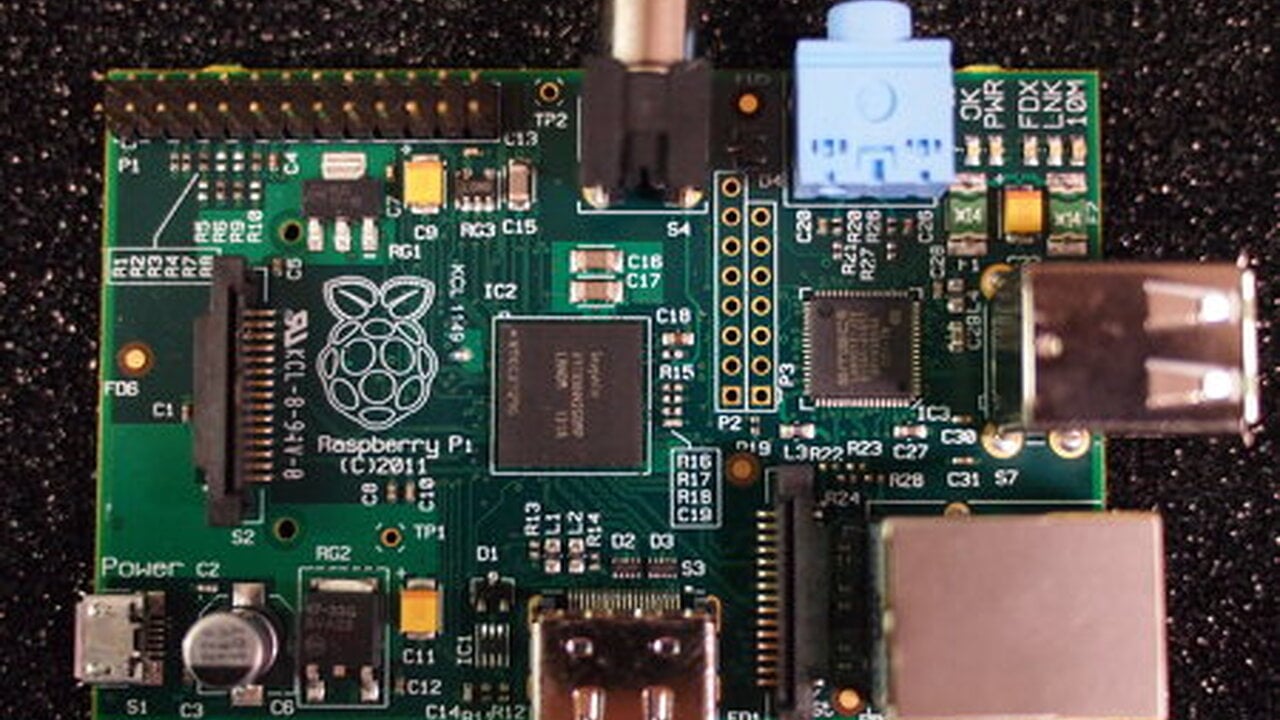
Raspberry Pi GPU doubles iPhone 4S performance
Incredible gaming potential for $25 open source computer
Digital Foundry
93 points · by indy · 14y ago · 59 comments
For now, they are the low volume option (<1-10m units) if you need special interfaces. If all you are doing is number crunching a Gpgu would likely be a more effective option.
Where’s the Beef? Why FPGAs Are So Fast -- http://research.microsoft.com/pubs/70636/tr-2008-130.pdf
BLAS Comparison on FPGA, CPU and GPU -- http://research.microsoft.com/pubs/130834/ISVLSI_FINAL.pdf
"Results show that FPGAs offer comparable performance as well as 2.7 to 293 times better energy efficiency for the test cases that we implemented on all three platforms."
Here's a talk about compiling legacy C/C++ code to FPGAs. With a couple of modifications to the code they claim 100x-300x performance/watt improvement in various benchmarks.
slides: http://msrvideo.vo.msecnd.net/rmcvideos/103696/dl/103696.pdf
video: http://research.microsoft.com/apps/video/default.aspx?id=103...
For example they have a Black Scholes simulation that runs 30x faster and uses 6W of power instead of 68W. That's >300x power efficiency.
It does mean you'll need to be more careful and considerate of how you use that memory though (and admittedly, on a console like a PS3 the OS takes up much, much less space).
My Archos 101 has 256MB RAM and runs Android suprisingly well. It only does 720p video playback though; full specs http://www.archos.com/products/ta/archos_101it/specs.html?co.... I'm not going to lie, it does tend to lag a bit; wonder how easy upgrading the RAM will be on the RPi.
The iPhone is highly optimized for mobile use. Both in hardware and software. Can the same be said about this chipset that the Raspberry Pi uses?
If not then the comparison is not very fair.
Anyway, I look really forward getting my hands on an RP.
The beagleboard-xm has an A8, 4 usb ports, and 512 ram for $150, the related beaglebone has arduino like pins and an A8 for $80, and the pandaboard has an A9, 1gb ram, and wifi for $180.
I am interested to know what other folks think of the potential to build low cost PCs using Raspberry Pi (RPi) for education in India & the developing world.
I am curious to know what other people think of OLPC XO3 vs RPi vs Aakash (the Indian govt.'s low cost tablet)
OLPC http://news.bbc.co.uk/2/hi/technology/8428147.stm http://asia.cnet.com/what-can-we-learn-from-the-olpc-xo-3-0-...
Aakash Ubislate7 http://blogs.wsj.com/speakeasy/2012/01/08/the-inside-story-o...
1. Raspberry Pi(RPi) requires monitor + mouse +k/b while XO3 is self-contained. 2. RPi is more geared to be a lab machine or a home pc while XO3 is more of a personal device.
3. From a pedagogical viewpoint, IMHO, i think younger kids should not have a digital device 24x7 as they could possibly get "addicted" to it . It is more important to impart a sense of curiosity(scientific temper) & hunger for learning, & having an XO3 might hamper kids' social activities - going outdoors & playing with other kids, being fit, taking part in sports.
So i feel younger kids could be exposed to low-cost computers( made of a RPi) in school, which are low cost & encourage tinkering (open source, simple inexpensive hw) while older (say high school kids can get their own personal XO3.
#4. From an Indian perspective, i wish the Indian govt scraps the crappy Aakash tablet in favour of the XO3.
http://phonemantra.com/2012/01/olpc-india-head-rips-into-aak...
The vast majority of schools in India are run by the govt & most govt. schools dont have a computer lab or the computers:students ratio is abysmal. The RPi could be an excellent, low-cost way to create computer labs in all govt schools, colleges & vocational institutions.
#5. Internet connectivity
http://laptop.org/en/laptop/hardware/specs.shtml http://www.raspberrypi.org/faqs http://www.akashtablet.com/
The XO3 comes with 802.11b/g & most importantly 802.11s(mesh networking) & the concept of school servers, so kids can download learning content even if access to the larger public Internet is not available.
Aakash has GPRS( much slower) & RPi supports wired ethernet & USB WiFi dongles.
Exciting times ahead for sure & would love to hear what other folks think
cheers
p.s. Detailed interview with Eben Upton, RPi's executive director (free registration required)
http://www.gamesindustry.biz/articles/digitalfoundry-inside-...
I guess $25 isn't exactly a high price to pay for six months to a year of messing about, but it seems a sad fate for an otherwise remarkable piece of hardware.
If the point of this thing is to promote computer science education, then it's already dead. Remember, not everything happens in userspace. For example, there are advanced operating systems courses out there that are focused very closely on the low-level side or are based on non-GPL-compatible operating systems where they can't simply lift stuff out of Linux.
It's nobody's loss but Broadcom's: the educators will go for platforms like BeagleBone instead (which, although more than double the price, is still cheap), the students will have the benefit of well-documented hardware, and TI will be happy that many of those students who grow up to work in the embedded space will be specifying TI (rather than Broadcom) SoCs.
Next up, I want to see some Ubuntu Pi edition, and perhaps even some ChromeOS fork.
My hope is to be able to attach that to the back of a monitor/TV and get a usable browsing and movie watching machine.
[x] i mean the article, not the Pi project itself
http://www.anandtech.com/show/4951/iphone-4s-preliminary-ben... says SGX543MP2.
(edit: fixed typo)
I'm curious, though, is it really a fully open source computer? How does that work when it uses an ARM chip? Or does the open source part refer only to the OS? As soon as ARM replaces ARM11 with Cortex A7 or whatever, we should ask them to open source ARM11.
It runs linux. That's open. The rest, not so much. Its still awesome. It just is what it is.
Also, it's pretty confusing, mixing statements about Tegra 2 and iPhone 4S, which are quite different beasts.
It would certainly be impressive, but I'd rather wait for at least a demo, if not proper benchmarks, before throwing the party.
The iPhone runs its GPU in a particular way, and its GPU was chosen based on the fact that the iPhone needs to have its battery last all day.
However the Raspberry can draw a continuous 1A without rest, because it effectively has an infinite battery.
So, sure, you can put a larger GPU in a device like that.