Did Google Kill The Longtail ? - The Big Picture
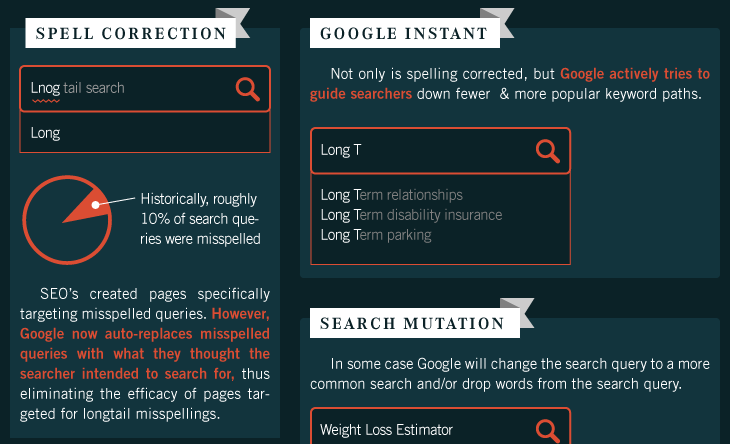
Via SEO Book, comes this interesting look at how Google is impacting search results: > click for full graphic Infographic by SEO Book
The Big Picture
36 points · by wslh · 14y ago · 23 comments
Google is a winner takes all deathmatch, except it creates many more winners by letting different products or services win in every individual search term. This is the long tail of stuff you couldn't even find out about before the internet landed in our laps. The long tail isn't even fully populated. You can't buy a book about unicorns riding skateboards, but I'm sure that once you can, you'll be able to find it easily through google, or bing, or amazon, or apple, or well, the whole wonderful internet.
You see, the "long tail" isn't about stuffing dreadful SEO optimised semi-products cloned from content mills, it's the outlet for creators of awesome products that no one ever knew they wanted, until the internet let each and every community of peculiar but particular consumers coalesce. Stop calling it the "long tail" but call it "commerce", call it "shopping", call it "stuff you never knew you wanted or could get" but don't confuse it with "stuff people can't spell".
This was the long tail. Folks trying to get to a place that have the niche item they are looking for - having to wade through an endless see of affiliate sites to get there.
Now ignoring for the moment Aaron Wall's thesis that this is all part of Google shitting on the little guy - here's an undeniable fact:
The proliferation and sophistication of affiliate spammers made it impossible for Google to continue taking chances on 'unknowns' that hadn't previously done the work of establishing themselves. Hence the reliance on brand strength that Google was forced to turn to.
This is unfortunate. It was wonderful to see so many deserving people getting ahead and building new brands on account of the relative freedom Google granted to the long tail previously. But making it so cheap and easy to get ahead in this way attracted a zillion folks that just wanted to suck as much juice from the system.
Does that mean Aaron Wall and others are wrong about Google intentions? (i.e. to keep users within their own garden) Probably not... But I think the onus on folks like Aaron Wall to provide a positive account of what else Google could have done. Otherwise, I remain convinced that Google was heading into Yahoo and Myspace land if they hadn't made the changes they have.
The takeaway from the infographic should really be that Aaron Wall (of seobook.com) runs a business that teaches (white hat?) SEO to small business owners. It's in his best interest to make SEO seem incredibly complex, difficult, and full of dangers. Which is relatively true: effective SEO is hard to do. Wall, like any good SEO, keeps up with algorithm changes. He's a smart guy, and he's most likely figured out how to overcome all of the challenges in that infographic (for $X.XX he'll show you!). It's linkbait. And great inbound marketing.
Also, Aaron Wall is a very outspoken critic of Google. There's a post every week or two on his blog about Google's ethics (or lack thereof). It's really fascinating stuff, well worth a read [1].
I am tired of "marketers" posting content here, and I suggest that we should downvote the post and upload the image at an imagehost.
I'm guessing you're also vehemently against copyright laws.
Also, with a new account you're talking about advertisement at hackernews and being tired of marketers posting content here?
I'm just fascinated by how 80% of all complaints about the degrading quality of HN come from new users.
(Not knowing much about web marketing and SEO, I feel like I'm missing a lot of the context to understand this topic.)
Anyone know the rationale behind this one? How does this help in fighting the spam? Or how does it improve search experience?
Could be great for a little games company like mine. I make very niche games and have no hope of being ranked for a term like "strategy game". I hope that if people are talking us in their circles we might get a few more hits.
Makes good business sense, although it might be annoying for some SEOs