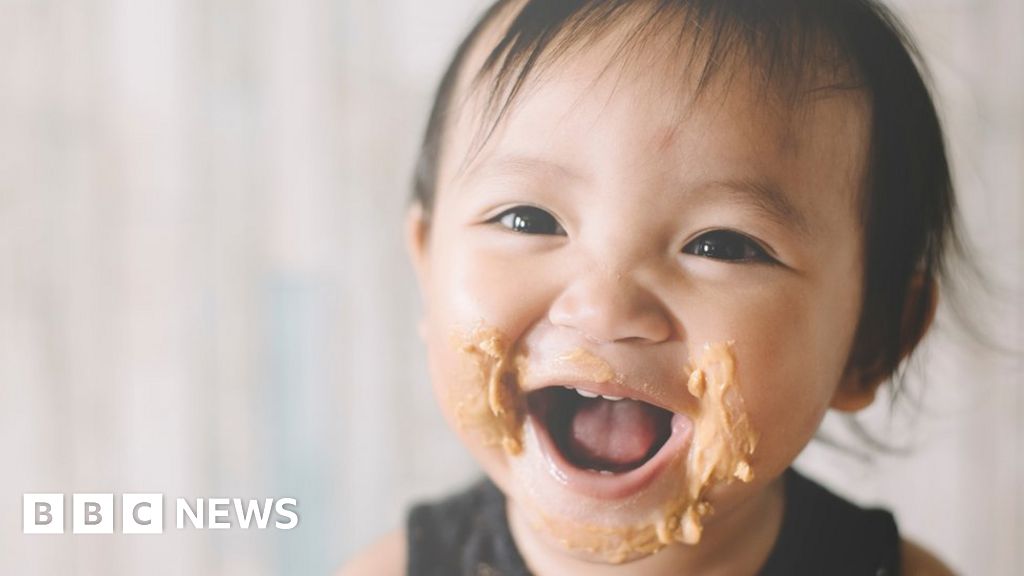
Give babies peanut butter to cut allergy by 77%, study says
Research suggests there is a crucial window during weaning to lower the allergy risk.
bbc.com
746 points · by tosh · 3y ago · 363 comments
Basically, the original study looked at Jewish kids in Israel versus the UK and saw that peanut allergies were about 10x lower in Israel, even though Jews of European background (Ashkenazi) there are fairly similar, genetically, to Ashkenazi Jews in the UK (the majority of both groups migrated recently from Central and Eastern Europe).
There is a snack called Bamba that they eat in Israel. It's kind of like a peanut butter Cheeto puff, and it is a nearly-universal snack for young kids in Israel. It melts in your mouth, so a 6-month-old can eat it almost as soon as they eat solid foods. It's about as popular in Israel as Cheerios are in the US, maybe more so. The hypothesis is that Bamba consumption there dramatically lowers the risk of developing peanut allergies.
[1] https://www.webofscience.com/wos/woscc/full-record/WOS:00026...
Peanut butter cheetos sounds like an incredible proposition, I'm going to be looking around for them this weekend!
"Bamba Peanut Snacks contain just four, simple ingredients: corn grits, peanut paste, palm oil, and salt."
Peanut I found out are technically legumes, where as pecan, almond, cashew, walnut, pistachio, etc are tree nuts.
So while we call them all "nuts", peanuts are quite different than tree nuts.
Daughter developed severe tree nut allergy(that we don't leave home without 2x EpiPen) by age 3.
Had pleanty of foods with peanut butter, but seldom tree nut exposure (outside of mixed nuts which she was too young to consume).
She can eat peanut products just fine, but we end up telling everyone all nuts allergy including peanuts... As some people don't know the difference.
Now I am finding everything "peanut free" is not always tree nuts free, there's different labeling =/
Cashew is in alot of vegan foods and South Asian dishes (though alot of restaurants stopped using cashew based thickener now, some still do).
https://www.target.com/p/osem-bamba-peanut-butter-baby-puffs...
[1] https://www.google.com/search?q=smoki&tbm=isch&ved=2ahUKEwiE...
Target sells these "Lil Mixins" sachets that contain peanut powder. They're designed to mix in to milk or oatmeal, etc. The packaging says you can use them with kids as young as 4 months. They also sell similar sachets of tree nuts and egg powder.
I remember reading that boiled and roasted peanuts have different allergen profiles, and are not interchangeable.
If you want to do this with your child, use actual bamba, not peanut butter.
If you decide to get some for your kid, get some extra for yourself.
An American friend told me it looks and tastes like captain crunch berries, and it is unfair that American kids have only a few in a serving, and israeli kids can just get bags of them.
In Germany they are mostly sold along potato chips (crisps), but they aren't as popular as them. And unlike Bamba they are usually not fed to small children, as far as I'm aware. Good to know they seem to protect against allergy, as peanut butter is not really a thing here.
Unfortunately it has not yet worked for tree nuts or bivalves but perhaps someday a switch will flip inside me.
https://www.google.com/search?q=%22peanut+ruffs%22
I wish I could compare the ingredients.
Now, the infant death rate in Israel seems to actually lower by almost half of the US (Iḿ seeing 5.4 per 1000 for the US, vs 2.2 for Israel).
https://www.macrotrends.net/countries/ISR/israel/infant-mort...
https://www.cdc.gov/reproductivehealth/maternalinfanthealth/...
If you IDS has never seen X and X is unlike anything it has seen, it will probably flag it.
> There had been long-standing advice to avoid foods that can trigger allergies during early childhood. At one point, families were once told to avoid peanut until their child was three years old.
This advice was never based on science.
Cultures where infants are fed on the same broad spectrum of foods that adults eat have MUCH lower incidence of allergies. France and Israel to name two.
Datapoint of 1, I started giving my own child chewed up food I was eating at about 2.5 months. She was eyeballing some chicken I was eating, I popped it out of my mouth, offered it to her and she ravenously devoured it.
A couple weeks later, I wiped a small amount of peanut butter on her lip and checked for any allergic reaction, then proceeded to slowly ramp the amount the next day.
Same thing with shellfish. I am not suggesting anyone else do this, but it worked for us.
Train how you live as soon as possible.
I'm not saying the advice is sound, just giving a perspective on what led to that advice. It's not about "they might develop an allergy so don't give it to them" it's "they may be allergic already and cause significant harm".
No, it was based on common sense. If X causes problems, not doing X is generally a good idea.
It turns out that in this particular scenario, common sense was wrong. But allergies weren't understood by science, so all we had to go on was common sense.
Also, we should stop testing for allergies unless there is a good reason to test a specific person for a specific allergy (e.g. they already had a bad reaction to something, and need to figure out what.) Those allergen tests have many false positives, people that could have gone their whole lives eating peanuts without thinking twice about it will instead spend their whole lives avoiding peanuts because a precautionary allergen test came back sliightly positive and they "don't want to take the risk". More medical testing is not always a good thing.
My kid's school bans anything that has those warnings about "not produced in a nut free factory". It's insane actually how limiting it is for a family with no allergies like ours.
> Common sense says that we need to give kids more peanut butter sandwiches, like we used to, and it would stop being a problem
Not sure if it was medically wise, but this was my common sense thinking too. Around 3-6 months, I figured we consume enough peanut butter in the house that if he had a severe allergy we'd have known by then (eg. accidental cross contamination). I also figured at this point he could survive the quick trip to the ER if needed. So I gave it to him and closely monitored his condition. First, just put a little on inside of forearm to see if any signs of irritation. Thinking perhaps a mild allergy may show itself this way, also thinking maybe his airway wouldn't swell up as initial symptom as it might with ingestion (would like to avoid that). It went well so shortly after let him eat a little. No problems. We did this similar approach with all of the common allergy stuff, no issues for us, although I don't know if I was fully informed of how allergies work or naively being cavalier with risk or something (I obviously didn't think so).
https://www.google.com/books/edition/Allergy_Proceedings/ecU...
We have observations that populations of kids eating peanuts early have lower allergy rate, but it´s not like we isolated 300 babies and experimented on them for 30 years, we just can´t. Short of other stronger evidence we assume it´s true, but if tomorrow we found that there were other causes specific to the US, independent from peanuts themselves, we´d have the same reaction: we didn´t know so we did our best.
"I don't know how this bad thing works, better rub it on my gums" is not a good strategy in general.
A generation later parents were told to avoid it until age 3 or 4 for no real reason, and it created a ton of peanut allergies in those kids. They were scared of their kid having a peanut allergy. This was fear, counter to the common sense they themselves were raised with.
One of these days I will draw a one panel image that demonstrates the fallacy of this thinking.
They had "peanut-free" lunch tables when I was in elementary school, and all I thought was people just need to stop being so sensitive. Even then, guess I was right.
I'm pretty sure that by elementary school some kids have already developed severe peanut allergies. Keeping peanuts away from someone that might go into anaphylactic shock seems the right amount of sensitivity.
Per the article, the time to be "less sensitive" is much earlier when introducing peanuts can reduce their chance of developing an allergy. By elementary school (ages 6-13) it's mostly too late.
At least when you're 3 and talking you can be more clear about what's going on with your body if there's a problem.
"Why give them any food at all" is a very glib reply to them. I'll let you figure out why people might avoid certain foods and not others, and why people feed small children
I don't think that's been proven conclusively.
I have three children, and they had three different pediatricians when they were babies. The three pediatricians had a different incompatible list of food the children must eat when they had between 6 and 12 month old. And if you go to the web, there is even more disinformation and snake oil.
It was funny to compare the list of food of the pediatricians of my children with the list of foods of the pediatricians of the children of my friends. Also, sometime people get too attached to this recommendations and make a big mess if the children of a friend does not follow the rules of their own children.
(I think the only food in the intersection was honey, because it's too difficult to pasteurize. It make sense, but I'm not sure how thoughtfully it was tested.)
I think in the US the issue is that there isn’t a ton of published material on it. My info may be out of date as my kids are well past this stage.
I guess what I'm getting at is that you might not be counted as having a peanut allergy if you're dead.
Most mammalian wild animals (and humans until 100 years or so ago) drink their mothers milk up until they're able to eat regular food and then from that point on eat whatever adults of their species eat. They don't go through 5 different levels of Gerber before eating real food.
Also I think the threat of mercury in fish is greatly overstated anyway. Look at Japan; they eat tons of fish and they're not all brain damaged dummies.
> This advice was never based on science.
I'm like 99% sure this was to avoid babies/young kids choking on peanut
https://www.sciencedirect.com/science/article/pii/S199179021...
There are dangerous caveats to this advice! For example, don't feed infants fish or shellfish more than this allergy test. They contain one of the highest levels of mercury in the entire food web. Best to wait until the they've grown.
Moreover, it has been observed that traditional fishing cultures that have a high mercury intake have zero symptoms of mercury toxicity. The leading hypothesis of this is that the high selenium content in these same fish is protective against mercury exposure[1]. Consider also the observation that cultures with high fish intake have good health outcomes, and that omega-3 supplementation fails to recover those benefits. This makes me feel that eating a lot of fish is likely much healthier than avoiding it, and avoiding it is probably leading to nutrition deficiency, including possibly selenium, which is a much bigger risk than the potential for mercury toxicity.
[1] https://www.sciencedirect.com/science/article/abs/pii/S01618...
From an allergy standpoint small exposure would be enough to reduce risk of developing an allergy.
https://www.nationalacademies.org/our-work/the-role-of-seafo...
I had allergies for basically all my life but the food stuff only started at around 10 or 11 years. Now I can't really eat any uncooked fruit, vegetables or nuts. Interestingly enough, most citrus fruit are just fine, something with not being exposed to those pollen maybe...
I think the normal way babies ramp their immune system is breastfeeding - their body struggles with soemthing, it is transferred to mom's nipple when breastfeeding, the mother forms an immune response, it is incorporated into the breast milk, the baby retrieves it next breast feeding.
I mean too early. Not sure when too early is.
It's a whole lost more complicated than this, see for example antigens https://en.wikipedia.org/wiki/Antigen and epitopes https://en.wikipedia.org/wiki/Epitope
How in tarnation did anyone think keeping babies away from the allergens would help with allergies is beyond me
Which countries has the least amount of peanut allergies? Countries where people give it without much concern
Thanks to these misguided though there are people severely allergic to peanuts
No one, AFAIK, thought it would reduce the rates of people developing allergies.
What people thought was that it would reduce the rates of people having dangerous allergic reactions as infants (which it does) and that the longer term effects would not be so negative as to outweigh that benefit (which seems, in the case of certain allergens – particularly peanuts – to very much not be the case.)
Again, the above reasoning is wrong but not completely baseless.
You gave a TWO AND A HALF MONTH OLD CHILD chicken??? this is so incredibly careless that I HAVE to call out this crazy misinformation on HN. DO not ever replicate this please, everyone else.
you mention giving your chewed up food: I read a few years ago that babies who sleep in the same bed as the parents have a much higher mortality rate; assuming it's true, I guess that with mouth to mouth germ exchange it would be even worse.
Also, a lot of food today is full of chemical residues etc that are tolerated by adults, not quite so by babies.
Ultimately risk falls off around four months though, so yeah maybe 2.5 months is a bit early to try weird things.
I'm not saying this is what happens in every instance, but it's probably the way it happens at least some of the time.
If you’re talking about sudden infant death, I don’t think it’s related to germs, although it’s a poorly understood phenomenon.
SIDS isn’t a cause, SIDS is a name for when no cause is known.
However, in recent years there has been a backlash to the backlash, and under certain conditions (no drugs/alcohol, exclusive breastfeeding, no blankets) some doctors will recommend co-sleeping. It’s controversial.
Disclosure: son has severe peanut allergy.
This works for nuts too. If people were fine with nuts for so long, I'm not going to believe that it's suddenly a problem. They made a first-world problem, and it's going to take more studies like this (this is just one) to conclude that scientifically.
It still makes sense to ask why we got this so wrong. Not just "this technique doesn't work the way we thought it did". We're talking COMPLETELY backwards.
Yes, it's well known doing that with anything can have unknown secondary effects, but there's also a million everyday things we logically don't let infants do or be exposed to that we aren't establishing the statistical significance of either.
Incidentally, with all of our advanced medicine and understanding of the human body, we still don't understand why some people develop severe allergic reactions to some foods and others don't, so let's not pat ourselves too hard on the back for developing better food exposure protocols from trial and error over decades.
There's a great clinic in the bay area called Latitude that conducts oral immunotherapy which is a fancy word, afaik, to do slow introduction to foods that you're allergic to. My child is on a 6 month program that he started at 1 year old to slowly increase his peanut consumption, via peanut flour, to a couple peanuts a day.
She is 3 now has to have an epipen ready to go. 2nd girl: no issues at all - same house, basic maternal diet, vaccine schedule, etc
The evidence supports this as one source of allergies. The cited study says 77% of such allergies may be sourced to lack of exposure, that still means almost 1/4 people with peanut allergies have them "naturally"
Don't have a baby, but couldn't you put a few drops of unrefined peanut oil in the bottle? Or a quarter teaspoon of peanut butter?
Before I had kids I heard in Europe about peanut allergies only from US movies and TV shows and never met person who would be allergic to them, so was shocked to find my kids having such "made up" US allergy.
Interesting... my wife is East Asian and has no history of Peanut allergies in her family. Same for my family (Caucasian, US) yet our daughter is allergic.
My wife also ate a lot of peanut butter while pregnant...
Interestingly, multiple allergists we've spoken to have alluded to a recent theory (not sure if supported by the literature) that a child is more likely to develop an allergy if the allergen is first introduced through the skin than through the gut, especially if the skin exposure involves inflammation like eczema. Their advice was to make sure new allergens get in the mouth and not all over the skin early on.
We’ve noticed spaghetti sauce will start to give him a rash on his belly only.
My 5 month old had beets last night for the first time and a full bath was not optional.
My wife now makes the baby food from scratch since with triplets it would become quite expensive quite quickly to buy premade. Those My Peanut pouches were awfully convenient though.
When did the apparent uptick in peanut allergies begin? There was no one in my entire school (~1,000 students) with a severe peanut allergy but now peanuts are banned entirely from campus. Did peanuts change or did children change>
It's true that we had bad advice to not introduce peanuts which provably made the problem worse (and has now been reversed), but this is only part of the problem. Papers on the subject make clear that are other countries that are not doing intentional early-introduction (which we are now in the US) and don't have the problem.
It's also abundantly clear from the research that the population-scale problem is 100% environmental... as you would expect since the SAME POPULATION saw rates go through the roof in a decade. It's something we did, environmentally, and we don't know what.
It also feels frustrating that the medical profession seems overwhelmingly incurious about discovering whatever it is we're doing that is literally harming children.
Something similar may be to blame here.
Speaking from experience, here. Wife is an ER doc and it was still a scary situation. (He's fine, but still has the allergy 7 years later)
All that said, you absolutely should give peanut butter (and other allergens) early and often. If you don't, you're signing your kid up for much worse odds of anaphylaxis later. The good news is fatal anaphylaxis is extremely rare even in people with confirmed food allergies, and even lower in infants than older kids and adults. Even when anaphylaxis occurs epinephrine is extremely effective, so anaphylaxis deaths are almost always due to failure to treat with epinephrine. So just make sure that you have access to prompt medical treatment if you need it (i.e. not camping in the mountains far from any hospital), and give those allergens ASAP.
We did the same with shrimp and oysters. My son loves seafood gumbo and made a whole restaurant turn around when he first tried it. He loves it.
Have you stopped trying allergic foods?
You have to work really hard with a really good allergist to get reliable results.
she will go into anaphylaxis if you wear a jacket you brought to somebody's house who has a cat.
her blood work says the IgE count is fairly low.
they can indicate more testing should be done, but they aren't perfect. neither are skin prick tests. i can dig up some of her reddit comments about it if you're interested.
Avoiding allergens and hoping the child grows into adulthood (with allergies) didn't seem like a very good strategy to us.
Being afraid of accidental exposure and epipens and stuff, no fun.
(In case anyone's curious. Honey contains spores of Clostridium botulinum, the bacterium responsible for botulism/botulinum toxin aka the world's deadliest molecule. People over the age of 1 can ingest honey safely. Infants need time to build up their immune systems.)
I suppose that means I'd be helping my own gut flora if I had more probiotic foods, but I'm generally not fond of sour tastes.
We then waited a while, then drove back home.
We did that twice with a couple of months in between.
Some called us crazy :)
>Other studies have suggested introducing other foods linked to allergies - such as egg, milk and wheat - early also reduced allergy.
I admit I haven't looked at studies, but this made such intuitive sense to us that we've been first giving both our sons very small samples, then feeding them absolutely every kind of food (that's safe, e.g. not raw honey, and non-junky, e.g. no soda pop) we eat, as early as possible. If for no other reason, then to find out if they do have an allergy. Anecdata ≠ data, but both of them have zero allergies as far as we know, 6 and 2 years old now. Obviously, the nutritional needs of children and adults are different, so they consume different amounts of each kind of food than we do.
We did hold off on honey until they were one due to the botulism risk tho.
My symptoms are just gastro related, so it’s probably not the same as childhood peanut allergies, though.
Maybe it's food intolerance, which is distinct from food allergy? Those I'm sure can develop later in life.
Or is the offending pollen only endemic to certan areas, so you could grow up in a normal way somewhere and still get it?
I'm not strongly allergic to anything, but certain mosquitoes and also horseflies will make the bite swell up a ridiculous amount sometimes. But it never happened with the mosquitoes and horseflies where I grew up and still doesn't when I visit.
But I'm also allergic to certain soaps starting in my 20s, yet I'm pretty sure my parents gave me plenty of baths as a baby. It did occur after a course of antibiotics, maybe that helped trigger it somehow.
This happened to me. I never had seasonal allergies growing up in New York, but in Massachusetts I am brutally allergic to whatever pollen is in the air in the spring and fall.
I also never was allergic to my pet cats until I went away to college and wasn't constantly exposed to cat hair. I first started getting itchy eyes when they slept on my bed after I came back home to visit.
> It did occur after a course of antibiotics, maybe that helped trigger it somehow.
This doesn't surprise me at all. I'm glad the research is finally starting to catch up to this kind of thing too. People with issues like this have been pooh-poohed out of doctors' offices for decades.
The one mentioned earlier was at age 20 due to severe pneumonia. And my mental health took yet another nosedive after that as well.
The appendix interacts with the gut microbiome and the immune system, which interact with eachother, and both have been linked to mental illness in various ways.
I always felt like all these things were somehow connected but I could never quite nail it down. I asked my GP once but she gave me a look that could only mean "who do you think I am, Greg House?" And very little concrete came of it.
The allergies might be the "signal" that helps give weight to this theory beyond my fool's hope that it can all be cured with a fecal transplant or something.
The hygiene hypothesis suggests that a newborn baby's immune system must be educated so it will function properly during infancy and the rest of life.
clarification: This is ofc much easier to do when your family lives in said 3rd world country.
The avoidance of allergens was a deliberate thing under prior advice, and/or them being less common in the diet to begin with, it's not really a matter of hygiene or cleanliness.
Or go outside with the kid. Visit a farm, park, whatever.
(My wife is allergic to sesame. We have tried to get people to have hummus parties with our children but to this day they have not eaten any sesame as far as we are aware.)
You mentioned your wife is allergic but you're not, and talked about the difficulty you've had finding friends/family to expose them to it. I don't see mention of you being the one to expose them to it in a setting a safe distance away from your wife, and I guess I'm just curious! Hummus as a snack when you're at a park, or something?
Like I said, genuinely not trying to criticize, just another parent who's curious. I've been lucky to not have any allergy issues with my kiddos, so I guess I'm ignorant and just wondering what it's like and how complicated it could be.
And truth is our children and myself have not been away from my wife for more than a few hours at a time since they were born!
Again, maybe this rule is not as important with the children who are not as vigorous kissers, but especially during the latest healthcare overloads we have been extra careful with avoidance. And as another commenter pointed out, the children don't understand that they are eating stuff that kills mom, so they may be unreliable in other ways.
Thanks for the insight. :)
Children are getting older, and thankfully, are no afflicted with the same allergy as their mother. But as time wears on, it is truly emotionally draining. The nuts held in a hermetically sealed container are compared to a caged viper - as they can easily cause life-threatening anaphylaxis for exactly 1 person in the household. We have to follow a super-clean process outside-and-inside to give an introduction, but you know what, kids don't always want to do what they're told. It sucks, and it's a problem more and more people will have in the future.
It is actually quite likely that you can help your infant outgrow their allergy with oral immunotherapy (simply eating the food, but in strictly controlled amounts). Recent research is showing that oral immunotherapy is dramatically more effective and safer for infants than older kids or adults. Every month that goes by reduces the chance of success, so start immediately (with the help of an allergist, not on your own) as soon as you discover a food allergy.
Also, treating allergies promptly (as well as eczema) may reduce your child's chance of progressing to hay fever and asthma later, as well.
If you guidelines assume a total lack of criteria from parents it's best to give strict guidance on "no this and that until XYZ".
Example: where I'm raising my kids it is standard medical guidance to avoid minced meat until 5yo because of HUS - a guidance that no one from where I grew up even today ever heard of. Now, Am I living in a place where the risk of catching HUS is higher? Maybe. But more likely is the fact that here it is easier to just tell people that ANY minced meat is a risk instead of explaining that it depends on how you prepare and cook it.
I know soap marketing has convinced us all that bacteria is evil, but apparently some bacteria is essential for humans (and animals, insects, etc..) being able to process certain foods.
Some bacteria is bad, some is bad in high quantities, and some is essential to digestion and/or virus control. If this is true, I would expect countries with higher cesarean birth rates to also have more allergies (though that wouldn't have to be the only reason).
When my son was a baby, he ate everything. Now he's a toddler, his second-favourite phrase is "I'll try some!" whenever there's some food. Some he likes, some he does not, but so far he's not turned out to be allergic to any of it. Pretty much, he eats everything.
The only approved treatment of peanut allergy is basically nothing else than slightly roasted peanut protein packed up in appropriate sized packages that increase the dose slowly.
Given the prevalence of peanut allergy and other allergies in the US vs. RoW I found it interesting that a product like SpoonfulONE recently announced they would stop sales in the US due to low interest and focus on RoW.
[1] https://raisingchildren.net.au/babies/breastfeeding-bottle-f...
That said, I have outgrown pretty much all allergies. And super grateful that my kids are free of any. Super curious to see new learning on this.
IMO the baby ones should be in adult sized packaging, they taste better than the adult puffs!
I have a strong suspicion that not only is there allergy benefit, but also that this is why she ended up not being too picky an eater.
Very dangerous advice, both of my kids have very strong reaction to nuts, even half nut is enough, so not sure when should I introduce them, interestingly both me and my wife like nuts and have no problems with them.
You actually need mrna from a specific federally approved corporation for that feature to continue to function as expected.
I suppose a technical (albeit not precise) analogy would be you producing 100 servers and selling half to both AWS and Azure. Then you find out that 25 of the servers at Azure are overheating and dying while AWS doesn't seem to have this problem at all. So you look into it and find that AWS is air-cooling their systems while Azure isn't. Sure you could argue post post hoc ergo propter hoc but you'd also probably call the folks at Azure and tell them to install an air-cooling system.
Extrapolating that to your point, you're saying it would be "shit" to tell the folks at Azure to install the air-cooling because you didn't test this acrossa majority of servers you've produced. The folks at Azure would point the incredible similarities (this is the same server model, the same chips, the same manufacturing run etc.) and then would promptly find another vendor.
Or it's based on a hundred different other things than when they first tried peanut butter.
The point here is that there seems to be a strong correlation between people eating Bamba and no peanut allergy. How can we develop a control group? Oh wait, there is a group of people that have the same genetics but doesn't consistently eat this...perhaps there's a connection.
The goal is to see if we can show a correlation/causation.
cz surely this, didn't need a study for.
this has been obvious for hundreds / thousands of years.
simply: expose your kids to the whole spectrum of food as soon as they're weaned. free range kids.
If it does perhaps expose babies to all known human allergens in some shot or something.
Also, I'm not sure what part of the peanut butter is the more important for the allergy. If it is a protein, perhaps a mRNA shot can make it better/worse, because the mRNA shot make some of your cell produce a protein.
If the allergenic substance in peanut butter is not a protein, I think it would be more difficult to make a mRNA shot that is good/bad.
So all this would do is introduce a lot of protein directly into serum. If someone was allergic, that would cause a reaction, and if not, it's not clear what it would do. It may not be a good idea for it to suddenly appear in the body without having been exposed through the GI tract.
[Disclaimer: In case it's not obvious, I'm not a medical doctor. https://xkcd.com/938/ ]