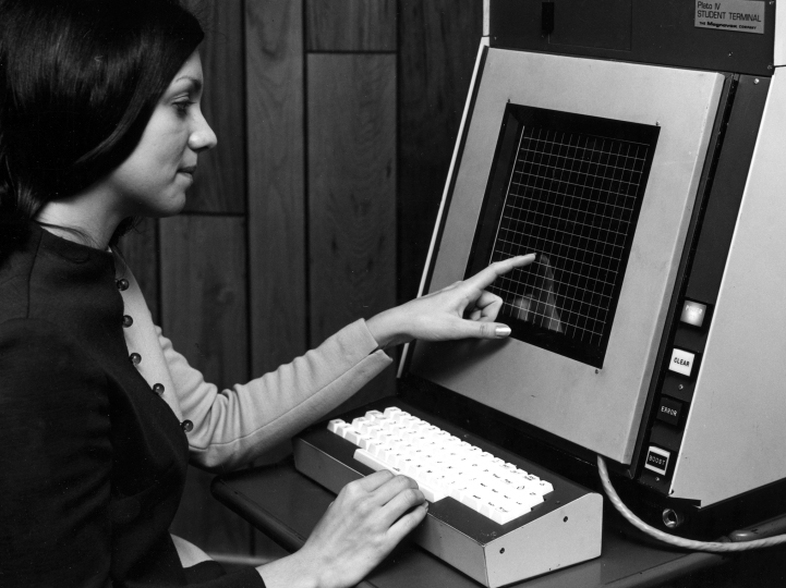
PLATO: How an educational computer system from the ’60s shaped the future
Forums, instant messaging, and multiplayer video games all started here.
Ars Technica
171 points · by mpweiher · 3y ago · 89 comments
Xerox PARC researchers visited PLATO in 1972 and when they got back to Palo Alto they implemented just about everything they saw! App generator for pictures (SD Mode), paint (charset editor), bitmap /memory graphics display (plasma panel), multiple fonts and character sets, etc!
Some backstory: I originally proposed three volumes, each 1000 pages, to the publisher. They laughed and told me absolutely no. My thinking was, PLATO as a topic needs to be approached the way Robert Caro approached Lyndon Johnson. It's going to need multiple 1000-page books.
The publisher's reaction to my proposal was laughter. Their deal was, one book, 150,000 words, take it or leave it. So I took it: I'd spent 30+ years working on the project, had accumulated some 7 million words of interview transcripts, and had to get it out. In the end I delivered 229,000 words to the publisher which even then was the result of painful and severe chopping out of not only major sections but even entire chapters--all kinds of history got removed from the manuscript. (By the way, the final book came out to 209,000 words. Publisher was pissed that it wasn't 150,000. Editor, god bless him, stood by me, and we shipped 209,000 words. Publisher, I firmly believe, punished me by listing the book at a $40.00 list price, which is instant market death for a hardcover book in 2017. Powell's refused to let me do a book event because they don't allow $40 books to be presented by authors. It was sabotage, in my opinion. The publisher did atrocious, half-hearted work at publicity. They sent seven copies to people at the New York Times, which did nothing and never reviewed it. Nor did WPost. Nor did LA Times. Or SF Chronicle. Or Boston Globe, etc, etc. Only Wall Street Journal reviewed it, and they gave it a glowing review.
But here's the thing... anyone who knew and used PLATO is going to have their pet topics and focus areas, and complain about topics the book did include that are not favorites to them personally. Trust me, I've heard from thousands of PLATO people and everybody's happy and unhappy at the same time with what is in, and what is not in, the book. But I didn't write the book for PLATO people. I wrote it for the 8 billion people on Earth who'd never heard of PLATO and who were likely to never hear of it and its significance if something didn't get published that triggered PLATO to finally enter the conversation.
And look what's happening: Y Combinator's Hacker News is talking about PLATO! Ars of all things is talking about PLATO! In the past 5 years, Slate and WIRED (who always hated PLATO and refused to mention it) talked about PLATO. Verge and Motherboard covered it. PLATO is now a part of the conversation. Mission accomplished.
Finally: If you want to get a copy and read The Friendly Orange Glow, you can buy a hardcover from me directly by going to the Amazon site's hardcover page for the book, and selecting a "New" copy from seller Birdrock Books. That's me. I'm selling new copies for $11.11. Brand new, out of the box from the publisher. They come from me, with my signature on it.
PLATO is not in that category, sorry. I was there (at UIUC). PLATO had an extremely small influence on the University, and especially on the Dept. of Computer Science. We never saw them at DCL.
According to the internet-history mailing list (which has essentially all the pioneers who are still alive), they had negligible influence on the Internet.
That's not to denigrate PLATO and what they did. It was the pinnacle of what you could do with a mainframe-and-terminals system. They could have had a much bigger influence on computers and society than they had.
Khan Academy (2013) v. PLATO (1973) https://farm8.staticflickr.com/7307/11141723746_d2b239bd18_o...
What I remember about PLATO was the games. I think there was one where you could drop a flower pot on Mickey Mouse's head. Does that sound familiar to anyone?
My Mom certainly was not a developer, but she was studying nursing at little Bay Du Noc college in the upper peninsula of Michigan and AMAZINGLY there was a computer lab there with those orange round plastic machines and it was completely empty save for one guy that gave me an account and allowed me to chat with someone in California via a dungeon game. I must have been about 11 or 12. Looking back I wish I'd spent more hours in that lab.
My PLATO usage also occurred at UD labs. I was even part of a photo shoot for a kid's PLATO summer camp. (I didn't get to attend the camp)
In the works of the quiz answer parser:
no
The trick was the tiny amount of memory available for each user -- 63 words -- not enough for much of a matrix. But words could have 8 characters, and we certainly did not need high precision in our interaction matrix, so I ended up packing 8 8-bit words in each variable, using masks and shifts, allowing much larger interaction matrices (I probably used 16x16)
Ten years later, the packing/shifting became a central part of one of the first widely used protein sequence similarity searching programs, FASTP (the precursor of FASTA and BLASTP).
Happy to answer any questions that people have.
You can also experience the wonders of PLATO through emulation: https://www.cyber1.org/
https://www.youtube.com/watch?v=THoxsBw-UmM
also there is https://en.wikipedia.org/wiki/PLATO_(computer_system)
they mention that they were linked by a network, is it known what kind of transport protocol they were using on the CDC systems?
I was there then. My total interaction with PLATO was once, as an experimental subject for a Psych class. A friend of mine had one class that used it. The consensus of the internet-history mailing list is that they were not very influential.
They didn't "shape the future" because they kept to themselves, in their own building. We never saw them in the Digital Computer Lab. CDC completely missed the distributed computing revolution.
I mean sure. Except for those places, the only place you could find a multi-thousand dollar PLATO terminal was the old RF research building. And CDC headquarters and a one or two at Cray's lab.
I remember the orange screens. And remember a "squash the bug" game possible due to the press-sensitive screen. But while I remember the admin mentioning some of PLATO's broader capabilities, that wasn't part of the student culture or knowledge base.
The local online community, for example, was based around the CONFER program running on the CDC Cyber, a machine accessible via several unlocked terminal rooms running dumb terminals.
I then went to UIUC (Illinois) for graduate school, in the physics department. PLATO was much more integrated into school life there. But this was also the time of Archie and Gopher, and of course the Mosaic web browser came out of UIUC shortly after I arrived. I only ever used PLATO as a T.A., to enter undergrad grades.
MECC on the other hand
I also working on the Multilingual stuff (I implemented the bidi stuff in the Star editor) with my friend Joe Becker and never heard of influence from PLATO. I’ll ask directly next time we talk but I just don’t believe it’s true at all.
For pioneering online education and communities with PLATO and coinventing the plasma display
When networks like the Internet were still a research lab curiosity, Don Bitzer's multiuser PLATO system served as a dress rehearsal for what we do on those networks today – learn, teach, collaborate, chat, mail, play games, argue, and more. PLATO's courseware language and touchscreen, multimedia terminals previewed features of decades hence. PLATO was a postcard from the future of online communities, and its example would help make that future real.
Donald L. Bitzer was born January 1, 1934 and is an American electrical engineer and computer scientist. He is co-inventor of the flat-panel plasma display and the "father of PLATO,” the world’s earliest time-shared, computer-based education system and home to one of the world’s most pioneering online communities.
The last section of my book documents some of the influences, including the most obvious one, Ray Ozzie's Iris project which created Lotus Notes, named after PLATO Notes. Lotus Notes had like 100 million users and was sold to IBM for billions of dollars. It had a huge influence on the corporate IT world.
And AuthorWare was developed by PLATO people, and got merged with Macromind, creating MacroMedia, which was ultimately gobbled up for billions by Adobe.
There's a lot of influence, but there's 100000x more noise and other stuff since, so it's buried and therefore the normal conclusion is "oh, there's no evidence so there was no impact" but that's too easy to dismiss... there's lots of impact, and PLATO people went everywhere, including me, doing a bunch of startups all of which were influenced by PLATO in one or more ways
Irata.online: A PLATO service for retro computing enthusiasts - https://news.ycombinator.com/item?id=32600338 - Aug 2022 (26 comments)
The PLATO Project - https://news.ycombinator.com/item?id=29782661 - Jan 2022 (1 comment)
Irata.online a modern implementation of the PLATO computing system - https://news.ycombinator.com/item?id=24207044 - Aug 2020 (1 comment)
John Hunter’s World Peace Game, Roger Ebert, and the PLATO System - https://news.ycombinator.com/item?id=23460259 - June 2020 (9 comments)
PLATO, Graphics, Time-sharing in 1960s - https://news.ycombinator.com/item?id=21830810 - Dec 2019 (1 comment)
PLATO Notes released 40 years ago today - https://news.ycombinator.com/item?id=21186845 - Oct 2019 (1 comment)
A Look Back at the 1960s PLATO Computing System - https://news.ycombinator.com/item?id=16615420 - March 2018 (45 comments)
When Star Trek’s Spock Met PLATO - https://news.ycombinator.com/item?id=16019201 - Dec 2017 (1 comment)
The Internet That Wasn’t: Review of “The Friendly Orange Glow” by Brian Dear - https://news.ycombinator.com/item?id=15784052 - Nov 2017 (24 comments)
The Friendly Orange Glow: The Untold Story of the PLATO System - https://news.ycombinator.com/item?id=15747924 - Nov 2017 (1 comment)
The Greatest Computer Network You’ve Never Heard of (PLATO) - https://news.ycombinator.com/item?id=15703024 - Nov 2017 (3 comments)
Performing History on PLATO: A Response to a Recent SIGCIS Presentation - https://news.ycombinator.com/item?id=15542999 - Oct 2017 (1 comment)
Want to see gaming’s past and future? Dive into the “educational” world of PLATO - https://news.ycombinator.com/item?id=12957552 - Nov 2016 (7 comments)
Ars Technica on the history of PLATO games - https://news.ycombinator.com/item?id=12827672 - Oct 2016 (1 comment)
PLATO (computer system) - https://news.ycombinator.com/item?id=6666430 - Nov 2013 (23 comments)
First decade: philosophical fervor, extreme optimism and speculative wonder into how the future will change
Second decade: Post-bust adjustment, pessimism, bias towards return to normalcy
Third decade: Full integration, time before feels alien
1960s: computers are a world changing, mind opening key to an unimaginably bright future
1970s: computers are just another tool and overhyped, not a change to the status quo
1980s: computers are inseparable from almost every part of our day to day lives
1990s: The internet is a world changing, mind opening key to a unimaginably bright future
2000s: the internet is just another tool and overhyped, not a change to the status quo
2010s: the internet is inseparable from almost every part of our day to day lives
2000s: AI is a world changing, mind opening key to an unimaginably bright future
2010s: AI is just another tool and overhyped, not a change to the status quo
2020s: AI is inseparable from almost every part of our day to day lives
As someone who lived through that period, I don't think so. That description would be more applicable to ~2010+.
Transportation: ""By 1981, all GM vehicles would be equipped with their new Computer Command Control System ("CCC") emission control system that featured an ECM (Electronic Control Module) that featured a Motorola 6802 based 8-bit microprocessor manufactured by Delco Electronics. "" https://www.chipsetc.com/computer-chips-inside-the-car.html
Entertainment - video games:
""we saw the release of all-time classic games such as Pac-man (1980), Mario Bros (1983), The Legend of Zelda (1986), Final Fantasy (1987), Golden Axe (1988), etc."" https://www.hongkiat.com/blog/evolution-of-home-video-game-c...
Financial - personal:
ATMs were quite common if no ubiquitous by the mid 1980's "" "The origins of the cashless society: cash dispensers, direct to account payments and the development of on-line real-time networks, c. 1965–1985" "" https://web.archive.org/web/20140714184815/http://www.ebhsoc...
Business:
VisiCalc came out in 1979, and spreadsheets were common in business offices in the U.S.A. through the 1980's.
Entertainment - TV and movies:
Computers were also used in commercial and movie production (ex. the 1984 Macintosh commercial, Pixar founded 1986 more or less out of Lucasfilm, and note that the VideoToaster came out for the Amiga in 1990 bringing professional level video production to a much more accessible price point.)