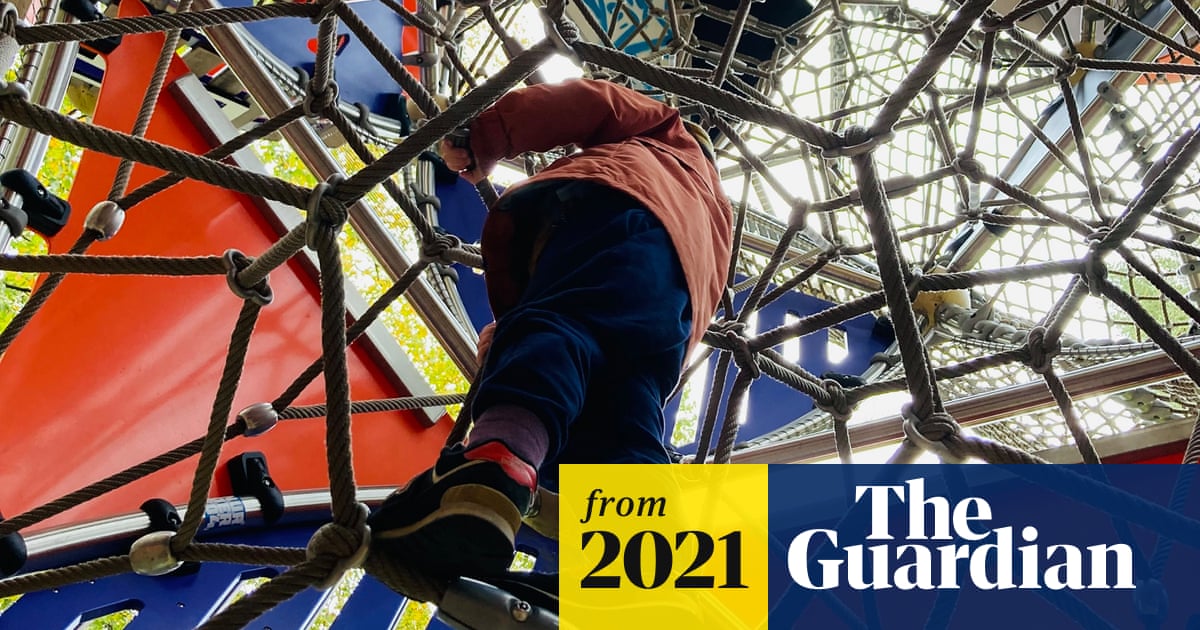
Learning the ropes: why Germany is building risk into its playgrounds
Lofty climbing towers are part of trend away from total safety and towards teaching children to navigate difficult situations
the Guardian
283 points · by mschuster91 · 3y ago · 156 comments
One is subjective. Like when you're high up and you see the ground beneath you, you know it'll hurt if you fall down, so you're more careful moving around.
Then there's all the hidden dangers that kids don't think about or see[1], like a small gap where a cord from the clothing can get attached potentially leading to suffocation.
The point being, the first aspect is something the kids should be able to expose themselves to. It teaches them about risk, but also can give them a goal and a sense of achievement when they finally dare to do something and succeed. His point was that this is an important part of their development, which could have knock-on effects later.
However the playground should be designed such that any accident should not lead to permanent injury or death. Sure they might get a bit banged up if they misjudge, lesson hopefully learned, but nothing permanent.
He was often in Germany to study their playgrounds for inspiration, and this article illustrates nicely why.
[1]: https://www.utdanningsnytt.no/barnehage-grunnskole-leker/her...
The risk to which we expose kids must ramp from "as close to zero as we can make it" for newborns, to "non-permanent injuries are acceptable" during childhood, and, while this is incredibly unpopular, "serious injury or death" needs to start creeping onto the table during the teenage years.
No, I'm not advocating for burying landmines on football fields, which is what safety cultists would have you believe ("You can never be too safe!" is their customary mantra). But teens need to engage in dangerous activities in order to develop fully into adults, meaning that a non-zero number are going to be maimed, crippled, or killed.
And yes, I have kids, and once they're old enough, they're going to do seriously dangerous stuff. Maybe one will break his neck end up in a wheelchair from downhill mountain biking. Or get stabbed and bleed out during a fight. Or lose a hand while working with power tools. Or...
I can and will do my best to prepare them, to train them to make good decisions, but what I can't do is try and keep them locked in a crib for their entire lives, because if I did, they would never develop the skills to handle real-world dangerous, life-or-death situations.
"The maximum fall height in the Triitopia structure’s spiderweb is 1.8 metres." That's not a risky fall, if you're falling onto a rope net.
Also, "The Triitopia tower is encased with boards and netting to ensure no child can take a tumble from a height above three metres." Kids used to climb on the outside and on top of tall playground structures like that. But they're making sure this much more difficult to attempt. This is not a criticism, just my observations.
Both are types of risk IMO, and as children come to recognize the actual risk through experience they will come to recalibrate their perceived risk. Ideally this makes them better at perceiving risk in the future.
They're not actually that high to an adult, but I have childhood memories of these seeming somewhat tall and scary. On an average one, a young child can fall 4-6 times their own height (but not straight, you'll get buffered by the structure as you go down).
Not the ones we have here in Croatia : https://fastly.4sqi.net/img/general/width960/57918118_91NXEE...
https://upload.wikimedia.org/wikipedia/commons/6/61/Park_Mak...
https://speleninstad.nl/mooiste-speeltuinen/speelplek-hoorns...
I grew up in a smaller village. We often climbed trees. I am pretty sure that this is safer.
I wish they made versions that were socially acceptable for adults to climb. These things were awesome.
Like being a kid again.
In any case, the more socially acceptable way is the Spartan Race or a CrossFit gym.
[1] https://www.dynamoplaygrounds.com/understanding-climbing-net...
EDIT:
Cayuga Playground in San Francisco: https://aparkadaybayarea.com/wp-content/uploads/2020/03/chay...
Junipero Serra Playground in San Francisco: https://aparkadaybayarea.com/wp-content/uploads/2019/08/Juni...
You were considered cool when you dared to jump off the highest possible standing position. The wood chips softened the fall :-)
I wish we had stuff like that when I was a kid.
Like, when a kid gets injured here in Germany, mandatory healthcare insurance picks up the cost, and even if the maintainer can be held liable it's a few thousand euros in damages ("Schmerzensgeld") at most.
In contrast, in the US healthcare insurances try to avoid paying up however possible, including shit such as forcing people to sue their family for healthcare cost. A paranoidly risk-averse society is the only thing that this can end up.
and thats a big IF. i dont think i ever heard of something like this happening in my circle
I am not so sure about this. It's true that the health insurers come up for the cost. But at least in cases where injury is due to a fight, they come after you for the money ("Durchgriffshaftung"). I would assume that if the maintainer failed its duties in a negligent manner, they (indirectly) would be held liable.
Take you kids to play in the woods!
https://www.nbcchicago.com/consumer/tower-slide-at-chicagos-...
https://www.westland.net/coneyisland/articles/steeplechase2....
the other scary thing you could do with it was to grab hold of the plank on the up-swing, which would boost you high in the air. you had to have a nice touch of judgement on where you let go, if you didn't want multiple broken bones.
Doesn't just apply to playgrounds.
A kid falling off of a playground -- kids are small, falls don't hurt them as much -- has a lot less risk than changing a traffic pattern and having an F-150 slam into another vehicle. Or having banks get greedy and collapse the economy.
Risks also require safety nets. Otherwise you're just screwing your people over.
Which is exactly what the piece said.
Not because german children are supposedly put at risk, not at all...
It is the tone of finger pointing. Risk is what eventually makes us grow.
A totally risk free world/life would be utterly worthless living, and perhaps a reason to attempt suicide.
If those examples are not "primitive" enough, already in 1894 Steinmetz collated an extensive list of at least forty-two documented cases of suicide amongst what he terms "savage peoples" like the "Polar peoples, North American Indians, Bedouins, Polynesians and native races of British India". Many of the terms he uses would be frowned upon today, but the article is available for free at https://www.jstor.org/stable/658295 and clearly documents many cases of suicide even in societies untouched by Western ideas. It's quite the list, from women killing themselves for "unrequited love" to adulterers committing suicide out of fear of repercussions. In fact he concludes that suicide may even be more prevalent in primitive cultures, relative to the size of the population, because some of those societies did not seem to have a stigma or taboo against suicide (unlike western civilizations where it is/was a sin).
https://www.garten-landschaft.de/guenter-beltzig-nachruf/
The page is an obituary because the designer died in December.
The video is in English.
"Parents can try to keep up with their young mountaineers as they ascend through the rope spiderweb, but they might get left behind in the tightly woven mesh."
Like Instagram and TikTok, but with real safety guarantees.
Is this a reference to Victorians sending kids into coal mines to die of back lung, or something else? As a bonus, the tunnels didn't need to be so large.
Spoken like someone in s country with an affordable healthcare system.
That's ironic - PPE that becomes dangerous in a different environment.
Kids helmets have started to show up with breakaway neck straps- the strap only need be so strong to prevent the helmet from slipping off in a crash.
There used to be a gentleman who gave the mandatory safety briefing before taking guests from Lundy Island by helicopter (the only travel option in winter months) who would make the point that if one person inflates their vest, the other passengers would lemming-like inflate their vests and then you suddenly find the cabin is filled with 5 or 6 inflated people that have no chance of getting out of the door. He always used to joke that the whistle was to amuse yourself until the coastguard arrived.
There's no way anything like that could ever get built again, and yet, we managed to don't kill ourselves as kids when we were sliding on them.
[1] https://www.cotidianul.ro/wp-content/uploads/2017/10/19/tobo...
Germany is building risk into its playgrounds - https://news.ycombinator.com/item?id=28978056 - Oct 2021 (6 comments)
https://theconversation.com/this-new-risky-playground-is-a-w...
https://www.abc.net.au/news/2022-11-07/risk-play-playground-...
Why is that? The big benefit as I see it is that it is natural free-form play. That's freedom. It's also a play as old as time, letting them connect with our ancestors. It teaches them to interact with an environment that doesn't care about them one way or another, it isn't designed to be safe, it isn't designed to be fun or engaging. Trees are just out there for their own reasons. Exploring that, playing with that and respecting that, it seems like it should be very healthy and teach the right lessons and intuitions and prepare them for the rest of the world.
https://playgroundology.wordpress.com/category/dennis-the-me...
There was a full size real steam locomotive that kids could climb inside, under, and through, and strange spinning things made of steel that were far off the ground that you could old get on by jumping off a concrete wall onto it.
Given how many accidents happen on the way to school ("Schulwegunfälle", yes we have a dedicated word for it), it's absolutely necessary. 62k accidents in 2021, and 16 dead kids [1].
A large part of the cause is how absurdly car-centric our cities are - and yet, we're harmless compared to the US.
[1] https://www.dguv.de/de/zahlen-fakten/schuelerunfallgeschehen...
https://laist.com/news/car-crash-accident-traffic-violence-l...
of course every preventable death is too much and we should be aiming at zero...but 16 doesn't seem that much? I would have guessed more for sure.
The problem is, the street is fucking wide - it used to be the supply road for a beer factory and only got developed into pure residential and schools zoning two decades ago, and that seems to invite people to not give a fuck.
There is a massive outcry and countries passing anti-constitutional laws aimed to protect women that are victims of domestic violence with similar casualty rates.
Maybe we should let kids vote so politicians pay some attention to them.
Besides, the quality of the drivers in Germany is far better than in the US in my experience.
'Schulwegunfälle' => schul + weg + un + fall = 'school' + 'way' + 'bad' + 'happening'.
Technically it's a single word, but composed of separate, composable parts which make logical sense when combined together.
Ban cars around schools. Ironically, the danger to kids walking to school is other parents driving their kid to school (a bit stressed, over the limit and probably on their phone).
Mixed feelings about it being unavailable to my children.
Was I scared a bit climbing this with my kids? Yes. Was it an awesome day? Hell, yeah, and returning there soon!
Berlin Frohnau is a very rich part of Berlin, so finding this quality of playgrounds is not that typical in Germany.
"What is happening to our young people? They disrespect their elders, they disobey their parents. They ignore the law. They riot in the streets, inflamed with wild notions. Their morals are decaying. What is to become of them?" - Plato
https://quoteinvestigator.com/2014/12/13/riot/
p.s. What I'm sick and tired already of is the word "boomerification", and that's the first time I've seen it.
Or that changes in the way children are raised don’t affect the child?
Research presented in this section indicates that removing play from early childhood classrooms may actually undermine intended achievement-oriented outcomes.
Play enhances attention, memory, self-regulation, and overall academic achievement throughout childhood. In short, physical play is necessary for learning.
Young children’s motor development has been found to be a powerful predictor of cognitive abilities in the elementary years.
A good playground will be exciting and thus promote spontaneous play, a creative process, and it will be challenging which help kids develop their motor skills.
A bad playground will be dull and lack challenges, thus not making kids develop those skills in the same way.
Thus it seems quite likely that the quality of the playgrounds available at their kindergarten, school and local area can have an effect into adulthood.
[1]: https://www.easternct.edu/center-for-early-childhood-educati...
My personal experience confirms this: for example, when teaching my young kid of 18mo to climb down stairs standing, I would stop holding his hands and observe his behavior. He would initially try to go down a step on his feet while holding the side rail, then hesitate and ask for my hand. If I told him to do it himself, he would instead sit down and slide down gently.
https://neurosciencenews.com/overprotective-parents-child-lo...